Anti-osteoporotic Effects of Unripe Fructus of Rubus coreanus Miquel in Osteoblastic and Osteoclastic Cells
Hyo Jin Kim, Dong-Soo Sim and Eun-Hwa Sohn*
Department of Herbal Medicine Resource, Kangwon National University, Samcheok 245-907, Korea
Abstract - Osteoporosis is a progressive bone disease characterized by low bone mass which is caused by disturbance in the
balance between the activities of osteoblasts and osteoclasts. Postmenopausal osteoporosis is one of the most common disorders in women after menopause, which is linked to an estrogen deficiency and characterized by an excessive loss of trabecular bone.
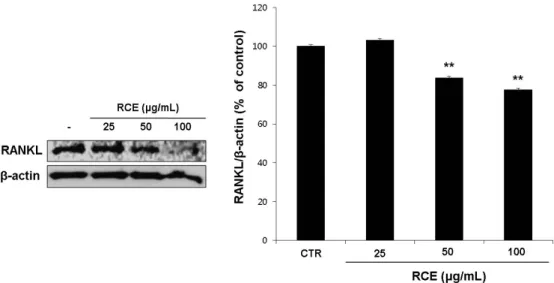
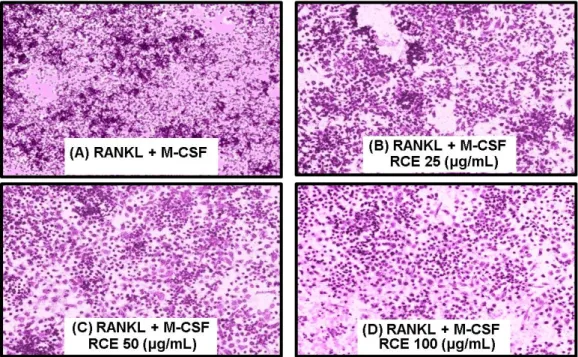
Rubus coreanus has been used for their various pharmacological properties in Asia as a traditional medicine. To investigate the effect of unripe fruits of R. coreanus 30% ethanol extract (RCE) on osteoblast-like cells (MG63) differentiation, we examined the effects of RCE on in vitro osteoblastic differentiation markers, alkaline phosphatase (ALP) activity and receptor activator of nuclear factor κ-B ligand (RANKL) and osteoprotegerin (OPG) expression. The high concentration (50 and 100 μg/mL) of RCE markedly increased ALP activity, whereas decreased the RANKL/OPG. We also investigated the effect of RCE on M-CSF plus RANKL-induced differentiation of pre-osteoclast cells (RAW 264.7). RCE treatment remarkably inhibited M-CSF/RANKL-induced formation of osteoclast-like multinuclear cells from RAW 264.7 cells. Moreover, the inhibitory effect of RCE was reduced by selective estrogen receptor-α antagonist. Our research suggests that suggested that unripe fruits of R. coreanus may act beneficial effects on bone mass by regulating both osteoblast and osteoclast.
Key words -
Osteoblast, Osteoclast, Osteoporosis, RANKL, Rubus coreanus
Introduction
Bone is continuously broken-down and re-formed in a process of turnover known as bone remodeling through the interaction and balance between bone forming cells, called osteoblasts, and bone resorbing cells, called osteoclasts (Karsenty, 2003). A disturbance in the tight balance between the activities of osteoblasts and osteoclasts causes problems with bone mass such as excessive gain of bone mass (osteopetro- sis) and loss of bone mass (osteoporosis). Osteoporosis is a progressive bone disease characterized by low bone mass and deterioration of bone tissue which occurs far more frequently and is a major burden on health-care systems globally (McNamara, 2010).
The osteoblasts produce, organize, and mineralize various bone matrix proteins including type I collagen, which is the most abundant extracellular bone protein (Aubin and Triffitt, 2002). The process of osteoblast differentiation and matrix mineralization requires a rise in high enzyme activity of
alkaline phosphatase (ALP) and the responses to osteotropic hormones and cytokines. Moreover, in the process of bone formation, the osteoblasts regulate osteoclast differentiation and resorption activity via cell-cell contact, whereby RANKL (receptor activator of nuclear factor κB ligand) binds to its cognate receptor, RANK (receptor activator of nuclear factor κ-B). Osteoprotegerin (OPG) is one of the tumor necrosis factor receptor (TNFR) superfamily members which plays as a decoy receptor for RANKL to inhibit osteoclast differentiation and decrease bone resorption by competing with the binding of RANKL to RANK (Kostenuik and Shalhoub, 2001).
RANKL and OPG synthesized by stromal osteoblasts have been identified as the two principal cytokines of osteoclast differentiation and activation (Kostenuik and Shalhoub, 2001;
Hamdy, 2007). The binding of RANKL to RANK results in the activation of signaling pathways, regulating osteoclast function (Khosla, 2001; Udagawa, 2000). Thus, the OPG/
RANKL/RANK signal pathway is considered as a key cytokine system implicated in the control of bone remodeling.
Osteoporosis is most often considered a bone disorder of
Original Research Article