생 약 학 회 지
Kor. J. Pharmacogn.
39(3) : 233
∼236 (2008)
233
방동사니 전초의 항산화 페놀성 성분
이사임·최 훈·전 훈·백남인1·김성훈2·김희자3·조종현4·안효초·양재헌·채병숙·
임종필·은재순·김대근
*
우석대학교 약학대학
,
1경희대학교생명공학원및식물대사연구센터,
2경희대학교한의과대학,
3오성제과
,
4전북농업기술원Antioxidant Phenolic Components from the Whole Plant Extract of Cyperus amuricus Max.
Sa Im Lee, Hoon Choi, Hoon Jeon, Nam-In Baek
1, Sung-Hoon Kim
2, Hee Ja Kim
3, Chong Hyeon Cho
4, Hyo-Cho Ahn, Jae-Heon Yang, Byeong Suk Chae, Jong Pil Lim, Jae Soon Eun and Dae Keun Kim
*College of Pharmacy, Woosuk University, Samrye 565-701, Korea
1
Graduate School of Biotechnology & Plant Metabolism Research Center, KyungHee University, Suwon 449-701, Korea
2College of Oriental Medicine, KyungHee University, Seoul 131-701, Korea
3
O Sung Co. LTD, Kimje 576-962, Korea
4
Jeollabuk-do Agricultural Research and Extension Servieces, Iksan 570-140, Korea
Abstract −
In order to find the antioxidative components, fractionation of Cyperus amuricus (Cyperaceae) methanol extract was performed by measuring the DPPH (1,1-diphenyl-2-picrylhydrazyl) scavenging effect. Three compounds, 3,4-dimethoxy benzoic acid (
1), 4-hydroxybenzoic acid (
2), and piceatannol (
3) were isolated from the active ethylacetate soluble fraction of C. amuricus through repeated silica gel and Sephadex LH-20 column chromatography. Among them, compound
3showed the significant antioxidative effect on DPPH free radical scavenging test. These compounds are reported for the first time from this plant.
Keywords −
Cyperus amuricus, Cyperaceae, DPPH, piceatannol
세포의노화와각종성인병의발병이활성산소와관련되 어있어활성산소를조절할수있는물질인항산화제에대 한연구가최근활발히연구되어오고있다
. 1-3) 현재 ascorbic acid, tocopherol, carotenoid
및 glutathione
등의저분자천
연물유래항산화물질이이용되고있으나
,
합성항산화제인BHT, BHA, Troxol C
등을능가하지는못하고있다.
그러나이들합성항산화제는발암성등의부작용우려가있어 항산화활성이우수하고보다안전한새로운항산화제의개 발이필요하다
. 4)저자등은수종의국내자생식물로부터항
산화물질을연구하는과정중에방동사니의
MeOH
추출물이항산화활성이있음을확인하였다
.
방동사니
Cyperus amuricus Max.
는사초과(Cyperaceae)
에속하는
1
년초로서들이나밭근처에흔히나며일본,
대만
,
중국등에널리분포한다.
방동사니는선형의잎을 가지며
,
줄기가세모지고60 cm
까지자란다.
꽃은8-10
월에적갈색으로피고꽃의인편은넓은도란형이며
,
원두이고끝이약간뒤로젖혀지고뾰족하다
. 5,6)
방동사니에대한약리활성과식물화학적성분연구는지 금까지보고된바가없다
.
본연구는방동사니의MeOH
추출물을용매분획하여얻은항산화활성이강한
EtOAc
분획에서
3
종의화합물을분리하고,
이화하적성상과기기분석을통하여구조를규명하고분리된성분들의
DPPH radical
소거효과에기인한항산화활성을조사하였다
. 재료 및 방법
실험재료 −본실험에사용한방동사니는
2007
년8
월에전북완주군에서채취하였으며
,
정확히감정한후에음건세*교신저자(E-mail):[email protected]
(FAX):063-290-1812
234 Kor. J. Pharmacogn.
절하여실험에사용하였다
.
시약 및 기기 −실험에사용한기기로는융점에
Electro- thermal melting point apparatus (Denmark)
를UV
는Shimadzu UV-1601 UV-Visible spectrophotometer (Japan)
를사용하여측정하였으며
, 1 H-NMR
및13 C-NMR spectrum
은
Jeol JMN-EX 400 spectrometer (Japan)
를이용하여 확보하였다
.
추출및분획용시약은1
급용매를사용하였으며, TLC
및column
용시약등은1
급용매를재증류하여사용하거나
,
특급시약을사용하였다. Column chromatography
용silica gel
은Kiesel gel 60 (Art. 1.07734, 230-400 mesh, Merck)
이며, molecular sieve column chromatography
용packing material
은Sephadex LH-20 (Pharmacia)
을사용하였다
. TLC plate
는Kiesel gel 60 F 254 precoated plate (Art.
1.07752, Merck)
를사용하였다.
발색시약으로는10% H 2 SO 4
(in EtOH)
시약을사용하였으며, UV
의검색은254, 365 nm
에서하였다
.
추출 및 분리 −신선한방동사니전초를음건세절한다 음건조하여얻은시료약
600 g
을MeOH
로가끔진탕하면서
5
시간씩50 o C
에서2
회온침추출하였다.
그추출액을수욕상에서감압농축하여
MeOH
엑스약55 g
을얻었으며,
이MeOH
엑스에증류수로 현탁시키고상법에따라동량의CH 2 Cl 2 , EtOAc
및n -BuOH
의순으로용매분획하여12.0, 5.2
및12.4 g
의분획물을각각얻었다.
이들중항산화활성이가장강한
EtOAc
분획을DPPH free radical
소거법을지표로 항산화 활성물질을 분리하였다
. EtOAc
분획을CH 2 Cl 2 :EtOAc:MeOH (7:1:1)
을유출용매로silica gel column chromatography
를수행하여TLC
양상에따라6
개의분획(E1-E6)
으로나누었다.
이중주요반점을나타낸E1
과E2
에서 물질분리를시도하였다
. E1
을CHCl 3 :EtOAc: MeOH (12:1:1)
혼합용매로silica gel column chromatography
를수행하여
3
개의소분획(E11-E13)
으로나누고이중E11
과E13
을
Sephadex LH-20 (MeOH)
로정제하여화합물 1(15 mg)
과 2
(13 mg)
를 각각 얻었다. E2
를CHCl 3 :EtOAc : MeOH (7:1:1)
혼합용매로silica gel column chromatography
를수행하여
2
개의 소분획(E21-E22)
으로 나누고 이중E21
을Sephadex LH-20 (MeOH)
으로정제하여화합물 3(65 mg)
을얻었다
.
화합물 1−
mp 180-181 o C; 1 H-NMR, (400MHz, CD 3 OD)
δ
: 7.55 (1H, dd, J = 8.8, 1.8 Hz, H-6), 7.32 (1H, d, J = 1.8 Hz, H-2), 6.82 (1H, d, J = 8.8 Hz, H-5), 3.88, 3.87 (each 3H, s, 3, 4-OCH 3 ).
화합물 2 −
mp 211-212 o C; 1 H-NMR, (400MHz, CD 3 OD)
δ
: 7.86 (2, d, J = 8.8 Hz, H-2, 6), 6.80 (2H, d, J = 8.8 Hz, H-3, 5). 13 C-NMR, (100 MHz, CD 3 OD)
δ: 170.2 (COO), 163.3 (C-4), 133.0 (C-2, 6), 122.8 (C-1), 115.8 (C-3, 5).
화합물 3 −
mp 221
∼222 o C; UV,
λmax (MeOH) 321, 220;
1 H-NMR, (400 MHz, CD 3 OD) δ: 6.98 (1H, d, J = 2.0 Hz, H-2'), 6.89 (1H, d, J = 16.0 Hz, H-
α), 6.83 (2H, dd, J = 8.0, 2.0 Hz, H-6'), 6.74 (1H, d, J = 16.0 Hz, H-
β), 6.74 (1H, d, J = 8.0 Hz, H-5'), 6.46 (2H, d, J = 2.1 Hz, H-2, 6), 6.15 (1H, d, J =2.1Hz, H-4). 13 C-NMR, (100MHz, CD 3 OD)
δ
: 159.4 (C-3, 5), 146.3 (C-3', 4'), 141.2 (C-1), 131.0 (C- 1'), 129.6 (C-
β), 126.9 (C-
α), 120.2 (C-2'), 116.4 (C-6'), 113.8 (C-5'), 105.8 (C-2, 6), 102.6 (C-4).
DPPH free radical 소거법에 의한 항산화활성7)−
96 well plate
에 시료를EtOH
로각 농도별로조제한용액에1.5×10 -4 M
의1,1-diphenyl-2-picrylhydrazyl (DPPH) (EtOH)
을일정량씩가하였다
. 10
초간진탕한후37 o C
에서30
분간방치한후
microplate reader
를이용하여515 nm
에서흡광도를 측정하였다
.
대조약물은L-ascorbic acid
와BHA (butylated hydroxy anisole)
를사용하였다.
항산화효과는시료를첨가하지않은대조군의흡광도를
50%
감소시키는데필요한검체의농도
(IC 50 )
로표시하였다.
각시료에 대한Fig. 1.
Structures of compounds
1-3
Table I.
Radical scavenging effects on DPPH radical of the methanol extract, and its subsequent fractions from the whole plants of C. amuricus
Samples IC
50(
µg/ml)
a)MeOH extract
CH
2Cl
2fraction EtOAc fraction n -BuOH fraction H
2O layer BHA
18.3 >60 11.2 43.7 39.9 3.25
a)
50% scavenging concentration
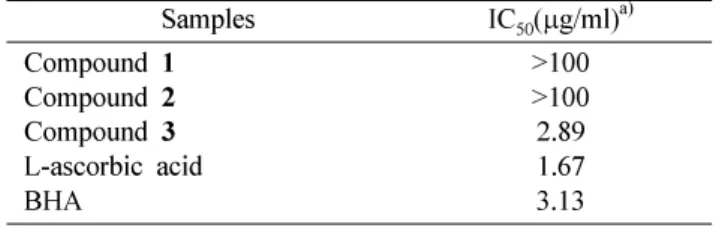
Table II.
Radical scavenging effects on DPPH radical of the isolated compounds from the whole plants of C. amuricus
Samples IC
50(
µg/ml)
a)Compound
1Compound
2Compound
3L-ascorbic acid BHA
>100
>100 2.89 1.67 3.13
a)
50% scavenging concentration
Vol. 39, No. 3, 2008 235 DPPH radical
소거작용을3
회반복하여측정하였다.
결과 및 고찰
화합물 1은
mp 180-181 o C
의백색분말상고체로얻어졌으며
, 1 H-NMR spectrum
에서aromatic
영역에서3
개의peak
가 δ
7.55 (1H, dd, J = 8.8, 1.8 Hz, H-6), 7.32 (1H, d, J = 1.8 Hz, H-2), 6.82 (1H, d, J = 8.8 Hz, H-5)
에서전형적인
ABC coupling
값을나타냈다.
δ3.88
과3.87 (each 3H)
에서
2
개의methoxy peak
가또한확인되었다.
이상의결과를검토한결과화합물 1은
3
치환된aromatic
화합물임을추정할 수 있었으며
,
기존 문헌8)
과 비교하여2,4-
dimethoxybenzoic acid
로확인·동정하였다.
화합물 2는
mp 211
∼212 o C
의백색분말상고체로얻어졌다
. 1 H-NMR spectrum
에서는aromatic
영역에서δ7.86 (2, d, J = 8.8 Hz, H-2, 6), 6.80 (2H, d, J = 8.8 Hz, H-3, 5)
에서4
개의proton signal
이전형적인A 2 B 2 coupling system
으로관찰되었다
. 13 C-NMR spectrum
에서는 총7
개의carbon signal
을관찰할수있었는데,
δ170.2
의signal
은carbonyl carbon
으로나머지peak
는aromatic
영역의carbon
로확인되었다
.
이상의결과를검토한결과화합물 2는carbonyl
기1
개를포함하여2
치환된aromatic
화합물임을추정할수있었으며
,
기존문헌9)
과비교하여4-hydroxybenzoic acid
로확인·동정하였다
.
화합물 3은
mp 221-222 o C
의갈색 분말로얻어졌으며, UV spectrum
에서321
과220 nm
에서흡수가관찰되었다.
1 H-NMR spectrum은 δ 6.98 (1H, d, J = 2.0 Hz, H-2'), 6.83 (2H, dd, J = 8.0, 2.0 Hz, H-6'), 6.74 (1H, d, J = 8.0 Hz, H- 5')
에서 ABX coupling system
으로관찰되었고,
δ 6.46 (2H, d, J = 2.1 Hz, H-2, 6), 6.15 (1H, d, J = 2.1 Hz, H-4)
에서
aromatic ring
에 meta-, meta '
에치환된형태의 3
개의 proton peak
가확인되었다.
또한 δ 6.89 (H, d, J = 16.0 Hz, H-
α)
와
6.74 (1H, d, J = 16.0 Hz, H-
β)
에서 trans coupling
하고 2
개
의
2
중결합proton peak
가관찰되었다. 13 C-NMR spectrum
에서는 모두
14
개로 추정되는carbon signal
을 관찰되었다
.
이상의 결과로 화합물 3은2
개의aromatic ring
과ethylene
을가지고있는화합물인stilbene
화합물로추정하였으며
,
기존문헌 data 10)와비교하여 3,3',4',5-tetrahydroxy- stilbene
인 piceatannol
로확인·동정하였다.
이상과같이방동사니전초의
MeOH
추출물중EtOAc
분획에서항산화활성물질
3
종을분리하여그구조를동정하였으며
,
이들화합물은본식물에서처음보고되는성분이다
.
이들화합물의항산화활성은Talble II
에나타낸바와같이
stilbene
유도체인화합물3이IC 50 2.89
µg/ml
로BHA
와유사한정도의
free radical scavenging effect
를보여주었으며
,
화합물 1과2는거의효과가나타나지않았다.
이상의결과를살펴보면방동사니의
MeOH
추출물중의항산화활성은주로
EtOAc
분획물에존재하는화합물에기인한것으로생각되며
,
그중에서도주성분으로보이는stilbene
계화합물에의한것으로사료된다
.
화합물 3은apoptosis, 11) stat3 inhibition, 12) osteoblast differentiation, 13) NF-
κB activation, 14) tyrosine kinase inhibition 15) 등다양한활성이보고되어있
으므로방동사니는
piceatannol
함유천연자원으로 활용할만한가치가있을것으로보인다
.
결 론
방동사니전초의
MeOH
추출물중EtOAC
분획에서3
종의화합물을단리하였으며
,
이들의물리화학적성상과spectral data
로부터구조를확인한결과3,4-dimethoxybenzoic acid (
1), 4-hydroxybenzoic acid (
2)
및piceatannol (
3)
로 각각확인
.
이화합물들은모두본식물로부터처음분리·보고되는화합물이며
, piceatannol
이가장강한DPPH radical
소거효능을보여주었다
.
사 사
이논문은
2008
년정부(
교육과학기술부)
의재원으로학술진흥재단의지원을받아수행된연구
(
지방거점사업단육성사업
/
헬스케어기술개발사업단)
이며,
이에감사드립니다. 인용문헌
1. Ma, Y. Q., Ye, X. Q., Fang, Z. X., Chen, J. C., Xu, G. H. and Liu, D. H. (2008) Phenolic compounds and antioxidant activ- ity of extracts from ultrasonic treatment of Satsuma Mandarin ( Citrus unshiu Marc.) peels. J. Agric. Food Chem.
56(14):
5682-5690.
2. Dembinska-Kiec, A., Mykknen, O., Kiec-Wilk, B. and Mykknen, H. (2008) Antioxidant phytochemicals against type 2 dia- betes. Br. J. Nutr.
99E Suppl 1: ES 109-117.
3. Li, D. L., Li, X. M., Peng, Z. Y. and Wang, B. G. (2007) Fla- vanol derivatives from Rhizophora stylosa and their DPPH radical scavenging activity. Molecules,
12(5): 1163-1169.
4. Branen, A. L. (1975) Toxicology and biochemistry of buty- lated hydroxyanisole and butylated hydroxytoluene. J. Am.
Oil. Chem. Soc .,
52:59-63 (1975).
5.
이창복(1986)
대한식물도감, 178,
향문사,
서울.
6.
이우철(1996)
원색한국기준식물도감, 468,
아카데미서적,
서울
.
7. Yoshida, T., Mori, K., Hatano, T., Okumura, T., Uehara, I.,
Komagoe, K., Fujita, Y. and Okuda, T. (1989) Studies on
inhibition mechanism of autooxidation by tannins and fla-
vonoids. V. Radical scavenging effects of tannins and related
polyphenols on 1,1-diphenyl-2-picrylhydrazyl radical. Chem.
236 Kor. J. Pharmacogn.
Pharm. Bull.
37: 1919-1921.
8. Katherine, N. S. (1972) Carbon-13 nuclear magnetic resonance of biologically important aromatic acids. I. Chemical shifts of benzoic acid and derivatives. J. Am. Chem . Soc.
94: 8564- 8568.
9. Yazaki, K., Fukui, H. and Tabata, M. (1986) Accumulation of p- O -
β‚-D-glucosylbenzoic acid and its relation to shikonin biosynthesis in Lithospermum cell cultures. Phytochemistry ,
25
: 1629-1632.
10. Kobyashi, K., Ishihara, T., Khono, E., Miyase, T. and Yoshizaki, F. (2006) Constituents of stem bark of Callistemon rigidus showing inhibitory effects on mouse
α-amylase activity. Biol.
Pharm. Bull .
29: 1275-1277.
11. Kim, H. J.
,Lee, K. W., Kim, M.-S. and Lee, H. J. (2008) Piceatannol attenuates hydrogen-peroxide- and peroxynitrite- induced apoptosis of PC12 cells by blocking down-regulation of Bcl-XL and activation of JNK. J. Nutr. Biochem .
19: 459- 466.
12. Cicinnati, V. R., Kang, J., Klein, C. G. Broelsch, C. E. Gerken,
G. and Beckebaum, S. (2007) Effect of stat3 inhibitor piceat- annol on human dendritic cell homeostasis and growth of hepatocellular carcinoma in vitro . J. Hepatol.
46: Supplement 1, S137.
13. Chang, J.-K., Hsu, Y.-L., Teng, I-C. and Kuo, P.-L. (2006) Piceatannol stimulates osteoblast differentiation that may be mediated by increased bone morphogenetic protein-2 pro- duction. Eur. J. Pharmacol.
551: 1-9.
14. Jin, C.-Y., Moon, D.-O., Lee, K.-J., Kim, M.-O., Lee, J.-D., Choi, Y. H., Park, Y.-M. and Kim, G.-Y. (2006) Piceatannol attenuates lipopolysaccharide-induced NF-
κB activation and NF-
κB-related proinflammatory mediators in BV2 microglia.
Pharmacol. Res .
54: 461-467.
15. Seow, C.-J., Chue, S.-C. and Fred Wong, W. S. (2002) Piceat- annol, a Syk-selective tyrosine kinase inhibitor, attenuated antigen challenge of guinea pig airways in vitro . Eur. J. Phar- macol.
443: 189-196.
(2008년 8월 5일 접수)