• 검색 결과가 없습니다.

Mapping Paddy Rice Varieties Using Multi-temporal RADARSAT SAR Images

N/A
N/A
Protected

Academic year: 2021

Share "Mapping Paddy Rice Varieties Using Multi-temporal RADARSAT SAR Images"

Copied!
8
0
0

로드 중.... (전체 텍스트 보기)

전체 글

(1)

1. Introduction

Paddy rice, a primary crop in South Korea, can be categorized according to growth cycles into early maturing rice and medium-late maturing rice. Early maturing rice is harvested 30-40 days earlier than medium-late maturing rice, although all rice types are

transplanted concurrently in May. Information about the amount and spatial distribution of cultivation areas according to rice varieties is now considered essential to environmental management as well as the advancement of agricultural statistics in that changes in land cover after harvesting affects hydrologic and ecologic responses, and yield and flow to food

Mapping Paddy Rice Varieties Using Multi-temporal RADARSAT SAR Images

Min-Won Jang*, Yi-Hyun Kim**, No-Wook Park*** and Suk-Young Hong**

*Department of Agricultural Engineering, Institute of Agriculture & Life Science, Gyeongsang National University

**National Academy of Agricultural Science, Rural Development Administration

***Department of Geoinformatic Engineering, Inha University

Abstract : This study classified paddy fields according to rice varieties and monitored temporal changes in rice growth using SAR backscatter coefficients (s˚). A growing period time-series of backscatter coefficients was set up for nine fine-beam mode RADARSAT-1 SAR images from April to October 2005.

The images were compared with field-measured rice growth parameters such as leaf area index (LAI), plant height, fresh and dry biomass, and water content in grain and plants for 45 parcels in Dangjin-gun, Chungnam Province, South Korea. The average backscatter coefficients for early-maturing rice varieties (13 parcels) ranged from -18.17 dB to -6.06 dB and were lower than those for medium-late maturing rice varieties during most of the growing season. Both crops showed the highest backscatter coefficient values at the heading stage (late July) for early-maturing rice, and the difference was greatest before harvest for early- maturing rice. The temporal difference in backscatter coefficients between rice varieties may play a key role in identifying early-maturing rice fields. On the other hand, comparisons with field-measured parameters of rice growth showed that backscatter coefficients decreased or remained on a plateau after the heading stage, even though the growth of the rice canopy had advanced.

Key Words : Early maturing rice, Backscattering coefficient, Multi-temporal SAR, RADARSAT

Received November 17, 2012; Revised December 11, 2012; Accepted December 12, 2012.

Corresponding Author: Suk-Young Hong ([email protected])

This is an Open-Access article distributed under the terms of the Creative Commons Attribution Non-Commercial License

(http://creativecommons.org/licenses/by-nc/3.0) which permits unrestricted non-commercial use, distribution, and reproduction in

any medium, provided the original work is properly cited.

(2)

markets has effects on government policies regarding food supply and safety. Furthermore, mapping early maturing rice fields is critical for planning crop protection, pesticide management against diseases like rice sheath blight, and water resource management. Unfortunately, currently there are no feasible ways of obtaining such information.

However, advances in remote sensing technology are expected to provide solutions.

In Asian countries with monsoon climates such as South Korea, using radar-based remote sensing data is a practical approach for nationwide mapping of rice fields and identifying growing cycles (Lee and Hong, 1999; Hong et al., 2007; Kim et al., 2009), and studies have been conducted to classify paddy rice fields using polarized synthetic aperture radar (SAR) images such as RADARSAT, ENVISAT, ALOS, and ERS (Bouvert et al., 2009; Chakraborty et al., 2005; Chen et al., 2007; Hong et al., 2000; Kurosu et al., 1997; Jinlong et al., 2001; Liew et al., 1998; Toan et al., 1997). The use of multi-temporal images is fundamentally based on temporal biomass changes in rice fields that are distinguished from other land cover

conditions. To identify early maturing rice in paddy fields, reference images should be those of medium- late maturing rice fields. As such, the temporal growth variation of each rice type and the relationships between rice growth and SAR data must first be understood because knowledge about similarities and dissimilarities between rice varieties facilitates the identification of which radar images are useful for discrimination.

This paper discussed quantitative differences in growth parameters between early maturing and medium-late maturing rice according to growth stages and analyzed the relationships between growth parameters and backscatter coefficients of SAR images. In addition, applications for discriminating early maturing rice parcels were assessed.

2. Methods

1) Growth calendar of paddy rice

The knowledge of rice growth calendar is fundamental to the success of remote sensing

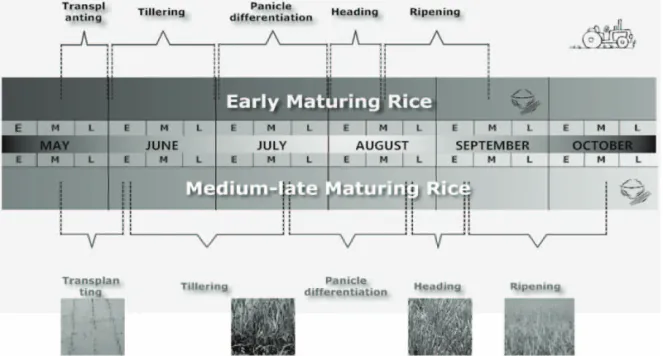
Fig. 1. Temporal differences in growth cycles between early maturing and medium-late maturing rice grown in South Korea.

(3)

applications. It plays a critical role in the planning stages of a remote sensing project like identifying target dates for satellite images as well as in the developed stage like discriminating paddy rice varieties (Ribbes and Toan, 1999; Toan et al., 1997).

There are four major categories of rice worldwide:

indica, japonica, aromatic, and glutinous, and East Asia including Korea, a part of northern China, and Japan mainly cultivates japonica rice varieties. The growth can be divided into two stages: vegetative and reproductive. The vegetative growth period is from germination to tillering, and the reproductive stage is characterized by panicle differentiation, heading, and ripening. As shown in Fig. 1, early maturing rice has a shortened vegetative growth stages comparing with medium-late maturing varieties although the transplanting dates are almost simultaneous between

the rice types. Early maturing rice faces a panicle differentiation stage in almost early July, about two weeks earlier than medium-late maturing rice varieties. As such, the discrimination of rice varieties in satellite images could be critical since at least early July, and the earlier harvest of early maturing rice could make it apparent that bare and flat-textured land cover without vegetation could be differentiated from the remaining biomass at medium-late maturing rice fields.

2) Study sites and rice growth data

The study site was located in Yedang irrigated plain, Dangjin-gun, Chungnam Province, about 65 km south of Seoul, South Korea (Fig. 2). The Yedang irrigated plain is the second largest agricultural area of South Korea, and rice planting begins in middle of

Fig. 2. The study site was located in Dangjin-gun (Yedang irrigation plain), Chuncheonggnam-do about 65 km away from Seoul,

South Korea. Six rice growth parameters were observed for 45 paddy rice parcels.

(4)

May. Harvesting is complete by early September to mid-October, according to rice varieties. In 2005, paddy fields were transplanted between May 15 and 30 regardless of rice variety, but the heading growth stage began in early maturing rice fields during late July and in medium-late maturing rice in mid-August, about 20 days later. The harvest was completed on September 10 for early maturing rice, almost one month earlier than for medium-late maturing rice.

Throughout the growth period, six rice growth parameters were observed in 13 parcels for early maturing rice and 32 parcels for medium-late maturing rice: plant height (PH, cm), leaf area index (LAI), total fresh weight (TFW, g/m

2

), total dry weight (TDW, g/m

2

), grain water content (GWC, %), and plant water content (PWC, %). Field investigations were carried out six times according to the growth stages, and just four field surveys were conducted for early maturing rice because of harvest in the early September.

3) SAR data and preprocessing

Multi-temporal RADARSAT data has a capable of rice mapping and can provide input to production estimation (Shao et al., 2001). For the growing season in 2005, nine fine-beam mode RADARSAT SAR images were collected starting on April 1 before transplanting, with collection continuing to October 10 after harvest, and were transformed into the Transverse Mercator coordinate system (Fig. 3). The images covered all growth stages of paddy rice:

transplanting, tillering, panicle differentiation, heading, and ripening. The backscatter coefficients were retrieved using SARscape software and the basic statistics were calculated for paddy parcels by referring to the Korean Land Information System (KLIS). The ranges and statistics of backscatter coefficients according to rice varieties are critical parameters for classifying early maturing rice- growing areas.

Fig. 3. All nine RADARSAT SAR images collected and processed between April before cultivation and October after harvest in

2005. The study site can be seen at the upper right: the backscattering at June and July was lower than in other seasons

because of the early growth stage and ponding for transplanting.

(5)

3. Analysis

1) Seasonal variations of rice growth and radar backscatter

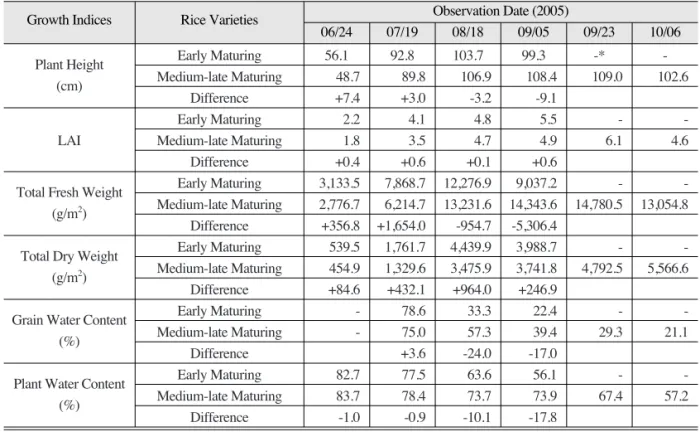
Early maturing rice is planted in expectation of faster harvest than medium-late maturing rice, and this leads to a gap of growth cycles. The temporal discord between rice types is described in Table 1.

Different growth parameters are more helpful at identifying early maturing rice fields at different growth stages: plant height and LAI at the tillering stage, TFW and TDW at the panicle differentiation stage before heading, and GWC and PWC after the heading stage of medium-late maturing rice.

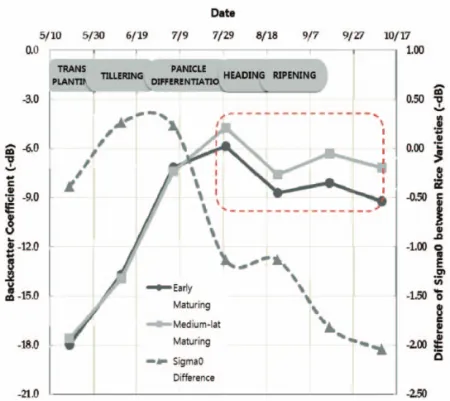
With respect to temporal variations of backscatter coefficient from RADARSAT SAR images after planting (Fig. 4), the gap between rice types became wider after mid-July, or the heading period of early

maturing rice. The average backscatter coefficients for early-maturing rice varieties (13 parcels) ranged from -18.17 dB to -6.06 dB and were lower than for medium-late maturing rice varieties during most of the growing season. At the heading stage (July 30) for early-maturing rice, both rice crops showed the highest backscatter coefficient values, and the difference was the greatest right before the harvest of early-maturing rice. As such, early maturing rice fields could be distinguished using SAR images just after mid-July in advance of the harvesting season.

On the other hand, compared with field-measured rice growth parameters, the backscatter coefficients either decreased or maintained a plateau after the heading stage even though the growth of the rice canopy continued regardless of the varieties.

Table 1. Crop growth parameters of early maturing rice and medium-late maturing rice. The growth parameters that could be used to recognize rice type varied depending on growth stage

Growth Indices Rice Varieties Observation Date (2005)

06/24 07/19 08/18 09/05 09/23 10/06

Plant Height Early Maturing 56.1 92.8 103.7 99.3 -* -

(cm) Medium-late Maturing 48.7 89.8 106.9 108.4 109.0 102.6

Difference +7.4 +3.0 -3.2 -9.1

Early Maturing 2.2 4.1 4.8 5.5 - -

LAI Medium-late Maturing 1.8 3.5 4.7 4.9 6.1 4.6

Difference +0.4 +0.6 +0.1 +0.6

Total Fresh Weight Early Maturing 3,133.5 7,868.7 12,276.9 9,037.2 - -

(g/m

2

) Medium-late Maturing 2,776.7 6,214.7 13,231.6 14,343.6 14,780.5 13,054.8 Difference +356.8 +1,654.0 -954.7 -5,306.4

Total Dry Weight Early Maturing 539.5 1,761.7 4,439.9 3,988.7 - -

(g/m

2

) Medium-late Maturing 454.9 1,329.6 3,475.9 3,741.8 4,792.5 5,566.6

Difference +84.6 +432.1 +964.0 +246.9

Grain Water Content Early Maturing - 78.6 33.3 22.4 - -

(%) Medium-late Maturing - 75.0 57.3 39.4 29.3 21.1

Difference +3.6 -24.0 -17.0

Plant Water Content Early Maturing 82.7 77.5 63.6 56.1 - -

(%) Medium-late Maturing 83.7 78.4 73.7 73.9 67.4 57.2

Difference -1.0 -0.9 -10.1 -17.8

* not investigated after harvest

Growth Indices Rice Varieties Observation Date (2005)

06/24 07/19 08/18 09/05 09/23 10/06

(6)

Fig. 4. Temporal variation of backscatter coefficients (sigma 0) from RADARSAT fine-beam mode images. The gaps between backscatter coefficients increased after mid-July, corresponding to the heading stage of early maturing rice.

Fig. 5. Rice varieties mapped using a simple threshold method for mean backscattering coefficients by parcel pixels. It was possible

to classify early maturing rice fields with only multi-temporal SAR data without on-the-ground surveys across a wide area.

(7)

2) Discrimination of early maturing rice parcels

As shown in Fig. 4, SAR data observed on July 6, July 30 and August 23 discriminated early maturing rice before harvest. First, parcel polygons were created by buffering 5 meters inside the KLIS parcel polygons to avoid mixed pixels along the edges of the parcels. Next, the mean backscattering coefficient per parcel was calculated by overlaying the buffered polygon map and each SAR image. Rice variety in each parcel was then determined by adopting a simple threshold method for the ranges of the average backscattering coefficient. We analyzed 9,474 parcels of about 4,206 ha of farmland, and about 18.4% of the paddy area (19.1% of the parcels) was categorized as early maturing rice (Fig. 5). According to the rice yield statistics in 2005 (545 ton/ha), the total yields of early maturing rice were estimated as 4,041 tons in 741.5 ha of paddy fields.

4. Conclusion

Multi-temporal RADARSAT-1 SAR data were analyzed to discriminate between two different rice varieties, early maturing rice and medium-late maturing rice, and carried out extensive on-the- ground investigations to obtain growth and backscattering information for each rice type in the Yedang irrigated plain, South Korea in 2005. The backscattering coefficients were extracted for KLIS parcel units from all nine fine-beam RADARSAT SAR images, and the temporal variation was not different from known SAR responses to rice growth (Lee and Hong, 1999; Hong et al., 2000) Reasonable differences between the rice varieties in the six rice growth parameters were observed after the panicle differentiation stage of early maturing rice, in mid- July, which coincided with the variation of

backscattering coefficient according to rice type.

SAR images prior to the heading stage of early maturing rice around mid-July did not show significant differences between rice varieties.

Classification with three series of SAR data collected between July and August by applying a simple threshold method indicated that early maturing rice was cultivated in 18.4% of paddy fields in the study site, and about 4,041 tons of rice were expected to be produced based on the rice yield statistics in 2005.

With respect to the advanced estimation of yield for early maturing rice, we found that multi-temporal SAR images obtained between the tillering and harvesting stages of early maturing rice facilitated acceptable levels of discrimination between rice varieties.

Our results may be further improved by using more advanced classification methods, different polarization methods, and frequency. In future studies, we will integrate the on-the-ground SAR backscattering coefficients with coefficients obtained from satellite SAR as described in Kim et al. (2009), and ultimately we expect to develop a nationwide monitoring system for rice yield and growth conditions by satellite SAR observation. It would be expected that this case study could help in the timely updating and the improvement of classification accuracy in paddy rice varieties discrimination over a large area with multi-temporal SAR data.

Acknowledgment

Part of this work was conducted under the JAXA Research Announcement agreement, “Retrieval of biophysical parameters using remotely sensed data”

(PI Number: P3880002).

(8)

References

Bouvet, A., T.L. Toan, and N. Lam-Dao, 2009.

Monitoring of the rice cropping system in the Mekong Delta using ENVISAT/ASAR dual polarization data, IEEE Transactions on Geoscience and Remote Sensing, 47(2): 517- 526.

Chakraborty, M., K.R. Manjunath, S. Panigrahy, N.

Kundu, and J.S. Parihar, 2005. Rice crop parameter retrieval using multi-temporal, multi-incidence angle RADARSAT SAR data, ISPRS Journal of Photogrammetry and Remote Sensing, 59(5): 310-322.

Chen, J., H. Lin, and Z. Pei, 2007. Application of ENVISAT ASAR data in mapping rice crop growth in Southern China, IEEE Geoscience and Remote Sensing Letters, 4(3): 431-435.

Hong, S.Y., M.W. Jang, Y.H. Kim, and N.W. Park, 2007. Discrimination of early-maturing paddy rice crops using multi-temporal SAR images, Proceedings of International Symposium on Remote Sensing (ISRS) 2007, Jeju, South Korea, Oct. 31 to Nov. 2.

Hong, S.Y., S.H. Hong, and S.K. Rim, 2000.

Relationship between RADARSAT backscattering coefficient and rice growth, Korean Journal of Remote Sensing, 16(2): 109-116.

Jinlong, F., W. Bingfang, and H. Huiping, 2003.

Using multitemporal RADARSAT-1 data to extract paddy rice structure in southern China, Proceedings of 2003 IEEE International Geoscience and Remote Sensing Symposium, Toulouse, France, July 21 to July 25.

Kim, Y.H., S.Y. Hong, and H.Y. Lee, 2009.

Estimation of paddy rice growth parameters using L, C, X-bands polarimetric scatterometer, Korean Journal of Remote Sensing, 25(1):

31-44.

Kurosu, T., M. Fujita, and K. Chiba, 1997. The identification of rice fields using multi- temporal ERS-1 C- band SAR data, International Journal of Remote Sensing, 18(14): 2953- 2965.

Lee, K.S. and C.H. Hong, 1999. L-band SAR monitoring of rice crop growth, Proceedings of International Symposium on Remote sensing, Seoul, South Korea, XV: 479-484.

Liew, S.C., S.P. Kam, T.P. Tuong, P. Chen, V.Q.

Minh, and H. Lim, 1998. Application of multitemporal ERS-2 synthetic aperture radar in delineating rice cropping systems in the Mekong River Delta, Vietnam, IEEE Transactions on Geoscience and Remote Sensing, 36(5): 1412-1420.

Ribbes, F. and T.L. Toan, 1999. Rice field mapping and monitoring with RADARSAT data, International Journal of Remote Sensing, 20:

745-765.

Shao, Y., X. Fan, H. Liu, J. Xiao, S. Ross, B. Brisco, R. Brown, and G. Saples, 2001. Rice monitoring and production estimation using multitemporal Radarsat, Remote Sensing of Environment, 76: 310-325.

Toan, T.L., F. Ribbes, L.F. Wang, N. Floury, N.K.

Ding, J.A. Kong, M. Fujita, and T. Kurosu,

1997. Rice crop mapping and monitoring

using ERS-1 data based on experiment and

modeling results, IEEE Transactions on

Geoscience and Remote Sensing, 35(1): 41-56.

수치

Fig. 1.  Temporal differences in growth cycles between early maturing and medium-late maturing rice grown in South Korea.
Fig. 2.  The study site was located in Dangjin-gun (Yedang irrigation plain), Chuncheonggnam-do about 65 km away from Seoul, South Korea
Fig. 3.  All nine RADARSAT SAR images collected and processed between April before cultivation and October after harvest in 2005
Table 1.  Crop growth parameters of early maturing rice and medium-late maturing rice
+2

참조

관련 문서

• Spatial coherence describes the correlation between waves at different points in space.. Temporal

Table 7 compares the accuracy when all the 100 frame images extracted from three pairs of video data were stitched, when the homography matrix was discretely generated for

Harmful algae SAR (Structure-Activity Relationship) Microcystis aeruginosa, Anabaena flos-aquae Selenastrum capricornutum Microplate assay. Anabaena flos-aquae

By the 19th century, organic images were revealed by recreating many natural forms with free curves, while from the late 19th century, organic and

Distribution of Cd in stream sediments, paddy soils, rice stalks and grains from the Kubong

OM images of porcelain fused to Ni-Cr alloy composite extracted from a dental patient after about four years usage (shown only metal portion which was

 The Autodesk Raster Design module supports grids and images and the Autodesk Onsite module handles all of the standard GIS data operations.  extensive tools

The error propagation coming from the camera calibration has been investigated, and the error propagation coming from the reconstruction of voxel images, in