• 검색 결과가 없습니다.

What makes University Students to continuously use Cloud Services? - Enjoyment and Social Influence

N/A
N/A
Protected

Academic year: 2021

Share "What makes University Students to continuously use Cloud Services? - Enjoyment and Social Influence"

Copied!
7
0
0

로드 중.... (전체 텍스트 보기)

전체 글

(1)

What makes University Students to continuously use Cloud Services?

- Enjoyment and Social Influence

1)

Jong Man Lee*, Sang Jong Lee**

Abstract

The purpose of this paper is to investigate the influence of utilitarian, hedonic and social motivations on continuance intention to use cloud services. To do this, this study built a research model and examined how ease of use, usefulness, enjoyment, social influence affect the continuance usage intention of cloud services. The survey method was used for this paper, and data from a total of 82 university students were used for the analysis. And structural equation model was used to analyze the data. The results of this empirical study is summarized as followings. First, enjoyment has a direct effect on the continuance usage intention of cloud services. Second, social influence has a direct effect on the continuance usage intention. Further, it will provide meaning suggestion point of the importance of not only utilitarian motivation but also hedonic and social motivations in establishing the use policy of cloud services.

▸Keyword: Cloud Services, Continuance Usage Intention, Usefulness, Enjoyment, Social Influence

I. Introduction

클라우드 서비스(cloud service)는 사용자가 하드웨어, 소프트 웨어, 네트워크 등과 같은 IT 자원을 필요한 만큼 빌려서 사용하고, 사용한 만큼 비용을 지불하는 컴퓨팅 서비스다[1]. 이러한 클라우 드 서비스는 모바일 환경이 발전하고 스마트폰이 대중화함에 따라 시간과 장소에 얽매이지 않고 다양한 장치를 통해 접근하여 협업할 수 있는 기회를 제공하는 등 최근 그 활용 가치가 주목받고 있다[2].

국내에서도 2009년 국가 차원에서 지식경제부 주도로 범정부 클라 우드 컴퓨팅 활성화 종합계획을 발표하였다[3]. 이후 공공기관 및 기업에서 클라우드 서비스를 지속적으로 도입하여 활용하고 있다. 하지만 클라우드 서비스의 기술 발전에 따른 활용 가치 논의에 비해 개인 사용자의 클라우드 서비스 지속 사용에 관한 동기 관련 실증연구는 부족한 편이다.

이에 본 연구자는 사용자가 새로운 기술 서비스를 사용하는데 있어 그들의 수용성을 파악할 수 있는 다양한 동기 관련 결정요인들 을 통합적으로 반영한 연구를 수행하고자 한다. 디지털 시대에

연결성을 기반으로 출현하는 시장의 변화[4]를 준비하는 조직에 도움이 되는 가이드라인을 제시하는 연구가 되기 위하여 본 연구는 Davis의 기술수용모형(Technology Acceptance Model: TAM) 을 이론적 배경으로 삼되, 이를 동기 관점에서 확장하고자 하였다.

이를 위하여 첫째, 사용 용이성(ease of use)과 유용성(usefulness) 이 사용자의 기술 수용 판단에 영향을 미친다는 논리에 초점을 둔 Davis 및 Davis 외 3인의 TAM(Technology Acceptance Model)[5][6] 둘째, 개인의 신념과 즐거움(enjoyment)을 구분하 여 이들의 영향력을 함께 고려한 Heijden의 연구[7] 셋째, 개인의 신념과 사회적 영향(social influence)을 구분하여 이들의 영향을 함께 고려한 Venkatesh와 Davis의 TAM2(Technology Accept ance Model2)[8] 및 Venkatesh 외 3인의 UTAUT(Unified Theory of Acceptance and Use of Technology)[9]를 본 연구의 이론적 틀로 삼았다[4]. 이후 본 연구는 실용적 동기요인들인 사용 용이성과 유용성, 쾌락적 동기 요인인 즐거움, 그리고 사회적 동기

∙First Author: Jong Man Lee, Corresponding Author: Jong Man Lee

*Jong Man Lee ([email protected]), Dept. of Management Information Systems, Dongyang Mirae University

**Sang Jong Lee ([email protected]), Metavalue Co.,Ltd.

∙Received: 2017. 12. 27, Revised: 2017. 12. 30, Accepted: 2018. 01. 04.

∙This work was supported by Dongyang Mirae Univ. Research Grant.

(2)

요인인 사회적 영향이 클라우드 서비스 사용 지속 의도에 미치는 영향을 파악할 수 있는 연구 모형 및 가설들을 개발하고자 한다.

이후 설문조사 및 설문 자료 분석과 해석을 통해 제시된 연구 모형과 가설을 실증적으로 검정하고자 한다.

본 연구는 다음과 같이 구성되어 있다. 먼저 Ⅱ장에서는 기술 서비스 수용 동기를 설명하는 기존의 이론들을 소개하였고, Ⅲ장에 서는 연구 모형과 연구가설을 개발한 후, Ⅳ장에서는 측정문항을 개발하고 설문 자료를 수집하였다. Ⅴ장에서는 측정모형을 분석하 고 구조방정식모형을 검정하였으며, 마지막으로 Ⅵ장에서는 본 연구내용을 요약하고 향후 연구 과제를 제시하였다.

II. Literature Review on User Motivation and Technology Service Acceptance

Davis는 1986년 자신의 박사학위 논문을 통하여 정보시스 템의 특징 및 기능과 사용자의 정보시스템 수용 간의 관계에 있어서 사용자의 정보시스템에 대한 사용동기가 이들 관계를 매개한다는 연구 결과를 발표하였다[10]. 그는 1989년에 이 논문을 요약 정리한 기술수용모형(Technology Acceptance Model: TAM)을 학술지에 게재하였다[5][6]. TAM 이론은 행 동에 대한 내적 신념(belief) 변수인 첫째, 사용자들이 많은 노 력을 들이지 않고 새로운 특정 기술을 이용할 수 있을 것으로 인지하는 정도를 의미하는 사용 용이성(ease of use)과 둘째, 사용자들이 새로운 특정 기술을 사용하여 업무 성과를 향상시 킬 수 있을 것으로 인지하는 정도인 유용성(usefulness)을 중 심 개념으로 삼고 있으며, 사용 용이성과 유용성이 새로운 기술 서비스 채택(adoption)/이용의도(intention to use)에 미치는 영향 관계를 담고 있다[5][6]. 이후 연구들은 Davis의 기술수 용모형을 검증하는 연구와 기술수용모형을 확장하는 연구로 분 류할 수 있다. 전자는 주로 기술수용모형에서 사용된 변수에 대 한 신뢰성 및 타당성 검증 연구들이며, 그 결과는 기술수용모형 이 개인과 기업 수준에서 기술의 수용 과정을 설명하는데 효과 적인 것으로 확인되었다[11]. 후자는 기술수용모형의 변형/확 장으로 기술수용모형의 설명력을 제고하려는 연구들이다.

Venkatesh와 Davis의 TAM2[8], Venkatesh 외 3인의 UTAUT(Unified Theory of Acceptance and Use of Technology)[9] 등이 대표적이며, 기술수용모형에서 중시하는 실용적 동기(utilitarian motivation)뿐만 아니라 즐거움 (enjoyment)과 같은 쾌락적 동기(hedonic motivation)도 사용 자의 기술 채택 혹은 이용의도에 영향을 미친다는 Heijden의 연구 결과도 주목받고 있다[7].

III. Research Model and Hypotheses

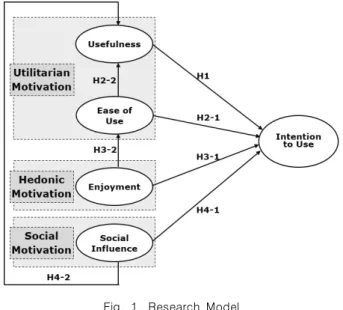
본 연구의 목적은 사용자가 클라우드 서비스를 지속적으로 사용하려는 의도가 무엇인지를 파악하는데 있다. 이를 위하여 동기 관점에서 클라우드 서비스 지속 사용 의도 결정요인에 접 근한 결과, 실용적 동기인 사용 용이성과 유용성, 쾌락적 동기 에 해당되는 즐거움, 그리고 사회적 동기인 사회적 영향을 도출 하였다[4]. [그림 1]은 사용자의 클라우드 서비스 지속 사용 의도를 파악하기 위하여 본 연구가 제안하는 모형이다.

Fig. 1. Research Model

1. Utilitarian Motivation and Continuance Usage Intention

유용성(usefulness)은 사용자가 새로운 기술을 사용하는 것이

성과를 향상시킬 것이라고 믿는 정도 즉, 성과에 대한 기대로 정의된

다[12]. 사용 용이성(ease of use)은 사용자가 새로운 기술을 사용

하는데 많은 노력을 요구하지 않을 것이라고 믿는 정도 즉, 노력에

대한 기대를 의미한다[12]. Davis는 이와 같은 사용자의 기술

사용에 대한 두 가지 실용적 동기(utilitarian motivation)가 새로운

기술에 대한 사용자의 태도 및 사용 의도에 미치는 영향 관계를

파악하는 기술수용모형(Technology Acceptance Model: TAM)

을 발표하였다[5][6]. Davis의 기술수용모형을 본 연구의 대상인

클라우드 서비스에 적용해보면 첫째, 유용성과 사용 용이성은 클라

우드 서비스의 지속사용의도에 유의미한 영향을 미칠 것이며 둘째,

사용 용이성은 유용성에도 유의미한 영향을 미칠 것이라는 가설

설정이 가능하다. 이와 관련된 국내 연구를 살펴보면, 권오준은

스마트폰 사용자의 사용 용이성이 유용성과 행동의도에 유의미한

영향을 미친다는 실증 연구 결과를 보고하였으며[13], 이호택 외

3인도 스마트 디바이스의 사용 용이성과 유용성이 사용 의도에

유의미한 영향을 미친다는 분석 결과를 발표하였다[14]. 이에 본

연구에서는 다음과 같은 가설들을 설정하였다.

(3)

Latent Variable Questionnaire Source

Usefulness

1 I feel that cloud services are useful.

2 I am helpful in dealing with my work using cloud services.

3 I can work effectively using cloud services.

4 I can help you deal with my concerns using cloud services.

5 I will help achieve my purpose using cloud services.

Davis, 1989[5];

Davis et al., 1989[6];

Kwon, 2010[14];

Park and Woo, 2013[12];

Ease of Use

1 It is easy to learn how to use the cloud service.

2 It is easy to become proficient in using cloud services.

3 It is easy to understand the functions of cloud services.

Davis, 1989[5];

Davis et al., 1989[6];

Enjoyment

1 Using cloud services would be pleasant.

2 Cloud services cause my curiosity.

3 I forget the time as I use cloud services.

Heijden, 2004[7];

Social Influence

1 People around me will use a lot of cloud services in the future.

2 People of my age will use a lot of cloud services in the future.

3 I think I will use a lot of cloud services in the future.

Venkatesh et al., 2003[9];

Kwon, 2010[14];

Park and Woo, 2013[12];

Lee, 2012[26]

Intention to Use

1 I think I will continue to use cloud services in the future.

2 I will continue to use cloud services in the future.

3 I think using cloud services will lead to better results than discontinuing use.

Venkatesh and Davis, 2000[8];

Lee, 2013[27]

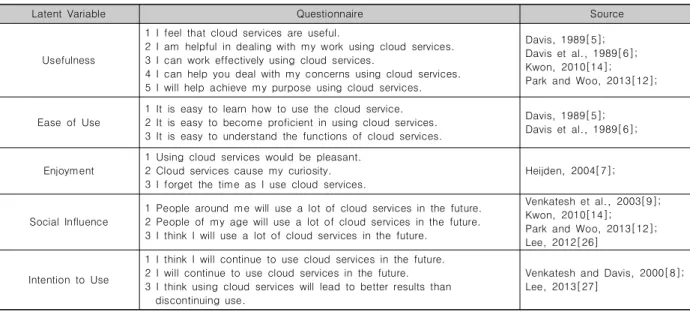
Table 1. Questionnaire Items of Construct

가설 1 : 유용성은 클라우드 서비스 지속사용의도에 정(+)의 영향을 미칠 것이다.

가설 2-1 : 사용 용이성은 클라우드 서비스 지속사용의도에 정(+)의 영향을 미칠 것이다.

가설 2-2 : 사용 용이성은 유용성에 정(+)의 영향을 미칠 것이다.

2. Hedonic Motivation and Continuance Usage Intention

Davis가 제안한 초기 기술수용모형은 조직 관점에서 사용자의 기술 수용 과정을 설명하는데 주안점을 두었기 때문에 실용적 동기 (utilitarian motivation)에 초점을 두었다는 점에 착안한 Heijden 은 2004년에 Davis의 핵심 개념인 유용성, 사용 용이성과 함께 쾌락적 동기(hedonic motivation)인 즐거움(enjoyment)을 통합 적으로 고려한 연구모형을 개발하여 실증하였다. 그 결과 즐거움이 사용자의 기술 사용 의도에 유의미한 영향을 미친다는 연구결과를 도출하였다[7]. 또한 Thong 외 2인은 즐거움이 사용 용이성에 유의미한 영향을 실증하였다[15]. 국내 연구에서도 이호택 외 3인 은 즐거움이 스마트 디바이스 사용 의도에 영향을 미친다는 주장을 실증하였으며[14], 손승혜 외 2인은 인지된 유희성이 스마트폰 사용의 용이성에 유의미한 영향을 미칠 것이라는 주장을 실증하였 다[16]. 본 연구는 이러한 연구들을 바탕으로 즐거움이 클라우드 서비스에 대한 지속 사용의도 및 사용 용이성을 유발시킬 것으로 기대할 수 있다고 생각하였다. 이에 본 연구에서는 즐거움이 클라우 드 서비스 지속사용의도 및 사용 용이성에 대하여 다음과 같은 영향을 미칠 것이라는 가설들을 설정하였다.

가설 3-1 : 즐거움은 클라우드 서비스 지속사용의도에 정(+)의 영향을 미칠 것이다.

가설 3-2 : 즐거움이 사용 용이성에 정(+)의 영향을 미칠 것이다.

3. Social Motivation and Continuance Usage Intention 사회적 영향과 지속사용의도에 관한 논문들을 살펴보면

Venkatesh와 Davis[8], Venkatesh 외 3인[9] 등 다양한 연구자 들이 기술수용모형2, UTAUT(Unified Theory of Acceptance and Use of Technology) 등과 같은 이론을 제안하면서 사회적 영향과 지속사용의도 간의 관계에 대한 연구를 진행하였다. 특히, Venkatesh 외 3인은 2003년에 발표한 UTAUT를 통하여 사회적 영향이 새로운 기술 서비스 사용 의도에 직접적인 영향을 미친다는 결과를 도출하였다[9]. 이와 관련된 국내 연구를 살펴보면, 권오준 은 사회적 영향이 행위의도와 유용성에 유의미한 영향을 미치는 분석 결과를 발표하였다[13]. 본 연구는 이러한 연구들을 바탕으로 사회적 영향이 클라우드 서비스에 대한 지속 사용의도와 유용성을 유발시킬 것으로 기대할 수 있다고 판단하였다. 이에 본 연구에서는 사회적 영향과 클라우드 서비스 지속사용의도 및 유용성 간의 관계 에 대해 다음과 같은 가설들을 설정하였다.

가설 4-1 : 사회적 영향은 클라우드 서비스 지속사용의도에 정(+)의 영향을 미칠 것이다.

가설 4-2 : 사회적 영향은 유용성에 정(+)의 영향을 미칠 것이다.

IV. Research Method

1. Design of Survey Instrument

본 연구는 [그림 1]의 연구모형을 바탕으로 설정된 연구가설을 설문조사를 실시하고 수집된 자료를 분석하여 검증하기로 하였다.

이를 위해 먼저 문헌연구를 수행하여 연구모형에서 제시된 연구변

수들을 바탕으로 설문문항을 개발하였고, 주로 Likert 7점 척도

(1=전혀 그렇지 않다, 4=그저 그렇다, 7=매우 그렇다)를 이용하여

설문지를 개발하였다. 경영정보 분야 연구자들과 클라우드 컴퓨팅

서비스 관련 실무자들에게 변수들의 측정 적합성을 검토한 후,

경영정보학 전공 대학생들을 대상으로 예비조사를 실시하여 애매

(4)

Latent Variable Cronbach's

Alpha CR AVE USE EOU ENJ SOI ITU

Usefulness Ease of Use

Enjoyment Social Influence Intention to Use

0.980 0.948 0.935 0.949 0.958

0.984 0.967 0.959 0.967 0.973

0.926 0.906 0.886 0.907 0.923

0.962 0.792 0.699 0.781 0.695

0.952 0.618 0.551 0.587

0.941 0.515 0.627

0.952

0.710 0.961

Table 4. Correlations between constructs

Latent Variable Observed Variable USE EOU ENJ SOI ITU

Usefulness (USE)

USE1 USE2 USE3 USE4 USE5

0.679 0.727 0.694 0.659 0.663

0.430 0.368 0.432 0.393 0.361

0.214 0.276 0.216 0.340 0.371

0.364 0.404 0.441 0.265 0.408

0.353 0.245 0.201 0.316 0.234 Ease of Use

(EOU)

EOU1 EOU2 EOU3

0.281 0.380 0.238

0.835 0.767 0.873

0.184 0.311 0.214

0.120 0.222 0.201

0.321 0.171 0.147 Enjoyment

(ENJ)

ENJ1 ENJ2 ENJ3

0.371 0.385 0.040

0.330 0.219 0.162

0.795 0.801 0.874

0.128 0.126 0.204

0.177 0.257 0.270 Social Influence

(SOI)

SOI1 SOI2 SOI3

0.403 0.339 0.161

0.123 0.197 0.240

0.210 0.198 0.093

0.795 0.827 0.795

0.274 0.243 0.443 Intention to Use

(ITU)

ITU1 ITU2 ITU3

0.245 0.225 0.199

0.177 0.189 0.281

0.317 0.311 0.171

0.323 0.266 0.296

0.812 0.819 0.814 Table 3. Results of PLS Factor Analysis

모호한 표현을 정제하여 [표 1]에서 보는 바와 같이 연구변수에 대한 최종 설문항목을 선정하였다.

2. Sample and Data Collection

앞서 제시한 연구모형과 가설을 검증하기 위해 본 연구는 수 도권 소재 D 대학교의 스마트워크 교과목을 통해 구글 캘린더 를 이용한 일정 관리 작업, 구글 문서를 이용한 여행 계획서 공 동 작성 작업, 구글 사이트 도구를 이용한 팀사이트 제작 작업 등과 같은 클라우드 서비스 활용 실습을 수행한 경험이 있는 수강생들을 대상으로 편의적 표집방법에 의한 표본을 추출하여 설문조사를 진행하였다. 수집된 설문 중에서 부실 기재 등으로 적합하지 않다고 판단된 설문을 제외한 총 82부의 설문지를 최 종 분석용 자료로 사용하였다. 본 연구의 표본의 일반적인 특성 은 [표 2]와 같다.

Gender Number Percent Age Number Percent

Male Female

30 52

36.59 63.41

-19 20-29 30-39 40-

59 18 2 3

71.95 21.95 2.44 3.66

Total 82 100.00 Total 82 100.00

Table 2. Demographic Characteristics of the sample

V. Analysis and Results

1. Analysis of Measurement Model

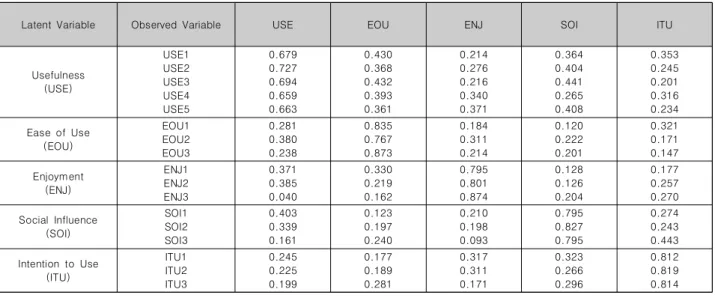
본 연구는 측정모형을 분석하기 위하여 IBM SPSS Statistics 24 통계 프로그램을 사용하였으며, 요인분석을 수행 하였다. 요인분석의 기초구조는 주성분 모형(principal component analysis)으로 결정하였으며, 요인의 회전은 배리 맥스 회전(varimax rotation method)을 사용하였다. 그 결과는 [표 3]에서 보는바와 같이 모든 요인들이 항목 간 상관계수 및 요인적재량에서 0.5이상이었다. 이후에 SmartPLS 2.0 M3 통 계프로그램을 사용하여 관측변수의 신뢰성 분석, 잠재변수의 내적일관성 분석, 그리고 잠재변수의 판별타당성 분석을 수행 하여 측정모형을 검증하였다[17]. 측정모형 검증결과는 첫째, 관측변수의 신뢰성은 각 관측변수의 요인적재량을 이용하여 판 단하였다. 본 연구에서는 [표 4]에서 보는바와 같이 크론바흐 알파(Cronbach's Alpha) 값이 모두 0.7이상이어서 각 관측변 수들의 신뢰성이 확보된 것으로 보았다[18][19][20]. 둘째, 잠재변수의 내적일관성은 복합신뢰도(Composite Reliability:

CR)를 이용하여 판단하였다. 본 연구에서는 [표 4]에서 보는바

와 같이 모두 0.7이상이어서 각 잠재변수들의 내적일관성이 확

보된 것으로 파악하였다[21][22].셋째, 판별타당성은 각 잠재

변수의 평균분산추출(Average Variance Extracted: AVE) 값

을 활용하여 판단하였다[21]. 본 연구에서는 [표 4]에서 보는

바와 같이 평균분산추출의 제곱근 값이 모두 0.5이상이면서

(5)

Hypothesis Path of Model Coefficient t-value Result H1

H2-1 H2-2 H3-1 H3-2 H4-1 H4-2

Usefulness → Intention to Use Ease of Use → Intention to Use Ease of Use → Usefulness Enjoyment → Intention to Use Enjoyment → Ease of Use Social Influence → Intention to Use Social Influence → Usefulness

0.019 0.134 0.519 0.286 0.618 0.474 0.495

0.096 1.124 6.490 2.754 10.301 3.805 7.465

reject reject accept accept accept accept accept Table 5. Hypothesis Model Testing Results

[21][23], 해당 횡축과 종축의 다른 상관계수보다 큰 것으로 나타났다[18][20]. 따라서 본 연구에서 사용된 잠재변수들은 모두 판별타당성이 있다고 할 수 있다.

주) * : p < 0.05, ** : p < 0.01, *** : p < 0.001 Fig. 2. Model Testing Result

2. Verification of Structural Model

본 연구는 측정모형의 분석 결과를 바탕으로 변수들의 판별 타당성과 신뢰성을 확보하였다고 판단하였으므로, SmartPLS 2.0 통계프로그램을 사용하여 부트스트랩 분석을 통한 경로분 석을 수행하여 가설검증을 위한 구조모형을 분석하였다. 그 결 과는 [그림 2]에서 보는바와 같다. 여기서 실선으로 표시된 경 로는 통계적으로 유의하였다는 것을 나타낸 것이며 점선은 통 계적으로 유의하지 않았다는 것을 의미한 것이다. 선행변수들 에 의해 설명되는 종속변수의 설명력(R

2

)은 클라우드 서비스 지속사용의도가 60.8%로 분석되었다.

한편, 본 연구에서 제시한 가설의 검증결과를 요약하면 [표 5]에서 보는바와 같다.

첫째, 실용적 동기인 유용성과 사용 용이성이 클라우드 서비 스 지속사용의도에 미치는 영향(가설 1과 가설 2-1)은 통계적 으로 유의하지 않은 것으로 나타났다. 둘째, 쾌락적 동기인 즐 거움과 사회적 동기인 사회적 영향이 지속사용의도에 미치는 영향(가설 3과 가설 4-1)은 설정된 가설대로 정(+)의 영향을 미치는 것으로 나타났다. 셋째, 즐거움이 사용 용이성에, 사용 용이성이 유용성에 미치는 영향은 통계적으로 유의한 수준에서

정(+)의 영향을 미치는 것으로 나타났고(3-2와 2-2), 사회적 영향도 유용성에 유의한 수준에서 정(+)의 영향을 미치는 것으 로 나타났다(가설 4-2).

VI. Conclusions

본 연구의 목적은 실용적 동기, 쾌락적 동기, 사회적 동기가 클라우드 서비스 사용 지속 의도에 미치는 영향을 조사하는 것 이었다. 이를 위하여 본 연구에서는 동기 관점에서 연구모형을 개발하였고, 사용 용이성, 유용성, 즐거움, 사회적 영향이 클라 우드 서비스 지속사용의도에 미치는 영향에 대한 가설들을 제 안하였다. 그리고 클라우드 서비스 사용 경험이 있는 대학생들 을 대상으로 설문조사를 수행하여 확보된 자료를 대상으로 구 조방정식모형을 사용하여 분석하였다. 클라우드 서비스의 사용 에 대한 실용적 동기가 지속사용여부에 미치는 영향은 일반적 으로 쾌락적 동기나 사회적 동기의 그것보다 더 크다. 하지만 본 연구의 실증결과는 쾌락적 동기와 사회적 동기가 실용적 동 기보다 지속사용여부에 더 큰 영향을 미치는 것으로 분석되었 다. 이에 본 연구자는 설문응답자에 대한 인터뷰를 실시하였고 그 결과, 본 연구 설문 응답자의 특성에서 기인한 것으로 분석 되었다. 즉, 본 연구의 설문 대상은 대학교 1학년 1학기 때 스 마트워크 정규 교과목을 수강하면서 구글 클라우드 서비스를 처음 사용해 본 경험을 보유한 대학생이다. 이들은 그 교과목에 서 자신의 스마트폰을 가지고 협업을 지원하는 구글 클라우드 서비스를 활용하여 팀 프로젝트를 수행하였다. 그 과정에서 기 존의 전통적인 팀 작업과는 달리 마치 카카오톡 서비스를 이용 할 때 느꼈던 즐거움과 비슷한 감정을 느꼈다. 하지만, 구글 클 라우드 서비스가 비교적 사용하기 쉽고 간단한 기능만을 제공 하기 때문에 상대적으로 실용적 동기는 미흡한 것으로 확인되 었다. 따라서 기존의 실용적 동기뿐만 아니라 쾌락적 동기 및 사회적 동기를 함께 고려하여 본 연구에서 제시한 통합적 연구 모형은 주의 깊게 사용할 필요가 있다 하겠다.

또한 본 연구자는 본 연구의 결과가 클라우드 서비스의 사용

현상을 더 잘 설명하기 위해서 다음과 같은 후속 연구들을 제

안한다. 첫째, 클라우드 서비스 지속 사용 관련 선행연구들를

좀더 면밀하게 조사하여 기존 연구자들이 제시된 결정요인들을

미시적 수준 거시적 수준 등을 포함한 다양한 기준으로 분류할

필요가 있다. 둘째, 구글과 같이 간단한 기능을 제공하여 사용

이 비교적 용이한 상황과 AWS와 같이 복잡한 기능 제공으로

사용이 비교적 어려운 상황에 따른 클라우드 서비스 지속 사용

(6)

의도를 분석하는 연구가 필요하다. 셋째, 클라우드 서비스를 충 분히 이해하고 다양한 클라우드 서비스를 경험하여 효과적으로 클라우드 서비스를 사용할 수 있는 전문 사용자 그룹과 그렇지 않은 일반 사용자 그룹 등 클라우드 서비스의 사용자 수준에 따라 클라우드 서비스 지속 사용 의도가 어떠한지를 비교 분석 연구도 필요하다 하겠다. 넷째, 개인의 생산성 향상을 목적으로 사용되는 클라우드 제공 서비스와 집단의 협업을 목적으로 사 용되는 클라우드 제공 서비스가 클라우드 서비스 지속 사용 의도에 미치는 영향을 파악하는 연구도 가치가 있다 하겠다.

REFERENCES

[1] E. S. Park and H. J. Woo, "A Study on Factors Affecting the Intention to Use Personal Cloud Service: Focused on the Convergence Model of TAM and PMT," Journal of Cybercommunication, Vol. 30, No. 2, pp. 111-150, 2013.

[2] D.-H. Park and K.-H. Han, "A Study on PIMS Controls for PII Outsourcing Management under the Cloud Service Environment," Journal of The Korea Institute of Information Security & Cryptology, Vol. 23, No. 6, pp.

1267-1276, 2013.

[3] S.-D. Lee, "The strategic steps of cloud services in Korea,"

Journal of KIISE, Vol. 28, No. 12, pp. 34-38, 2010.

[4] J.-M. Lee, "Technology Acceptance Model for Digital Transformation," Industrial Technology Research, Vol.

26, pp. 65-70, 2017.

[5] F. D. Davis, "Perceived Usefulness, Perceived Ease of Use, and User Acceptance of Information Technology,"

MIS Quarterly, Vol. 13, No. 3, pp. 319-340, 1989.

[6] F. D. Davis, R. P. Bagozzi, and P. R. Warshaw, "User Acceptance of Computer Technology: A Comparison of Two Theoretical Models," Management Science, Vol. 35, No. 8, pp. 982-1003, 1989.

[7] H. Heijden, "User Acceptance of Hedonic Information Systems," MIS Quarterly, Vol. 28, No. 4, pp. 695-704, 2004.

[8] V. Venkatesh and F. D. Davis, "A Theoretical Extension of the Technology Acceptance Model: Four Longitudinal Field Studies," Management Science, Vol. 46, No. 2, pp.

186-204, 2000.

[9] V. Venkatesh, M. G. Morris, G. B. Davis, and F. D. Davis,

"User Acceptance of Information Technology: Toward a Unified View," MIS Quarterly, Vol. 27, No. 3, pp.

425-478, 2003.

[10] F. D. Davis, "A Technology Acceptance Model for Empirically Testing New End-User Information

Systems: Theory and Results," Thesis(Ph.

D.)--Massachusetts Institute of Technology, Sloan School of Management, 1986.

[11] Y.-S. Wang, H.-H. Lin, P. Luarn, "Predicting consumer intention to use mobile service," Information Systems Journal, Vol. 16, No. 2, pp. 157-179, 2006.

[12] E. S. Park, H. J. Woo, "A Study on Factors Affecting the Intention to Use Personal Cloud Service : Focused on the Convergence Model of TAM and PMT," Journal of Cybercommunication Academic Society, Vol. 30, No.

2, pp. 111-150, 2013.

[13] Kwon, O., "An Empirical Study on Potential Smartphone Users," Internet and Information Security, Vol. 1, No.

1, pp. 55-83, 2010.

[14] Yi, H.-T., Huh, J.-H., Jung, J.-B., and Kim, K.-H., "A Study on the Influence of Product Attributes of Smart Device on User Acceptance: Mediating Effect of Utilitarian and Hedonic Motivation," Journal of The Korea Contents Association, Vol. 15, No. 4, pp. 454-468, 2015.

[15] J. Y.L. Thong., S.-J. Hong, and K. Y. Tam, "The effects of post-adoption beliefs on the expectation-confirma tion model for information technology continuance,"

International Journal of Human-Computer Studies, Vol.

64, No. 9, pp. 799-810, 2006.

[16] S. Sohn, Y. J. Choi, and H. S. Hwang, "Understanding acceptance of smartphone among early adopters using extended technology acceptance model," Korean journal of journalism & communication studies, Vol. 55, No.

2, pp. 227-251, 2011.

[17] SmartPLS, http://www.smartpls.de/

[18] D. Barclay, C. Higgins, and R. Thomson, "The Partial Least Squares(PLS) Approach to Causal Modeling, Personal Computer Adoption and Use as an Illustration,"

Technology Studies, Vol. 2, No. 2, pp. 285-309, 1995.

[19] E. G. Carmines and R. A. Zeller, “Reliability and Validity Assessment,” SAGE Publications, 1979.

[20] W. W. Chin, "Issues and Opinion on Structural Equation Modeling," MIS Quarterly, Vol. 22, No. 1, pp. 7-16, Mar.

1998.

[21] C. Fornell and D. Lacker, "Evaluating Structural Equation Models with Unobservable Variables and Measurement Error," J. of Marketing Research, Vol. 18, pp. 921-950, 1981.

[22] J. F. Hair, R. E. Anderson, R. L. Tatham, and W. C.

Black, “Multivariate Data Analysis,” Prentice Hall, 1998.

[23] R. P. Bagozzi and Y. Yi, "On the Evaluation of Structural Models," J. of Academy of Marketing Science, Vol. 16, No. 1, pp. 77-94, 1988.

[24] Y.-M. Huang, "The factors that predispose students

(7)

to continuously use cloud services: Social and technological perspectives," Computers & Education, Vol. 97, pp. 86-96, 2016.

[25] V. Terzis, C. Moridis, and A. Economides, "Continuance acceptance of computer based assessment through the integration of user’s expectations and perceptions,"

Computers & Education, Vol. 62, pp. 50-61, 2013.

[26] J. M. Lee, "An Empirical Study on Factors Influencing Non-Work Related Use Behavior of Smartphone,"

Journal of The Korea Society of Computer and Information, Vol. 17, No. 8, pp. 115-121, 2012.

[27] J. M. Lee, "A Study on the Factors Affecting Smart Phone Use Behavior of University Students in Class," Journal of The Korea Society of Computer and Information, Vol.

18, No. 4, pp. 191-199, 2013.

Authors

Jong Man Lee received his B.S. from Hanyang University. He received his master's degree from Korea Advanced Institute of Science and Technology (KAIST), and he received his Ph.D. in MIS from Sogang University. Dr. Lee joined the Department of Management Information Systems at Dongyang Mirae University, Seoul, Korea, in 2001. He is currently professor in the Department of Management Information Systems, Dongyang Mirae University. He is interested in behaviors in IT usage, electronic business, and IT Outsourcing.

Sang Jong Lee received his bachelor's

degree from Ajou University. He received

master’s degree from Sogang University,

and he is Ph.D. candidate in Kyung Hee

University. He is currently representative

director in Metavalue Co.,Ltd. He is

interested in behaviors in IT Usage, Bigdata, CRM, and

Digital Marketing.

수치

Fig.  1.  Research  Model
Table  1.  Questionnaire  Items  of  Construct
Table  2.  Demographic  Characteristics  of  the  sample

참조

관련 문서

The purpose of this study is to examine the relationship between the social support and mental health of university taekwondo athletes, and clearly clas sify

An Empirical Study on the Influence on Entrepreneurship Education Quality and Career Choice Reasons to University Student’s Entrepreneurial Intention..

The purpose of this study is to investigate the effects on elementary school students' academic English improvement, interest, and self-confidence through the

The purpose of this study is to analyze the influence of dance leaders' inst ructional behavior patterns on participants' desire to participate and

The purpose of this study is to analyze the relationship between dance performances, which is a part of social contribution activities of local governments,

In this Thesis, an empirical study on the Influence of Consumer's Preferences and Satisfaction on Purchase Intention of Korean Automobile in Vietnamese Consumers

For the relationship between these variables, this study analyzed the influence of parental rearing attitude on juvenile subjective well-being and examined

The purpose of this study was to investigate the impact of social capital and positive psychology capital on the will of start-up according to experience