JKSCI
Development of teaching and learning materials using Arduino and piezo buzzer
1)
Eun-Sang Lee*
*Professor, Dept. of Technology and Home Economics Education, Kongju National University, Chungcheongnam-do, Korea
[Abstract]
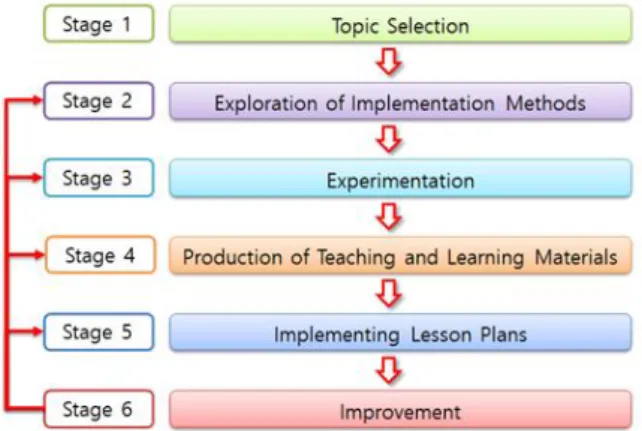
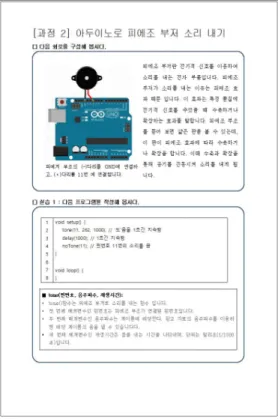
In this paper, I propose a presentation examples of the development of teaching materials using Arduino. For this purpose, a six-step low-cost microcontroller teaching-learning development model was used, the steps being topic selection, exploration of implementation methods, experimentation, production of teaching and learning materials, implementing lesson plans, and improvement. After analyzing the composition of the source code and circuits introduced in the existing Arduino book, this content was reconstructed to fit the programming education context. A simple method of constructing a circuit using materials such as Arduino and a piezo buzzer is proposed to save time on circuit composition. Using this circuit, examples of use in teaching-learning activities for various programming content elements are presented. The core concept of this study is that it provides a direct experience of the content of C language programming exercises that can only be found on existing screens.
▸Key words: Arduino, C programming language, teaching and learning materials, piezo buzzer, programming education
[요 약]
본 연구에서 저자는 C언어 프로그래밍 교육에서 아두이노를 활용한 교수-학습 자료의 개발 사 례를 제시하고자 하였다. 이를 위해 주제 선정-구현 방법 탐색-실험-교수학습자료 제작-수업 적용- 개선 등 6단계의 저비용 마이크로컨트롤러 교수-학습 개발 모형을 이용하였다. 본 연구에서는 기 존 아두이노 교재에 소개되어 있는 소스 코드와 회로의 구성을 분석한 후 , 이를 프로그래밍 교육 주제에 맞게 재구성하였다. 또한, 아두이노와 피에조 버저 등의 재료를 이용하여 간단히 회로를 구성하는 방법을 제시하여 회로 구성에 많은 시간이 소요되지 않게 하였다. 이 회로를 이용하여 여러 가지 프로그래밍 내용 요소의 교수 -학습 활동에 활용한 사례를 제시하였다. 본 연구는 기존 화면상에서만 확인할 수 있는 C언어 프로그래밍 실습 내용을 직접 실물로 체험할 수 있는 사례를 제시하였다는 점에서 그 의의가 있다.
▸주제어: 아두이노, C언어, 교수-학습 자료, 피에조 버저, 프로그래밍 교육
∙First Author: Eun-Sang Lee, Corresponding Author: Eun-Sang Lee
*Eun-Sang Lee ([email protected]), Dept. of Technology and Home Economics Education, Kongju National University
∙Received: 2020. 11. 20, Revised: 2020. 12. 08, Accepted: 2020. 12. 08.
Copyright ⓒ 2020 The Korea Society of Computer and Information http://www.ksci.re.kr pISSN:1598-849X | eISSN:2383-9945