학제 간 융합연구 활성화 방안 연구
Facilitating Interdisciplinary Research:
An Analysis of Grant Proposal Acceptance Rates in South Korea
조성겸*, 이광희**
충남대학교 언론정보학과*, 한국연구재단 문화융복합단**
Sung Kyum Cho([email protected])*, Kwang Hee Lee([email protected])**
요약
최근 융합연구의 중요성이 부각되고, 정부차원의 재정지원이 확대되고 있다. 실제 많은 연구자들이 융합 과제를 신청하는 것으로 조사되었다. 2017년에 신청한 4,930건의 인문사회 기초연구사업 연구과제를 학제 간 연계성을 조사ㆍ분석한 결과 52.2%에 이르는 2,575건이 연구분야 대분류 기준으로 1개 이상의 다른 연 구 분야와 연계된 것으로 나타나 융합연구로 분류될 수 있었다. 이렇게 분류된 융합연구 과제의 최종 지원 및 선정률이 단일분야(42.1%)보다 7.1% 낮은 35%로 분석되었다. 이 조사결과에 기초할 때 인문사회 기초 연구에 학제 간 연계성을 띄는 연구과제의 비중이 많음에도 불구하고, 심사평가에서 융합연구의 특성이 적 절하게 반영되지 못하고 있는 것으로 보인다. 향후, 학제 간 융합연구의 활성화를 위해 연구지원 분류체계 에 융합연구의 분류기준을 마련하고, 연구과제 심사평가 시 학제 간 융합연구 과제의 특성이 고려될 수 있 도록 평가방안을 정비할 필요가 있다.
■ 중심어 :∣학제 간 연구∣융합연구∣한국연구재단∣연구계획서∣인문사회기초연구∣
Abstract
Interdisciplinary, or convergence, research has been a priority for the National Research Foundation of Korea (NRF) and many scholars in Korea have proposed interdisciplinary projects.
Of the 4,930 proposals for the submitted in 2017, 2,575 (52.2%) of these proposals could be considered interdisciplinary projects. However, interdisciplinary projects had an acceptance rate of 35.0%, compared to an acceptance rate of 42.1% for single-discipline proposals. According to the study, despite the large share of research projects that appear to be interdisciplinary research, the characteristics of interdisciplinary studies was not reflected properly in the evaluation. I would suggest that it is required to prepare the criteria for classification of interdisciplinary studies in the classification system of research fields so that the characteristics of interdisciplinary research projects may be duly considered.
■ keyword :∣Interdisciplinary Research∣Convergence Research∣National Research Foundation of Korea (NRF)∣Grant Proposals∣Humanities and Social Sciences (HSS) Basic Research Program∣
접수일자 : 2018년 04월 23일 수정일자 : 2018년 05월 16일
심사완료일 : 2018년 05월 16일
교신저자 : 조성겸, e-mail : [email protected]
1. INTRODUCTION
Interdisciplinary research, sometimes called convergence research, allows us to access opinions and procedures from multiple fields in order to find the best possible approach to complex issues. The answer from one field alone is often not enough. If we consider various perspectives to be partial truths, we realize that only when we search for alternative explanations to our ideas and combine our knowledge with others will we find the truth. However, interdisciplinary research is only possible if we know how to search for a new perspective. We may be stuck working in our own paradigm and need someone with a new vision to create the new paradigm, allowing us to leap forward in our research.
A first step to getting these new perspectives would be enabling researchers to cross the boundaries between fields more easily. We need to be able to share ideas and working methods with those in other fields and fully integrate our ideas to produce worthwhile results. Some external factors make it difficult for us to work in this way, such as evaluation practices, while other factors are our own internal problems.
For example, one of us (Cho) was part of an interdisciplinary research team dealing with climate change. The members of this team worked hard to understand the current status of research in each other’s disciplines and to share our own knowledge.
However, in taking the time to try to overcome our personal limitations and better understand new information early in the project, we did not complete any original papers during our first year, which led to the grant not being renewed. The external problem of needing to publish quickly prevented us from overcoming our prior knowledge limitations to optimize our efficacy.
Recognizing these factors and taking concrete steps to overcome them is an important step in making interdisciplinary research productive and more widely used. This paper aims to identify the factors impeding interdisciplinary research, focusing primarily on the grant application process, and to suggest how to facilitate these studies.
2. LITERATURE REVIEW
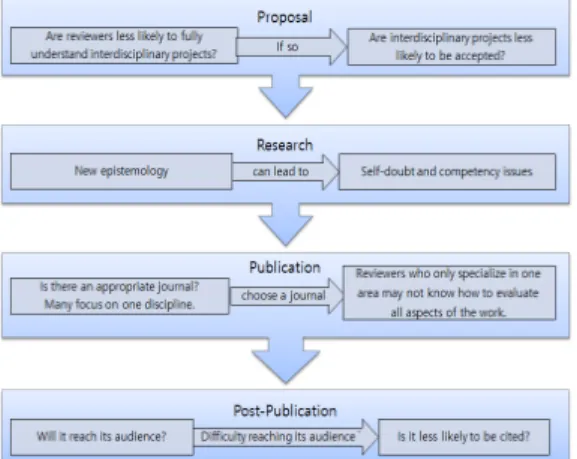
Interdisciplinary research presents its own unique challenges at every stage of research. An analysis of research proposals in Australia showed that interdisciplinary projects are less likely to receive funding in that country[1]. Even after this first step, challenges continue: During the research process, a scholar may struggle to understand some of their colleague’s ways of working, eliciting feelings of inadequacy and self-doubt. Scholars, who have reached a high level of competency in their own fields, may find that it is uncomfortable to try something they do not understand and may also worry about how their colleagues perceive them[2].
The review process can lead to additional challenges, when reviewers who may not be familiar with one of the disciplines involved object to methods or ideas commonly accepted in that discipline. For example, one scholar, part of an interdisciplinary climate change research team, had a reviewer comment “How can the experience of local residents be ‘knowledge?”
The reviewer seemed unfamiliar with expressions and ideas used in the social sciences[3]. Finally, papers that make use of disparate fields or have a more equal balance between fields (as opposed to focusing on one of the disciplines involved) may be less likely to be cited by others, which has more than one possible explanation, including the possibility that scholars are
hesitant to cite heterodox papers and that research from distant fields may be associated with a greater chance of failure[4].
Fig. 1. Potential Challenges at Various Phases of Interdisciplinary Research Projects
Several scholars have already made suggestions about how we can work well together. We have found that we agree with many of their ideas. In particular, [5]’s emphasis on the importance of communicating with each other and focusing on problem solving, and [6]’s vector model emphasizing the intersection of knowledge, insight, experience, and methodology from different fields coincide with our personal experience. Many other factors may play an important role, as actual research situations are a little different from the ideal situation. We agree with [7] that the more we are engaged with the problem, the more we are further engaged with science’s potential specific contribution to solving it. There could be many theories that can serve to ground our research. Reference [8] proposed, for example, the integrative system theory as a frame of understanding for interdisciplinary approach. Thus, having a common problem is crucial to the success of this kind of project. However, our research environment is not facilitating interdisciplinary
research, as [9] has already pointed out.
3. RESEARCH QUESTION AND METHODOLOGY
As a first step to considering how well the research environment in South Korea facilitates interdisciplinary research, we wanted to know if the difficulties in funding interdisciplinary research noted by [1] in Australia occur in South Korea as well.
We analyzed the research proposals submitted in 2017 to the Humanities and Social Sciences (HSS) Basic Research Program to investigate the frequency of interdisciplinary project proposals and the relative acceptance rate of these proposals. The HHS grant supports creative research activities. Our analysis includes individual proposals from three categories:
post-doctoral researchers, junior researchers (professors appointed within the last five years), and mid-career researchers (professors who have more than six years of research results). When applying for this grant, researchers identified the field(s) of their research proposal with the understanding that scholars from that area would act as their reviewers.
The National S&T Classification System divides science and technology research into 16 large and 207 middle categories and social sciences and humanities into 17 large and 145 middle categories. If the identified fields came from two or more of the 33 large fields, we regarded the proposal as an interdisciplinary proposal.
4. RESULTS
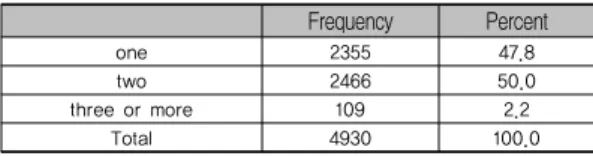
Of the 4930 proposals for these HHS grants only 109 (2.2%) can be regarded as belonging to three or
more than three categories and 2466 (50%) be regarded as belonging to two categories.
Table 1. Proposals by the number of fields Frequency Percent
one 2355 47.8
two 2466 50.0
three or more 109 2.2
Total 4930 100.0
This result showed that 52.2% of the proposals for this grant (2575 proposals) could be considered to be interdisciplinary research proposals.
Of the proposals considered as interdisciplinary projects, 35.1% were accepted, which was lower than the overall acceptance rate of 38.4%. The acceptance rate for single discipline projects was 42.1%. This pattern was statistically significant (Chi-square=27, p=0.00). This pattern was not consistent across fields, but it should be noted that some of these fields had very few proposals. All the six fields which received more than 400 proposals were less likely to accept interdisciplinary projects. In our calculations of acceptance rate by field, interdisplinary projects were counted in all applicable fields.
5. DISCUSSION AND CONCLUSION
The NRF tries to facilitate interdisciplinary research. It allocates a certain amount of funding for interdisciplinary research. Our analysis of grant proposal acceptance rates suggests a few things.
First, in spite of the NRF’s intention to support interdisciplinary research, interdisciplinary research proposals have a lower chance of being accepted.
One reason for the discrepancy between single- discipline projects’ acceptance rates and the acceptance rates of interdisciplinary projects is that the reviewers of proposals submitted may not be able
to fully evaluate all aspects of the interdisciplinary project.
The next phase of our research may include a more in-depth analysis of who is proposing and conducting interdisciplinary research in Korea. For example, it may be worth exploring whether younger scholars, who may be more willing to try new things and are still exploring new ways of working, are more likely to submit interdisciplinary research proposals, or whether older scholars, who have already established their reputation and position, may be more likely to take the risk involved with this kind of research. We might also look at gender to see if women or men are more likely to conduct interdisciplinary research.
Other variables could also be considered. Knowing who is most likely to propose interdisciplinary projects in an important step in understanding how we can best support this research.
In addition, the reviewer selection process may benefit from being modified in a way that lets proposals be reviewed by scholars from the different disciplines involved. Grant proposals may also benefit from some de-contextualization. Each discipline has its own epistemology, which can make it difficult for scholars to properly evaluate interdisciplinary proposals. Grant writers may make it easier for evaluators to understand all aspects of the proposal by only including small pieces of relevant information and making the research process clear rather than assuming that the evaluator has a deep knowledge of all the disciplines involved. The peer review process prevents negative changes in a field and keeps us from losing our way. At the same time, it prevents a lot of changes that could be good.
We would suggest that our peer review process include one reviewer from an outside field. Knowing that our papers may need to be understood by those outside our field, we would be forced to write in a
way that would make our ideas understandable to everyone. The outside reviewer may not have a perfect understanding of the field or be certain about whether the work is really original. However, he will be able to judge whether it can be clearly understood by a scholar from an outside field and give suggestions for places that should be clarified or revised to be understandable. In addition, the outside reviewer will then be aware of this research. It will therefore facilitate more dialogue between fields and will help us make the change from interdisciplinary research being something occasionally conducted in special circumstances to being the modus operandi in most cases. There is no reason not to modify our writing style so that our proposals, and eventually our papers, can be read by everyone. We would like to suggest a metaphor for this idea. Imagine that the boundaries between disciplines are walls. It is as if in initiating interdisciplinary research, we imagine that we have to climb over these walls and become fully immersed in other fields. Instead, we can imagine our knowledge as small parcels that could be tossed over the walls more easily than these walls could be climbed. By de-contextualizing our writing to make it as specific, simple, and clear as possible, we can accomplish this.
Research grants are necessary but not enough. The research environment, including publications, evaluations, and associations, is built mainly with a single-discipline approach in mind. Journals for interdisciplinary fields should be encouraged, and establishing special grants for these journals may help facilitate interdisciplinary work. The evaluation process should reflect this trend. Only when we lower the barrier of information exchange among different fields, can interdisciplinary research reach its full potential. In an ideal world every scholar would be able to access new information from other fields.
When he has a question and cannot find an answer in his own field, he should be able to freely consult with experts in other fields. New alternative structures are needed, but the transition will not be an easy one. We need to create a new framework for conducting interdisciplinary research and evaluating it. We need to learn to de-contextualize information to share it with scholars from other fields. Including reviewers from other fields in the peer review process will help make this the norm. To really bring about change, we must accept that the outcomes from this new kind of research may not be what we have come to expect in our respective fields. If we accept this, we will free scholars to make a new research paradigm and allow them to find new and original solutions to the complex problems of today's world.
참 고 문 헌
[1] L. Bomham, R. Dinnage, and X. Hua,
“Interdisciplinary Research Has Lower Funding Success,” Nature, Vol.534, pp.684-687, Jun. 2016.
https://doi.org/10.1038/nature18315
[2] D. E. Trussell, S. Paterson, S. Hebblethwaite, T.
M. K. Xing, and M. Evans, “Negotiating the Complexities and Risks of Interdisciplinary Qualitative Research,” International Journal of Qualitative Methods, Vol.16, No.1, pp.1-10, Jun.
2017, https://doi.org/10.1177/1609406917711351 [3] E. T. Yeh, “‘How can experience of local residents
be “knowledge”?’ Challenges in interdisciplinary climate change research,” Area, Vol.48, No.1, pp.1-7, 2015. https://doi: 10.1111/area.12189.
[4] A. Yegros-Yegros, I. Rafols, and P. D’Este,
“Does Interdisciplinary Research Lead to Higher Citation Impact: The Different Effect of Proximal and Distal Interdisciplinarity,” PLoS
ONE, Vol.10, No.8, 2015.
https://doi.org/10.1371/journal.pone.0135095 [5] S. W. Lee, “Several branches of cognitive
science: Cognitive Revolution, Polyscientific Studies, and Selective Cooperation,” Knowledge Integration and Future Scientific Technology and Social Research Institute's 3rd Annual Seminar Announcement, 2011.
[6] S. W. Hong, Creative convergence ‘Vector Model’. S. W. Hong (Ed.) 『What is convergence』 Seoul: Science Books, 2012.
[7] H. S. Kim, Engagement: the key to the communicative effectiveness of science and ideas. B. Schiele, M. Claessens and S. Shi (Eds.). Science Communication in the World, 2012.
[8] K. H. Kim, “New Horizons of Psychological Interventions in Health: Roles of Psychology and Maum Model in Convergence Approach,”
Korean Journal of Health Psychology, Vol.18, No.2, pp.251-266, 2013.
https://doi.org/10.17315/kjhp.2013.18.2.001 [9] S. W. Park, How much fusion is possible with
theoretical possibilities and practical barriers. S.
W. Hong (Ed.) What Is Convergence, Seoul:
Science Books, 2012.
저 자 소 개
조 성 겸(Sung Kyum Cho) 정회원
▪1990년 2월 : 서울대학교 언론학 박사
▪1991년 11월 ∼ 현재 : 충남대학 교 언론정보학과 교수
▪2016년 : 한국언론학회 회장
▪2008년 : 충남대학교 사회조사센 터 소장, 한국조사연구학회 편집위원장
<관심분야> : 여론조사/연구방법, 과학커뮤니케이션
이 광 희(Kwang Hee Lee) 정회원
▪2000년 2월 : 서울대학교 행정학 박사
▪2009년 6월 ∼ 현재 : 한국연구 재단 문화융복합단 PO
▪2006년 4월 : 한국학술진흥재단 학술정책단 연구위원
▪2004년 10월 : 행정자치부 전자정부/행정개혁본부 전 문위원(가급)
<관심분야> : R&D정책, 전자정부, 도시 및 지역정책