허리통증이 있는 농촌지역 여성들에 대한 허리 강화 운동 프로그램의 효과*
백소라1),2), 김보람3), 김고운1),2), 박희원1),2) 강원대학교병원 농업안전보건센터1),
강원대학교병원 재활의학과, 강원대학교 의학전문대학원 의학과 재활의학교실2), 강원대학교 스포츠과학과3)
Effect of Back-Strengthening Exercise Program in Rural Community-Dwelling Women with Mild Low Back Pain
Sora Baek1),2), Boram Kim3), Gowun Kim1),2), and Hee-won Park1),2)
Center for Farmers' Safety and Health, Kangwon National University Hospital, Chuncheon, Korea;1), Department of Rehabilitation Medicine, Kangwon National University Hospital,
Kangwon National University School of Medicine, Chuncheon, Korea;2), Department of Sport Science, Kangwon National University, Chuncheon, Korea3)
= Abstract =
목적: 농촌 지역사회 기반의 허리 근력 강화 운동 프로그램이 운동과 허리 건강에 대한 개인의 태도 및 믿음에 미치는 효과를 평가하고자 하였다.
방법: 강원도 지역 네 개의 농촌 마을에서 가벼운 허리 통증이 있는 79명의 여성 자원자(42-76세) 들을 운동군(n=40)과 대조군(n=39)으로 마을단위로 배정하였다. 운동군에서는 지역사회 기반의 허리 강화 운동 프로그램(주당 3회, 8주간)이 시행되었고 대조군에는 일반적인 건강 관리에 대한 강의가 제공되었다. 등척성 허리 신전 근력과 허리 통증 관련 장애, 운동에 대한 태도, 허리 질환에 대한 위협 인지, 운동의 자기 효능감을 중재전과 중재후 1, 2개월째 측정하였다.
결과: 운동군에서 2개월후 허리 신전근력은 뚜렷이 증가하였으며 허리 통증 관련 장애도 유의미하게 감소하였다. 운동에 대한 태도와 허리 질환에 대한 위협 인지는 운동군에서 증가하였으나 대조군에서는 변화가 없었다. 운동의 자기효능감은 양군에서 같이 증가하였으나 운동군에서 그 정도가 더 뚜렷했다.
결론: 농촌 지역 여성들을 대상으로 한 허리 근력 강화 운동 프로그램은 허리 통증으로 인한 장애를 감소시켰고 운동의 효과에 대한 태도와 믿음을 변화시켰다.
주제어: 허리통증, 허리근력, 운동, 농촌여성
* Received March 9, 2021; Revised May 4, 2021; Accepted May 7, 2021.
* Corresponding author: 박희원, 강원도 춘천시 백령로 156(우: 24289) 강원대학교 의학전문대학원 의학과 재활의학교실, 강원대학교병원 재활의학과
Hee-won Park, Department of Rehabilitation Medicine, Kangwon National University Hospital, Kangwon National University School of Medicine, 156 Baengnyeong-ro, Chuncheon 24289, Korea
Tel: +82-33-248-9100, Fax: +82-33-258-9097, E-mail: [email protected]
* 이 연구는 농림축산식품부의 지원을 받아 수행되었습니다.
Introduction
Low back pain is ranked high in terms of disability, has increased significantly over the past 25 years, and its prevalence was estimated at 9.4% globally in 2010 [1]. Strong evidence supports the effectiveness of exercise therapy in decreasing back pain and increasing back-specific functional status in patients with low back pain [2]. However, even though the effect of exercise is well known, only few people engage in it [3]. Insufficient exercise has been found to be a risk factor for chronic back pain [4]. Therefore, exercise is widely used for the treatment and prevention of low back pain [5].
Community-based programs for achieving change in health-concerning behaviours have been emphasised for patients with chronic disease [6]. Considering the high prevalence and their recurrent nature, low back pain would require management through community-based programs [7]. There are very few exercise facilities in rural areas with low population densities, and access to conventional healthcare is limited.
For the improvement and prevention of back pain, a community-based exercise program would be considered for adults dwelling in rural areas. The potential target population of community-based programs would be relatively healthy people with several risk factors.
Women are more vulnerable to low back pain [8].
In this study, we included community-dwelling women with low back pain with an intensity of visual analogue scale 5 or less for a target population.
Psychological factors must be considered to improve exercise program compliance. An important psychological aspect is the patients’
attitude toward exercise, which is related to exercise compliance [9]. Self-efficacy, the belief that one is capable of performing tasks to attain a particular goal, also describes the confidence one has in their own ability to achieve the desired outcome [10]. The poor adherence to physiotherapy sessions was associated with low self-efficacy [3]. In a previous study, adherence to a community-based exercise program was a strong predictor of improving back pain in older adults [7].
Community-based exercise programs have demonstrated feasibility, yet many lack controlled studies examining their efficacy in pain, disabilities, trunk muscle strength, and psychological factors [11].
Trunk extensor strength showed a close relationship with future occurrence of low back pain. In addition to lumbar muscle dysfunction due to pain, muscle atrophy in lumbar multifidus was identified in patients with low back pain [12]. Relatively weak trunk extensor muscle compared to trunk flexor muscle might be one risk factor for low back pain [13].
Measuring back muscle strength is also an objective way to determine the effectiveness of an exercise program especially in patients currently not experiencing low back pain.
However, in community-based programs, trunk muscle strength is difficult to measure due to the expensive and large equipment required.
Park et al. previously developed a new method for isometric back extensor strength measurement using a portable dynamometer. This method was easy to perform and showed high reliability and validity [14]. We used isometric back extensor strength as an outcome measure for our exercise program.
We constructed a community-based exercise program comprising back extensor strengthening.
We hypothesised back-strengthening exercises for community-dwelling women with mild low back pain could show psychological benefit. In this study, we aimed to investigate (1) the effect of the 8-week community program on back extensor muscle strength and back pain-related disability, consisting of core exercise and strengthening exercise, and (2) whether the community-based program could show beneficial effects on attitudes toward exercise, perceived threat of back disorder, and exercise self-efficacy.
Materials and Methods
1. Participants
Women aged ≥ 40 years in four rural villages (Saam-ri, Balsan-ri, Geodu-ri, and Sin-dong) located in the rural region of Gangwon-do, South Korea were recruited.
Those with significant back pain with a visual
analogue scale score of ≥ 6 were excluded.
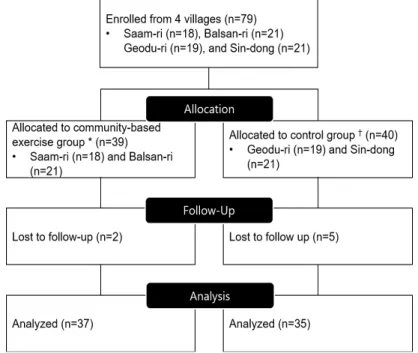
The four villages were assigned to be the control group or exercise group. Thirty-nine volunteers from Saam-ri (n=18) and Balsan-ri (n=21) were allocated to the exercise group, and 40 volunteers from Geodu-ri (n=19) and Sin-dong (n=21) were allocated to the control group (Figure 1). Effective blinding was not possible because both the subjects and researchers clearly understood the differences between the two groups. All subjects were engaged in agriculture. The exercise program was conducted during the winter season, when farming works were reduced.
Age, height, and weight were assessed at baseline, and body mass index (BMI) was calculated. The study protocol was approved by the Kangwon National University Hospital Institutional Review Board. All participants provided written informed consent.
Figure 1. Flow chart of inclusion. *Participants recruited from Saam-ri and Balsan-ri were assigned to exercise groups. †Participants recruited from Geodu-ri and Sin-dong were assigned to control groups.
2. Experimental procedure
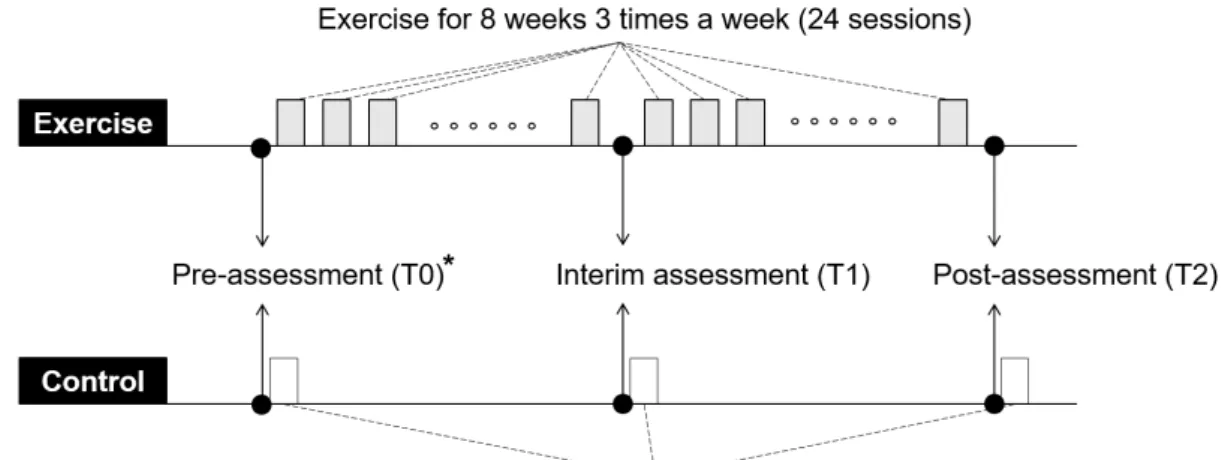
For the exercise group, a lecture on back health was provided pre-assessment. One hour of supervised back-strengthening exercise sessions were performed three times per week for 8 weeks (Figure 2). For the control group, a lecture on general health was provided on the initial day, and 1-hour group leisure activities (stretching, line dancing, etc.) were provided at baseline, 1 month, and 2 months.
All activities, including the lecture, leisure, and exercises, were conducted in each village’s community hall. Outcome measurements were assessed at baseline (T0), after 1 month (T1), and upon completion of the 2-month program (T2).
3. Community-based exercise program
The exercise program, developed by the authors, was directed by an exercise specialist.
Twenty-three exercise movements, encompassing stretching, strengthening, and core stabilisation exercises, were included. Each exercise session included warm-up (10 minutes), main (40 minutes), and cool-down (10 minutes) exercises.
Warm-up exercises included neck stretching, neck circles, arm stretching, chest stretching, shoulder circles, spine extension, side stretching, frog stretching, and ankle stretching. Main exercises included gym ball sitting, squats, lunges, one leg back lift, gym ball planks, superman, one leg reaching, cat, prone one leg lift, bridging, laying head up, cycling, leg scissors, and crunches. Cool-down exercises included gym ball spine extension, gym ball waist relaxation, and pelvic relaxation.
4. Outcome measurements
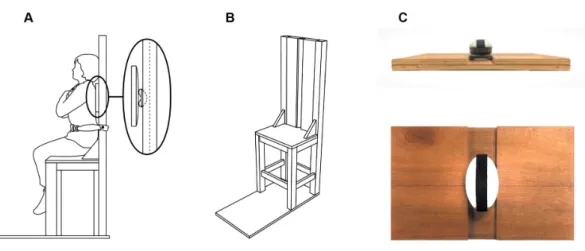
1) Trunk extensor strengthIsometric trunk extensor strength was measured in the sitting posture using a hand-held dynamometer (Power Track II Commander Muscle Tester, JTECH Medical, Utah, US) positioned at the inferior angle of the scapula (at the level of T7) (Figure 3). A custom-made chair designed by authors was used, which ensured that the feet of the participants were off the floor and were not influenced by the lower limb [14].
Figure 2. Exercise and control interventions. *On the pre-assessment day, education on general health and back health was provided to both the exercise control groups.
Figure 3. Isometric back extensor strength measurement. (A) The participant was seated in a chair, which did not allow the feet to touch the floor, and the pelvis was fixed by fastening the seat belt. Extension strength was measured using a portable dynamometer located between the square backplate and chair seatback (bold-lined oval). (B) The vertical linear groove on the centre of the chair’s backrest is designed for holding a sensor unit, with a ruler to set the sensor unit in a specific height. (C) The square wooden backplate interface with participants’ back muscle, which transmits compression pressure to the attached force sensor unit.
2) Back pain-related disability
Back pain-related disability was assessed using the Oswestry Disability Index (ODI), a self-administered, 10-item questionnaire. ODI was translated into Korean, and its validity and reliability were assessed [15]. ODI includes questions regarding pain intensity and questions describing its disabling effect on typical daily activities. ODI score ranges from 0 to 100;
higher scores depict increased disability. ODI is the most recommended condition-specific outcome measure for spinal disorders.
3) Questionnaire assessing attitudes toward exercise, perceived threat, and exercise self-efficacy We developed a self-administered questionnaire composed of 11 items and three subcategories to assess attitudes toward exercises (Q1–4), perceived threat (Q5–7), and exercise self-efficacy
(Q8–11). Each item’s score ranged from 1 (strongly disagree) to 5 (strongly agree) using a Likert scale.
Attitude toward exercises was assessed using four items modified from previous questionnaire items [16]: ‘Q1. I think it is good to exercise’, ‘Q2. I think it is wise to exercise’,
‘Q3. I think it is desirable to exercise’, ‘Q4. I think it is beneficial to exercise’. The final score was the average score of the four items.
Perceived threat of back disorder was assessed via severity and susceptibility. Items were modified from previous questionnaire items [17]: ‘Q5. Back disease is one of the high-incidence diseases’, ‘Q6. Back disease is a disease that affects a lot of everyday life and quality of life’, and ‘Q7. I can also have back disease’. The final score was the average score of the three items.
Exercise self-efficacy was assessed in terms of self-confidence about exercise: effect and capability. Items were modified from previous questionnaire items [17]: ‘Q8. If I want, I do not find it difficult to exercise’, ‘Q9. I am confident to exercise to prevent back disease’,
‘Q10. Exercise is effective in preventing back disease’, ‘Q11. Exercise can help prevent back disease’. The final score was the average score of the four items.
5. Validity test of the developed questionnaire
We tested the psychometric properties of the newly developed questionnaire to assess participants’ psychological aspects. Psychometric properties were tested as follows: (1) construct validity through factor analysis and (2) internal consistency of identified factors through Cronbach’s alpha. Construct validity was assessed through principal components analysis, and factor structure rotated using orthogonal rotations (varimax). Factor analysis suitability was determined using the Kaiser–Meyer–Olkin (KMO) measure of sampling adequacy, and Bartlett’s sphericity test was also conducted. KMO values > 0.5 and Bartlett’s sphericity with P values < 0.05 were acceptable.
Factors with eigenvalues > 1.0 were extracted according to the Kaiser–Guttman criterion.
After factor selection, a correlation matrix was generated using varimax rotation, and factor loadings > 0.40 on only one factor were interpreted. If an item loaded on multiple factors, then the factor with the highest loading was considered for interpretation.
Subscale internal consistency was tested with Cronbach’s alpha. Values ≥ 0.6 were considered satisfactory.
To assess the concurrent validity of individual psychological aspects with a back
pain-related disability, we analysed correlations among attitudes toward exercises, perceived threat of back disorders, exercise self-efficacy, and ODI score at baseline (T0), all of which were assessed using Spearman’s rho (ρ) for all subjects.
6. Statistical analysis
Baseline characteristics were compared between groups using Student’s t-test. Outcome variables were expressed as the median (interquartile range, IQR). Differences in measured outcomes between T0 and T2 were calculated and expressed as ΔT2–T0, and significance was analysed using the Wilcoxon signed-rank test.
Outcome values at T0, T1, T2, and ΔT2–T0 were compared between the exercise and control groups using the Mann–Whitney U test.
Statistical analysis was performed using Jamovi version 1.1.9 (https://www.jamovi.org/), a free open-source graphical user interface for the R software, and P<.05 was considered significant.
Results
1. Participants’ characteristics
Overall, 7 participants dropped out (exercise group, 2; control group, 5), and 72 participants were included in the final analysis (Figure 1).
Baseline characteristics are shown in Table 1.
The control group (62.0±7.45 years) was older than the exercise group (59.0±7.86 years), but this difference was not significant (P=0.10).
There was no significant difference between the groups in height, weight, and BMI.
2. Validity of the developed questionnaire
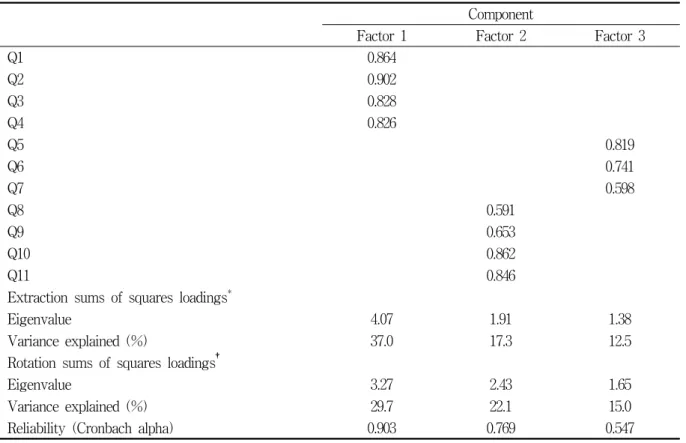
Construct validity of the newly developed questionnaire to assess participant psychologicalaspects were evaluated using principal components analysis. The KMO value was 0.758, and Bartlett’s test of sphericity was significant (P<0.001). Three factors with eigenvalues > 1.0 were extracted, explaining 66.8% of the total variance. Eigenvalue and percent of variance explained using each factor are listed in Table 2. Factor one reflects attitudes toward exercise, factor two reflects
perceived threat, and factor three reflects exercise self-efficacy. Internal consistency of factors one and three, but not factor two, was satisfactory (Cronbach’s alpha ≥ 0.6). The perceived threat category evaluates both perceived susceptibility and perceived severity, so the Cronbach value appears to be relatively low (Cronbach’s alpha=0.547).
Table 1. Baseline characteristics
Exercise group (n=37) Control group (n=35) P-value Age (years), mean±SD, min–max 59.0 ± 7.86, 42–75 62.0 ± 7.45, 49–76 0.10
Height (cm), mean±SD 153.8 ± 5.66 154.8 ± 3.45 0.37
Weight (kg), mean±SD 60.5 ± 10.95 60.4 ± 5.74 0.94
Body mass index, mean±SD 25.5 ± 3.56 25.2 ± 2.40 0.71
SD: standard deviation
Table 2. Results of principal factor analysis with varimax rotation
Component
Factor 1 Factor 2 Factor 3
Q1 0.864
Q2 0.902
Q3 0.828
Q4 0.826
Q5 0.819
Q6 0.741
Q7 0.598
Q8 0.591
Q9 0.653
Q10 0.862
Q11 0.846
Extraction sums of squares loadings*
Eigenvalue 4.07 1.91 1.38
Variance explained (%) 37.0 17.3 12.5
Rotation sums of squares loadings†
Eigenvalue 3.27 2.43 1.65
Variance explained (%) 29.7 22.1 15.0
Reliability (Cronbach alpha) 0.903 0.769 0.547
*Extraction method: principal component analysis
†Rotation method: varimax with Kaiser normalisation
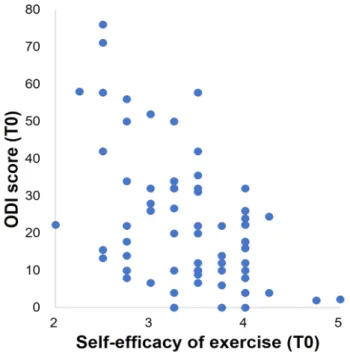
For concurrent validity evaluation, we assessed the correlation between personal attitudes toward back health and back pain-related disability at baseline (T0). ODI score at baseline showed significant correlation with exercise self-efficacy, perceived risk of
back disorders, and attitudes toward exercise (ρ=-0.448, P<0.001; ρ=0.409, P<0.001; ρ=0.258, P=0.03) (Table 3). Scatter slopes between ODI (T0) and self-efficacy (T0) are shown in Figure 4.
Figure 4. Scatter slope shows the correlation between exercise self-efficacy and ODI score at baseline (ρ= -0.448, P<0.001) for all participants (n=72).
ODI, Oswestry Disability Index
3. Effect of our exercise program
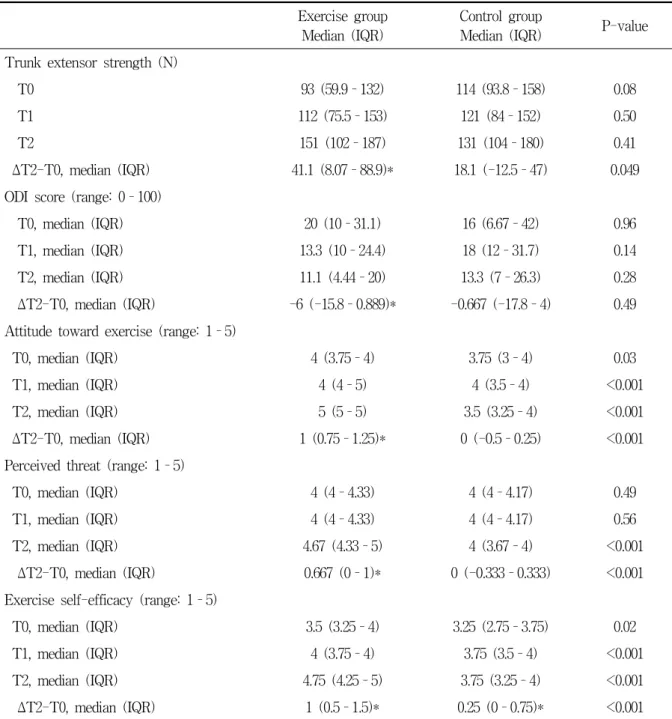
1) Trunk extension strengthTrunk extensor strength measured at baseline was lower in the exercise group (median 93 N;
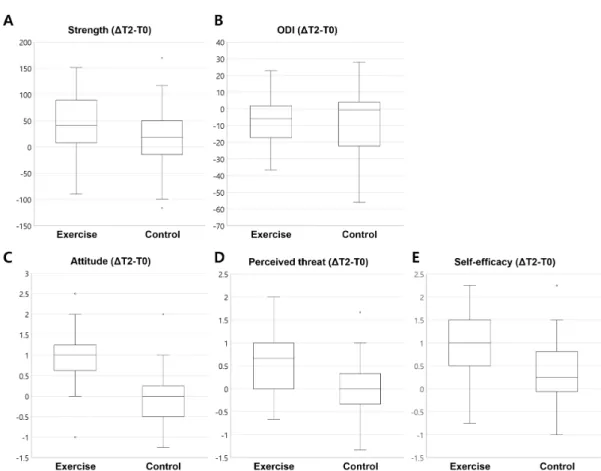
IQR 59.9–132 N) than in the control group (114 N; IQR 93.8–158 N), but there was no significant difference. Trunk extensor strength significantly changed between baseline and T2 in the exercise group (ΔT2-T0=41.1 N (IQR:
8.07–88.9 N)); no significant change was observed in the control group (ΔT2-T0=18.1 N (IQR: -12.5–47 N)) (Table 4, Figure 5A).
2) Back pain-related disability
Median ODI values at baseline were 20 (IQR: 10–31.1) and 16 (IQR: 6.67–42) in the exercise and control groups, respectively. The difference between these values was not significant. ODI changes of ΔT2-T0 were -6 (IQR: -15.8–0.889) in the exercise group (P=0.01) and -0.667 (IQR: -17.8–4) in the control group (P=0.06) and were not significantly different between groups (Table 4, Figure 5B).
Table 3. Correlation between individual attitude and belief and ODI
ODI score (T0)*
Spearman’s ρ P-value
Back extensor strength (T0) -0.030 0.80
Attitude toward exercise (T0) -0.258 0.03
Perceived threat (T0) 0.409 <0.001
Exercise self-efficacy (T0) -0.448 <0.001
ODI score (ΔT2-T0)†
Back extensor strength (ΔT2-T0) -0.077 0.65
Attitude toward exercise (ΔT2-T0) -0.074 0.67
Perceived threat (ΔT2-T0) -0.231 0.17
Exercise self-efficacy (ΔT2-T0) -0.502 0.002
*Analysed for all participants (n=72)
†Analysed for exercise group (n=37) ODI: Oswestry Disability Index
Figure 5. Outcome measurement changes (ΔT2–T0) in exercise and control groups. (A) Trunk extensor strength. (B) Back pain-related disability using Oswestry Disability Index (ODI). (C) Attitude toward exercise. (D) Perceived risk of back disorder. (E) Exercise self-efficacy
Table 4. Outcome changes from baseline compared between exercise and control group Exercise group
Median (IQR)
Control group
Median (IQR) P-value Trunk extensor strength (N)
T0 93 (59.9–132) 114 (93.8–158) 0.08
T1 112 (75.5–153) 121 (84–152) 0.50
T2 151 (102–187) 131 (104–180) 0.41
ΔT2-T0, median (IQR) 41.1 (8.07–88.9)* 18.1 (-12.5–47) 0.049
ODI score (range: 0–100)
T0, median (IQR) 20 (10–31.1) 16 (6.67–42) 0.96
T1, median (IQR) 13.3 (10–24.4) 18 (12–31.7) 0.14
T2, median (IQR) 11.1 (4.44–20) 13.3 (7–26.3) 0.28
ΔT2-T0, median (IQR) -6 (-15.8–0.889)* -0.667 (-17.8–4) 0.49 Attitude toward exercise (range: 1–5)
T0, median (IQR) 4 (3.75–4) 3.75 (3–4) 0.03
T1, median (IQR) 4 (4–5) 4 (3.5–4) <0.001
T2, median (IQR) 5 (5–5) 3.5 (3.25–4) <0.001
ΔT2-T0, median (IQR) 1 (0.75–1.25)* 0 (-0.5–0.25) <0.001
Perceived threat (range: 1–5)
T0, median (IQR) 4 (4–4.33) 4 (4–4.17) 0.49
T1, median (IQR) 4 (4–4.33) 4 (4–4.17) 0.56
T2, median (IQR) 4.67 (4.33–5) 4 (3.67–4) <0.001
ΔT2-T0, median (IQR) 0.667 (0–1)* 0 (-0.333–0.333) <0.001 Exercise self-efficacy (range: 1–5)
T0, median (IQR) 3.5 (3.25–4) 3.25 (2.75–3.75) 0.02
T1, median (IQR) 4 (3.75–4) 3.75 (3.5–4) <0.001
T2, median (IQR) 4.75 (4.25–5) 3.75 (3.25–4) <0.001
ΔT2-T0, median (IQR) 1 (0.5–1.5)* 0.25 (0–0.75)* <0.001
*P<.05 comparing paired values between T0 and T2.
ODI: Oswestry Disability Index
3) Attitudes toward exercise
The median score of attitudes toward exercises at baseline was 4 (IQR: 3.75–4) in the exercise group, higher than that in the control group (3.75 (IQR: 3–4), P=0.03). Attitude changes of ΔT2–T0 were significantly greater in the exercise group (1 (IQR: 0.75–1.25),
P<0.001) than in the control group (Table 2, Figure 5C).
4) Perceived threat of back disorders
Median scores of perceived threats at baseline were 4 (IQR: 4–4.33) and 4 (IQR: 4–4.17) in the exercise and control groups, respectively.
The difference between these values was not significant. Perceived threat changes of ΔT2–
T0 were significantly larger in the exercise group than in the control group (0.667 (IQR: 0 –1) vs. 0 (IQR: -0.333–0.333), P<0.001) (Table 2, Figure 5D).
5) Exercise self-efficacy
The median score of exercise self-efficacy at baseline was significantly higher in the exercise group (3.5 (IQR: 3.25–4)) than in the control group (3.25 (IQR: 2.75–3.75)). Exercise self-efficacy significantly changed between baseline and T2 in both groups (ΔT2-T0: 1 (IQR: 0.5–1.5) vs 0.25 (IQR: 0–0.75)).
Exercise self-efficacy changes of ΔT2–T0 were significantly larger in the exercise group than in the control group (Table 2, Figure 5E).
Discussion
This study demonstrated the effects of an 8-week exercise program comprised of stretching and strengthening exercises conducted in the community with supervision. For the exercise program, we focused on the strengthening of back extensor muscles which was confirmed by isometric strength tests. Pain-related disability at the 2-month follow-up reduced significantly in the exercise group compared with the baseline. Strength training improved individuals’ attitudes and beliefs toward exercise and back health. Attitude toward exercise and perceived threat of back disorders improved in only the exercise group. Exercise self-efficacy improved in both groups but increased significantly in the exercise group compared with the control group.
Community-based intervention for education and exercise programs have been implicated
for improving diet habits, physical activity, and knee pain [18–20]. For low back pain, community-based education programs showed efficacy [21]. In an observational study, adherence to grouped community exercise programs strongly related to improved low back pain [7].
However, the effect of community-based exercise for low back pain was not conclusive in the randomised controlled trials compared to the education-only group [22]. In this study, the exercise program also did not significantly reduce low back pain compared to the no-exercise control. This may be due to the small sample size and the heterogeneous composition of the subjects.
Most previous studies used pain or pain-related disability to show results of back-strengthening exercise [2,23]. Exercise therapy consisting of stretching or strengthening exercises delivered with supervision improved pain and function in chronic, non-specific low back pain [23]. A previous study measuring trunk extension/flexion strength determined that patients with low back pain had weaker back muscles than healthy controls, and back muscle strengthening and pain reduction were observed with muscle-strengthening exercises [24]. We measured trunk extensor strength and demonstrated that our exercise program was effective for back extensor muscle strengthening.
There was a significant increase in trunk extensor strength in only the exercise group.
Trunk extensor muscles are important for spinal motion. Previous studies demonstrated that strength deficits were associated with chronic low back pain. In patients with chronic low back pain, values for both flexors and extensors markedly decreased and extensor strength was significantly affected compared with flexor strength [25]. Discrepancies
between patients and controls were more evident in females than males [25]. Lumbar muscle dysfunction in patients with low back pain might be related to the altered lumbar muscle structure, due to the atrophic changes in the multifidus and paraspinal muscles but not in the erector spinae muscles [12].
Perceived susceptibility, perceived severity, and self-efficacy are constructs of the Health Belief Model, the most widely used individual health behaviour theory in public health. Since the early 1950s, the Health Belief Model has been widely used as a conceptual framework in health behaviour research that explains change and maintenance of health-related behaviours and is used as a guiding framework for health behaviour interventions [26]. Exercise is also closely related to the individual beliefs.
High self-efficacy and high perceived level of susceptibility were associated with better exercise adherence [3]. Education has attempted to improve these attitudes and beliefs.
However, in a previous study, the educational intervention based on the Health Belief Model showed no significant difference in the mean values of the Health Belief Model constructs prior to the intervention between the intervention and control groups [27].
Participation in the exercise program itself may increase the adherence to the home exercise program [3]. Participation in a home exercise program was associated with adherence at 1, 2, and 3-month follow-up [28]. The psychological benefit of the exercise program was also reported. A previous study conducted a stretching exercise program for nurses. The exercise self-efficacy in the exercise group was significantly higher than that in the control group at 4 and 6 months [29].
Conversely, to our knowledge, the effects of
exercise program on perceived threat have not yet reported. We assessed individuals’ attitudes and beliefs toward exercise and back health.
We used a newly developed 11-item questionnaire comprising three factors (exercise self-efficacy, attitudes toward exercise, and perceived threat of back disorders) highly associated with participants’ back pain-related disability. More severe back pain-related disability correlated with lower exercise self-efficacy, more negative attitudes toward exercise, and higher perceived risk of back disorders. As a result of our program, participants’ perceived threat to back disorders were increased after the exercise program. Through high levels of attitude and beliefs after the exercise program, we expect better low back pain preventive behaviours [30].
There are implications of this study as a community-based study. Using supervised exercise programs, healthy participants, validated outcome measures, our newly designed method, and a relatively short-term exercise program led to significant change. Advantages of our back-exercise program are its low cost and participation ease. Our exercise program can be used for community health care.
This study has several limitations. First, we included only healthy participants with no or mild low back pain. Second, our back-exercise program included stretching, strengthening, and core stabilisation exercises. Participants did not complain of increased pain or discomfort during the exercise program, but increased pain may occur in participants with more severe pain. This may limit the effectiveness of extending this exercise program to patients with severe back pain. Third, this study included a relatively small study population and a relatively short follow-up period; therefore, long-term benefits cannot be ascertained.
Fourth, this study did not apply the blinding method, and evaluators and participants may have been affected. Participants may have changed their behaviour because they are watched.
In conclusion, this study indicates that community-based back-strengthening exercise has positive effects on back extensor strength and individual attitudes and beliefs toward exercise and back health in adult women.
References
1. Hoy D, March L, Brooks P, et al. The global burden of low back pain: estimates from the Global Burden of Disease 2010 study. Ann Rheum Dis 2014;73:968–74 2. Searle A, Spink M, Ho A, et al. Exercise
interventions for the treatment of chronic low back pain: A systematic review and meta-analysis of randomised controlled trials. Clin Rehabil 2015;29:1155–67
3. Jack K, McLean SM, Moffett JK, et al.
Barriers to treatment adherence in physiotherapy outpatient clinics: A systematic review. Man Ther 2010;15:220–8
4. Jonsdottir S, Ahmed H, Tómasson K, et al.
Factors associated with chronic and acute back pain in Wales, a cross-sectional study.
BMC Musculoskelet Disord 2019;20:215 5. Bigos SJ, Holland J, Holland C, et al.
High-quality controlled trials on preventing episodes of back problems: systematic literature review in working-age adults.
Spine J 2009;9:147–68
6. Desveaux L, Beauchamp M, Goldstein R, et al. Community-based exercise programs as a strategy to optimize function in chronic disease a systematic review. Med Care 2014;52:216–26
7. Hicks GE, Benvenuti F, Fiaschi V, et al.
Adherence to a community-based exercise program is a strong predictor of improved back pain status in older adults: An observational study. Clin J Pain 2012;28:195 –203
8. Min D, Baek S, Park HW, et al. Prevalence and characteristics of musculoskeletal pain in Korean farmers. Ann Rehabil Med 2016;40:1–13
9. Sluijs EM, Kok GJ, van der Zee J. Correlates of exercise compliance in physical therapy.
Phys Ther 1993;73:771–82
10. Bandura A. Self-efficacy: Toward a unifying theory of behavioral change. Psychol Rev 1977;84:191–215
11. Kwon S-C, Ryou H-C, In H-K, et al. Effect of the Prevention Programs for Musculoskeletal Disorders in one Farming Village. J Agric Med Community Heal 2008;33:1–10
12. Goubert D, Oosterwijck J Van, Meeus M, et al. Structural changes of lumbar muscles in non-specific low back pain: a systematic review. Pain Physician 2016;19:E985–1000 13. Cho KH, Beom JW, Lee TS, et al. Trunk
Muscles Strength as a Risk Factor for Nonspecific Low Back Pain : A Pilot Study 2014;38:234–40
14. Park H, Baek S, Kim HY, et al. Reliability and validity of a new method for isometric back extensor strength evaluation using a hand-held dynamometer. Ann Rehabil Med 2017;41:793–800
15. Kim D-Y, Lee S-H, Lee H-Y, et al.
Validation of the Korean version of the oswestry disability index. Spine (Phila Pa 1976) 2005;30:E123-7
16. Yoon S-M. A study on the behavioral adherence of tourists pursuing adventurous leisure activity, by using extension about
Theory of Planned Behavior: focusing on the role of flow, attachment and past behavior [dissertation]. Kyunghee University Graduate School, 2010
17. Yoo S. A study on the effect model of health communication campaigns on social media [dissertation]. The Graduate School of Sogang University, 2011
18. Kimura M, Moriyasu A, Kumagai S, et al.
Community-based intervention to improve dietary habits and promote physical activity among older adults: a cluster randomized trial. BMC Geriatr 2013;13:8
19. Levy SS, Thralls KJ, Goble DJ, et al.
Effects of a Community-Based Exercise Program on Older Adults’ Physical Function, Activities of Daily Living, and Exercise Self-Efficacy: Feeling Fit Club. J Appl Gerontol 2020;39:40–9
20. Rawiworrakul T, Sirapo-ngam Y, Davis AHT, et al. A community-based exercise program promotes self-efficacy for exercise among Thai women with osteoarthritis of the knee. Thai J Nurs Res 2007;11:132–51 21. Jinnouchi H, Matsudaira K, Kitamura A, et al. Effects of brief self-exercise education on the management of chronic low back pain: A community-based, randomized, parallel-group pragmatic trial. Mod Rheumatol 2020:1–9
22. Brodsky M, Hansen A, Bjerke W. Randomized Pilot Trial for a Community-Based Group Stretching Exercise Program for Chronic Low Back Pain. Glob Adv Heal Med 2019;8:216495611984605
23. Hayden JA, van Tulder MW, Tomlinson G.
Systematic review: strategies for using exercise therapy to improve outcomes in chronic low back pain. Ann Intern Med 2005;142:776–85
24. Holmes B, Leggett S, Mooney V, et al.
Comparison of female geriatric lumbar- extension strength: asymptotic versus chronic low back pain patients and their response to active rehabilitation. J Spinal Disord 1996;9:17–22
25. Mayer TG, Smith SS, Keeley J, et al.
Quantification of lumbar function. Part 2:
sagittal plane trunk strength in chronic low-back pain patients. Spine (Phila Pa 1976) 1985;10:765–72
26. Glanz K, Rimer B k., Viswanath K. Health Behavior and Health Education. 4th ed. San Francisco: Jossey-Bass, 2008
27. Sharafkhani N, Khorsandi M, Shamsi M, et al. The Effect of an Educational Intervention Program on the Adoption of Low Back Pain Preventive Behaviors in Nurses: An Application of the Health Belief Model. Glob Spine J 2015;6:29–34
28. Kuukkanen T, Mälkiä E, Kautiainen H, et al. Effectiveness of a home exercise programme in low back pain: a randomized five-year follow-up study. Physiother Res Int 2007;12:213–24
29. Chen HM, Wang HH, Chen CH, et al.
Effectiveness of a stretching exercise program on low back pain and exercise self-efficacy among nurses in Taiwan: a randomized clinical trial. Pain Manag Nurs 2014;15:283–91
30. Sari SAAY, Indarto D, Wijaya M. Application of Health Belief Model on Preventive Behaviors of Patients with Low Back Pain.
J Heal Promot Behav 2018;3:192–8