四物湯加香附子가 난소적출 흰쥐의 우울 및 학습에 미치는 영향
원광대학교 한의과대학 한방부인과학교실 이순이, 김송백, 서윤정, 최창민, 조한백
ABSTRACT
The Effect of Samul-tanggahyangbuja on Depression and Learning on Repeated Stress in Ovariectomized Rats
Soon-Yee Lee, Song-Baek Kim, Yun-Jung Seo, Chang-Min Choi, Han-Baek Cho Dept. of Korean Gynecology and Obstetrics, College of Korean Medicine,
Won-Kwang University
Objectives: In this research, the effect of samul-tanggahyangbuja on depression and learning in ovariectomized rats subjected to repetitive stress were assessed.
Samul-tanggahyangbuja is the prescription consisting of Samul-tang and Cyperi Rhizoma.
Methods: Ovariectomized rats were repeatedly stressed over a 2-week period.
After being orally medicated with samul-tanggahyangbuja (100 or 400 mg/kg), rats performed the Morris water maze test and forced swimming test, and social exploration was assessed in a behavior test. As well, sucrose intake was measured and measurements of blood serum corticosterone and the change of interleukin-1
β(IL-1
β) and tumor necrosis factor-
α(TNF-
α) in blood samples were made.
Results:
1. In the Morris water maze test, rats medicated with 100 mg samul-tanggahyangbuja mastered the maze in a shorter time on the 4th day in comparison with the control group, while rats medicated with 400 mg samul-tanggahyangbuja mastered the maze more quickly (p<0.05 on the 3rd day ; p<0.01 on the 4th day, as compared to control).
2. Immobility time in the forced swimming test was significantly decreased in rats receiving 400 mg samul-tanggahyangbuja compared with the control group (p<0.05).
3. Sucrose intake and active social behavior of rats receiving 400 mg samul- tanggahyangbuja were markedly increased in comparison with the control group (p<0.01).
4. Blood serum corticosterone measurements revealed decreased blood serum corticosterone level after medicating with samul-tanggahyangbuja. But it was not statistically significant.
5. Treatment with either dose of samul-tanggahyangbuja significantly reduced IL-1
βand TNF-
α(p<0.05).
Conclusions: These results suggest that samul-tanggahyangbuja possesses the anti-depressant and cognitive-enhancing activities related to menopause.
Key Words: Menopausal depression, Samul-tanggahyangbuja, Morris Water Maze Test, Forced Swimming Test, Corticosterone, Cytokine
1)
Corresponding author(Han-Baek Cho) : Wonkwang Univ. Sanbon Korean Medical Hospital, 1126-1, Sanbon-dong, Gunpo, Gyeonggi-do, 435-040, Korea
Tel : 031-390-2664 Fax : 031-390-2319 E-mail : [email protected]
Ⅰ. Introduction
Menopause refers to the physiological and psychological changes that occur in the progression of a woman from the fertile state to the infertile state 1,2) . Menstruation is suspended as production of the female sex hormone estrogen declines and stops altogether. The age at which menopause occurs varies, but generally occurs in late 40s.
The transition into menopause is termed perimenopause. It has been estimated that up to 30% of women in a given population are perimenopausal. This prevalence is increasing as populations age. As an increasing proportion of women experience `the turning point of life’, there may be consequences for internal medicine and mental health of societies 3) .
Perimenopausal women in particular are at risk of new onset and recurrence of major depressive episodes, and the risk is greater in women with a previous history of premenstrual syndrome or postpartum depression. Symptoms may present with features of melancholia, agitation, somatic symptoms, or sleep disturbances 4) .
Traditional medication Samul-tang (四物湯) derive from Goongguigyoae-tang (芎歸膠艾湯) written on ≪Geumgweyolyag (金匱要略)≫ 5) and it is comprised of Rehmanniae Radix Preparat, Angelicae Gigantis Radix, Cnidii Rhizoma, and Paeoniae Radix. Samul-tang has been used in the treatment of women's disease
and it has the effect of tonify blood (補血), regulate menstruation (調經), activate blood (活血) 6) . Samul-tang widely applied to malfunction of hypothalamus or ovary and to autonomic nervous system disorder including menstrual irregularity and dysmenorrhea 7) .
There have been many studies seeking natural antidepressant substance. Recently oriental medicines have been increasingly focused on such as Gwibi-tang (歸脾湯) 8,9) , Nelumbinis semen (蓮子肉) 10) .
In Laboratory studies, Yiseon-tang (二 仙湯), Soyo-san (逍遙散) and Gammaekdaejo -tang (甘麥大棗湯) have been shown to have anti-depressive like effects 11-13) . However, no attempts have been to investigate menopausal depresson and cognitive deficits.
The aim of the present study was to explore the behavioral and the neurobiological effects of Samul-tanggahyangbuja (SGH) on ovariectomized rats and to form a basis for clinical treatment. samul-tanggahyangbuja is the prescription consisting of Samul-tang and Cyperi Rhizoma. samul-tanggahyangbuja's antidepressant effect was tested via a Morris Water Maze Test (WMT), a Forced Swimming Test (FST), a sucrose intake test and a social exploration measurement and the serum levels of corticosterone, IL-1
βand TNF-
αwere also measured.
Ⅱ. Materials and Methods
1. Subjects and stress procedure
Sprague Dawley female rats (about
200 g) at the age of 3 months (Orient, Inc. Korea) were used for the study.
The rats were housed under a controlled temperature (22-24℃) with a 12h light /dark cycle. The lights were on from 8:00 to 20:00. Food and water were made available ad libitum. They were allowed at least 1 week to adapt to their environment before the experiments.
The animal experiments were carried out in accordance with the Prevention of Cruelty to Animals Act 1986 and NIH guidance for the care and use of laboratory animals for experimental procedures, and were approved by local committee review.
The female rats were randomly divided into four groups (n=10 per group) : the nonoperated and nonstressed group (normal), the ovariectomized and stressed group
(control), and the ovariectomized, stressed and SGH 100 mg/kg treated group (SGH 100), stressed and SGH 400 mg/kg treated group (SGH 400).
Using aseptic conditions, bilateral ovariectomy was performed under general anesthesia with pentobarbital sodium (50 mg/kg, i.p.). After postoperative recovery for 7 days, the ovariectomized rats were stressed daily. Stress was produced by forcing the animals into an immobilizer device (a disposable rodent restraint cone, Harvard Instrument, U.S.A.) for 2 h (10:00-12:00 a.m.) for 14 days. From the day of the first immobilization, the SGH group was daily treated with the samul -tanggahyangbuja extract (100 and 400 mg/kg, p.o.) for 2 weeks, and other groups were given sterile saline. Immobilization began 30 min after the treatments.
Experimental Procedure
Immobilization stress (2h/day)
1st day 7th day 14th day 15th day 16th day
1st day-7th day :Morris Water Maze
9th day-14th day :sucrose preference test
15th day :social
exploration
16th day FST
Fig. 1. Experimental Procedure.
2. Preparation of herbal extracts Samul-tanggahyangbuja was purchased from an oriental drug store (Omniherb, Inc. Korea). The boucher specimens are deposited at the herbarium located in the College of Oriental Medicine, Wonkwang
University. The dried SGH samples (720 g) were immersed in a 10-fold volume of distilled water, boiled at 80℃ for 1h, and then the water extract was collected.
The process was repeated once, and the
extracts were combined and concentrated
with a rotary evaporator and vacuum -dried to yield about 7.0% (w/w) of the extract.
Pharmaceutical name Dose(g)
Cyperi Rhizoma 8
Rehmanniae Radix Preparat 4 Angelicae Gigantis Radix 4
Cnidii Rhizoma 4
Paeoniae Radix 4
Total amount 24
Table 1. Prescription of Samul- tanggahyangbuja
3. Morris Water Maze Test (WMT) The swimming pool of the Morris Water Maze was a circular water tank 200 cm in diameter and 35 cm deep. It was filled to a depth of 21 cm with water at 23±2℃. A platform 15 cm in diameter and 20 cm in height was placed inside the tank with its top surface being 1.5 cm below the surface of the water. The pool was surrounded by many cues that were external to the maze. A CCD camera was equipped with a personal computer for the behavioral analysis. Each rat was received for daily trials. For 6 consecutive days, the rats were tested with three acquisition tests.
They also received retention tests on the 7th day. For the acquisition test, the rat was allowed to search for the hidden platform for 180s and the latency to escape onto the platform was recorded.
The animals were trained to find the platform that was in a fixed position during 6 days for the acquisition test,
and then for the retention test, they received a 1 min probe trial in which the platform was removed from the pool. The intertrial interval time was 1 min. Performance of the test animals in each water maze trial was assessed by a personal computer for the behavioral analysis (S-mart program, Spain).
4. Forced Swimming Test (FST)
The Forced Swimming Test (FST)
was originally described by Porsolt et
al. (1977) and is the most widely used
pharmacological model for assessing
antidepressant activity 14) . The development
of immobility when the rodents are placed
in an inescapable cylinder of water reflects
the cessation of persistent escape-directed
behavior 15) . The apparatus consisted of
a transparent Plexiglas cylinder (50 cm
high×20 cm wide) filled to a 30 cm depth
with water at room temperature. In the
pre-test, rats were placed in the cylinder
for 15min, 24h prior to the 5-min swimming
test. Samul-tanggahyangbuja extract (100,
400 mg/kg) or saline was administrated
p.o. three times : immediately after the
initial 15min pre-test, 5-min test and
1h prior to the swimming test. During
the 5-min swimming test, the following
behavioral responses were recorded by a
trained observer : Climbing behavior, which
is defined as upward-directed movements
of the forepaws along the side of the swim
chamber. Swimming behavior, defined as
movement throughout the swim chamber,
which included crossing into another quadrant.
Immobility was considered when the rat made no further attempts to escape except the movement necessary to keep its head above the water. Increases in active responses, such as climbing or swimming, and reduction in immobility, are considered as behavioral profiles consistent with an antidepressant-like action 14) .
5. Sucrose intake
For the sucrose intake test, subjects were exposed to 1% sucrose solution for 5 days(9th-14th day) after the start of exposure with stress. Testing took place daily, from 14:00 to 17:00 on the same time of the day. Animals were subjected to sucrose preference test on the 14th day. Prior to each test, animals were deprived food and water for 24h. Sucrose solution and water consumption was recorded by reweighing pre-weighed bottles of test solution.
6. Social interaction test
After two weeks of stress session, total time of active social behaviors (grooming, rearing, sniffing, licking) and inactive behaviors (immobility) was measured for 5 min.
7. Corticosterone (CORT) measurements After the behavior test, blood samples were collected from the rats. The total concentration of CORT was measured by an ELISA kit (DuoSet ELISA development system, R&D Systems, Inc., Minneapolis,
MN., USA). Cardiac blood was collected just prior to sacrificing the rats. The blood was centrifuged for 15 min at 1000×g within 30 minutes of collection.
The samples were immediately assayed or stored at ≤-60℃. All reagents, working standards and samples were prepared.
The excess microplate strips were removed from the plate frame, returned to the foil pouch containing the desiccant pack and sealed. All of the samples or standards (100 μl) were added into the appropriately labeled wells and 50
μl of conjugated serum was placed into all of the wells except for the nonspecific binding wells and total count wells. Corticosterone (50 μl) was added into all of the wells.
All of the wells were incubated for two hours at room temperature on a horizontal orbital microplate shaker (0.12〃 orbit) set at 500±50 rpm. Each well was washed three times with wash buffer. After the last washing, any remaining Wash Buffer was removed by aspirating or decanting.
5
μl of corticosterone conjugate and 200
μl of p-nitrophenyl phosphate-substrate was added to all of the wells. The well was incubated for 1 hour at room temperature (without shaking). Next, 50 μl of Stop Solution was added to each well. Using a microplate reader, the optical density of each well was immediately determined.
The absorbance was read at 450 nm and
550 nm, and the sample values were
calculated from a standard curve.
8. Cytokine measurements
After the behavior test, plasma separated from the blood was used to estimate the cytokine levels. Enzyme-linked immunosorbent assay (ELISA) was performed using DuoSet ELISA development system according to the manufacturer's instructions (R
& D Systems, Minneapolis, MN, USA).
Briefly, polystyrene microtiter plates (NUNC, U16 Maxisorp type, Roskilde, Denmark) were coated with monoclonal capture antibody (antirat IL-1βand antirat TNF-
α) obtained from mouse (R & D Systems) and incubated at 4℃ overnight.
The following day, the plates were blocked and then incubated for 2 hour with plasma. This was followed by the addition of corresponding biotinylated detection antibody obtained from goat (R & D Systems) and incubated for 2 hour.
Streptavidin horseradish peroxidase (R &
D Systems) and then, tetramethylbenzidine substrate (Bangalore Genei, Bangalore, India) treatment followed this incubation.
The reaction was stopped using 2N sulfuric acid, and optical density reading was taken at 450 nm. All the experiments were conducted in duplicate. A standard curve was obtained based on the standards provided by the manufacturer.
9. Data analysis
Statistical comparisons were done for the behavioral and immunological studies using the one-way ANOVA, respectively, and LSD post hoc was done. All of the results were presented as means ± S.E.M.,
and we used SPSS 15.0 for Windows for analysis of the statistics. The significance level was set at p<0.05.
Ⅲ. Results
1. Effects of samul-tanggahyangbuja on the Morris Water Maze Test (WMT)
The latency to escape onto the hidden
platform during the acquisition trial of
the water maze was recorded, and the
results are depicted in Fig. 2. The escape
latency differed among the groups when
the results were averaged over all the
session. The control group showed a
worse performance than did the normal
group (on the 3rd, 4th day respectively,
p<0.05). There were no significant main
effects, but there was a slight trend for a
significant interaction effect on the distance
traveled to reach the platform. SGH
treatment groups increased performance
of acquisition trials (p<0.05 on the 4th day
of SGH 100 mg ; p<0.05 on the 3rd day
of SGH 400 mg ; p<0.01 on the 4th day
of SGH 400 mg). The present test found
that samul-tanggahyangbuja treatment
in ovariectomized and immobilization-
stressed female rats prevented forgetting
during retention of the WMT(Fig. 2).
Fig. 2. Effects of Samul-tanggahyangbuja on the Acquisition Test.
The control group showed a worse performance than did the normal group (on the 3rd, 4th day respectively, p<0.05). SGH treatment groups increased performance of acquisition trials (p<0.05 on the 4th day of SGH 100 mg;
p<0.05 on the 3rd day of SGH 400 mg;
p<0.01 on the 4th day of SGH 400 mg).
The results of acquisition test were analyzed by performing separate one-way ANOVA among the groups. Each value represents the mean±S.E.M.
Normal : non-ovariectomized group
Control : after ovariectomized, exposed to immobilization stress group
SGH 100 : after ovariectomized, exposed to immobilization stress, samul-tanggahyangbuja 100 mg/kg treated group
SGH 400 : after ovariectomized, exposed to immobilization stress, samul-tanggahyangbuja 400 mg/kg treated group.
# : p<0.05 in comparison with Normal
* : p<0.05 in comparison with Control
**: p<0.01 in comparison with Control
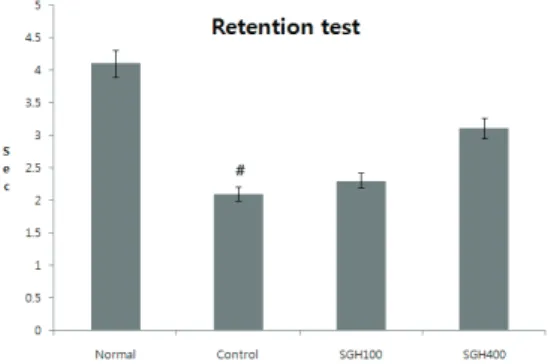
To examine the spatial memory of rats, analysis of the performance on the probe trial with comparing the time spent around the platform is illustrated in Fig. 3. The times spent around the platform were significantly different among the groups, and the control group spent less time around the platform than the normal group. SGH treatment groups did not show statistically significance.
Therefore ovariectomy and repeated stress
severely impaired spatial learning and memory in the Morris Water Maze Test.
But SGH treatment groups did not show statistically significance. Therefore ovariectomy and repeated stress severely impaired spatial learning and memory in the Morris Water Maze Test.
Fig. 3. Effects of Samul-tanggahyangbuja on the Performance of Retention Test.
The control group spent less time around the platform than the normal group. SGH treatment groups did not show statistical significance. The results of retention test were analyzed by performing separate one-way ANOVA among the groups. Each value represents the mean±S.E.M.
Normal : non-ovariectomized group
Control : after ovariectomized, exposed to immobilization stress group
SGH 100 : after ovariectomized, exposed to immobilization stress, samul-tanggahyangbuja 100 mg/kg treated group
SGH 400 : after ovariectomized, exposed to immobilization stress, samul-tanggahyangbuja 400 mg/kg treated group.
# :
p<0.05 in comparison with Normal 2. Effects of samul-tanggahyangbuja on the Forced Swimming Test (FST)
The effects of SGH on active behaviors
in the FST of rats are shown in Fig. 4. SGH
treatment groups significantly shortened
the immobility time in comparison to
control values (p<0.05). This effect was
accompanied by increases in swimming behavior, after SGH 400 mg/kg. These data revealed a statistically significant difference between the control group and the SGH 400 mg group, which means antidepressant-like effect of samul- tanggahyangbuja on the basis of the decrease of immobility time in the repeated FST(Fig. 4).
Fig. 4. Effects of Samul-tanggahyangbuja on the Forced Swimming Test (Immobility Time).
SGH treatment groups significantly shortened the immobility time in comparison to control values. The results of Forced Swimming Test were analyzed by performing separate one-way ANOVA among the groups. Each value represents the mean±S.E.M.
Normal : non-ovariectomized group
Control : after ovariectomized, exposed to immobilization stress group
SGH 100 : after ovariectomized, exposed to immobilization stress, samul-tanggahyangbuja 100 mg/kg treated group
SGH 400 : after ovariectomized, exposed to immobilization stress, samul-tanggahyangbuja 400 mg/kg treated group.
## : p<0.01 in comparison with Normal
* : p<0.05 in comparison with Control
3. Effects of samul-tanggahyangbuja on the Sucrose intake test
The control group tended to consume sucrose solution less than the normal group. There were no significant differences
among three groups (the normal group, the control group and the SGH 100) on sucrose consumption and water consumption.
But 400 mg SGH group significantly increased amount of sucrose intake, compared with the control group(p<0.01) (Fig. 5).
Fig. 5. Effects of Samul-tanggahyangbuja on the Sucrose Intake Test.
The control group tended to consume sucrose solution less than the normal group. 400 mg SGH group significantly increased amount of sucrose intake, compared with the control group. The results of sucrose intake test were analyzed by performing separate one-way ANOVA among the groups. Each value represents the mean±S.E.M.
Normal : non-ovariectomized group
Control : after ovariectomized, exposed to immobilization stress group
SGH 100 : after ovariectomized, exposed to immobilization stress, samul-tanggahyangbuja 100 mg/kg treated group
SGH 400 : after ovariectomized, exposed to immobilization stress, samul-tanggahyangbuja 400 mg/kg treated group.
** : p<0.01 in comparison with Control
4. Effects of samul-tanggahyangbuja on the Social interaction test
Total time of active social behaviors
(grooming, rearing, sniffing, licking) was
decreased in the control group, compared
with the normal group (p<0.05). However,
400 mg SGH group significantly increased time of active social behaviors, compared with the control group(p<0.01)(Fig. 6).
Fig. 6. Effects of Samul-tanggahyangbuja on the Social Interaction Test.
Total time of active social behaviors in the control group was less than that time of the normal group and 400 mg SGH group. The results of social interaction test were analyzed by performing separate one-way ANOVA among the groups. Each value represents the mean±S.E.M.
Normal : non-ovariectomized group
Control : after ovariectomized, exposed to immobilization stress group
SGH 100 : after ovariectomized, exposed to immobilization stress, samul-tanggahyangbuja 100 mg/kg treated group
SGH 400 : after ovariectomized, exposed to immobilization stress, samul-tanggahyangbuja 400 mg/kg treated group.
# : p<0.05 in comparison with Normal
** : p<0.01 in comparison with Control
5. ELISA
1) Effects of samul-tanggahyangbuja on the serum levels of Corticosterone (CORT)
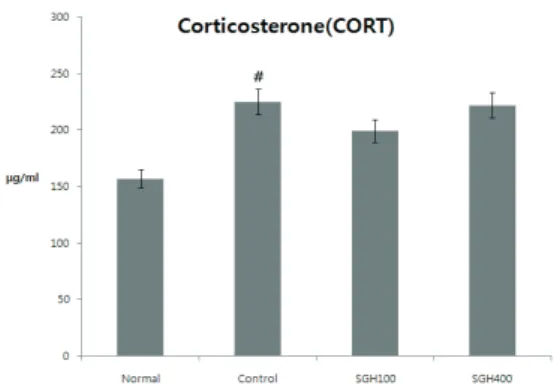
Fig. 7 shows that the serum levels of CORT were significantly different in comparisons among the groups. The serum levels of CORT were significantly increased in the control group compared to the normal group (p<0.05). However, after
administration with samul-tanggahyangbuja, there were no changes on the serum levels of CORT (Fig. 7).
Fig. 7. Effects of Samul-tanggahyangbuja on the Serum Levels of CORT.
The serum levels of CORT were increased in the control group compared to the normal group. After administration with SGH, the serum levels of CORT were slightly decreased.
The results of ELISA were analyzed by performing separate one-way ANOVA among the groups.
Each value represents the mean±S.E.M.
CORT : corticosterone
Normal : non-ovariectomized group
Control : after ovariectomized, exposed to immobilization stress group
SGH 100 : after ovariectomized, exposed to immobilization stress, samul-tanggahyangbuja 100 mg/kg treated group
SGH 400 : after ovariectomized, exposed to immobilization stress, samul-tanggahyangbuja 400 mg/kg treated group.
# : p<0.05 in comparison with Normal
2) Effects of samul-tanggahyangbuja
on the serum levels of IL-1
βFig. 8 shows that the serum levels of
IL-1
βwere significantly different in
comparisons among the groups. The LSD
test results indicated a significantly
increased the serum levels of IL-1
βin
the control group compared to the normal
group (p<0.01). Administration with samul
-tanggahyangbuja (100 mg and 400 mg)
significantly decreased the serum levels of IL-1β compared to the control group (p<0.05)(Fig. 8).
Fig. 8. Effects of Samul-tanggahyangbuja on the Serum Levels of IL-1
β.
In the LSD test results, Increased the serum levels of IL-1
β
in the control group were decreased in the SGH groups (100 mg, 400 mg). The results of ELISA were analyzed by performing separate one-way ANOVA among the groups. Each value represents the mean±S.E.M.Normal : non-ovariectomized group
Control : after ovariectomized, exposed to immobilization stress group
SGH 100 : after ovariectomized, exposed to immobilization stress, samul-tanggahyangbuja 100 mg/kg treated group
SGH 400 : after ovariectomized, exposed to immobilization stress, samul-tanggahyangbuja 400 mg/kg treated group.
## : p<0.01 in comparison with Normal
* : p<0.05 in comparison with Control
3) Effects of samul-tanggahyangbuja on the serum levels of TNF-
αFig. 9 shows that the serum levels of TNF-
αwere significantly different in comparisons among the groups. The LSD test results indicated a significantly increased the serum levels of TNF-
αin the control group compared to the normal group (p<0.05). Administration with samul -tanggahyangbuja (100 mg and 400 mg) significantly decreased the serum levels
of TNF-
αcompared to the control group (p<0.05)(Fig. 9).
Fig. 9. Effects of Samul-tanggahyangbuja on the Serum Levels of TNF-α.
The LSD test results indicated a significantly increased the serum levels of TNF-
α
in the control group compared to the normal group.Administration with SGH (100 mg and 400 mg) significantly decreased the serum levels of TNF-
α
compared to the control group.The results of ELISA were analyzed by performing separate one-way ANOVA among the groups. Each value represents the mean
±S.E.M.
Normal : non-ovariectomized group
Control : after ovariectomized, exposed to immobilization stress group
SGH 100 : after ovariectomized, exposed to immobilization stress, samul-tanggahyangbuja 100 mg/kg treated group
SGH 400 : after ovariectomized, exposed to immobilization stress, samul-tanggahyangbuja 400 mg/kg treated group.
# : p<0.05 in comparison with Normal
* : p<0.05 in comparison with Control
Ⅳ. Discussion
Menopause-related depression manifests as anxiousness, strong emotions, hypochondria, repentance, feelings of guilt and helplessness, behavior changes, and depressive delusion, as well as major depressive disorder symptom 16) .
There have been many studies concerning
the causes of menopausal depression.
Implicated phenomena include functional change due to the decay of the endocrine and germline, subsequent metabolic and biochemical disorders, and imbalance of the autonomic nervous system. Psychosocial factors have been more persuasively linked to acquired despair 17) .
Menopausal depression can accompany perception degradation 18) and estrogen deficit is often related with hypomnesia 19) . Samul-tang (四物湯) was first written on ≪Taepyeonghyeminhwajegugbang (太 平惠民和劑局方)≫ 20) as the prescription of ‘regulating nutrient and defense (調 益營衛), nourishing qi and blood (滋養 氣血)' effect. Samul-tang consists of 4 kinds of medical herbs: Rehmanniae Radix Preparat of ‘enrich yin and tonify blood (滋陰補血)', Paeoniae Radix of
‘tonify blood and pacify the liver (補血 平肝)', Angelicae Gigantis Radix of
‘tonify blood and activate blood (補血 活血)' and Cnidii Rhizoma of ‘activate blood and move qi (活血行氣)’ 7) .
In recent years, various studies have made progress on therapeutic value of Samul-tang such as anti-inflammatory effect 21,22) , vasodilatory effect 23) and the effect on the gynecology 24-27) .
The Cyperi Rhizoma (香附子) was dried and used, that is the perennial medical herbs and belongs to Cyperaceae, coco grass Cyperus rotundus L. rhizoma.
Cyperi Rhizoma has been used to effectively cure women's disease. According to oriental medicine theory, the effect of
Cyperi Rhizoma is ‘soothe the liver and regulate qi and releasing depression (疏 肝理氣解鬱), regulate menstruation and relieve pain (調經止痛)' 6) .
Look into the ≪Dongeuibogam (東醫 寶鑑)≫ 28) , samul-tang is used in gynecologic disease or blood deficiency (血虛) over 34.9%. It has been often used to accompany with Cyperi Rhizoma.
Also in the traditional oriental herbal medicine, Samul-tang and Cyperi Rhizoma were frequently used in women's disease, such as ‘menstrual irregularities (月經不 調)', ‘flooding and spotting (崩漏)', and
‘infertility (不姙)'. Samul-tang is related to the endocrine hormone secretion and adjustment related to a menstruation and ovulation of the female 7) .
Accordingly, in this paper, samul- tanggahyangbuja (SGH) was used. samul- tanggahyangbuja consists of Samul-tang and Cyperi Rhizoma. Stressed ovariectomized rats performed the Morris Water Maze Test (WMT) and Forced Swimming Test (FST), and social exploration was assessed in a behavior test. As well, sucrose intake was measured and measurements of blood serum corticosterone (CORT) and the change of interleukin-1β (IL-1β) and tumor necrosis factor-α (TNF-α) in blood samples were made.
Cognitive impairment of major depression
is most often encountered in the cognitive
domains of attention, memory, and
psychomotor speed. cognitive deficits and
psychomotor retardation are symptoms
of depression 29) . The WMT is one of the
most frequently used laboratory tools in behavioral neuroscience. This informs the affect that uncertainties influences on the cognition disorder 30) . Animals were trained to learn the location of a spatially fixed hidden platform in a Morris Water Maze. Starting from a random variable position, animals had to swim in a pool until they located a hidden platform with a cue located on its opposite site. Animal learns the location of a hidden platform relative to distal visual cues in a process known as spatial learning 31) .
FST in which Porsolt develops is the useful test coverage that it checks an effect and neurobiology mechanism of the various antidepressants 32) . Animals in the water were observed `immobility behavior, swimming behavior, climbing behavior'. The rat's immobility behavior shown in the FST has been interpreted as `behavioral despair' and has been suggested as an animal model of human depression 31,33) .
In the depression model, a reduced sucrose intake has been defined as one of the core symptoms of depression, anhedonia 34) . Stressed animals shows a lower level of sucrose intake, therefore we measured sucrose intake. Lastly, in order to measure the offensive movement and anxiety between animals, social behavior (grooming, rearing, sniffing, licking) was measured 31) .
The results of behavior test were as follows.
In the acquisition test of Morris Water Maze, 100 mg SGH group has taken less time than the control group on the 4th day (p<0.05). 400 mg SGH group has taken significantly less time than control group and 100 mg SGH group on the 3rd, 4th day (p<0.05 on the 3rd day ; p<0.01 on the 4th day).
The acquisition time of SGH treated groups were shortened in comparison with the control group. Therefore administration of samul-tanggahyangbuja reversed memory deficits induced by repeated stress on the ovariectomized rats.
After removing a platform, retention test was performed. The time spent around the platform among the groups differed. The control group spent less time around the platform than normal group. The stress impaired spatial memory capability seriously. But SGH treatment had no effect in this test.
In FST, immobility time of 400 mg SGH group was remarkably shortened in comparison with the control group (p<0.05). The result confirm the ability of SGH to prevent ovariectomized rats from displaying forgetfulness in this test.
The consequences of exposure to anxiety
upon stress were measured using the
sucrose intake test. 400 mg SGH group
remarkably increased amount of sucrose
intake, compared with the control group
(p<0.01). In social interaction measurement,
social behavior decreased in the control
group and remarkably increased in 400
mg SGH, compared with the control
group (p<0.01).
These behavioral studies suggest that samul-tanggahyangbuja has the effects that would treat menopausal depression and increase the ability of learning. But it was not dose-dependently and there was no effect in the spatial memory ability test.
Corticosterone (CORT) sensitively reacts to the stress and it's secretion is increased in depressive condition. It is often used in an inspection 35,36) .
IL-1
βis representative pro-inflammatory cytokine. Also, it is one of the most critical molecules involved in neuroendocrine and neurobehavioral stress responses.
Specifically ample evidence from both human and experimental animal studies demonstrates that many types of stressors, including immunological, physiological and psychological challenges, induce the production of IL-1
β, both in the periphery and within the brain 37) .
Recently, it is clarified that the IL-1β and TNF-
αplay the role of being important in the process of the complicated recognition of the molecular orientation. Recognition processes related to especially, these cytokines are known that there is the close relation in the power generation and pathological process of the disease, that is a neuropsychopathy such as the major depression and dementia 38) .
CORT, IL-1
βand TNF-
αof the experimental group and the control group were measured. And we observed the effect of SGH to immunity and
depression.
The levels of CORT in the control group were significantly increased in comparison with the normal (p<0.05), and those of the SGH groups were slightly decreased in comparison with the control group. but it was not statistically significant.
Samul-tanggahyangbuja reduced serum IL-1
βinduced by repeated stress. The levels of IL-1β in the control group were significantly increased in comparison with the normal (p<0.01), and those of the SGH groups (100 mg, 400 mg) were significantly decreased in comparison with the control (p<0.05).
The serum level of TNF-α remarkably was increased in the control group compared to the normal group (p<0.05), and those of the SGH groups were decreased in comparison with the control (p<0.05).
In menopausal depression model, the volume of IL-1β and TNF-α after samul-tanggahyangbuja was administrated were significantly changed in serum.
The results confirm antidepressant effect of samul-tanggahyangbuja.
But retention trial in WMT, the results could not show whether samul- tanggahyangbuja had effect on the spatial memory capability damage due to the stress or not. There was no effect that samul-tanggahyangbuja reduced CORT level induced by repeated stress.
These results demonstrated that samul
-tanggahyangbuja may be effective for
treatment of depression and improving the impairment of learning by stress. So these results suggest that samul- tanggahyangbuja can be useful for treating menopausal depression.
Ⅴ. Conclusions
In order to research into the effects of samul-tanggahyangbuja on repetitive stressed ovariectomized rat, present study was performed the measure of Morris Water Maze Test (WMT), Forced Swimming Test (FST), sucrose intake and social exploration and the measure of CORT, IL-1β and TNF-α of serum and investigated the following results.
1. In the Morris Water Maze Test, rats treated with 100 mg SGH mastered the maze in a shorter time on the 4th day in comparison with the control group (p<0.05), and rats medicated with 400 mg SGH mastered the maze more quickly (p<0.05 on the 3rd day
; p<0.01 on the 4th day, as compared to control).
2. Immobility time in the FST was significantly decreased in rats receiving 400 mg SGH compared with the control group (p<0.05).
3. Sucrose intake and active social behavior of rats receiving 400 mg SGH were markedly increased in comparison with the control group (p<0.01).
4. CORT measurements revealed decreased CORT level after treatment with SGH.
But it was not statistically significant.
5. Treatment with either dose of SGH significantly reduced IL-1β and TNF-α (p<0.05).
In conclusion, the present results demonstrated that samul-tanggahyangbuja effectively reduced patho-physiological depression-like responses. These results suggest that samul-tanggahyangbuja may be useful for treatments of menopausal depression.
□ 투 고 일 : 2013년 7월 15일
□ 심 사 일 : 2013년 8월 7일
□ 게재확정일 : 2013년 8월 19일
국문초록