Isolation and Synthesis of Tryptamine Derivatives Bull. Korean Chem. Soc. 2003, Vol. 24, No. 5 623
Isolation and Synthesis of Tryptamine Derivatives from a Symbiotic Bacterium Xenorhabdus nematophilus PC
Seunguk Paik,* Myung Kwang Park, Seong Hoon Jhun, Heai Ku Park, Chun Soo Lee, Bum Rae Cho, Hong Sik Byun, Seok Burm Choe, and Seong Il Suh†
Faculty of Chemical & Materials Engineering, Keimyung University, Daegu 704-701, Korea
†Department of Microbiology, School of Medicine, Keimyung University, Daegu 704-701, Korea Received March 3, 2003
Nematophin and its analog incorporating tryptamine unit have been isolated and characterized from strain XR- PC of a symbiotic bacterium Xenorhabdus nematophilus, which was newly isolated from Korean entomopathogenic nematodes. The stereoselective synthesis of these compounds was accomplished, and the relative configurations were determined. Nematophin exhibited potent antibacterial activities over several strains of methicillin-resistant S. aureus (MRSA) comparable to those of vancomycin.
Key Words : Xenorhabdus nematophilus, Staphylococcus aureus, Nematophin, Tryptamine, L-Isoleucine
Introduction
In recent years, there has been much interest in bacteria of the genus Xenorhabdus since they were successfully used in the biological control of pest insects and a search for biologically active natural products.1 Xenorhabdus spp. are symbiotically associated with soil-dwelling, entomopatho- genic nematodes of the genus Steinernema2 and has shown to be a rich source of several types of secondary metabolites exhibiting antibacterial, antineoplastic and/or antifungal activities.3 The compounds previously reported from the bacterial genus Xenorhabdus include indole derivatives,4 xenorhabdins,5 hydroxystilbenes,6 water-soluble xenocou- macins7 and anthraquinones.6
In the course of our studies on the secondary metabolites from five strains of Xenorhabdus nematophilus symbiotic to Korean entompathogenic nematodes of the genus Steinernema, we recently described the isolation and characterization of the unusual cytotoxic phenethylamides from the XR-NC strain of Xenorhabdus nematophilus.8 Continued investigation on bioactive constituents among microbial metabolites from another XR-PC strain of X. nematophilus have led to the finding of nematophin4 and its analog bearing indole moiety as the major constituents. We describe herein the isolation, bioactivity and synthesis of the indole derivatives from an insect-pathogenic bacterium newly isolated from the Korean entomopathogenic nematodes.
Results and Discussion
A symbiotic bacterium was isolated from entomopathogenic nematode Steinernema carpocapsae obtained from a soil sample collected at Pocheon located in the middle of the Korean Peninsula, and identified as Xenorhabdus nemato- philus strain XR-PC.9 The cell-free broth of the mass cultured X. nematophilus was extracted with ethyl acetate.
The organic extract was subjected to flash chromatography on C-18, and the fractions eluted with 50% and 75% MeOH
were separated by reverse-phase HPLC to afford two antibiotic indole derivatives 1 and 2a.
Gross Structure. Compound 1, the major constituent of the organic extract, had a molecular formular of C16H20N2O2
as established by HREIMS and NMR spectral data. The 1H NMR spectrum of 1 showed six downfield protons [δ 8.07 (1H, br s, NH), 7.61 (1H, d, J = 8.0 Hz), 7.38 (1H, d, J = 8.4 Hz), 7.22 (1H, td, J = 8.0, 1.2 Hz), 7.13 (1H, td, J = 8.0, 1.2 Hz), and 7.04 (1H, d, J = 2.4 Hz)], reminiscent of a 3- substituted indole, which was supported by 13C-NMR and COSY data. The presence of two adjacent methylene signals [δ 3.64 (2H, q, J = 6.8 Hz) and 3.03 (2H, t, J = 6.8 Hz)], two methyl signals [δ 1.08 (3H, d, J = 6.8 Hz) and 0.88 (3H, t, J
= 7.6 Hz)], a multiplet methine signal [δ 3.50 (1H, m)] and one methylene signal [δ 1.72 (1H, m) and 1.39 (1H, m)] was observed in the NMR spectra; the COSY data indicated sec- butyl and aminoethyl (NH-CH2-CH2) moieties, the latter of which was directly linked to the indole ring at the position 3.
The inspection of the 13C NMR and DEPT spectra revealed the presence of two carbonyl carbons (δ 202.3 and 160.0) which were assigned as skeletal carbons of α-ketoamide by COSY and HMBC spectra. These data, coupled with com- parison of data from the literature, were in good agreement with those reported for nematophin.4 Thus, compound 1 was established as 3-indoleethyl (3'-methyl-2'-oxo)pentanamide (nematophin).
Compound 2, a minor component of the organic extract, proved to had a molecular formular of C16H22N2O2 as deduced from HREIMS and NMR spectral data. The 1H NMR spectrum of 2 were very similar to that of 1 except for
624 Bull. Korean Chem. Soc. 2003, Vol. 24, No. 5 Seunguk Paik et al.
an additional methine signal [δ 3.93 (1H, d, J = 3.2 Hz, H- 2')], which was directly coupled to another methine proton [δ 1.82 (1H, m, H-3')]. The 13C NMR spectrum revealed only one carbonyl carbon (δ 173.0), which suggested that α- carbonyl group of α-ketoamide functionality was converted to a carbon bearing a hydroxyl group (δ 2.35, 1H). These data, coupled with comparison of those from the literature, established the structure of compound 2 as the known nematophin derivative, N-(indol-3-ylethyl)-2'-hydroxy-3'- methylpentanamide.4b Li et al. proposed that the stereo- chemistry of the two asymmetric carbons in 2 was 2'R,3'S on the bases of the 1H NMR chemical shifts10 of H-3' and H-4' and L-isoleucine as a possible biosynthetic precursor.
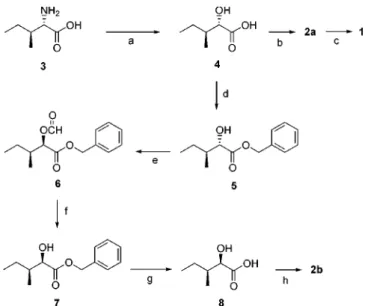
Synthesis. A stereoselective synthesis of two diastereo- mers of 2 was carried out to establish the relative stereo- chemistry of the asymmetric carbons and to evaluate the biological activities on these synthetic derivatives. Our synthetic strategy using L-isoleucine as a chiral template was straightforward to prepare the diastereomers with anti- or syn-relative configuration (Scheme 1). L-Isoleucine was widely used as a starting material in natural product synthe- sis and its conversion to the corresponding 2-hydroxy- isoleucic acid with retention of configuration has been well established in literature.11
The reaction of (2S,3S)-isoleucine (4, L-isoleucine) with sodium nitrite in 0.5 M H2SO4 gave a diastereomeric mixture of the corresponding (2S,3S)-hydroxypentanoic acid 4, which was crystallized out from petroleum ether and ether to yield an optically pure white solid of 4 in 84% yield.
Coupling of tryptamine with the unprotected hydroxy acid 4 was effected by means of DEPC method12 (DEPC/Et3N/
DMF) to give 3-indolylethyl amide 2a in 65% yield. The synthetic (2'S,3'S)-indolylethyl amide 2a was identical in all
respects (1H and 13C NMR, HPLC tR) with the natural product. This result demonstrated that the relative configu- ration of C'-2 and C'-3 in the natural indolylethyl amide 2 ought to be anti (2'S*,3'S*) which was the opposite from 2'R,3'S conjectured by Lee and coworkers.4 Oxidation of 2a with Dess-Martin reagent (12-I-5)13 finally afforded keto- amide 1 in 48% yield; the PDC oxidation of 2a in DMF resulted in a low yield of 1 (< 20%).
The synthesis of another diastereomeric 2b with 2'S,3'S was accomplished by reaction of Mitsunobu inversion14 of the hydroxylic carbon of 4 via formate. Thus, benzyl ester 5 was prepared by alkylation of 4 with benzyl bromide under phase-transfer condition (aliquat 336, 25 oC, 90%). In other to obtain (2R,3S)-isomer, a Mitsunobu reaction was carried out with formic acid in the presence of triphenylphosphine and diisopropyl azodicarboxylate to furnish the desired (2R, 3S)-isomer 6 in 48% yield after chromatographic separation on silica gel. Ammonolysis of the formyl group in 6 with 25% NH3 in THFselectively gave 7 in 83% yield. Catalytic hydrogenation of 7 in the presence of Pd/C afforded the desired (2R,3S)-isomer 8 (91%), which was used in the next step without further purification. The 1H NMR indicated that 8 was diasteromerically pure to the limits of detection (> 95%). Coupling of tryptamine with 8 by DEPC method12 (DEPC/Et3N/DMF) gave (2'R,3'S)-indolylethyl amide 2b (62%), which showed different 1H and 13C NMR spectra from those of the natural indolylethyl amide. This result again indicated that the relative configuration of C'-2 and C'- 3 in the natural indolyl amide 2 was anti (2'S*,3'S*); how- ever, we were not able to establish its absolute stereo- chemistry due to very limited amount of the compound obtained naturally. It is suggested that the structure of 2 should be (2'S,3'S)-N-(indol-3-ylethyl)-2'-hydroxy-3'-methyl- pentanamide (2a) based on the levorotatory property4b of the synthetic amide 2a ( −3.22o, c 1.55, CHCl3) and a postulated biosynthesis derived from L-isoleucine as a hydroxy acid precursor.4
Biological Activity. The MTT bioassay15 of 1 and 2 exhibited no significant cytotoxicities against human cancer cell lines of gastric adenocarcinoma, cervical adenocarci- noma, hepatoblastoma, colon adenocarcinoma, and lung adenocarcinoma. However, nematophin 1 showed highly selective activity against the Gram positive bacterium Staphylococcus aureus as reported by Li, et al.4a; no considerable activity of compounds 2a and 2b against S.aureus was observed.In addition,compound 1 exhibited
α [ ]D Scheme 1. Reagents and conditions: (a) NaNO2, 0.5 M H2SO4, 25
oC, 24 h, 84% (b) DEPC, tryptamine, TEA, DMF, 0 oC to 25 oC, 24 h, 65% (c) Periodinane, CH2Cl2, 25 oC, 1 h, 48% (d) NaHCO3, H2O, aliquat336, CH2Cl2, benzyl bromide, 25 oC, 2 day, 90% (e) formic acid, PPh3, DIAD, THF, 0-25 oC, 2 h, 48% (f) NH4OH, THF, 25 oC, 2 h, 83% (g) 10% Pd/C, MeOH, 25 oC, 4 h, 91% (h) DEPC, tryptamine, TEA, DMF, 0-25 oC, 24 h, 62%.
Table 1. Minimum Inhibitory Concentration (µg/mL) of 1 and 2a against selected bacterial species
Compound
bacterium 1 2a vancomycin
Escherichia coli 078
Pseudomonas aeruginosa 1592E Salmonella typhimurium Streptococcus pyogenes 308A Staphylococcus aureus 285 Staphylococcus aureus 809
> 100.000
> 100.000
> 100.000 50.000 0.781 0.391
> 100.0
> 100.0
> 100.0
> 100.0
> 100.0
> 100.0
100.000 100.000 100.000 0.391 0.781 0.781
Isolation and Synthesis of Tryptamine Derivatives Bull. Korean Chem. Soc. 2003, Vol. 24, No. 5 625
potent activities over several strains of methicillin-resistant S.aureus (MRSA), which were comparable to vancomycin.
Experimental Section
General Experimental Procedures. MS spectra (70 eV) were obtained with a Jeol JMS-700 instrument. 1H and 13C NMR spectra were recorded on a Bruker DRX-400 using TMS as internal references. HPLC was conducted with a Rainin Dynamax SD-200 instrument equipped with a Rainin Dynamax UV-C detector. Optical rotations were obtained with an ATAGO POLAL-L polarimeter. Analytical TLC was performed using Merck silica gel 60 PF254. Dimethylform- amide was distilled from calcium sulfate at 40 Torr and was stored over 4-Ao molecular sieves. Unless otherwise noted, materials were obtained from commercial suppliers and used without further purification.
Extraction and Isolation. The cell-free broth (6 L, pH = 8.2) of the cultured XR-PC strain of X. nematophilus was neutralized with conc. HCl and extracted with ethyl acetate (1 L × 3). After evaporation of the solvent, the crude extract (1.6 g) was flash chromatographed on a C-18column (40 g of YMC-GEL, ODS, 120A) with 3 : 1, 1 : 1, 1 : 3 H2O/
MeOH mixtures, MeOH, and ethyl acetate to give five fractions (100 mL each). Fraction 3 was concentrated and then subjected to HPLC (Dynamax C-18, 5 µ, 21 × 250 mm, 5 mL/min; UV detection at 254 nm) using 70% MeOH as an eluent to give 1 (ca. 10 mg). Fraction 2 was concentrated and then subjected to HPLC under the same condition above.
The fractions containing compounds 1 and 2a was further purified by semi-preparative reversed-phase HPLC (Dynamax C-18, 2 µ, 250×10 mm, 5 mL/min; UV detection at 254 nm) using an isocratic system of 70% aqueous MeOH to afford 1 (ca. 5 mg, tR 10.2 min) and 2a (ca. 5 mg, tR 6.5 min).
Nematophin (1): IR (KBr) λmax 3450, 3400, 2950, 1700, 1690, 1520 cm−1; 1H NMR (CDCl3, 400 MHz) δ 8.07 (1H, br s, NH), 7.61 (1H, d, J = 8.0 Hz, H-4), 7.38 (1H, d, J = 8.4 Hz, H-7), 7.22 (1H, td, J = 8.0, 1.2 Hz, H-5), 7.13 (1H, td, J = 8.0, 1.2Hz, H-6), 7.04 (1H d J = 2.4 Hz, H-2), 7.06 (1H, br s, NH), 3.64 (2H, q, J = 6.8 Hz, H-11), 3.50 (1H, m, H-3'), 3.03 (2H, t, J = 6.8 Hz, H-10), 1.72 (1H, m, H-4'), 1.39 (1H, m, H-4'), 1.08 (3H, d, J = 6.8 Hz, Me-3'), 0.88 (3H, t, J = 7.6 Hz, H-5'); 13C NMR (CDCl3, 100 MHz) δ 202.3 (C-2'), 160.0 (C-1'), 136.4 (C-9), 127.1 (C-8), 122.3 (C-5), 122.0 (C-2), 119.6 (C-6), 118.6 (C-4), 112.5 (C-3), 111.2 (C-7), 40.3 (C-3'), 39.5 (C- 10), 25.4 (C-11), 25.1 (C-4'), 15.1 (Me-3'), 11.5 (C-5');
HREIMS 272.1522 (calcd for C16H20N2O2 272.1525).
(2'S,3'S)-N-(Indol-3-ylethyl)-2'-hydroxy-3'-methylpentan- amide (2a): IR (KBr) λmax 3420, 3350, 2950, 1630, 1540 cm−1; 1H NMR (CDCl3, 400 MHz) δ 8.04 (1H, br s, NH), 7.62 (1H, d, J = 8.0 Hz, H-4), 7.38 (1H, d, J = 8.0 Hz, H-7), 7.21 (1H, td, J = 8.0, 1.2 Hz, H-5), 7.13 (1H, td, J = 8.0, 0.8 Hz, H-6), 7.04 (1H, d, J = 2.0 Hz, H-2), 6.41 (1H, br s, NH), 3.93 (1H, d, J = 2.8 Hz, H-2'), 3.65 (2H, q, J = 6.4 Hz, H- 11), 3.00 (2H, m, H-10), 2.35 (1H, d, J = 5.6 Hz, OH), 1.82 (1H, m, H-3'), 1.35 (1H, m, H-4'), 1.12 (1H, m, H-4'), 0.95 (3H, d, J = 6.8 Hz, Me-3'), 0.86 (3H, t, J = 7.2 Hz, H-5'); 13C
NMR (CDCl3, 100 MHz) δ 173.0 (C-1'), 136.5 (C-9), 127.4 (C-8), 122.3 (C-5), 122.0 (C-2), 119.5 (C-6), 118.7 (C-4), 113.1 (C-3), 111.3 (C-7), 76.4 (C-2'), 39.3 (C-11), 38.8 (C- 3'), 25.4 (C-10), 23.0 (C-4'), 15.6 (Me-3'), 11.8 (C-5');
HREIMS 274.1679 (calcd for C16H22N2O2 274.1681).
(2S,3S)-2-Hydroxy-3-methylpentanoic Acid (4). To a cooled (0 oC) solution of L-isoleucine (9.8 g, 75 mmol) in 0.5 M H2SO4 (300 mL) was added NaNO2 (31 g, 450 mmol) over a period of 1 h. After 1 h, the mixture was allowed to warm to 25 oC and then stirred for 24 h. The resulting solution was extracted with ether (3×50 mL). The combined organic extracts were dried over anhydrous Na2SO4, filtered, and concentrated in vacuo to give a yellow oil, which was crystallized from ether and petroleum ether to afford 5 (8.3 g, 84%) as a white solid; mp 54-57 oC; IR (KBr) λmax 3450, 1700, 1430 cm−1; 1H NMR (CDCl3, 100 MHz) δ 4.19 (1H, d, J = 3.6 Hz), 1.89 (1H, m), 1.44 (1H, m), 1.29 (1H, m), 1.03 (3H, d, J = 7.2 Hz), 0.93 (3H, t, J = 7.6 Hz); 13C NMR (CDCl3, 400 MHz) δ 179.5, 74.61, 38.8, 23.6, 15.3, 11.7;
28.75 (c 4, CHCl3).
(2S,3S)-2-Hydroxy-3-methylpentanoic Acid Benzyl Ester (5). To a cooled (0 oC) solution of 4 (1 g, 7.57 mmol), NaHCO3 (0.64 g, 7.57 mmol), and aliquat 336 (3.06 g, 7.57 mmol) in H2O (10 mL) was added dropwise a solution of benzyl bromide (0.9 mL, 7.57 mmol) in CH2Cl2 (10 mL) over a period of 30 min. The mixture was allowed to warm to 25 oC and then stirred for 72 h. The mixture was extracted with CH2Cl2 (3×10 mL), dried over anhydrous Na2SO4, filtered, and concentrated in vacuo to afford a yellow oil, which was purified by silica gel chromatography (4 : 1 Hex/
EtOAc) to afford 1.5 g (90%) of 5 as a colorless oil; 1H NMR (CDCl3, 400 MHz) δ 7.35 (5H, m), 5.20 (2H, ABq, J
= 12 Hz), 4.11 (1H, m), 3.03 (OH, d, J = 6.0 Hz), 1.82 (1H, m), 1.34 (1H, m), 1.12 (1H, m), 0.95 (3H, d, J = 6.8 Hz), 0.86 (3H, t, J = 7.6 Hz); 13C NMR (CDCl3, 400 MHz) δ 174.7, 135.1, 128.5, 128.4, 128.3, 74.7, 67.0, 39.0, 23.6, 15.3, 11.6.
(2R,3S)-2-Formyloxy-3-methylpentanoic Acid Benzyl Ester (6). To a cooled (0 oC) solution of 4 (0.70 g, 3.14 mmol) in anhydrous THF (30 mL) was added triphenyl phosphine (0.99 g, 3.77 mmol) and diisopropyl azodicarbox- ylate (0.63 mL, 3.20 mmol). After 5 min at 0 oC, 0.24 mL (6.34 mmol) of anhydrous formic acid was added over 5 min, and the mixture was maintained for 10 h. To the reaction mixture was added sequentially another portion of triphenyl phosphine (1.89 g), diisopropyl azodicarboxylate (1.55 mL) and formic acid (0.42 g) at 0 oC. The mixture was stirred at 0 oC for 12 h, allowed to slowly warm to 25 oC over an additional 10 h and then quenched with water. The mixture was extracted with EtOAc (3×100 mL), washed with saturated aqueous NaCl (50 mL), dried over anhydrous MgSO4, filtered, and concentrated in vacuo. The isolated yellow oil was chromatographed on silica gel (10 : 1 hexane/
ethyl acetate) to afford 0.38 g (48%) of 6 as a colorless oil;
1H NMR (CDCl3, 400 MHz) δ 8.14 (1H, s), 7.40-7.26 (5H, m), 5.21 (1H, d, J = 3.2 Hz), 5.20 (2H, ABq, J = 12.4 Hz), 2.01 (1H, m), 1.44 (1H, m), 1.29 (1H, m), 0.92 (3H, d, J = 6.8 Hz), 0.91 (3H, t, J = 7.2 Hz); 13C NMR (CDCl3, 100
α [ ]D
626 Bull. Korean Chem. Soc. 2003, Vol. 24, No. 5 Seunguk Paik et al.
MHz) δ 169.6, 160.8, 135.6, 129.0, 128.9, 128.7, 74.6, 67.5, 36.9, 26.2, 14.6, 11.9.
(2R,3S)-2-Hydroxy-3-methylpentanoic Acid Benzyl Ester (7). To a solution of 6 (150 mg, 0.60 mmol) in THF (3 mL) was added 0.7 mL of ammonia water at 25 oC. The mixture was stirred for 5 h and extracted with EtOAc (3 × 10 mL). The organic extracts were washed with saturated aqueous NaCl (50 mL), dried over anhydrous MgSO4, filtered, and concentrated in vacuo to afford a yellow oil, which was then purified by silica gel chromatography (9 : 1 Hex/EtOAc) to afford 0.11 g (83%) of 7 as a colorless oil; 1H NMR (CDCl3, 400 MHz) δ 7.34-7.42 (5H, m), 5.24 (2H, ABq, J = 12 Hz), 4.27 (1H, s), 3.03 (1H, s, OH), 1.87 (1H, m), 1.57 (1H, m), 1.34 (1H, m), 0.97 (3H, t, J = 7.6 Hz), 0.83 (3H, d, J = 7.2 Hz); 13C NMR (CDCl3, 100 MHz) δ 175.7, 135.6, 129.1, 129.0, 128.8, 73.4, 67.7, 39.0, 26.4, 13.5, 12.2;
HREIMS 222.1256 (calcd for C13H18O3 222.1256).
(2R,3S)-2-Hydroxy-3-methylpentanoic Acid (8). To a solution of 7 (130 mg, 0.59 mmol) in MeOH (5 mL) was added a catalytic amount of 10% Pd/C, and the mixture was stirred under H2 at 25 oC for 2 h. The mixture was filtered and washed with ethanol. The filtrate was concentrated to dryness in vacuo to afford 70 mg (91%) of 8 as a white solid, pure by 1H NMR analysis, which was used without further purification. 1H NMR (CDCl3, 400 MHz) δ 4.25 (1H, s), 1.90 (1H, m), 1.54 (1H, m), 1.35 (1H, m), 0.96 (3H, t, J = 7.2 Hz), 0.88 (3H, d, J = 6.4 Hz).
Synthesis of (2'S,3'S)-N-(Indol-3-ylethyl)-2'-hydroxy- 3'-methylpentanamide (2a). To a cooled (0 oC) solution of 4 (0.5 g, 3.78 mmol) in anhydrous DMF (5 mL) was added tryptamine (0.73 g, 4.54 mmol), diethyl cyanophosphate (DEPC, 0.69 mL, 4.54 mmol) and triethyl amine (0.63 mL, 4.54 mmol). The reaction mixture was stirred for 2 h, allowed to warm to 25 oC and then maintained at this temperature for an additional 24 h. Water (10 mL) was added, followed by extraction with ethyl acetate (3×10 mL). The organic extracts were dried over anhydrous Na2SO4, filtered, and concentrated in vacuo to afford 0.75 g of a yellow residue which was purified by silica gel chromatography (50 : 1 CHCl3/MeOH) to yield 2a (0.68 g, 65%) as a white solid;
mp 118-120 oC; −3.22o (c 1.55, CHCl3). 1H and 13C NMR data were identical to those of the natural product.
(2'R,3'S)-N-(Indol-3-ylethyl)-2'-hydroxy-3'-methylpentan- amide (2b). To a cooled (0 oC) solution of 8 (100 mg, 0.76 mmol) in anhydrous DMF (3 mL) was added tryptamine (149 mg, 0.91 mmol), diethyl cyanophosphate (DEPC, 0.16 mL, 0.91 mmol) and triethyl amine (0.13 mL, 0.91 mmol).
The reaction mixture was stirred for 2 h, allowed to warm to 25 oC and then maintained at this temperature for 24 h.
Water (5 mL) was added, followed by extraction with ethyl acetate (3×5 mL). The combined organic extracts were dried over anhydrous Na2SO4, filtered, and concentrated in vacuo to afford 0.15 g of a yellow residue which was purified by silica gel chromatography (50 : 1 CHCl3/MeOH) to yield 2b (0.13 g, 62%) as a white solid; mp 137-140 oC;
1H NMR (CDCl3, 400 MHz) δ 8.17 (1H, br s, NH), 7.61 (1H, d, J = 8.0 Hz), 7.36 (1H, d, J = 8.0 Hz), 7.20 (1H, td, J
= 8.0, 1.2 Hz), 7.12 (1H, td, J = 8.0, 1.2 Hz), 7.01 (1H, d, J = 2.0 Hz), 6.56 (1H, br s, NH), 4.02 (1H, t, J = 2.8 Hz), 3.63 (2H, q, J = 6.4 Hz), 2.98 (2H, m), 2.60 (1H, d, J = 5.6 Hz, OH), 1.83 (1H, m), 1.42 (1H, m), 1.28 (1H, m), 0.91 (3H, t, J
= 7.2 Hz), 0.77 (3H, d, J = 7.2 Hz); 13C NMR (CDCl3, 400 MHz) δ 173.0, 136.5, 127.4, 122.3, 122.0, 119.6, 118.7, 113.1, 111.3, 76.4, 39.4, 38.9, 25.5, 23.2, 15.5, 11.8; HRMS 274.1681 (calcd for C16H22N2O2 274.1681); +15.1o (c 0.33, MeOH).
Nematophin (1): To a solution of 2 (100 mg, 0.36 mmol) in CH2Cl2 (5 mL) was added 200 mg (0.47 mmol) of Dess- Martin reagent (periodinane). The mixture was stirred for 20 min at 25 oC. The solution was filtered through Celite, and the solvent was removed under reduced pressure. The residue was subjected to silica gel chromatography with 2 : 1 EtOAc/CHCl3 to give 48 mg (48%) of 1 as a white solid; mp 72-75 oC. 1H and 13C NMR data were identical to those of the natural product.
Acknowledgment. The present research has been conducted by the attached research institute Research Grant of Keimyung University in 2000. This work was supported in part by Ministry of Science & Technology (MOST) and the Korea Science and Engineering Foundation (KOSEF) through the Center for Traditional Microorganism Resources (TMR) at Keimyung University.
References and Notes
1. (a) Kaya, H. K.; Gauger, R. Ann. Rev. Entomol. 1993, 38, 261- 206. (a) Akhurst, R. J. J. Gen. Microbiol. 1982, 128, 3061-3065.
2. (a) Paul, V. J.; Frautschy, S.; Fenical, W.; Nealson, K. H. J. J.
Chem. Ecol. 1981, 7, 589-597. (b) Forst, S.; Nealson, K.
Microbiol. Rev. 1996, 60, 21-43.
3. (a) Maxwell, P. W.; Chen, G.; Webster, J. M.; Dunphy, G. B. Appl.
Environ. Microbiol. 1994, 60, 715-721. (b) Chen, G.; Dunphy, G.
B.; Webster, J. M. Biol. Control 1994, 4, 157-162.
4. (a) Li, J.; Chen, G.; Webster, J. M. Can. J. Microbiol. 1997, 43, 770-773. (b) Li, J.; Chen, G.; Webster, J. M. J. Nat. Prod. 1996, 59, 1157-1158. (c) Paul, V. J.; Frautschy, S.; Fenical, W.; Nealson, K. H. J. Chem. Ecol. 1981, 7, 589-597.
5. (a) Li, J.; Chen, G.; Webster, J. M.; Czyzewska, E. J. Nat. Prod.
1995, 58, 1081-1086. (b) McInerney, B. V.; Gregson, R. P.; Lacey, M. J.; Akhurst, R. J.; Lyons, G. R.; Rhodes, S. H.; Smith, D. R.;
Engelhardt, L. M.; White, A. H. J. Nat. Prod. 1991, 54, 774-784.
6. Richardson, W. H.; Schmidt, T. M.; Nealson, K. H. Appl. Environ.
Microbiol. 1988, 54, 1602-1605.
7. McInerney, B. V.; Taylor, W. C.; Lacey, M. J.; Akhurst, R. J.;
Gregson, R. P. J. Nat. Prod. 1991, 54, 785-795.
8. Paik, S.; Park, Y. H.; Suh, S. I.; Kim, H. S.; Lee, I. S.; Park, M. K.;
Lee, C. S.; Park, S. H. Bull. Korean Chem. Soc. 2001, 22, 372-374.
9. Park, S. H.; Yu, Y. S. Biotechnol. and Bioprocee Eng. 1999, 4, 12-16.
10. Crombie, L.; Horsham, M. A.; Jarrett, S. R. M. J. Chem. Soc., Perkin Trans. 1 1991, 1511-1524.
11. (a) Irie, H.; Matsumoto, K.; Kitagawa, T.; Zhang, Y.; Ueno, T.;
Nakashima, T.; Fukami, H. Chem. Pharm. Bull. 1987, 35, 2598- 2601. (b) Degerbeck, F.; Fransson, B.; Grehn, L.; Ragnarsson, U.
J. Chem. Soc. Perkin Trans. 1 1993, 11-14. (c) Schmidt, U.;
Kroner, M.; Griesser, H. Synthesis 1989, 832-835.
12. Yamada, S.; Kasai, Y.; Shioriri, T. Tetrahedron Lett. 1973, 1595.
13. Dess, D. B.; Martin, J. C. Org. Chem. 1983, 48, 4155-4156.
14. Mitsunobu, O. Synthesis 1981, 1-28.
15. Twentyman, P.; Luscombe, M. Br. J. Cancer 1987, 56, 279-285.
α [ ]D
α [ ]D