* To whom correspondence should be addressed.
E-mail: [email protected] 청정생산공정기술
Comparative Study of NIR-based Prediction Methods for Biomass Weight Loss Profiles
Hyun-Woo Cho, and J. Jay Liu
†*
Department of Industrial and Management Engineering, Daegu University 201 Daegudae-ro, Jillyang, Gyeongsan, Gyeongbuk, 712-714, Republic of Korea
†
Department of Chemical Engineering, Pukyong National University 365 Sinseon-ro, Nam-gu, Busan, 608-739, Republic of Korea
(Received for review February 3, 2012; Revision received March 2, 2012; Accepted March 2, 2012)
요 약
바이오매스가 가진 재생 가능성과 환경적인 장점으로 인해 바이오매스는 바이오에너지와 다른 제품의 주요 원료가 되었다.
바이오매스의 중요 성질을 예측하기 위해 분광학 데이터를 이용하는 연구를 포함한 많은 연구가 수행되었는데 근적외선 분 광학은 빠르고 신뢰성 있는 결과를 저비용으로 제공하는 비파괴 방법이기 때문에 널리 사용되었다. 이 연구에서는 서로 다 른 여섯가지의 목질계 바이오매스의 근적외선 스펙트럼 데이터를 기반으로 질량 손실 프로파일을 예측하는 다변량 통계기 법을 개발하였으며, 상관없는 잡음을 제거하고 근적외선 데이터를 잘 설명하는 파장대역을 선택하기 위해 웨이블릿 분석이 사용되었다. 실제 근적외선 데이터를 가지고 개발된 방법을 예시하였는데 이 때 여러가지 예측모델이 예측 성능을 기준으 로 평가되었고 적절한 근적외선 스펙트럼 전처리법의 장점 또한 설명되었다. 웨이블릿으로 압축된 근적외선 스펙트럼을 이 용한 부분최소자승법 예측모델이 가장 좋은 성능을 보였으며 개발된 방법은 바이오매스의 빠른 분석에 쉽게 적용될 수 있 음 또한 증명되었다.
주제어 : 바이오연료, 바이오매스, 근적외선, 웨이블릿 분석, 부분최소자승법
Abstract : Biomass has become a major feedstock for bioenergy and other bio-based products because of its renewability and environmental benefits. Various researches have been done in the prediction of crucial characteristics of biomass, including the active utilization of spectroscopy data. Near infrared (NIR) spectroscopy has been widely used because of its attractive features:
it’s non-destructive and cost-effective producing fast and reliable analysis results. This work developed the multivariate statistical scheme for predicting weight loss profiles based on the utilization of NIR spectra data measured for six lignocellulosic biomass types. Wavelet analysis was used as a compression tool to suppress irrelevant noise and to select features or wavelengths that be- tter explain NIR data. The developed scheme was demonstrated using real NIR data sets, in which different prediction models were evaluated in terms of prediction performance. In addition, the benefits of using right pretreatment of NIR spectra were also given.
In our case, it turned out that compression of high-dimensional NIR spectra by wavelet and then PLS modeling yielded more re- liable prediction results without handling full set of noisy data. This work showed that the developed scheme can be easily applied for rapid analysis of biomass.
Keywords : Biofuel, Biomass, Near Infrared (NIR), Wavelet analysis, Partial least squares
1. Introduction
There has been an increasing need for alternative energy re- sources which are renewable and do not cause pollution. It is mainly due to the fact that greenhouse pollution caused by tra- ditional fossil fuels aggravates the global warming and energy crisis. There are two major problems related to conventional fuels.
That is, these energy sources are at the verge of getting extinct, and energy extraction causes serious pollution worldwide. Thus, such circumstances lead to the attention given to renewable clean
energy sources such as solar, wind, biomass, etc. As one of re- newable clean energy sources, a focus is placed on bio-fuels made from biomass, which is the fourth largest source of ener- gy in the world (i.e., after coal, petroleum and natural gas). Bio- mass is derived from growing plants including algae, trees and crops, in which solar energy is stored in chemical bonds. The amount of biomass that a plant produces depends on the amount of solar energy the plant receives and the amount it can store as carbohydrates[6].
Biomass can be used to meet a variety of energy needs such as generating electricityand fueling vehicles. When compared to other biomass including sucrose-containing feedstocks such as
31
sugar cane and fruits and starchy materials such as potatoes, corn, and wheat, lignocellulosic biomass has become a promising raw feedstock for bioenergy and other bio-based products because of its abundance, renewability, and other environmental benefits [2]. During the thermochemical conversion of lignocellulosic biomass into bioenergy, thermal decomposition behavior is cru- cial to understanding the reaction mechanism and the charac- teristics of the end-products.
Spectroscopic analysis techniques such as near infrared (NIR) recently provided a good alternative to off-line laboratory analy- sisbecause of their increased reliability. In particular, NIR spec- troscopy has been frequently used in many areas. It is mainly attributed to the fact that it is one of non-destructive and cost- effect analysis tools for identification of materials or prediction of certain characteristics of interest[7]. NIR data often consist of several hundred or thousand wavelengths or variables, in which different parts of the spectrum are correlated with each other.
Basically, NIR radiation is guided into the sample, and some of the backscattered radiation is captured and matched with va- riables. It provides useful information about the chemical com- position of the sample. The capability of predicting certain qua- lity characteristics or attributes of the samples by NIR has been evaluated extensively in many research areas[3,5]. Such calibra- tion models have been built based on simple linear regression techniques.
Prediction model based on NIR spectra data may not perform well when there is the inherent collinearity and/or redundancy of NIR data. In PLS an orthogonal basis consisting of latent variables is built in such a way that they are oriented along di- rections of maximal covariance between input data X and output data Y. Typically a relatively small number of latent variables is required compared to original predictor variables X. Applica- tion of PLS is sometimes computationally expensive because it must deal with large datasets of NIR spectra[3]. Thus, when the dimension of the NIR spectra is very large, suitable compression methods should be adopted to improve the speed of related com- putation. Considering the redundant nature of NIR data, it is necessary to eliminate irrelevant noise and to select important wavelengths for prediction.
As one of parsimonious representation of original spectra, wa- velet compression of spectral data has emerged to mathematically process or handle spectral data. Some reports have shown that it provides good compression and de-noising of complicated sig- nals or images with high dimensionality[1,4]. Wavelet analysis takes advantage of the local and multiscale properties of spectral data. Then there are good properties that wavelet functions are local in both time and frequency. Such advantages help to make the wavelet transform versatile and useful in industrial problem solving.
The objective of this work is to predict thethermal decompo- sition behavior (i.e., weight loss profiles with temperatures) using NIR spectroscopy and multivariate analysis, which are rapid analysis tools for characterizing biomass raw feedstock. NIR spectra are usually quite redundant by nature and thus suitable compression tools need to be combined with other techniques.
Another aspect that should be considered in dealing with NIR data is that we need reliable techniques to handle high-dimen- sional correlated NIR data. The use of simple techniques may deteriorate the performance of NIR-based prediction modes.
Furthermore, the inappropriate selection of NIR preprocessing or pretreatment methods can result in poor filtering of inherent noisy information of NIR data. Based on real NIR spectra data of six biomass types, multivariate statistical prediction models are built combined with wavelet analysis and pretreatment of spectra. Here, three prediction models were compared in terms of prediction errors between observed and predicted weight loss profiles.
This paper is organized as follows. First, a brief review of wavelet analysis is given in section 2, which is followed by the introduction of PLS and pretreatment methods. Section 3 presents the measurement data of biomass NIR spectra and details about prediction results. Using real NIR data obtained from three woody and three herbaceousbiomass samples, comparative studies are conducted to demonstrate the biomass prediction models. In sec- tion 4, finally, concluding remarks are given.
2. Methods
2.1. Wavelet
Wavelet transform decomposes original data or signals into its contributions at different regions of a time-scale space. Such a task is executed by projecting it on corresponding wavelet basis functions. Basically, wavelets are families of orthonormal basis functions that can be used to parsimoniously represent other func- tions. A wavelet is a family of functions derived from a basis function ψ (t) defined in terms of two parameters, a, dilation (scale), and b, translation (time):
ψ
a,b(t) = 2
-a/2ψ (2
-at - b) (1)
The wavelet analysis takes advantage of the local and multi-
scale properties of spectral signals, which is given by separating
a signal into its individual frequency contributions. The wavelet
is stretched or compressed to create other scales, changing the
width of the windows. This property makes a wavelet suitable
to describe different features of the signal. Wavelet coefficients
at finer levels are used to capture sharp features and wavelet co-
efficients at coarser level to capture for broad or smooth features.
Performing this transformation on NIR spectra is to isolate the contributions of the signal from noise.
2.2. PLS and OSC
Partial least squares (PLS) performs a linear mapping of ori ginal data into latent variables. As one of multivariate projection methods, it seeks to find and model a relationship between inde- pendent variables X and dependent variable(s) Y. It is necessary to find a set of latent variables that maximizes the covariance between X and Y. PLS decomposes X and Y into the form:
X = TP
T+ E (2)
Y = UQ
T+ F (3)
where T and U are matrices of the extracted A score vectors, P and Q loading matrices, and E and F residual matrices. The PLS method searches for weight vectors w and c that maximize the sample covariance between t and u. By regressing X (Y) on t (u), a loading vector p (q) can be computed as follows:
P = (t
Tt)
-1X
Tt (4)
Q = (u
Tu)
-1Y
Tu (5)
Finally, the PLS regression model can be expressed as Y = XB + G where B represents regression coefficients.
Orthogonal signal correction (OSC) is a PLS-based technique that removes from X the unwanted variation orthogonal to Y [9]. In this work, OSC is applied to the original NIR data so that the unnecessary variation of X that is orthogonal to Y is selectively removed. This is possible because OSC uses the res- ponse Y to construct a kind of signal filter for X. The main purpose of OSC-based pre-processing is to improve the pre- dictive power of the prediction model by removing unwanted variations of the NIR data that do not contribute to prediction.
The optimum pre-treatment for a given spectra depends on the type of signal. There is no general rule for choosing the right preprocessing method. Pretreatments may be quite helpful but there is always a tradeoff between information loss and noise reduction.
2.3. Spectral pretreatment
As OSC places focus on the elimination of unnecessary in- formation of data, the source of noise in NIR spectra may come from the sample or the instrumentation. Unwanted variations of NIR spectra should be removed because it is the chemical in- formation that is of interest. Pretreatment or preprocessing of NIR spectra data is thus required before the analysis. Pretreatment
or preprocessing of spectra data reduces noise and increases signal of interest. The use of pretreatment techniques to NIR spectra may improve the prediction performance of calibration models. Among those, mean centering of the spectra is to remove the absolute baseline. Scaling of the spectra, in addition, involves dividing each wavelength data by its standard deviation, which allows each wavelength to have the same importance during ca- libration[5]. However, scaling is not recommended when most of the spectra do not contain useful information. It is because unfortunately variables with more noise than relevant informa- tion will have the same importance as the ones with important signal.
Similar to OSC, multiplicative scatter correction (MSC) and standard normal variate (SNV) are two widely known pretreat- ment methods that reduce spectral distortions due to scattering.
SNV centers and scales each spectrum individually so that each has a mean equal to 0 and standard deviation equal to 1, which is given by
p SD j
x SNV x
x
ij( )
ij−
i, = 1 , 2 , K ,
= (6)
Here, x
ijis the ith spectrum measured at the jth wavelength and
is the mean value of the uncorrected ith spectrum. SD represents standard deviation of p values. In MSC, original spectra are first averaged and each individual spectrum is regressed to the total average. The regression slope and intercept represent the additive and multiplicative effects of light scattering, res- pectively. Finally, each spectrum is corrected for offset (the offset value is subtracted) and each wavelength of the spectrum is di- vided over the slope:
p b j
a MSC x
x
ij( )
ij− , = 1 , 2 , K ,
= (7)
where a and b are the intercept and slope estimated by regre- ssion.
3. Results and Discussion
3.1. NIR Data
NIR measurement data for various biomasses was obtained with an advanced spectral devices (ASD) field spectrometer (wavelength range from 350 nm to 2,500 nm, Boulder, USA).
In order to collect the reflectance spectra, a fiber optic probe
oriented at sixty degrees to the sample surface was used. Three
scans for each of samples were collected from different location
of samples. In this work we considered three woody biomass
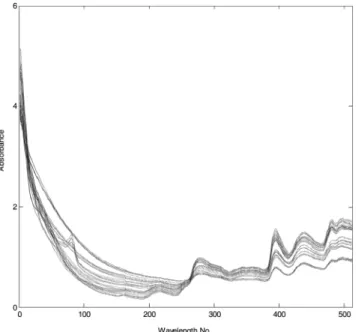
Figure 1. Plots of NIR spectra data.
such as red oak, yellow poplar, and hickory along with three herbaceous biomass of switchgrass, corn stover, and bagasse.
Three different samples were collected from each biomass. Here, wood samples were collected from different trees. A thermogra- vity analyzer was used to investigate the weight loss (%) profile of different biomass over temperature. Specifically, samples were first heated from 50 ℃ to 105 ℃ with the rate of 25 ℃/min and kept at 105 ℃ during ten minutes to remove the moisture.
Then they were heated to 750 ℃ within a nitrogen atmosphere.
Three spectra collected on each of a total of 18 samples were used to predict the weight loss profile of different biomass. The reflectance spectra were converted to absorbance spectra. The data set was further reduced by averaging the 1 nm interval spectra to one with 4 nm intervals. NIR plots of the samples are shown in Figure 1. The NIR data were used to perform a sta- tistical analysis.
3.2. Results
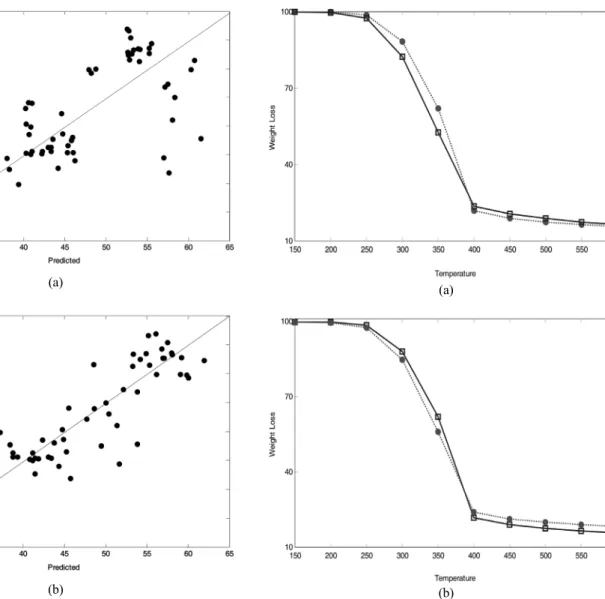
In this work, the prediction of a weight loss profile of biomass with temperatures was conducted based on multivariate statistical calibration models by analyzing the NIR spectra data. Before building a prediction model for the NIR data and weight loss profile with temperature, various preprocessing methods was applied to the original NIR data to choose optimal pretreatment scheme. Based on the 54 NIR samples three PLS models were built using the three pretreatment methods and compared. When implementing OSC, a direct orthogonal signal correction algori- thm[8] was applied. The OSC-treated PLS model of 54 NIR samples was able to explain 92.1% of the Y variation. In addi- tion, it showed a higher predictive power of 86.1% than 75.8%
and 75.2 obtained from SNV and MSC, respectively. As a result, OSC was chosen in this work because the best performance was achieved from the NIR data. It is mainly because OSC-based preprocessing is able to remove unwanted variations of the NIR data that do not contribute to prediction.
The use of simple regression techniques makes it difficult to build reliable prediction models because of the high dimensio- nality and collinearity of NIR data. Thus, we tried to adopt an effective compression tool of a wavelet transform. A leave- three-out procedure was performed on the 54 NIR spectrain order to evaluate the performance of the proposed prediction model using test data. Specifically, three of the 54 spectra are kept out of prediction model development, and these are then predicted by the prediction model. Then, this process is repeated until every sample had been kept out only once. Such a leave-three-out test procedure is used to evaluate the prediction model by using sam- ples that are not included in the model-building stage. It may indicate how reliable the prediction model would be practically in predicting unknown samples.
A cross-validation procedure based on the predicted residual error sum of squares was used in this work in order to select the number of latent variables for PLS models. It is due to the fact that acritical parameter that determines the performance of PLS models is the number of latent variables retained. This num- ber should be determined by considering both the curse of di- mensionality and the loss of data information. In this work as a measure of the predictive performance of a prediction model we calculated root mean squared error in prediction (RMSEP) values of residuals, which is defined as
n y RMSEP y
n
i i i