22 This is an Open-Access article distributed under the terms of the Creative Commons Attribution Non-Commercial License (http://
creativecommons.org/licenses/by-nc/3.0) which permits unrestricted non-commercial use, distribution, and reproduction in any medium, provided the original work is properly cited.
J. Mushrooms 2018 March, 16(1): 22-30 http://dx.doi.org/10.14480/JM.2018.16.1. 22 Print ISSN 1738-0294, Online ISSN 2288-8853
© The Korean Society of Mushroom Science
*Corresponding author E-mail : [email protected] Tel : +82-61-862-8877 Received December 8, 2017 Revised January 10, 2018 Accepted March 8, 2018
반응표면 분석법에 의한 표고균사체발효 적하수오 열수 추출조건의 최적화
오준석
1· 홍재희
1· 박태영
1· 신지은
2· 김경제
3· 진성우
3· 반승언
3· 고영우
3· 임승빈
3· 서경순
3,*
1
동부생약영농조합법인
2
충남대학교 정보통계학과
3
(재)장흥군버섯산업연구원
Optimal hot water extraction conditions of fermented Polygonum multiflorum root by Lentinula edodes pegler mycelials using response surface methodology
Junseok Oh
1, Jae-Heoi Hong
1, Tae-Young Park
1, Ji-eun Shin
2, Kyung-Je Kim
3, Seong-Woo Jin
3, Seung-Eon Ban
3, Young-Woo Koh
3, Seung-Bin Im
3, and Kyoung-Sun Seo
3,*
1
Dongbu Eastern Herbal Medicine Agricultural Association Corporation, Suncheon 58019, Korea
2
Department of Information Statistics, Chungnam National Universitiy, Taejeon 34134, Korea
2
Jangheung Research Institute for Mushroom Industry, Jangheung 529-851, Korea
ABSTRACT:
This study was performed to determine optimal extraction conditions of fermented Polygonum multiflorum root by Lentinula edodes (JMI10079) Pegler mycelials using response surface methodology. The independent factors were extraction temperature (X1: 40–100
oC), extraction time (X2: 2–10 hrs.), and the ratio of water to sample (X3: 33–100 mg/mL). Their effects were assessed on dependent variables of the extract properties, which included soluble solid contents (Y1), °Brix of sample extract (Y2), total polyphenol content (Y3), total flavonoid content (Y4), 2,2'-azino-bis(3-ethylbenzothiazoline-6-sulphonic acid) radical cation scavenging activity (Y5) and 2,2-diphenyl-1-picrylhydrazyl radical scavenging activity (Y6). The experimental data obtained were fit to a second-order polynomial equation. The optimal extraction conditions for fermented P. multiflorum root were: X1:
91.22°C, X2: 7.72 hrs, and X3: 39.71 mg/mL.
KEYWORDS:
DPPH radical scavenging activity, Lentinula edodes, Optimal extraction conditions, Polygonum mutiflorum root, RSM (response surface methodology)
서 론
고령화 사회로 진행됨에 따라 건강하게 노화되는 건강 유지에 대한 관심이 높아지고 있으며, 건강한 삶을 유지 하기 위한 일환으로 천연물 소재를 활용한 연구가 광범위 하게 진행되고 있다(Goldberg, 1994). 특히, 식품으로 사 용이 가능한 생약과 채소류에 대한 항산화 및 항암, 항진 균 등의 생리활성과 유용성분에 관한 결과들이 다수 보고 되고 있다(Han et al, 1992; Cao et al, 1996; Jansen, 2002; Nanasombat and Teckcheuen, 2009). 표고 (Lentinula edodes)는 국내에서 약 100년의 재배역사를 가지고 있으며 활엽수에 기생하는 담자균류 주름버섯목 느타리과 잣버섯에 속하는 식용버섯이다(Kwon et al,
1987). 표고는 식재료로도 국민에게 많은 사랑을 받는 대 중적인 버섯 중 하나이며 인체를 구성하는 필수 영양소를 다량 함유하고 있는 건강한 식품소재이다(Hong and Kim, 1989). 또한, 표고는 혈청지질을 분해시키는 성분이 있어서 혈행개선, 성인병 예방 효과가 기대되고 있다 (Dragsted et al, 1993).
적하수오(Polygonum multiflorum)는 마디풀과(Polygonaceae) 하수오의 덩이뿌리이다(Lee, 2006). 한방에서는 보익약 (補益藥)으로 분류되어 보익정혈(補益精血), 해독절학 ( ), 윤장통변(潤腸通便) 등의 효능이 있다고 알 려져 있다. 또한 항산화(Chiu et al, 2002), 심보호 효과 (Yim et al, 1998), 신경보호(Wang et al, 2006), 항노화 (Xiao et al, 1993) 등의 효과가 보고된 바 있다. 이와 같 이 인체에 유익한 효과 및 효능을 확보하고 있는 적하수 오는 자극성이 있다는 민간의 소문이 있어 자극성 완화를 통한 소비자들의 신뢰도 확보가 시급한 상황이다. 이에 따라 본 연구에서는 적하수오의 자극성 완화 및 표고의 유용성분을 추가한 시너지 효과 창출을 위하여, 적하수오 를 표고 균사로 발효한 발효물의 최적 추출조건을 탐색하 였다.
반응표면분석법은 최소의 실험횟수로부터 최대의 정보 를 얻을 수 있는 실험계획 및 결과 정리 기법으로, 다수의 반응변수에 영향을 주는 요인을 분석하여 연구진행 및 실 험결과의 최적화가 기대되어 식품가공 등 다양한 분야에 서 사용되고 있다(Joo and Park, 1996; Yoon et al, 2012). 또한 물리적 시간 절감이 가능하고 요인별 상호작 용도 관찰할 수 있기 때문에 one factor at a time method 로 찾아내기 어려운 true optimum condition을 구할 수 있다(Kim, 2014).
따라서 본 연구에서는 반응표면분석법을 이용하여 개 별적 유용성분과 생리활성을 지닌 표고균사체와 적하수 오 복합발효물의 시너지 효과를 분석하였다. 또한, 반응 표면분석법을 적용한 최적 열수추출물을 확보하기 위하 여 수행하였으며, 표고발효 적하수오의 효과를 확인하고 자 항산화물질인 총 폴리페놀 및 플라보노이드 함량과 항산화활성인 ABTS cation radical scavenging activity 와 DPPH radical scavenging activity를 각각 탐색하였 다. 이상의 결과를 기반으로 표고균사발효 적하수오를 소재로 한 건강식품개발 기초자료로 활용하고자 한다.
재료 및 방법
재료
본 실험에 사용한 적하수오(Polygonum multiflorum)는 동부생약영농조합법인 부설 재배단지(위도 35°01’95″, 경 도127°30’25″)에서 2016년 12월에 생산한 것을 사용하였 다. 발효에 사용한 표고균사는 (재)장흥군버섯산업연구원 에서 분양받은 Lentinula edodes (JMI10079)를 배양하여 발효에 사용하였다. 절단 적하수오를 표고균사체로 발효 시키고 열풍건조한 후, 분쇄하여 보관하였다. 추출물은 분 말상태로 밀봉 후 실리카겔을 2차 동봉하여 실온에서 보 관하면서 실험에 사용하였다.
시약
본 실험에서 사용된 분석 및 추출, chromatography용 용 매와 시약은 일급 또는 특급시약을 구입하여 사용하였다.
반응표면 분석 시험 설계
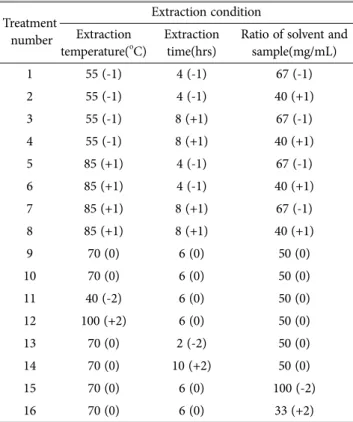
본 연구에서는 추출특성의 모니터링과 추출조건의 최적화 를 위하여 반응표면 분석법(repose surface methodology, RSM)을 이용하였고, 추출조건에 대한 실험계획은 Table 1과 같이 중심합성계획(central composite design)을 실시 하였다. 추출공정에서 중요한 독립변수(Xi)로서 추출온도 (X1), 추출시간(X2) 및 시료에 대한 용매비(X3)에 대한 실험범위를 설정하여 각각을 5단계로 부호화하였으며, 중 심합성계획에 따라 16구로 설정하여 추출하였다(Table 2).
또한 이들 독립변수에 영향을 받을 종속변수(Yn)로는 고형분 함량(Y1), 당도(Y2), TPC (total polyphenol contents, Y3), TFC (total flavonoid contents, Y4), ABTS cation radical scavenging activity (Y5) 및 DPPH radical scavenging activity (Y6)로 하였으며, 모든 실험은 3반복 측정하여 평균값을 회귀분석에 사용하였다. 회귀분석에 의한 최적 조건의 예측은 Minitab 14.0 Ver. program (Mini Tab Inc, Pa, USA)을 이용하였다.
고형분 함량
표고균사체로 발효한 적하수오 열수추출물의 고형분 함 량은 항량을 구한 수기에 추출액 20 mL을 취하여 105oC 에서 증발 건고시킨 후 그 무게를 측정하였으며, 추출액 조제에 사용된 원료량(건물량)에 대한 백분율로써 고형분 함량(soluble solid contents, %)을 나타내었다.
Table 1. Levels of extraction conditions in experimental design for Response Surface Methodology(RSM) analysis
Xi Extraction conditions Levels
-2 -1 0 1 2
X1 Extraction temperature (
oC) 40 55 70 85 100
X2 Extraction time (hrs) 2 4 6 8 10
X3 Added sample ratio (mg/mL) 100 67 50 40 33
당도 측정
표고균사체로 발효한 적하수오 열수추출물의 당도측정 은 추출물을 취하여 디지털 당도계(PAL-3, Atago Co., Japan)로 3회 반복 측정하여 평균값으로 나타내었다.
Total polyphenol 함량 측정
표고균사체로 발효한 적하수오 열수추출물의 총 폴리페 놀 함량은 Folin-Denis법을 실험하였다(Joslyn, 1970). 추 출물을 열풍건조하여 얻은 시료를 증류수를 이용하여 농 도별로 희석한 후, 각 시료 25 uL에 증류수 75 uL와 Folin-Ciocalteu phenol reagent 시약 25 uL 가하였다. 6분 간 실온에서 반응시킨 뒤 포화용액 Na2CO3 100 uL를 가 하여 혼합하고, 90분간 실온에서 방치한 후 765 nm에서 흡광도를 측정하였다. 표준물질로 gallic acid를 각각 0.5 및 1.0, 5.0, 10, 50, 100 mg/mL로 조제한 후 흡광도와 농 도와의 관계를 나타내는 표준곡선을 나타내었으며, 추출물 의 총 폴리페놀 함량을 mg GAE (gallic acid equivalent)/g 로 나타내었다.
Total flavonoid 함량 측정
표고균사체로 발효한 적하수오 열수추출물의 총 플라보 노이드 함량은 Herald 등(2012)이 사용한 실험방법에 준 하여 측정하였다. 추출물을 열풍건조하여 얻은 시료를 증 류수를 이용하여 농도별로 희석한 후, 각 시료 25 uL에
증류수 100 uL와 5% NaNO2 10 uL를 가하여 5분간 반 응시켰다. 반응이 끝난 후, 10% AlCl3 15 uL를 가하여 6분 간 방치하고, 1N NaOH 50 uL와 증류수 50 uL를 가하였 다. 1분 후, 반응액의 흡광도 값을 510 nm에서 측정하였다.
표준물질로 quercetin을 각각 0.5 및 1.0, 5.0, 10, 50, 100 mg/mL로 조제한 후 흡광도와 농도와의 관계를 나타내는 표준곡선을 나타내었으며, 추출물의 총 플라보노이드 함량 을 mg QE (quercetin equivalent)/g로 나타내었다.
ABTS cation radical scavenging activity
ABTS radical을 이용한 항산화력 측정은 ABTS+·
cation decolorization assay 방법에 의하여 측정하였다 (Roberta et al, 1999). 7 mM 2,2-azinobis (3-ethyl- benthiazolin3-6-sulfonic acid)와 2,4 mM potassium persulfate를 혼합하고 실온에서 24시간 동안 방치하여 ABTS+·를 형성시킨 다음 ethanol로 희석하고 ABTS+· 100 uL에 시료 100 uL를 가하여 1분 동안 방치한 후 732 nm 에서 흡광도를 측정하였다.
DPPH radical scavenging activity
DPPH radical 소거능 측정은 Abe 등(2000) 및 Yamachuchie 등(1998), Blois(1958)의 방법을 준용하여, 각 추출물의 DPPH (1,1-diphenyl-2-picrylhydrazyl)에 대 한 수소공여 효과로 측정하였다. 즉, 일정 농도의 시료 2 mL에 2×10⁻⁴ M DPPH용액 (dissolved in 99% methanol) 을 1 mL를 가하고, vortex mixing하여 37oC에서 30분간 반응시켰다. 이 반응액을 흡수분광광도계를 사용하여 517 nm에서 흡광도를 측정하였다. DPPH radical 소거능 (DPPH radical scavenging acitivity, %)으로 측정하였으 며, 3회 반복 실험하여 얻은 결과를 평균과 표준편차로 나타내었다.
통계분석
표고균사체 발효 적하수오로부터 최적의 열수추출물을얻 고자 추출조건에 대한 실험계획으로써 fractional factorial design 사용하였으며, 반응표면 회귀분석을 위해서 Minitab 14.0 Ver. program을 사용하였다(Ha et al, 2014).
결과 및 고찰
추출물의 특성
Scavenging activity(%) = ( 1- Absorbance of sample
) ×100 Absorbance of control
DPPH(%) = ( 1- Absorbance of sample
) ×100 Absorbance of control
Table 2. The fractional factorial design by RSM for optimal
hot water extraction conditions of fermented Polygonummultiflorum root by Lentinula edodes mycelials
Treatment number
Extraction condition Extraction
temperature(
oC)
Extraction time(hrs)
Ratio of solvent and sample(mg/mL)
1 55 (-1) 4 (-1) 67 (-1)
2 55 (-1) 4 (-1) 40 (+1)
3 55 (-1) 8 (+1) 67 (-1)
4 55 (-1) 8 (+1) 40 (+1)
5 85 (+1) 4 (-1) 67 (-1)
6 85 (+1) 4 (-1) 40 (+1)
7 85 (+1) 8 (+1) 67 (-1)
8 85 (+1) 8 (+1) 40 (+1)
9 70 (0) 6 (0) 50 (0)
10 70 (0) 6 (0) 50 (0)
11 40 (-2) 6 (0) 50 (0)
12 100 (+2) 6 (0) 50 (0)
13 70 (0) 2 (-2) 50 (0)
14 70 (0) 10 (+2) 50 (0)
15 70 (0) 6 (0) 100 (-2)
16 70 (0) 6 (0) 33 (+2)
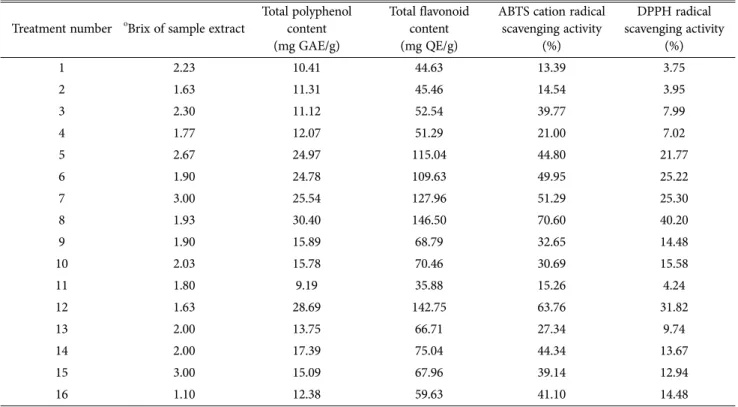
표고발효 적하수오의 최적 열수추출조건을 탐색하고자 반응표면분석법 실험계획에 따라 추출한 열수추출물의 brix, 총 폴리페놀 함량, 총 플라보노이드 함량, ABTS 소 거활성 및 DPPH free radical 소거활성을 측정한 결과는 Table 3과 같다. 표고발효 적하수오 열수추추물은 8번 시 험구와 12번 시험구에서 높은 수준의 총 폴리페놀 함량, 총 플라보노이드 함량, ABTS 소거활성 및 DPPH free radical 소거활성이 나타났으나, 표고발효 적하수오 열수 추출물들의 brix와는 연관성이 없는 것으로 나타났다. 이 와 같은 결과를 바탕으로 독립변수(Xi)인 추출온도(X1)
및 추출시간(X2), 시료에 대한 용매비(X3)의 추출조건과 종속변수(Yn) 고형분 함량(Y1) 및 당도(Y2), TPC (total polyphenol contents, Y3), TFC (total flavonoid contents, Y4), ABTS cation radical scavenging activity (Y5), DPPH radical scavenging activity (Y6)에 대한 각각의 반 응표면 회귀식은 Table 4와 같다. 본 실험결과 분석된 반 응표면분석법 실험계획을 바탕으로 표고발효 적하수오 열 수추출물의 최적 추출조건을 구명하고자 아래의 실험들을 수행하였다.
Table 3. The brix, total polyphenol content, total flavonoid content, ABTS and DPPH of hot water extracts from fermented Polygonum multiflorum root by Lentinula edodes mycelials
Treatment number
oBrix of sample extract
Total polyphenol content (mg GAE/g)
Total flavonoid content (mg QE/g)
ABTS cation radical scavenging activity
(%)
DPPH radical scavenging activity
(%)
1 2.23 10.41 44.63 13.39 3.75
2 1.63 11.31 45.46 14.54 3.95
3 2.30 11.12 52.54 39.77 7.99
4 1.77 12.07 51.29 21.00 7.02
5 2.67 24.97 115.04 44.80 21.77
6 1.90 24.78 109.63 49.95 25.22
7 3.00 25.54 127.96 51.29 25.30
8 1.93 30.40 146.50 70.60 40.20
9 1.90 15.89 68.79 32.65 14.48
10 2.03 15.78 70.46 30.69 15.58
11 1.80 9.19 35.88 15.26 4.24
12 1.63 28.69 142.75 63.76 31.82
13 2.00 13.75 66.71 27.34 9.74
14 2.00 17.39 75.04 44.34 13.67
15 3.00 15.09 67.96 39.14 12.94
16 1.10 12.38 59.63 41.10 14.48
Table 4. Polynomial equations calculated by RSM program on quality test for processing of extracts of extracts from petals of
fermented Polygonum multiflorum root by Lentinula edodes mycelialsResponse Polynomial model equation
1)R
2p
Soluble solid contents(%) -3.2151+0.3232X
1+2.4187X
2-0.0819X
3-0.1141X
12-0.066X
22- 0.0013X
32
+0.0094X
1X
2+0.0237X
1X
3+0.0078X
2X
30.867 0.044
Sugar content(
oBrix) 0.6335+0.0053X
1-0.0185X
2-0.0639X
3-0.0022X
12+0.0009X
22-0.0003X
32- 0.0029X
1X
2+0.0006X
1X
3-0.0012X
2X
30.851 0.059 Total polyphenol content
(mg GAE/g)
15.4575-1.9860X
1+0.1423X
2-0.2792X
3-0.0166X
12- 0.0210X
22
+0.0034X
32
+0.0637X
1X
2+0.0197X
1X
3+0.0047X
2X
30.902 0.020 Total flavonoid content
(mg QE/g)
125.034-14.414X
1-0.093X
2-2.254X
3+0.078X
12- 0.058X
22
+0.022X
32
+0.273X
1X
2+0.150X
1X
3+0.023X
2X
30.924 0.010
ABTS cation radical scavenging activity(%) 111.881+2.912X
1-7.723X
2-1.542X
3+0.261X
12+0.084X
22+0.009X
32- 0.072X
1X
2-0.024X
1X
3+0.070X
2X
30.940 0.005
DPPH radical scavenging activity(%) 45.6219-2.2904X
1-2.2154X
2-0.7801X
3-0.2078X
12- 0.0132X
22
+0.0033X
32
+0.1285X
1X
2+0.0467X
1X
3+0.0319X
2X
30.911 0.015
1)
X
1: Extraction temperature(
oC), X
2: Extraction time(hrs), X
3: Ratio of solvent to sample content
고형분 함량
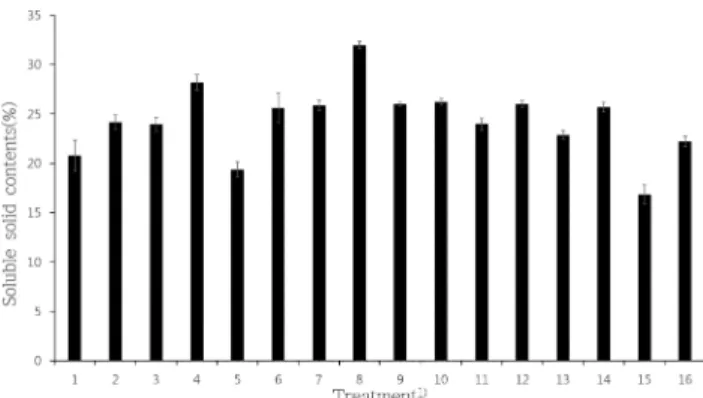
추출조건별 표고균사체 발효 적하수오 추출물의 고형분
함량은 Fig. 1과 같았으며 반응표면분석 결과는 Fig. 2와 같으며 고용분 함량 최대값과 최소값은 각각 31.99%와 16.84%로 나타났다. 이를 회귀분석한 결과 고형분 함량 에 대한 모델식의 R2은 0.867로 나타났다. 고형분함량은 추출온도와 추출시간이 높을수록 증가하는 것으로 나타 났으며, 용매비가 높을수록 감소하는 경향을 보였다. 그 러나 추출온도와 용매비가 함께 높아지거나 추출시간과 용매비가 함께 높아질수록 고형분 함량은 증가하는 것으 로 확인되었다. 용매비가 높을수록 증가하는 이 등(Lee et al, 2016)의 연구결과와 다소 차이를 보였으며 이는 실험 시료의 특성에 따라 가용성 고형분의 용해력 차이 및 추 출성분의 확산, 표면적 등에 따른 차이가 원인으로 생각 된다.
당도 측정
표고균사체 발효 적하수오 추출물의 당도에 대한 반응
Fig. 1. The soluble solid contents of hot water extracts
from fermented Polygonum multiflorum root by Lentinula
edodes mycelials.
Fig. 2. Response surface plot for soluble solid and sugar contents of hot water extraction from fermented Polygonum
multiflorum root by Lentinula edodes mycelials cultivation.
표면 분석결과 당도는 7번(8 hrs, 85oC, 67 mg/mL)과 15 번(6 hrs, 70oC, 100 mg/mL)시험구에서 3.0 brix로 다른 시험구에 비하여 높은 함량을 보였다(Table 3). 이를 회귀 분석한 결과 당도에 대한 모델식의 R2은 0.851로 나타났 다. 반응표면분석결과 추출시간 10 hrs 및 추출온도 59.27oC, 용매비 100 mg/mL일 때 가장 높은 고형분 함량 은 3.0 brix로 나타났으며, 동일시간 및 동일 온도에서는 용매비가 낮을수록 높은 당도를 나타내었다. 윤과 조 (Yoon and Cho, 2007)는 동일한 시료량에서 일정온도와 일정시간이 지나면 당의 추출수율은 더 이상 올라가지 않 는다고 보고한 바 있다. 본 연구결과도 최대 추출조건 이 상에서는 추출 수율의 향상이 이루어지지 않아, 당도 변 인의 목표값을 최대값으로 하여 최적조건을 판단할 때 최 적 추출시간은 10시간으로 판단하였다.
Total polyphenol 함량 및 Total flavonoid 함량
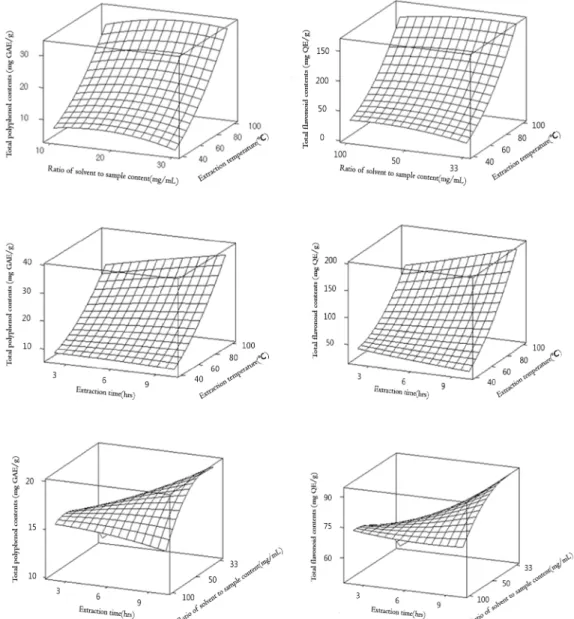
표고균사체 발효 적하수오 추출물의 총 폴리페놀과 플 라보노이드 함량은 Table 3과 같다. 8번 시험구(8 hrs, 85oC, 40 mg/mL)에서 총 폴리페놀 함량이 30.40 mg GAE/g, 총 플라보노이드 함량이 146.50 mg QE/g으로 가 장 높게 나타났다. 추출조건에 따른 총 폴리페놀 함량의 결과를 반응표면 분석한 것은 Fig. 3에서 보는 것과 같이 10 hrs 및 86.81oC, 43 mg/mL 추출조건에서 31 mg GAE/g으로 가장 높게 분석되었으며, 총 플라보노이드 함 량을 반응표면 분석한 것은 4.96 hrs, 100oC 그리고 80 mg/mL 일 때 148 mg QE/g으로 분석되었다. 각각의 회 귀식의 결정계수 R2은 0.902 및 0.924로 반응모형이 적합 하였다.총 폴리페놀 함량은 추출온도가 증가함에 따라 크게 감 소하는 반면, 추출시간의 증가와 연관성이 상대적으로 낮
Fig. 3. Response surface plot for total polyphenol and flavonoid contents of hot water extraction from fermented Polygonum
multiflorum root by Lentinula edodes mycelials cultivation.
게 나타났다. 용매량의 증가에 따라 총 폴리페놀 함량이 증가하였으나, 용매비 최적점을 지나치면서 폴리페놀은 다소 감소하는 경향을 보였다. 기존 연구에서 민들레 잎 과 천마의 항산화 물질을 추출할 때, 일정량 이상의 용매 를 적용한 경우 폴리페놀 함량이 증가하지 않는다고 보고 (Koh et al, 2008; Kim et al, 2006) 한 바 있어, 본 연구 와 유사한 결과를 나타내었다. 총 플라보노이드 함량은 총 폴리페놀 함량 보다 추출온도의 증가와 밀접하게 증가 하는 경향을 나타내었으나, 용매양과 추출시간에는 연관 성이 낮게 나타났다. 청미래덩굴 잎 열수 추출조건 탐색 (Kim et al, 2013)에서 총 폴리페놀과 총 플라보노이드는 최적 추출온도가 각각 82.2oC와 92.59oC로 분석하여, 본 연구와 유사한 상관관계를 보였다. 이상과 같은 결과로 표고발효 적하수오는 열에 비교적 안정한 폴리페놀류와
플라보노이드류를 다량 함유한 것으로 판단되었다.
항산화 활성
ABTS radical은 DPPH와 같은 radical의 일종이지만 free radical인 전자공여능(DPPH)에 비해 ABTS는 peroxidase, H2O2와 반응시킨 활성 양이온 radical 이라는 점에서 차이가 있다(Miller et al, 1993). 따라서 표고균사 체 발효 적하수오 열수 추출물의 항산화 활성 탐색에서 두 가지 항산화 활성을 측정하였다. ABTS radical 소거능 과 전자공여능(DPPH)을 측정한 결과는 Table 3과 같다.
16가지 시험구의 항산화 활성도는 총 폴리페놀 및 총 플 라보노이드 함량분석 결과와 같이 8번 시험구(8 hrs, 85oC, 40 mg/mL)에서 가장 높은 활성을 보였다. 70.60%
의 ABTS radical 소거능과 40.20%의 전자공여능(DPPH)
Fig. 4. Response surface plot for antioxidant activities of hot water extraction from fermented Polygonum multiflorum root by
Lentinula edodes mycelials.
이 측정되었으며, 각각의 회귀식의 결정계수 R2은 0.940 과 0.991로 나타났다. 인진쑥 열수추출물의 항산화 특성 에 관한 연구(Kim, 2014)에서 인진쑥 추출물의 전자공여 능 변화는 추출온도가 높고 시료에 대한 용매비가 증가 할수록 항산화활성이 증가하였으며, 이는 본 연구결과와 유사하게 나타났다.
ABTS radical 소거능은 Fig. 4와 같이 그래프가 아래로 움푹 꺼지는 형태로 나타나 최대값이 나타나지 않았다.
그러나 동일한 용매비에서는 추출시간이 증가할수록 추출 온도다 높을수록 낮은 활성을 보였으나 고온에서는 다시 높아지는 경향을 나타내었다. 이는 건조방법에 따른 아로 니아의 열수 추출물 ABTS cation radical 소거능이 추출 온도와 높은 상관관계를 보였다는 결과와 유사하였다 (Lee, 2015).
열수 추출조건의 최적화
표고균사체 발효 적하수오에 대한 열수 추출조건을 최적화 할 목적으로 추출온도를 95oC로 고정하고 용매비와 추출시 간에 대한 각 종속변수들의 contour map을 superimposing 하여 추출물의 특성 중 생리활성물질 함량과 생리활성을 만족시켜주는 최적조건은 91.22oC에서 39.71 mg/mL 용 매비와 7.72 hrs 추출시간으로 각각 예측되었다(Fig. 5.).
이와 같은 최적 추출조건들은 상업화 환경에 따라 다소 변수가 발생할 수 있다고 판단된다. 표고발효 적하수오의 생리활성에 대한 연구가 추가적으로 진행되어 기능적 특 성에 대한 기초 연구가 진행된다면 새로운 기능성 제품에 이용되는 원료로 사용될 가능성이 있다고 보여진다.
요 약
본 연구는 표고균사체 발효 적하수오 열수 최적 추출조 건 탐색을 목적으로 수행하였으며, 표고균사로 배양된 하
수오의 독립변수로는 독립변수(Xi)로서 추출온도(X1), 추 출시간(X2) 및 시료에 대한 용매비(X3)에 대한 실험범위 를 설정하여 각각을 5단계로 부호화하였고 중심합성계획 에 따라 16구로 설정하여 추출하였다. 또한 이들 독립변 수에 영향을 받을 종속변수(Yn)로는 고형분 함량(Y1) 및 당도(Y2), TPC (total polyphenol contents, Y3), TFC (total flavonoid contents, Y4), ABTS cation radical scavenging activity (Y5), DPPH radical scavenging activity (Y6)으로 하였다. 고용분 함량 최대값과 최소값은 각각 31.99%와 16.84%로 나타났다. 이를 회귀분석한 결 과 고형분 함량에 대한 모델식의 R2은 0.867로 나타났다.
당도는 7번(8 hrs, 85oC, 67 mg/mL)과 15번(6 hrs, 70oC, 100 mg/mL)시험구에서 3.0 brix로 다른 시험구에 비하여 높은 함량을 보였다. 항산화물질인 총 폴리페놀과 플라보 노이드 함량은 8번 시험구(8 hrs, 85oC, 40 mg/mL)에서 총 폴리페놀 함량이 30.40 mg GAE/g, 총 플라보노이드 함량이 146.50 mg QE/g으로 가장 높게 나타났으며, 16가지 시험구의 항산화 활성도 총 폴리페놀과 총 플라보노이드 함 량의 결과와 같이 8번 시험구(8 hrs, 85oC, 40 mg/mL)에서 가장 높은 활성을 보였다. 이상의 결과를 참조하여 표고균 사체 발효 적하수오에 대한 열수 추출조건을 최적화할 목적 으로 추출온도를 95oC로 고정하고 용매비와 추출시간에 대 한 종속변수들의 contour map을 superimposing하여 추출물 의 특성 중 생리활성물질 함량과 생리활성을 만족시켜주 는 최적조건은 91.22oC에서 39.71 mg/mL 용매비와 7.72 추출시간으로 각각 분석되었다.
본 연구는 적하수오에 표고균사체를 배양한 후 생리활 성이 우수한 원료를 추출 생산하고자 최적 추출조건을 확 립하기 위하여 반응표면분석법을 활용하였다. 향후 생리 활성부분에 대한 추가적인 연구가 이루어진다면 더욱 완 성도가 높은 표고균사체 발효 적하수오 식품개발에 가능 할 것으로 사료된다.
감사의 글
본 결과물은 농림축산식품부의 재원으로 농림수산식품 기술기획평가원의 고부가가치식품개발사업의 지원을 받 아 수행되었으며 이에 감사드립니다(과제번호 : 116031-2).
References
Abe N, Nemoto A, Tsuchiya Y, Hojo H, Hirota A. 2000. Study of the 1,1-diphenyl-2-picrylhydrazyl radical scavenging mechanism for a 2-pyrone compound. Biosci Biotech Biochem 64:306-333.
Blois MS. 1958. Antioxidant determination by the use of a table free radical. Nature 26:1199-1744.
Cao G, Sofic E, Ronald L. 1996. Antioxidant capacity of tea and common vegetables. J Agric Food Chem 44:3426-3431.
Chiu PY, Mak DH, Poon MK 2002. In vivo antioxidant action of Fig. 5. Supermposed contour map for optimization of
response variables in fermented Polygonum multiflorum root by Lentinula edodes mycelials.