지역정체성 함양을 위한 시각정보디자인 수업
-정릉동을 중심으로-
김민진1, 허윤정2*
1국민대학교 교육대학원 미술교육전공 석사, 2국민대학교 예술대학 미술학부 교수
Visual Information Design Lesson for Cultivating Local Identity
- Focused on Jungnungdong -
Min-Jin Kim1, Yoon-Jung Huh2*1Master, Graduate School of Arts Education, Kookmin University
2Professor, College of Arts, School of Fine Arts, Kookmin University
요 약 본 연구는 정릉동에 위치한 꿈나래지역아동 센터의 중학생 7명을 선정하여 지역정체성을 함양을 위한 시각 정보 디자인 수업을 진행하고 학생들의 사전 사후 설문지를 분석하여 그 효과성을 검증하고자 하였다. 첫째, 사전·사후 설문지의 결과에서 학습자들이 지역정체성 요소인 지역관심도, 지역애착도, 지역 자긍심의 평균값이 상승하였다. 둘째, 지역정체성 요소 중 지역관심도는 가장 많은 상승 폭을 보여주고 있다. 본 수업이 지역정체성 형성에 있어서 첫 번째 단계인 지역관심도 측면에서 효과성이 가장 크게 나타난 것으로 해석할 수 있다. 셋째, 학습자들은 검색을 통한 자료 수집과 경험적 지식을 바탕으로 객관적인 지역정체성과 주관적인 지역정체성 모두를 확장시켰다.
주제어 : 지역정체성, 지역관심도, 지역애착도, 지역자긍심, 시각정보디자인
Abstract In this study, seven middle school students in the Kumnarae local children's center in Jungnung-dong were selected to conduct visual information design lesson to cultivate local identity.
Through the pre and post questionnaires of students and self-evaluation of students' outputs we will verify its effectiveness. First, in the results of the pre and post questionnaire, the learner 's level of local identity which are local affinity, local affection and local self - esteem increased. Second, local affinity shows the greatest increase. This class can be interpreted as the most effective in terms of local affinity, which is the first step in forming regional identity. Third, learners expanded both objective locality and subjective local identity based on data collection and empirical knowledge.
Key Words : Local identity, Local interest, Local affinity, Local pride, Visual Information Design
*This paper is a summary of 'The Study of Visual Information Design Program for Getting Regional Identity- Focusing on Jungnung-dong -' which is master 's paper of Graduate School of Education, Kookmin University, 2019.
*Corresponding Author : Yoon-Jung Huh([email protected])
Received November 1, 2019 Revised December 17, 2019 Accepted January 20, 2020 Published January 28, 2020
1. 서론
중ㆍ고등학생들은 입시에 치우친 과열 경쟁으로 정서 적 안정을 취하기 힘든 환경에 놓여있다. 이에 학생들의 정서적 안정을 위해서 학생들에게 여가 활동을 할 수 있
는 장소를 제공해야하고 학생들은 주변 공간과 자신의 사이에서 행동들을 통해 의미를 구축 할 수 있어야 한다 [1]. 학생들은 주변 환경과 소통하고 경관을 관찰하여 미 적 유희를 느끼며 주변 환경과 나 자신과의 관계를 끊임 없이 재조명하고 정립해야 한다. 그 과정에서 학생들은
Stage First stage Second stage Third stage Social
Categorization Social Identification Social Comparison Meaning Understanding the
subject and classifying the characteristics of the subject. If it is
applicable to the area, understand the area and classify the area by recognizing the
difference of the area where the person resides and the localness
It is the step of applying the value of society to belong to the social group and getting recognized and it is a process to
make the local people acquire the specific identity of the region to belong
to the area.
It is a process of recognizing the disadvantages and
advantages by comparing the group with other
groups and comparing the differences and similarities between the regions and regions and taking pride in the region in the
Table 1. Stage to form local identity자신의 정서를 되돌아볼 수 있게 된다. 이러한 활동이 학 생들에게 가장 적합한 장소는 그들이 거주하는 지역이다.
지역에 거주하는 중ㆍ고등학생들은 학업으로 지역에 대 한 주관적이고 공통적인 인식을 갖기가 쉽지 않다. 지역 에 대한 주관적이고 객관적인 인식으로서의 지역정체성 을 인지하지 못 한 상태에서 여가를 위한 공간 탐구는 지 역의 미적 유희를 느끼지 못한 채 여가 공간을 탐구하는 것과 같다. 따라서 학생들의 지역에 대한 정확한 인지를 위해서는 거주 지역의 지역정체성을 인지해야 한다. 이에 본 연구에서는 정릉동에 위치한 꿈나래지역아동 센터의 중학생 7명을 선정하여 지역정체성을 함양을 위한 시각 정보 디자인 수업을 진행하고자 한다. 수업을 진행 이후 다음과 같은 효과성을 검증해 보고자 한다.
학생들의 사전 사후 설문지를 통해 지역정체성의 하위 요소로서 지역관심도, 지역애착도. 그리고 지역 자긍심의 변화를 분석하여 그 효과성을 검증한다.
2. 지역정체성
2.1 지역정체성의 의미정체성이란 개인이나 집단이 공통된 역사, 문화적 배 경을 바탕으로 사회와 자아의 동일시를 느끼는 심리적 현상이라고 할 수 있다. 자연과학의 관점으로 정체성은 "
근본적으로 사회, 공간적 관계 안에서 자신이 속해 있는 지역사회 구성원들 간의 공유된 존재 의미나 의식"이라 고 정의하고 있다[2]. 지역의 구성원들이 지역에서 공유 되는 독특한 가치로 경제, 문화, 사회문제를 바라보면서 동질적인 사회적 정체성을 가지게 되는데 지역정체성은 이러한 정체성을 바탕으로 타 지역과 구별되는 특정한 지역의 문화적 의미와 실천을 공유하는 집단이 느끼는 일체성 내지 귀속감이라고 볼 수 있다[3]. 즉 지역정체성 의 의미는 지역 주민들이 공통적으로 자신과 동일시하는 지역의 제반 특성이다[4].지역 제반의 특성은 하나의 고 정된 의미가 아니며 사회의 요구에 의해 바뀔 수 있으며 지속적인 변화가 있는 것이다. 지역성이라는 개념은 지역 의 사회 환경과 문화를 내포한 의미를 지니고 있다. 공간 성을 내포하고 있지만, 공간이 구별되지 않는다 해도 공 통적인 사회와 문화가 형성된다면 표준화 되지 않은 새 로운 지역성이 산출된다.
2.2 지역정체성의 형성 과정 및 요소
지역정체성은 주관적인 지역정체성과 객관적인 지역 정체성이 2개의 수준으로 있다. 주관적인 지역정체성의 수준에는 지역에서의 개인적 삶을 보여주고 있으며 객관 적인 지역정체성의 수준에서는 지역의 객관적이고 공통 된 특징을 보여주고 있다[5]. 지역정체성의 형성은 지역 사회 구성원들이 공동으로 가지게 되는 주관적인 가치에 서 시작된다. 이 주관적인 가치가 군집화되면서 객관적인 지역정체성의 형태로 발전하게 된다. 즉 지역정체성은 각 개인들의 주관적인 지역정체성 형태로 존재하다가 동일 한 생각을 가진 개인들의 정체성이 군집화되면서 객관적 인 지역정체성으로 발전하게 된다.
Table 1은 터너가 주장한 지역정체성의 형성 과정이 다. 첫 번째 단계는 사회 분류화(Social Categorization) 단계이다. 사회 분류화 단계는 대상을 정의하고 이해하기 위해 분류하는 단계로 분류 기준은 개인이 속속한 집단의 기준 예를 들어 직업, 권력, 피부색을 기준으로 대상을 판 단하고 분류한다. 이 단계가 지속적으로 반복되면서 개인 은 그 집단의 특성에 동질화되고 그 집단의 가치를 내면 화하게 된다. 두 번째 단계는 사회 정체성화(Social Identification) 단계이다. 이 단계에서는 각 개인이 속 한 집단에서 인정받고자 노력하게 되는 단계이다. 집단의 일원으로서 행동함으로 집단의 인정을 받게 되고 집단의 정체성을 이해하게 된다. 더불어 개인의 자부심도 집단과 함께 생성된다. 마지막 세 번째는 집단적 비교(Social Comparison)단계이다. 이것은 정체성이 확립되고 완벽 한 분류화가 생성된 뒤에 발생한다. 집단에 의해 생성된 자부심을 유지하기 위해 속한 집단과는 반대적 성향을 지닌 집단과 비교하는 경향이 생기게 된다[6]. 심재권, 황 정희는 터너의 이론에 기반한 지역정체성의 형성 과정을 다음과 같은 요소로 제시하고 있다.
of the area only. speciality of the area in which they
live.
Local identity element
s
Local categorization (Local interest)
Local identification
(Local affinity) Local self-esteem (Local pride)
Classificatio
n Elements Explanation Factor Characteristic
Expression elements perceived by eyes - Graphic representati on
Illustration
A visualized picture to convey specific
content Color,
brightnes s, texture, symbol, location, icon
Meaningfulness can be extracted from the information.
Typography Informational symbols for readability
Color
A tool that conveys the meaning and sensitivity of information in a multidimension al manner
Table 3. Representative elements of information visualization
첫째, 자신의 지역이 다른 지역과 구별되고 차별화되 는 지역의 자기다움을 의미하는 지역범주화, 둘째, 지역 의 특성을 자신과 동일시하여 자신으로 받아들이는 지역 동일시, 셋째, 지역에 대한 자부심과 자아존중감을 지역 자존감으로 분류하고 있다[7]. 이영원은 이를 지역민과 지역사회와의 관계 속에서 지역민이 지역사회에 가지고 있는 지역 관심도, 지역사회에 소속하고자 하는 지역 애 착도, 지역의 특별함을 인지하는 지역자긍심으로 분류하 여 설명한다[8]. 본 연구는 터너의 지역정체성의 형성단 계와 심재권, 황정희의 지역 정체성의 요소, 그리고 그것 을 다시 해석한 이영원의 지역 정체성의 요소를 Table.
1에 제시하였다. 본 연구는 이영원의 지역정체성 요소를 기준으로 사전 사후 설문지를 구성하여 지역정체성 함양 을 분석하고자 한다.
2.3 지역정체성의 분류
지역 정체성은 여러 기준으로 분류할 수 있는데 심재 권, 황정희는 지역정체성이 지역민의 다양한 문화 기반으 로 형성되며 지역정체성의 종류가 Table 2와 같이 문화 정체성, 경관 정체성, 역사 정체성, 산업 정체성, 인성 정 체성으로 나누어진다고 설명하고 있다.
Classification Specific details
Historical
identity Historical facts, historical figures, historical sites, relics, democratization movements
Cultural
identity Culture, theater, film, art, music, dance, food, folklore, festival, costume
Landscape identity
Aesthetics, natural scenery, urban scenery, architecture, structure, environmental movement, experience and image
Industrial
identity Tourism, handicraft, high-tech industry, agricultural products, tertiary industry
Personality
identity Personality, collectivity
Table 2. Classification of local identity [7]
3. 시각정보 디자인
3.1 시각정보 디자인인간의 시각 기관은 인간의 감각 중에서 가장 발달한 기관으로 눈의 망막으로 사물의 형, 색, 위치 등을 인식하 고 수집한 정보들을 분석하여 처리하는 기관이다. 이러한 시각 기관을 통해 인지한 것들을 정보 시각 (Information Visualization)이라고 한다[9]. 시각정보 디자인은 사람들이 효율적이고 효과적으로 정보를 사용 할 수 있도록 하는 기술이라고 정의한다[10]. 시각정보디 자인의 주요 목표는 사람들이 이해하기 쉽게, 정확하게 정보를 검색하여 효과적으로 행동에 옮길 수 있도록 하 는 것이다[9]. 더 나아가 시각 정보형성에 대해 장현석은 정보의 생산자가 정보의 사용자에게 정보를 좀 더 풍부 한 의미로 전달하는 '의미 만들기(data organizition)'의 과정으로 보고 정보는 정보사용자의 인지 수준과 지식, 경험을 통해 정보를 내면화하는 과정을 거쳐 정보의 맥 락이 형성되며 정보 사용자는 정보를 구조화하고 합리적 인 분류를 통한 정보의 해석과 이해의 과정을 거친다고 했다[11]. 이와 같이 정보는 정보의 맥락 이해와 구조화 를 통해 의미가 생겨나는 것이며 이 의미를 사용자의 의 도에 맞게 시각화하여 시각 정보가 형성된다.
3.2 시각정보 디자인 평가요소
시각정보 디자인의 평가 요소에 대해 장현석[11], 조 결[12], 김진희[13]는 각 각 차이점을 보이고 있으나 이 들이 제시한 시각정보 디자인의 평가 요소를 정리하면 크게 문자로서 인식되는 표현 요소와 눈으로 지각되는 표현 요소로 나누어진다. 눈으로 지각되는 표현 요소는 그래픽 표현와 구조적 표현으로 나누어진다. 시각정보 디 자인의 평가 요소들은 Table 3으로 정리 하여 재구성하 였다. Table. 3은 수업에서 작품을 진행 한 후 자기평가 지의 문항으로 사용하였다.
Local pride
I think our area is famous.
I am proud of our local culture.
I can speak proudly of our local culture.
I am proud to tell others about our area.
I am proud to live in our area.
Local interest
I am interested in the culture of the area where I live.
I am interested in the history of the area in which I live.
I am interested in the natural landscape of the area in which I live.
Table 4. Composition of questionnaire[15]
I am interested in the industry in my area.
I am interested in the area where I live.
I will participate in cultural events in the region where I live.
I think I should learn the beauty of the area where I live.
I think I should keep the beautiful culture of the area where I live.
I know there is a beautiful place in the area where I live.
I know that there is a beautiful culture in the area where I live.
Local affinity
I think our area is a good place to live.
I like the natural environment of our area.
I like the natural environment of our area.
I like people in the area where I live.
I do not want to leave the area where I live now.
Perceptual Representat ion - Structural representati on
Layout
Place letters or pictures according to importance, balance proportion
Size, location, balance, unificatio n
It induces easy perceptual reasoning through intuitive cognition of information.
Storytelling Literary symbol, distinctive expression
It induces the interest of the information user and helps the user to easily find the meaning inherent in the information.
4. 연구 방법
4.1 연구 대상연구대상은 정릉동에 위치한 꿈나래지역아동 센터의 중학생 7명이다. 연구 당시 꿈나래지역아동 센터에 재원 하는 중학생이 7명이라 적은 수로 진행했다. 꿈나래지역 아동 센터는 정릉 교회의 부설로 지역사회의 적절한 지 원을 받고 있다. 학습자들은 대체로 미술에 대해 관심이 있으며 이 시기의 청소년이 가지는 특성대로 사회화의 과정 속에서 성장통을 겪고 있으며 학습자들 간에 상호 소통 하며 유대감은 높은 편이다.
4.2 연구 도구
본 연구에 사용할 도구는 지역정체성에 대한 사전 및 사후설문지이다. 설문지는 사전·사후 설문지로 구성되어 있으며 지역정체성을 평가하기 위해 이영원(2010)이 푸 디푸트(Puddifoot, 1966)[14]가 도출한 지역정체성을 한국 실정에 맞게 수정한 설문지 문항을 사용하였다. 설 문지는 지역 정체성의 하위 요소인 지역자긍심, 지역애착 도, 지역 관심도로 나뉘어 20개의 설문 문항이 구성되었으 며 5점 척도로 사용하여 불만족에서 만족까지 선택하도록 했다. Table 4는 각 항목에 대한 정확한 설문의 구성이다.
4.3 수업 설계 4.3.1 수업 목표
본 수업의 목표는 자신이 살고 있는 지역의 정체성을 담아내는 브로슈어 제작 수업을 통해 학습자들이 거주하 는 지역에서의 지역정체성을 함양하는 것이다.
4.3.2 수업 내용
본 수업은 정릉동 지역 소재의 중학생들을 대상으로 진행되었으며 기간은 2019년 1월 4일부터 2월 1일까지 총 6차시로 실시되었고 각 차시는 90분이었다. 수업 주차 별 주제, 학습목표, 활동사항은 Table 5에 기술하였다.
1주차에는 수업 시작과 함께 사전 설문지를 통해 지역 정체성의 정도를 측정한다. 학습자들이 각자 생각하는 자 신의 마을에 대해 나누고 정릉 지역의 지역정체성과 관 련된 객관적인 자료를 소개한다. 개인 별로 마을 여가 장 소를 결정하고 탐사 계획을 세우고 문헌조사를 수행하고 발표한다. 2주차는 1주차에 선택한 여가 장소를 사전 답 사한 내용을 바탕으로 지역에서 자신만의 특별한 여가 장소를 발표하고 서로의 여가 장소를 공유한다. 또한 여 가 장소에 대한 정보를 추가 수집한다. 3주차는 시각정보 디자인의 레이아웃에 대해 공부를 하며 각자 브로슈어에 넣을 여가 장소에 대한 정보를 선별하여 배치해본다. 학 생과 학생 학생과 교사 간에 서로 피드백을 주고받으며 진행한다. 4주차에는 배치한 레이아웃에 맞추어 장소와 맞는 색을 선택하고 이미지와 텍스트를 디자인 해보는 시간을 가진다. 5주차는 브로슈어 결과물을 공유하며 서 로 피드백하는 시간을 가지며 수정한다. 학습자들이 자기 평가지를 작성하여 스스로의 결과물을 평가하는 시간을 진행한다. 6주차에는 마무리 시간으로 학생들의 지역 정
Time Subject Learning Objectives Activities
1 Investig
ation explorati and
on plan Jungnun for g-dong
“I am living in Jeongneung, what place? "
- It is possible to recognize and understand the objective local identity of Jungnung-dong.
- You can learn about the town where you live and introduce your own place.
- Plan the hot-place plan and plan the exploration plan.
1. Learn about the identity of Jungnung-dong and understand the objective Jungnung-dong.
2. Talk about the place where you think of Jungnong-dong's leisure and try to designate the best Jungnung location.
3. Do literature survey on the place of leisure in
Jungnung-dong.
4. Announce the reason for selection of the group of leisure places and brief bibliographic information for 10 minutes.
2 Announ cement discussi and
on of explorati
results on
"My Own Hot Place Introduction"
- Using all the results of the survey, we introduce the hot place of Jungnung.
- You can listen to other groups' hot places and share their beauty.
- Investigate accurate information about your hot place and understand the need and purpose of the place.
1. Make a presentation by combining the results of the survey of the first week and the detailed survey of the second week.
2. Select and edit the information to be included in the brochure as a result of assignments and activities.
3. Through the presentation, you can introduce your own Jungnung hot place to other students and tell their impressions about the hot places of other students.
3
Brochur producti e on
"Promote Our Hot Place"
- Create a brochure layout that introduces a group of hot places.
- Think about images that correspond to brochure information.
- Think about the media.
1. Select the representative color of the selected hot place.
2. Design a quick map and think about effective promotional methods for hot place Introduction brochures.
3. Gives feedback to and from students, creating better layouts and selecting images.
4
"Create our Hot Place publicity paper now."
- Try to make a layout and an image of a person's plan with thick cardboard.
- Identify the local identity of Jungnung-dong and designate the representative color of the area and express its beauty in the brochure.
1. Create a hot place brochure through visual information design.
2. Give and receive feedback from students, students, and students, and produce better brochure output.
5 Supple menting
editing and brochur es
"Did you show your hot place?"
- Give feedback to each other through brochure presentation.
1. Introduce hot place and show place in brochure.
2. Based on the self-evaluation of the results, we evaluate each other's strengths and
Table 5. Lecture schedule of class- Modify the results through feedback.
weaknesses through feedback through communication and consideration. At this time, they have a good evaluation attitude for each other.
6 Self-ch eck and self-ass essmen
t
“Let's meet the designer next time! "
- Recognize the objective information of local identity.
- Talk about your subjective local identity.
1. Talk about your own local identity and local image.
2. Complete the post-questionnaire by completing the program.
Art work
Table 6. A student's work and self-assessment 체성에 대한 생각을 이야기하는 시간을 가진다. 그리고
사후 지역정체성 설문지를 실시해 학생들의 지역정체성 함양 및 형성 여부를 측정한다.
5. 수업 결과물
Table 3에 제시된 시각정보 디자인의 평가 요소인 일 러스트, 컬러, 레이아웃, 타이포그래피, 스토리텔링을 참 고하여 학생들의 지역정체성 형성을 관찰할 수 있는 자 기 평가지를 구성하였다. 이 중 일러스트, 컬러, 레이아 웃, 스토리텔링은 학생들이 디자인의 과정에서 개인의 지 역정체성을 계속 재조명할 수 있는 기회를 준다. 자기평 가지의 구성은 Table 3을 기준으로 하여 학생 수준에 맞 게 일러스트를 이미지와 일러스트 항목으로, 컬러와 레이 아웃은 그대로 활용하였고, 스토리텔링은 텍스트 항목으로 자기 평가지의 문항을 구성하였다. 그러나, 타이포그래피 는 가독성을 위한 부분으로 연구 목적에서 벗어나 있으므 로 축소시켰다. 자기 평가지는 개인의 주관적인 정체성을 관찰할 수 있도록 컬러, 텍스트, 레이아웃, 일러스트, 이미 지 그리고 지역정체성에 관한 글을 적도록 구성하였다.
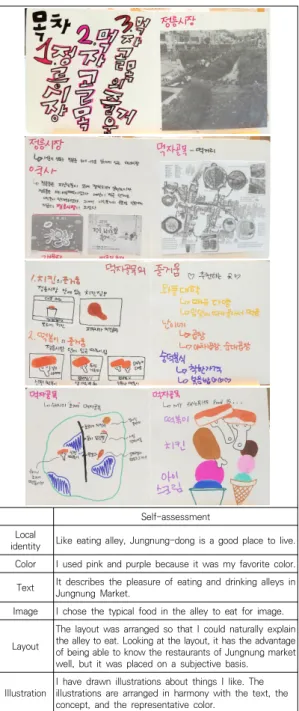
다음은 7명 학생의 작품과 자기 평가지를 분석해 보고 자 한다. Table 6은 A학생의 작품과 자기평가지이다. 전 체적으로 적절한 레이아웃 배치를 통해 전하고자 하는 메시지를 분명하게 전달하고 있다. 학습자의 지역정체성은 정릉동에 ‘다있소’의 이미지에서 시작하여 정릉 시장 먹자 골목에서의 즐거운 추억을 시작으로 하여 수업을 진행하면 서 살기 좋은 동네라는 지역정체성으로 확장되었다.
Art work
Self-assessment Local
identity I made a brochure that reveals the peacefulness of Jungnung-dong with the concept of Jungnung Stream.
Color The representative color is sky blue, and it is a color that matches with Jungnung Stream.
Text I wrote mainly about our good living neighborhood.
Image I used the image of Jungnung Stream.
Layout I do not know if I arranged well.
Illustration I pictured Jungnungcheon as an illustration. The illustrations reflect the local identity and are arranged in harmony with the text and the representative color.
Table 7. B student's work and self-assessment
Art work
Table 8. C student's work and self-assessment
Self-assessment
Local
identity Like eating alley, Jungnung-dong is a good place to live.
Color I used pink and purple because it was my favorite color.
Text It describes the pleasure of eating and drinking alleys in Jungnung Market.
Image I chose the typical food in the alley to eat for image.
Layout
The layout was arranged so that I could naturally explain the alley to eat. Looking at the layout, it has the advantage of being able to know the restaurants of Jungnung market well, but it was placed on a subjective basis.
Illustration I have drawn illustrations about things I like. The illustrations are arranged in harmony with the text, the concept, and the representative color.
Table 7은 B학생의 작품과 자기평가지이다. B학생은 정릉천을 주제로 삼아 정릉천을 중심으로 주변의 상가들 을 나열하며 평화로운 정릉동이라는 정체성을 드러냈다.
푸른색을 대표 색으로 정하여 푸르고 살기 좋은 정릉을 표현했다.
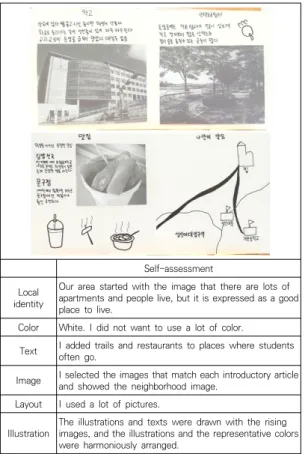
Table 8은 C 학생의 작품과 자기평가지이다. C학생 은 학생들이 많고 학교가 많은 동네의 특성에서 시작하 여 학생들이 자주 가는 산책로와 맛집을 추가하면서 살기 좋은 동네라는 지역정체성이 확장되었으며 ‘나만의 약도’
라는 내용을 추가하여 주관적 지역정체성을 강화하였다.
Self-assessment Local
identity
Our area started with the image that there are lots of apartments and people live, but it is expressed as a good place to live.
Color White. I did not want to use a lot of color.
Text I added trails and restaurants to places where students often go.
Image I selected the images that match each introductory article and showed the neighborhood image.
Layout I used a lot of pictures.
Illustration The illustrations and texts were drawn with the rising images, and the illustrations and the representative colors were harmoniously arranged.
Art work
Table 9. D student's work and self-assessment
Self-assessment
Local identity I made the result to let people know how good and warm Jung-dong people are.
Color If I left Jungnung-dong, I will miss it so I chose orange Text In the theme of Neighborhood friend Jungnung-dong, I described Neighborhood Service, Eating Alley, Happiness of Jungnung-dong, and Festival in Jungnung-dong.
Image I used the smile of my neighbors as an image.
Layout Subject and description were placed next to the image, depending on the importance of local identity.
Illustration I wanted to express my genuine favorite heart in Jungnung-dong.
Table 9는 D 학생의 작품과 자기평가지이다. 이웃친 구 정릉을 주제로 이웃봉사, 먹자골목, 정릉의 행복, 정릉 에서 하는 축제를 다루었다. 학습자는 정릉동이 정이 든 동네로 정릉의 행복을 알려주고자 결과물을 제작하였다.
그는 정릉동의 축제를 인터넷 검색으로 조사하고 학습 자들과 먹자골목에 대하여 이야기하며 객관적 지역정체 성과 주관적 지역정체성이 확장되고 강화되는 현상을 보 여 주었다.
Table 10은 E 학생의 작품과 자기평가지이다. E학생 은 시골이란 소재를 바탕으로 ‘정겨운 우리 동네’라는 작 업물을 제작하였다. 시골에서 산 경험을 바탕으로 정릉동 에서 시골에서 맡았던 냄새를 떠올렸고, 야경을 보며 시 골의 밤하늘을 연상하면서 브로슈어를 제작하였다. E 학 생에게 정릉동은 정겨운 시골이라는 지역정체성으로 인 식되었다. 검색과 토론을 통해 지역정체성이 확장되기보 다는 시골 기억에 의존한 지역정체성을 보여주었다.
Art work
Self-assessment Local
identity Changed from the rural Jungnung-dong to our homely neighborhood.
Color The representative color is blue. It was designated as the blue meaning the sky of the countryside.
Text The theme of the countryside is the memories of Jungnung-dong and the feeling of Jungnung-dong scenery at home.
Image The smell of Jungnung-dong and the smell of the countryside were the same, so I used the same image as the countryside.
Layout The motif of memories gives me a sense of layout.
Illustration I see a bridge on my way home. I thought of crossing a bridge in the countryside and painted a bridge to my house.
Table 10. E student's work and self-assessment
Art work
Self-assessment Local
identity I made a brochure about memories of Jungnung-dong in 'Rural Seoul'.
Color The color that comes to mind is yellow.
Text Described the memories of living in Jungnung-dong Image I remembered the camera film as an image related to my
memories, so I used the image of the camera film.
Layout I made a free layout. However, the arrangement of the free layout is not well understood and has the disadvantage that it seems to be ungraceful.
Illustration Both the text and the illustrations are in proper harmony with the memories.
Table 11. F student's work and self-assessment Table 11은 F 학생의 작품과 자기평가지이다. F 학생 은 정릉에 살면서 있었던 추억에 대하여 기술하였다. 추 억하면 보통 카메라 필름이 생각났기에 카메라 필름의 이미지를 활용하여 자신의 지역정체성을 드러냈다. 어린 시절 정릉동 놀이터에서의 추억, 아파트 옥상에서의 추억 을 바탕으로 그때의 느낌과 추억 장소를 브로슈어 담아 강화된 주관적인 지역 정체성을 보여주었다.
학습자들의 대부분은 자신의 지역정체성을 브로슈어 에 담았다. 브로슈어의 내부에 학습자들은 지역의 객관적 인 정보를 배치하였고 후반에는 자신만의 여가 장소를
기술하였다. 학습자들은 객관적인 지역의 정보와 함께 자 신의 주관적 느낌과 흥미의 순위에 따라 배치를 하였다.
주관적인 정보를 바탕으로 브로슈어의 대표 색을 선정하 고, 이미지를 구성하였고, 일러스트를 제작하였다. 수업 가운데 이루어지는 지역의 자료조사와 발표 그리고 상호 피드백을 통해 A 학생은 정릉동이 무엇이든 다 있는 동 네로 인식하였지만, 살기 좋은 정릉동으로 변화했다. B 학생은 사람이 좋은 동네로 정릉동을 인식했으나, 정릉동 의 역사를 알고 정릉시장에 대해 조사를 하면서 정릉동 에 대해 재인식하게 되었다. C 학생은 정릉동에 아파트 가 밀집되어 있어 사람이 많은 동네로 인식하였지만, 지 역의 자료조사를 통해 살기 좋은 동네로 변화하였다. D 학생은 정릉동을 정이 많은 동네로 인식하였으며 지역의 정보를 조사하고 거주민과의 이야기를 통해 동네에서 진 행되는 축제와 정릉동에 대한 행복한 경험들을 떠올리며 정릉동에 대한 애착심을 보여주었다. E 학생은 정릉동을 정겨운 곳이라고 인식하였지만 학습자들 간의 소통 가운 데 지역적인 문제로 정릉동이 발달되면서 정릉천에 쓰레 기가 많아져 환경이 더러워진 점을 지역의 문제로 인식 하였다. F 학생은 정릉동을 평화로운 곳이라고 인식하였으 며 정릉시장을 조사하는 과정에서 정릉동에서의 경험을 재 인식하는 과정을 가졌다. 학습자의 결과물인 브로슈어는 기존의 학습자들의 지역정체성이 자료조사와 발표 그리고 상호 피드백을 통해 변화가 일어났음을 보여주고 있다.
6. 결과 분석
결과 분석은 사전과 사후 설문지 분석으로 이루어진 다. 사전과 사후 설문지를 통해 지역정체성의 하위 요소 인 지역관심도, 지역애착도. 지역 자긍심의 변화를 분석 하여 그 효과성을 검증하였다.
6.1 사전·사후 설문지 분석
지역정체성을 평가하기 위한 사전 사후 설문지는 지역 정체성의 하위 요소로서 지역자긍심, 지역애착도, 그리고 지역 관심도로 구분하였다. 각각의 요소들은 Table 5와 같이 지역의 특성과 지역과 지역 유산에 대한 자부심을 나타내는 ‘지역 자긍심’, 지역민과 지역 행정 등에 관심을 갖는 ‘지역 관심도’, 지역에 대한 애정을 나타내는 ‘지역 애착도’로 구분하였다. Fig. 1은 설문지의 결과를 평균값 으로 환산한 것이다. 지역자긍심의 경우 사전에서는 평균
3.65점이 나왔으나 사후에서는 4.06점으로 0.41점 상승 하였다. 지역애착도는 사전 4.0점에서 사후 4.03점으로 0.03점이 증가하였다. 마지막으로 지역관심도는 사전 3.51점에서 사후4.34점으로 0.83점이 증가하였다. 지역 정체성의 모든 요소가 사전보다 사후에서 상승하였다. 특 히 지역관심도는 가장 많은 상승 폭을 보여주고 있다. 지 역정체성의 형성 과정을 보여준 Table. 1에서 첫 번째 단계에 해당되는 것이 지역관심도이다. 따라서 본 수업이 지역정체성 형성에 있어서 첫 번째 단계인 지역관심도 측 면에서 효과성이 가장 크게 나타난 것으로 해석할 수 있다.
3.66
4.19 3.67 4 4.06 4.03 3.51
4.34
7. 결론
본 연구는 지역정체성을 함양을 위한 시각 정보 디자 인 수업을 진행하고 학생들의 사전 사후 설문지 분석을 통해 지역정체성의 변화를 분석하여 그 효과성을 검증 하였다. 첫째, 본 프로그램은 지역정체성을 함양하는 교 육적 효과를 지니고 있다. 사전·사후 설문지의 결과에서 지역정체성 하위 요소로서 지역자긍심, 지역애착도, 그리 고 지역 관심도의 평균이 상승하였음을 보여주고 있다. 둘 째, 지역정체성 형성에 있어서 첫 번째 단계인 지역관심도 측면에서 효과성이 가장 크게 나타난 것을 볼 수 있었다.
작품 결과에 대한 자기평가지는 학습자들이 지역정체 성이 함양하였음을 보여주었다. 수업에서 진행된 검색을 통한 자료 수집은 학습자들의 객관적인 지역정체성의 유 지, 발전, 강화에 영향력을 주었으며 경험적 지식은 주관 적인 지역정체성의 형성 과정에서 지속적으로 영향을 주
Mean
Local pride
Local interest
Local affinity
었다. 학습자들은 이미 거주 지역에 거주하면서 지역에 대한 인식을 가지고 있었으며 이 인식은 다량의 경험으 로 축척된 것으로 주관적인 지역정체성의 형성에서 기반 이 되었다. 앞선 검색을 통한 자료 수집과 경험적 지식은 수업 시간에서 이루어진 학습자들의 상호작용을 통해 상 호보완적으로 작용하면서 지역정체성 형성에 영향을 주 었다. 학습자들은 상호 소통을 통해 지역에 대한 문제나 경험을 공유하면서 객관적인 지역정체성과 주관적인 지 역정체성 모두가 확장되었다.
끝으로, 본 연구는 사전 및 사후 설문지를 통해 논리 적 합리성을 확보하고자 하였다. 비록 참여한 학습자들의 인원이 적어 유의미한 통계 결과로서는 한계가 있지만, 작품과 자기평가지를 통해 그 한계를 극복하고자 하였다.
본 연구의 결과를 토대로 본 프로그램은 학습자들에게 지역정체성을 함양할 수 있음을 증명하였다.
REFERENCES
[1] S. W. Jung. (2014). A Study on the Usage Behavior and Place Strength of School Space , Korea National University of Education, M. A. thesis, Cheongju.
[2] K. T. Kim. (2011). A structural relationship between local identity, team identity, and intention to revisit:
Focusing on professional soccer industry, Journal of the Korea Contents Association, 11(4), 404-413.
[3] G. Y. Yang et al. (2006). A Study on Policy for Establishing Cultural Identity, Korea Cultural Policy Development Institute, 16-18.
[4] G. S. Jung. (1997). Local Identity and Urban Symbolism Research - Seeking Method of Community Research-, Chonnam National University Press.
[5] P. Chromy & H. Janu. (2003). Regional identity, activation of terriorial communities and the potential of the development of peripheral reions, ACTA Universitatis Carolinae 2003 Georgraphica, 1, 105-117.
[6] J. C. Turner & H. Tajfel. (1986). The social identity theory of intergroup behavior, sychology of intergroup relations , 7-24.
[7] J. K. Shim & J. H. Hwang. (2014). A Study on the Regional Identity of College Students: Students in the Area Studies (Cheonan), Local Government Research, 18(1), 441-464.
[8] Y. W. Lee. (2014). A Study on the Effects of Local Identity on Regional Image Formation, Journal of Media Science, 14(2) , 295-321.
[9] B. G. Oh & S. J. Kang. (2008). Information design textbook, Angraphics.
[10] R. Jacobson. (2002). Information design, Angraphics.
[11] S. H. Jang. (2008). Information Design Methodology Using Knowledge Visualization, Ajou University, M. A.
thesis, Suwon.
[12] G. Jo. (2016). A Study on Visualization Expression of Daily Information: Focusing on Personal Habits through Receipt Project, Hongik University, M. A.
thesis, Seoul.
[13] J. H. Kim. (2011). A Study on Guide Map Design for Tourist Information for Suwon Hwaseong Fortress, Konkuk University, M. A. thesis, Seoul.
[14] J. E. Puddifoot. (2003). Exploring "Personal" and
"shared" sense of community identity in durham city, Univerisity of Luton, M. A. thesis, England.
[15] Y. W. Lee. (2010). A Study on Regional Identity and Regional Satisfaction by Region Characteristics, Social Science Research, 49(2), 251-277.
김 민 진(Min-Jin Kim) [정회원]
․ 2019년 8월 : 국민대학교 교육대학원 미술교육 전공
․ 관심분야 : 미술교육, 지역정체성
․ E-Mail : [email protected]
허 윤 정(Yoon-Jung Huh) [정회원]
![Table 3. Representative elements of information visualization 첫째, 자신의 지역이 다른 지역과 구별되고 차별화되는 지역의 자기다움을 의미하는 지역범주화, 둘째, 지역의 특성을 자신과 동일시하여 자신으로 받아들이는 지역동일시, 셋째, 지역에 대한 자부심과 자아존중감을 지역자존감으로 분류하고 있다[7]](https://thumb-ap.123doks.com/thumbv2/123dokinfo/5561877.474541/3.799.87.386.119.210/representative-차별화되는-자기다움을-지역범주화-동일시하여-받아들이는-자아존중감을-지역자존감으로.webp)
![Table 4. Composition of questionnaire[15]](https://thumb-ap.123doks.com/thumbv2/123dokinfo/5561877.474541/4.799.413.714.117.367/table-composition-of-questionnaire.webp)