- 376 -
서 론
1)
건강에 대한 소비자들의 관심과 천연물에 대한 선호도 가 증가함에 따라 식품의 고유한 기능 이외에 건강증진과 질병 치료 등의 기능을 가진 식품에 대한 관심이 늘어나고 있다 (1). 특히 견과류는 식용유 외에 버터나 과자류 또는 기호식품으로 널리 이용되고 있는 수익성 높은 작물로서 지질과 단백질이 풍부하며 각각 독특한 성분을 함유하고 있어 그 효능에 대한 다양한 연구들이 이루어지고 있다
또한 견과류의 지방 중 가 불포화지방산으
(2,3). , 70 80% ∼
로 이루어져 있으므로 혈장 콜레스테롤과 중성지질 농도를 저하시킴으로써 동맥경화증 유발 억제인자로 여겨져 왔다
따라서 동맥경화증을 예방하기 위해서
(4-6). palmitic acid
같은 포화지방산의 섭취량을 감소시키고 , linoleic acid 같은 고도 불포화지방산의 섭취량을 증가시키는 것이 좋다(7-9).
†
Corresponding author. E-mail:[email protected], Phone : 82-42-821-6729, Fax : 82-42-822-6729
특히 호두와 같은 견과류에 많이 포함되어있는 ω 3 계 지방 산은 혈장 중성지방을 저하시키며 혈소판 응집을 방해하고 죽종형성 (atherogenesis) 을 저해시킨다고 보고되고 있다
또한 임상실험에선 계 지방산이 결핍된 식이를
(10). , ω 3 지
속할 경우 학습능력 저하 비정상적인 망막전도 , (electroretinogram), 시력손상 신경학적 기능장애 , (neurological dysfunction) 등의 임상 증상이 발현되었다 이러한 일반적인 지방산은 . triacylglycerol (TAG), diacylglycerol(DAG), monoacylglycerol(MAG) 및 free 의 형태로 존재하는데 식품에서 주로 존재하는 fatty acid(FFA) ,
는 인체 내의 소화효소에 의하여
TAG 2-monoacylglycerol
과 로 가수 분해된다 분해된 는 의
(2-MAG) FFAs . 2-MAG glycerol
에서 방출된 와
sn-1,3 position long-chain fatty acid(LCFA) 함께 대부분 chylomicrons(CM) 을 형성한 후 림프관과 혈관을 통해 신체 세포로 이동되며 FFAs 는 탄소 수에 따라 그 흡수 되는 경로가 다르다 이때 흡수된 . 2-MAG 는 FFAs 보다 흡수 율이 높아 인체 내에서 높은 이용 효율을 보인다는 보고가 있다 (11,12). 따라서 sn-2 position 에 위치할 경우 더 높은 효과를 얻을 수 있어서 그 중요성이 강조되어지고 있다.
견과류의 지방산 트리아실글리세롤 토코페롤 및 파이토스테롤의 조성 연구, ,
성민혜류현경이선모이기택․ ․ ․ †
충남대학교 식품공학과
Studies on the Content of Triacylglycerol Species, Tocopherols, and Phytosterols from the Selected Nuts
Min-Hye Sung, Hyun-Kyeong Lyu, Sun-Mo Lee and Ki-Teak Lee†
Department of Food Science and Technology, Chungnam National University, Daejeon 305-764, Korea
Abstract
Including crude fat content, triacylglycerol species, tocopherols and phytosterols were analyzed in 8 kinds of nuts (sunflower seed, cashew nut, walnut, pistachio, pumpkin seed, ginkgo, hazel nut and pecan). The extracted crude fats showed 0.63 ∼ 39.60 wt%, among which hazel nut showed the highest amount of fat content. Oleic acid (C18:1) was major fatty acids at sn-2 position in cashew nut, pistachio, hazel nut, and pecan while sunflower seed, walnut, and pumpkin seed showed linoleic acid (C18:2) as a major fatty acids at sn-2 position. Especially, ginkgo contained 10.72 wt% of vaccenic acid (C18:1-n7) at sn-2 position. The TAG species of 8 kinds of nuts were analyzed by reverse-phase HPLC, from which PN value ranged 40 ∼ 52. Among the analyzed nuts, higher content of tocopherols were observed in ginkgo (48.57 mg/100 g), sunflower seed (38.35 mg/100 g), and pumpkin seed(31.43 mg/100 g). Total phytosterols were observed with the range of 88.60 ∼ 947.20 mg/100 g.
Key words:nuts, crude fat content, fatty acid composition, tocopherol, phytosterol
한편 식물성 유지의 , phytosterol 및 tocopherol 류도 다량 함유하고 있는데 , tocopherol 은 생체 내에서 노화현상과 관 련이 많은 과산화지질의 생성을 억제하는 항산화 효과를 나타내어 영양학적으로 볼 때 중요한 역할을 한다고 알려져 있고 식물성 유지에서 발견되는 , tocopherol 동족체인 α -, 의 식품저장 및 가공과정 중 산화안정성에 -, -tocopherol δ
ɤ
기여하는 것이 널리 알려져 있다(13-14).
따라서 본 연구에서는 식물자원 중 견과류 종을 선택하 8 여 추출된 유지의 지방산 조성 분석 및 sn-2 position 분석 , triacylglycerol(TAG) species 의 분석 , tocopherol, phytosterol 함량을 분석하였다.
재료 및 방법
실험재료
본 실험에서 사용된 시료는 시중에 유통되고 있는 총
종의 견과류 즉 해바라기씨 캐슈넛
8 , (sunflower seed),
호두 피스타치오 호박씨
(cashew nut), (walnut), (pistachio),
은행 개암 피칸
(pumpkin seed), (ginkgo), (hazel nut), (pecan) 을 2009 년 월에 대전 유성구 내의 시장과 대형 할인점에서 1 구입 사용하였다 , .
조지방 추출 및 함량 분석
시료의 지방함량 추출을 위해 folch 추출법을 이용하였는 데 folch 법은 수분의 존재 유무에 영향을 받지 않고 지방을 추출할 수 있는 방법으로 인지질을 포함하여 fat 과 oil 을 모두 추출할 수 있는 방법이다 시료 . 10 g 을 vial 에 취한 후 30 mL 의 folch(chloroform:methanol=2:1, v/v) 를 첨가하 였다 시료의 균질화를 위해 . sonication 을 이용하여 시간 2 시행한 후 filter paper(Whatman No.2) 로 불순물을 제거하였 다 거른 여과액에 . 4 mL 의 0.88% NaCl 용액을 넣고 정치시 키면 두 층으로 분리되는데 이를 원심분리 , (1500 rpm, 5 ) 분 를 이용하여 두 층으로 완전히 분리시켰다 이 후 아래층만 . 취해 sodium sulfate 를 이용하여 수분을 제거하고 이를 항량 이 될 때까지 질소 가스로 용매를 완전히 제거한 후 조지방 의 무게를 측정하였으며 추출은 두 반복 실시하였다.
에 의한 지방산 조성 및 위치별
Gas chromatograph 조성 분석
를 이용하여 시료의 지방산 조성 Gas chromatograph(GC)
분석을 위해 methylation 을 실시하였다 . Methylation 방법은 식품의약품안전청에서 고시한 식품 등 중 기준규격미설정 물질의 시험방법을 참고하여 실시하였다 (15). Test tube 에 시료 약 25 mg 을 취하고 1.5 mL 의 0.5N NaOH 메탄올용액 을 넣고 균질화한 다음에 100 ℃ 에서 분간 가열하고 냉각하 5 였다 냉각 후 . 2 mL 의 BF
3- 메탄올을 넣고 약 100℃ 에서
분간 다시 가열하고 냉각시켰다 의 과
2 . 2 mL iso-octane 1
의 포화 을 넣고 원심분리 분 를 이용하
mL NaCl (1500 rpm, 5 )
여 상층액을 취해 sodium sulfate 로 수분을 제거한 후 GC 에 옮겨 분석하였다 분석 장치는
vial . Gas chromatograph
(Hewlett-Packard 6890 series, Avondale, PA, USA) 와 Flame
를 사용하였다 은
ionized detector(FID) . Column SP
TM-2560 (biscyanopropyl polysiloxane, 100 m×0.25 mm×0.2 m, film μ 을 이용하여 분석하였으며 온도는 thickness, Supelco, USA)
에서 분간 유지 후 으로 승온시켜 까지
150 ℃ 5 4 /min ℃ 220 ℃
도달하여 30 분간 유지하였다 . Injector 온도는 250 , ℃
온도는 로 각각 설정하였다 는
detector 260 ℃ . Split ratio 50:1 이었으며 운반 기체는 질소로 , 1 mL/min 을 유지시켰으며 의 시료를 주입하여 지방산 메틸 에스테르 분석을 실행 1 L μ
하였다 지방산의 . wt% 를 구하기 위하여 다음 계산식을 사 용하였으며 FID 전환계수와 지방산 메틸에스테르로부터의 지방산 전환계수는 식약청에서 제시한 방법 (15) 에 의해 산 출하였다.
FA
i(g/100 g 지방산) = P
i× f
i× 100
R
iΣ ( P
j×f
j/ R
j)
P
i, P
j: 지방산 피크면적
R
i, R
j: 각 지방산 표준물질에서 구한 FID 전환계수 f
i, f
j: 각 지방산 메틸에스테르로부터 지방산으로의 전환
계수
및 위치의 지방산 조성분석을 위해 시료를
Sn-2 sn-1,3
각각 7 mg 씩 취하고 7 mL 의 Tris-HCl buffer(pH 7.6) 와 1.75
의 용액 의
mL 0.05% bile salt , 0.7 mL 2.2% CaCl
2용액, 7
의 를 넣고 항온수조에서 분간
mg pancreatic lipase 37 ℃ 3 가열 냉각을 회 수행하고 분간 다시 가열 냉각을 하였다 , 2 2 , .
의 을 가하여 상층액을 를
4 mL diethyl ether sodium sulfate 이용해 수분을 제거하고 질소 가스를 이용하여 분리된 상징 액이 약 50 μ L 정도 되도록 하였다 이를 . thin-layer chromatography(TLC) silica plate(20×20 cm, Merck, USA) 와 전개용매(hexane:diethyl ether:acetic acid = 50:50:1,
를 이용하여 전개시켰다 완료된 로부
v/v/v) . TLC silica plate
터 Rf 값이 0.03 인 부위만 취하여 위의 지방산 조성 분석과 같은 방법으로 sn-2 위치의 지방산 조성을 분석하였다 .
위치의 지방산 조성 계산식은 과 의 계
Sn-1,3 Fomuso Akoh
산식을 따랐으며 (16), 다음과 같다 .
Sn-1,3(%) = 〔 3TAG(%) - sn-2(%) / 2 〕
를 이용한
Reversed-phase HPLC triacylglycerol
분석
시료의 TAG species 조성을 확인하기 위해 reversed-
phase high performance liquid chromatography (RP-HPLC) 를 이용하였다 분석기기는 . SP930D dual pump(Younglin, Korea) 와 Sedex Model 75 evaporative light scattering
가 장착된 detector(ELSD, Dedere, Alfortvill, France) HPLC 를 사용하였다 . Column 은 Nova-Pak(R) C18 60 Å 4 μ 를 이동상은 m(150×3.9 mm I.d., Waters, Milford, Ireland) ,
과 용매를 사용하
acetonitrile iso-propanol:hexane(2:1, v/v)
였다 기울기 용리 조건은 처음 시작하여 . 45 분 동안 80:20 의 비율로 흘려준 후 54:46 의 비율로 15 분간 흘려주었으며
으로 변화시켜 분까지 유지하였고 유속은
80:20 70 1 mL/min
으로 흘려주었다 시료 . 15 mg 을 20 mL 의 chloroform(HPLC grade) 에 녹여 PTFE syringe filter(0.5 m, Advantec, Tokyo, μ
를 이용하여 여과 후 를 주입하여 분석하였다
Japan) 20 L μ .
형태는 와
Triacylglycerol species retention time(RT) 사이의 관계식을 통해 반응생성물 내 partition number(PN)
형태를 분석하였다 이때 은 다음과 같이
TAG species . PN
계산하였다.
Partition number(PN) = total number of carbons(CN) - 2×total number of double bonds(ND)
정량 분석 Tocopherol
추출된 유지의 α -, -, ɤ 및 δ -tocopherol 을 HPLC 를 통하여 정량 분석하였다 시료 . 1 g 을 vial(50 mL) 에 취하고 산화방 지를 위한 5 mL 의 6% pyrogallol 에탄올과 비누화를 위한 용액을 첨가한 후 로 유지된 항온교
1.25 mL 60% KOH 70℃
반수조에서 30 분 간 반응 후 냉각하였다 이에 . 5 mL 의 2%
용액과 의
NaCl 2.5 mL hexane:ethyl acetate = 85:15 를 넣고 회 반복추출 후 질소 가스 (containing 0.05% BHT) 3
로 용매를 완전히 제거하였다 이에 . 5 mL 의 hexane 을 넣고 균질화시킨 후 syringe filter(13 mm, 0.2 m, Whatman, NJ, μ
를 이용하여 여과 시켰다 분석 시
USA) . SP930D dual
가 장착되어 있는 pump(Younglin Acme, Korea) HPLC
를 이용하였으며
(Younglin, Acme, Korea) UV730 detector
의 파장은 로 은
(Younglin Acme, Korea) 295 nm Column LiChrosorb Dior 5 m(100×3 mm, Chrompack, Raritan, NJ, μ
을 사용하였다 분석 시 유속은 이동상은
USA) . 0.5 mL/min,
의 비율로 분 동안 분석하
hexane:acetic acid 1000:1(v/v) 30 였으며 시료는 20 μ L 를 주입하였다 .
의 정량 분석 Phytosterol
에 의 추출된 시료와 로써
Test tube 25 mg internal standard
의 와 의 에탄올
50 L μ 5 -cholestane(1 mg/mL) α 2 mL 2N KOH 용액을 가한 후 , 90 ℃ 의 항온수조에서 15 분 동안 비누화 반응을 시켰다 냉각 후 . hexane 및 증류수를 각각 1 mL 씩 넣고 진탕한 뒤 상층 액을 sodium sulfate 를 이용해 수분을 제거해 주었다 위 과정을 번 반복하여 추출한 후 용매는 . 3
질소를 이용하여 완전히 제거해 주었으며 여기에 , 200 L μ 의
을 가하여 를 주입하였다 분석 시
hexane 2 L μ . flame ionized 가 장착된
detector(FID, Younglin 5890) gas chromatography 를 사용하였으며, SAC
TM-5 capillary column(30 m×0.25
을 사용하였다 은
mm×0.25 m film thickness) μ . Oven program
에서 분간 유지시켜 주었으며 및
285 ℃ 25 , injector detector 온도는 각각 300 ℃ 로 설정해주어 분석하였다 .
통계 처리
실험 결과는 평균 표준편차로 나타내었고 각 그룹간의 ± , 유의성은 SAS(statistical analysis system, version 8.01)
의 를 실시하여
program duncan's multiple range test p 0.05 〈 수준에서 유의성을 검정하였다(17).
결과 및 고찰
조지방 함량과 총 지방산 조성 및 sn-2위치 분석
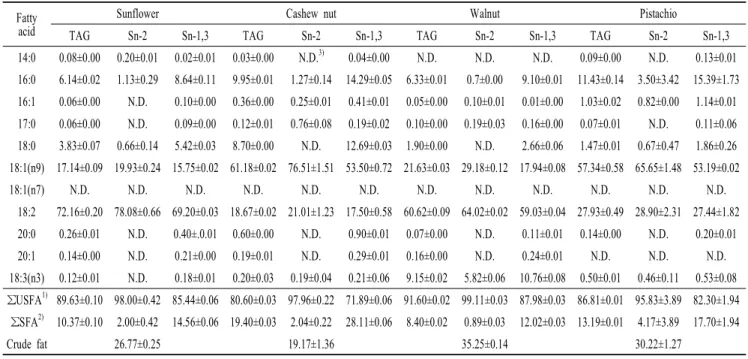
시중에서 판매되고 있는 견과류 종류를 수거하여 분석 8 한 조지방 함량과 지방산 조성을 Table 1 과 Table 2 에 나타 내었다 견과류의 조지방 함량은 . 0.63 39.60 wt% ∼ 로 다양하 게 나타내었는데 특히 hazel nut 이 39.60 wt% 로 가장 많은 양을 나타내었으며 walnut 이 35.25 wt%, pistachio 가 30.22 로써 각각 비교적 높은 양을 나타내고 있었다 지방산
wt% .
조성의 경우 대부분의 시료가 불포화 지방산을 다량 함유 , 하고 있다는 것을 알 수 있었으며, cashew nut, pistachio,
의 경우 공통적으로
hazel nut, pecan oleic acid, linoleic acid, 의 순으로 높은 함량을 나타내고 있었 palmitic acid(C16:0)
으며 이는 , Toschi 등 (18) , Kim 과 등 이 연구한 것과 유사 (3) 하게 나타났다 그 중에서도 . hazel nut 은 oleic acid(C18:1) 가 로 다른 견과류에 비교하여 가장 많은 양을 함유 82.44 wt%
하고 있었으며 불포화 지방산 또한 , 91.89 wt% 로 cashew
의 불포화 지방산 함량인 에 비하여
nut 80.60 wt% 11.29 wt%
정도 높았음을 확인할 수 있었다 . Linoleic acid 가 72.16 wt%,
로 각각 높은 함량을 나타낸 와
46.01 wt% sunflower seed
는 다음으로 의
pumpkin seed C18:2 oleic acid, palmitic acid 순으로 높은 함량을 나타내어 cashew nut, pistachio, hazel
과는 다른 조성을 나타내고 있다는 것을 알 수 nut, pecan
있었다 . Sunflower seed 의 경우 Kim(19) 이 연구한 결과와 비교하였을 때 다른 양상을 나타내었는데 이는 , sunflower 의 종자가 다름으로 인한 결과임을 유추할 수 있다 또한 . ,
는 등 이 연구한 결과와 유사하게
pumpkin seed Glew (20)
나타났다 . Walnut 의 경우 지방산 조성이 linoleic acid, oleic
가 각각 이였으며 특히
acid 60.62, 21.63 wt% , linolenic
가 다른 견과류에 비하여 가장 높은 를
acid(C18:3) 9.15 wt%
함유하고 있는 것으로 나타내어 walnut 은 ω 3 계 지방산을
많이 함유 하고 있을 것으로 유추할 수 있다 이는 .
Table 1. Positional fatty acid compositions of the extracted seed oils Fatty
acid
Sunflower Cashew nut Walnut Pistachio
TAG Sn-2 Sn-1,3 TAG Sn-2 Sn-1,3 TAG Sn-2 Sn-1,3 TAG Sn-2 Sn-1,3
14:0 0.08±0.00 0.20±0.01 0.02±0.01 0.03±0.00 N.D.3) 0.04±0.00 N.D. N.D. N.D. 0.09±0.00 N.D. 0.13±0.01 16:0 6.14±0.02 1.13±0.29 8.64±0.11 9.95±0.01 1.27±0.14 14.29±0.05 6.33±0.01 0.7±0.00 9.10±0.01 11.43±0.14 3.50±3.42 15.39±1.73 16:1 0.06±0.00 N.D. 0.10±0.00 0.36±0.00 0.25±0.01 0.41±0.01 0.05±0.00 0.10±0.01 0.01±0.00 1.03±0.02 0.82±0.00 1.14±0.01 17:0 0.06±0.00 N.D. 0.09±0.00 0.12±0.01 0.76±0.08 0.19±0.02 0.10±0.00 0.19±0.03 0.16±0.00 0.07±0.01 N.D. 0.11±0.06 18:0 3.83±0.07 0.66±0.14 5.42±0.03 8.70±0.00 N.D. 12.69±0.03 1.90±0.00 N.D. 2.66±0.06 1.47±0.01 0.67±0.47 1.86±0.26 18:1(n9) 17.14±0.09 19.93±0.24 15.75±0.02 61.18±0.02 76.51±1.51 53.50±0.72 21.63±0.03 29.18±0.12 17.94±0.08 57.34±0.58 65.65±1.48 53.19±0.02
18:1(n7) N.D. N.D. N.D. N.D. N.D. N.D. N.D. N.D. N.D. N.D. N.D. N.D.
18:2 72.16±0.20 78.08±0.66 69.20±0.03 18.67±0.02 21.01±1.23 17.50±0.58 60.62±0.09 64.02±0.02 59.03±0.04 27.93±0.49 28.90±2.31 27.44±1.82 20:0 0.26±0.01 N.D. 0.40±.0.01 0.60±0.00 N.D. 0.90±0.01 0.07±0.00 N.D. 0.11±0.01 0.14±0.00 N.D. 0.20±0.01 20:1 0.14±0.00 N.D. 0.21±0.00 0.19±0.01 N.D. 0.29±0.01 0.16±0.00 N.D. 0.24±0.01 N.D. N.D. N.D.
18:3(n3) 0.12±0.01 N.D. 0.18±0.01 0.20±0.03 0.19±0.04 0.21±0.06 9.15±0.02 5.82±0.06 10.76±0.08 0.50±0.01 0.46±0.11 0.53±0.08 ΣUSFA1) 89.63±0.10 98.00±0.42 85.44±0.06 80.60±0.03 97.96±0.22 71.89±0.06 91.60±0.02 99.11±0.03 87.98±0.03 86.81±0.01 95.83±3.89 82.30±1.94 ΣSFA2) 10.37±0.10 2.00±0.42 14.56±0.06 19.40±0.03 2.04±0.22 28.11±0.06 8.40±0.02 0.89±0.03 12.02±0.03 13.19±0.01 4.17±3.89 17.70±1.94
Crude fat 26.77±0.25 19.17±1.36 35.25±0.14 30.22±1.27
1)
The sum of total unsaturated fatty acid,
2)The sum of total saturated fatty acid,
3)Not detected.
Table 2. Positional fatty acid compositions of the extracted seed oils Fatty
acid
Pumpkin Ginkgo Hazel nut Pecan
TAG Sn-2 Sn-1,3 TAG Sn-2 Sn-1,3 TAG Sn-2 Sn-1,3 TAG Sn-2 Sn-1,3
14:0 0.11±0.00 N.D.3) 0.16±0.00 0.11±0.00 N.D. 0.16±0.01 N.D. N.D. N.D. 0.05±0.00 N.D. 0.08±0.00 16:0 11.45±0.00 1.93±0.53 16.21±0.27 8.57±0.00 4.64±0.41 10.54±0.21 5.30±0.02 0.46±0.01 7.72±0.03 6.53±0.12 0.60±0.02 9.49±0.17 16:1 0.09±0.00 N.D. 0.13±0.00 3.25±0.01 1.98±0.05 3.89±0.04 0.13±0.01 N.D. 0.19±0.01 0.08±0.00 N.D. 0.13±0.01
17:0 0.10±0.01 N.D. 0.15±0.01 N.D. N.D. N.D. N.D. N.D. N.D. N.D. N.D. N.D.
18:0 6.81±0.03 1.14±0.22 9.65±0.06 1.07±0.11 1.99±0.65 0.61±0.48 2.69±0.04 0.40±0.06 3.83±0.03 2.05±0.04 N.D. 3.08±0.06 18:1(n9) 34.66±0.19 35.17±0.09 34.40±0.32 15.42±0.03 26.55±0.15 9.86±0.03 82.44±0.13 87.20±0.06 80.06±0.23 56.62±2.11 56.78±1.81 56.54±2.26
18:1(n7) N.D. N.D. N.D. 20.37±0.13 10.72±0.16 25.20±0.27 N.D. N.D. N.D. N.D. N.D. N.D.
18:2 46.01±0.22 61.48±0.71 38.28±0.02 48.43±0.03 53.19±0.73 46.05±0.41 9.16±0.06 11.94±0.11 7.77±0.14 32.83±2.01 41.33±1.84 28.58±2.10 20:0 0.52±0.00 N.D. 0.78±0.00 0.52±0.02 N.D. 0.79±0.03 0.12±0.00 N.D. 0.18±0.00 0.11±0.00 N.D. 0.16±0.00
20:1 N.D. N.D. N.D. N.D. N.D. N.D. 0.16±0.00 N.D. 0.24±0.02 0.27±0.01 N.D. 0.41±0.02
18:3(n3) 0.24±0.00 0.28±0.04 0.23±0.02 2.24±0.05 0.93±0.03 2.90±0.09 N.D. N.D. N.D. 1.45±0.00 1.29±0.05 1.53±0.02 ΣUSFA1) 81.01±0.03 96.93±0.76 73.04±0.33 89.73±0.09 93.37±1.06 87.91±0.66 91.89±0.06 99.14±0.06 88.26±0.05 91.26±0.09 99.40±0.02 87.19±0.12
ΣSFA2) 18.99±0.03 3.07±0.76 26.96±0.33 10.27±0.09 6.63±1.06 12.09±0.66 8.11±0.06 0.86±0.06 11.74±0.05 8.74±0.09 0.60±0.02 12.81±0.12
Crude fat 25.48±3.19 0.63±0.06 39.60±0.57 23.98±1.66
1)
The sum of total unsaturated fatty acid,
2)The sum of total saturated fatty acid,
3)Not detected.
이 연구한 결과와 유사함을 볼 수 있었으며
Sabudak(21) ,
의 경우 특이적으로 의 이성체인
ginkgo oleic acid vaccenic
를 확인할 수 있었으며 이는 보다 약
acid , oleic acid 5 wt%
정도 높은 차이를 보였으며 , sn-1,3 위치에서는 25.20 wt% 로 높게 나타났음을 알 수 있었다 이는 . Kim 등 (22) 이 연구한 결과와 유사함을 보였다 이후 추출된 유지의 총 지방산 . 조성이외에 위치별 조성을 살펴보았다 . Sn-2 위치의 지방산
조성으로는 cashew nut, pistachio, hazel nut 이 총 지방산 조성과 비슷한 양상을 보여 oleic acid, linoleic acid, palmitic
의 순으로 나타났다 역시
acid . Sunflower seed linoleic acid, 의 순으로 높은 함량을 나타내어 oleic acid, stearic acid(18:0)
총 지방산 조성과 비슷하였음을 확인하였다 . Walnut 의 경
우 64.02 wt% 로 linoleic acid 가 가장 높았으며 , sn-2 위치에
서의 linolenic acid 는 총 지방산 조성에서보다 3.33 wt% 나
적게 나타났음을 알 수 있었다 . Pumpkin seed 의 경우 sn-2 는 총 지방산의 조성과 비슷한 양상을 나타내었으며, palmitic
는 위치의 보다 적은 를 나타
acid sn-1,3 16.21 wt% 1.93 wt%
내었다 또한 견과류 중에서 특이하게 . , oleic acid 의 이성체 인 vaccenic acid 를 나타내었던 ginkgo 의 경우 10.72 wt% 를 나타내었는데 이는 총 지방산 조성에서 보다 , 9.65 wt%
적은 함량 이였으며 , sn-2 위치에서는 oleic acid 가 vaccenic
보다 높은 함량을 나타내었다 의 경우
acid . Pecan oleic acid
와 linoleic acid 가 56.78, 41.33 wt% 로 총 지방산과 비슷한 양상을 나타내었다.
에 의한 분석
Reverse-phase HPLC triacylglycerol
과 는 견과류의 조성
Fig. 1 Table 3 triacylglycerol species 을 reverse-phase HPLC 를 이용하여 분석한 것을 나타내었 다 . TAG 의 PN 값은 40 52 ∼ 사이에 존재하였으며 sunflower
가 범위에서 로 가장 높게 나타났는
seed PN 42 46.55 area%
데 그 이유로는 지방산 조성을 보았을 때 linoleic acid 를 많이 함유하고 있기 때문인 것으로 추측할 수 있다. Cashew 으로부터 추출된 유지는 대부 nut, pistachio, hazel nut, pecan
분이 PN 48 범위에 해당되었고 이때의 , area% 는 각각 55.46,
이었으며 특히 은 대부분
46.76, 86.63, 39.54 area% , hazel nut
의 TAG 조성이 PN 48 범위에서 다른 견과류에 비하여 뚜렷 이 높은 함량을 나타냈음을 볼 수 있었다 . Walnut 의 경우
범위에서 로 비슷하게 나타났
PN 42, 44 39.13, 36.46 area%
다 . Pumpkin seed 는 PN 46 범위에서 37.18 area% 로 가장 높았으며 , PN 44 범위에서 32.33 area% 로 그 다음으로 높았 다 . Ginkgo 의 PN 값은 42 48 ∼ 사이에 존재하였으며 , PN 44 범위에서 48.22 area% 로 가장 높았음을 확인할 수 있었다 .
Table 3. Peaks classified by partition number (PN) of TAG species in the textracted seed oils.
Partition number(PN)
(Area%) Sunflower seed Cashew nut Walnut Pistachio Pumpkin seed Ginkgo Hazel nut Pecan
PN1)=40 N.D.2) N.D. 7.31±0.32 N.D. N.D. N.D. N.D. N.D.
PN=42 46.55±2.02 N.D. 39.13±1.33 1.40±0.01 7.84±0.56 14.76±0.63 N.D. 3.00±0.78
PN=44 40.93±1.46 4.16±0.25 36.46±0.11 12.10±0.64 32.33±3.30 48.22±1.48 0.80±0.25 17.30±3.44 PN=46 12.53±0.54 23.02±0.16 14.42±0.34 39.00±2.19 37.18±1.02 30.98±1.51 9.66±2.14 39.17±1.35
PN=48 N.D. 55.46±0.04 2.70±1.42 46.76±2.28 18.64±3.69 6.06±0.61 86.63±3.24 39.54±5.68
PN=50 N.D. 15.68±0.19 N.D. 0.75±0.52 3.36±1.14 N.D. 2.92±0.84 1.00±0.12
PN=52 N.D. 1.68±0.25 N.D. N.D. 0.65±0.04 N.D. N.D. N.D.
1)
Partition number(PN) = total number of carbons(CN) - 2 × total number of double bonds(ND).
2)
Not detected.
Tocopherol 분석
조사된 견과류의 tocopherol 의 분석 결과는 Table 4 에 나 타내었다 총 . tocopherol 함량을 분석한 결과 ginkgo 가 48.57
으로 가장 높은 함량을 나타내며
mg/100 g , sunflower seed
및 pumpkin seed 가 각각 38.35, 31.43 mg/100 g 을 나타내었
다 . Pistachio 와 hazel nut 은 각각 23.22, 23.35 mg/100 g 으로 분석되었고 서로 유사한 경향성을 보였다 , (p<0.05). 특히 ,
는 이 으로
pistachio γ -tocopherol 21.79 mg/100 g α -tocopherol 보다 약 14 배 높은 수치를 나타내는 반면 hazel nut 은 α
이 으로 보다 약 배
-tocopherol 20.46 mg/100 g γ -tocopherol 7 높은 수치를 나타내고 있었다 또한 . , walnut 과 pecan 역시
으로 유사한 경향성을 보임을 알 수 15.06, 13.41 mg/100 g
있었으며 (p<0.05), walnut 의 경우 다른 견과류와는 달리 유 일하게 δ -tocopherol 을 1.47 mg/100 g 이나 함유하고 있는 것으로 나타내어졌다 . Cashew nut 은 5.07 mg/100 g 으로 다 른 견과류에 비하여 비교적 낮은 수치를 보여주며 가장 , 높은 함량을 나타낸 ginkgo 와 약 43.5 mg/100 g 의 차이를 보였다.
Phytosterol 분석
조사된 견과류로부터 추출된 시료에 함유되어 있는 총
과 각각의 및
phytosterol campesterol, stigmasterol β
의 함량을 분석한 결과는 에 나타내었다
-sitosterol Table 5 .
총 sterol 의 경우 88.60 mg/100 g 부터 많게는 947.20 mg/100
까지 다양하게 나타내었으며 은 과
g , cashew nut pecan
으로 유사한 경향을 보였다
104.77, 88.60 mg/100 g .
의 경우 분석한 견과류 중 유일하게 Sunflower seed
을 이나 함유하고 있었다 또한
stigmasterol 33.18 mg/100 g . ,
의 경우 이 각각
ginkgo campesterol, β -sitosterol 204.92, 을 나타내어 총 의 경우 다른 견과류에 742.28 mg/100 g sterol
비해 가장 높은 947.20 mg/100 g 이 포함 되어 있는 것을 확인 할 수 있었다 . Sunflower seed 와 ginkgo 이외에
또한 이 포함되어 있는 것으로 확인되
pistachio campesterol
었으며 그 양은 다른 분석된 시료에 비해 적은 , 12.33
이였다 총 의 대부분이 이 차지하
mg/100 g . sterol β -sitosterol
였으며 , hazel nut 과 walnut 은 117.31, 116.68 mg/100 g 으로
인 과 유사한 경향성을 보임을 알
124.52 mg/100 g pumpkin
수 있었으며 (p<0.05), 104.77 mg/100 g 인 cashew nut 과도
유사한 경향성을 보였음을 알 수 있었다(p<0.05).
Fig. 1. Chromatograms from the reversed-phase HPLC separation of (A) sunflower, (B) cashew nut, (C) walnut, (D) pistachio, (E) pumpkin, (F) ginkgo, (G) hazel nut (H) pecan.
Table 4. Tocopherol contents in the extracted seed oils
Plant oils Tocopherol (mg/100 g)
-Tocopherol
α ɤ-Tocopherol δ-Tocopherol Total tocopherol
Sunflower 37.48±0.22a1) 0.88±0.02f N.D.2) 38.35±0.24b
Cashew nut 0.35±0.03f 4.72±0.03e N.D. 5.07±0.06f
Walnut 0.54±0.08ef 13.05±0.04d 1.47±0.19 15.06±0.31e
Pistachio 1.52±0.19d 21.70±0.72c N.D. 23.22±0.91d
Pumpkin 1.50±0.06d 29.93±2.67a N.D. 31.43±2.73c
Ginkgo 22.90±0.69b 25.67±0.36b N.D. 48.57±1.06a
Hazel nut 20.46±1.10c 2.90±0.12ef N.D. 23.35±1.22d
Pecan 1.12±0.08de 12.29±0.78d N.D. 13.41±0.86e
1)
Means in the same column with different letters are significantly different (p<0.05).
2)
Not detect.
Table 5. Phytosterol contents in the extracted seed oils
Plant oils Phytosterol (mg/100 g)
Campesterol Stigmasterol β-sitosterol Total phytosterol
Sunflower 48.64±4.49b1) 33.18±0.22 284.08±11.23b 365.90±15.50b
Cashew nut N.D. N.D.2) 104.77±6.67e 104.77±6.67de
Walnut N.D. N.D. 116.68±6.21de 116.68±6.21d
Pistachio 12.33±0.12c N.D. 264.76±3.64c 277.09±3.76c
Pumpkin N.D. N.D. 124.52±5.48d 124.52±5.48d
Ginkgo 204.92±8.98a N.D. 742.28±8.38a 947.20±17.35a
Hazel nut N.D. N.D. 117.31±13.56de 117.31±13.56d
Pecan N.D. N.D. 88.60±2.25f 88.60±2.25e
1)
Means in the same column with different letters are significantly different (p<0.05).
2)
Not detected.
요 약
견과류 중 sunflower seed, cashew nut, walnut, pistachio, 을 원료로 하여 지방 pumpkin seed, ginkgo, hazel nut, pecan
산 조성 분석 및 sn-2 position 분석 , triacylglycerol species 의 분석 , tocopherol, phytosterol 함량을 분석하였다 조지방 함 . 량은 hazel nut 에서 약 39.60 wt% 로 가장 높았으며 , walnut
등의 순이었다 에 의한
35.25 wt%, pistachio 30.22 wt% . GC
위치의 지방산 조성 분석 결과 의 함량이
sn-2 , oleic acid
많은 견과류는 cashew nut, pistachio, hazel nut, pecan 이였으 며 특히 , ginkgo 의 경우 특이적으로 oleic acid 의 이성체인
가 나타냄을 확인할 수 있었다 반
vaccenic acid 10.72 wt% .
면 , linoleic acid 등이 높은 견과류는 sunflower seed, walnut,
이었다 견과류들의 의 값은
pumpkin seed . TAG species PN
사이에 존재하였다 의 함량은
40 52 ∼ . Tocopherol ginkgo, 등에서 각각
sunflower seed, pumpkin seed 48.57, 38.35, 순으로 높은 함량을 나타내었다 또한 총
31.43 mg/100 g .
의 경우 사이에 함량을
phytosterol 88.60 947.20 mg/100 g ∼ 나타내었다.
감사의 글
본 연구는 2010 년도 식품의약품안전청 용역연구개발과 제의 연구개발비 지원 (10162 영기안 088) 에 의해 수행되었 으며 이에 감사드립니다.
참고문헌
1. Park, Y.G., Park, M.Y., Sung, M.K. and Kwon, H.J.
(2005) Study on the intake pattern of health intended
foods depending on inclusion of proclaimed health
functional food materials. J. Korean Soc. Food Sci. Nutr., 34, 374-379
2. Pattee, H.E. and Young, C.T. (1982) Peanut science and technology, American Peanut Research and Education Society. Yoakum, Texas, U.S.A., p.139-163
3. Kim, J.N., Cho, D.H. and Kim, Y.M. (2000) Studies on the physicochemical properties of natural and imitation nuts. J. Korean Soc. Food Sci. Nutr., 13, 235-241 4. Grundy, S.M. (1977) Treatment of hypercholesterolemia.
Am. J. Clin. Nutr., 30, 985-992
5. Kritchevsky, D., Tepper, S.A., Bises, G and Klurfeld, D.M. (1982) Experimental atherosclerosis in rabbits fed cholesterol free diets. Atherosclerosis, 41, 279-284 6. Shepherd, J., Packard, C.J., Grundy, S.M., Yeshrun, D.,
Gotto, A.M. and Taunton, O.D. (1980) Effects of saturated and polyunsaturated fat diets on the chemical composition and metabolism of low density lipoproteins in man. J. Lipid Res., 21, 91-99
7. Becker, N., Illingworth, D.R., Alaupovic, P., Connor, W.E. and Sundbery, E.E. (1983) Effects of saturated, monosaturated, and ω -6 polyunsaturated fatty acid on plasma lipid, lipoprotein and apoproteins in human. Am.
J. Clin. Nutr., 37, 355-360
8. Sinclair, H.M. (1956) Deficiency of essential fatty acids and atherosclerosis, etcetea. Lancet, 1, 381-383 9. Zhu, B.Q., Smith, D.L., Sievers, R.E., Insenberg, W.M.
and Parmley, W.W. (1988) Inhibition of atherosclerosis by fish oil in cholesterol-fed rabbits. J. Am. Coll. Cardiol., 12, 1073-1078
10. Glomset, J.A. (1985) Fish, fatty acids, and human health.
N. Engl. J. Med., 312, 1253-1254
11. White, D.A., Bennett, A.J., Billett, M.A. and Salter, A.M.
(1998) The assembly of triacylglycerol-rich lipoproteins:
an essential role for the microsomal triacylglycerol transfer protein. Br. J. Nut., 80, 219-229
12. Ikeda, I., Tomari, Y., Sugano, M., Watanable, S. and Nagata, J. (1991) Lymphatic absorption of structured glycerolipids containing medium-chain fatty acid linoleic
acid, and their effect on cholesterol absorption in rats.
Lipids, 26, 369-373
13. Harman, D., (1969) Dibenzanthracene-induced cancer.
Inhibition effect of dietary vitamin E, Clin. Res., 17, 125-129
14. McCay, P.B., Poyer, J.L., Pfeifer, P.M., May, H.E. and Gilliam, J.M. (1971) A function for alpha-tocopherol:
stabilization of the microsomal membrane from radical attack during TPNH-dependent oxidations. Lipid, 6, 297-306
15. 식품의약품안전청 . (2007) 식품 등 중 기준규격 미 설정 물질의 시험방법 식품의약품안전청고시 제 . . 2007-10 . 호 16. Fomuso. L.B. and Akoh, C.C. (2002) Lipase-catalyzed acidd Asis of olive oil and cl rylic acid live bench-scale packed bed bioreactor. Food Res. Int., 35, 15-21 17. SAS Institute, Inc. (2000) SAS User's Guide. Statistical
Analysis Systems Institute, Cary, NC, USA.
18. Toschi, T.G., Caboni, M.F., Penazzi, G., Lercker, G. and Capella, P. (1993) A study on cashew nut oil composition.
J. Am. Oil. Chem. Soc., 70, 1017-1020
19. Kim, J.Y. and Lee, K.T. (2009) Enzymatic synthesis of low trans fats using rice bran oil, palm stearin and high oleic sunflower seed oil. J. Korean Soc. Food Sci. Nutr., 38, 470-478
20. Glew, R.H., Glew, R.S., Chuang, L.T., Huang, Y.S. and Millson, M. (2006) Amino acid, mineral and fatty acid content of pumpkin seeds (Cucurbita spp) and Cyperus esculentus nuts in the republic of niger. Plant Foods for Human Nutrition, 61, 51-56
21. Sabudak, T. (2007) Fatty acid composition of seed and leaf oils of pumpkin, walnut, almond, maize, sunflower and melon. Chemisty of Natural Compounds, 43, 465-467 22. Kim, S.J., Lee, K.H., Kim, Y.S. and Joh, Y.G. (1993) Studies on the presence of all cis-△
5,11,14-C
20:3fatty acid in the seed oils of ginkgo. J. Korean Oil Chem. Soc., 10, 57-65
접수 년 월 일 수정 년 월 일 채택 년 월 일
( 2009 12 31 , 2010 4 29 , 2010 6 4 )