고추냉이 잎, 엽병 추출물의 이화학적 특성과 항산화 활성
성은희․신세미․강윤한 강릉원주대학교 식품가공유통학과
Physicochemical Quality Characteristics and Antioxidant Activity of Wasabi (Wasabia japonica) Leaf and Petiole Extracts
Eun Hee Sung, Se Mi Shin, and Yoon-Han Kang
Department of Food Processing and Distribution, Gangneung-Wonju National University
ABSTRACT In this study, we investigated the physicochemical quality characteristics and antioxidant activities of water extracts (20°C and 95°C) against different parts (leaf and petiole) from Wasabia japonica (wasabi). Water extracts were divided into six types of wasabi powders: leaf hot air dried (LD), petiole hot air dried (PD), whole (leaf+petiole) hot air dried (WD), leaf steamed and hot air dried (LSD), petiole steamed and hot air dried (PSD), and whole steamed and hot air dried (WSD). Turbidity was higher in wasabi 20°C water extracts than in 95°C hot water extracts. Browning degree was higher in wasabi leaf extracts than in petiole extracts. The pH of hot water extraction was lower than that of room temperature extraction. Wasabi extracts did not show much difference in Hunter’s color values according to extraction temperature, expected that b value of yellowness was significantly higher in leaf extracts than in petiole extracts. Carbazole pectin contents of leaf extracts were significantly higher than in petiole extracts, however water soluble pectin was higher in petiole extracts. The total polyphenol contents of LD20 and LD95 were 1,561.43 mg gallic acid equivalent (GAE)/100 g and 1,163.02 mg GAE/100 g, respectively, and total polyphenols decreased during hot water extraction. Extracts from different parts of wasabi showed a significant difference in total flavonoid contents.
Total flavonoid contents of LD20, LD95, PD20, and PD95 were 554.44 mg/100 g, 396.65 mg/100 g, 55.42 mg/100 g, and 47.68 mg/100 g, respectively. In the sensory evaluation, LD95 extract showed significantly higher values than other samples in terms of color, flavor, taste, mouth feeling, and overall acceptability. In the analysis of sourness, saltiness, umami, sweetness, and bitterness taste by an electronic tongue, the sourness values of LD20 and PSD95, saltiness values of WSD20 and WSD95, and umami values of PD20 and PD95 were significantly higher than other extracts. The results of this study suggest that wasabi leaf and petiole extracts enhance qualities and antioxidant activities when used different parts together.
Key words: Wasabia japonica, wasabi, total polyphenol, total flavonoid, antioxidant activity
Received 8 September 2016; Accepted 1 February 2017 Corresponding author: Yoon-Han Kang, Department of Food Proc- essing and Distribution, Gangneung-Wonju National University, Gangneung, Gangwon 25457, Korea
E-mail: [email protected], Phone: +82-33-640-2966
서 론
고추냉이는 십자화과 채소에 속하는 채소류로 서늘한 기 후에서 최근에 밭 재배 양식으로 재배되고 있다. 성분으로 allyl isothiocyanate가 전체 정유의 조성 중 22.13%로 그 생성은 glucosinolate 화합물의 일종인 sinigrin이 myr- osinase에 의해 가수분해 되어 allyl isothiocyanate의 특성 인 강렬한 향미를 가지는 것으로 서양산 고추냉이(Horse- radish, Armoracia rusticana)에 대하여 보고되어 있다(1).
그리고 일본이 원산지인 와사비(Wasabia japonica Mat- sum.) 잎을 이용한 열수 추출물로부터 항비만 효과가 있는
것으로 나타났다(2). 고추냉이 배당체인 sinigrin은 고추냉 이 특유의 매운 향과 맛을 내는 성분으로 항균성이 있으며, 부위별 함량에 있어서 근경에 가장 많고 엽병과 잎에도 일정 량 함유되어 있는 것으로 보고되어 있다(3). 고콜레스테롤 관련 고추냉이의 잎과 뿌리의 부위별 급여한 동물실험에서 흰쥐의 항콜레스테롤 효과가 있는 것으로 보고되었다(4). 또 한, 고추냉이는 생선의 비린내를 없애는 향신료로서의 용도 뿐만 아니라 allyl isothiocyanate 등 매운맛 성분에 의한 항균작용의 보존료 등 천연첨가물로서의 재료로 각광을 받 고 있다(5-7). 분말이나 추출물을 이용한 김치(8-10), 어묵 (11), 고추장(12) 등의 제조에 이용되고 있다.
고추냉이는 휘발성 향기와 맛 성분뿐만 아니라 기능성 물 질인 sinigrin(13), ally isothiocyanate(14,15)에 대한 다수 의 연구가 이루어져 있으나, 차와 커피 등 기호음료의 지표 물질인 카테킨, 프로안토시아니딘 등 폴리페놀화합물에 대 한 잎, 엽병, 뿌리 등 부위별 함량과 활용 사례는 거의 없는
실정이다.
폴리페놀화합물은 폴리페놀 구조(벤젠 고리에 수개 이상 의 수산기)를 가진 고등 식물체 성분의 총칭이다. 종류는 4,000~7,000종이며 대사산물로는 페놀산(phenolic acids;
benzoic acids 및 그 유도체, cinnamic acids 및 그 유도체), 플라보노이드(flavonoids), 탄닌(tannin) 등으로 대별된다.
이러한 폴리페놀은 체내 활성산소를 제거하는 항산화제 (antioxidants)로 심장병(cardiovascular diseases-CVDs), 암, 당뇨, 염증, 노화, 천식 등을 예방하며, 비만 억제, 콜레스 테롤 상승 억제 등 생리 기능을 가지고 있다(16). 그러나 이들 성분이 함유된 고추냉이 추출물의 향미 성분에 대한 관능적 특성 연구는 없는 실정이며, 고추냉이의 이용은 뿌리 에 집중되어 있다. 따라서 본 연구는 잎, 엽병의 기능성 성분 을 이용한 침출차 등 고부가가치 제품의 개발을 위한 기초자 료로 활용하고자 한다.
재료 및 방법
실험 재료
고추냉이는 2014년 영월군 소재 농원에서 잎과 엽병이 있는 그대로 구입하여 세척한 후 잎(leaf, L), 엽병(petiole, P), 전체(whole, W)로 구분하였다. 이 시료를 그대로인 생, 열처리한 증숙(steaming, S) 처리구 등을 건조기로 40°C에 서 15시간 열풍건조(hot air drying, D) 하고 분쇄기로 분쇄 하여 분말 시료로 하였다.
고추냉이 잎, 엽병 추출물의 제조
고추냉이 잎, 엽병 추출물은 상온 추출(20°C), 열수 추출 (95°C)로 하였다. 추출용 고추냉이 시료 분말의 제조는 다음 과 같이 6종으로 전처리하여 이용하였다. 즉 잎 열풍건조 (leaf hot air dried, LD), 엽병 열풍건조(petiole hot air dried, PD), 전체 열풍건조[whole(leaf+petiole) hot air dried, WD], 잎 증숙 열풍건조(leaf steamed and hot air dried, LSD), 엽병 증숙 열풍건조(petiole steamed and hot air dried, PSD), 전체 증숙 열풍건조[whole(leaf+petiole) steamed and hot air dried, WSD] 등으로 구분하였다.
상온 추출은 분말 3 g에 증류수 100 mL 첨가하여 실온에 서 1시간 추출하여 여과지(Whatman No. 2, GE Health- care, Amersham, UK)로 여과한 액을 100 mL로 정용하여 상온 추출물로 하였다. 열수 추출은 분말 3 g에 증류수 100 mL를 첨가한 후 water bath 상에서 95°C, 1시간 환류 추출 하여 여과한 다음 100 mL로 정용하여 분석시료로 하였다.
탁도, 갈변도 및 pH
상온과 열수 추출물의 탁도는 여과액을 분광광도계(Uvi Line 9100, Schott Instruments, Mainz, Germany)를 이용 하여 600 nm에서 흡광도를 측정하였다(17). 갈변도는 상온 및 열수 추출 중에 일어나는 색의 변화와 관련하여 여과액을
분광광도계를 이용하여 420 nm에서 흡광도를 측정하여 나 타내었다. 추출물의 pH는 각각 추출한 여과물을 pH 메타 (pH 210, Hanna, Woonsocket, RI, USA)로 측정하였다.
색도
고추냉이 추출물의 색도는 Hunter 값인 L값(백색도/흑색 도), a값(적색도/녹색도), b값(황색도/청색도) 및 ΔE값을 색 차계(CM-3500d, Minolta, Tokyo, Japan)로 측정하였다.
이때 백색판의 L, a, b 값은 98.57, -0.21, -0.31이었다.
총펙틴 측정
총펙틴은 카바졸 펙틴과 수용성 펙틴 정량법에 의하여 추 출물 중 함량을 측정하였다. 카바졸 펙틴은 McComb와 McCready(18)의 방법에 따라 다음과 같이 정량하였다. 추 출물 0.2 mL에 황산 1.2 mL를 첨가하여 수조에서 85°C, 5분간 가열하였다. 냉각 후 0.1% carbazole을 0.1 mL 첨가 하여 vortex mixer로 잘 혼합하고 실온에서 15분간 방치한 다음 분광광도계(UV-Visible spectrophotometer, T60U, PG Instruments Ltd., Lutterworth, UK)를 사용하여 525 nm에서 흡광도를 측정하였다. 표준곡선은 농도별 galac- turonic acid(Sigma-Aldrich Co., St. Louis, MO, USA) 용 액을 조제하여 작성하여 함량을 계산하였다. 수용성 펙틴은 Blumenkrantz와 Asboe-Hansen(19)의 방법에 따라 샘플 1 mL를 1°C에서 5분간 방치한 후 황산용액에 녹인 0.0125 M sodium tetraborate 6 mL를 첨가하여 vortex mixing 하였다. 혼합한 것은 100°C의 항온수조에서 5분간 끓인 후 1°C에서 5분간 냉각시켜 0.15% NaOH에 녹인 0.15%
m-hydroxydiphenyl을 0.1 mL 첨가하였다. 혼합한 후 20 분간 방치하여 분광광도계(UV-Visible spectrophotome- ter, T60U, PG Instruments Ltd.)로 520 nm에서 흡광도를 첨가하였다. 이때 표준물질은 galacturonic acid(Sigma- Aldrich Co.)를 사용하였다.
총폴리페놀과 총플라보노이드
추출물 중 총폴리페놀 함량의 측정은 Da Silva Pinto 등 (20)의 방법에 따라 시료 0.25 mL에 Folin-Ciocalteu 시약 0.25 mL, 증류수 2 mL를 각각 첨가하여 실온에서 3분 동안 정치한 후 20% Na2CO3 0.25 mL를 첨가하여 수조에서 37
°C, 30분간 반응시킨 다음 흡광도를 분광광도계를 이용하여 750 nm에서 측정하였다. 이때 사용한 표준물질은 gallic acid(Sigma-Aldrich Co.)로 검량곡선으로부터 함량을 산 출하였다. 추출물의 총플라보노이드 함량은 샘플 1 mL에 diethylene glycol 10 mL를 첨가하여 잘 혼합한 후 1 N NaOH 1 mL를 가하여 수욕조에서 37°C에서 1시간 반응시 킨 다음 420 nm에서 흡광도를 측정하였다. 함량 산출을 위 한 플라보노이드 표준물질은 naringin(Sigma-Aldrich Co.) 을 이용하였다.
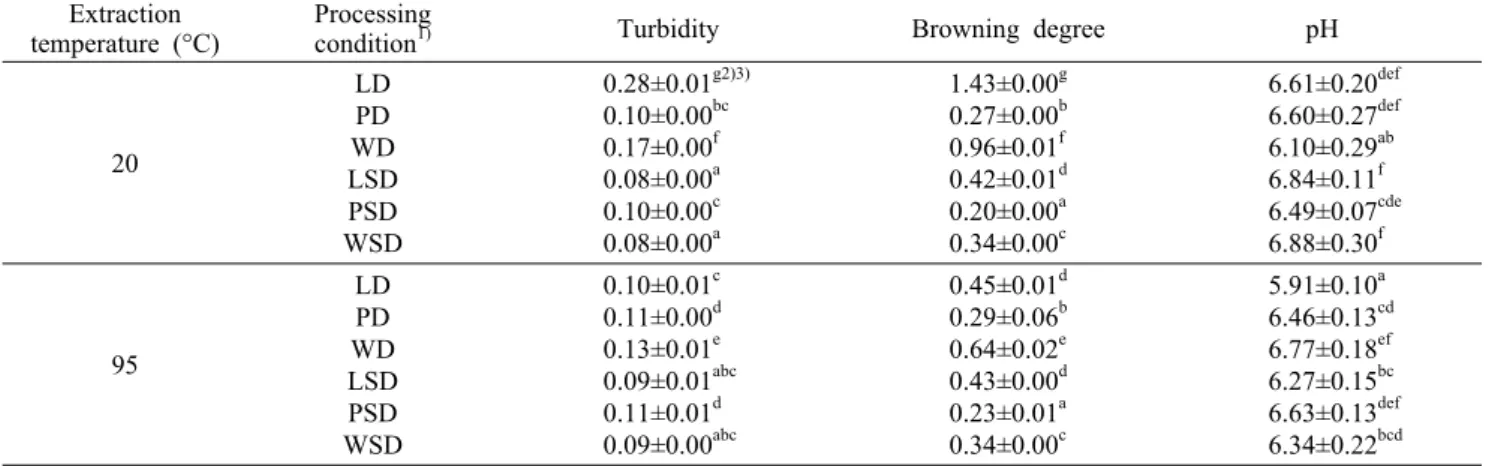
Table 1. Turbidity, browning degree, and pH of wasabi leaf and petiole extracts by processing condition and extraction temperature Extraction
temperature (°C) Processing
condition1) Turbidity Browning degree pH
20
LD PD WD LSD PSD WSD
0.28±0.01g2)3) 0.10±0.00bc 0.17±0.00f 0.08±0.00a 0.10±0.00c 0.08±0.00a
1.43±0.00g 0.27±0.00b 0.96±0.01f 0.42±0.01d 0.20±0.00a 0.34±0.00c
6.61±0.20def 6.60±0.27def 6.10±0.29ab 6.84±0.11f 6.49±0.07cde 6.88±0.30f
95
LD PD WD LSD PSD WSD
0.10±0.01c 0.11±0.00d 0.13±0.01e 0.09±0.01abc 0.11±0.01d 0.09±0.00abc
0.45±0.01d 0.29±0.06b 0.64±0.02e 0.43±0.00d 0.23±0.01a 0.34±0.00c
5.91±0.10a 6.46±0.13cd 6.77±0.18ef 6.27±0.15bc 6.63±0.13def 6.34±0.22bcd
1)LD: leaf hot air dried, PD: petiole hot air dried, WD: whole (leaf+petiole) hot air dried, LSD: leaf steamed and hot air dried, PSD: petiole steamed and hot air dried, WSD: whole steamed and hot air dried.
2)Values are mean±standard deviation of triplicate determinations.
3)Values with different letters within the same property are significantly different (P<0.05).
관능검사
고추냉이 잎, 줄기 추출물에 대한 관능검사는 강릉원주대 학교 식품가공유통학과 소속 총 10명의 재학생이 참가하여 실시하였다. ‘아주 나쁘다’의 1점으로부터 ‘아주 좋다’의 9 점까지 9점 척도법으로 색, 향, 맛, 입안 촉감 및 종합적 기호 도 항목을 평점법으로 평가하였다.
전자혀 분석
시료에 따른 맛에 대한 평가를 전자혀(Astree Ⅱ, Alpha MOS, Toulouse, France)를 사용하여 분석하였다. α- Astree Ⅱ는 자동 샘플러와 화학적으로 변형된 FET(Chem FET)에 의한 전위차 적정 센서가 장착되어 있다. 시료의 측정은 각각 SRS(신맛), STS(짠맛), UMS(감칠맛), SWS (단맛), BRS(쓴맛) 그리고 GPS와 SPS(보정센서)로 구성된 7개의 ISFET(Ion Selective Field Effector Transistor)와 Ag/AgCl 3 M KCl 기준 전극으로 구성된 센서에 의해 정성 분석 하였다. 분말시료 3 g에 증류수 100 mL 첨가하여 실온 또는 water bath에 넣어 1시간 추출한 후 여과(Whatman No. 2, GE Healthcare)한 액 25 mL를 유리용기에 담아 자동 시료측정기에 놓았다(21). 센서의 신호 수신 시간은 120초로 하였다. 모든 시료는 7회 반복 측정하여 5개의 값 을 통계처리 하였으며, Alpha MOS에서 제공된 소프트웨어 (Alphasoft version 12.4 & Arochembase V4)를 이용하였 다.
전자공여능과 환원력
추출물의 항산화 활성은 전자공여능의 DPPH(1,1-di- phenyl-2-picrylhydrazyl) 라디칼 소거 활성과 환원력을 각각 측정하였다. DPPH 라디칼 소거 활성은 Blois(22)의 방법에 따라 추출물 0.2 mL에 0.2 mM DPPH 0.8 mL를 첨가하여 잘 혼합한 후 10분간 방치한 다음 분광광도계로 525 nm에서 흡광도를 측정하였다. 전자공여능은 시료 첨가
전후의 흡광도 차이를 백분율(%)로 산출하여 나타내었다.
환원력 측정은 Yildirim 등(23)의 방법을 변형하여 시료 2.5 mL에 0.2 M 인산완충용액(pH 6.6) 2.5 mL, 1% potassium fericyanide 2.5 mL를 첨가하고 혼합하여 50°C에서 30분 간 반응시켰다. 반응 후 10% trichloroacetic acid 용액 2.5 mL를 첨가한 후 3,000 rpm에서 10분간 원심분리 하였다.
상징액 0.5 mL에 증류수 0.5 mL, 0.1% FeCl3 0.1 mL를 첨가하여 700 nm에서 흡광도를 측정하였다. 환원력이 클수 록 흡광도 값이 크고 항산화 활성이 높은 것으로 하였다.
통계처리
실험 결과의 통계분석은 SPSS(19.0, SPSS Inc., Chica- go, IL, USA) 통계프로그램을 이용하여 ANOVA를 실시하 고 3회 반복으로 시행한 시료 간 평균값을 구하여 Duncan’s multiple range test 방법으로 P<0.05 수준에서 유의성을 검증하였다. 페놀성 화합물 함량과 항산화 활성과의 상관성 분석은 Pearson의 상관계수를 사용하였다.
결과 및 고찰
탁도, 갈변도, pH
탁도는 고추냉이의 뿌리를 제거한 후 잎, 엽병 및 전체로 구분하고 증숙 유무별 열풍건조 하여 얻어진 분말 6종으로 부터 20°C와 95°C에서 조제한 추출물 LD, PD, WD, LSD, PSD, WSD 등의 흡광도를 측정하여 Table 1에 나타내었다.
20°C의 상온 추출에서 탁도 값은 LD20, PD20이 각각 0.28, 0.10, LSD20, PSD20이 각각 0.08, 0.10으로 나타나 생잎 이 증숙한 잎보다 탁도 값이 높았으며, 엽병은 생과 증숙했 을 때 같은 탁도 값을 나타내 열처리에 의해 엽병을 제외한 잎과 전체는 투명한 추출액을 얻을 수 있었다. 생 분말의 경우 가용성 성분의 용출과 갈변이 심한 것으로 나타났다.
반면 95°C의 열수 추출에서 탁도 값은 LD95, PD95이 각각
Table 2. Hunter’s color values of wasabi leaf and petiole extracts by processing condition and extraction temperature Extraction
temperature (°C) Processing
condition1) L2) a b ΔE
20
LD PD WD LSD PSD WSD
83.38±0.01a3)4) 91.32±0.02h 89.96±0.02g 87.26±0.01e 93.07±0.01j 85.58±0.03c
0.72 0.87 -2.70 -1.31 -0.03 0.09
±0.01k
±0.01l
±0.02d
±0.02f
±0.02g
±0.01h
21.34 1.60 16.77 17.90 2.57 18.55
±0.02j
±0.01a
±0.01e
±0.02g
±0.01c
±0.02h
27.05 8.87 19.71 22.00 7.39 23.49
±0.01k
±0.02d
±0.02e
±0.02g
±0.01b
±0.04h
95
LD PD WD LSD PSD WSD
85.26±0.13b 92.81±0.10i 89.56±0.09f 87.27±0.14e 93.19±0.02k 86.96±0.02d
-2.51 0.22 -2.98 -2.90 0.36 -3.20
±0.02e
±0.02i
±0.03b
±0.01c
±0.01j
±0.15a
22.75 2.76 17.36 20.38 2.21 22.47
±0.04l
±0.04d
±0.03f
±0.02i
±0.01b
±0.04k
27.20 7.70 20.46 24.19 7.17 26.17
±0.03l
±0.10c
±0.06f
±0.09i
±0.02a
±0.05j
1)LD: leaf hot air dried, PD: petiole hot air dried, WD: whole (leaf+petiole) hot air dried, LSD: leaf steamed and hot air dried, PSD: petiole steamed and hot air dried, WSD: whole steamed and hot air dried.
2)L: lightness/blackness, a: redness/greenness, b: yellowness/blueness.
3)Values are mean±standard deviation of triplicate determinations.
4)Values with different letters within the same color value significantly different (P<0.05).
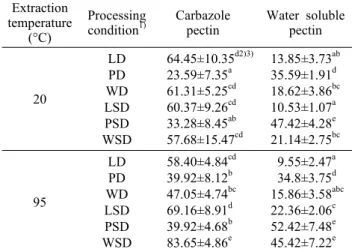
Table 3. Carbazole pectin and water soluble pectin of wasabi leaf and petiole extracts by processing condition and extraction temperature (mg/100 g)
Extraction temperature
(°C)
Processing
condition1) Carbazole
pectin Water soluble pectin
20
LD PD WD LSD PSD WSD
64.45±10.35d2)3) 23.59±7.35a 61.31±5.25cd 60.37±9.26cd 33.28±8.45ab 57.68±15.47cd
13.85±3.73ab 35.59±1.91d 18.62±3.86bc 10.53±1.07a 47.42±4.28e 21.14±2.75bc
95
LD PD WD LSD PSD WSD
58.40±4.84cd 39.92±8.12b 47.05±4.74bc 69.16±8.91d 39.92±4.68b 83.65±4.86e
9.55±2.47a 34.8±3.75d 15.86±3.58abc 22.36±2.06c 52.42±7.48e 45.42±7.22e
1)LD: leaf hot air dried, PD: petiole hot air dried, WD: whole (leaf+petiole) hot air dried, LSD: leaf steamed and hot air dried, PSD: petiole steamed and hot air dried, WSD: whole steamed and hot air dried.
2)Values are mean±standard deviation of triplicate determinations.
3)Values with different letters within the same pectin are sig- nificantly different (P<0.05).
0.10, 0.11, LSD95, PSD95이 각각 0.09, 0.11로 큰 차이는 없었다. 갈변도는 증숙하지 않은 잎 추출물인 LD20의 1.43, LD95의 0.45, 엽병 추출물인 PD20의 0.27, PD95의 0.29 로 잎 추출물의 갈변도가 심했지만 엽병 부분은 유의적으로 갈변도가 낮았다. 본 결과는 쇠무릎 부위별 추출물의 갈변도 측정 결과 잎의 경우 용매 중 물 추출물의 흡광도가 가장 높게 나타난 보고(24)와 일치하였다. 증숙한 잎 추출물은 LSD20의 0.42, LSD95의 0.43으로 열처리에 의해 갈변을 방지할 수 있었다. 이는 침출차 제조 시 색을 밝게 할 수 있으 며, 또한 열수 추출액 제조 시 갈변을 방지할 수 있을 것으로 생각된다. 그리고 엽병을 포함하여 추출한 잎 추출액은 엽병 추출액의 색도를 개선하는 데 이용될 수 있을 것으로 판단된 다. pH는 상온 추출액에서 6.10(WD20)~6.88(WSD20) 범 위이며, 열수 추출액이 5.91(LD95)~6.77(WD95)로 열수 추출액의 pH가 다소 낮은 것으로 나타났다.
색도
Table 2는 고추냉이를 잎과 엽병으로 나누어 열처리 여 부에 따라 건조하고 분쇄한 후 상온(20°C)과 고온(95°C)에 서 추출물을 얻어 백색도(L값), 적색도(a값), 황색도(b값) 등 을 측정한 것이다. 상온 추출의 L값은 잎 추출물의 LD20이 83.38로 백색도가 낮았으나 LSD20이 87.26으로 증숙을 통 하여 증가하였다. Kwon과 Youn(25)은 증숙에 따른 우엉차 의 백색도를 측정한 결과 증숙 열풍건조 한 우엉차의 밝기가 높다고 보고한 결과와 일치하였다. a값은 LD20, LSD20이 각각 0.72, -1.31로 증숙 후 적색도가 낮아짐을 알 수 있으 며 엽병인 PD20, PSD20 또한 0.87, -0.03으로 잎과 같은 경향을 보였다. b값도 LD20이 21.34였으나 LSD20이 17.90 으로 낮아져 밝은 황색으로 변하였다. 열수 추출물의 L값은 LD95, LSD95가 각각 85.26, 87.27로 증가하였으며 엽병 인 PD95, PSD95가 92.81, 93.19로 잎과 같은 경향을 보였
다. a값은 LD95, LSD95가 -2.51, -2.90으로 적색도가 비 교적 낮아졌다. b값은 LD95, LSD95가 각각 22.75, 20.38 로 증숙 후 황색도가 다소 낮아졌다.
카바졸 펙틴과 수용성 펙틴
고추냉이의 잎과 엽병 및 전체 등 부위별 증숙, 열풍건조 한 분말로부터 얻은 추출물 중 카바졸 펙틴과 수용성 펙틴 함량은 Table 3과 같다. 카바졸 펙틴은 LD20의 64.45 mg/
100 g, PD20의 23.59 mg/100 g이었으며, LSD20의 60.37 mg/100 g, PSD20의 33.28 mg/100 g으로 증숙 여부와 관
Table 4. Total polyphenol, total flavonoid values of wasabi leaf and petiole extracts by processing condition and extraction tem- perature
Extraction temperature
(°C)
Processing
condition1) Total polyphenol (mg GAE/100 g)
Total flavonoid (mg/100 g)
20
LD PD WD LSD PSD WSD
1,561.43±47.97g2)3) 667.85±44.43bc 1,513.56±95.74g 1,090.17±641.44e 555.30±84.13ab 880.72±92.08d
555.44±3.42g 55.42±10.47a 498.92±35.69f 384.70±7.83de 76.14±13.25a 343.76±12.00c
95
LD PD WD LSD PSD WSD
1,163.02±20.01e 551.75±59.67ab 1,322.39±73.43f 700.87±144.57c 429.94±31.30a 766.89±37.62cd
396.65±11.95e 47.68±0.86a 520.09±37.64f 364.21±6.16cd 68.29±5.25a 286.60±16.22b
1)LD: leaf hot air dried, PD: petiole hot air dried, WD: whole (leaf+petiole) hot air dried, LSD: leaf steamed and hot air dried, PSD: petiole steamed and hot air dried, WSD: whole steamed and hot air dried.
2)Values are mean±standard deviation of triplicate determinations.
3)Values with different letters within the same property are sig- nificantly different (P<0.05).
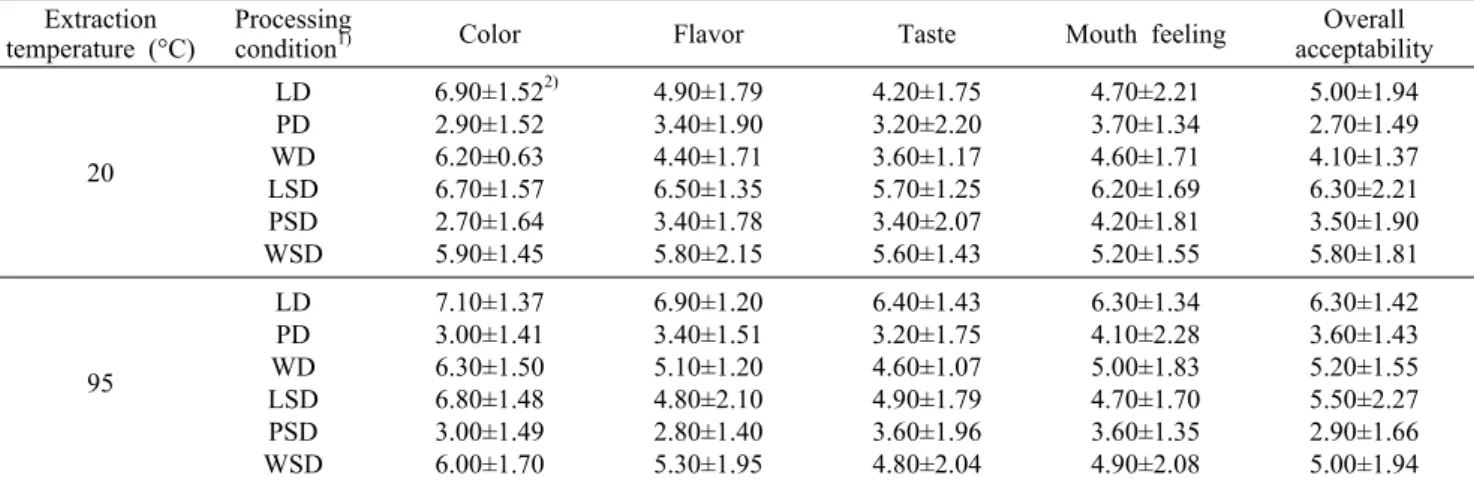
Table 5. Sensory characteristics scores of wasabi leaf and petiole extracts by processing condition and extraction temperature Extraction
temperature (°C) Processing
condition1) Color Flavor Taste Mouth feeling Overall acceptability
20
LD PD WD LSD PSD WSD
6.90±1.522) 2.90±1.52 6.20±0.63 6.70±1.57 2.70±1.64 5.90±1.45
4.90±1.79 3.40±1.90 4.40±1.71 6.50±1.35 3.40±1.78 5.80±2.15
4.20±1.75 3.20±2.20 3.60±1.17 5.70±1.25 3.40±2.07 5.60±1.43
4.70±2.21 3.70±1.34 4.60±1.71 6.20±1.69 4.20±1.81 5.20±1.55
5.00±1.94 2.70±1.49 4.10±1.37 6.30±2.21 3.50±1.90 5.80±1.81
95
LD PD WD LSD PSD WSD
7.10±1.37 3.00±1.41 6.30±1.50 6.80±1.48 3.00±1.49 6.00±1.70
6.90±1.20 3.40±1.51 5.10±1.20 4.80±2.10 2.80±1.40 5.30±1.95
6.40±1.43 3.20±1.75 4.60±1.07 4.90±1.79 3.60±1.96 4.80±2.04
6.30±1.34 4.10±2.28 5.00±1.83 4.70±1.70 3.60±1.35 4.90±2.08
6.30±1.42 3.60±1.43 5.20±1.55 5.50±2.27 2.90±1.66 5.00±1.94
1)LD: leaf hot air dried, PD: petiole hot air dried, WD: whole (leaf+petiole) hot air dried, LSD: leaf steamed and hot air dried, PSD: petiole steamed and hot air dried, WSD: whole steamed and hot air dried.
2)Values are mean±standard deviation of triplicate determinations.
계없이 잎에서 함량이 높았다. 열수 추출 시 잎인 LD95, LSD 95는 각각 58.40 mg/100 g, 69.16 mg/100 g으로 나타났 으며, 엽병인 PD95, PSD95는 각각 39.92 mg/100 g으로 동일한 값을 보였다. 이는 상온 혹은 열수 추출 시 잎으로부 터 다량의 카바졸 펙틴을 얻을 수 있다. Kye(26)의 보고에 서 카바졸 펙틴 함량은 각 추출물을 산 가수분해 하여 카바 졸 시약과 펙틴과의 반응 후 흡광도를 측정한 결과, 열수 가용성 펙틴 함량이 고추잎에서 550 mg/100 g으로 본 시료 의 함량보다 높은 값을 보였다.
수용성 펙틴과 관련하여 Jang과 Park(8)에 의하면 배추 김치의 수용성 펙틴 함량이 발효 전 155 mg/100 mL였으나 처리구 중 고추냉이 뿌리의 첨가량이 증가할수록 발효 후 수용성 펙틴의 함량이 낮아진다고 보고하였다. 본 결과에서 수용성 펙틴 함량은 LD20의 13.85 mg/100 g, PD20의 35.59 mg/100 g이었으며, LSD20의 10.53 mg/100 g, PSD20의 47.42 mg/100 g으로 엽병은 증숙 시 수용성 펙틴의 함량이 증가하였다. LD95의 9.55 mg/100 g, PD95의 34.8 mg/
100 g이었으며, LSD95의 22.36 mg/100 g, PSD95의 52.42 mg/100 g으로 상온 혹은 열수 추출 시 엽병이 잎보다 다량 의 수용성 펙틴의 공급원이라고 할 수 있다. 특히 WSD20, WSD95에서 각각 21.14 mg/100 g, 45.42 mg/100 g으로 나타나 수율 증진을 위해 엽병을 혼합하여 전체를 열수 추출 하는 것이 바람직할 것으로 생각된다.
총폴리페놀과 총플라보노이드
총폴리페놀 함량은 LD20, LSD20, LD95, LSD95의 잎 추출물이 각각 1,561.43, 1,090.17, 1,163.02, 700.87 mg gallic acid equivalent(GAE)/100 g 분말로 증숙과 고온 추 출로 감소하는 것으로 나타났다. PD20, PSD20, PD95, PSD95의 엽병 추출물의 총폴리페놀 함량은 각각 667.85, 555.30, 551.75, 429.94 mg GAE/100 g 분말로 잎과 같이 증숙과 고온 추출로 감소하였다. 총플라보노이드 함량은
LD20, PD20의 추출물이 각각 555.44 mg/100 g 분말, 55.42 mg/100 g 분말로 잎이 엽병보다 10배량 많은 것으로 나타났다(Table 4). 고추냉이 잎 열수 추출물에 함유되어 있는 총폴리페놀 함량은 1,944 mg/100 g, 총플라보노이드 함량은 769 mg/100 g으로 보고된 Park과 Lee(27)의 결과 와 비교할 때 함량이 낮은 것은 분말 조제 시 동결건조와 열풍건조에 따른 건조방법의 차이인 것으로 판단된다. LSD 20의 384.70 mg/100 g, LSD95의 364.21 mg/100 g으로 볼 때 증숙한 후 열수 추출하더라도 함량이 많이 감소하지 않는 것으로 나타났다.
0 2 4 6 8 10 SRS-sourness
STS-saltiness
UMS-umami SWS-sweetness
BRS-bitterness
LD PD
WD LSD
PSD WSD
A
0 2 4 6 8 10 SRS-sourness
STS-saltiness
UMS-umami SWS-sweetness
BRS-bitterness
LD PD
WD LSD
PSD WSD
B
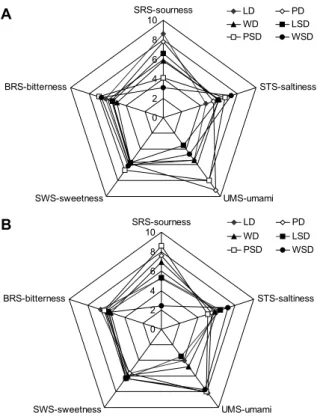
Fig. 1. Electronic tongue analysis of water extracts of wasabi leaf and petiole extracts by processing condition and extraction temperature (A, 20°C; B, 95°C). LD, leaf hot air dried; PD, petiole hot air dried; WD, whole (leaf+petiole) hot air dried;
LSD, leaf steamed and hot air dried; PSD, petiole steamed and hot air dried; WSD, whole steamed and hot air dried; SRS, sour- ness; STS, saltiness; UMS, umami; SWS, sweetness; BRS, bitterness.
0 10 20 30 40 50 60 70 80 90
LD20 PD20 WD20 LSD20 PSD20 WSD20 Wasabi extracts
Electron donating ability (%) .
A
0 10 20 30 40 50 60 70 80
LD95 PD95 WD95 LSD95 PSD95 WSD95 Wasabi extracts
Electron donating ability (%) .
B
Fig. 2. Electron donating ability of water extracts of wasabi leaf and petiole extracts by processing condition and extraction tem- perature (A, 20°C; B, 95°C). LD, leaf hot air dried; PD, petiole hot air dried; WD, whole (leaf+petiole) hot air dried; LSD, leaf steamed and hot air dried; PSD, petiole steamed and hot air dried; WSD, whole steamed and hot air dried. All results are mean±standard deviation of triplicate determinations.
관능검사
고추냉이 잎과 엽병을 증숙 등 전처리하고 상온 및 열수 추출물을 조제하여 색, 향, 맛, 입안 촉감 및 종합적 기호도를 조사한 결과는 Table 5와 같다. LD95의 추출물이 색, 향, 맛, 입안 촉감, 종합적 기호도 모두 가장 좋게 나타났으나 PD20, PSD20, PD95, PSD95 등에서는 종합적 기호도가 낮게 나온 것으로 보아 엽병 추출물의 관능적 특성을 높이기 위해 잎을 혼합하여 맛을 보완하는 데 이용될 수 있을 것으 로 생각한다. Kim과 Park(28)은 밭고추냉이의 성분 비교에 서 특히 잎은 감칠맛을 내는 glutamic acid를 포함한 아미노 산 함량이 다른 부위보다 다소 높아 엽채류 작물로 개발가치 가 있다고 평가하였다.
전자혀 분석
고추냉이 잎과 엽병을 증숙 등 전처리하고 상온 및 열수 추출물을 조제하여 맛의 차이를 판별함수분석(discrimi- nant function analysis; DFA)으로 각 시료 간 차별성의 전 체적인 패턴을 Fig. 1과 같이 나타내었다. Kim 등(29)은 전 자혀를 통해 탄닌 함량을 정량하였으며 전자혀 기기는 쓴맛 과 떫은맛 간의 정확도가 높다고 평가하였다. 또한, Kim 등 (30)의 연구에 따르면 묘사분석으로 나타내지 못한 단맛과
신맛의 차이를 전자혀를 통해 구분 가능하다고 보고하였다.
상온과 열수 추출물의 전자혀 특성 변화 중 신맛(SRS), 짠맛 (STS), 감칠맛(UMS), 단맛(SWS), 쓴맛(BRS)의 강도를 나 타낸 것이다. 시료 중 LD20, PSD95가 8.60의 값으로 신맛 이 가장 강하게 나타났다. 짠맛은 WSD20, WSD95에서 각 각 7.30, 7.20으로 가장 높은 값을 나타낸 것으로 보아 고추 냉이 전체를 증숙하여 추출할 경우 잎이나 엽병만 단독으로 하였을 때보다 짠맛이 강한 것을 알 수 있다. 감칠맛은 엽병 추출물인 PD20, PD95에서 각각 9.20, 8.10으로 가장 높은 값을 나타냈으며 고추냉이 잎과 엽병을 함께 사용할 시 감칠 맛의 역할인 짠맛과 단맛은 증가하고 신맛과 쓴맛은 감소할 것으로 생각된다.
항산화 활성
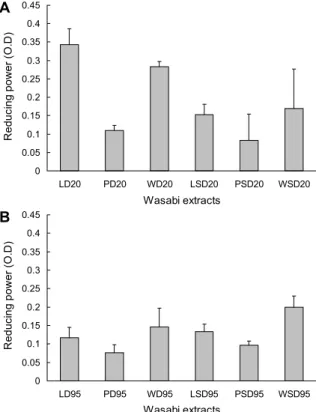
전처리를 달리한 고추냉이 잎과 엽병의 추출온도에 따른 추출액의 항산화 활성을 나타내는 전자공여능과 환원력은 각각 Fig. 2 및 Fig. 3과 같다. 전자공여능은 LD20, LSD20, LD95, LSD95의 잎 추출물이 각각 63.42%, 81.85%, 67.35
%, 67.60%로 나타났으며, 엽병 추출물인 PD20, PSD20, PD95, PSD95는 각각 32.4%, 72.90%, 0.08%, 0.08%로 잎이 엽병보다 항산화능이 우수하나 특히 엽병의 경우 열수
0 0.05 0.1 0.15 0.2 0.25 0.3 0.35 0.4 0.45
LD20 PD20 WD20 LSD20 PSD20 WSD20 Wasabi extracts
Reducing power (O.D) .
A
0 0.05 0.1 0.15 0.2 0.25 0.3 0.35 0.4 0.45
LD95 PD95 WD95 LSD95 PSD95 WSD95 Wasabi extracts
Reducing power (O.D) .
B
Fig. 3. Reducing power of water extracts of wasabi leaf and petiole extracts by processing condition and extraction temper- ature (A, 20°C; B, 95°C). LD, leaf hot air dried; PD, petiole hot air dried; WD, whole (leaf+petiole) hot air dried; LSD, leaf steamed and hot air dried; PSD, petiole steamed and hot air dried; WSD, whole steamed and hot air dried. All results are mean±standard deviation of triplicate determinations.
Table 6. Correlation coefficients between antioxidant phenolic compounds and antioxidant activities of wasabi leaf and petiole extracts by processing condition and extraction temperature
Total polyphenol Total flavonoid EDA Reducing power Total polyphenol
Total flavonoid
EDA (electron donating ability) Reducing power
1.000 0.894**
0.508**
0.730**
1.000 0.659**
0.661**
1.000
0.349* 1.000
*P<0.05, **P<0.01.
에서 페놀성 화합물의 손실로 인해 항산화능이 거의 나타나 지 않았다. 전자공여능은 총플라보노이드 함량 등 페놀성 화합물에 따른 변화가 커서 생잎을 열처리하여 열풍건조 하 더라도 항산화능은 유지되는 것으로 나타났다. 환원력은 LD20, LSD20, LD95, LSD95의 잎 추출물이 각각 0.34, 0.15, 0.12, 0.13이었으며, 엽병 추출물 PD20, PSD20, PD95, PSD95는 0.11, 0.08, 0.08, 0.10으로 엽병을 열처리 하여 열풍건조 및 높은 온도에서 추출하더라도 활성은 유지 되는 것으로 나타났다. 항산화 활성은 앞서 보고된 고추냉이 에 함유된 15종의 phenylpropanoid glycoside(31), 10종 의 flavonoids 즉 apigenin, isovitexin, isosaponarin, lu- teolin, isoorientin 및 그 유도체(32), 서양고추냉이잎 kaempferol 배당체(33) 등의 결과와 같이 페놀성 화합물의
작용에 기인한 것뿐만 아니라 가공 중 변화할 수 있는 총함 량 및 그 조성에 영향을 받는 것으로 생각된다.
페놀성 화합물과 항산화 활성과의 상관관계
항산화 성분 중 총폴리페놀, 총플라보노이드의 페놀성 화 합물과 전자공여능, 환원력 등의 항산화 활성 간의 상관관계 는 Table 6과 같다. 총폴리페놀은 총플라보노이드와 0.894 로 높은 정의 상관관계를 보였으며(P<0.01), 이는 Kim 등 (34)이 참외 추출물의 총페놀 함량과 총플라보노이드 함량 간의 상관성이 높았다는 연구 결과와 일치하였다. 총폴리페 놀 함량과 전자공여능 및 환원력과의 상관관계는 각각 0.508, 0.730으로 비교적 높은 정의 상관관계를 나타내었 다. 이는 느타리버섯의 경우 총폴리페놀 함량과 항산화 활성 은 상관관계가 있음을 확인하였으며, 물로 추출하는 것이 가장 적합하다고 Kim 등(35)이 보고한 바 있다. 본 물 추출 물에서도 항산화 활성을 나타내는 주된 성분은 페놀성 화합 물인 것으로 생각된다.
요 약
고추냉이를 잎, 엽병 및 혼합한 전체 등으로 나누어 잎 열풍 건조(LD), 엽병 열풍건조(PD), 전체 열풍건조(WD), 잎 증숙 열풍건조(LSD), 엽병 증숙 열풍건조(PSD), 전체 증숙 열풍 건조(WSD) 등으로 구분하여 상온(20°C) 추출액, 열수(95
°C) 추출액 등 6종 시료에 대하여 이화학적 특성을 조사하였 다. 탁도와 갈변도는 각각 상온 추출과 증숙하지 않은 잎에 서 더욱 높았다. pH는 열수 추출액이 상온 추출액보다 대체 로 낮은 값을 나타냈다. Hunter 색도값인 L, a, b 값은 다소 차이는 있었으나 황색도인 b값은 잎이 줄기보다 유의적으로 아주 높게 나타났다. 카바졸 펙틴은 잎에서, 수용성 펙틴은 엽병에서 각각 함량이 높게 나타났다. 총폴리페놀 함량은 잎의 경우 LD20, LD95 각각 1,561.43 mg GAE/100 g, 1,163.02 mg GAE/100 g을 보여 열수 추출로 많이 감소하 는 것으로 나타났다. 그러나 총플라보노이드는 엽병의 경우 추출온도별 유의적인 함량 차가 없는 것으로 나타났다. 관능 검사 결과 추출액 LD95 값이 색, 향, 맛, 입안 촉감, 종합적 기호도 등 각 항목에서 가장 높게 나타났다. 전자혀에 의한 신맛, 짠맛, 감칠맛, 단맛 및 쓴맛을 분석한 결과 신맛은 LD20, PSD95, 짠맛은 WSD20, WSD95, 감칠맛은 PD20, PD95에서 각각 가장 높은 값을 나타내었다. 본 연구 결과
고추냉이 잎과 엽병을 이용한 추출액은 부위별 단독보다 병 용하여 사용 시 품질 특성을 높일 수 있을 것으로 판단된다.
REFERENCES
1. Jung DC, Lee SY, Yoon JH, Hong KP, Kang YS, Park SR, Park SK, Ha SD, Kim GH, Bae DH. 2009. Inhibition of pork and fish oxidation by a novel plastic film coated with horseradish extract. LWT-Food Sci Technol 42: 856-861.
2. Ogawa T, Tabata H, Katsube T, Ohta Y, Yamasaki Y, Yamasaki M, Shiwaku K. 2010. Suppressive effect of hot water extract of wasabi (Wasabia japonica Matsum.) leaves on the differentiation of 3T3-L1 preadipocytes. Food Chem 118: 239-244.
3. Park YY, Cho MS, Park S, Lee YD, Jeong BR, Chung JB.
2006. Sinigrin contents in different tissues of wasabi and antimicrobial activity of their water extracts. Kor J Hort Sci Technol 24: 480-487.
4. Lee YS. 2008. Anti-hypercholesterolemic effects of Wasabia japonica in high cholesterol-fed SD strain rats. J Life Sci 18: 747-751.
5. Park KN, Lee SH. 2003. Antimicrobial activity of pine nee- dle extract and horseradish on the growth of Vibrio. J Kore- an Soc Food Sci Nutr 32: 185-190.
6. Seo YC, Choi WY, Kim JS, Zou Y, Lee CG, Ahn JH, Shin IS, Lee HY. 2010. Enhancement of antimicrobial activity of nano-encapsulated horseradish aqueous extracts against food-borne pathogens. Korean J Med Crop Sci 18: 389-397.
7. Yang JY, Han JH, Kang HR, Hwang MK, Lee JW. 2001.
Antimicrobial effect of mustard, cinnamon, Japanese pepper and horseradish. J Food Hyg Saf 16: 37-40.
8. Jang MS, Park JE. 2007. Effects of Wasabi (Wasabia japon- ica Matsum) on the physicochemical characteristics of bae- chu kimchi during fermentation. J Korean Soc Food Sci Nutr 36: 1219-1224.
9. Jang MS, Park JE. 2004. Effect of wasabi (Wasabia japonica Matsum) on the physicochemical properties of Dongchimi during fermentation. J Korean Soc Food Sci Nutr 33: 392- 398.
10. Rha YA, Park JN, Na YS. 2004. The effects of pine pollen and horseradish on fermentation of Kimchi. Korean J Culi- nary Res 10: 178-189.
11. Jang JA, Kim HA, Choi SK. 2010. Quality characteristics of fish cake made with silver pomfret (Pampus argenteus) with added wasabi powder. J East Asian Soc Diet Life 20:
103-112.
12. Oh JY, Kim YS, Shin DH. 2002. Changes in physicochem- ical characteristics of low-salted kochujang with natural preservatives during fermentation. Korean J Food Sci Tech- nol 34: 835-841.
13. Balasinska B, Nicolle C, Dueux E, Majewska A, Demigne C, Mazur A. 2005. Dietary horseradish reduces plasma cho- lesterol in mice. Nutr Res 25: 937-945.
14. Shin IS, Masuda H, Naohide K. 2004. Bactericidal activity of wasabi (Wasabia japonica) against Helicobacter pylori.
Int J Food Microbiol 94: 255-261.
15. Byeon HS, Lim SJ, Seo JS, Heo SJ. 2003. Changes of allyli- sothiocyanate content and hardness of rhizome by months after planting in Wasabia japonica Matsum.. Korean J Med Crop Sci 11: 186-189.
16. Pandey KB, Rizvi SI. 2009. Plant polyphenols as dietary antioxidants in human health and disease. Oxid Med Cell Longev 2: 270-278.
17. Kim SE, Lee SW, Yeum DM, Lee MJ. 2012. Quality char- acteristics of tofu with added alfalfa (Medicago sativa L.) extracts. J Korean Soc Food Sci Nutr 41: 123-128.
18. McComb EA, McCready RM. 1952. Colorimetric determi- nation of pectic substances. Anal Chem 24: 1630-1632.
19. Blumenkrantz N, Asboe-Hansen G. 1973. New method for quantitative determination of uronic acids. Anal Biochem 54: 484-489.
20. Da Silva Pinto M, Lajolo FM, Genovese MI. 2007. Bioactive compounds and antioxidant capacity of strawberry jams.
Plant Foods Hum Nutr 62: 127-131.
21. Suh YS, Lee SH, Shang Y, Yoon JR, Lee WJ. 2014. Changes in antioxidant activities and flavor patterns of Coffea arabica beans during roasting. Korean J Food Preserv 21: 224-230.
22. Blois MS. 1958. Antioxidant determinations by the use of a stable free radical. Nature 181: 1199-1200.
23. Yildirim A, Mavi A, Kara AA. 2001. Determination of anti- oxidant and antimicrobial activities of Rumex crispus L. ex- tracts. J Agric Food Chem 49: 4083-4089.
24. Jeong KS. 2011. A study on physicochemical properties of Achyranthes japonica and Smilax china extracts. J Korea Acad Industr Coop Soc 12: 3317-3326.
25. Kwon YR, Youn KS. 2014. Physicochemical of burdock (Arctium lappa L) tea depending on steaming and roasting treatment. Korean J Food Preserv 21: 646-651.
26. Kye SK. 2014. Studies on composition of dietary fiber in vegetables. J East Asian Soc Diet Life 24: 28-41.
27. Park SJ, Lee HY. 2015. Component analysis and antioxidant activity of Wasabi japonica Matsum leaves. Korean J Med Crop Sci 23: 207-213.
28. Kim SY, Park KC. 1997. Comparison of chemical constitu- ents of upland Wasabia japonica Matsum grown by different propagation methods. Korean J Med Crop Sci 5: 294-301.
29. Kim KH, Park SJ, Kim JE, Dong H, Park IS, Lee JH, Hyun SY, Noh BS. 2013. Assessment of physicochemical charac- teristics among different types of pale ale beer. Korean J Food Sci Technol 45: 142-147.
30. Kim JS, Jung HY, Park EY, Noh BS. 2016. Flavor analysis of commercial Korean distilled spirits using an electronic nose and electronic tongue. Korean J Food Sci Technol 48:
117-121.
31. Hosoya T, Yun YS, Kunugi A. 2008. Antioxidant phenyl- propanoid glycosides from the leaves of Wasabia japonica.
Phytochemistry 69: 827-832.
32. Hosoya T, Yun YS, Kunugi A. 2005. Five novel flavonoids from Wasabia japonica. Tetrahedron 61: 7037-7044.
33. Hur JM, Lee JH, Choi JW, Hwang GW, Chung SK, Kim MS, Park JC. 1998. Effect of methanol extract and kaemp- ferol glycosides from Armoracia rusticana on the formation of lipid peroxide in bromobenzene-treated rats in vitro. Kor J Pharmacogn 29: 231-236.
34. Kim HS, Hong MJ, Kang IY, Jung JY, Kim HK, Shin YS, Jun HJ, Suh JK, Kang YH. 2009. Radical scavenging activ- ities and antioxidant constituents of oriental melon extract.
J Bio-Environ Control 18: 442-447.
35. Kim MH, Jeong EJ, Kim YS. 2016. Studies on the antioxi- dative activities and active components of the extracts from Pleurotus ostreatus. J Food Hyg Saf 31: 119-125.