R E S E A R C H A R T I C L E Open Access
Impact of statin pretreatment on the complications of carotid stenting in
asymptomatic patients: observational study
Seong Hwa Jang 1 , Doo Hyuk Kwon 1 , Moon-Ku Han 2 , Hyungjong Park 1 , Sung-Il Sohn 1 , Huimahn Choi 3 and Jeong-Ho Hong 1*
Abstract
Background: Carotid stenosis is a known risk factor for ischemic stroke, and carotid artery stenting is an effective preventive procedure. However, the stroke risk reduction for asymptomatic patients is small.
Therefore, it is important to reduce the risk of complications, particularly in asymptomatic carotid stenosis.
Statins are known to reduce the overall risk of periprocedural complications, although there is a lack of data focusing on asymptomatic patients. We aimed to investigate whether different doses of statin pretreatment can reduce periprocedural complications of carotid artery stenting (CAS) in patients with asymptomatic carotid artery stenosis.
Methods: Between July 2003 and June 2013, 276 consecutive patients received CAS for asymptomatic carotid stenosis. Periprocedural complications included the outcome of stroke, myocardial infarction, or death within 30 days of CAS. Statin pretreatment was categorized as no-statin ( n = 87, 31.5%), standard-dose (< 40 mg, n = 139, 50.4%), and high-dose statin ( ≥40 mg, n = 50, 18.1%) according to the atorvastatin equivalent dose. The Cochran-Armitage (CA) trend test was performed to investigate the association of periprocedural
complications with statin dose.
Results: The overall periprocedural complication rate was 3.3%. There was no significant difference in the risk of periprocedural complications between the three groups (no statin: n = 3 [3.4%]; standard-dose: n = 4 [2.9%];
high-dose n = 2 [4.0%] p = 0.923). The CA trend test did not demonstrate a trend in the proportion of periprocedural complications across increasing statin equivalent doses ( p = 0.919).
Conclusions: Statin pretreatment before CAS showed neither absolute nor dose-dependent effects against periprocedural complications in asymptomatic patients undergoing CAS.
Keywords: Carotid stenosis, Stents, Complications, Statin
© The Author(s). 2021 Open Access This article is licensed under a Creative Commons Attribution 4.0 International License, which permits use, sharing, adaptation, distribution and reproduction in any medium or format, as long as you give appropriate credit to the original author(s) and the source, provide a link to the Creative Commons licence, and indicate if changes were made. The images or other third party material in this article are included in the article's Creative Commons licence, unless indicated otherwise in a credit line to the material. If material is not included in the article's Creative Commons licence and your intended use is not permitted by statutory regulation or exceeds the permitted use, you will need to obtain permission directly from the copyright holder. To view a copy of this licence, visit http://creativecommons.org/licenses/by/4.0/.
The Creative Commons Public Domain Dedication waiver (http://creativecommons.org/publicdomain/zero/1.0/) applies to the data made available in this article, unless otherwise stated in a credit line to the data.
* Correspondence: [email protected]
1
Department of Neurology, Keimyung University Dongsan Hospital, Keimyung University School of Medicine, 1095 Dalgubeol-daero, Dalseo-gu, Daegu 42601, South Korea
Full list of author information is available at the end of the article
Introduction
Carotid artery atheromatous disease accounts for ap- proximately 10–20% of ischemic strokes [1, 2]. Carotid artery stenting (CAS) has grown substantially in use as an alternative definitive revascularization procedure to carotid endarterectomy (CEA) for carotid occlusive dis- ease. In a cross-sectional analysis of US Medicare benefi- ciaries, the percentage of asymptomatic carotid artery stenosis among patients who underwent CAS between 1999 and 2014 was 82.5% [3]. However, the absolute risk reduction associated with CAS in patients with asymp- tomatic carotid artery stenosis is small [4]. Therefore, it is important to reduce periprocedural complications in asymptomatic patients with CAS.
Various treatments are available to reduce periproce- dural complications [5–7]. In particular, statin therapy prior to CAS was associated with significant reductions in periprocedural risk [6–8]. In CEA, pre-statin therapy has been shown to have a protective effect only in symp- tomatic patients, while it was not significant in asymp- tomatic patients [9]. Our previous study showed that statin pretreatment reduced the incidence of periproce- dural complications dose-dependently in patients who underwent CAS for symptomatic carotid artery stenosis [10]. However, this dose-effectiveness has not yet been proven in patients with asymptomatic carotid artery stenosis.
We aimed to investigate whether statin pretreatment is dose-dependently associated with a reduction of peri- procedural complications in patients with asymptomatic carotid stenosis who underwent CAS.
Methods
Study subjects and data collection
This study used retrospective CAS registry data from two tertiary university hospitals collected between July 2003 and June 2013. We included patients with asymp- tomatic carotid stenosis, defined as ≥60% stenosis of the carotid artery [according to the North American Symp- tomatic Carotid Endarterectomy Trial criteria [11]] on digital subtraction angiography (DSA), in the absence of retinal or cerebral ischemia in the preceding 6 months.
These criteria were benchmarked in the Carotid Revas- cularization Endarterectomy Versus Stenting Trial (CREST) [12].
We obtained clinical characteristics and procedure- related factors from our CAS registry database. All pa- tients underwent clinical assessment at baseline, 24 h after the procedure, and daily thereafter until discharge from the hospital. The statin name and dose were ob- tained from hospital data. According to the lipid reduc- tion fraction, high-dose statin was defined as atorvastatin ≥40 mg/day, and standard-dose as atorva- statin < 40 mg based on the atorvastatin-equivalent dose
[13, 14]. This study was approved by the Institutional Review Board (IRB) of Keimyung University Dongsan Hospital. The requirement for informed consent was waived because of the retrospective nature of this study (IRB of Keimyung University Dongsan Hospital, IRB number 2017–05-042).
Stenting procedure
All patients requiring CAS were treated following the current guidelines [15]. Stents and cerebral protection devices were chosen at the discretion of the neuro- interventionist. All patients received optimal medical treatment and control of vascular risk factors. Dual anti- platelet (aspirin + clopidogrel) was given routinely for at least 7 days prior to the procedure. The use of intrapro- cedural heparin was mandatory, with a dose of 3000 U.
Dilatation after stenting was discretionary. The degree of residual stenosis at the end of the procedure was deter- mined based on DSA.
Outcomes and definitions
Complications after CAS, such as the rates of transient ischemic attack (TIA), stroke, myocardial infarction or death, were analyzed according to pretreatment statin dose. Periprocedural complications were considered the combined outcome of any incidents of stroke, myocar- dial infarction, or death within 30 days of CAS. Defini- tions of each periprocedural complications are derived from a previous study [10].
Statistical analysis
Statistical variables are presented as medians (interquar- tile range, IQR) or frequencies (percentages). Compara- tive analyses between the no-statin, standard-dose, and high-dose statin groups were performed for vascular risk factors, imaging findings, and periprocedural complica- tions. Groups were compared using chi-square tests for categorical variables, analysis of variance for parametric interval variables, or the Kruskal-Wallis test for non- parametric interval variables. We assigned the sample median for missing values of the lipid profile because we assumed that missing data were occurring randomly.
Multivariable logistic regression models were created to assess the impact of variables contributing to periproce- dural complications. Variables with p < 0.15 in the bi- variate analysis were selected. In addition, the Cochran- Armitage (CA) trend test was performed to investigate the possible association of periprocedural complications with the statin dose. Statistical analyses were calculated using R statistical software (R, version 3.6.2; R project).
Results
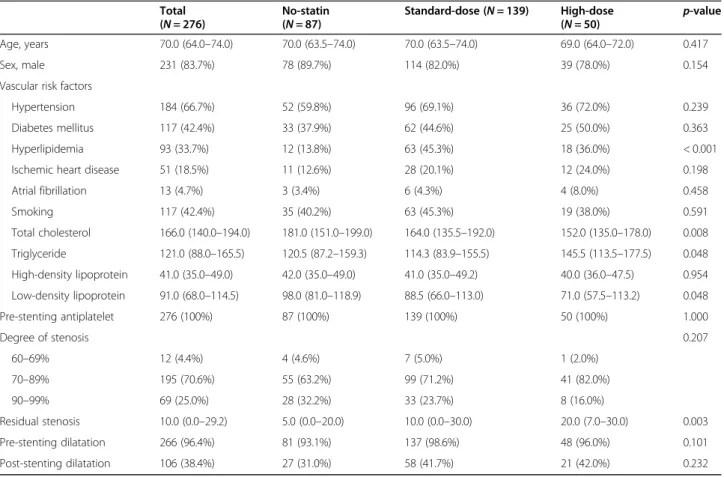
In our study, 276 patients were enrolled. The majority
were male (83.7%), and the median age was 70.0 years
(IQR, 64.0–74.0). Most patients had > 70% stenosis (95.6%). The most common vascular risk factor was hypertension (66.7%), followed by diabetes mellitus (42.4%), smoking (42.4%), and hyperlipidemia (33.7%).
Prior to CAS, all patients were on antiplatelet treatment.
The patients were allocated into three groups according to the atorvastatin equivalent dose: no-statin (n = 87, 31.5%), standard-dose (n = 139, 50.4%), and high-dose statin (n = 50, 18.1%). Overall baseline characteristics are presented in Table 1.
The groups according to statin dose did not differ sig- nificantly in age. In procedure-related characteristics, such as pre-stenting dilatation and post-stent dilatation, there was no difference between the three groups.
Although the degree of stenosis was similar between the three groups (p = 0.207), residual stenosis was signifi- cantly higher in the high-dose statin group compared to other groups (p = 0.003). In terms of lipid profile, there were no significant differences between groups in high- density lipoproteins. However, the high-dose statin group had lower low-density lipoproteins (LDL) and total cholesterol than other groups. A summary of statin drugs and doses used is shown in Additional file 1: Sup- plementary Table I.
Overall, the periprocedural complication rate was 3.3%
(9 cases). The rate for any type of stroke or death was 3.0% (8 cases). Six patients (2.2%) had ischemic strokes, two (0.7%) had hemorrhagic strokes, and one (0.3%) had Table 1 Baseline characteristics of patients undergoing stenting for asymptomatic carotid artery stenosis
Total
( N = 276) No-statin
( N = 87) Standard-dose ( N = 139) High-dose
( N = 50) p-value
Age, years 70.0 (64.0 –74.0) 70.0 (63.5 –74.0) 70.0 (63.5 –74.0) 69.0 (64.0 –72.0) 0.417
Sex, male 231 (83.7%) 78 (89.7%) 114 (82.0%) 39 (78.0%) 0.154
Vascular risk factors
Hypertension 184 (66.7%) 52 (59.8%) 96 (69.1%) 36 (72.0%) 0.239
Diabetes mellitus 117 (42.4%) 33 (37.9%) 62 (44.6%) 25 (50.0%) 0.363
Hyperlipidemia 93 (33.7%) 12 (13.8%) 63 (45.3%) 18 (36.0%) < 0.001
Ischemic heart disease 51 (18.5%) 11 (12.6%) 28 (20.1%) 12 (24.0%) 0.198
Atrial fibrillation 13 (4.7%) 3 (3.4%) 6 (4.3%) 4 (8.0%) 0.458
Smoking 117 (42.4%) 35 (40.2%) 63 (45.3%) 19 (38.0%) 0.591
Total cholesterol 166.0 (140.0 –194.0) 181.0 (151.0 –199.0) 164.0 (135.5 –192.0) 152.0 (135.0 –178.0) 0.008 Triglyceride 121.0 (88.0 –165.5) 120.5 (87.2 –159.3) 114.3 (83.9 –155.5) 145.5 (113.5 –177.5) 0.048 High-density lipoprotein 41.0 (35.0 –49.0) 42.0 (35.0 –49.0) 41.0 (35.0 –49.2) 40.0 (36.0 –47.5) 0.954 Low-density lipoprotein 91.0 (68.0 –114.5) 98.0 (81.0 –118.9) 88.5 (66.0 –113.0) 71.0 (57.5 –113.2) 0.048
Pre-stenting antiplatelet 276 (100%) 87 (100%) 139 (100%) 50 (100%) 1.000
Degree of stenosis 0.207
60 –69% 12 (4.4%) 4 (4.6%) 7 (5.0%) 1 (2.0%)
70 –89% 195 (70.6%) 55 (63.2%) 99 (71.2%) 41 (82.0%)
90 –99% 69 (25.0%) 28 (32.2%) 33 (23.7%) 8 (16.0%)
Residual stenosis 10.0 (0.0 –29.2) 5.0 (0.0 –20.0) 10.0 (0.0 –30.0) 20.0 (7.0 –30.0) 0.003
Pre-stenting dilatation 266 (96.4%) 81 (93.1%) 137 (98.6%) 48 (96.0%) 0.101
Post-stenting dilatation 106 (38.4%) 27 (31.0%) 58 (41.7%) 21 (42.0%) 0.232
Values are presented as percentage or median (interquartile range)
Table 2 Periprocedural complications within 30 days of stenting for asymptomatic carotid artery stenosis Total
( N = 276) No-statin
( N = 87) Standard-dose ( N = 139) High-dose
( N = 50) p-value
Periprocedural complications 9 (3.3%) 3 (3.4%) 4 (2.9%) 2 (4.0%) 0.923
Ischemic stroke 6 (2.2%) 1 (1.1%) 4 (2.9%) 1 (2.0%) 0.684
Hemorrhage stroke 2 (0.7%) 1 (1.1%) 0 (0.0%) 1 (2.0%) 0.307
a
Myocardial infarction 1 (0.30%) 1 (1.1%) 0 (0.0%) 0 (0.0%) 0.336
Death 0 (0.0%) 0 (0.0%) 0 (0.0%) 0 (0.0%) 1.000
a
One patient had myocardial infarction after 1 day
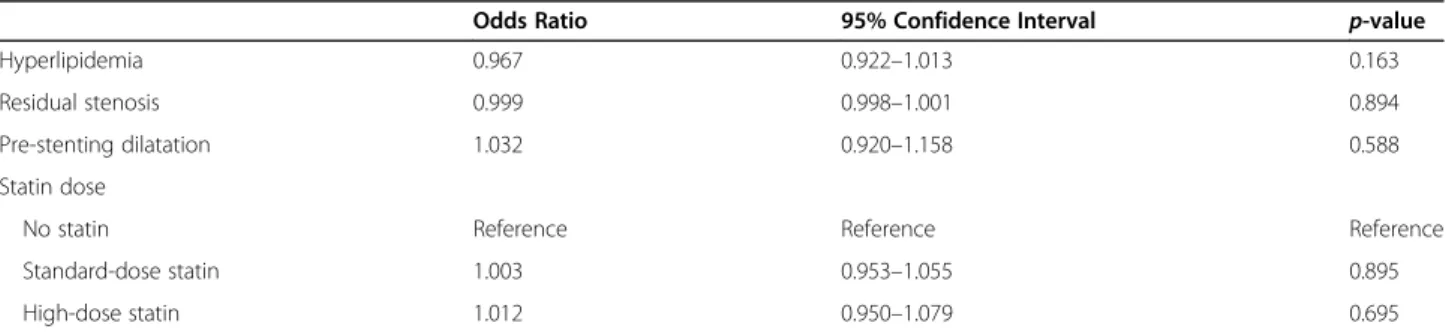
a myocardial infarction (Table 2). Considering the de- gree of stenosis, one periprocedural complication (1/12, 8.3%) occurred in a patient with 60 to 69% stenosis, six complications (6/195, 3.1%) occurred in those with 70 to 89% stenosis, and two complications (2/69, 2.9%) oc- curred in those with 90 to 99% stenosis. Analyzing re- sults according to pretreatment statin dose, patients in the high-dose statin group had two complications, the standard-dose statin group had four complications, and the no-statin group had three complications. This differ- ence was not statistically significant (p = 0.923). When analyzed depending on the use of pretreatment statin, no difference in periprocedural complications was found between the groups (Additional file 1: Supplementary Table II). After adjusting for confounders, including hyperlipidemia, residual stenosis, and pre-stenting dilata- tion, statin-pretreatment remained a non-independent factor associated with periprocedural complications after CAS (Standard-dose statin: odds ratio, 1.003; 95% CI [0.953, 1.055]; High-dose statin: odds ratio, 1.012; 95%
CI [0.950, 1.079]) (Table 3). The CA trend test also did not demonstrate a trend in the proportion of periproce- dural complications across increasing statin equivalent dose (p = 0.919).
Discussion
In our study, the CAS 30-day periprocedural complica- tion rate was 3.3% (9 of 276), which is consistent with previous studies on asymptomatic carotid artery stenosis [4, 12]. The overall periprocedural complications were not different between the three groups according to the pretreatment statin dose, and showed no linear trend of association to the statin dose. In addition, when the ana- lysis was conducted comparing use to no-use of statin before CAS, there was no difference in the results.
Statins are considered an option for preventing peri- procedural complications. Pretreatment statin use has been shown by previous studies to significantly decrease the frequency of cardiovascular, cerebrovascular, and secondary stroke events after vascular procedures or endarterectomy [9, 16–22]. This might be due to the multiple effects of statin, such as plaque stabilization
and reduction of intravascular thrombosis. Preventive ef- fects of statins are supported by findings of its use being associated with reduced plaque volume and atheroma regression in the carotid circulation, [23] in addition to less embolic debris during CAS [24]. However, all of these studies included both symptomatic and asymptom- atic patients [25]. There is no study about the pretreat- ment statin effects on periprocedural complications of CAS limited to asymptomatic patients. In contrast to studies with symptomatic carotid artery stenosis, our study demonstrated no significant dose-dependent or absolute statin effects in preventing periprocedural com- plications in asymptomatic patients with carotid artery stenosis. There is a possible explanation for this finding.
A previous study suggests that infiltration of the fibrous cap with foam cells, fibrous cap thinning, and plaque rupture are more common in patients with symptomatic carotid artery stenosis than in asymptomatic patients [26]. Similar to acute coronary syndromes, plaque rup- tures are an important etiopathogenetic factor of neuro- logical deterioration as a result of carotid artery stenosis.
During stent deployment, embolism from the carotid ar- tery plaque is generally responsible for the majority of new ischemic lesions. Based on this study, the multiple pleiotropic effects of statins did not alter the risk of peri- procedural complications in asymptomatic patients with carotid artery stenosis because the plaques are generally more stable. Nonetheless, caution is advised in the inter- pretation of our results, which showed that there is no protective effect of statin, limited to the periprocedural period. Statins are known to have protective effects on long-term outcome [6, 27].
In this study, we observed an LDL-lowering effect of statins. However, statins have multiple pleiotropic ef- fects, such as promoting endothelial function, reducing inflammation, affecting arterial myocyte proliferation, migration and apoptosis, as well as regulating platelet activity, plaque stability, and the coagulation process.
Therefore, LDL is not the only concern when contem- plating successful risk reduction [28, 29]. As previous studies suggest, statin treatment should be administered in accordance with the global vascular risk factors and
Table 3 Multivariable logistic regression for complications within 30 days of stenting for asymptomatic carotid artery stenosis
Odds Ratio 95% Confidence Interval p-value
Hyperlipidemia 0.967 0.922 –1.013 0.163
Residual stenosis 0.999 0.998 –1.001 0.894
Pre-stenting dilatation 1.032 0.920 –1.158 0.588
Statin dose
No statin Reference Reference Reference
Standard-dose statin 1.003 0.953 –1.055 0.895
High-dose statin 1.012 0.950 –1.079 0.695
not chiefly according to base LDL level [30, 31]. Consist- ently, our results indicated that LDL levels alone did not correlate with the risk of periprocedural complications.
Our study has several limitations. First, this was a retrospective study with a relatively small sample, which did not allow us to extract statistically significantly re- sults in the analysis of periprocedural complications (9 cases). Second, there was a lack of data on pretreatment duration. Thus, it was not possible to evaluate where this parameter was associated with periprocedural complica- tions. Third, we lacked information on the type of stents used. Previous studies have shown a higher risk of peri- procedural stroke in patients treated with open-cell stent devices compared to those implanted with closed-cell devices [32, 33]. Fourth, we cannot be certain that there were no differences in the original plaque morphology or vascular anatomy of the groups considered, which might have differentially influenced the risk of peripro- cedural complications. Therefore, our results should be verified in randomized trials or prospective trials with larger datasets.
In conclusion, this study shows that statin pretreat- ment did not have dose-dependent or absolute effects on periprocedural complications risk in patients under- going CAS for the treatment of asymptomatic carotid ar- tery stenosis.
Supplementary Information
The online version contains supplementary material available at https://doi.
org/10.1186/s12883-021-02104-z.
Additional file 1: Supplementary Table 1. Summary of statin drug and dose use before carotid artery stenting. Supplementary Table 2.
Periprocedural complications within 30 days of stenting for asymptomatic carotid artery stenosis.
Acknowledgements
We would like to express our deepest appreciation to ‘Keimyung Neurology Alumni Association ’ for their guidance, support and encouragement.
Authors ’ contributions
S-HJ analyzed and interpreted the data and wrote the manuscript. H-MK, D- HK, H-JP, S-IS, H-C analyzed and interpreted the data, and revised the manu- script. J-HH designed and conceptualized the study, interpreted the data, and revised the manuscript. The author(s) read and approved the final manuscript.
Funding
This research received no specific grant from any funding agency in the public, commercial, or not for profit sectors.
Availability of data and materials
The datasets generated during and/or analyzed during the current study are available from the corresponding author on reasonable request.
Ethics approval and consent to participate
The protocol for data collection was approved by the Institutional Review Board (IRB) of Keimyung University Dongsan Hospital (IRB number 2017 –05- 042). Our study was implemented in accordance with the ethical standards of the 1964 Declaration of Helsinki and its lateral amendments. The need for written informed consent was waived because of the retrospective nature of
this study. IRB of Keimyung University Dongsan Hospital (IRB number 2017 – 05-042) waived the need for informed consent.
Consent for publication Not Applicable.
Competing interests
The authors declare that they have no competing interests.
The authors declared no potential conflicts of interest with respect to the research, authorship, and/or publication of this article.
Author details
1