A Stack of Recessive Alleles of Kunitz Trypsin Inhibitor, Lectin, and Stachyose in Soybean
Sang Woo Choi, Won Gi Chae, Gyung Young Kang and Jong Il Chung*
Department of Agronomy, Gyeongsang National University, Jinju 52828, Korea Received June 10, 2019 /Revised July 7, 2019 /Accepted July 7, 2019
Soybean [Glycine max (L.) Merr.] is one of the major food sources of protein, oil, carbohydrates, iso- flavones, and other nutrients for both humans and animals. However, soybean seeds contain antinutri- tional factors, such as lectin protein, Kunitz Trypsin Inhibitor (KTI) protein, and stachyose. The ob- jective of this research was to stack recessive alleles for development a triple recessive genotype, titil- elers2rs2, with low KTI protein, lectin protein, and stachyose contents. Three parents (Gaechuck#2, PI200508, and 14G20) were used to develop the breeding population. The presence or absence of the lectin and KTI proteins was detected by western blotting. The stachyose content in mature seeds was determined by HPLC. Agronomic traits, such as plant type, plant height, maturity date, lodging, seed quality, and 100-seed weight, were evaluated for the four F3 plant strains. One F4 plant strain with the desired agronomical traits was selected. One new strain with the triple recessive titilelers2rs2 geno- type was developed. The plant height of the new strain was 51 cm and the 100-seed weight was 31.0 g. The new strain had a yellow seed coat and yellow hilum. The stachyose content of the new strain was 3.8 g/kg. One strain developed in this research will be used to produce improved yellow soybean cultivars that are free of lectin and KTI proteins and low in stachyose content.
Key words : Kunitz trypsin inhibitor (KTI), lectin, stachyose, soybean, triple recessive
*Corresponding author
*Tel : +82-55-772-1872, Fax : +82-55-772-1879
*E-mail : [email protected]
This is an Open-Access article distributed under the terms of the Creative Commons Attribution Non-Commercial License (http://creativecommons.org/licenses/by-nc/3.0) which permits unrestricted non-commercial use, distribution, and reproduction in any medium, provided the original work is properly cited.
Journal of Life Science 2019 Vol. 29. No. 7. 774~778 DOI : https://doi.org/10.5352/JLS.2019.29.7.774
Introduction
Soybean is the main source of protein and oil for human and animal nutrition. Soybean seed is composed of 40%
protein, 20% oil, 35% carbohydrates, and 5% ash on average [9]. Demand of soybean and soybean products has increased in recent years because of high quantity and quality of soy- bean protein and oil. Also, there are antinutritional factors and several allergenic proteins in the raw mature soybean.
Lectin protein, Kunitz Trypsin Inhibitor (KTI) protein, and stachyose are a main antinutritional factor in soybean seed.
Soybean lectin protein is a glycoprotein with a molecular weight of 120 kDa with four similar subunits [17]. The soy- bean lectin is able to link to carbohydrate chains found in glycoproteins and glycolipids and present a strong affinity for N-acetyl-D-galactosamine and to a lower extent for D- galactose. This lectin-carbohydrate interaction will con-
sequently result into a changed morphology of the intestinal epithelium, as well as a decrease in the digestion and ab- sorption of nutrients [18]. The presence of seed lectin is controlled by a single dominant gene designated Le and the homozygous recessive lele results in the lack of lectin [15]. Ti and Le loci were segregated independently [11, 13, 16]. Recently, a new soybean line with triple null recessive genotypes (ti/ti-le/le-p34/p34) was developed [19].
Kunitz Trypsin Inhibitor (KTI) protein is a small and non-glycosylated protein containing 181 amino acid resi- dues with 21.5 kDa. KTI protein was first isolated and crys- tallized from soybean seeds by Kunitz [10]. Kunitz trypsin inhibitor protein strongly inhibits trypsin, thus reducing food intake by diminishing digestion and absorption. Five electrophoretic forms of KTI have been discovered. The ge- netic control of four forms, Tia, Tib, Tic, and Tid, has been reported as a codominant multiple allelic series at a single locus [6, 16, 21]. Orf and Hymowitz [16] found that the fifth form does not exhibit a soybean trypsin inhibitor-A2 band and is inherited as a recessive allele designated ti.
Orf and Hymowitz [16] identified two soybean accessions (PI157440 and PI196168) which lacks KTI protein from USDA germplasm collection. The Ti locus has been located on linkage group 9 in the classical linkage map of soybean
Table 1. Genotype for Ti (ti), Le (le), and RS2 (rs2) alleles of parents used in this experiment
Parents Trait/genotype
KTI protein Ti (ti) Lectin protein Le (le) Stachyose content RS2 (rs2) Gaechuck#2
PI200508 14G20
Absent Present Present
titi TiTi TiTi
Present Present Absent
LeLe LeLe lele
Normal Low Normal
RS2RS2 rs2rs2 RS2RS2 [5, 8], which was integrated in linkage group A2 (chromo-
some 8) of the USDA/Iowa State University soybean molec- ular linkage map [1].
Stachyose is a major soluble sugar second to sucrose in soybean seed [12]. Stachyose are considered undesirable sugars in soybean seed, because they are not readily diges- tible and cause flatulence or diarrhoea for non-ruminant an- imals [4]. Stachyose content ranges from 14 to 41 g/kg on a dry-weight basis [7]. Stachyose content in soybean is envi- ronmentally stable but genotypically dependent [3]. Sta- chyose content was shown to be controlled by a single gene or a major QTL [20, 22]. The low stachyose and high sucrose phenotype in PI200508 was reported as the result of a muta- tion on a galactosyl transferase gene, and the low-stachyose allele was labelled asrsm1 [22]. There were no negative agro- nomic characteristics between lines derived from PI200508 containing the reduced stachyose content and wild types in traits of field emergence, seed yield, maturity, height, and fatty acid content [14]. Dierking and Bilyeu [2] found that a novel allele (the deletion of a codon encoding a con- served tryptophan residue at amino acid position 331, W331
−) of a raffinose synthase gene, raffinose synthase 2 (RS2, Glyma06g18890) was responsible for the improved seed composition phenotype of PI200508 through complete asso- ciation of the PI200508 rs2 W331− allele with the increased sucrose and decreased raffinose and stachyose phenotype.
The key enzyme in raffinose and stachyose bisynthesis is RS2. An rs2 enzyme containing three-bp deletions results in low raffinose and stachyose in soybean line PI200508 [22].
RS2 locus is located in chromosome 6. Lectin protein, KTI protein, and stachyose limit the utilization of raw soybeans as direct feed requiring a heating step to denature the activ- ity and energy costs as well as altering the physical proper- ties of the soybean proteins. Also excessive heat treatment may lower amino acid availability. The genetic elimination of lectin and KTI protein could be an alternative to the heat treatment. Also, soybean cultivars with genetically low levels of stachyose enhance the utilization of soybean in food as well as feed uses. Development of of new soybean
cultivar with lectin and KTI protein free and low levels of stachyose is needed to improve the nutrition values and to modify the food processing properties of soybeans. The objective of this research was to stack of recessive alleles (development of triple recessive genotype, titilelers2rs2) of KTI protein, lectin protein and stachyose.
Materials and Methods
Breeding population
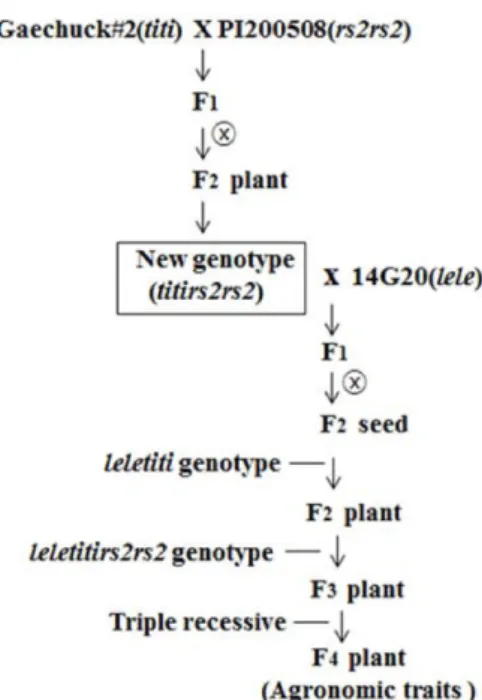
Three parents (Gaechuck#2, PI200508, and 14G20) were used to develop breeding population. Gaechuck#2 parent has titiLeLeRS2RS2genotype (KTI protein absent, lectin pro- tein present, normal content of stachyose), yellow seed coat and black hilum. PI200508 parent has TiTiLeLers2rs2geno- type (KTI and lectin protein present, low content of sta- chyose), yellow seed coat and brown hilum. 14G20 parent has TiTileleRS2RS2 genotype (KTI protein present, lectin protein absent, normal content of stachyose), greenish yel- low seed coat and yellow hilum. Genotype for Ti (ti), Le (le), and RS2 (rs2) alleles of three parents is presented in Table 1. The seeds of Gaechuck#2 and PI200508 parents were planted to cross in a greenhouse. The crosses of Gae- chuck#2 (titiLeLeRS2RS2) × PI200508 (TiTiLeLers2rs2) were made and F1 seeds were obtained. F1 seeds obtained were planted in greenhouse. F2 seeds from F1 plant were har- vested. titiLeLers2rs2 new genotype were selected from the F2 plant population. The cross of new genotype (titiLe Lers2rs2) × 14G20 (TiTileleRS2RS2) were made and F1 seeds were obtained. F1 seeds obtained were planted in green- house. F1 hybridity was confirmed on morphological traits.
F2 seeds were harvested. The F2 seeds were analyzed to screen the seed with titilele genotype (lectin and KTI protein free).
Determination of lectin protein by Western blot analysis
Proteins of parent, each F2 seed, and random F4 seed were separated by 10% or 12% SDS-PAGE, and transferred on
Fig. 1. Scheme for development of new soybean strain with Kunitz Trypsin Inhibitor protein free, lectin protein free, and low content of stachyose (triple recessive gen- otype, titilelers2rs2).
to Immobilon-P membrane (PVDF, Millipore). After block- ing for 2 hr in TBS buffer [20 mM Tris (pH7.5), 150 mM NaCl, and 0.1% Tween 20] with 5% nonfat dried milk (Carnation, Glendale, CA) at room temperature, the mem- brane were incubated with lectin antibody for 1 hr. After washing in TBS buffer three times, the blot was incubated with a horseradish peroxidase conjugated secondary anti- body, and the complex was visualized using an enhanced chemiluminescence kit (Amersham, Bucking-hamshire, UK).
The thickness of band was then determined visually.
Determination of KTI protein by Western blot analysis Proteins of parent, each F2 seed, and random F4 seed were separated by 10% or 12% SDS-PAGE, and transferred onto Immobilon-Pmembrane (PVDF, Millipore). After blocking for 2 hr in TBS buffer [20 mM Tris (pH7.5), 150 mM NaCl, and 0.1% Tween 20] with 5% nonfat dried milk (Carnation, Glendale, CA) at room temperature, the membrane were incubated with KTI antibody for 1 hr. After washing in TBS buffer three times, the blot was incubated with a horse- radish peroxidase conjugated secondary antibody, and the complex was visualized using an enhanced chemilumines- cence kit (Amersham, Bucking-hamshire, UK). The thickness of band was then determined visually.
Determination of stachyose content
Randon seeds of parent, F3 seeds, and F4 seeds were used for stachyose analysis. Each sample was ground to fine powder. The fine powder sample was used for stachyose extraction and quantified by HPLC as described by Sung et al. (2014). Stachyose content was expressed as g/kg in dry weight after moisture correction.
Selection of triple recessive titilelers2rs2 genotype The F2 seeds with titilele genotype (lectin and KTI protein free) were planted to advance F2 plant generation. F2 plants with a proper agronomic traits were individually harvested.
Randon F3 seeds of each F2 plants harvested were analyzed to select the rs2rs2 genotype (low content of stachyose). F3
seeds with triple recessive titilelers2rs2 genotype were plant- ed to F3 plant generation. F3 plants with a proper agronomic traits were individually harvested. Random F4 seeds from F3 plants harvested were used to confirm lectin protein free, KTI protein free, and low content of stachyose. Plant height, 100-seed weight, seed coat color, hilum color, and content of stachyose were recorded on the F4 plant generation. Mean
values of plant height, 100-seed weight, and content of sta- chyose were compared by Duncan’s multiple range test at the 5% level. Scheme for development of new soybean strain with triple recessive titilelers2rs2 genotype is pre- sented in Fig. 1.
Results and Discussion
A total 250 F2 seeds from the cross of new genotype (titiLeLers2rs2) and 14G20 parent (TiTileleRS2RS2) were obtained. Seventeen F2 seeds with titilele genotype (lectin and KTI protein free) were selected. These results supported the previous reports [6, 11, 15]. Seventeen F2 seeds were planted and fifteen F2 plants were individually harvested.
Among the 15 lines obtained, four lines with low stachyose content were selected. This result supports that stachyose content was controlled by a single recessive gene [20, 22].
Four F3 seed strains were planted. Agronomic traits such as plant type, plant height, maturity date, lodging, seed quality, and 100-seed weight were evaluated on the four F3 plant strains. One F3 plant strain with a proper agronom- ical traits were selected and harvested. Random F4 seeds were used to confirm absence for both lectin and KTI pro- teins (Fig. 2).
Lectin and KTI proteins were not observed in the mature
Table 2. Agronomic traits of parents and new strain developed in this experiment
Parent/strain Plant height (cm) Seed weight (g/100 seed) Stachyose content (g/kg) Seed coat color Hilum color Gaechuck#2
PI200508 14G20 New strain
54a 75b 45a 51a
24.4a 13.1b 34.5c 31.0d
13.5a 3.2b 14.5a 3.8b
Yellow Yellow Greenish Yellow
Yellow
Black Brown Yellow Yellow a - d: Different letters in the column are significantly different by DMRT at 5%.
Fig. 2. Confirmation of lectin protein free (A) and Kunitz tryp- sin inhibitor (KTI) protein free (B) in the general cultivar and new strain. C: cultivar, S: new strain (titilelers2rs2 genotype). +, -: presence and absence of lectin and KTI proteins, respectively.
Fig. 3. Plant (left) and seed (right) of new soybean strain (triple recessive genotype, titilelers2rs2) with Kunitz Trypsin Inhibitor protein free, lectin protein free, and low content of stachyose.
F4 seed of new strain. F4 seeds were planted. Plant height, 100-seed weight, stachyose content, seed coat color, and hi- lum color were recorded on F4 plant strain. Agronomic trait and stachyose content for three parents and new strain are presented in Table 2.
Plant height of new strain was 51 cm and 100-seed weight was 31.0 g. New strain has yellow seed coat and yellow hilum. Stachyose contents (g/kg) of Gaechuck#2, PI200508, 14G20 parents were 13.5, 3.2 and 14.5, respectively.
Stachyose contents (g/kg) of new strain was 3.8. This result indicates that genotype of new strain is rs2rs2. Plant type harvested and seed of new strain with triple recessive titil- elers2rs2 genotype is shown in Fig. 3.
One strain developed in this research will be used to im- prove new yellow soybean cultivar with lectin prtoein free, KTI protein free, and low content of stachyose.
Acknowledgement
This research was supported by Basic Science Research Program through the National Research Foundation of Korea (NRF) funded by the Ministry of Education (NRF-2018 R1D1A1B07045483).
References
1. Cregan, P. B., Jarvik, T., Bush, A. L., Shoemaker, R. C., Lark, K. G., Kahler, A. L., Kaya, N., VanToai, T. T., Lohnes, D.
G., Chung, J. I. and Specht, J. E. 1999. An integrated genetic linkage map of the soybean. Crop Sci. 39, 1464-1490.
2. Dierking, E. C. and Bilyeu, K. D. 2008. Association of a soy- bean raffinose synthase gene with low raffinose and sta- chyose seed Phenotype. The Plant Genome 1, 135-145.
3. Geater, C. W., Fehr, W. R. and Wilson, L. A. 2000. Associa- tion of soy-bean seed traits with physical properties of natto.
Crop Sci. 40, 1529-1534.
4. Hata, Y., Yamamoto, M. and Nakajima, K. 1991. Effects of soybean oligosaccharides on human digestive organs: esti- mation of fifty percent effective dose and maximum non- effective dose based on diarrhea. J. Clin. Biochem. Nutr. 10, 135-144.
5. Hildebrand, D. F., Orf, J. H. and Hymowitz, T. 1980. Inher- itance of anacid phosphatase and its linkage with the Kunitz trypsin inhibitor seed protein of soybeans. Crop Sci. 20, 83- 85.
6. Hymowitz, T. and Hadley, H. H. 1972. Inheritance of a tryp- sin variant in seed protein of soybeans. Crop Sci. 12, 197-198.
7. Hymowitz, T., Collins, F. I., Panezner, J. and Walker, W.
M. 1972. Relationship between the content of oil, protein, and sugar in soybean seed. Agron. J. 64, 613-616.
8. Kiang, Y. T. 1987. Mapping three protein loci on a soybean chromosome. Crop Sci. 27, 44-46.
9. Krober, O. A. and Cartter, J. L. 1962. Quantitative inter- relations of protein and nonprotein constituents of soybeans.
Crop Sci. 2, 171-172.
10. Kunitz, M. 1945. Crystallization of a trypsin inhibitor from soybean. Science 101, 668-669.
초록:콩에서 쿠니츠트립인히비터, 렉틴 및 스타키오스에 대한 열성 유전자의 집적
최상우․채원기․강경영․정종일*
(경상대학교 농학과)
성숙 콩[Glycine max (L.) Merr.] 종자에는 단백질, 지방, 탄수화물의 3대 영양소와 아이소플라본 등 다양한 기능 성 성분이 함유되어 있다. 그러나, Kunitz Trypsin Inhibitor (KTI) 단백질, 렉틴 단백질, 난소화성 올리고당인 sta- chyose 성분이 함유되어져 있어 품질과 기능성을 저하시키고 있다. 본 연구는 콩 및 콩 제품의 품질과 기능성을 저하시키는 KTI 및 렉틴 단백질과 stachyose의 성분 함량과 관련된 유전자들이 모두 열성으로 작용하는 콩 계통 (triple recessive genotype)을 선발하기 위하여 진행되었다. 3개의 모본(개척2호, PI200508, 14G20)을 이용한 육종 집단으로부터 성숙 종자에서KTI 및 렉틴 단백질이 없으면서 stachyose의 함량이 일반콩보다 현저히 적은 triple recessive 유전자형(titilelers2rs2) 개체를 선발하였다. 선발된 계통의 초장은 51 cm 정도였으며 백립중은 31.0 g으 로 대립이었으며 종피색 및 제색은 노란색이었다. Stachyose의 함량(g/kg)은 일반콩(13.5 g/kg)보다 훨씬 낮았다 (3.8 g/kg). 본 연구를 통하여 선발된 계통은 KTI 단백질과 렉틴 단백질이 동시에 없으며 stachyose의 함량이 낮은 다양한 콩 품종 육성을 위한 중간모본으로 이용될 수 있을 것으로 사료되었다.
11. Lee, K. J., Park, M. S., Sung, M. K., Kim, M. S. and Chung, J. I. 2008. Inheritance between Le gene and Ti gene in soy- bean (Glycine maxL.). Kor. J. Breed Sci. 40, 97-100.
12. Liu, K. 1997. Soybeans; chemistry, technology, and uti- lization. Chapman & Hall NY. P, 532.
13. Moraes, R. M. A., Soares, T. C. B., Colombo, L. R., Salla, M. F. S., Barros, J. G. A. and Piovesan, N. D. 2006. Assisted selection by specific DNA markers for genetic elimination of the kunitz trypsin inhibitor and lectin in soybean seeds.
Euphytica 149, 221-226.
14. Neus, J. D., Fehr, W. R. and Schnebly, S. R. 2005. Agronomic and seed characteristics of soybean with reduced raffinose and stachyose. Crop Sci. 45, 589-592.
15. Orf, J. H., Hymowitz, T., Pull, S. P. and Pueppke, S. G. 1978.
Inheritance of a soybean seed lectin. Crop Sci. 18, 899-900.
16. Orf, J. H. and Hymowitz, T. 1979. Soybean linkage test be- tween Ti and Le seed proteins. Soyb. Genet. Newsl. 6, 32.
17. Pull, S. P., Pueppke, S. G., Hymowitz, H. and Orf, J. H.
1978. Soybean lines lacking the 120,000 daltons seed lectin.
Science 200, 1277-1279.
18. Schulze, H., Saini, H. S., Huisman, J., Hessing, M., Berg, W. and Verstegen, M. W. A. 1995. Increased nitrogen secre-
tion by inclusion of soya lectin in the diets of pigs. J. Sci.
Food Agric. 69, 501-510.
19. Schmidt, M. A., Hymowitz, T. and Herman, E. M. 2015.
Breeding and characterrization of soybean triple null; a stack of recessive alleles of Kunitz Trypsin Inhibitor, Soybean Agglutinin, and P34 allergen nulls. Plant Breed. 134, 310-315.
20. Sebastina, S. A., Kerr, P. S., Pearisten, R. W. and Hitz, W.
D. 2000. Soybean germplasm with novel genes for improved digestibility. In: J.K. Drackely (ed), Federation of Animal Sci.
Soc., Savoy, IL. Soy in Animal Nutrition, 56-74.
21. Singh, L., Wilson, C. M. and Hadley, H. H. 1969. Genetic differences in soybean trypsin inhibitors separated by disc electrophoresis. Crop Sci. 9, 489-491.
22. Skoneczka, J. A., Saghai Maroof, M. A., Shang, C. and Buss, G. R. 2009. Identification of candidate gene mutation asso- ciated with low stachyose phenotype in soybean lines PI200508. Crop Sci. 49, 247-255.
23. Sung, M. K., Han, S. J., Seo, H. J., Choi, S. W., Nam, S. H.
and Chung, J. I. 2014. Genotype and environment influence on raffinose and stachyose content of soybean seed. Kor. J.
Crop Sci. 59, 319-324.