A Study on Synthesis of Ni-Ti-B Alloy by Mechanical Alloying from Elemental Component Powder
Jung Geun Kim * and Yong Ho Park
aDefense Agency for Technology and Quality, Sacheon Center, Changwon 642-160, Korea
a
Department of Material Science and Engineering, Pusan National University, Pusan 609-735, Korea (Received April 5, 2016; Revised May 31, 2016; Accepted June 2, 2016)
···
Abstract A Ni-Ti-B alloy powder prepared by mechanical alloying (MA) of individual Ni, Ti, and B components is examined with the aim of elucidating the phase transitions and crystallization during heat treatment. Ti and B atoms penetrating into the Ni lattice result in a Ni (Ti, B) solid solution and an amorphous phase. Differential thermal analysis (DTA) reveals peaks related to the decomposition of the metastable Ni (Ti, B) solid solution and the separation of equi- librium Ni
3Ti, TiB
2, and τ-Ni
20Ti
3B
6phases. The exothermal effects in the DTA curves move to lower temperatures with increasing milling time. The formation of a TiB
2phase by annealing indicates that the mechanochemical reaction of the Ni-Ti-B alloy does not comply with the alloy composition in the ternary phase diagram, and Ti-B bonds are found to be more preferable than Ni-B bonds.
Keywords: Ball-milling, Mechanical alloying, X-ray diffraction, Phase transitions, Differential Thermal Analysis
···
1. Introduction
A solid-state reaction between mixture components during MA is a non-equilibrium process that leads to the formation of metastable phases. The application of MA to exotic sys- tems began after their discovery by Schwarz and Koch [1].
They synthesized the amorphous powders of Ni
32Ti
68and Ni
45Nb
55by MA starting from a mixture of pure crystalline powders. The amorphization is attributed to a solid-state interdiffusion reaction, the kinetics of which is controlled by the excess point and lattice defects generated by plastic defor- mation. The accumulation of point and lattice defects by plastic deformation raises the free energy of the faulted inter- metallic above that of the amorphous alloy. Since then the formation of one or more phases using MA has attracted considerable attention. Using this technique, a number of studies have been carried out to synthesize a range of stable and metastable phases including supersaturated solid solu- tions, crystalline and quasi-crystalline intermediate phases, as well as amorphous alloys [2-4]. Many studies on the synthe- sis of Ni-based alloys by MA have been reported. In particu- lar, binary Ni-(B,Ti) systems have been shown to form the
solid solution and exhibit alloying behavior from the mixture components [5-7].
On the other hand, in a ternary Ni-Ti-B system, the alloys have been prepared by a liquid solidification method, such as melt spinning, arc melting and suction casting.
Several studies have examined amorphous materials pro- duced by melt spinning were studied [8, 9]. Although the Ni-based composite coating such as Ni-TiB
2exhibits excel- lent wear resistance [10], researches connected with the mechanochemical synthesis and crystalline of ternary Ni-Ti- B alloy obtained by means of MA are not found in litera- ture. In a Ni-Ti-B system using MA, the structure of the resulting product is expected to be determined by the com- petitive parameters of Ni-Ti, Ni-B and Ti-B pairwise interac- tions. The objective of the present work is to study the synthesis of Ni-Ti-B alloy powder by MA, as well as analy- sis of its structure and phase transitions during the crystalliza- tion of ternary alloys.
2. Experimental
The Ni
82Ti
12B
6alloy powder was synthesized from ele-
*Corresponding Author: Jung Geun Kim, TEL: +82-55-279-4088, FAX: +82-55-287-4780, E-mail: [email protected]
<PM리뷰>
mental components of nickel powder (99.9%), titanium pow- der (99.9%) and boron powder (99%) with a particle size 2~3 µm, 100 µm and 45 µm, respectively. The powder mixture was loaded into SUS304 steel vials with SU2J bearing steel balls. A ball to powder ratio (BPR) of 50:1 was maintained under an inert argon atmosphere to pre- vent oxidation. MA process was performed using vibra- tory ball mill machine, which agitates the vials at 25Hz with an amplitude of 2.5~3.0 mm. The vials were rotated every hour to favor the fracture of particles and mini- mize the formation of ductile coatings on the walls and balls. The mechanical alloyed powder and subsequent annealed powder was investigated by X-ray diffraction (XRD, RIGAKU D/MAX) using Cu K α-radiation. The thermal transition behavior was analyzed by differential thermal analysis (DTA, DTG-60H) under non-isothermal conditions at a heating rate of 10
oC/min with flowing argon, and the temperature ranged from 100
oC to 1000
oC. To confirm the DTA curves, the as-milled powder after 60 h was annealed in a furnace at 350
oC, 410
oC and 500
oC at a heating rate of 10
oC/min under an argon atmosphere.
3. Result and Discussions
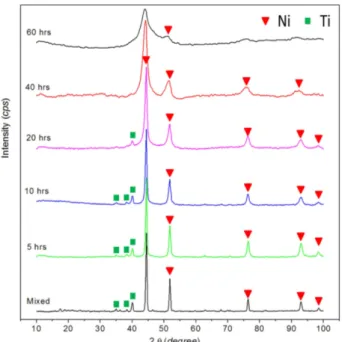
Fig. 1 presents XRD patterns of the Ni
82Ti
12B
6powder after different milling times. The as-received powder showed peaks related to Ni and Ti without B due to the
main difference between the boron intensity and others peaks. No phase transformation was detected until 60 h milling, but the peaks related to Ti disappeared 40 h of milling. Further milling up to 60 h did not result in the formation of any other intermetallics, and became an amorphous. On the other hand, the solid state interaction in the Ni
82Ti
12B
6system led to the formation of a Ni (Ti, B) FCC solid solution, as confirmed by the results from XRD (Fig. 2). The phase shifted to the minor angles compared to the position of the Ni (111) peak. This sug- gests that the mechanochemical reaction between the com- ponents of the mixture resulted in the formation of a Ti and B solid solution in FCC Ni. Fig. 3 presents the change
Fig. 1. XRD patterns of Ni
82Ti
12B
6initial mixture of components and alloyed powder after different milling time.
Fig. 2. Shift of Ni line (111) as a result of milling of the Ni
82Ti
12B
6mixture.
Fig. 3. Change in the Ni lattice parameter and root-mean-
square microdeformation for the lattice of the fcc phase of
the Ni
82Ti
12B
6alloy on MA time.
in the Ni lattice parameter and microdeformation root-mean- square ( ε
rms) of the lattice for FCC phase of the Ni
82Ti
12B
6alloy on MA time. The lattice parameter and ε
rmsof Ni increased continuously with increasing milling time due to the interstitial diffusion of Ti, B into the Ni lattice. The lattice parameter of the Ni (Ti, B) solid solution (a=0.35630 nm) was considerably higher than that of the Ni (B) equi- librium solid solution containing 15 wt.% B (a=0.35255 nm [6]). In addition, the present study showed that the ε
rmsvalue ( 1.1%) of Ni lattice was significantly increased in comparison with the ε
rmsof Ni (B) solid solution ( ε
rms0.48 [11]). If only B dissolves in the Ni lattice during the chemical interaction of the components and Ti remains as a second amorphous phase, then according to [6], the lat- tice parameter of the Ni (B) solid solution in this study should be lower than 0.35255 nm. These results indicate that the higher lattice parameter and ε
rmsof the FCC Ni phase can be explained by the supplementary solid solu- tion of Ti in Ni. In addition, the defective region caused by microdeformation in the solid solution lattice can con- tain enhanced concentrations of Ti and B atoms as ele- ments in the non-equilibrium FCC lattice.
DTA characterization of MA powder during heating attributed the heat effects to structural changes in the metastable alloys. DTA (Fig. 4) revealed only one exo- thermic peak on the MA powder for 20 h and 60 h, respectively, in a narrow temperature range 400~430
oC.
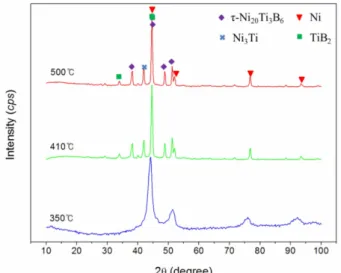
This was attributed to decomposition of the metastable Ni (Ti, B) solid solution and to separation of the equilib- rium Ni
3Ti, TiB
2and τ-Ni
20Ti
3B
6phases, which was con- firmed by XRD of the annealed powder, as shown in Fig.
5. No phase transformation was observed after heating of powder up to 350
oC, and the peaks of the FCC Ni phase
were sharper. After annealing up to 410
oC, considerable peaks related to Ni
3Ti, TiB
2and τ-Ni
20Ti
3B
6phases were detected. Therefore, until thermal decomposition of the solid solution, the Ni (Ti, B) solid solution is energeti- cally more stable. DTA showed that the peak tempera- tures with the formation of the above mentioned intermetallics decreased from 410
oC to 424
oC with increasing milling time. This observation can be explained by considering the energy given to the milled powder during MA, which can help the transformation to run at lower temperature.
Thus, with increased milling times, more energy is trans- ferred to the powder [6].
In the FCC lattice of Ni, Co and γ-Fe, Goldschmidt consid- ered the possibility of isostructural metastable cluster groups of Metal and B atoms similar to the formation of Genie-Preston zones (G-P zone). B atoms penetrate into the FCC Ni lattice, which leads to strong distortion of its lattice and these clusters are stable up to the moment when the boride phase with another structure separates from the solid solution [12-14]. In particular, the forma- tion of boride phases in Me-B bonds is agreement with Hägg’s dimensional rule formulated for the metal-metal- loid systems. This rule states that amorphous alloys can be formed only if the ratio of constituent’s atoms radii satisfies the inequality,
0.59 < r
B/r
Me< 0.88 (1)
where the lower limit comes from the geometric con- straints in dense packing structures, whereas the upper
≅
≅