한국정보통신학회논문지 Vol. 25, No. 1: 152~159, Jan. 2021
통계 분석 기법을 이용하여 중국 소비자의 한국 화장품 만족도에 영향을 미치는 요인 분석
구아군1·한카이1·정회경2*
Analysis of Factors Affecting Satisfaction of Korean Cosmetics by Chinese Consumers Using Statistical Analysis Techniques
Qiu Yajun
1· Han Kai
1· Hoekyung Jung
2*1
Graduate Student, Department of Business Management, Woosong University, Daejeon 34606, Korea
2*
Professor, Department of Computer Engineering, Paichai University, Daejeon 35345, Korea
요 약
중국 시장에서는 한국 화장품의 점유율이 급격히 증가하고 세계 시장에서의 입지가 점차 안정되고 있다. 중국 소 비자들이 한국 화장품에 열광하는 이유는 다음과 같다. 우선 한국 화장품은 아시아계 중국 소비자에게 적합하다. 둘 째, 한국 화장품의 스타 효과는 의심할 여지가 없는 효과를 발휘하여 한국 화장품이 빠르게 발전하고 중국 시장을 빠 르게 점유하고 있다. 한국 화장품에 대한 중국 소비자의 만족도는 한국 화장품 시장에 직접적인 영향을 미친다. 따라 서 본 연구의 연구 대상은 '중국 소비자'로 정하고, '한국 화장품에 대한 중국 소비자의 만족도에 영향을 미치는 요인' 에 초점을 맞추고 있다. "한국 화장품에 대한 중국 소비자 만족도" 모델을 구축하여 관련 영향 요인을 찾아내고 가설 에 대해 시뮬레이션을 하여 중국 소비자가 한국 화장품에 대한 만족도에 실제로 영향을 미치는 요인을 분석하여 제 안한다.
ABSTRACT
In the Chinese market, the market share of Korean cosmetics is rapidly increasing and its position in the global market is gradually becoming stable. The reasons why Chinese consumers are enthusiastic about Korean cosmetics are as follows.
First of all, Korean cosmetics are suitable for Asian Chinese consumers. Second, the star effect of Korean cosmetics has shown an undoubted effect, making Korean cosmetics rapidly developing and rapidly occupying the Chinese market.
Chinese consumers' satisfaction with Korean cosmetics directly affects the Korean cosmetics market. Therefore, the research subject of this study is set to Chinese consumers and focuses on factors that affect Chinese consumers' satisfaction with Korean cosmetics. The “Chinese Consumer Satisfaction with Korean Cosmetics” model is established to find the relevant influencing factors and simulate the hypothesis to analyze and propose the factors that actually affect the satisfaction of Chinese consumers with Korean cosmetics.
키워드
: 증국, 소비자, 화장품, 만족도, 통계
Keywords
: China, Consumers, Cosmetics, Satisfaction, Statistics
Received 8 November 2020, Revised 20 November 2020, Accepted 29 November 2020
* Corresponding Author Hoekyung Jung(E-mail:[email protected], Tel:+82-42-520-5640) Professor, Department of Computer Engineering, Paichai University, Daejeon 35345, Korea
Open Access
http://doi.org/10.6109/jkiice.2021.25.1.152
print ISSN: 2234-4772 online ISSN: 2288-4165Ⅰ. INTRODUCTION
Korean relies on its geographical advantages, cultural features that are closely related to China, and Chinese youth groups’s pursuit of Korean Wave has given Korean cosmetics a certain advantage in the Chinese market[1]. Korean cosmetics are very popular all over the world. Korean cosmetics manufacturers have made full use of advanced research and development technology and various unique conditions to create miracles in the development of the global cosmetics industry and have achieved remarkable achievements[2]. The reasonable price and practicality of Korean cosmetics are very attractive to young Chinese consumers. Korean cosmetics has developed targeted functional cosmetics such as anti-wrinkle, anti-aging and whitening according to the skin characteristics of East Asians, and invested substantial research costs and high-end biological technology.
Compared with European and American cosmetics, Chinese consumers prefer Korean cosmetics[3].
Only when Chinese customers are satisfied with the products and services provided by Korean cosmetics companies can they cultivate a high degree of customer loyalty and thus bring long-term benefits to Korean cosmetics companies. Thus, Chinese consumers’ satisfaction with Korean cosmetics is vital to the development of Korean cosmetics companies. Therefore, this research focuses on the factors that affect Chinese consumer's satisfaction with Korean cosmetics, and then finds out the main factors that affect Chinese consumers' satisfaction, and puts forward suggestions and countermeasures to improve Chinese consumers' satisfaction with Korean cosmetics.
Ⅱ. Theoretical background
2.1. Theoretical background
Customer satisfaction is the customer's direct perception of the products or services provided by the company, and also the customer's recognition of the company.
Customers judge whether they are satisfied based on their feelings about the products and services provided by the company. From the perspective of the company, the goal of customer service is doesn’t just stop at satisfying customers. Satisfying customers is only the first step of marketing management, so that customers can be satisfied in every purchase process and after- purchase experience, thereby enhancing customer loyalty and increasing corporate profits.
2.2. TRA、TPB Theory
Theory of Reasoned Action, TRA[4] is also translated as “Theory of Rational Action” ,it was proposed by American scientists Fishbein and Ajzen in 1975. It is mainly used to analyze how attitudes consciously affect individual behavior, and focus on the process of attitude formation based on cognitive information. Its basic assumptions are to think that people are rational, and will synthesize all kinds of information to consider the meaning and consequences of their own actions before making a certain behavior.
The theory believes that an individual's behavior can be reasonably inferred to a certain extent for his own intentions, and that an individual's behavioral intention is determined by his attitude toward behavior and subjective criteria. A person’s behavioral intention is a measure of people’s intention to engage in a specific behavior, and an attitude is a positive or negative emotion that people have for engaging in a target behavior. It is determined by the main belief in the behavior result and an estimate of the importance of this result. Subjective norms (subjective criteria)refer to the degree of perception that people who have important influence on them want to use the new system, and it is determined by the degree of individual trust in what others think they should do and the level of motivation to be consistent with others’ opinions. These factors combine to produce behavioral intentions (inclinations), which ultimately lead to behavioral changes.
Behavior theory is a general model it proposes that
any factor can only indirectly affect usage behavior
through attitudes and subjective criteria, which makes people have a clear understanding of the rational production of behavior. This theory has an important implicit assumption: people have the ability to completely control their behavior. However, in an organizational environment, individual behavior is subject to management intervention and the external environment.
Therefore, it is necessary to introduce some external variables, such as situational variables and self-control variables, to meet the needs of research.
The theory of planned behavior was proposed by Icek Ajzen (1988, 1991), and is the successor of the rational behavior theory TRA (Theory of Reasoned action, TRA) jointly proposed by Ajzen and Fishbein (1975, 1980), because Ajzen’s research found that human behavior is not 100% voluntary, but under control. Therefore, he expanded TRA and added a new concept of "Perceived Behavior Control", then become a new behavioral theory research model —Theory of Planned Behavior (TPB)[5].
TPB theory is more valued by scholars and is recognized as a more complete behavioral intention model; many empirical research results show that TPB's predictive ability is indeed higher than TRA behavior theory. The elements are explained as follows:
1) Attitude
It refers to the continuous assessment of an individual's like or dislike of a particular object or idea, and the performance of the attitude can predict its possible behavior.
2) Subjective norm
It refers to the social pressure that an individual feel when taking a specific behavior, that is, the important person or group that the individual feels thinking whether he should perform the specific behavior. The stronger the positive subjective norm is, the easier it is to induce the intention to engage in the behavior.
3) Perceived behavioral control
It refers to an individual’s perception of the ability to control the resources and opportunities which required when an individual engages in a particular behavior; In
addition to personal desires and intentions, non-motivational factors that an individual also cannot control, including time, money, skills, opportunities, abilities, resources, or policies, are all related to personal behavior control.
Even if an individual want to engage in a specific behavior, he will eventually be unable to actually engage in that behavior due to lack of the ability to control resources. In addition, perceived behavioral control can be divided into self-efficacy and external resources, the former refers to the cognition of whether one can complete the behavior, and the latter refers to the ease of personal use of resources. Both of them may influences an individual’s decision to take a certain action.
4) Behavior intention
It refers to the behavioral tendency and degree of an individual who wants to engage in a particular behavior, that is, the psychological strength of whether the individual has acted in the decision process of the behavioral selection; in terms of measurement, it can be transformed into whether the individual is willing to try hard or how much effort is willing to put in, etc. Based on the measurement, that can explain and predict the actual behavior of the individual.
Ⅲ. Model design and research assumptions
3.1. Model design
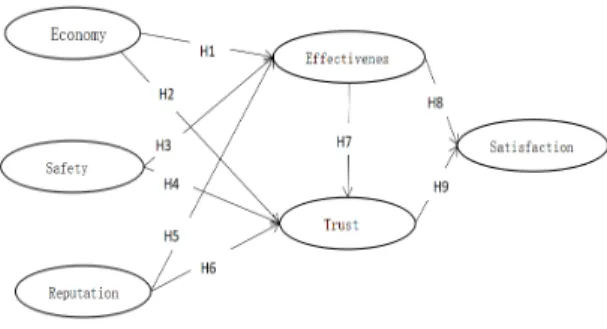
Based on the TPB model, this research model is established for Chinese consumers’ satisfaction with Korean cosmetics. Based on the research on cosmetics satisfaction in domestic and foreign related literature and considering possible influencing factors in the current social environment, this study proposes that the influencing factors of Chinese consumers’ satisfaction with Korean cosmetics are mainly considered from five aspects : economy, safety, reputation, effectiveness and trust.
Based on the above five main factors, the original
model of Chinese consumers’ satisfaction with Korean
cosmetics is set as fig 1.
Fig. 1 Research model
Economy are economic related factors of the price of Chinese consumers for Korean cosmetics sales, Economy will have a positive impact on the effectiveness (H1) and trust (H2) of cosmetics; Safety is the main safe factors of quality safety of Korean cosmetics ,safety will have a positive impact on effectiveness (H3) and trust (H4);
Reputation is a social effect of consumers around Korean cosmetics, it has a positive impact on effectiveness (H5) and trust (H6); Effectiveness is a response to the practical effects of Korean cosmetics, and the efficacy of cosmetics will significantly affect Chinese consumers' trust in Korean cosmetics (H7);
cosmetics effectiveness (H8) and consumer trust in cosmetics (H9) will directly affect consumer satisfaction with Korean cosmetics.
3.2. Research hypothesis
This research mainly focuses on the research and analysis of Chinese consumers' satisfaction with Korean cosmetics. The modelling research on economy, suitability, reputation, effectiveness and trust is conducted respectively. The hypotheses in the research are as follows:
(H1) The economy of Korean cosmetics will have a positive impact on the effectiveness of Korean cosmetics.
(H2) The economy of Korean cosmetics will have a positive impact on Chinese consumers' trust in cosmetics.
(H3) The suitability of Chinese consumers to Korean cosmetics will have a positive impact on the
effectiveness of Korean cosmetics.
(H4) The suitability of Chinese consumers to Korean cosmetics will have a positive impact on Chinese consumers' trust in cosmetics.
(H5) The reputation of Korean cosmetics will have a positive impact on the effectiveness of Korean cosmetics.
(H6) The reputation of Korean cosmetics will have a positive impact on Chinese consumers' trust in cosmetics.
(H7) The effectiveness of Korean cosmetics will have a positive impact on Chinese consumers' trust in cosmetics.
(H8) The trust of Chinese consumers in cosmetics will have a positive impact on the satisfaction of Korean cosmetics.
(H9) The trust of Chinese consumers in cosmetics will have a positive impact on the satisfaction of Korean cosmetics.
3.3. Research method
In order to verify the model hypothesis of this study, the questionnaire was designed to conduct a questionnaire survey on Chinese consumer groups. The analysis steps based on the hypothetical model are as follows: first, use SPSS 22.0[6-8] to test the validity and reliability of the questionnaire data of Chinese consumers who use Korean cosmetics; then, use the correlation analysis in SPSS 22.0 to test the nine hypotheses of the research model; finally, draw conclusions and enlightenments based on research and analysis.
Ⅳ. Empirical analysis
4.1. Questionnaire survey
The results of this survey did show that for the Chinese consumer satisfaction with Korean cosmetics questionnaire, 231 questionnaires were collected:
Among them, the network questionnaires were collected
90 copies and the paper version of 132 questionnaires
were collected, analyzed its results. The answer to each questionnaire are used Likert 7-point scale to measure.
In the sample of 231 subjects, 165 (71.43%) are women, more than men. People aged 20-30 accounted for 33.77%, those aged 30-40 accounted for 27.27%, and those over 40 accounted for 38.96%.
4.2. Validity and reliability test
Validity refers to the degree of consistency or stability of the survey results. Cronbach’s Alpha coefficient is an index to measure validity. The greater the coefficient, the higher the reliability. By using SPSS software to test the validity of the 231 questionnaires data collected, based on the hypothetical model, the questionnaire has six modules, and the Cronbach’s Alpha coefficient values of each module are shown in the table 1. It is generally believed that a Cronbach’s Alpha index of 0.8 or higher is considered to be a higher validity, and a Cronbach’s Alpha index of 0.6 or higher is considered to be an effective validity. The validity of each module of this questionnaire is above 0.6, and the Chinese.
Table. 1 Validity analysis table Project Initial
project
Delete project
Final project
Alpha index
economy 4 0 4 0.961
uitability 3 0 3 0.888
eputation 3 0 3 0.612
effectiveness 3 0 3 0.939
trust 2 0 2 0.692
satisfaction 2 0 2 0.762
Reliability usually refers to the validity and correctness of the questionnaire, that is, the degree to which the questionnaire can measure its desired characteristics.
Factor analysis is the main method of structure validity analysis of data collection methods such as questionnaires.
Through the rotation of factor analysis, the observation variables can be more concentrated on the description of the main factors. According to the hypothetical model, six factors can be extracted to summarize the research topic. The six factors are economy, suitability, reputation,
effectiveness, trust and consumer satisfaction. It can be seen from the data in the table 2 that all items can basically be verified correctly. However, the effectiveness of 1 item in the teaching method is low, the data in the table is 0.242, which will be deleted in the subsequent analysis.
Table. 2 Reliability analysis table Project economy suitabilityreputati
on
effectiv
eness trust satisfact ion economy1 0.938 0.1 0.099 0.145 0.061 0.159 economy2 0.927 0.074 0.134 0.062 0.055 0.088 economy3 0.865 0.054 0.114 0.164 0.105 0.119 economy4 0.949 0.046 0.1 0.074 0.066 0.085 suitability1 0.018 0.898 0.201 0.04 0.128 0.089 suitability2 0.134 0.9 0.233 -0.003 0.114 -0.001 suitability3 0.075 0.945 0.053 0.041 0.08 -0.011 reputation1 0.168 0.126 0.888 0.071 0.122 0.131 reputation2 0.108 0.15 0.837 0.191 0.187 0.105 reputation3 0.123 0.222 0.85 -0.022 -0.015 0.131 effectiveness1 0.087 0.372 0.311 0.242 -0.124 0.489 effectiveness2 0.237 0.058 0.158 0.857 0.122 -0.01 effectiveness3 0.127 0.019 0.032 0.733 0.028 0.422 trust1 0.153 0.139 0.14 0.095 0.854 0.098 trust2 0.062 0.19 0.101 0.066 0.699 0.457 satisfaction1 0.195 -0.041 0.151 -0.046 0.322 0.802 satisfaction2 0.163 -0.003 0.119 0.256 0.152 0.788
**. When the Validity (double test) is 0.01, the correlation is significant;
*. When the Validity (double test) is 0.05, the correlation is significant.
4.3. Correlation analysis and interpretation
In order to verify the relationship between economy, suitability, reputation, effectiveness, trust and consumer satisfaction, this study adopted "Pearson" correlation analysis (Table 3).
Table. 3 Correlation analysis 1 econo
my suitabil
ity reputat
ion effecti
veness trust satisfa ction economy ignific
ance .007 .001 .113(H1) .018 .002 suitability signifi
cance .007 .017 .001 .004 .003
**. When the Validity (double test) is 0.01, the correlation is significant,
*. When the Validity (double test) is 0.05, the correlation is significant.
Pearson, Kendall's tau-b and Spearman's Tau-b and Spearman's Sig value greater than 0.05, indicating the impact of economy on the effectiveness analysis (H1), reputation effectiveness (H5), and effectiveness versus satisfaction not significant (H1), the effect of reputation on effectiveness is not significant (H5), and the effect of effectiveness on satisfaction is not significant (H8).The Sig values of Pearson, Kendall's tau-b and Spearman of the variables of suitability, reputation, and trust are all less than 0.05, which have a significant impact, indicating that economy has a significant impact on trust (H2), and suitability has an effect on effectiveness and trust, there are significant effects (H3),(H4), reputation has a significant effect on trust (H6), efficiency has a significant effect on trust (H7), and trust has a significant effect on satisfaction (H9),
Based on the above relevant analysis, it shows that in the research of Chinese consumers' satisfaction with Korean cosmetics:
1) economy has no significant impact on effectiveness (H1), but has a positive impact on trust (H2).
According to the data, economy has no significant effect on effectiveness (H1), and the efficacy of Korean cosmetics is not affected by economic factors such as price, indicating that cosmetics of different price levels are suitable for different age groups; the data shows that economy directly affects reliability (H2), indicating that Chinese consumers are very recognize of the price, quality, packaging and marketing of Korean cosmetics,
and economy has a positive impact on trust.
2) Suitability has a positive impact on effectiveness and trust (H3), (H4)
The suitability of Chinese consumers to Korean cosmetics directly affects the effectiveness (H3) and trust (H4) of Korean cosmetics. This study is the subject of research conducted by Chinese consumers and conducts a questionnaire analysis on the satisfaction of Korean cosmetics. In itself, China and Korea belong to Asian countries, and the skin quality of the yellow population is basically similar, so Chinese consumers still have a certain degree of trust in Korean cosmetics.
3) Reputation has no significant impact on effectiveness (H5), but has a positive impact on trust (H6)
The data shows that the reputation of Korean cosmetics has no significant impact on the effectiveness of Korean cosmetics (H5). Although Chinese consumers
"Korean Wave" and "favor" Korean cosmetics, they still have their own opinions on the efficacy of Korean cosmetics. Will not directly determine the effectiveness of cosmetics because of reputation; reputation has a positive effect on trust(H6). The research results show that the “star” effect and “Korean wave” reputation have played a certain role in catalyzing Chinese consumers’
trust in Korean cosmetics to a certain extent.
4) Effectiveness has a positive effect on trust (H7) Chinese consumers have a positive impact (H7) on the trust of the effectiveness of the Korean cosmetics.
The effect of cosmetics is good, and they naturally trust in cosmetics. Therefore, the results of this study
"effectiveness has a positive effect on trust".
5) Effectiveness has no significant impact on satisfaction (H8), and trust has a positive impact on satisfaction (H9)
Effectiveness does not have a significant impact on satisfaction (H8), indicating that Chinese consumers are not satisfied with the good or bad effects of Korean cosmetics. Chinese consumers need to perceive the
"trust" of Korean cosmetics through economy, suitability, and reputation. Only after relying on trust can Chinese consumers be satisfied with Korean cosmetics.
econo my
suitabil ity
reputat ion
effecti
veness trust satisfa ction reputationsignifi
cance .001 .017 .264(H5) .016 .000 effective
ness signifi
cance .113(H1) .001 .264(H5) .006 .412(H8) trust signifi
cance .018 .004 .016 .006 .000 satisfacti
on signifi
cance .002 .003 .000 .412(H8) .000
Ⅴ. Main research conclusions and enlightenments
By studying the satisfaction of Chinese consumers with Korean cosmetics, we concluded that improving Chinese consumers’ satisfaction with Korean cosmetics can be considered from the following aspects:
5.1. It is difficult to predict the desired effect of Chinese consumers on Korean cosmetics
Famous marketing experts believe that customer satisfaction depends on the comparison between expectations and reality. If customers feel that the quality of service provided by the company exceeds their expectations, they will be satisfied; otherwise, they will be dissatisfied. If the services and products provided by the enterprise and the expectations and requirements of consumers are difficult to predict, each customer has its own requirements and expectations, and different customer requirements vary from person to person, and customer requirements are always complex and diverse, especially for cosmetics, consumers always want to buy products that are not only comprehensive but also safe.
Therefore, it is recommended to establish an effective platform for Chinese consumer feedback on this solution, and use big data technology to grasp and analyze customer complaints. Correctly treating Chinese consumer complaints is an important way for companies to provide consumer satisfaction. The way companies handle consumer complaints directly determines consumer impressions of companies. If consumer complaints are handled properly, not only will they not lose customers, but also it will win a good reputation, otherwise it will lose customers and affect the development of the company.
5.2. It is difficult for Chinese consumers to improve satisfaction through the effectiveness of Korean cosmetics
Ways to improve Chinese consumer satisfaction: First of all, it is necessary to clarify the Chinese consumer groups in the market and their needs. From the
perspective of marketing, to subdivide Chinese consumers, the Korean cosmetics industry must know the consumers’
needs and expectations for the products. Only in this way can improve targeted products and services for Chinese consumers; Secondly, learn about Chinese culture and Chinese consumers’ preferences, create distinctive product culture and Chinese brands of Korean cosmetics, and produce various sets of products suitable for Chinese consumers.
If Korean cosmetics want to be in an advantageous position in the increasingly fierce market competition, Chinese consumer satisfaction is the top priority, and striving to improve customer satisfaction is the best way for Korean cosmetics companies to strengthen their competitiveness. Only when the competitiveness is improved can greater benefits be obtained and the enterprise can develop in the long term.
ACKNOWLEDGEMENT
This work was supported by the research grant of Pai Chai University in 2020.
References
[ 1 ] K. S. Ham and S. Y. Lee, “A study on the changes of the trade environment of the chinese market and the Korean enterprises’ strategies of export to China,” 2015 ICBE, pp.
401-403, Jul. 2015.
[ 2 ] J. Wang, “Korean cosmetics market,” Science of Household Chemicals, vol. 3, pp. 33-36, 2020.
[ 3 ] T. Zhu, “Analysis on the present situation of Korean cosmetics export to China,” Modern Economic Information, vol. 10, pp.190, 2015.
[ 4 ] I. Azjen, “Understanding Attitudes and Predicting Social Behavior,” Englewood Cliffs, 1980.
[ 5 ] F. D. Davis, “A technology acceptance model for empirically testing new end user information systems:
theory and results,” Doctoral dissertation, Massachusetts Institute of Technology, 1986.
[ 6 ] W. Zhang, “Advanced course of SPSS statistical analysis,”
Higher Education Press, 2017.
[ 7 ] C. O. Jung, I. Y. Yeo, and H. K. Jung, “Classification Model of facial acne using deep learning,” Journal of the Korea Institute of Information and Communication Engineering, vol. 23, no. 4, pp. 381-387, Apr. 2019.
[ 8 ] D. Y. Hwang, J. S. Bang, and H. K. Jung, “Procuct recommendation system based on user purchase priority,”
Journal of information and communication convergence engineering, vol. 18, no. 1, pp. 55-60, Mar. 2020.
구아군(Yajun Qiu)
2014년 우송대학교 뷰티디자인학과(예술학사) 2018년 우송대학교 뷰티경영학과(예술학석사) 2018년 ~ 현재 우송대학교 국제경영학과 박사과정 재학
※관심분야 : 화장품 분야 마켓팅 전략
한카이(Kai Han)
2012년 배재대학교 전자상거래학과(전자상거래학사) 2014년 배재대학교 국제통상학과(무역학석사) 2019년 배재대학교 컴퓨터공학과(공학박사)
2019년 ~ 현재 우송대학교 국제경영학과 박사과정 재학
※관심분야 : ICT, 빅데이터 융합연구
정회경(Hoekyung Jung)
1985년 광운대학교 컴퓨터공학과(공학사) 1987년 광운대학교 컴퓨터공학과(공학석사) 1993년 광운대학교 컴퓨터공학과(공학박사) 1994년 ~ 현재 배재대학교 컴퓨터공학과 교수
※관심분야 : Machine learning, Big data, Embedded system, U-Healthcare, IoT