• 검색 결과가 없습니다.

Identification of a New Host Plant of Callipogon relictus Semenov (Coleoptera: Cerambycidae) in South Korea

N/A
N/A
Protected

Academic year: 2021

Share "Identification of a New Host Plant of Callipogon relictus Semenov (Coleoptera: Cerambycidae) in South Korea"

Copied!
4
0
0

로드 중.... (전체 텍스트 보기)

전체 글

(1)

Callipogon relictus Semenov belongs to the longhorn beetle family (Coleoptera: Cerambycidae) and is one of the largest beetle species in the Palearctic region, occurring in the Korean Peninsula, Russian Far East, and Mongolia (Lee et al., 2018; Yi et al., 2018). In South Korea, C. relictus has been designated as a Class I endangered species by the Ministry of Environment and as a Natural Monument No. 218 by the Korean Cultural Heritage Administration. Since 2006, the Korea National Arboretum (KNA) has been conducting intensive research on its biological features and habitat to aid its conservation in South Korea. During a survey of C. relictus habitat in Gwangneung Forest in 2020, we found three live larvae of C.

relictus within cut logs of Quercus serrata Thunb. ex Murray (Fagales: Fagaceae). In this communication, we report Q. serrata as a new host plant of C. relictus and describe the morphometric characteristics of the three larvae, which will be useful for species conservation measures (Figs. 1-2; Table 1). Additionally, we provide an updated list of C. relictus host plants, with the addition of Q. serrata (Table 2).

Materials and Methods

In 2020, field surveys to identify host plants of C. relictus were carried out in Gwangneung Forest, which surrounds the KNA in Gyeonggi Province, South Korea. Trees were visually examined for signs and symptoms of C. relictus infestations, including holes made by C. relictus adults and feeding scars made by larvae. A tree

Short communication KOREAN JOURNAL OF APPLIED ENTOMOLOGY

한국응용곤충학회지 ⓒ The Korean Society of Applied Entomology

Korean J. Appl. Entomol. 59(4): 357-360 (2020) pISSN 1225-0171, eISSN 2287-545X

DOI: https://doi.org/10.5656/KSAE.2020.10.0.050

Identification of a New Host Plant of Callipogon relictus Semenov (Coleoptera: Cerambycidae) in South Korea

Seung-Gyu Lee, Moo-Sung Kim 1 , Bong-Woo Lee 1 and Jongok Lim 1 *

Animal Resources Division, National Institute of Biological Resources, Incheon 22689, Korea

1

Division of Forest Biodiversity, Korea National Arboretum, Pocheon, 11186, Korea

한국산 장수하늘소의 새로운 기주식물 보고

이승규ㆍ김무성 1 ㆍ이봉우 1 ㆍ임종옥 1 *

국립생물자원관 동물자원과, 1국립수목원 산림생물다양성연구과

ABSTRACT: We identified Jolcham oak (Quercus serrata Thunb. ex Murray) (Fagales: Fagaceae) as a new host tree for Callipogon relictus Semenov (Coleoptera: Cerambycidae), a Korean natural monument and an endangered species, in Gwangneung Forest, South Korea. We herein report the morphometric characteristics of C. relictus larvae found in a Q. serrata tree and provide a revised list of C.

relictus hosts.

Key words: Callipogon relictus, Gwangneung forest, Host plants, Quercus serrata, South Korea

초 록: 본 연구에서는 국내 광릉숲에서 우리나라 천연기념물이자 멸종위기 종인 장수하늘소(Callipogon relictus Semenov)의 새로운 기주식물 로 졸참나무(Quercus serrata Thunb. ex Murray)를 처음 보고한다. 졸참나무 안에서 발견하였던 장수하늘소 유충의 형태학적 측정값과 재검 토한 장수하늘소의 기주식물 목록을 제공한다.

검색어: 장수하늘소 , 광릉숲 , 기주식물 , 졸참나무 , 한국

*Corresponding author: [email protected]

Received August 14 2020; Revised October 12 2020 Accepted November 2 2020

357

This is an Open-Access article distributed under the terms of the Creative Commons Attribution Non-Commercial License (http://creativecommons.org/licenses/by-nc/3.0) which permits unrestricted non-commercial use, distribution, and reproduction in any medium, provided the original work is properly cited.

(2)

358 Korean J. Appl. Entomol. 59(4) 357~360 (2020)

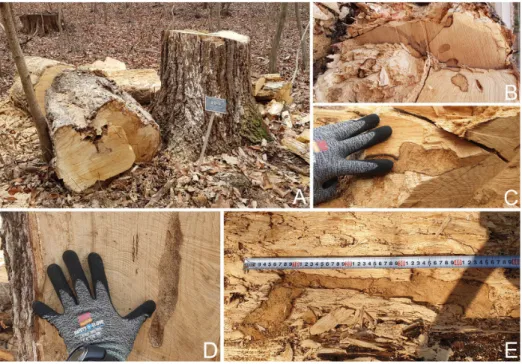
Fig. 1. Dissection of a Jolcham oak (Quercus serrata) damaged by Callipogon relictus. A, base and cut logs; B and C, larval feeding traces; D, larval gallery; E, measurement of larval gallery and feeding traces.

Fig. 2. Larvae of Callipogon relictus discovered in Quercus serrata. A and B, larva no. 1; C and D, larva no. 2; E and F, larva no. 3. Larva

numbers correspond to those in Table 1.

(3)

A new host of Callipogon relictus 359 dissection was performed in the field, with suspect trees being cut

and split along the larval galleries.

On February 24, 2020, we found defoliated logs of Quercus (Fagaceae) near a trail path in the KNA (37° 45ʹ 5.5ʺ N, 127° 10ʹ 0.7ʺ E, altitude 80 m) (Fig. 1A). It was assumed that the trees had been felled to clear the trail of obstructions for tourists. One of these trees showed signs of larval infestations. It had been cut appro-

ximately 90 cm above the earth, and its diameter at breast height was approximately 80 cm. The total length of the cut logs was appro- ximately 680 cm. The upper part of the trunk was cut off and could not be measured.

The morphometric characteristics of the live larvae, such as length, head width, and weight, were measured. The list of host plants provided by Lee et al. (2019) was used as a reference to Table 1. Characteristics of larvae obtained from Quercus serrata logs

No. Length of Body (mm) Width of Head Capsule (mm) Weight of larva (g)

1 74.0 10.19 9.42

2 72.0 10.28 9.89

3 82.0 9.5411.93

Table 2. An updated list of host plants of Callipogon relictus Semenov (modified from Lee et al., 2019) (*, new record from present study)

No. Host plant Prevalence in each country

Family Scientific name S. Korea China Russia

1 Aceraceae Acer mandshuricum Maxim. √

2 Anacardiaceae Anacardiaceae mono Maxim. √

3 Betulaceae Betula costata Trautv. √

- " Betula spp. √

4 " Carpinus cordata Blume √

5 " Carpinus laxiflora (Siebold & Zucc.) Blume √ √

- Carpinus spp. √

6 Fagaceae Quercus aliena Blume √

7 " Quercus mongolica Fisch. √ √ √

8 " Quercus serrata Thunb. ex Murray* √

9 " Quercus wutaishanica Mayr √

- " Quercus spp. √ √

10 Salicaceae Chosenia arbutifolia (Pall.) A. Skvorts. √

11 " Populus maximowiczii A. Henry √

12 " Salix caprea L. √

13 " Salix schwerinii E. Wolf. √

14Tiliaceae Tilia amurensis Rupr. √

15 Ulmaceae Fraxinus mandshurica Rupr. √ √ √

16 " Fraxinus rhynchophylla Hance √ √

- " Fraxinus spp. √ √

17 " Ulmus davidiana var. japonica (Rehder) Nakai √ √

18 " Ulmus laciniata (Trautv.) √

19 " Ulmus propinqua Koidz √

- " Ulmus spp. √

7 families 11 genera 19 species 8 7 11

(4)

360 Korean J. Appl. Entomol. 59(4) 357~360 (2020)

confirm Quercus as a new host plant.

Results and Discussion

We observed a dead broadleaved tree bearing holes and feeding scars made by the larvae (Fig. 1B–E). Dissection of the tree along the larval galleries and feeding traces (Fig. 1B, C, D, E) revealed three large live C. relictus larvae within the galleries (Fig. 1B, E). We concluded that the galleries were made by C. relictus larvae. The tree in which the larvae were observed was identified as Quercus serrata Thunb. ex Murray (Fagales: Fagaceae), commonly called Jolcham oak. This species has not been previously recorded as a host plant of C. relictus.

The first larva was 74 mm in length, 10.19 mm in head width, and 9.42 g in weight (Fig. 2A, B). The second larva was 72 mm in length, 10.28 mm in head width, and 9.89 g in weight (Fig. 2C, D). The third larva was 82 mm in length, 9.54 mm in head width, and 11.93 g in weight (Fig. 2E, F). The first, second, and third larvae were found 370 cm, 345 cm, and 285 cm, respectively, from the ground, and all were approximately 20 cm inside the bark (Fig. 1E).

In the present communication, we report Quercus serrata Thunb.

ex Murray as a new host of Callipogon relictus and provide an updated list of host plants of C. relictus (Table 2).

Acknowledgments

We thank our colleagues in the Korea National Arboretum, Dr.

Yong-Hwan Park, Dr. Dong-Jun Lee, and Mrs. Young-Min Shin for their help in identifying the host plants of C. relictus. This study was supported by the Korea National Arboretum (KNA1-2-36, 20-2).

Statements for Authorship Position &

contribution

Lee, S.-G.: National Institute of Biological Resources: Helped conduct the field experiments and helped write the manuscript.

Kim, M.-S.: Korea National Arboretum, Assistant researcher.

Helped conduct the field experiments.

Lee, B.-W.: Korea National Arboretum, Senior researcher. Helped conduct the field experiments.

Lim, J.: Korea National Arboretum, Researcher. Designed the field experiments and helped write the manuscript.

All authors read and approved the manuscript.

Literature Cited

Lee, S.G., Kim, C.H., Choi I., Kuprin, A.V., Lim, J., 2019. A review of host plants of Callipogon (Eoxenus) relictus Semenov (Coleoptera: Cerambycidae: Prioninae), a Korea natural monument, with a new host, Quercus aliena Blume. J. Asia-Pac. Entomol. 22, 353-358.

Lee, S.G., Kim, C.H., Kuprin, A.V., Kang, J.H., Lee, B.W., Oh, S.H., Lim, J., 2018. Survey research on the habitation and bio- logical information of Callipogon relictus Semenov in Gwangneung forest, Korea and Ussurisky nature reserve, Russia (Coleoptera, Cerambycidae, Prioninae). Zookeys 792, 45-68.

Yi, D.A., Kuprin, A.V., Bae, Y.J., 2018. Distribution of the

longhorned beetle Callipogon relictus Coleoptera: Cerambycidae) in

Northeast Asia. Zootaxa 4369, 101-108.

수치

Fig. 1.  Dissection of a Jolcham oak (Quercus serrata) damaged by Callipogon relictus
Table 2.  An updated list of host plants of Callipogon relictus Semenov (modified from Lee et al., 2019) (*, new record from present study)

참조

관련 문서

North Korea is not the country which deserves to be invested, but it could play a crucial role in the process of propelling the South Korea's new

In this paper, I explored the desirable direction of fiscal policy for inclusive growth in Korea in view of the current situation of Korea economy which

This paper proposes a perspective of political economy to explore important issues on regulation studies, focusing on the case of tobacco control in South

This paper proposes a perspective of political economy to explore important issues on regulation studies, focusing on the case of tobacco control in South Korea.

 As a affiliated company of Green Cross in the field of genome analysis, we provide disease diagnosis services, such as prenatal genetic test, oncogenomic analysis and

1 John Owen, Justification by Faith Alone, in The Works of John Owen, ed. John Bolt, trans. Scott Clark, "Do This and Live: Christ's Active Obedience as the

Arabic Scripted Language Identification System in order to identify the language of the Arabic script by using PCA and KNN, here, the number of PCA features were optimized

including 2 billion tons coking coal and 10.1 billion including 2 billion tons coking coal and 10.1 billion.. tons