ORIGINAL ARTICLE
Tetracycline계 항생물질들의 활성탄 흡착 및 생물여과 공정에 의한 생분해 특성
손희종․염훈식․류동춘․장성호
1)*
․손형식2)
부산광역시 상수도사업본부 수질연구소, 1) 부산대학교 지역환경시스템공학과, 2) 울산테크노파크 전략산업기획단
Characteristics of Adsorption and Biodegradation of Tetracycline Antibiotics by Granular Activated Carbon and Biofiltration Process
Hee-Jong Son, Hoon-Sik Yeom, Dong-Choon Ryu, Seung-Ho Jang
1)*
, Hyung-Sik Son2) Water Quality Institute, Busan Water Authority, Busan 609-817, Korea
1) Department of Environmental System Engineering, Pusan National University, Busan 609-717, Korea
2) Regional Innovation Agency, Ulsan Technopark, Ulsan 681-802, Korea
Abstract
Adsorption and biodegradation performance of tetracycline antibiotic compounds such as ttetracycline (TC), oxytetracycline (OTC), minocycline (MNC), chlortetracycline (CTC), doxycycline (DXC), meclocycline (MCC), demeclocycline (DMC) on granular activated carbon (GAC) and anthracite-biofilter were evaluated in this study. Removal efficiency of seven tetracycline antibiotic compounds showed 54%∼97% by GAC adsorption process (EBCT: 5∼30 min). The orders of removal efficiency by GAC adsorption were tetracycline, demeclocycline, oxytetracycline, chlortetracycline, doxytetracycline, meclocycline and minocycline. Removal efficiencies of seven tetracycline antibiotic compounds showed 1%∼61% by anthracite biofiltration process (EBCT: 5∼30 min). The highest biodegradable tetracycline antibiotic compound was minocycline, and the worst biodegradable tetracycline antibiotic compounds were oxytetracycline and demeclocycline.
Key words : Tetracycline antibiotic compounds, Granular activated carbon process, Biofiltration process, Adsorption, Biodegradation.
1. 서 론
1)
인간이 제조하여 사용하는 항생물질은 수십 년 동 안 인간, 가축 및 양식어류의 질병 예방과 구제에 이용 되어오고 있다. 하지만 인간의 질병예방과 치료 목적 으로 항생물질의 과다한 남용과 가축, 양식어류의 질 병구제 및 성장촉진 목적으로 사료에 넣어 남용한 결 과로 이러한 항생물질은 가정과 병원을 비롯한 도시
하수, 축산폐수 및 다양한 경로를 통하여 자연환경으 로 유입되어 항생물질 자체의 독성뿐만 아니라 인간 과 환경을 위협하는 항생물질에 강한 내성을 가진 병 원균들의 출현에 기여하였다(Boxall 등, 2003; Chee- Sanford 등, 2001; Daughton과 Ternes, 1999; Halling- Sorensen 등, 1998; Heberer, 2002; Hileman, 2001;
Wollenberger 등, 2000).
항생물질은 전국 도처에서 사용되고 있고, 사용된
Received 4 June, 2013; Revised 10 October, 2013;
Accepted 15 October, 2013
* Corresponding author : Seung-Ho Jang, Department of Environ- mental System Engineering, Pusan National University
Phone: +82-350-5435 E-mail: [email protected]
ⓒ The Korean Environmental Sciences Society. All rights reserved.
This is an Open-Access article distributed under the terms of the Creative Commons Attribution Non-Commercial License (http://
creativecommons.org/licenses/by-nc/3.0) which permits unrestricted
non-commercial use, distribution, and reproduction in any medium,
provided the original work is properly cited.
Compounds Abbreviation CAS-No. Structure Formular M.W.
Oxytetracycline OTC 79-57-2 C 22 H 25 N 2 O 9 460.4
Minocycline MNC 10118-90-8 C 23 H 27 N 3 O 7 457.5
Doxycycline DXC 564-25-0 C 22 H 24 N 2 O 8 444.4
Meclocycline MCC 2013-58-3 C 22 H 21 ClN 2 O 8 476.9
Chlortetracycline CTC 57-62-5 C 22 H 23 ClN 2 O 8 478.9
Demeclocycline DMC 127-33-3 C 21 H 21 ClN 2 O 8 464.9
Tetracycline TC 60-54-8 C 22 H 24 N 2 O 8 444.4
Table 1. Physico-chemical properties of the seven tetracyclines
양의 상당한 부분이 축산폐수 및 도시하수 처리장에서 완전히 제거되지 않고 자연 수계로 유입된다(Stumpf 등, 1999)Choi 등의 연구(2007a)에서 낙동강 부근에 위치한 하수처리장(activated sludge 공정)과 축산폐 수 처리장(A2
O 공정)의 유입수와 2차 처리수를 대상 으로 tetracycline계 항생물질 7종에 대한 검출여부를 조사한 결과, 유입수에서는 7종 모두 검출되었으며 하 수처리장 및 축산폐수 처리장의 2차 처리수에서는 각 각 4종과 5종이 검출되었다고 보고하였다. 또한, 도시 하수 보다 축산폐수 2차 처리수에서 비교적 높은 농도 의 tetracycline계 항생물질이 검출되었고, 검출농도는 chlortetracycline이 90.9 μg/L, oxytetracycline이 6.53 μg/L 및 tetracycline 1.41 μg/L로 보고하였다. 현재 전 세계적으로 다양한 수처리 공정들을 이용하여 수중 잔 류 항생물질들에 대한 제거능 및 제거 메카니즘에 대한 많은 연구가 진행중에 있으며, 특히 산화, 흡착 및 생물 분해 등의 다양한 처리공정들에서의 tetracycline계 항생 물질들의 제거능 평가에 관한 연구결과들이 많이 보 고되고 있다(Choi 등, 2007b; Oturan 등, 2013; Son 등, 2008; Son 등, 2009; Wan 등, 2013; Wang 등, 2012; Wang 등, 2011)본 연구에서는 tetracycline계 항생물질 7종에 대해 석탄계 및 야자계 재질의 활성탄을 이용하여 이들의 흡 착 특성을 평가하였으며, 또한, 활성이 있는 박테리아들 이 부착된 안트라사이트 biofilter를 이용하여 이들의 생 물분해능도 함께 평가하여 이들 물질들이 정수처리 공 정으로 유입되었을 경우 입상활성탄(granular activated carbon) 공정과 생물활성탄(biological activated carbon) 공정에서의 이들 물질들의 제어를 위한 기초 운영자 료로 활용하고자 하였다.
2. 실험재료 및 방법
2.1. 실험 재료 2.1.1. 항생물질
본 실험에 사용된 항생물질은 tetracycline계 7종으로 tetracycline (TC), oxytetracycline (OTC), minocycline (MNC), chlortetracycline (CTC), doxycycline (DXC), meclocycline (MCC), demeclocycline (DMC) 7종이 며, sigma-aldrich사(USA)에서 제조한 순도 99% 이상 의 특급물질을 사용하였다. 실험에 사용된 tetracycline 계 항생물질 7종에 대한 물리․화학적인 특성들을
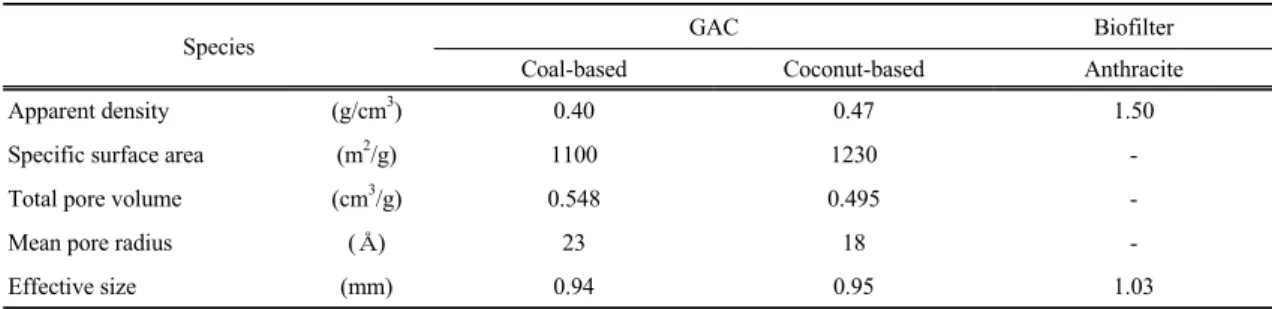
Species GAC Biofilter
Coal-based Coconut-based Anthracite
Apparent density (g/cm 3 ) 0.40 0.47 1.50
Specific surface area (m 2 /g) 1100 1230 -
Total pore volume (cm 3 /g) 0.548 0.495 -
Mean pore radius ( Å ) 23 18 -
Effective size (mm) 0.94 0.95 1.03
Table 2. The physical characteristics of coal- and coconut-based GACs and anthracite
Table 1에 나타내었다.2.1.2. 입상활성탄 및 안트라사이트 성상
본 실험에서는 입상활성탄은 석탄계 재질의 활성 탄(F400, Calgon, USA)과 야자계 재질의 활성탄(1급, Samchully, Korea)으로 신탄을 충진한 후 2주일 정도 사 용한 후 실험을 진행하였다. 또한, Biofilter의 여재로 사 용된 안트라사이트(한국 안트라사이트)는 biofilteration 공정에서 1년 정도 운전한 것을 초순수로 깨끗이 세척 한 후 실험에 사용하였다. 실험에 사용된 입상활성탄 의 세공용적, 비표면적, 세공크기 분포 및 평균 세공크 기는 활성탄 세공용적 측정기(AUTOSORB-1 MP, Quantachrome, USA)로 측정하였다.
Pore diameter [Angstroms]
10 100 1000
Deso rp ti on v o lum e [cc/g ]
0.0 0.3 0.6 0.9 1.2
Coconut-based Coal-based
Fig. 1. Pore size distributions of coal- and coconut-based GACs.
2.1.3. 유입수 성상
GAC 및 biofilter 컬럼의 유입수는 300 m
3
/일 규모의 고도 정수처리용 파일롯트 플랜트의 후오존 처리 수를 사용하였다. 고도 정수처리 공정의 후오존 처리 수에 tetracycline계 항생물질 7종을 각각 투입하여 유 입되는 각각의 성분 농도가 5 μg/L가 되도록 하였다.
증류수가 아닌 수중에 용존유기탄소(dissolved organic carbon, DOC)가 잔존하는 물을 유입수로 사용한 이 유는 실제로 정수장에서의 활성탄 흡착조의 운전조건 과 유사하게 만들기 위해서이며, 실험에 사용된 시료 수의 특성을 Table 3에 나타내었다. 후오존 처리수의 성상은 DOC 농도가 1.15~1.27 mg/L로 조사되어 낙 동강 원수를 정수처리하는 정수장의 활성탄 접촉조 유입수의 특성과 거의 유사하였다.
Table 3. Characteristics of influent water Parameters
pH Turbidity Alkalinity DOC Temp.
(-) (NTU) (mg/L) (mg/L) ( ℃ )
Value 7.0
~ 7.3
0.04
~ 0.08
31
~ 47
1.15
~ 1.27
15 ~ 18
2.2. 실험방법
2.2.1. 입상활성탄 및 생물여과 컬럼 운전
본 실험에 사용된 입상활성탄 및 생물여과 컬럼은 아크릴 재질로 내경 5 cm, 총 길이 200 cm, 층고 100 cm이며, 각각의 컬럼 세트에 고농도 tetracycline계 7 종의 조제수가 유입되어 혼화조에서 300 m
3
/일 처리 규모의 pilot-plant 최종처리수와 혼합된 후 각각의 컬 럼으로 유입되도록 설계하였다. 컬럼은 하향류식으로 운전하였으며, 공탑체류시간(empty bed contact time, EBCT)은 각각의 컬럼들의 중층부에서 하층부까지Antibiotics P
P pos t O
3wate r M ixing tank
Tre ate d wate r
B e d he ight 100 cm
Grave l 5 cm 5cm
200 cm
15 cm 5 cm (Grave l) 100 cm 110 cm
90 cm 70 cm 50 cm 30 cm 5 cm
B ackwash wate r influe nt Tre ate d wate r
Fig. 2. Schematic diagram of GAC and biofilter column system.
설치되어 있는 sampling 지점에 따라 EBCT가 5분에 서 30분이 되도록 설정하여 운전하였다. 역세척은 잔 류염소가 존재하지 않는 처리수로 주 1회 실시하였으 며, 입상활성탄 및 생물여과 컬럼의 상세한 설계인자 를 Fig. 2에 나타내었다.
2.2.2. 항생물질 고체상 추출 및 LC/MSD 분석
시료수는 50 mL를 채수하여 입자성 물질의 제거를 위하여 0.2 μm 멤브레인 필터(Millipore, USA)로 여 과한 후 5% Na2
EDTA를 0.2 mL 첨가하였다(Yang과 Carlson, 2003). Na2
EDTA 첨가 후 40% 황산을 사용하 여 시료수의 pH를 3 이하로 조절한 후 on-line용 SPE (solid phase extraction)와 LC/MSD 시스템을 이용하여 분석하였다. On-line용 SPE (Spark Holland, Netherlands) 와 LC/MSD (Agilent 1100 SL, Agilent, USA)는 on-line으로 연결되어 있어 SPE에서 시료의 농축 및 추출이 끝난 target 물질들은 자동적으로 LC/MSD로 유입되는 시스템이다(Son 등, 2013). On-line용 SPE 카트리지는 ProspektTM
oasis HLB 카트리지(10 mm× 2 mm, Waters, USA)를 이용하였다. 카트리지는 메 탄올 1 mL, 0.5 N HCl 1 mL 그리고 순수(DI water) 1 mL를 순서대로 사용하여 컨디셔닝한 후, 시료수 10 mL를 2 mL/min의 유속으로 카트리지에 통과시켰으 며, 추출시에는 0.1% formic acid (in water)와 0.1%
formic acid (in acetonitrile)을 0.2 mL/min의 유속으
로 카트리지에 흡착되어 있는 target 물질들을 용출시 켰으며, 이 때 카트리지는 LC/MSD와 on-line으로 연 결되어 cartridge 내에 수집된 target 물질 전량을 LC 컬럼으로 보낸다. 분석에 사용된 LC용 컬럼은 충진물 의 충진물 내경 및 길이가 2.1 mm×50 mm인 Atlantis
Ⓡ
dC18 column(Waters, USA)을 사용하였다. 그 외의 LC/MSD 분석조건을 Table 4에 나타내었다.Tetracycline계 항생물질 7종의 calibration 및 정량 은 각각의 물질이 가지는 고유한 protonated molecular ion [M+H]
+
만을 추출해 내는 EIC (extracted ion chromatogram) 모드로 정량하였으며, 각각의 protonated molecular ion은 TC, DXC, MNC, OTC, DMC, MCC, CTC 순으로 445, 445, 458, 461, 465, 477, 479이다 (Choi 등, 2007a).Table 4. Analytical conditions of LC/MSD Description Analytical condition
Mode API, positive
Fragment voltage, volts 100
Mobile phase A : 0.1% formic acid in water B : 0.1% formic acid in acetonitrile Gradient program 0 min, A/B = 96/4
20 min, A/B = 70/30
21 min, A/B = 96/4
Flow rate, mL/min 0.4
(a) Minocycline
EBCT (min) 0 10 20 30 R esi du al r at io , C/ C
0(-)
0.0 0.2 0.4 0.6 0.8 1.0
(b) Meclocycline
EBCT (min) 0 10 20 30 0.0
0.2 0.4 0.6 0.8 1.0
(c) Doxycycline
EBCT (min) 0 10 20 30 0.0
0.2 0.4 0.6 0.8 1.0
(d) Chlortetracycline
EBCT (min) 0 10 20 30 0.0
0.2 0.4 0.6 0.8 1.0
(e) Oxytetracycline
EBCT (min) 0 10 20 30 0.0
0.2 0.4 0.6 0.8 1.0
(f) Demeclocycline
EBCT (min) 0 10 20 30 0.0
0.2 0.4 0.6 0.8 1.0
(g) Tetracycline
EBCT (min) 0 10 20 30 0.0
0.2 0.4 0.6 0.8 1.0
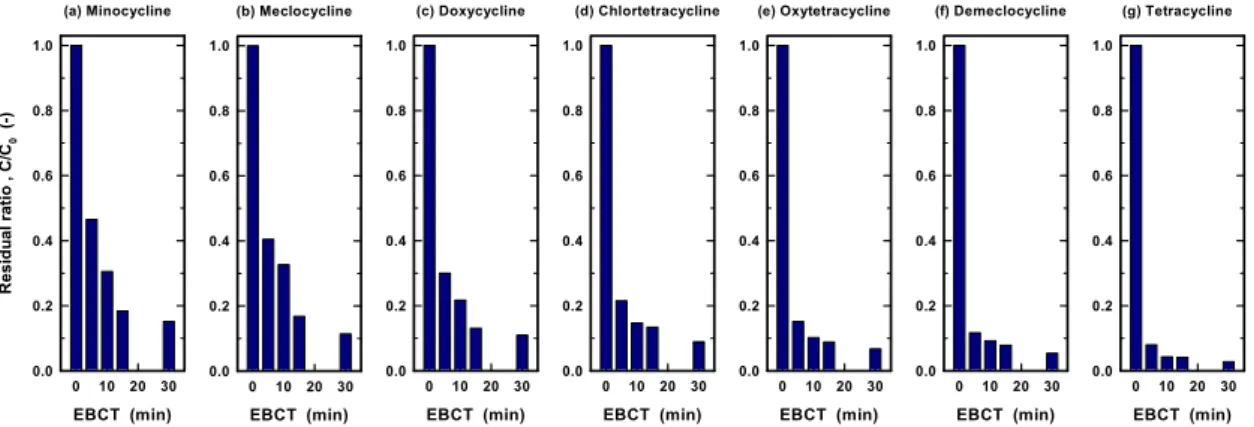
Fig. 3. Effect of EBCT on the tetracycline class of antibiotics adsorption.
3. 결과 및 고찰
3.1. GAC 공정에서의 tetracycline계 항생물질들의 흡착 특성
석탄계 재질의 GAC에서의 tetracycline계 항생물 질 7종에 대한 흡착제거 특성을 평가한 것을 Fig. 3에 나 타내었다. Fig. 3에서 볼 수 있듯이 7종의 tetracycline계 항생물질들은 EBCT가 5분에서 30분으로 증가할수 록 제거율은 모두 증가하였으며 특히, Fig. 3(a)에 나 타낸 minocycline (MNC)의 경우는 EBCT가 5분에서 30분으로 증가할수록 흡착 제거율은 54%에서 85%로 나타난 반면 Fig. 3(g)에 나타낸 tetracycline (TC)의 경우는 EBCT가 5분에서 30분으로 증가할수록 흡착 제거율도 92%에서 97%로 나타나 실험에 사용된 7종 의 tetracycline계 항생물질들 중 가장 높은 흡착 제거 율을 보였다. 7종의 tetracycline계 항생물질들의 흡착 제거율은 tetracycline (TC)가 가장 높게 나타났으며, 다 음으로 demeclocycline (DMC), oxytetracycline (OCT), chlortetracycline (CTC), doxytetracycline (DXC), meclo- cycline (MCC), minocycline (MNC) 순으로 나타났다.
일반적으로 활성탄에서의 피흡착 물질의 흡착능은 Log
K ow
값과 높은 상관성을 가진다(Westerhoff 등, 2005).여러 연구결과들에서 보고된 tetracycline계 항상물질 들의 Log K
ow
값을 비교해보면 tetracycline (TC), oxytetracycline (OTC), chlortetracycline (CTC) 및 minocycline (MNC)의 Log Kow
값은 각각 –1.19 (Xu 와 Li, 2010), -1.12 (Loke 등, 2002), -0.62 (Son 등, 2008) 및 0.05 (Son 등, 2008)로 보고되어 MNC의 소수도(hydrophobicity)가 가장 높은 것으로 나타났고, TC의 소수도가 가장 낮았다. 그러나 본 연구에서 이 들의 흡착 제거능의 경우는 가장 큰 소수성을 가지는 MNC가 활성탄에서의 흡착 제거능은 가장 낮았으며, TC가 가장 높은 흡착 제거능을 보여 tetracycline계 항 생물질들의 Log K
ow
값은 활성탄에서의 흡착 제거능 에 영향을 주지 않는 것으로 나타나 tetracycline계 항 생물질들이 공통적으로 가지고 있는 작용기외에 개별 고리에 붙은 산소, 질소 혹은 메틸기의 전기 음성도 등 의 반응성 차이가 활성탄의 흡착능에 영향을 미친 것 으로 판단된다.석탄계 및 야자계 재질의 GAC에서의 tetracycline 계 항생물질 2종에 대한 흡착제거 특성을 비교․평가 한 것을 Fig. 4에 나타내었다. Tetracycline계 항생물 질 2종은 Fig. 3에서 석탄계 재질의 활성탄 흡착실험 에서 흡착 제거율이 가장 낮았던 minocycline (MNC) 과 가장 높은 흡착 제거율을 나타낸 tetracycline (TC) 이다. MNC와 TC에 대해 야자계와 석탄계 활성탄에 서의 흡착 제거능을 비교한 Fig. 4를 보면 MNC의 경 우 EBCT가 5분에서 30분으로 증가할수록 석탄계 및 야자계 재질의 활성탄에서의 흡착 제거율은 각각 54%
∼ 85% 및 40%∼68%로 나타나 석탄계 재질의 활성 탄에서 14%∼17% 정도 높은 흡착 제거율을 나타내 었다. 또한, TC의 경우는 EBCT가 5분에서 30분으로 증가할수록 석탄계 및 야자계 재질의 활성탄에서의 흡착 제거율은 각각 92%∼97% 및 90%∼94%로 나 타나 석탄계 재질의 활성탄에서 2%∼3% 정도 높은 흡착 제거율을 나타내어 MNC에 비해 활성탄 재질의
(a) Oxytetracycline
EBCT (min) 0 10 20 30 R esi du al r at io , C/ C
0(-)
0.0 0.2 0.4 0.6 0.8 1.0
(b) Demeclocycline
EBCT (min) 0 10 20 30 0.0
0.2 0.4 0.6 0.8 1.0
(c) Chlortetracycline
EBCT (min) 0 10 20 30 0.0
0.2 0.4 0.6 0.8 1.0
(d) Doxycycline
EBCT (min) 0 10 20 30 0.0
0.2 0.4 0.6 0.8 1.0
(e) Tetracycline
EBCT (min) 0 10 20 30 0.0
0.2 0.4 0.6 0.8 1.0
(f) Meclocycline
EBCT (min) 0 10 20 30 0.0
0.2 0.4 0.6 0.8 1.0
(g) Minocycline
EBCT (min) 0 10 20 30 0.0
0.2 0.4 0.6 0.8 1.0
Fig. 5. Effect of EBCT on the tetracycline class of antibiotics biodegradation.
차이에 따른 흡착 제거율의 차이가 많이 감소하였다. 활성탄 재질의 차이에 따른 MNC와 TC의 흡착 제거 율의 차이는 Fig. 1에 나타낸 세공크기 분포도에서 알 수 있듯이 야자계 재질의 활성탄의 경우는 20 Å 이하 의 미세세공(micro pore)이 발달한 반면, 석탄계 재질 의 활성탄은 50 Å 이상의 중간세공(meso pore)이 발 달해 있는 것으로 나타났다. 일반적으로 20 Å 이하의 미세세공은 저분자 물질의 흡착에 관여하며(Son 등, 2005), 중간세공의 경우는 tetracycline계 항생물질들 과 같은 중․고분자 물질들의 흡착에 관여한다(Son 등, 2010). 또한, Table 2에 나타낸 세공용적(total pore volume) 결과를 보면 석탄계 재질의 활성탄이 0.548 cm
3
/g으로 야자계 재질의 활성탄 0.495 cm3
/g에 비해 10% 정도 높은 결과를 나타내었다. 세공용적의 경우 도 활성탄의 흡착능에 많은 영향을 미치는 것으로 보 고되고 있다(Choi 등, 2005)EBCT (min)
0 10 20 30
Mi noc yc lin e C/C
0(-)
0.0 0.2 0.4 0.6 0.8 1.0
EBCT (min)
0 10 20 30
Te tr ac yc lin e C /C
0(-)
0.0 0.2 0.4 0.6 0.8 1.0
Coal-basedCoconut-based
Fig. 4. Effect of material of GAC on the minocycline and tetracycline adsorption.
활성을 가진 박테리아들이 부착된 안트라사이트 biofilter에서의 tetracycline계 항생물질 7종에 대한 생물분해 특성을 평가한 것을 Fig. 5에 나타내었다.
Fig. 5에서 볼 수 있듯이 7종의 tetracycline계 항생물질 들은 EBCT가 5분에서 30분으로 증가할수록 생물분해 에 의한 제거율은 모두 증가하였다. 가장 높은 생분해 율을 보인 물질은 minocycline으로 EBCT 5분∼30분 에서의 제거율이 23%∼61%로 나타났다. 또한, 가장 낮은 생물분해율을 나타낸 물질은 oxytetracycline과 demeclocycline으로 EBCT 5분∼30분에서의 제거율 이 약 1%∼39% 정도로 나타났다. 일반적으로 친수성 이며 저분자 물질들이 생물학적 처리공정에서의 생물 분해능이 높은 것으로 알려져 있다(Çeçen과 Aktaş, 2012). 본 연구에 사용된 7종의 tetracycline계 항생물 질들의 분자량은 444∼479의 범위로 큰 차이를 보이 지는 않았고, 앞에서도 언급하였듯이 Log K
ow
값은 – 1.19∼0.05의 범위로 나타나 친수성 특성이 강한 것으 로 평가된다. 그러나 이들의 7종의 biofilter 부착 박테 리아들에 의한 생물분해능에는 다소 차이가 나타나 며, 이러한 이유는 GAC 흡착능 평가에서 언급하였듯 이 작용기외에 개별 고리에 붙은 산소, 질소 혹은 메틸 기의 전기 음성도 등과 같은 반응성의 차이를 유발하 는 인자들의 영향으로 판단된다. 입상활성탄 흡착 공 정 및 biofilter 생물분해 공정에서 EBCT 15분에서의 7종의 tetracycline 항생물질들에 대한 제거율을 비교 한 것을 Table 3에 나타내었다. 흡착에 의한 제거능이 높은 물질들은 생물분해에 의한 제거능이 비교적 낮 게 나타나고 있다.Tetracycline class Adsorption Biodegradation Coal-based GAC Coconut-based GAC Anthracite-Biofilter
Minocycline 81.6% 54.6% 52.0%
Meclocycline 83.2% 66.0% 45.1%
Doxycycline 86.9% 76.2% 38.8%
Chlortetracycline 86.6% 79.3% 36.5%
Oxytetracycline 91.2% 85.5% 32.9%
Demeclocycline 92.2% 86.3% 31.6%
Tetracycline 95.9% 92.0% 42.8%
Table 3. Removal efficiencies of the seven tetracycline antibiotics by adsorption and biodegradation at an EBCT of 15 minutes in the GAC and biofilter
4. 결 론
입상활성탄 흡착 및 biofilter 생물분해 공정에서 tetracycline계 항생물질 7종에 대한 흡착 및 생물분해 능을 조사한 결과 다음과 같은 결론을 얻을 수 있었다.
1. 입상활성탄 흡착 공정에서 tetracycline계 항생물 질들은 EBCT 5분∼30분에서 54%∼97%의 제거율을 나 타내었으며, tetracycline이 가장 제거율이 높았으며, 다음 으로 demeclocycline, oxytetracycline, chlortetracycline, doxytetracycline, meclocycline, minocycline 순으로 나타났다.
2. 활성탄 재질에 따른 흡착능 평가에서 50 Å 이상 의 중간세공들이 발달한 석탄계 재질의 활성탄이 tetracycline계 항생물질들의 흡착 제거에 유리하였다.
3. 안트라사이트 biofilter를 이용한 생물분해 공정 에서 tetracycline계 항생물질들은 EBCT 5분∼30분 에서 1%∼61% 제거율을 나타내었으며, minocycline 이 가장 높은 생분해율을 나타낸 반면 oxytetracycline 과 demeclocycline이 가장 생분해율이 낮았다.
4. Tetracycline계 항생물질들의 효과적인 제거를 위해서는 흡착 공정과 생물분해 공정을 병행하여 운 전하는 것이 효과적일 것으로 나타났다.
참 고 문 헌