• 검색 결과가 없습니다.

Innovation Capabilities and Small and Medium Enterprises' Performance: An Exploratory Study

N/A
N/A
Protected

Academic year: 2021

Share "Innovation Capabilities and Small and Medium Enterprises' Performance: An Exploratory Study"

Copied!
10
0
0

로드 중.... (전체 텍스트 보기)

전체 글

(1)

Print ISSN: 2288-4637 / Online ISSN 2288-4645 doi:10.13106/jafeb.2020.vol7.no10.959

Innovation Capabilities and Small and Medium Enterprises’

Performance: An Exploratory Study*

Hazem ALI

1

, Yunhong HAO

2

, Chen AIJUAN

3

Received: August 01, 2020 Revised: September 06, 2020 Accepted: September 10, 2020

Abstract

Research underlined that Small and Medium Enterprises’ performance is enhanced by different types of innovation capabilities. This research tends to present a comprehensive model to explain the relationship between innovation capabilities and SMEs’ financial and operational performance. Specifically, this study tends to achieve three objectives: explores the set of product, process, organizational and marketing innovation capabilities possessed by owners/managers of SMEs and their impact on Chinese manufacturing SMEs’ operational and financial performance dimensions, identify the determinants of innovation capabilities, and determine the contextual factors that moderate innovation capabilities and SMEs’ performance. This research employed a qualitative research method using in-depth interviews with eight owners/managers of Chinese manufacturing SMEs. Research findings revealed that product and marketing innovation capabilities have a significant impact on SMEs’ financial performance while process and organizational innovation capabilities positively influence SMEs’ operational performance. The major determinants of innovation capabilities involved availability of sufficient organizational resources, entrepreneurial orientation, knowledge development and external networks. The contextual moderating factors on the relationship between innovation capabilities and SMEs’ performance involved internal factors which are: SME size, SMEs’ owner/manager work experience, entrepreneurial mindset; and external factors: market dynamism and cooperation strategies. This paper ends by drawing some concluding remarks and proposing future research avenues.

Keywords: Innovation Capabilities, Operational Performance, Financial Performance, SMEs, China JEL Classification Code: M10, L25, O30

of maintaining distinctive competitive position and improving organizational performance (Lichtenthaler, 2016; Yuan et al., 2016), especially for SMEs (Love & Roper, 2015).

In China, SMEs represent around 99% of total business establishments with a pessimistic status for innovation which is largely due to lack of funding, size and limited experience (Chen, Zhu & Zhang, 2017). According to Mckinsey Global Institute (2015), Chinese companies maintain a clear competitive position in customer-focused innovation in today’s large and dynamic business environment. In their research on investigating the unique Chinese innovation pathways of SMEs, Chung and Tan (2017) showed that many Chinese SMEs have several constrains such as limited advanced technological capabilities, lack of skilled workforce, and insufficient funds. On the other hand, Yuan, Shin, He and Young Kim (2016) argued that Chinese firms are capable of finding and developing new technologies and innovative ways of doing businesses in order to succeed and grow.

Previous research acknowledged that innovation capabilities allow firms to achieve desired outcomes by acquiring new technologies and knowledge (Hult.et.al,

1. Introduction

The development of SMEs is a high priority for many governments around the world due to their contribution in creating employment opportunities and developing innovation. Research emphasize innovation as a vital driver

*Acknowledgements:

The authors acknowledge and appreciate the support given by Zhejiang Gongshang University for conducting this research.

1

First Author and Corresponding Author. Postdoctoral Researcher, School of Business Administration, Zhejiang Gongshang University, China [Postal Address: No.18, Xuezheng Street, Xiasha University Town, Hangzhou, Zhejiang Province, 310018, China]

Email: [email protected].

2

Professor, School of Business Administration, Zhejiang Gongshang University, China. Email: [email protected].

3

DBA Candidate, UCSI University, School of Business and Information Science, Malaysia. Email: [email protected]

© Copyright: The Author(s)

This is an Open Access article distributed under the terms of the Creative Commons Attribution Non-Commercial License (https://creativecommons.org/licenses/by-nc/4.0/) which permits unrestricted non-commercial use, distribution, and reproduction in any medium, provided the original work is properly cited.
(2)

2004). In Asian context, manufacturing SMEs contribute significantly to increasing exports and offering cheaper products compared to their counterparts throughout the world (Terziovski, 2010).

Extant literature revealed the positive and significant association between innovation and performance of an organization (Exposito & Sanchis-Llopis, 2018; Gunday et al., 2011; Hervas-Oliver et al., 2014; Hult.et.al, 2004;

Jimenez-Jimenez & Sanz-Valle, 2011; Nemlioglu and Mallick, 2017; Saunila, Pekkola, & Ukko, 2014; Sahoo, 2019: Sok.et.al, 2015, Vu, 2020). In a systematic review on innovation capability in SMEs’ context, Saunila (2019) argued that empirical research conceptualize innovation capability as a process or an outcome affecting SMEs’

performance especially in manufacturing sector using survey questionnaire and limited studies using qualitative design. Further, Saunila (2019) called for more research on investigating the relationship between innovation capability and SMEs’ performance. Research focused mainly on product innovation capability and SMEs’ performance using survey. Therefore, further research should examine the impact of a specific dimension of innovation capability such as process, product, organizational structure and marketing innovation capabilities and SMEs’ performance using qualitative designs (Saunila, 2019).

Von Koskull and Strandvik (2014) advocated the need for more detailed research on what is really happening with the innovation capabilities of SMEs. This study calls for adopting a multifaceted view of innovation capabilities with diverse impacts on SMEs’ operational and financial performance. More specifically, this research tends to investigate the impact of product, process, organizational structure, and marketing innovation capabilities on different financial and operational dimensions of firm performance.

Further, this research identifies the determinants of innovation related to SMEs’ owner/manager, while the contextual factors were determined in relation to SMEs and their business environment.

2. Literature Review

This section presents the major conceptualization of dynamic capabilities especially in the context of the SMEs’, review and synthesis of literature on the impact of innovation capabilities on SMEs’ operational and financial performance, determinant of innovation capabilities, and contextual moderating factors affecting the relationship between innovation capabilities and SMEs’ performance.

2.1. Conceptualization of Innovation Capabilities Research presents various categorizations of innovation capabilities related to renewing product, process, service, and organizational structure (Hult.et.al, 2004; Saunila.et.al,

2014). Some studies focused on specific set of innovation capabilities such as process innovation product and process innovation (Martínez-Costa & Martínez-Lorente, 2008), and management and marketing innovation (Gunday.et.al, 2011). Other studies employed collective set of innovation capabilities such as product, process, management and marketing innovation capabilities (Avermaete.et.al, 2003), product, process, marketing, and organizational innovation (OECD, 2005). In conceptualizing innovation capability in SMEs’ context, research emphasized on innovation as an outcome and a process.

Researchers viewed innovation capabilities as a one- dimensional construct as a process used to create innovative outputs (Dadfar, Dahlgaard, Brege, & Alamirhoor, 2013;

Keskin, 2006) and enhance SMEs’ performance (Castela, Ferreira, Ferreira, & Marques, 2018). Keskin (2006) conceptualized innovation capabilities as organizational readiness to implement new ideas, develop new manners to do things, and to maintain creativity in operation while Zhang and Hartley (2018) argued that innovation capability focuses on utilizing ideas and experiences from distinct origins. In a similar vein, innovation capability was argued to have multiple dimensions (e.g. leadership, competence management, organizational culture, utilization of external knowledge and employee creativity) to creative outputs (Boly, Morel, Camargo, 2014; Saunila & Ukko, 2014). Similarly, some researchers argued that innovation capabilities consists of specific capabilities such as marketing capabilities, learning capabilities, entrepreneurial capabilities, networking capabilities and resource exploitation capabilities (Oura, Zilber, & Lopes, 2016).

On the other hand, the second research stream views innovation as an outcome and define innovation capability as the ability to produce different types of innovations. The most common types of innovations involve product, process and organizational innovation (Çakar & Ertürk, 2010;

Landoni.et.al, 2016; O’Cass & Sok, 2014). Some studies underline that process innovation has been considerably less studied (Hervas-Oliver, Boronat-Moll, & Sempere-Ripoll, 2016), other studies focused only on product and process innovation capabilities (Mejía Vallejo & Arias-Pérez, 2017), while some other researchers employed product, process, organizational and marketing innovation together (Bruhn, Alcântara, & Calegário, 2016; De Martino & Magnotti, 2018; Kafetzopoulos & Psomas, 2015; Maldonado-Guzmán, Garza-Reyes, Pinzón-Castro, & Kumar, 2018).

In the context of the small businesses, researchers relied on a separate single study which divided innovation capabilities into incremental explorative and exploitative innovation capabilities (Kittilaksanawong & Ren, 2013).

This research didn’t consider technological innovation

capabilities as they mostly related to product and process

innovation (Exposito & Sanchis-Llopis, 2018). This

research builds on the comprehensive conceptualization

(3)

of innovation capabilities: product, process, organizational and marketing (OECD, 2005). Such categorization provide wide and detailed explanation of various innovation capabilities possessed by SMEs’ owners/managers and their impact on different dimensions of operational and financial performance.

Marketing innovation pertains to renewing or improving marketing and commercialization methods of existing products or processes, modifying or improving the design, packaging, container, advertising and price of products (OECD, 2005). Yam.et.al (2011) defined marketing innovation as firm’s ability to promote and sell its products and adjusting them to customers’ preferences, competition level and to enhance firm performance. In this regard, marketing innovation allows firms, especially SMEs, to understand customers’ preferences, explore new markets, increase sales and improve firm’s competitive position (Gunday.et.al, 2011). Marketing innovation involves renewing marketing programs to cope with market requirement, develop new methods to build and improve relationships with customers, regular revision of the sales techniques, implementing innovative marketing programs, develop new business models, renew product design constantly, and adopting new ways to improve promotion (Sok.et.al, 2013). Yuan, Shin, He, and Yong Kim (2016) examined the impact of innovation capability and marketing capability on firm performance in China and Korea. Their research findings revealed that both capabilities positively influence firm performance and innovation capability is more important in Chinese market, while marketing capability is more vital for firms competing in Korea.

Process innovation includes all operational aspects of an organization which reduce the cost and complexity of production processes and improve product or service quality, delivery methods as well as enhancing competitive market position and enhancing organizational performance (Gunday et al., 2011). According to McKinsey Global Institute (2015) Chinese companies are very good at efficiency-driven innovation. The research findings revealed that Chinese SMEs pay attention to enhancing efficiency to produce low cost products with new added features.

Prajogo and McDermott (2013) argued that product innovation involves introducing new products, developing new product features, repositioning the existing products, and new products to penetrate markets. Jiménez-Jiménez and Sanz-Valle (2011) argued that product innovation is a fundamental dimension of innovation capability with a positive impact on firm performance especially in SMEs.

2.2. Innovation Capabilities and SMEs’

Performance

Various studies acknowledged the positive impact of innovation capabilities on SMEs’ performance (Castela et al.,

2018; Dadfar et al., 2013; Hervas-Oliver et al., 2016; Keskin, 2006; Saunila, 2016; O’Cass & Sok, 2014; Oura.et.al, 2016;

Zhang & Hartley, 2018). Innovation capabilities present a balanced and dynamic way in measuring firm performance (Saunila.et.al, 2014; Taticchi.et.al, 2010). Research on innovation and firm performance in SMEs presents inclusive and/or mixed results (Rosenbusch et al., 2011; Sok et al., 2015; Terziovski, 2010), due to limited research and lack of robust large-scale data surveys and the need to combine specific resources such as technological, human, and financial resources, which are considered a major constraints of SMEs (Sok.et.al., 2015). Research has paid little attention to investigate different performance indicators of SMEs (Hervas-Oliver.et. al., 2014). Despite the fact that SMEs are characterized as reactive companies with informal strategies, flexible structures and resource limitations (Terziovski, 2010), they are more innovative compared to their larger rivals (Gupta.et.al, 2013). SMEs’ managers and entrepreneurs need to innovate in order to effectively compete with established larger companies (Rosenbusch.et.al, 2011).

Research on innovation capabilities and firm performance addressed dimensions of both operational and financial performance. Dimensions of financial performance involve sales growth and reduction in manufacturing costs (Love &

Roper, 2015). Maldonado-Guzmán, Garza-Reyes, Pinzón- Castro and Kumar (2018) argued that innovation in products, processes, marketing and management has a positive and significant effect on the business return of Mexican SMEs.

Operational dimensions of firm performance involves increasing productive capacity and improving product quality. Research paid less attention to examining the impact of innovation on SMEs’ operational performance (Rosenbusch.et.al, 2011).

Prajogo et al. (2013) underlines that innovation enhances organizations’ ability to establish higher quality standards in their products or services while Saunila (2016) argued that innovative firms maintain distinctive capabilities to identify, assimilate and apply knowledge more easily throughout the firm. Process and organizational innovations may lead to improving the quality of a product or service resulting from introducing new forms of management that enhances quality in the whole company or in certain areas (Prajogo.et.al., 2013). Hence, innovation capabilities related to improving product or services enhances the operational performance of SMEs. Walker et al. (2015) stated that organizational innovation leads to improving SMEs’ performance.

Innovation has a positive relationship with firm’s financial performance such as sales growth and internal efficiency, thereby considerably decreasing production costs resulting from increasing productive capacity (Foreman-Peck, 2013).

Product and process innovations have a positive effect on

increasing SME productivity and reducing production costs

and positive impact on SMEs’ financial turnover (Foreman-

Peck, 2013; Hervas-Oliver et al., 2014).

(4)

Research on SMEs performance focused on specific financial performance dimensions such as profitability, sales, productivity, and production costs (Nemlioglu &

Mallick, 2017). Innovation research didn’t emphasize the potential impact of a particular type of innovation on specific operational or financial performance dimension (Rosenbusch.et.al, 2011). Therefore, Lichtenthaler (2016) and Hervas-Oliver and Sempere-Ripoll (2015) stressed the need for examining innovation as a multifaceted phenomenon with various favorable SMEs’ performance outcomes in relation to the specific type of innovation undertaken by the companies. Further, research on innovation and business performance focused mainly on the relationship between technological innovation such as product and process innovation and firm performance growth measures (Walker.

et.al., 2015, Vu, 2020) while little attention was paid to other performance dimensions such as quality improvement and non-technological innovations (Lichtenthaler, 2016). Mejía Vallejo and Arias-Pérez (2017) showed that process and product innovation capabilities don’t necessarily lead to increasing market share or sales growth. Firms’ ability to design and manage quality into products is vital for product and process innovation to translate new ideas into product features and technical specification that meet customer’s expectation in effective and timely manner (Sahoo, 2019).

Researchers recommended using a multi-dimensional analytical approach to examine the impact of various types of innovations on various dimensions of organizational performance such as financial, sales and operational performance (Exposito & Sanchis-Lopis, 2018; Nemlioglu

& Mallick, 2017; Rosenbusch.et.al, 2011). Therefore, this study investigates the impact of product, organizational, process, and marketing innovation capabilities on SMEs’

operational and financial performance.

2.3. Determinants of Innovation Capabilities

Research presented various determinants of innovation capabilities such as knowledge development (Saunila.et.al, 2014), entrepreneurial orientation (Nor.et.al, 2017), and external net-works (Jørgensen & Ulhøi, 2010), collaboration with research institutes (Kittilaksanawong & Ren, 2013), and leadership (Saunila & Ukko, 2014). In identifying the determinants of a specific type of innovation capability, technological intensity, external sources (e.g. customers and suppliers), and internal sources are closely related to product innovation capabilities (Bruhn.et.al, 2016) while uncertainty avoidance is negatively associated with product innovation capability (Çakar & Ertürk, 2010). Exploitative learning strategy has a positive impact on product and process innovation capabilities (Valaei, Rezaei, & Emami, 2016), while external links pertain to enhancing organizational innovation capabilities (Bruhn.et.al, 2016). Hoang and Ngoc (2019) argued that the fundamental determinants of firms’ innovation

involve institutional, leadership. Marketing and technological factors. Al‐kalouti.et.al (2020) argued that innovation capability determinants which are: knowledge sharing, organizational culture, customer engagement and resource management had a positive impact on both financial and nonfinancial performance of Jordanian banking sector. Gunday.et.al (2011) advocated the need for decision-makers and practitioners to consider factors related to innovation to improve their operational performance.

2.4. Contextual Factors Affecting Innovation Capabilities-SMEs’ Performance Linkage For gaining a comprehensive understanding of the relationship between innovation capabilities and SMEs’

performance, it is necessary to identify the contextual factors that may moderate such relationship. Contextual factors, both internal and external to the firm, may moderate SMEs performance (Foreman-Peck, 2013; Lichtenthaler, 2016; Rosenbusch et al., 2011) such as firm age and size (Kindash & Nuryakin, 2020), entrepreneur’s features such as managerial experience and education level (Saunila, 2016b), and strategic and entrepreneurial determinant (Lichtenthaler, 2016). Product innovation capability is related to gaining competitive advantages especially in the short run (Landoni.

et.al, 2016), and business growth when accompanied by higher level of intellectual resources (O’Cass & Sok, 2014).

3. Research Methodology

This research seeks to investigate the impact of product, process, organizational and marketing innovation capabilities on SMEs’ operational and financial performance, determine the determinant of innovation capabilities and identify the contextual factors that moderate the relationship between innovation capabilities of SMEs’ owners’/managers and SMEs’ performance. Qualitative research using in-depth interviews with owners/managers of SMEs was employed to fulfill these research objectives. Saunila (2019) proposes using qualitative research or case studies methods to provide integrative explanation on how innovation capabilities are implemented within SMEs context. This research employed a qualitative research using in-depth interviews with eight owners/managers of Chinese manufacturing SMEs based on the following criteria: 1) interviewee must be at a senior level of management such as with the CEO, general manager, marketing manager and project manager, 2) manufacturing SMEs must be involved in exporting the global market, and 3) SMEs encounter growth over the last five years.

At a preliminary stage, twelve owners/managers of Chinese manufacturing in Suzhou, Hangzhou, Guangzhou and Shanghai were contacted and informed about the current study and were invited for interviews.

To enhance validity, this research builds on interviews

with owners/managers of Chinese manufacturing SMEs in

(5)

different industries and different cities operating in local and foreign markets. Researchers ensured to have a representative sample by selecting respondents from different industrial cities and not to focus on a specific industrial area. Some industrial areas are either dominated by SMEs or well- known for producing a specific set of products. For instance, manufacturing SMEs in Shzhou maintain a distinctive innovation system with a higher regional sales volume than the large companies (Liefner & Wei, 2013), Hangzhou is famous for textile and cloth products, Guangzhou is well known for producing electronic products and Shanghai is famous for producing metal and plastic products. Further, researchers relied on revised SMEs’ websites and favorable customers’ reviews in identifying research participants.

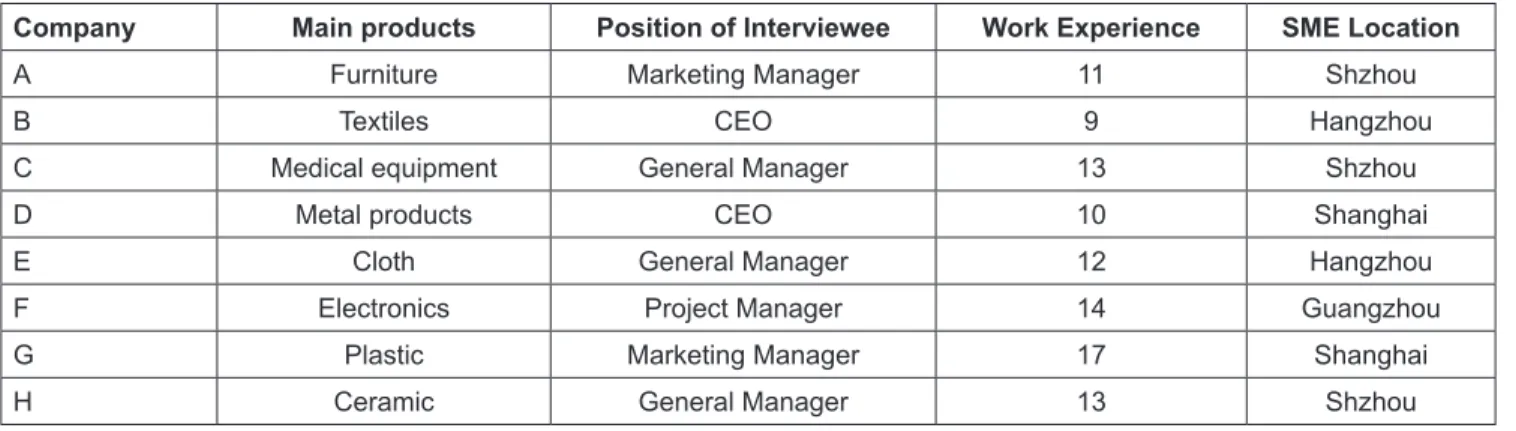
Due time and resources availability and follow up with respondents, only eight participants were selected as shown in Table 1.

Three face to face interviews were conducted with SMEs’ owners/managers in cases A, C, and H at their offices and five online interviews using WeChat with cases B, D, E, F, and G. The interviews with SMEs’ owners/managers were conducted in simplified Chinese language (Mandarin) and lasted between 45 and 60 minutes. Interviewee responses were recorded and transcribed. Respondents were requested to list their organizational, product, process and marketing innovation capabilities and to identify the effect of each type of innovation capability on firm’s operational (productive capacity and improved product performance) and financial performance (growth in sales and, decreasing manufacturing costs, and profitability). In addition, interviews were asked to identify the determinants of innovation. Further, respondents were requested to determine the impact of contextual factors that may moderate the relationship between innovation capabilities and firm performance.

Responses gained from each SMEs’ owner/manager were recorded and written up as a report in Microsoft word file. Data collected from interviews underwent through three main data analysis stages: data reduction, focused coding,

and data display. Transcribed data and codes were arranged for each company, type of questions and interview number.

Well determined codes such as common themes, concepts and insights were developed after numerous iterations and systematically interrelated based on statements of relationship between type of innovation capabilities and firm performance.

4. Results and Discussion

The results of this study revealed that SMEs’ owners/

managers possess different level of innovation capabilities.

All respondents indicated that they possess product, process, marketing, and organizational innovation capabilities. In explaining their product innovation capabilities, owners and managers from cases B, C, and H revealed that: “We search for product gap through analysis of future market trend. We rely on existing products to tap into the product gap and analyze product future commercialization. Then, we develop ideas and knowledge related to designing and identifying the initial features of the new product.

The fundamental product innovation capabilities possessed by SMEs’ owners/managers include developing new products with different technical functionalities and specifications which are different from existing products, renewing current products by improving ease of use and increasing customer satisfaction, developing new products with different materials and components, and reducing manufacturing costs related to materials and components of existing products.

Managers underlined that many of their existing products are highly demanded. Respondents from Cases A, B, D, F, and H reported that: “Over the last few months and with the recovery from Covid 19 pandemic in China, we received many orders from local and foreign customers.

Hence, we work at our optimum productive capacity and we don’t have any spare resources to develop our new products.”

Table 1: SMEs’ Background Information

Company Main products Position of Interviewee Work Experience SME Location

A Furniture Marketing Manager 11 Shzhou

B Textiles CEO 9 Hangzhou

C Medical equipment General Manager 13 Shzhou

D Metal products CEO 10 Shanghai

E Cloth General Manager 12 Hangzhou

F Electronics Project Manager 14 Guangzhou

G Plastic Marketing Manager 17 Shanghai

H Ceramic General Manager 13 Shzhou

(6)

Respondents from cases A, F, D, and H said that:

“We rely mainly on existing products in increasing sales and profits with maintaining some changes in product’s technical features, color, size and packaging. Therefore, we produce generic product as we believe that developing new products is a complicated and long term process. Further, all respondents agreed that product innovation capabilities lead to enhancing firm’s financial performance by increasing sales and entering new markets and attracting new customers.

In revealing their organizational innovation capabilities, respondents claimed that they renew their SMEs’

organizational structure, match authority and responsibility, ensure collaboration among various departments, and build outside networks with suppliers and business partners. For instance, SMEs’ owners/managers from cases A, B, E, and H reported that: “We maintain flexible organizational structure to facilitate teamwork, enhance coordination between departments (e.g. marketing and manufacturing).

In addition, we perform organizational activities and tasks in innovative manner and facilitate long term collaboration with suppliers, distributors, business partners and other networks.” Further, respondents from cases A, C, D, F, G, and H said that: “We embrace cooperation between departments and units, encourage employees to be multi-skilled, advocate employees’ well-being and appreciation.”

All interviewees believe that organizational innovation capabilities lead to enhancing firm’s operational performance through ensuring cooperation among various departments and collaboration with external networks that result in achieving reasonable level of efficiency and meeting scheduled plans and budgets.

For marketing innovation capabilities, interviewees revealed that they regularly renew product promotion methods, distribution channels, pricing techniques, and product design such as volume, shape, appearance and packaging. Respondents from cases B, C, E, F, G, and H indicated that they need to consider the logistics processes associated with product delivery. Respondents from A, E, and F cases relied on promoting a package of different yet related products with different sizes, colors and designs to attract customers at different ages and preferences.

Respondents distinguished between marketing for local and foreign customers. For example, respondents from cases A, E, and F argued that their advertising and promotion tools consider customers’ culture and preferences. Respondent from furniture industry revealed that they produce small sized pieces of furniture for narrow apartments for local Chinese customers while respondent from cloth industry revealed that they provide customized cloth products for African and Middle East customers. All respondents agreed that marketing innovation capabilities lead to increasing sales and firm’s profitability. However, respondents from

cloth and electronics industries argued that marketing innovation capabilities can enhance operating performance as well based on feedback gained from customers to focus on highly sold products, respond to customers’ complaints and improve product quality, design and technical features.

In explaining their innovation process capabilities, respondents revealed that they identify and eliminate non- value adding activities in production and logistics processes, reduce variable costs in logistics, accelerate delivery in related logistics processes, and increase quality of output in manufacturing techniques and processes. Respondents from cases B, E, F, and H reported that: “We rely on consistent work instruction and planned operational system that result in accurate and transparent information accessibility and overcome miscommunication. This allows us to identify our priorities, avoid bottleneck points and simplify the whole production process”. Interviewees agreed that process innovation capabilities have a significant impact on enhancing operational performance. For instance, respondents from cases A, B, C, F, and H claimed that employing their process innovation capabilities increase resource efficiency, improve product quality and, save manufacturing time and costs.

In identifying the determinants of innovation capabilities, respondents reported that availability of resources (human, financial and technological), knowledge development, entrepreneurial orientation, and external networks as the fundamental determinants of innovation capabilities.

In responding to identifying the contextual factors that

moderate the relationship between innovation capabilities

and SMEs’ Performance, respondents reported two types

of factors: internal and external. Internal factors involve

SME size, SMEs’ owner/manager work experience, and

entrepreneurial and strategic mindset while external factors

involve market dynamism and cooperation strategies. All

respondents agreed that their SMEs suffered during the

Covid 19 outbreak period with the exception of restaurants,

retailing and medical equipment and tools industries. In

explaining the importance of firm size, respondents from

cases B, C, D, and H argued that big companies produce

sufficient quantities at a reasonable costs and respond to

purchase orders on time. On the other hand, respondents

from A, C, E, F, and G argued that SMEs’ owner/manager

need to possess entrepreneurial and strategic mindset along

with enough work experience to increase sales volume in

local and global market. All respondent revealed that market

dynamism such as competitors’ actions and changing

customers’ needs and preferences exert a significant impact

on SMEs performance and require instant adaptation and

coping with relevant market conditions. Respondents from

cases A, D, F, and G indicated that involving in cooperation

strategies with suppliers, customers, business partners,

(7)

and R&D agencies results in penetrating new markets and increasing sales volumes that positively influence SMEs’

performance.

Research findings revealed that Chinese SMEs’

owners/managers possess and employ marketing, product, process, and organizational innovation capabilities.

Product, organizational, process and marketing innovation capabilities are connected to firm’s operational performance (Kafetzopoulos & Psomas, 2015), and business return (Maldonado-Guzmán.et.al, 2018). Exposito and Sanchis- Llopis (2018) indicated that product, process and organizational innovation had a significant effect on operational and financial performance of Spanish SMEs and advocated the need to adopt a multidimensional approach when examining the association between innovation choices and firm performance especially in SMEs’ context.

Tuan.et.al (2016) argued that process, marketing, and organizational innovations had a positive impact on firm performance in Vietnamese supporting firms in industries of mechanics, electronics, motorbike and automobile. Varis and Littunen (2010) argued that improving firm performance and organizational success are the main reasons for firms’

engagement in innovation activities. Foroudi.et.al (2016) argued that technical innovation capability (new services, service operations, and technology) and non-technical innovation capabilities (management, sales, and marketing) leads to creating customer value. Gunday.et.al (2011) argued that organizational, process, product and marketing innovations have significant impact on innovation, production, market and financial performances in Turkish manufacturing industries.

Relevant literature revealed that many organizations paid attention to innovation and improving their performance due to uncertainty and dynamism of business environment such as mortgage crisis and the outbreak of Coronavirus Disease (COVID-19) (Kwon, Han, & Lee, 2020). Therefore, SMEs need to consider the need to find out-of-box innovative solutions and should adopt to innovative approaches and models to respond to severe competition (Taticchi.et.al, 2010). In their research on innovation and Zimbabwean metal SMEs’ performance, Makate.et.al (2019) indicated that firm and firm owner characteristics and policy are important correlates of innovation while entrepreneurial innovations promote firm performance. Due to accelerate technological change, severe competition and globalized markets, SMEs need to possess innovation in order to gain sustainable competitive advantages (Dadfar.et.al, 2013;

Varis & Littunen, 2010).

A firm’s survival relies mainly on its innovation that arises from customers’ demands, rising competition and entering new markets (Jimenez & Sanz-Valle, 2011). In their research on the determinants of innovation capabilities

in British small electronics software companies, Romijn and Albaladejo (2002) differentiated between internal and external sources of innovation capabilities. Romijn and Albaladejo (2002) reported that internal sources involve professional background of firm’s owner/manager, skills of workforce and internal efforts to improve technology while external sources include intensity of networking, proximity advantages related to networking and availability of institutional support. Chen.et.al (2017) argued that government support, distinctive position of R & D, external knowledge sources, cooperation with venture capitalists, and entrepreneurs’ innovation willingness have a significant impact on disruptive innovation in Chinese SMEs (Chen.

et.al, 2017). Shen.et.al (2020) claimed that the Chinese companies actively involved research and development, improved competitiveness, and improved their international repercussion and recognition. High-tech manufacturing SMEs develop new products on their own due to building collaborative relationships with research institutions and business partner (Chung & Tang, 2017).

The results of this research revealed that availability of sufficient organizational resources (technological, financial and human resources), entrepreneurial orientation, external networks and knowledge development are the major determinants of innovation capabilities. Researchers recommended the need to integrate various determinants of innovation capability for drawing a reliable conclusion especially in today’s dynamic business environment. In a review of empirical literature on innovation capability in SMEs, Saunila (2019) stated that identifying the determinants and examining the outcomes of innovation capability are the two paths of research. The term “Guanxi” and networking significantly impact SMEs on new knowledge acquisition (Chong & Zhou, 2014) and capital funds obtaining.

Respondents from cases A, C, E, and H said that: “We maintain and collaborate with good networks “Guanxi”

such as government agencies, suppliers, bank, and research institutions. Such collaboration support us in solving problems associated with new product development”. Such findings are compatible with Mckinsey Global Institute (2015) view that China’s manufacturing ecosystem has different interacting parties who collaborate in suppling and transporting resources, materials and components that can facilitate and accelerate production and delivery. Similarly, Chong and Zhou (2014) argued that “Guanxi” network has a significant positive influence on the whole innovation processes.

Further, SMEs’ owners and managers argued that: “It

is essential to consider the interaction between product,

process, marketing, and organizational capabilities. For

instance, it is essential to match organizational structure,

logistics and production processes, financial management,

(8)

training work force, and marketing activities with new product development plan” Therefore, SMEs’ owners/

managers need to have a coordination and interaction among their innovation capabilities. In their research on the interaction among innovation types, Azadegan and Wagner (2011) argued that innovation capabilities and activities need to focus on simultaneous aspects such as new processes, new organizational and marketing practices, new products, and administrative systems.

Former research called for a balanced rate of technical and administrative innovation, and innovation types which needs to be implemented in conjunction (Walker.et.al, 2015) in order to improve firm performance. This study suggests that SMEs’ business performance has different dimensions and the impact of innovation capabilities may differ based on the type of innovation and performance dimensions. This study stresses the need to maintain a multi-dimensional analytical approach when analyzing the relationship between innovation and SMEs’ performance as technical and non-technical innovations have different influences on different dimensions of SMEs performance. For operational performance dimension of SMEs, process and organizational innovation were mainly associated with improvement in product quality and increasing productive capacity. In addition, marketing innovation was moderately related to improving product quality based on customers’ feedback during promotion and sales of a given product. The findings of this research indicated that innovative capabilities have positive impact on different SMEs’ financial and operational performance indicators.

5. Conclusions and Recommendations

This research focused on exploring the innovative capabilities possessed by owners/managers of SMEs and investigated their impact on SMEs’ operational and financial performance, identifying the determinants of innovation capabilities, and determining the contextual factors that moderate the relationship between innovation capabilities and SMEs’ performance. It is evident that the Chinese manufacturing SMEs’ owners/managers utilize different forms of innovation capabilities namely product, process, and organizational and marketing innovation capabilities.

Product and marketing innovation capabilities exert a positive and significant influence on SMEs’ financial performance, while organizational and process innovation capabilities lead to enhancing SMEs’ operational performance.

The main determinants of innovation capabilities involve availability of sufficient organizational resources (technological, financial and human resources), entrepreneurial orientation, knowledge development, and external networks. The contextual moderating factors between innovation capabilities and SMEs’ performance

include internal factors such as SME size, SMEs’ owner/

manager work experience, and entrepreneurial and strategic mindset; and external factors such as market dynamism and maintaining cooperation strategies with suppliers, customers, agencies and business partners. This research argues that SMEs’ owners/managers need to maintain a multidimensional view when deciding on a specific innovation strategies required for achieving a specific operational or financial outcome. The generalizability of the findings of this research may be challenged due to employed sample size. Future research avenues may focus on empirically testing the results of this study with a larger sample size in different industries and contexts. Further research may also investigate the interaction between SMEs’

owners/managers product, process, organizational, and marketing, resources management innovation capabilities and its impact on SMEs’ performance.

References

Al‐kalouti, J., Kumar, V., Kumar, N., Garza‐Reyes, J. A., Upadhyay, A., & Zwiegelaar, J. B. (2020). Investigating innovation capability and organizational performance in service firms.

Strategic Change, 29(1), 103–113. doi:10.1002/jsc.2314 Avermaete, T., Viaene, J., Morgan, E. J., & Crawford, N.

(2003). Determinants of innovation in small food firms.

European Journal of Innovation Management, 6(1), 8–17.

doi:10.1108/14601060310459163

Azadegan, A., & Wagner, S. M. (2011). Industrial upgrading, exploitative innovations and explorative innovations.

International Journal of Production Economics, 130(1), 54–65.

doi:10.1016/j.ijpe.2010.11.007

Boly, V., Morel, L., Assielou, N. G., & Camargo, M. (2014).

Evaluating innovative processes in french firms: Methodological proposition for firm innovation capacity evaluation. Research Policy, 43(3), 608–622. doi:10.1016/j.respol.2013.09.005 Çakar, N. D., & Ertürk, A. (2010). Comparing Innovation Capability

of Small and Medium-Sized Enterprises: Examining the Effects of Organizational Culture and Empowerment. Journal of Small Business Management, 48(3), 325–359. doi:10.1111/j.1540- 627x.2010.00297.x

Castela, B. M. S., Ferreira, F. A. F., Ferreira, J. J. M., & Marques, C. S. E. (2018). Assessing the innovation capability of small and medium-sized enterprises using a non-parametric and integrative approach. Management Decision, 56(6), 1365–

1383. doi:10.1108/md-02-2017-0156

Chen, J., Zhu, Z., & Zhang, Y. (2017). A study of factors influencing disruptive innovation in Chinese SMEs. Asian Journal of Technology Innovation, 25(1), 140–157. doi:10.1080/1976159 7.2017.1302552.

Chong, A. Y.-L., & Zhou, L. (2014). Demand chain management:

Relationships between external antecedents, web-based

integration and service innovation performance. International

(9)

Journal of Production Economics, 154, 48–58. doi:10.1016/j.

ijpe.2014.04.005

Chung, L., & Tan, K. H. (2017). The unique Chinese innovation pathways: Lessons from Chinese small and medium sized manufacturing firms. International Journal of Production Economics, 190, 80–87. doi:10.1016/j.ijpe.2016.09.004 Dadfar, H., Dahlgaard, J. J., Brege, S., & Alamirhoor, A. (2013).

Linkage between organisational innovation capability, product platform development and performance. Total Quality Management & Business Excellence, 24(7-8), 819–834. doi:10 .1080/14783363.2013.791102

De Martino, M. & Magnotti, F. (2018). The innovation capacity of small food firms in Italy. European journal of innovation management

Exposito, A., & Sanchis-Llopis, J. A. (2018). Innovation and business performance for Spanish SMEs: New evidence from a multi-dimensional approach. International Small Business Journal: Researching Entrepreneurship, 026624261878259.

doi:10.1177/0266242618782596

Foreman-Peck, J. (2013). Effectiveness and efficiency of SME innovation policy. Small Business Economics, 41(1), 55–70.

doi:10.1007/s11187-012-9426-z

Foroudi, P., Jin, Z., Gupta, S., Melewar, T. C., & Foroudi, M. M. (2016). Influence of innovation capability and customer experience on reputation and loyalty. Journal of Business Research, 69(11), 4882–4889. doi:10.1016/j.

jbusres.2016.04.047

Gunday, G., Ulusoy, G., Kilic, K., & Alpkan, L. (2011). Effects of innovation types on firm performance. International Journal of Production Economics, 133(2), 662–676. doi:10.1016/j.

ijpe.2011.05.014

Gupta, P., Guha, S., & Krishnaswami, S. (2013). Firm growth and its determinants. Journal of Innovation and Entrepreneurship, 2(1), 15. doi:10.1186/2192-5372-2-15

Hervas-Oliver, J. L., Boronat-Moll, C., & Sempere-Ripoll, F. (2016).

On Process Innovation Capabilities in SMEs: A Taxonomy of Process-Oriented Innovative SMEs. Journal of Small Business Management, 54, 113–134. doi:10.1111/jsbm.12293

Hoang, C. C, & Ngoc, B. H. (2019). The Relationship between Innovation Capability and Firm’s Performance in Electronic Companies, Vietnam. Journal of Asian Finance, Economics and Business, 6(3), 295-304. doi:10.13106/jafeb.2019.vol6.

no3.295

Hult, G. T. M., Hurley, R. F., & Knight, G. A. (2004). Innovativeness:

Its antecedents and impact on business performance. Industrial Marketing Management, 33(5), 429–438. doi:10.1016/j.

indmarman.2003.08.015

Jimenez, J. D., & Sanz-Valle, R. (2011). Innovation, organizational learning and performance. Journal of Business research, 64(4), 408-417. http://dx.doi.org/10.1016/j.jbusres.2010.09.010 Jørgensen, F., & Ulhøi, J. P. (2010). Enhancing Innovation Capacity

in SMEs through Early Network Relationships. Creativity and

Innovation Management, 19(4), 397–404. doi:10.1111/j.1467- 8691.2010.00577.x

Kafetzopoulos, D., & Psomas, E. (2015). The impact of innovation capability on the performance of manufacturing companies.

Journal of Manufacturing Technology Management, 26(1), 104–130. doi:10.1108/jmtm-12-2012-0117

Keskin, H. (2006). Market orientation, learning orientation, and innovation capabilities in SMEs. European Journal of Innovation Management, 9(4), 396–417. doi:10.1108/14601060610707849 Kindash, L., & Nuryakin, N. (2020). The Relationship between

Organizational Capability, Organizational Learning and Financial Performance. Journal of Asian Finance, Economics and Business, 7(8), 625-633. doi:10.13106/jafeb.2020.vol7.

no8.625

Kittilaksanawong, W., & Ren, Z. (2013). Innovation capability building through intermediary organizations: Cases of manufacturing small and medium-sized enterprises from China’s Zhejiang province. Asian Journal of Technology Innovation, 21(sup2), 62–79. doi:10.1080/19761597.2013.81 9247

Kwon, O., Han, O., & Lee, D. H. (2020). SME Profitability of Trade Credit during and after a Financial Crisis: Evidence from Korea. Journal of Asian Finance, Economics and Business, 7(7), 35–47. doi:10.13106/jafeb.2020.vol7.no7.035

Landoni, P., Dell’Era, C., Ferraloro, G., Peradotto, M., Karlsson, H.,

& Verganti, R. (2016). Design Contribution to the Competitive Performance of SMEs: The Role of Design Innovation Capabilities. Creativity and Innovation Management, 25(4), 484–499. doi:10.1111/caim.12165

Lichtenthaler, U. (2016). Toward an innovation-based perspective on company performance. Management Decision, 54(1), 66–87. doi:10.1108/md-05-2015-0161

Love, J. H., & Roper, S. (2015). SME innovation, exporting and growth:

A review of existing evidence. International Small Business Journal, 33(1), 28–48. doi:10.1177/0266242614550190 Makate, C., Makate, M., Siziba, S., & Sadomba, Z. (2019). The

impact of innovation on the performance of small-to-medium informal metal-trade enterprises in Zimbabwe. Cogent Business & Management, 6(1). doi.org/10.1080/23311975.20 19.1625095

Maldonado-Guzmán, G., Garza-Reyes, J. A., Pinzón-Castro, S. Y.,

& Kumar, V. (2018). Innovation capabilities and performance:

are they truly linked in SMEs?. International Journal of Innovation Science. doi:10.1108/ijis-12-2017-0139

Martínez-Costa, M., & Martínez-Lorente, A. R. (2008). Does quality management foster or hinder innovation? An empirical study of Spanish companies. Total Quality Management & Business Excellence, 19(3), 209–221. doi:10.1080/14783360701600639 Mckinsey Global Institute. (2015). The China Effect on Global

Innovation. McKinsey & Company, Research bulletin.

Retrieved from http://www.mckinseychina.com/wp-

content/uploads/2015/07/mckinsey-china-effect-on-global-

innovation-2015.pdf?bd0bde.

(10)

Mejía Vallejo, A., & Arias-Pérez, J. (2017). Approach to differences in product and process innovation capabilities and financial performance in manufacturing companies. Espacios, 38(4).

Nemlioglu, I., & Mallick, S. K. (2017). Do Managerial Practices Matter in Innovation and Firm Performance Relations? New Evidence from the UK. European Financial Management, 23(5), 1016–1061. doi:10.1111/eufm.12123

Nor, M., Azila, N., Muhammad, A., Aljanabi, A. Q. A., & Ku Ishak, A. (2017). The significant role of entrepreneurial orientation in fostering technological innovation capabilities among small and medium-sized manufacturing enterprises. International Journal of Economic Research, 14(21), 1-10. ISSN 0972-9380 O’Cass, A., & Sok, P. (2013). The role of intellectual resources,

product innovation capability, reputational resources and marketing capability combinations in firm growth.

International Small Business Journal, 32(8), 996–1018.

doi:10.1177/0266242613480225

OECD. (2005). Oslo Manual: Proposed Guidelines for Collecting and Interpreting Technology Innovation Data. Paris: OECD.

Oura, M. M., Zilber, S. N., & Lopes, E. L. (2016). Innovation capacity, international experience and export performance of SMEs in Brazil. International Business Review, 25(4), 921–

932. doi:10.1016/j.ibusrev.2015.12.002

Prajogo, D. I., McDermott, C. M., & McDermott, M. A. (2013).

Innovation orientations and their effects on business performance: Contrasting small and medium-sized service firms.

R&D Management, 43(5), 486–500. doi:10.1111/radm.12027 Romijn, H., & Albaladejo, M. (2002). Determinants of innovation

capability in small electronics and software firms in southeast England. Research Policy, 31(7), 1053–1067. Doi: 10.1016/

s0048-7333(01)00176-7

Rosenbusch, N., Brinckmann, J., & Bausch, A. (2011). Is innovation always beneficial?: A meta-analysis of the relationship between innovation and performance in SMEs. Journal of Business Venturing, 26(4), 441–457. doi:10.1016/j.jbusvent.2009.12.002 Sahoo, S. (2019). Quality management, innovation capability and

firm performance. The Total Quality Management Journal, 31(6), 1003–1027. Doi: 10.1108/tqm-04-2019-0092

Saunila, M. (2014). Innovation capability for SME success:

Perspectives of financial and operational performance. Journal of Advances in Management Research, 11(2), 163–175.

doi:10.1108/jamr-11-2013-0063

Saunila, M. (2016). Performance measurement approach for innovation capability in SMEs. International Journal of Productivity and Performance Management, 65(2), 162–176.

doi:10.1108/ijppm-08-2014-0123

Saunila, M. (2019). Innovation capability in SMEs: A systematic review of the literature. Journal of Innovation & Knowledge.

doi:10.1016/j.jik.2019.11.002

Saunila, M., Pekkola, S., & Ukko, J. (2014). The relationship between innovation capability and performance. International Journal of Productivity and Performance Management, 63(2), 234–249. doi:10.1108/ijppm-04-2013-0065

Shen, Z., Siraj, A., Jiang, H., Zhu, Y., & Li, J. (2020). Chinese-Style Innovation and Its International Repercussions in the New Economic Times. Sustainability. doi:10.3390/su12051859.

Sok, P., O’Cass, A., & Miles, M. P. (2015). The Performance Advantages for SMEs of Product Innovation and Marketing Resource-Capability Complementarity in Emerging Economies. Journal of Small Business Management, 54(3), 805–826. doi:10.1111/jsbm.12172

Sok, P., O’Cass, A., & Sok, K. M. (2013). Achieving superior SME performance: Overarching role of marketing, innovation, and learning capabilities. Australasian Marketing Journal, 21(3), 161–167. doi:10.1016/j.ausmj.2013.04.001

Taticchi, P., Tonelli, F., & Cagnazzo, L. (2010). Performance measurement and management: A literature review and a research agenda. Measuring Business Excellence, 14(1), 4–18.

doi:10.1108/13683041011027418

Terziovski, M. (2010). Innovation practice and its performance implications in small and medium enterprises (SMEs) in the manufacturing sector: a resource-based view. Strategic Management Journal. doi:10.1002/smj.841

Tuan, N., Nhan, N., Giang, P., & Ngoc, N. (2016). The effects of innovation on firm performance of supporting industries in Hanoi, Vietnam. Journal of Industrial Engineering and Management, 9(2), 413. doi:10.3926/jiem.1564

Varis, M., & Littunen, H. (2010). Types of innovation, sources of information and performance in entrepreneurial SMEs.

European Journal of Innovation Management, 13(2), 128- 154. doi.org/10.1108/14601061011040221

Von Koskull, C., & Strandvik, T. (2014). Discovering the unfolding of service innovations. Journal of Business &

Industrial Marketing, 29(2), 143–150. doi:10.1108/jbim-05- 2012-0084

Vu, H. M (2020). A Review of Dynamic Capabilities, Innovation Capabilities, Entrepreneurial Capabilities and Their Consequences. Journal of Asian Finance, Economics and Business, 7(8), 485–494. doi:10.13106/jafeb.2020.vol7.

no8.485

Walker, R. M., Chen, J., & Aravind, D. (2015). Management innovation and firm performance: An integration of research findings. European Management Journal, 33(5), 407–422.

Yam, R. C. M., Lo, W., Tang, E. P. Y., & Lau, A. K. W. (2011).

Analysis of sources of innovation, technological innovation capabilities, and performance: An empirical study of Hong Kong manufacturing industries. Research Policy, 40(3).

doi:10.1016/j.emj.2015.07.001

Yuan, X., Shin, S., He, X., & Yong Kim, S. (2016). Innovation capability, marketing capability and firm performance: A two-nation study of China and Korea. Asian Business &

Management, 15(1), 32–56. doi:10.1057/abm.2015.17

Zhang, M., & Hartley, J. L. (2018). Guanxi, IT systems, and innovation capability: The moderating role of proactiveness.

Journal of Business Research, 90, 75–86. doi:10.1016/j.

jbusres.2018.04.036.

수치

Table 1: SMEs’ Background Information

참조

관련 문서

Objectives: The present study was conducted to determine the relationship between degree of work performance and job satisfaction in NICU nurses.. Methods: The subjects of

Therefore, in this study, we investigate how workplace innovation affects workers' workplace learning and corporate performance for workers engaged in

The purpose of this study is to analyze the effects of sports marketing strategy fit on organizational attitude and organizational citizenship behavior

This study is to determine the effect of peer abusive supervision on the organizational silence and service oriented organizational citizenship behaviors

This study selected collectivism as the independent variable and analyzed the effect of organizational trust and organizational commitment on

In order to achieve this objective, this study set up research questions about differences in the understanding, the actual operating status, and needs

China has reinforced the competitive power of enterprises through attracting foreign direct investment during the period of innovation, 20 years, and raised

This study has the following academic suggestions: First, this study focused on the effects of workplace innovation on living quality of rural people with