Print ISSN: 2288-4637 / Online ISSN 2288-4645 doi:10.13106/jafeb.2021.vol8.no8.0375
Service Innovation Readiness of Health Institutions during COVID-19: A Perspective from the Kingdom of Saudi Arabia*
Nadeem AKHTAR
1, Hassen ALTALHI
2, Ashfaque AHMED
3, Fakhar MUSTAFA
4, Muhammad Asad MERAJ
5Received: April 20, 2021 Revised: July 04, 2021 Accepted: July 15, 2021
Abstract
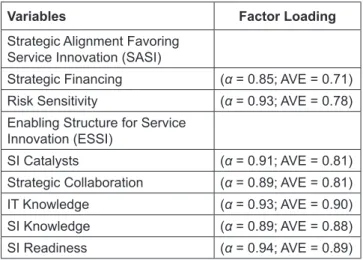
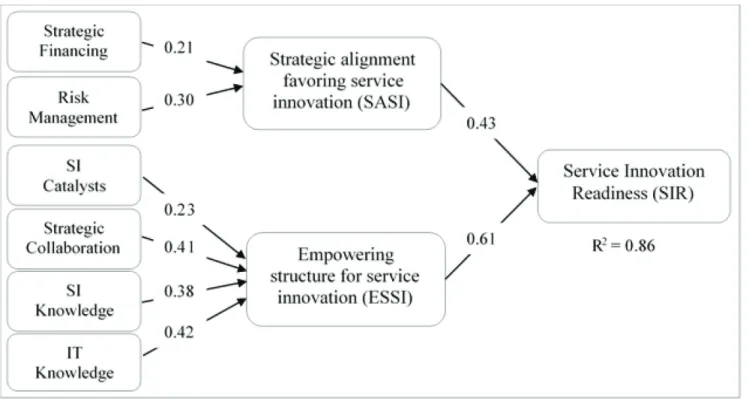
The purpose of the research was to explore the factors which affect service innovation in organizations and how the utilization of resources can improve organizational performance, and gain a competitive advantage by adopting numerous innovative practices. This study hypothesizes Service Innovation Readiness (SIR) to consist of Strategic Alignment favoring Service Innovation (SASI) and Empowering Structure for Service Innovation (ESSI), which regulate the organization’s preparedness to adopt service innovation changes. Six dimensions were identified and analyzed to understand their effects on SASI and ESSI. A structured questionnaire on a 5-point Likert scale was used to collect data from the selected hospitals of Saudi Arabia. The research results contribute considerably to the subject matter by theorizing SIR and the complex variable settings essential for embracing SI. This research also provides some understanding of the service innovation management dimension through a complete assessment that measures the organization’s readiness and attempts to direct organizations’
efforts to achieve and sustain competitive advantage. The study conducted is unique in the current geographic limits and has explored numerous SI areas of an organization’s readiness to adopt service innovation.
Keywords: Service Innovation Readiness, Strategic Investment, Strategic Orientation, Saudi Arabia JEL Classification Code: O32, O35, O38
1. Introduction
“Service innovation” (SI) refers to the innovation taking place in the various contexts of services, including the introduction of new services or incremental improvements of existing services. Service innovation is a type of open innovation gaining prominence in recent times. With the growing economic importance of the services sector, service innovation is playing an ever more significant role in driving growth in today’s knowledge-intensive economy. This type of innovation responds to increased customer input, interactivity, and specialization; is multidimensional in nature; and includes strategic, productivity, and performance dimensions. Many developing countries have realized the potential of service sector innovation and set aside a long- term plan (Cylus et al., 2018). Many firms have started realizing the potential of innovating in the service sector and are continuously doing so to be competitive, thereby striving to survive and achieve sustainable growth.
Many countries worldwide are experimenting with innovative ways to provide better quality service to sustain their competitiveness (Nolte, 2018). The growth of attention to innovation involving services has been driven by the rising
*Acknowledgements:
The authors of the paper would like to acknowledge the support brought by Yanbu University College, Royal Commission for Yanbu Project, Saudi Arabia.
1
First Author and Corresponding Author. Assistant Professor, Department of Management Sciences, Yanbu University College, Saudi Arabia [Postal Address: Yanbu University College – Male Campus, Al-Aziziah, Yanbu 46435, Kingdom of Saudi Arabia]
Email: [email protected]
2
Associate Professor, Department of Management Sciences, Yanbu University College, Saudi Arabia [Postal Address: Yanbu University College – Male Campus, Al-Aziziah, Yanbu 46435, Kingdom of Saudi Arabia] Email: [email protected]
3
Assistant Professor, Department of Management Sciences, Yanbu University College, Saudi Arabia. Email: [email protected]
4
Lecturer, Department of Mathematics, COMSATS University Islamabad, Sahiwal Campus, Pakistan.
Email: [email protected]
5
Professor, University of Education, Lahore, Multan Campus, Pakistan. Email: [email protected]
© Copyright: The Author(s)
This is an Open Access article distributed under the terms of the Creative Commons Attribution Non-Commercial License (https://creativecommons.org/licenses/by-nc/4.0/) which permits unrestricted non-commercial use, distribution, and reproduction in any medium, provided the original work is properly cited.