서 론
황색조식물문(Chromophyte)에 속한 침편모조류(Raph- idophytes)의 대발생은 전 세계적으로 어류의 대량 폐사 의 주요 원인으로 알려져 왔다 (Honjo 1993; Odebrecht and Abreu 1995; Munday and Hallegraeff 1998; Bourdelais
et al. 2002; Handy et al. 2005). 특히 Heterosigma akashiwo 는 캐나다, 미국, 칠레 등에서뿐만 아니라 중국, 일본 그 리고 우리나라에서 대발생으로 수년간 막대한 경제적 손실을 야기하였다. 예로, 중국에서는 1985년부터 대련 항과 중국해 북부 지역에서 매년 H. akashiwo에 의한 적조 피해가 발생하고 있고 (Tseng et al. 1993), 일본에서 도 1955년에 가고시마 만에서 대규모 적조로 인한 양식 장에서의 새끼 방어의 대규모 폐사로 인한 피해가 보고 된 바 있다 (Khan et al. 1997). 국내에서도 매년 높은 밀 Korean J. Environ. Biol. 32(2) : 129~137 (2014) http://dx.doi.org/10.11626/KJEB.2014.32.2.129
염분과 미량원소가 Heterosigma akashiwo (Raphidophyceae) 성장률에 미치는 영향
이 주 연∙장 만∙한 명 수1,* 한국해양과학기술원, 1한양대학교 생명과학과
Effect of Salinity and Micronutrients on the Growth Rate of Bloom from Heterosigma akashiwo (Raphidophyceae)
Juyun Lee, Man Chang and Myung-Soo Han1,*
Marine Ecosystem Research Division, Korea Institute of Ocean Science and Technology (KIOST), Ansan 426-744, Korea
1Department of Life Science, Hanyang University, Seoul 133-791, Korea
Abstract -- In order to understand the Heterosigma akashiwo (Raphidophyceae) bloom, we investi- gated the cell division pattern of its strains under various physicochemical conditions from three different origin. Among the three tested strains, HYM06HA and NFHTS-AK-1, are belong to South Korea and CCMP452 strain was from USA. Interestingly among three strains, HYM06HA was established from the cyst in Korea. Our study results showed that these three strains were indistinguishable under various salinity and iron (Fe) conditions. All strains were survived at 10 to 40 psu and the growth patterns under different iron (Fe) concentrations were observed to be similar. The growth patterns under different N:P ratios and selenium (Se) concentrations led to classification of strains into Korean and USA strain. Briefly these results indicated that the growth pattern from different strains of H. akashiwo could be dominant using their salinity toler- ance. Furthermore nutritional enhancer seemed to be different based on geographical origin.
Key words : HABs (Harmful Algal Blooms), Heterosigma akashiwo, physicochemical factors, nutritional enhancer, growth rate
* Corresponding author: Myung-Soo Han, Tel. 02-2220-0956, Fax. 02-2296-1741, E-mail. [email protected]
<Review paper>
ⓒ2014. Korean Society of Environmental Biology.
도로 대발생을 야기시키고 있다 (Kim et al. 1990; Kim 2006). H. akashiwo대발생에서 중요한 요인은 빠른 분열 과 휴면포자 (cyst)의 발아이며, 특히 빠른 분열은 높은 밀도의 대발생 형성에 있어 가장 중요하다 할 수 있다 (Bearon et al. 2006).
일반적으로 유해조류 대발생 (HABs)은 수온, 광도, 염 분, 영양염과 같은 물리∙화학적 요인과 긴밀한 연관이 있다 (Erga and Heimdal 1984; Smayda 1998; Diehl et al.
2002). 수온의 경우, H. akashiwo의 성장과 휴면포자 발아 에 영향을 주며, 현장에서 군집 변화 양상과 긴밀한 관련 이 있다 (Tomas 1980; Imai and Itakura 1999). 또한, 일부 해역에서는 대발생의 빈도와 풍부한 영양염 사이에는 긴 밀한 영향이 있으며, 특히 질소와 인과 같은 영양염이 원 인이 되기도 한다고 알려져 있다(Watanabe and Nakamu- ra 1984a). 일반적으로 미량원소는 식물플랑크톤의 종 구 성과 생물량 (Brand et al. 1983; Martin and Fitzwater 1988;
Van Leeuwen et al. 1997), 그리고 식물플랑크톤 대발생에 중요한 인자로 알려져 있다 (Hutchins and Bruland 1998;
Hutchins et al. 1998; Zhang 2000). 그 중에서 철 (Fe)과 셀 레늄 (Se)은 유해조류 대발생 촉매제로 알려져 있음에도 불구하고 (Doblin et al. 2000; Bruland et al. 2001; Maldo- nado et al. 2002), H. akashiwo를 대상으로는 연구되어진 바가 거의 없다. 특히 우리나라 연안 저니질에 존재하는 토착화된 휴면포자로부터 발아한 H. akashiwo 유영세포 의 생리학적 특성의 경우 그 연구가 전무하다. 따라서 본 연구는 H. akashiwo의 대발생 기작 중에서 빠른 분열에 초점을 맞추고, 세포분열에 영향을 끼치는 화학적 환경
요인들에 따른 성장률을 각각 비교하여 대발생 기작을 이해하고자 한다.
재료 및 방법
1. 배양주와 배양 조건
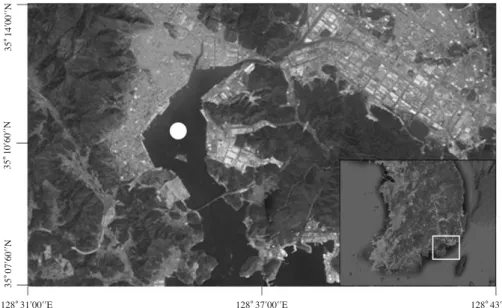
본 연구에서는 국내에서 분리한 2개의 배양주와 미국 에서 분리한 1개의 배양주로 실험을 실시하였다. 즉, NFHTS-AK-1은 국립수산과학원 (NFRDI)에서 분양 받 은 부산시 기장군 연안지역에서 분리된 배양주이며, HYM06HA은 2006년 마산만의 퇴적물에서 휴면포자로 존재하고 있던 H. akashiwo로부터 분리한 배양주이다 (Fig. 1). 그리고 미국의 CCMP 452는 Provasoli-Guillard 국립센터 (CCMP)에서 분양 받은 미국 로스엔젤레스에 서 분리된 배양주이다 (Table 1). DNA 염기서열 분석은 PCR을 이용하여18S rDNA, ITS, 5.8S rDNA를 대상으로 실시하였다(Ki et al. 2004).
모든 배양주는 염분 30 psu에 맞춰진 여과 멸균 해수 를 사용하여 F/2-Si Free 배지에서 배양하였다. 배양 온도 는 20±1�C, 명암 주기는 12 : 12 h, 광도는 약 80 μmol
Fig. 1. HYM06HA isolation station at Masan Bay, Korea.
Table 1. List of strains examined and isolation locality
Strain Isolation locality
CCMP452 Long Island Sound, CT, USA
HYM06HA Masan Bay, southern coastal area, Korea NFHTS-AK-1 Busan Bay, southern eastern area, Korea
128�31′00′′E 128�37′00′′E 128�43′00′′E
35�07′60′′N35�10′60′′N35�14′00′′N
photons m-2s-1빛을 이용하여 30일 동안 배양하였다. 조 도는 Li-Cor 3000 (Li-Cor, Lincoln, NE, USA)으로 측정하 였다. 모든 배양실험은 대수기 동안 시료를 수집하였다.
2. 성장요인 실험 조건
H. akashiwo배양주에 대하여 염분, N:P ratio, 철, 셀레 늄의 각 농도에서의 최고 성장률을 확인하였다. 성장요 인 실험을 위하여 인공해수 배지인 O-3 (McIntoch and Cattolico 1978)를 사용하였으며, 확보한 배양주를 실험 전 O-3에서 3주간 안정화시킨 후 실험을 실시하였다. H.
akashiwo의 성장률 비교를 위한 염분 실험은 5 psu 간격 으로 5~40 psu 구간에서 수행되었다. 염분은 NaCl을 이 용하여 조절하였고 Salinometer (model S/Mill-E, Atago) 로 확인하였다. 최적의 N:P ratio을 확인하기 위하여 인 산염 농도는 고정시킨 후 (12 μM), 질산염의 농도를 점 차적으로 증가시켜 5단계 (1, 5, 15, 30, 60, N:P ratio)에서 실험을 수행하였다. 미량 원소에 의한 성장률 변화를 확 인하기 위하여 철 4단계 (0.012, 0.12, 1.2, 12 M)와 셀레 늄 6단계 (10-3, 10-2, 10-1, 100, 101, 102nM)의 농도에서 실험을 실시하였다.
모든 배양은 30 mL Pyrex test-tube를 이용하여 삼배수 로 실시하였으며, 초기 세포 밀도는 1×10⁴ cells mL-1에 서 실시되었다.
3. 성장률
성장률은 생체내의 chlorophyll a를 Turner Designs Model 10 AU fluorimeter로 같은 시간 (12~13시)에 측정
하여 환산하였다 (Brand et al. 1981). 측정된 chlorophyll a 를 개체수로의 환산은 Martinez et al. (2010)에 근거하였 으며, 환산에 사용한 공식은 다음과 같다.
1 fluorescence unit
==0.45×10⁴(cells mL-1)++0.32 (R2==0.984)
대조군은 배지만을 이용하여 동일한 조건에서 실험을 실시하여 사용하였다. 성장률 (μ)은 Guillard et al. (1973) 를 따라 계산하였으며 수식은 다음과 같다.
μ==ln (N2/N1) / (t2-t1)
여기서 시간은 t1과 t2, 개체수는 N1과 N2를 나타내며, 이를 활용하여 배양주의 분열능을 확인하였다. 본 연구 에서는 배양기간 중 최대 성장률(μMax)을 기반으로 실험 군에 따른 성장 차이를 확인하고자 하였다.
결 과
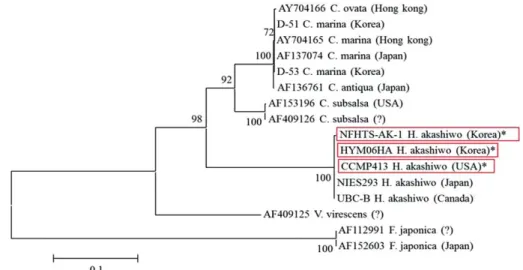
본 연구에서 이용한 유영세포와 휴면포자 각각에서 분리한 두 개의 국내 배양주 그리고 미국에서 분리한 배양주의 분자생물학적 차이점 유무를 확인하기 위하여 18S rDNA, ITS, 5.8S rDNA 염기서열 분석을 수행한 결 과 모든 배양주가 H. akshiwo이며, 지역에 따른 차이점 을 나타내지 않았다 (Fig. 2). 본 연구를 통해 지역적 차 이에 따른 염기서열 차이가 관찰되지 않은 3개의 배양 주를 이용하여 각각의 조건에서 최대 성장률을 비교하 였다.
Fig. 2. Phylogenetic tree with partial 18s rDNA, ITS, 5.8 rDNA sequence (*; It means the strains which used in this study).
1. 염분 농도에 따른 최대 성장률
NFHTS-AK-1은 최적 성장조건이 10 psu와 25 psu 사이 에서 나타났으며, 상대적으로 5 psu 이하와 30 psu 이상에 서는 낮은 성장을 나타냈다. HYM06HA는 최적 성장조 건이 10 psu와 30 psu 사이에서 나타났으며, 10 psu에서 가 장 높은 성장률 (1.2 division d-1)을 보였고, 5 psu 이하와 30 psu 이상에서 감소하였다. CCMP452는 5 psu와 40 psu 와 같은 극단적인 조건을 제외하고 모든 염분에서 잘 성 장하는 것을 확인하였다. 염분 실험 결과에서 NFHTS- AK-1은 다른 배양주보다 5 psu에서 비교적 생존률이 높 은 것으로 나타났다. 결과 확인을 위하여 동일한 실험을
수행하였으나 같은 결과를 얻을 수 있었다(Fig. 3).
2. N:P ratio에 따른 최대 성장률
NFHTS-AK-1은 1 (N==12 μM)에서 5 (N==60 μM)로 증 가하자마자 최대 성장률 (1.20 division d-1)을 나타냈고, HYM06HA 역시 5 μM에서 최대 성장률(1.52 division d-1) 이 나타났다. CCMP452는 30 μM에서 최대 성장률 (0.64 division d-1)을 나타냈으나 다른 농도와 큰 차이를 보이 지 않았다. 본 결과를 통하여 국내 배양주는 N : P ratio 5 에서 잘 성장하는 반면 미국 배양주의 경우 질산염과 인 산염에 큰 영향을 받지 않은 것으로 나타났다(Fig. 4).
Fig. 3. The maximum growth rate of H. akashiwo in the different gradient of salinity. A: NFHTS-AK-1, B: HYM06HA and C: CCMP452. Each value represents the S.D. of the mean for three times.
Growth rate(d-1)Growth rate(d-1)Growth rate(d-1) 1.6
1.2
0.8
0.4 1.6
1.2
0.8
0.4
(A)
(B)
(C)
1.6
1.2
0.8
0.4
1.6
1.2
0.8
0.4
5 10 15 20 25 30 35 40
Salinity (PSU)
Fig. 4. The maximum growth rate of H. akashiwo in the different gradient of N:P ratios. A: NFHTS-AK-1, B: HYM06HA and C: CCMP452. Each value represents the S.D. of the mean for three times.
Growth rate(d-1)Growth rate(d-1)Growth rate(d-1) 2.0
1.6
1.2
0.8
0.4
(A)
(B)
(C)
2.0
1.6
1.2
0.8
0.4
2.0
1.6
1.2
0.8
0.4
1 5 15 30 60
N:P ratios
3. 철 농도에 따른 최대 성장률
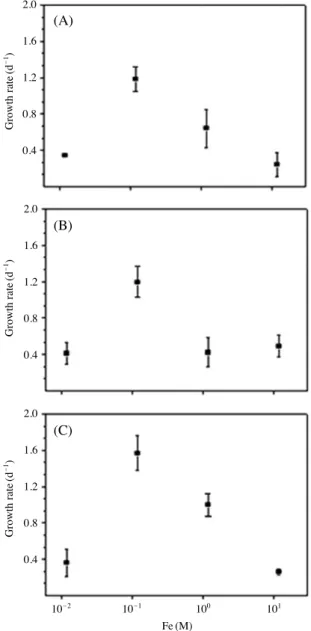
NFHTS-AK-1은 철 0.12 M에서 최대 성장률 (1.18 divi- sion d-1)을 나타냈고, HYM06HA 역시 같은 농도에서 최 대 성장률 (1.19 division d-1)을, CCMP452도 동일한 농도 에서 최대 성장률 (1.58 division d-1)을 나타냈다. 철의 실 험 결과 모든 배양주들이 0.012 M에서 모두 낮은 성장률 을 보였다. 또한, NFHTS-AK-1과 CCMP452는 1.2 M 이상 에서 감소하는 경향을 보였으며, HYM06HA는 0.12 M을 제외한 모든 농도에서 비슷한 성장률을 보였다(Fig. 5).
4. 셀레늄 농도에 따른 최대 성장률
NFHTS-AK-1은 10 nM에 최대 성장률(1.30 division d-1) 을, HYM06HA 역시 동일한 농도에서 최대 성장률 (1.56 division d-1)을 나타냈고, CCMP452는 10-1 nM에 최대 성 장률(1.28 division d-1)을 나타냈다. 국내 배양주인 NFHTS- AK-1는 10-2 nM부터 큰 변화를 보이지 않았지만, 미국 배양주인 CCMP452는 100nM부터 성장률이 급격하게 감 소하여 102nM에서 가장 낮은 성장률을 보였다(Fig. 6).
Fig. 5. The maximum growth rate of H. akashiwo in the different gradient of Fe (Iron). A: NFHTS-AK-1, B: HYM06HA and C: CCMP452. Each value represents the S.D. of the mean for three times.
Growth rate(d-1)Growth rate(d-1)Growth rate(d-1) 2.0
1.6
1.2
0.8
0.4
(A)
(B)
(C)
2.0
1.6
1.2
0.8
0.4
2.0
1.6
1.2
0.8
0.4
10-2 10-1 100 101
Fe (M)
Fig. 6. The maximum growth rate of H. akashiwo in the different gradient of Se (selenium). A: NFHTS-AK-1, B: HYM06HA and C: CCMP452. Each value represents the S.D. of the mean for three times.
Growth rate(d-1)Growth rate(d-1)Growth rate(d-1) 2.8 2.4 2.0 1.6 1.2 0.8 0.4
(A)
(B)
(C)
2.8 2.4 2.0 1.6 1.2 0.8 0.4
2.8 2.4 2.0 1.6 1.2 0.8 0.4
10-3 10-2 10-1 100 101 102 Se (nM)
고 찰
생태학적으로 적조를 일으키는 중요한 요인은 대상 생 물의 유입과 온도, 염분, 영양염 등과 같은 성장 조건, 그 리고 수문학과 기상학으로 알려져 있다 (Steidinger and Haddad 1981). 본 연구는 대발생 현상을 이해하기 위해 H. akashiwo의 성장 특성을 이해함으로써 적조 심화 기 작에 중요한 성장요인을 찾고자 하였다. 과거에 국외에 서 발생한 H. akashiwo의 대발생 기작을 이해하기 위하 여 수온, 영양염, 철 등이 성장에 끼치는 영향에 대한 연 구 (Yamochi 1983, 1984; Li et al. 2002)와 휴면포자의 형 태학적 규명과 해양에서 휴면포자의 발아와 적조 발생 에 대한 관계 규명 연구 (Yamochi 1983, 1984; Imai and Itakura 1999) 등이 진행되었다. 그러나 지리적 기원이 다 른 종의 경우, 염분 내성과 생리학적 특성에 따른 성장 률이 다를 수 있음에도 불구하고 (Smayda 1998), 국내에 서는 이와 같은 연구가 거의 이루어지지 않았으며, 휴면 포자 분리가 어려워 국내에서 토착화한 배양주의 확보 가 힘든 실정이었다. 이러한 부분을 보강하여 본 연구는 휴면포자를 발아시켜 확보한 국내 토착 배양주와 더불 어 유영세포에서 분리한 국내 배양주, 그리고 미국에서 분리한 배양주를 이용하여 그들의 성장에 영향을 끼치 는 요인을 규명하였다.
일반적으로 H. akashiwo는 광범위한 염분 농도에서 생 존과 생장이 가능한 종으로 알려져 있다 (Watanabe and Nakamura 1984b). 본 연구에서 모든 배양주는 광염성으 로 나타났으며, 특히 국내 배양주인 NFHTS-AK-1은 다 른 배양주들에 비하여 더 낮은 5 psu에서도 비교적 높은 생존률을 보였다. 외국에서는 H. akashiwo 배양주가 염분 농도 20~35 psu에서 성장이 빠르며(Honjo 1993; Martinez et al. 2010), 반면에 5 psu에서는 대부분의 경우 대부분 사 멸하는 것으로 보고하였다 (Martinez et al. 2010). 그러나 5.7 psu와 같은 저염수에서도 H. akashiwo의 유영세포가 생존할 수 있다고 보고하였다 (Yamochi and Abe 1984).
그리고 Haque and Onoue (2002)는 10 psu 이하에서의 생 장이 가능하다고 보고하였으며, Tomas (1980)도 5 psu에 서도 성장할 수 있다고 보고하였다. 휴면포자는 약 20~25 psu 정도의 염분일 때 포자의 발아와 유영세포 생 장이 빨라지는 것으로 보고하였다 (Haque and Onoue 2002; Kempton et al. 2008). 본 연구에서 나타난 낮은 염 분에서 생존과 성장이 가능한 국내 H. akashiwo의 적조 발생 기작은 하계 마산만에서 해마다 강우로 염분이 32.5 psu에서 23.5 psu로 급격하게 감소한 후 H. akashiwo
적조가 발생되는데, 이는 염분에 의한 스트레스에서 생 존한 H. akashiwo가 대량 증식된 것으로 사료된다 (Lee and Han 2007). 염분 스트레스에 대한 내성은 Mahoney and Mc Laughlin (1979)의 연구에서도 염분이 30 psu에서 10 psu로 감소함에도 불구하고 생존한 결과가 확인되었 다. 즉, 광염성의 H. akashiwo의 적조 발생 기작과 강우 는 밀접한 관계가 있는 것으로 판단된다.
H. akashiwo는 다른 편모조류와 비교하여 영양염 반포 화 상수인 Ks가 높은 종으로 생장을 위해서 많은 양의 영 양염을 필요로 하는 것으로 알려져 있다 (Smayda 1998).
Shikata et al. (2008)은 Hakata 만에서 빈번하게 발생하는 H. akashiwo의 광범위한 적조 현상이 DIP 농도가 증가 함에 따라 발생하는 것을 관찰하였다. 그 사실을 확인하 기 위하여 질산염과 인산염이 추가된 실험군 (++NP)과 인산염만 추가된 실험군 (++P)에서 각각 H. akashiwo의 성장을 확인한 결과, ++NP 실험군에서 ++P 실험군과 비교 하여 현저하게 높은 성장률을 확인하였다 (Shikata et al.
2008). 이것은 N:P ratio가 배양주의 분열에 있어 중요한 요인이 될 수 있다는 것을 의미한다. 본 연구에서도 각 각의 배양주를 대상으로 질소와 인산염에 따른 성장률 을 N:P ratio에 따라 확인해 본 결과, NFHTS-AK-1과 HYM06-HA 모두 질산염의 농도가 증가하자마자 성장 률이 증가하여 낮은 질산염의 농도에도 민감하게 반응 한다고 판단된다. 그러나 질산염의 농도가 계속적으로 증가하지만 성장률에는 변화가 없는 것을 보아 국내에 서 분리한 H. akashiwo의 경우 N:P ratio 5와 같은 특정 농도를 선호하는 것으로 사료된다. 또한 두 배양주의 성 장률이 전반적으로 비슷한 값을 보여 유영세포에서 분 리한 배양주와 휴면포자에서 분리한 배양주의 성장률에 는 큰 차이점이 없는 것으로 나타났다. 국외 배양주의 경우, N:P ratio에 따른 성장률에 큰 변화가 없었으며 질 산염과 인산염에 크게 영향을 받지 않는 것으로 나타났 다. 이와 같이 배양주가 분리된 지역에 따라 다른 성장 특성이 나타나는 것은 H. akashiwo가 서식지에 따라 환 경에 적응하기 때문인 것으로 추정된다.
연안 와편모조류와 편모조류에 의한 적조는 강이나 하 천 유래 미량원소와 DOM (dissolved organic matter)이 원 인인 것으로 추정되며, 이러한 물질들은 강우에 의해서 그 유입량이 급격히 증가하였을 때, 대발생을 초래하는 것으로 알려져 있다 (Paerl et al. 1990; Hallegraeff et al.
1995; Paerl 1997; Doblin et al. 2000). 철은 식물플랑크톤 의 성장과 기능을 위한 필수적인 미량원소로 (Sunda and Huntsman 1995), H. akashiwo역시 초기 대발생과 유지를 위하여 높은 농도의 철이 요구되는 것으로 알려져 있다
(Yamochi 1983, 1987; Taylor and Haigh 1993). Li et al.
(2002)은 중국에서 분리한 H. akashiwo 배양주로 철 농도 에 따른 성장률을 관찰한 결과, 철이 제한요인으로 작용 하고 있었다. 본 연구에서는 1.2 M에서보다 12 M에서 성 장률이 억제되었다. 유영세포에서 분리한 NFHTS-AK-1 과 CCMP452는 비슷한 성장률 경향을 보였으나, 휴면포 자에서 분리한 국내 배양주 HYM06HA는 다른 성장률 경향을 보였다. 3개의 배양주 모두 철의 농도가 0.12 M 인 조건에서 가장 높은 성장률을 나타낸 것을 보아 H.
akashiwo가 철의 특정 농도를 선호하는 것으로 판단된다.
셀레늄도 식물플랑크톤의 성장에 중요한 원소로 알려져 있다 (Ishimaru et al. 1989; Boyer and Brand 1998; Doblin et al. 2000). 본 연구에서 셀레늄 10-3 nM에서는 낮은 성 장률을 보였지만, 10-2 nM 이상의 농도에서부터 높은 성 장률을 보였다. 그러나 국외 배양주의 경우, 10-2 nM 부터 1 nM의 농도에서 하루 한 번 이상 분열하였지만, 10 nM 부터 102 nM에서 성장률이 감소하는 경향을 보여, 고농 도의 셀레늄이 성장률이 저해되는 것으로 나타나 배양 주의 성장 특성이 다르게 나타났다.
결과를 종합해 보면, 하천 유입부 지역이나 강우의 영 향을 받는 곳에서 H. akashiwo가 생존 경쟁에서 우위를 차지할 수 있는 기회를 가지는 것으로 판단된다. 특히 염 분에 대한 내성은 휴면포자에서 분리한 배양주 (HYM06 HA)와 유영세포에서 분리한 배양주 모두에서 확인하였 으며, 국외 종에서도 같은 양상을 보여 범지역적 특이성 으로 판단된다. 본 특이성을 바탕으로, 국내에서 발생하 는 H. akashiwo에 의한 적조는 강우 등과 같은 육지기원 의 저염수와 영양염의 대량 유입 이후, 연안역에서 풍부 한 질소, 인과 더불어 철과 셀레늄의 증가로 인하여 더욱 활발하게 분열하여 적조를 일으킬 것이라고 추정된다.
따라서 국내 H. akashiwo 적조 발생의 경우, N:P ratio와 셀레늄의 농도와 긴밀한 관계성의 있는 것으로 판단되 므로 이에 대한 현장 조사가 지속적으로 이루어져야 할 것으로 판단된다.
적 요
Heterosigma akashiwo의 대발생 기작을 규명하기 위하 여 환경 요인들에 따른 성장률을 각각 비교하였다. 환경 요인, 염분, N:P ratio, 철 (Fe), 셀레늄 (Se)을 대상으로 국 내 배양주 2종과 국외 배양주 1종의 성장 특성을 확인하 였다. 그 결과, H. akashiwo 배양주는 염분과 철의 농도에 따른 최대 성장률의 특성을 기반으로 지리학적 특이성을 찾기는 힘들었으나, 염분에 대한 내성은 강하여 10 psu에
서 40 psu에서 생존이 가능한 것으로 나타났다. N:P ratio 와 셀레늄은 국내 배양주와 국외 배양주의 차이를 보였 다. 이와 같은 생리학적 특성에 대한 결과를 보았을 때, H. akashiwo가 염분에 대한 높은 내성을 기반으로 우점 할 수 있으며, 풍부한 영양염을 이용하여 더욱 빠른 성장 으로 대발생을 가능하게 할 수 있을 것이라고 판단된다.
사 사
본 논문은 해양수산부의 재원으로 해양생명공학기술 개발사업 연구개발비, 2013년도 환경변화에 따른 동해 생물자원 변동 예측을 위한 1차 생산력 모니터링 과제 (PM57570), 해양 유해조류 자동판별 시스템 개발 및 방 제 적용기술 타당성 분석 과제(PN65760)의 지원을 받아 수행되었음.
REFERENCES
Bearon RN, D Grunbaum and RA Cattolico. 2006. Effects of salinity structure on swimming behavior and harmful algal bloom formation in Heterosigma akashiwo, a toxic raphido- phyte. Mar. Ecol. Prog. Ser. 306:153-163.
Bourdelais AJ, CR Tomas, J Naar, J Kubanek and DG Baden.
2002. New fish-killing alga in coastal Delaware produces neurotoxin. Environ. Health Persp. 110:465-470.
Boyer GL and LE Brand. 1998. Trace elements and harmful algal blooms. pp.489-580. In physiological Ecology of Har- mful Algal Blooms (Anderson DM, AD Cembella and GM Hallegraeff eds.). Springer. Berlin. Germany.
Brand LE, RRL Guilard and LS Murphy. 1981. A method for the rapid and precise determination of acclimated phyto- plankton reproduction rates. J. Plankton Res. 3:193-201.
Brand LE, WG Sunda and RRL Guillard. 1983. Limitation of marine phytoplankton reproductive rates by zinc manganese and iron. Limnol. Oceanogr. 28:182-198.
Bruland KW, EL Rue and GJ Smith. 2001. Iron and macronu- trients in California coastal upwelling regimes: implications for diatom blooms. Limnol. Oceanogr. 46:1661-1674.
Connell LB. 2000. Nuclear ITS region of the alga Heterosigma akashiwo (Raphidophyceae) is identical in isolates from Atlantic and Pacific basins. Mar. Biol. 136:953-960.
Diehl S, SA Berger, R Ptacnik and A Wild. 2002. Phytoplank- ton, light, and nutrients in a gradient of mixing depths: field experiments. Ecology 83:399-411.
Doblin MA, SI Blackburn and GM Hallegraeff. 2000. Intraspe-
cific variation in the selenium requirement of different geo- graphic strains of the toxic dinoflagellate Gymnodinium catenatum. J. Plankton Res. 22:421-432.
Erga SR and BR Heimdal. 1984. Ecological studies on the phy- toplankton of Korsfjorden, western Norway. The dynamics of a spring bloom seen in relation to hydrographical condi- tions and light regime. J. Plankton Res. 6:67-90.
Guillard RRL, P Kilham and TA Jackson. 1973. Kinetics of silicon-limited growth in the marine diatom Thalassiosira pseudonana Hasle and Heimdal (==Cyclotella nana Hustedt).
J. Phycol. 9:233-237.
Hallegraeff GM, MA McCausland and PK Brown. 1995. Early warning of toxic dinoflagellate blooms of Gymnodinium catenatum in southern Tasmanian waters. J. Plankton Res.
17:1163-1176.
Handy SM, KJ Coyne, KJ Portune, E Demir, MA Doblin, CE Hare, SC Cary and DA Hutchins. 2005. Evaluating vertical migration behavior of harmful raphidophytes in the Dela- ware Inland Bays utilizing quantitative real-time PCR.
Aquat. Microb. Ecol. 40:121-132.
Haque SM and Y Onoue. 2002. Effects of salinity on growth and toxin production of a noxious phytoflagellate, Hetero- sigma akashiwo (Raphidophyceae). Bot. Mar. 45:356-363.
Honjo T. 1993. Overview on bloom dynamics and physiologi- cal ecology of Heterosigma akashiwo. pp.33-41. In Toxic Phytoplankton Blooms in the Sea (Smayda TJ and Y Shimi- zu eds.). Elsevier. Amsterdam.
Hutchins DA and KW Bruland. 1998. Iron-limited diatom growth and Si:N uptake ratios in a coastal upwelling regime. Nature 393:561-564.
Hutchins DA, GR Di Tullio, Y Zhang and KW Bruland. 1998.
An iron limitation mosaic in the California upwelling regime.
Limnol. Oceanogr. 43:1037-1054.
Imai I and S Itakura. 1999. Importance of cysts in the popula- tion dynamics of the red tide flagellate Heterosigma akash- iwo (Raphidophyceae). Mar. Biol. 133:755-762.
Ishimaru T, T Takeuchi, Y Fukuyo and M Kodama. 1989. The selenium requirement of Gymnodinium nagasakiense. pp.
357-360. In Biology, Environmental Science and Toxicol- ogy (Okaichi A and K Nemoto eds.). Elsevier. Sci. Obul.
Co. Inc. Amsterdam.
Kempton J, CJ Keppler, A Lewitus, A Shuler and S Wilde. 2008.
A novel Heterosigma akashiwo (Raphidophyceae) bloom extending from a South Carolina bay to offshore waters.
Harmful Algae 7:235-240.
Khan S, O Arakawa and Y Onoue. 1997. Neurotoxins in a toxic red tide of Heterosigma akashiwo (Raphidophyceae) in Ka- goshima Bay, Japan. Aquacul. Res. 28:9-14.
Ki JS, GY Jang and MS Han. 2004. Integrated method for sin-
gle-cell DNA extraction, PCR amplification, and sequenc- ing of the ribosomal DNA from the harmful dinoflagellates Cochlodinium polykrikoides and Alexandrium catenella.
Mar. Biotechnol. 6:587-593.
Kim HG. 2006. Mitigation and controls of HABs. pp. 327-338.
In Ecology of Harmful Algae (Graneeli E and JT Terner eds.). Ecological Studies, Vol. 189. Springer-Verlag. Berlin Heidelberg.
Kim HG, JS Park and SG Lee. 1990. Coastal algal blooms caus- ed by the cyst-forming dinoflagellates. Bull. Korean Fish.
Soc. 23:468-474.
Kim MC. 2006. Algal Growth Potential (AGP) Assay Using Heterosigma akashiwo (Raphidophyceae) in Pukman Bay, Korea. J. Korean Soc. Mar. Environ. Saf. 12:81-87.
Lee J and MS Han. 2007. Change of blooming pattern and pop- ulation dynamics of phytoplankton in Masan Bay, Korea.
Ocean Sci. J. 12:147-158.
Li D, W Cong, Z Cai, D Shi and F Ouyang. 2002. Response of growth and photosynthesis of marine red tide alga Hetero- sigma akashiwo to iron and iron stress condition. Biotech- nol. Lett. 24:743-747.
Mahouney JB and JJA Mc Laughlin. 1979. Salinity influence on the ecology of phytoflagellate blooms in lower New York Bay and adjacent waters. J. Exp. Mar. Biol. Ecol. 37:213- 223.
Maldonado MT, MP Hughes, EL Rue and ML Wells. 2002. The effect of Fe and Cu on growth and domoic acid production by Pseudo-nitzschia multiseries and Pseudo-nitzchia austr- alis. Limnol. Oceanogr. 47:515-526.
Martin JH and SE Fitzwater. 1988. Iron deficiency limits phyto- plankton growth in the north east Pacific subarctic. Nature 331:341-343.
Martinez R, E Orive, A Laza-Martinez and AS Seoane. 2010.
Growth response of six strains of Heterosigma akashiwo to varying temperature, salinity and irradiance conditions. J.
Plankton Res. 32:529-538.
McIntoch L, RA Cattolico. 1978. Preservation of algal and high- er plant ribosomal RNA integrity during extraction and elec- trophoretic quantitation. Anal. Biochem. 91:600-612.
Munday BL and GM Hallegraeff. 1998. Mass mortality of cap- tive southern Bluefin tuna (Thunnus Maccoyii) in April/May 1996 in Boston Bay, South Australia: a complex diagnostic problem. Fish Pathol. 33:343-350.
Odebrecht C and PC Abreu. 1995. Raphidophycean in southern Brazil IOC UNESCO. Harmful Algal News 12:4.
Paerl HW. 1997. Coastal eutrophication and harmful algal blooms: Importance of atmospheric deposition and ground- water as “new” nitrogen and other nutrient sources. Limnol.
Oceanogr. 42:1154-1165.
Paerl HW, J Rudek and MA Mallin. 1990. Stimulation of phy- toplankton production in coastal waters by natural rainfall inputs: nutritional and trophic implications. Mar. Biol. 170:
247-254.
Shikata T, S Yohikawa, T Matsubara, W Tanoue, Y Yamasaki, Y Shimasaki, Y Matsuyama, Y Oshima, IR Jekinson and T Honjo. 2008. Growth dynamics of Heterosigma. Eur. J. Phy- col. 43:395-411.
Smayda TJ. 1998. Ecophysiology and bloom dynamics of Hete- rosigma akashiwo (Raphidophyceae). pp.113-131. In Phy- siological ecology of harmful algal blooms (Anderson DM, AD Cembella and GM Hallegraeff eds.). NATO ASI Series 41. Springer-Verlag, Berlin.
Steidinger KA and K Haddad. 1981. Biologic and hydrographic aspects of red tides. Bio. Science 31:814-819.
Sunda WG and SA Huntsman. 1995. Iron uptake and growth limitation in oceanic and coastal phytoplankton. Mar. Chem.
50:189-206.
Taylor FJR and R Haigh. 1993. The ecology of fish-killing blooms of the chloromonad flagellate Heterosigma in the Strait of Georgia and adjacent waters. pp.705-710. In Toxic Phytoplankton Blooms in the Sea (Smayda TJ and Y Shimi- zu eds.). Elsevier. Amsterdam.
Tomas CR. 1980. Olisthodiscus luteus (Chrysophyceae) V. Its occurrence, abundance and dynamics in Narragansett Bay, Rhode Island. J. Phycol. 16:157-166.
Tseng CK, MJ Zhou and JZ Zou. 1993. Toxic phytoplankton
studies in China. pp.347-352. In Toxic Phytoplankton Blooms in the Sea (Smayda TJ and Y Shimizu eds.). Else- vier. Amsterdam.
Van Leeuwe MA, R Scharek, HJW Baar, JTM Jong and L Go- eyens. 1997. Iron enrichment experiments in the Southern Ocean: physiological responses of plankton communities.
Deep-Sea Res. II 44:89-207.
Watanabe M and Y Nakamura. 1984a. Growth characteristics of red tide flagellate, Heterosigma akashiwo (Hada) 2. The utilization of nutrients. Res. Rep. Natl. Inst. Environ. Stud.
Jpn. 63:59-68.
Watanabe M and Y Nakamura. 1984b. Growth characteristics of red tide flagellate, Heterosigma akashiwo (Hada) 1. The effect of temperature, salinity, light intensity and pH on growth. Res. Rep. Natl. Inst. Environ. Stud. Jpn. 63:51-58.
Yamochi S. 1983. Mechanisms for outbreak of Heterosigma akashiwo red tide in Osaka Bay, Japan. J. Oceanogr. Soc.
Japan 39:310-316.
Yamochi S and TA Be. 1984. Mechanisms to initiate a Hetero- sigma akashiwo red tide in Osaka Bay II Diel vertical mig- ration. Mar. Biol. 83:255-261.
Zhang J. 2000. Evidence of trace metal limited photosynthesis in eutrophic estuarine and coastal waters. Limnol. Oceanogr.
45:1871-1878.
Received: 17 February 2014 Revised: 6 June 2014 Revision accepted: 9 June 2014