ORIGINAL ARTICLE
Effects of Different Root Restriction Media on Root Activity and Seedling Quality and Early Growth Parameters of Runner Plantlets of Strawberry After Transplanting
Gab Soon Park
*Buyeo-gon Agriculture Technology Center, Buyeo 323-814, Korea
Abstract
The present study aimed to determine the influence of various root restriction media on seedling quality and early growth of strawberry after transplanting. The root activity of the seedlings, measured 20 days after fixation, was considerably higher (0.096, 0.090, and 0.063 mg·g-1·h-1 at 420, 450, and 480 nm, respectively) in expanded rice hull (ERH) treatment than in the sandy loam and loamy sand treatments. The volumetric water content (VWC) of the root media tested across 3 irrigation regimes (15 d, 30 d, 45 d) in the nursery field was highest in sandy loam (65.0–66.8%), followed by 59.4–61.3% in loamy sand and 38.6–45.3% in ERH. When growth parameters of runner plantlets were compared, ERH treatment was found to result in the highest crown thickness and fresh weights of root and above-ground parts. This had a favorable influence on above-ground tissue growth after transplanting to plastic house soil. As mentioned above, ERH treatment resulted in the highest seedling quality and early growth after transplanting. The results of this study would serve as useful on-site data for the production of high-quality strawberry seedlings.
Key words : Crown diameter, Expanded rice hull, Porosity, Water content
1. Introduction
1)This is developing towards a rain shield seedling type in order to increase yield and suppress the incidence of anthracnose(Park et al., 2015a). The seedling types occurring within the rain shield system can be largely divided into two types, one of which the seedling bed is installed 0.8 1 m above ground and in its center, an elevated pot seedling type that attracts the runners that arise from the planted stock plant to the pot. The second type involves the use of transparent polyethylene (PE) film to restrict the root growth of runner plantlets on the surface and growing the runner plantlets after fixation, using rice-husk or a
5 7-cm-thick soil layer(RDA, 2001). The elevated pot nursery is a particularly advantageous method for eliminating soil-borne diseases and obtaining consistently high quality. However, careful maintenance is required, as the capacity of runner plantlet pots is small and the physical and chemical buffering power is very low. In order to improve this, a subirrigation nursery is being implemented; however, there are various shortcomings, such as the need for professional knowledge and the high costs incurred(Choi et al., 2010). Compared to the elevated pot nursery, the nursery field has low investment costs required for management labor such as runner plantlet attraction and nursery facility, and produces seedlings with
Received 31 December, 2015; Revised 28 February, 2016;
Accepted 2 March, 2016
*Corresponding author : Gab Soon Park, Buyeo-gon Agriculture Technology Center, Buyeo 323-814, Korea
phone: +82-41-830-2774 E-mail: [email protected]
ⓒ The Korean Environmental Sciences Society. All rights reserved.
This is an Open-Access article distributed under the terms of the Creative Commons Attribution Non-Commercial License (http://
creativecommons.org/licenses/by-nc/3.0) which permits unrestricted non-commercial use, distribution, and reproduction in any medium, provided the original work is properly cited.
relatively high quality in comparison with those from the pot nursery, rendering it a simple method to implement at the current state where the ageing process is intensifying(Park et al., 2015b). When semi-forcing cultivation dominated in the past, soil was used as the root media; however, because of the need to evade soil borne diseases and improve seedling quality, expanded rice hull (ERH) treatment was introduced(RDA, 2001). Especially, if ‘Seolhyang’
Strawberries were grown in nursery fields using ERH treatment, substantial root growth and early increase in yield was evident using ERH treatment as root media labor expenses continually increased(Lee, 2013). The low water holding capacity of ERH as a medium is problematic; however, its large particle size has been reported to enhance its air permeability (Hwang et al., 2003; Kim et al., 2001; Lee, 1999).
Therefore, by using ERH treatment, it was possible to increase root activity and ensure reliable growth of crops(Cho et al., 2011; Kang et al., 2010). Therefore, if the influence of ERH treatment on seedling quality and early growth after transplantation of strawberries can be confirmed, this gives rise to a technique that is highly practical for high quality production. However, existing studies that had created a mixture media of ERH and pot did not involve strawberry growth in nursery fields. Thus, considering the conditions above, the present study investigated the influence of various nursery root media, mainly ERH, on the runner plantlet’s root activity and seedling quality, as well as on growth after transplanting. The results of the present study will serve as data for field application.
2. Materials and Methods
The present study was conducted at an experimental field at the Buyeo Agricultural Technology Center, where a nursery field (70 cm height × 140 cm width) was installed in an even span glass house were the
‘Seolhyang’ Strawberry stock plant was transplanted on the 20th of March, 2013 in 18 cm intervals (2 columns). Nutrients were supplied by using Korean standard nutrient solution (N-P-K-Ca-Mg-S = 13-3- 6-6-3-3 me/L) within EC 0.5 0.7 dS·m-1 over 2 3 trials in 1 day. In order to investigate the root media and root activity response of runner plants for different root restriction media and growth response, Polyethylene film (PE, thickness 0.03 mm, transparent) was spread on the floor of the nursery bed on either side of the plant bed and the ERH (plain rice hull compressed at 80-110°C, physically improved after expansion and grinding, particle size smaller than 1.6 mm, Daewon GSI, Kyeongbuk Chilgok). The bed was filled with sandy loam and loamy sand, each 7 cm deep. The EC of ERH, sandy loam, and loamy sand was 0.26, 0.41, 0.22, and the pH was 7.1, 5.3, 6.6, respectively. Between mid-May and the first ten days of July, these were spread evenly above the media so that the runner plantlets arising from the stock plant could grow at 8 10 cm. Following the completion of attracting the runner plantlets in order for the roots to fixate, 100 mL was irrigated per plant body from mid-July every 5 6 days.
We measured the root activity response of the runner plantlets that had been influenced by various root media during the nursing period using the water-soluble tetrazolium salt (WST) method. After 20 days of fixation, the even runner plantlets were collected every 3 weeks beginning on August 5, repeating 3 times and after washing in water, placed in a filter bed to dry remaining moisture. Once the moisture dried, the end of the roots was cut into pieces of 0.5 1.0 cm, and then 0.05 g of the root pieces was immersed in a tube containing 1 mL of distilled water.
In addition, 10 μL of color reagent (premix WST-1
Cell proliferation assay system, Takara Bio Inc.,
Japan) was added and then after heating it at 28°C for
20 hours, ELISA leader (Eon, BioTek, VT, USA) used
100 μL each to measure the absorbance at wavelengths
of 420, 450 and 480 nm to calculate the root activity.
Root Activity =
(mg·g⁻¹·h⁻¹) amount of formazan produced (mg) Weight of root (mg FW) × reaction time (h)
The volumetric water content of the seedlings in each root medium was investigated to determine the influence of the media on root growth. Research was conducted 3 times after commencing irrigation of the water content of the media, on day 15 (August 1), 30 (August 15), and 45 (August 30). Following 4 hours of irrigation, a moisture sensor (Ct-100, Future Sensor, Kyeongki, Seoul) of length of 6.5 cm was inserted into each medium to measure the volumetric water content.
At the end of the nursery period, the plant height, leaf width, crown thickness, number of first roots, were investigated. The average temperature inside the greenhouse during the nursery period was 25.5°C, and the luminosity was 298 μmol m
-2s
-1.
The runner plantlets were collected on September 12, and in a red brass vinyl house (length 90 m × 7 m, 3 parts) of width 115 cm × height 40 cm and transplanted at 16.5 cm intervals (2 columns) to carry out 3 completely randomized repeated trials for each treated pot every 10 weeks. In order to promote growth after rooting, ferticare (N-P
2O
5-K
2O = 20-20-20 + 2MgO + 6 types of trace elements, Dof, Kyeongki Pyeongtaek) was conventionally irrigated with the EC regulated within 0.4 0.5 dS·m
-1given100
150 mL/day. After transplantation, crop growth was analyzed using plant height, leaf number, leaf width and chlorophyll content. The temperature of the experimental field was 25 27°C during the day and regulated to 13°C atnight. Additional management was in accordance with the Rural Development Administration of strawberry agricultural practice.
The data collected were statistically analyzed using the Duncan’s multiple range test (P<0.05) by utilizing
the SAS 0.2(NC, USA) Program.
3. Results and Discussion
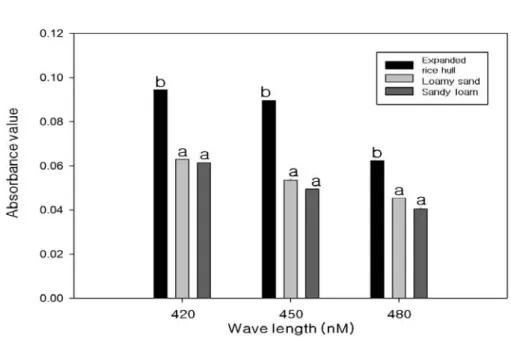
Strawberry growth in the nursery field was completed using ERH, sandy loam, and loamy sand as root media. The results showed that 20 days after fixation, the runner plantlet root activity with ERH treatment was 0.096 mg·g
-1·h
-1at a wavelength of 420 nm, 0.090 mg·g
-1·h
-1at 450 nm and 0,063 mg·g
-1·h
-1at 480 nm (Fig. 1). The use of sandy loam or loamy sand did not show noticeable differences in root activity, with values of 0.062 or 0.063 mg·g
-1·h
-1at 420 nm, 0.050 or 0.054 mg·g-1·h-1 at 450 nm, and 0.041 or 0.046 mg·g
-1·h
-1at 480 nm, respectively. ERH treatment resulted in the highest root activity of runner plantlets across various root media. This high root activity following ERH treatment spreading PE on the nursery bed floor and covering with ERH 7 cm thick to restrict water movement through the lower part was concluded to improve the low water-holding capacity, a physical fault of ERH(Lee, 1999) despite the high porosity and flow rate, thereby positively influencing plant growth. On the other hand, loamy sand has relatively high levels of micropores(Verndonck and Penninck, 1986), which increases the water retention ability. This results in sustained high water content, which probably reduced the root activity by causing poor ventilation after transplantation during the nursing period. If the oxygen in the rhizosphere is insufficient, a physiological disorder can occur due to low root respiration(Drew, 1983; Yang et al., 1991);
however in the case of flooded grape trees, increases in root activity through vent processing of the rhizosphere portion has been demonstrated(Kang et al., 2010). Thus, it is suggested that the air permeability of the root media and the root activity are closely related.
The volumetric water content of the root media was
analyzed across 3 trials following irrigation of the
Fig. 1. Differences in root activity of 'Seolhyang' strawberry daughter plants, in terms of absorbance values at 420, 450, and 480 nM, as influenced by various root media in "Chageun" raising. The lowercase letters indicate mean separation within each wavelength by Duncan's multiple range test, P < 0.05.
nursing field on day 15 (August 1), 30 (August 15), and 45 (August 30) during the nursery period with the three root media types (Table 1). The water content of the ERH treated was 38.6%, 43.0%, and 45.3% after 15, 30, and 45 days, respectively, showing a steady increase over time. The water content of the sandy loam remained between 65.0 and 66.8%, showing the highest water content of the three root media. Loamy sand had a water content of 59.4 61.3%, lower than that of sandy loam, but significantly higher than that of ERH. Styer and Koranski(1997) stated that measuring the physical properties after spreading 5 different types of commercial media on 10 cm of a plastic pot resulted in water volume 67 69% of the container, and the porosity was 11 14%. This is consistent with the water content of sandy loam observed in this study, and whereas the loamy sand had relatively high water content (60%), ERH had significantly lower water content. Park et al.(2015c) stated that soil with high water retention capacity
has a higher probability to induce a physiological disorder due to poor ventilation of the rhizosphere.
Furthermore, a low liquid fraction indicates a high level of water in the lower portion, which can be effectively applied to root growth if accompanied with appropriate irrigation regimes. Considering these reports, in the case that the root media is restricted, using sandy loam and loamy sand maintained high water content, negatively affecting root activity. Thus, it is concluded that regulating the amount of irrigation and mixing soil with large particles is ideal. The use of ERH in the nursery field facilitated an ideal environment that resulted in high root activity. In addition, the water content with ERH treatment steadily increased towards the end of the nursery period, owing to the decomposition of the risk husk (Yun, 1996).
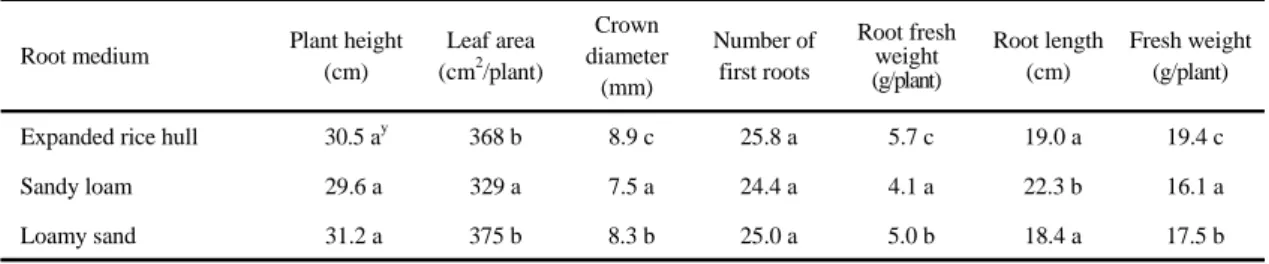
The growth of the runner plantlets across different
nursery growth treatments is shown in Table 2. The
plant height investigation for each root media ranging
Root medium
Water content(%)y
15 days 30 days 45 days
Expanded rice hull 38.6 ax 43.0 a 45.3 a
Sandy loam 65.0 c 66.8 c 65.2 c
Loamy sand 59.4 b 60.5 b 61.3 b
zInvestigation date: 15 days (August 1), 30 days (August 15), and 45 days (August 30) post-irrigat
yVolumetric water content of various root media 4 hours after treatment
xMeans within a column followed by the same lowercase letter are not significantly different by Duncan’s multiple range test (P<0.05)
Table 1. Water content of root media across various nursery field growth treatmentsz
Root medium Plant height
(cm)
Leaf area (cm2/plant)
Crown diameter (mm)
Number of first roots
Root fresh weight (g/plant)
Root length (cm)
Fresh weight (g/plant)
Expanded rice hull 30.5 ay 368 b 8.9 c 25.8 a 5.7 c 19.0 a 19.4 c
Sandy loam 29.6 a 329 a 7.5 a 24.4 a 4.1 a 22.3 b 16.1 a
Loamy sand 31.2 a 375 b 8.3 b 25.0 a 5.0 b 18.4 a 17.5 b
zInvestigation date: September 12, 2013
yMeans within a column followed by the same lowercase letter are not significantly different by Duncan’s multiple range test (P<0.05)
Table 2. Growth parameters of runner plantlets following treatmentwith various root mediaz
between 29.6 and 31.2 cm, involved 24.4-25.8 in the
1st trial, not showing a significant difference throughout treatment. The leaf width following treatment with loamy sand and ERH was similar, 375 cm
2and 368 cm
2, respectively; however the use of sandy loam showed the narrowest growth. The crown thickness of the runner plantlets that were ERH treated was 8.9 mm, significantly thicker than 8.3 mm for loamy sand and 7.5 mm for sandy loam. The weight and fresh weight were highest for the ERH treated, (5.7 g and 19.4 g, respectively, followed by loamy sand and sandy loam. Seedling age, crown thickness, T/R percentage, weight, and fresh weight are suggested as key standard indicators of the quality of runner plantlets(Cocco et al., 2010; Fady, 1997).
Considering these standards, the crown thickness,
weight, and fresh weight of the ERH treated was
noticeably higher, in particular the crown was 8.9 mm
presenting the thickest, satisfying the seedling age
standard(Cocco et al., 2010). Sandy loam treatment
resulted in the highest length (22.3 cm); however,
weight and fresh weight were lower than those in the
other two media, and thus reflected low quality. ERH
treatment of fruit vegetables led to the production of
high-quality plantlets that showed high root growth
and lower T/R ratios, and this was ascribed to the high
porosity and aeration of ERH(Hwang et al., 2003; Lee,
1999). This physical property of ERH induces high
root activity as sufficient oxygen was provided to the
lower regions to produce high quality runner plantlet
growth. However, sandy loam and loamy sand, which
have comparatively high micro-porosity, are the
Root medium Plant height
(cm) Number of leaves Leaf length (cm)
Leaf width (cm)
Chlorophyll contents (SPAD)
Expanded rice hull 27.3 by 4.3 b 12.5 b 10.3 b 43.9 b
Sandy loam 22.6 a 3.7 a 11.3 a 9.0 a 43.1 b
Loamy sand 22.5 a 3.7 a 11.1 a 9.2 a 43.4 b
zInvestigation date: October 11, 2013
yMeans within a column followed by the same lowercase letter are not significantly different by Duncan’s multiple range test (P<0.05)
Table 3. Above-ground growth following the transplantation of runner plantlets across various root mediaz
reason for which poor ventilation of the rhizosphere rate of particle formation is high and thus induced poor rhizosphere ventilation and reduced runner plantlet growth. However, sandy loams and loamy sands with comparatively higher micro- porosity led to the formation of higher liquid-filled porosity, and this was thought to lead to lower aeration in the lower parts and lower plantlet growth.
The results of analysis of above-ground growth 30 days after transplantation in various root media are shown in Table 3. The number of leaves, leaf length, and leaf width had a tendency to resemble plant height growth, the number of leaves after using ERH treatment was 4.3; however, for sandy loam and loamy sand, this value was a relatively low (3.7). The leaf length in the ERH treatment group was 12.5 cm, at least 1 cm longer than that in the sandy loam and loamy sand treatments. The results obtained for leaf width resembled those for leaf length across different media. Cho et al.(2011) reported that rooted cutting that had high root activity during strawberry nursing period, showed substantial growth following transplantation, whereas Lee(2008) stated that trans -planting high quality seedlings and enough of the plant must be produced before budding in order to increase the yield. In the present study, ERH treatment was found to result in high levels of root activity and high runner plantlet growth and above-ground growth following transplantation. This demonstrates the
potential to provide a positive influence in producing commercial yield. However, the use of sandy loam and loamy sand resulted in relatively inferior growth parameters of runner plantlets following transplantation.
Therefore, it is recommended that further studies regarding the regulation of irrigation and air permeability be carried out.
4. Conclusion
The present study was carried out to determine the
influence of various media on the quality of the runner
plantlet and early growth following transplantation for
growing in strawberry nursery fields. The root activity
of the runner plantlet 20 days after fixation, in ERH
treatment was 0.096, 0.090, and 0.063 mg·g
-1·h
-1and
significantly higher than that in sandy loam and loamy
sand. The water content of the root media measured
across 3 trials (15 days, 30 days, 45 days) after
commencing irrigation was highest in the sandy loam
(65.0 66.8%), followed by loamy sand (59.4
61.3%) and ERH (38.6-45.3%). Of the growth
parameters crown thickness, root weight, and fresh
weight of the runner plantlets, ERH treatment resulted
in the heaviest or thickest runner plantlets, having a
substantial influence on above-ground growth
following transplantation. Therefore, the quality of the
runner plantlet and early growth following
transplantation was highest in the ERH treated
strawberries. The results of the present study will serve as on-site data useful for the production of high quality plantlets.
REFERENCES
Choi, J. M., Park, J. Y., Youn, M. K., 2010, Impact of physico·chemical properties of root substrates on growth of 'Seolhyang' strawberry daughter plants occurred through bag culture of mother plants, Kor.
J. Hort. Sci. Technol., 28, 964-972.
Cocco, C. O., Jeronimo, L. A., Ligia, E., Francieli, L. C., Gustavo, S. C., 2010, Development and fruit yield of strawberry plants as affected by crown diameter and plantlet growing period, Pesq. Agropec. Bras., Brasilia., 45, 730-736.
Cho, I. H., Lee, H. Y., Kim, T. Y., Shin, Y. A., Chae, Woo, Y., 2011, Strawberry root length of seedling characteristics by method of raising seeding, Kor. J.
Hort. Sci. Technol., 29 (Suppl.I), 59. (Abstr.)
Drew, M. C., 1983, Plant injury and adaptation to oxygen deficiency in the root environment: A review. Plant and Soil., 75, 179-199.
Faby, R., 1997, The productivity of graded 'Elsanta' frigo plants from different origin, Acta Hort., 439, 449-445.
Hwang, I. T., Cho, K. C., Lee, J. H., Chung, S. J., Kim, K. S., Kim, J. G., 2003, Effect of substrate kind and depth on growth and development of hydroponically -grown Chrysanthemum grandiflorum cv. Chungwoon, J. Kor. Soc. Hort. Sci., 44, 107-113.
Kang, S. B., Lee, I. B., Park, J. M., Lim, T. J., 2010, Effect of waterlogging conditions on the growth, root activities and nutrient content of ‘Campbell Early’ grapevine, Kor. J. Hort. Sci. Technol., 28, 172-179.
Kim, K. H., Lim, S. H., Kim, S. I., Yoo, K. C., 2001, Improvement of method for supplying the nutrient solution at expanded rice hull substrates during hydroponic culture of tomato plants, J. Bio-Env.
Con., 10, 101-105.
Lee, J. W., 1999, Improvement of physicochemical properties of rice hull-based substrate for raising seedlings. PhD Diss., Seoul Natl. Univ., Seoul, Korea.
Lee, W. K., 2008, Studies on nursery system and soil management for forcing culture of domestic strawberry cultivar in Korea. PhD Diss., Chungnam Natl. Univ., Daejeon, Korea.
Lee, K. H., 2013, Effect of management method at seedling raising stage of strawberry 'Seolhyang' on growth and yield. PhD Diss., Kong Ju Natl.
Univ., Kong Ju, Korea.
Park, G. S., Chae, S. C., Oh, C. S., 2015a, Influence of root restriction materials and media on soil environment and growth of runner plantlets during propagation of 'Seolhyang' strawberry, Kor. J. Hort.
Sci. Technol., 33(4), 511-517.
Park, G. S., Choi, J. M., 2015b, Medium depths and fixation dates of 'Seolhyang' strawberry runner plantlets in nursery field influence the seedling quality and early growth after transplanting, Kor.
J. Hort. Sci. Technol., 33(4), 518-524.
Park, G. S., Kim, Y. C., Ann, S. W., Kang, H. K., Choi, J. M., 2015c, Influence of various root media in pot growth of ‘Seolhyang’ strawberry on the growth of daughter plants and early yield after transplant, Kor.
J. Hort. Sci. Technol., 33, 219-226.
Rural Experiment Administration (RDA), 2001, Labor saving strawberry propagation using rice-hull based root media, Suwon, Korea.
Styer, R. C., Koranski, D. S., 1997, Plug & transplant production, Ball Publishing, Batavia, IL.
Verdonck, O., Penninck, R., 1986, Air content in horticultural substrates, Acta Hort., 178, 101-106.
Yang, W. M., Yang, S. Y., 1991, Basic study on a new soilless culture: Effect of oxygen level in rhizosphere on the physioecological characteristics of tomato in aeroponics, J. Kor. Soc. Hort. Sci., 32, 434-439.
Yun, S. Y., 1996, Study on composting of the popped rice hull, J. Kor. Soc. Soil Sci. Fert., 29, 124-129.