Phylogenic Study of Genus Asarum (Aristolochiaceae) in Korea by trnL-trnT Region
Byeong Ryong Lee, Seon Hoan Kim1 and Man Kyu Huh1*
Department of Science Education, Seowon University, Cheongju 361-742, Korea
1Department of Molecular Biology, Dongeui University, Busan 614-714, Korea Received September 15, 2010 /Accepted November 11, 2010
Asarum consists of low-growing herbs and is a genus in the Aristolochiaceae family with species found in the north temperate zones with most species in Asia. We evaluated the nine taxa with the trnL - trnT region of the chloroplast genome to estimate phenotypic relationships within genus Asarum in Korea. Alignment of the DNA sequences required the addition of numerous gaps. Sequence varia- tion within the Asarum was mostly due to nucleotide inserts/deletions, although several indels and inserts were found. Another source of sequence divergence was length variation due to stretches of short repeats that occur at the trnL - trnT region in all the Asarum. A + T content for nine Korean species of genus Asarum ranged between 74.7% and 78.3%. These values were higher than those for the angiosperm alignments of the totaltrnL and trnT region (64.5~67.1%). Within genus Asarum, A.
patens was strikingly different from the others in the three phylogenetic analyses (MP, ML, and NJ).
However, some internal nodes were poorly supported. Within KoreanAsarum, four species were un- solved portions. Possible reasons for the striking non-congruence between the previous morphological traits and the trnL - trnT based on phylogeny were discussed.
Key words : Asarum, trnL - trnT, phenotypic relationships
*Corresponding author
*Tel:+82-51-890-1529, Fax:+82-51-890-1521
*E-mail : [email protected]
서 론
쥐방울덩굴과(Aristolochiaceae)에 속하는 족도리풀속(Asarum L.) 식물은 북반구의 온대(한, 중, 일, 베트남)와 한대에 걸쳐 있으며 유럽에 1종과 북미에 일부 종이 분포되어 있는 것으로 알려져 있다[8]. 특히 생물 지리학적으로 족도리풀속 식물의 기원은 아시아로 추정된다[10].
이 식물의 꽃이 족도리 모양이라서 족도리풀이라고 명명되 었으며 우리나라에는 이 풀의 뿌리는 가늘고 맵다고 하여 예 로부터 세신(細辛)이라 하여 약용으로 쓰였다[4]. 감기로 코가 막히거나 콧물이 흐를 때, 또 열이 심하고 두통이 있을 때, 만성기관지염이나 진해제로서도 쓰이고 구내염에도 효과가 있다고 하였다. 근래에는 2002년에 대한민국 특허청에 세신추 출물을 함유하는 뇌 보호 및 기억력 증진용 조성물로 공개특 허공보(특 2002-0073237)가 있다.
식물의 분자생물학적 분류에 사용되는 엽록체 DNA에서 trnL 유전자를 포함하고 있는 trnL-trnT 부위는 한 개의 group I intron, 한 개의 intergenic spacer, 그리고 한 개의trnT exon 으로 구성되어 있다. Group I intron은 잘 보존된 핵심 구조로 pre-tRNA로부터 자가 스플라이싱을 촉매 하는 활성 자리를 암호화하고 있다[3,13].trnL intron은 group I의 첫 번째 in-
tron이며 tRNA 유전자를 저해한다[2]. 식물에서trnL 인트론 은 보통 양측면의trnL exons에서 보존된 부위이다. intergenic spacer에서 이차 구조 요소(secondary-structural elements) 스 프라이싱 부위에서는 발견되지 않는다[2]. cpDNA spacer 부 위의 일반적인 특징은 인델(indel)을 가지고 있는데 인델은 결 실, 인접 서열의 중복, 스페이스의 비반복에서 발생한다[6].
우리나라에 자생하고 있는 족도리풀속 식물은 2종에서부터 19종까지 분류학자들에 따라 많은 차이를 나타내고 있다 [16,18,19]. 이는 자생지에 따라 차이가 나타낼 수 있지만 특히 형태학적 가소성이 있는 것에 기인한다고 볼 수 있다[12]. 족도 리풀속 식물은 20 cm 정도의 작은 초본으로 심장 또는 신장모 양의 잎은 턱잎이 결여되어있고 근경(rhizome)을 가지고 있 다. 그 외 많은 형질이 분류학적 검색에 쓰이고 있으나 잎과 꽃에서 가소성을 가지고 있어 표현형적 변이를 유발한다.
Lee [8]은 상위 검색으로 잎의 표면에 흰 무늬가 있을 경우 Asarum maculatum (개족도리풀), 잎이 녹색일 경우 A. sieboldii (족도리풀)로 분류하였다. 그러나 최근 Oh [16]는 잎이 자주색 이냐 녹색이냐를 상위검색으로 설정한 바 있다.
특히 Oh [16]과 Kweon [12]는 ITS (nuclear ribosomal DNA internal transcribed spacer sequences)를 이용하여 족도리풀 속 식물 9개 분류군에 대해 계통분석 연구를 수행한 바 있다.
그러나 ITS만으로는 일부 분지군이 분해되지 않은 점이 있었 다. 그런데 앞서 ITS의 분류 결과에서 분해되지 않는 분류군이 trnL-trnT에 의한 본 연구 결과에서 분지가 있었다. 또한 형태
Table 1. Taxa used in the molecular study of the genus Asarumincluding population locations
Code Scientific Name Geographic origin
21 34 5 67 89
Asarum siboldii Miquel for. koreanumY. Lee A. patens Yamaki
A. heterotropoides var.seoulense(Nakai) Kitag.
A. maculatum Nakai
A. siboldii Miquel var. manshuricumMaximowicz A. vericolor (Yamaki) Y. Lee var.non-vericolor Y. Lee
A. siboldii Miquel var. manshuricumMaximowicz for. misandrumY. Lee A. sieboldii Miquel
A. siboldii Miquel var. cornutumY. Lee
Jeong-eup, Jeollabuk-do
Cheongju-si, Chungcheongbuk-do Pohang-si, Gyeongsangnam-do Mt. Halla, Jeju-do
Mt. Juwang, Gyeongsangbuk-do Cheongju-si, Chungcheongbuk-do Jeong-eup, Jeollabuk-do
Mt. Halla, Jeju-do Mt. Halla, Jeju-do
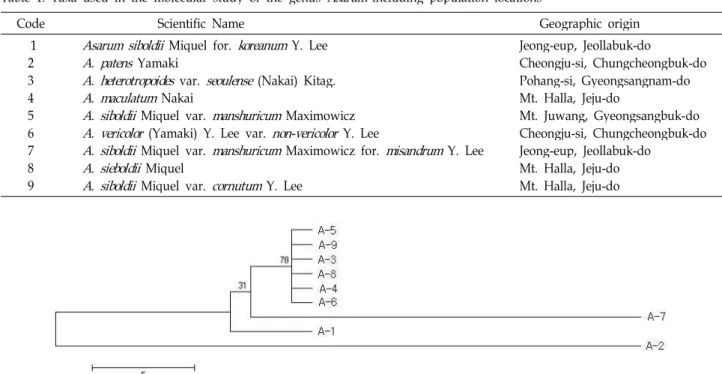
Fig. 1. The maximum parsimonious tree for genusAsarumbased ontrnL and trnT analysis using PAUP 4b10, exhaustive search, unweighted parsimony analysis, gaps=fifth state) from the 1011 aligned positions of the initial matrix. Symbols of taxa were added the numbers of Table 1 with A-.
학적으로 너무 세분화된 결과라는 것을 입증하는지 ITS 결과 와 비교하고자 하였다. 본 연구에서는 Oh [16]에서 분석하지 않은 3 분류군을 추가하여 선행 연구 결과와 비교하였다.
재료 및 방법 재료와 genomic DNA 추출
본 분석에 사용한 식물 분류군은 자주족도리풀(A. siboldii Miquel for. koreanum Y. Lee), 금오족도리풀(A. patens Yamaki), 서울족도리풀(Asarum heterotropoides var. seoulense (Nakai) Kitag.), 개족도리풀(A. maculatum Nakai), 민족도리풀 (A. siboldii Miquel var. manshuricum Maximowicz), 민무늬족 도리풀(A. vericolor (Yamaki) Y. Lee var. non-vericolor Y. Lee), 각시족도리풀(Asarum siboldii Miquel var. manshuricum Maximowicz for. misandrum Y. Lee), 족도리풀(A. sieboldii Miquel), 뿔도리풀(A. siboldii Miquel var. cornutum Y. Lee)로 자생지에서 직접 채집하여 사용하였다(Table 1).
각 식물체로부터 DNA를 추출하기 위하여 Plant DNA Zol Reagent (Life Technologies Inc., Grand Island, New York, USA)를 사용하였다 추출방법은 사용자의 지침서에 의 거하여 추출하였다. 추출된 DNA는 진공 흡입기로 5분간 건 조시킨 후 TE 100 ul에 용해하여 3일간 냉장 보관하였다. 용 해된 시료는 DNA 정량을 체크하였고 TE로 DNA 농도가 균 질하게 조정하여 본 분석을 위해 사용하거나 -20oC 냉동고에
보관하였다.
trnL and trnT 분석
엽록체의 trnL intron과 trnL - trnT spacer 부위(Fig. 1)는 Taberlet 등[21]이 고안한 시발체(primer)로 PCR (polymerase chain reaction)을 이용하여 증폭시켰다.
PCR 반응을 위하여 추출한 각 분류군의 게놈 DNA 50 ng, 각 dNTP 100 uM, 시발체 각 0.2 uM, 1x enzyme buffer, Taq polymerase 2 unit를 넣고 증류수로 전체 50 ul volume이 되도 록 추가하였다. 증폭반응은 초기 94oC에서 90 sec간 변성한 후, 28 사이클로 94oC에서 30 sec, 42oC에서 60 sec, 72oC에서 60 sec간 실시하였고, 추가로 72oC에서 5분간 연장하였다.
PCR 산물은 1.5% agarose gel에서 분리하였는데 이때 절편 들의 상대적 크기를 비교하기 위해 100 bp ladder DNA mark- er를 같이 loading시켰다. 전기영동 후 젤은 ethidium bro- mide로 염색하여 밴드를 현상하였다. 현상된 젤은 Alpha Image TM (Alpha Innotech Co, USA)을 사용하여 밴드 양상 을 조사하였다. 이후 젤에서 DNA를 QIAquick Gel Extraction Kit (QIAGEN)로 추출하였다. 추출된 DNA를 bluescript vec- tor로 클로닝한 후 ABI Prism 377 Sequencer (Applied Biosystem, USA)로 염기서열을 분석하였다.
통계 분석
분류군간 유전적 거리(I)와 유전적 동질성(D)은 분류군간
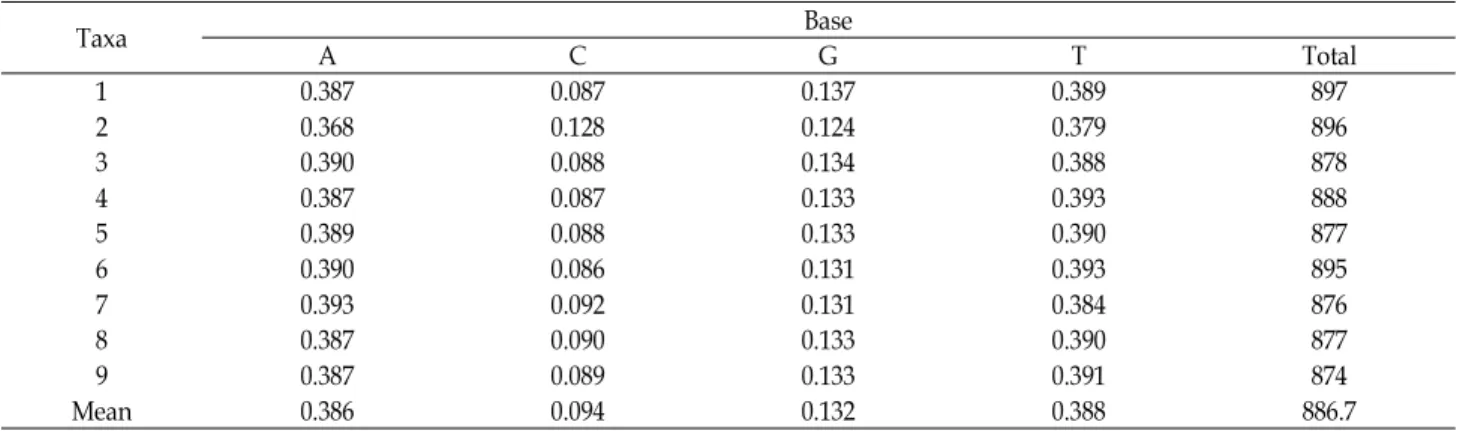
Table 3. The base frequencies across taxa of genus AsarumusingtrnL and trnT analysis
Taxa Base
A C G T Total
1 0.387 0.087 0.137 0.389 897
2 0.368 0.128 0.124 0.379 896
3 0.390 0.088 0.134 0.388 878
4 0.387 0.087 0.133 0.393 888
5 0.389 0.088 0.133 0.390 877
6 0.390 0.086 0.131 0.393 895
7 0.393 0.092 0.131 0.384 876
8 0.387 0.090 0.133 0.390 877
9 0.387 0.089 0.133 0.391 874
Mean 0.386 0.094 0.132 0.388 886.7
염기쌍의 비교로 산출하였다[14]. PAUP에서 분류군간 핵산 차이에 의한 유의성 검증, 염기 빈도, 서열쌍 거리, un- corrected "p"에 의한 측정된 거리 등을 산출하였다[20]. 염 기자리 당 서열 간 염기 조성 차이, 불일치 계수를 검증하였 다[11].
서열간 코돈의 중립성 검증은 갭과 결손 서열을 제외하고 1,000회 반복으로 MEGA4로 실시하였다[15]. 타지마의 여러 통계치(M=number of sites, S=Number of segregating sites, ps=S/M, and π=nucleotide diversity. D=Tajima test statistic) 를 산출하였다[22].
유연관계 분석
각 족도리풀trnL - trnT에서 얻은 크로마토그램(chromato- gram)은 소프트웨어 Sequence Navigator 1.0.1 (Applied Biosystems Inc.)로 편집하였다. 족도리풀trnL - trnT 서열에서 결손부위를 포함한 서열 배당은 MEGA4 version 4.1과 Clustal X program으로 분석하였다[23]. 배당된 서열에서 gap 의 부위는 missing data로 처리하였다. 그러나 계통학적으로 정보적인 인델은 이진법 처리로 data에 삽입하였다.
최절약법에 의한 tree (maximum parsimonious tree, MP) 는 heuristic search, branch-swapping options, tree bi- section-reconnection에 따랐다[20]. 최우법(maximum like- lihood tree, ML), N-J법(neighbor-joining tree, NJ)으로 tree 작성을 실시하여 비교하였다. 계통분석의 분지는 PHYLIP version 3.57의 NEIGHBOR, neighbor-joining (NJ) 방법에 의 해 구성하였다[5,17]. 분류군의 가지에 대한 Bootstrap 분석은 1000회 반복법으로 실시하였다.
결 과
족도리풀속 8개 분류군에 대한trnL - trnT 부위의 profiles 는 100 bp ladder DNA marker로 크기를 비교한 결과 모두 약 880 nucleotides (bp)의 크기를 가지고 있었다(Table 3). 이 들 밴드를 purification하여 DNA 염기서열을 분석한 결과 족
도리풀속 식물은 874-897 bp였다. 최고와 최저의 24 bp 차이는 삽입과 결실에 의한 것이다(Appendix 1).
A+T 함량은 74.7-78.3%였으며(Table 3), 분류군간 염기 차 이는 금오족도리풀의 염기 C에서만 1% 수준에서 유의성을 나타내었고, 다른 분류군의 염기에서는 유의성을 나타내지 않 았다(Table 4). A+T 함량의 비율은 피자식물에서trnL과 trnT 부위의 평균값(64.5%~67.1%)과 비교할 때 약간 높았다.
DNA 서열의 서열 배당은 많은 갭(gaps)을 필요로 하였다.
전체 934 특성(characters)이였으며 866 특성은 일정하였다. 63 개 변이는 절약-비정보적이었고 단지 5개만 절약-정보적이었 다. 7곳(위치 34, 35, 38, 42, 48, 53, 589)에서 한 염기의 삽입이 발견되었다. 3부위(위치 284~295, 599~619, 717~735)에서 긴 직렬 염기 삽입이 있었다. 염기 직렬 결실은 뿔족도리풀에 서 144~173 자리에서 였다. 또 다른 서열 변이는 짧은 염기들 의 반복이 있었는데 TATTAGTTATTA였다(Table 5).
서열 쌍 거리 분석에서 개족도리풀과 민족도리풀이 가장 근연하였다(Table 6). 금오족도리풀은 나머지 분류군의 쌍에 비해 유전적 거리가 높았다.
모든 염기 자리 당 불일치 지수(disparity index) 또는 불균 등 지수를 산출하였다(Table 7). 0 보다 클 경우 서열 간 진화 분화의 차이가 우연에 의한 예상 값보다 염기 조성 편향에서 큰 차이를 나타내게 된다. 금오족도리풀과 각시족도리풀은 다 른 분류군과 유의한 차이를 나타내었다.
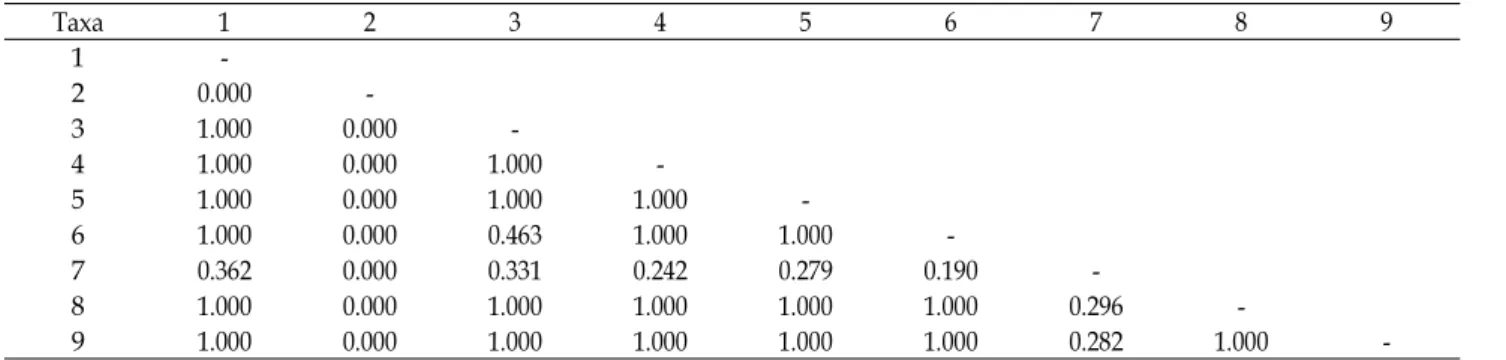
DNA 서열에서 염기 치환이 같은 패턴으로 진화해왔다는 가설을 몬테-카를로 테스트(1000 반복)로 검증하였다(Table 8). 금오족도리풀은 다른 분류군과 유의한 차이를 나타내었으 며 다른 분류군은 유의한 차이가 없었다.
타지마(Tajima)의 중립성 검증에서 자리 수는 9였으며 분리
Table 2. Synthetic primer sequencing (5'-3') used for the trnL andtrnT analysis in this study
Name Sequence 5'-3' Code
ab CATTACAAATGCGATGCTCT
TCTACCGATTTCGCCATATC B48557
A49291
Table 4. The chi-square test of homogeneity of base frequencies across taxa of genus AsarumusingtrnL and trnT analysis
Taxa A χ2 C χ2 G χ2 T χ2
1 Obs.Exp. 346.49347 0.001 83.3078 0.337 118.58123 0.165 348.63349 0.000
2 Obs.Exp. 346.11330 0.750 83.20115 12.154** 118.45111 0.489 348.24340 0.195
3 Obs.Exp. 339.15342 0.024 81.5377 0.252 116.07118 0.032 341.25341 0.000
4 Obs.Exp. 343.01344 0.003 82.4677 0.362 117.39118 0.003 345.13349 0.043
5 Obs.Exp. 338.77341 0.015 81.4477 0.242 115.93117 0.010 340.86342 0.004
6 Obs.Exp. 345.72349 0.031 83.1177 0.449 118.31117 0.015 347.86352 0.049
7 Obs.Exp. 338.38344 0.093 81.3581 0.002 115.80115 0.006 340.47336 0.059
8 Obs.Exp. 338.77339 0.000 81.4479 0.073 115.93117 0.10 340.86342 0.004
9 Obs.Exp. 337.61338 0.001 81.1678 0.123 115.54116 0.002 339.69342 0.016
The taxon codes are the same as Table 1.
**=p<0.01
Table 5. Stretches of short repeats at the trnL - trnT region in the Asarum
600 610 620 630 670 680 690 700
1 T A T T A A T T - - - A TTAATAATAA ATATGAATAC TATTAGAGTA TTATAGTAAG TATATGGTAT 2 C · · · - - - · · · C · · · C · · 3 · · · · G · · · - - - · · · · 4 · · · - - - · · · · 5 · · · - - - · · · · 6 · · · T · · - - TAATA-TTAA TAATTAATTA · · · · 7 · · · - - - · · · A · · · · 8 · · · - - - · · · · 9 · · · A T TAATAATTAA T T A T T A A T - · · · · The taxon codes from 1 to 8 are the same as Table 1.
Table 6. The sequence pair distances of sites between two sequences in a multiple alignment among species of genusAsarumusing trnL and trnT analysis
Taxa 1 2 3 4 5 6 7 8 9
1 -
2 0.049 -
3 0.007 0.047 -
4 0.006 0.045 0.001 -
5 0.006 0.045 0.001 0.000 -
6 0.007 0.047 0.002 0.001 0.001 -
7 0.028 0.070 0.027 0.026 0.026 0.027 -
8 0.007 0.047 0.002 0.001 0.001 0.002 0.027 -
9 0.007 0.047 0.002 0.001 0.001 0.002 0.027 0.002 -
The taxon codes of first line are the same as those of first column.
The taxon codes from 1 to 9 are the same as Table 1.
되는 자리 수는 61이었으며 이들의 비는 0.073이었고, 다양도 는 0.017로 낮았다(Table 9). 중립설의 검증 결과는 도태에 의
한 중립가설보다는 삽입과 결실에 의한 결실돌연변이설로 설 명된다(D=-1.825).
Table 7. The disparity index per site for all sequence pairs in genus AsarumusingtrnL and trnT analysis
Taxa 1 2 3 4 5 6 7 8 9
1 -
2 0.832 -
3 0.000 0.893 -
4 0.000 0.893 0.000 -
5 0.000 0.893 0.000 0.000 -
6 0.000 0.885 0.001 0.000 0.000 -
7 0.004 0.725 0.005 0.008 0.008 0.018 -
8 0.000 0.833 0.000 0.000 0.000 0.000 0.007 -
9 0.000 0.833 0.000 0.000 0.000 0.000 0.007 0.000 -
The taxon codes of first line are the same as those of first column.
The taxon codes from 1 to 9 are the same as Table 1.
Table 8. Test of the homogeneity of substitution patterns between sequences
Taxa 1 2 3 4 5 6 7 8 9
1 -
2 0.000 -
3 1.000 0.000 -
4 1.000 0.000 1.000 -
5 1.000 0.000 1.000 1.000 -
6 1.000 0.000 0.463 1.000 1.000 -
7 0.362 0.000 0.331 0.242 0.279 0.190 -
8 1.000 0.000 1.000 1.000 1.000 1.000 0.296 -
9 1.000 0.000 1.000 1.000 1.000 1.000 0.282 1.000 -
The taxon codes of first line are the same as those of first column.
The taxon codes from 1 to 9 are the same as Table 1.
Fig. 2. The maximum likelihood tree for genusAsarumbased ontrnL and trnT analysis using PAUP 4b10. Symbols of taxa were added the numbers of Table 1 with A-.
Table 9. Results from Tajima's neutrality test for nine sequences
M S ps ∏ D
9 61 0.073 0.017 -1.825
M=number of sites, S=Number of segregating sites, ps=S/M, and π=nucleotide diversity. D is the Tajima test statistic.
MP tree에서 서울족도리풀, 개족도리풀, 민족도리풀, 민무늬 족도리풀, 족도리풀, 뿔족도리풀은 거의 분리되지 않았다(Fig.
1). 이들 그룹은 각시족도리풀과 자매군을 형성한다(지지도 78%). 이들 그룹은 자주족도리풀과는 낮은 지지도(31%)로 근연 하며 금오족도리풀은 가장 분지된 분류군이었다. ML tree 역시
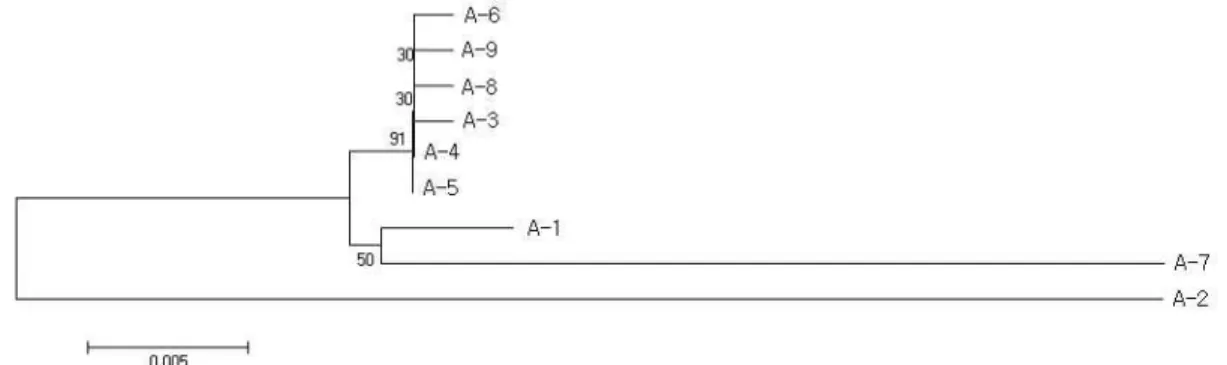
유사하나 자주족도리풀이 각시족도리풀과 같은 분지군을 형성 하였다(Fig. 2). 이 계통도에서도 금오족도리풀은 가장 분지된 분류군이었다. NL tree는 MP tree보다 ML tree에 더 유사한 양상을 나타내었다(Fig. 3). 다만 민족도리풀이 높은 지지도 (91%)로 개족도리풀, 서울족도리풀 등과 분리되었다. 자주족도 리풀이 각시족도리풀과 같은 분지군을 형성하였다(Fig. 2). 이 계통도에서도 금오족도리풀은 가장 분지된 분류군이었다.
고 찰
한국 내 분포하는 족도리풀속 식물은 연구자들 간 일치된
Fig. 3. The neighbor-joining tree for genusAsarumbased ontrnL andtrnT analysis using MEGA 4x1. Symbols of taxa were added the numbers of Table 1 with A-.
검색분류표가 작성되어 있지 않아 분류하기 어려운 측면이 있다. 즉, 연구자에 의해 종의 동정부터 문제시 되어 도감마다 같은 종이라도 학명이 달라 누구의 견해를 취해야 할 지 문제 시된다. 최근 Lee [9]의 개정된 도감과, So [18], So와 Kim [19], Oh [16]에 의해 많이 정리되었다. Lee [8]의 도감에는 많은 변종이 수록되어 지리적 집단 간 차이를 인정함으로써 지나치 게 종을 세분한 면이 없지 않다. 다만 그간 두 종으로만 인식한 Lee[9]의 분류와 여러 학자나 원예용 족도리풀속 재배자들이 임의로 국명을 부여하여 혼돈한 것에 대한 형태 형질을 정리 한 점은 높이 평가된다[12]. 특히 최근 Oh [16]에 의해 한국산 족도리풀의 형태학적 측면에서 분류학적 재검토에서 7종으로 정리하였고, Kweon [12]에 의해 분자생물학적 측면이 추가되 었지만 아직도 학명이 서로 일치되지 않았다.
한편 앞서 핵 내 리보솜 서열(ITS) 연구 결과와 본 연구의 엽록체 trnL - trnT 결과는 형태학적 분류에 의한 결과와도 일치하지 않는다. 또한trnF - trnL의 결과(미발표)도 형태나 ITS 결과와 일치하지 않아 역시 분류의 어려움을 모호하게 한다. 형태학적 분류로는 털족도리풀과 더불어 잎이 녹색으로 자주색인 자주족도리풀과 구별되고 더 하위 검색으로 악편은 편평하고 전체가 바깥으로 젖혀지며 악편 전체가 악통과 밀착 하여 족도리풀, 금오족도리풀, 개족도리풀, 무늬족도리풀과 다른 계통으로 간주된다[16]. 따라서 ITS 결과에 의거한다면 잎에서 털의 유무가 더 상위 검색으로 설정되어 털이 결여된 각시족도리풀과 털이 약간이라도 있는 나머지 전체 족도리풀 속 분류군과 구별된다. 본 연구 결과에서도 ITS,trnF - trnL와 더불어 많은 종이 형태 분류와 일치하지 않는다. 따라서 각기 독립된 종으로 세분하기 보다는 어떤 정립된 분류 검색에서 아종이나 변종으로 처리할 것과 일부는 통합할 것을 제시하고 있다.
한편, 앞서 연구된 ITS 결과에서 So [18]에 의하면 집단에 따라 여러 개체를 채집했을 때 같은 분류군 내 일부 개체들이 다른 분류군 내로 군집되는 것을 볼 수 있다. 즉, 족도리풀의 일부는 자주족도리풀과 뿔족도리풀에 같은 분지군을 형성하 기도 하지만 일부 개체들은 선운산족도리풀(Asarum sonunsa-
nense Y. Lee)과 같은 분지군을 형성하였다[12]. 털족도리풀 (Asarum manshuricum)도 마찬가지였다. 따라서 잎의 형질에 서 많은 변이가 있음으로 향후 엽록체 DNA에 의한 분자마커 로 보완할 필요가 있을 것이다. 따라서 잎과 꽃에 나타난 색상 형질이 중요한 특성이긴 하나 족도리풀속의 가소성(plasticity) 의 결과라면 분류 기준에서 제외하거나 여러 형질이 모여야 다른 변종으로 간주하는 것이 더 바람직할 수 있다. 물론 cod- ing 부위는 진화속도가 non-coding 부위보다 느려 낮은 분류 군에서 논쟁이 일부 발생하고 있는 것도 한 원인으로 볼 수 있다[1,7]. 그런데 Kelly [10]는 형태와 ITS에 의한 광범위한 족도리풀속 분류를 시도한 바 있다. 그의 재료 중 족도리풀이 포함되어 있는데 중국과 한국에서 채집한 것이다. 비록 한국 에 분포하는 종으로는 한 종밖에 포함되어 있지 않지만 형태 에 의한 결과와 ITS에 의한 결과가 매우 일치하는 것으로 나타 나 본 연구와 So [18]의 결과와 대조적이다. 이는 지나치게 우리나라의 족도리풀 식물을 세분한 것에 기인한다고 볼 수 있다.
References
1. Backmann, K. 2001. Evolving and the genetic analysis of populations: 1950-2000. Taxon 50, 7-45.
2. Bonnard, G., F. Michel, J. H. Well, and A. Steinmetz. 1984.
Nucleotide sequence of the tRNALeu gene from Vicia faba chloroplasts: evidence for structural homologies of the tRNALeu intron with intron from the autosplicable Tetrahymenaribosomal RNA precursor.Mol. Gen. Genet. 194, 330-336.
3. Cech, T. R. 1988. Conserved sequences and structures of group I introns: building an active site for RNA catalysis - a review. Gene73, 259-271.
4. Choi, K. S. 2006. Ecological study on Asarum spp. MS, Kyungsung University, Busan, Korea.
5. Felsenstein, J. 1993. PHYLIP (Phylogeny Inference Package) version 3.5s, Distributed by the author. Department of Genetics, Univ. Washington, Seattle.
6. Golenberg, E. M., M. T. Clegg, M. L. Durbin, J. Doebley,
초록:trnL-trnT 부위에 의한 한국 족도리풀속 식물종의 계통분류학적 연구 이병룡․김선환1․허만규1*
(서원대학교 과학교육과, 1동의대학교 분자생물학과)
족도리풀속은 쥐방울덩굴과에 속하는 키 작은 초본이며 아시아의 온대지역에서 많은 종이 주로 분포한다. 이 속에 속하는 우리나라 자생 식물 아홉 분류 간 계통 관계를 평가하기 위해 엽록체 게놈의 trnL - trnT 부위로 평가하였다. DNA 서열 배당은 많은 갭(gaps)을 가지고 있었다. 이 속 내 서열 변이는 일부 삽입과 결실이 발견되 었지만 주로 핵산의 삽입/결실에 기인하였다. 서열 분화의 또 다른 원천은 이 속의trnL - trnT 부위에서 발생한 짧은 반복 서열에 의한 길이 변화이다. 이 속의 9개 분류군에 대한trnL - trnT 부위에서 A+T 함량은 74.7~78.3%
로 피자식물의 평균(64.5~67.1%)보다 높았다. 이 속의 금오족도리풀은 세 계통도(MP, ML, and NJ)에서 모두 현 저하게 차이가 났다. 그런데 일부 내부 분지마디는 낮은 지지도를 보였으며 네 종은 분리되지 않았다. 기존의 형태학적 특성과 trnL - trnT의 계통도 간 불일치에 대해 논의하였다.
and D. P. Ma. 1993. Evolution of a noncoding region of the chloroplast genome. Mol. Phylogenet. Evol. 2, 52-64.
7. Holderegger, R. and R. Abbott. 2003. Phylogeography of the arctic-alpineSaxifraga oppositifolia(Saxifraceae) and some re- lated taxa based on cpDNA and ITS sequences variation.
Am. J. Bot. 90, 931-936.
8. Lee, T. B. 2003. Coloured Flora of Korea. Hyangmoon-sa, Seoul. Korea.
9. Lee, Y. N. 2007. New Flora of Korea. Kyo-Hak Publishing Co., Seoul. Korea.
10. Kelly, L. M. 1998. Phylogenetic relationships in Asarum (Aristlochiceae) based on morphology and ITS sequences.
Am. J. Bot. 85, 1454-1467.
11. Kumar, S. and S. R. Gadagkar. 2001. Disparity Index: A sim- ple statistic to measure and test the homogeneity of sub- stitution patterns between molecular sequences. Genetics 158, 1321-1327.
12. Kweon, E. J. 2009. Phylogeny study of genus Asarum (Aristolochiaceae) in Korea by internal transcribed spacer se- quence (ITS). MS, Pusan Natl. University, Korea.
13. Michel, F. and B. Dujon. 1983. Conservation of RNA secon- dary structures in two intron families including mitochon- drial-, chloroplast- and nuclear-encoded members.EMBO J.
2, 33-38.
14. Nei, M. 1973. Analysis of gene diversity in subdivided populations. Proc. Natl. Acad. Sci. USA. 70I, 3321-3323.
15. Nei, M. and T. Gojobori. 1986. Simple methods for estimat- ing the numbers of synonymous and nonsynonymous nu- cleotide substitutions. Mol. Biol. Evol. 3, 418-426.
16. Oh, B. U. 2008. A taxonomic review of Korean Asarum (Aristolochiaceae). Korean J. Pl. 38, 251-270.
17. Saitou, N. and M. Nei. 1987. The neighbor-joining method:
A new method for reconstructing phylogenetic trees.Mol.
Biol. Evol. 4, 406-425.
18. So, S. 2008. A molecular phylogenetic study of the genus Asarumin Korea. MS, Chonbuk Natl. University, Korea.
19. So, S. and M. Kim. 2008. A taxanomic study of Asarum (Aristolochiaceae) in Korea. Korean J. Pl. 38, 121-149.
20. Swofford, D. L. 2003. PAUP*. Phylogenetic Analysis Using Parsimony (*and other methods). Version 4. Sunderland, Sinauer Associates, Inc. MA.
21. Taberlet, P., L. Gielly, G. Pauton, and J. Bouvet. 1991.
Universal primers for amplification for three non-coding re- gions of chloroplast DNA. Plant Mol. Biol. 17, 1105-1109.
22. Tajima, F. 1989. Statistical methods to test for nucleotide mutation hypothesis by DNA polymorphism. Genetics123, 585-595.
23. Tamura, K., J. Dudley, M. Nei, and S. Kumar. 2007. MEGA4:
molecular evolutionary genetics analysis (MEGA) software version 4.0. Mol. Biol. Evol. 24, 1596-1599.