J. Fish Pathol., 28(2) : 99~107 http://dx.doi.org/10.7847/jfp.2015.28.2.099
Rock bream (Oplegnathus fasciatus) is an econom- ically important species in the Korean aquaculture in- dustry (Kim & Baeck, 2010). However in recent years, with the rapid progress of rock bream industry, the infectious diseases caused by bacteria, viruses and parasites have also become more severe resulting in a great economic loss. Therefore, better understanding of the physiological and immunological elements of Oplegnathus fasciatus may contribute to the emerging strategies of sustainable industry.
Rab proteins are highly conserved small GTPase of the Ras superfamily (ras, Rho/Rac/Cdc42, Ran, sar/Arf and RabGTPase), present in all eukaryotes, including plants, yeasts, insects and mammals (Rink, Ghigo, Kalaidzidis, & Zerial, 2005; Wennerberg, Rossman, & Der, 2005). Rab proteins play a key role in membrane trafficking transport. They are function- ing as ‘molecular switches’ in the key steps of mem- brane trafficking process including vesicle formation, vesicle motility, membrane modeling, vesicle dock- ing, membrane fusion and act at multiple stages of intracellular transport processes (Segev, 2001; Zerial
& McBride, 2001). This proteins regulate membrane
Genomic identification and spatial expression analysis of Rab-5C-like gene identified from rock bream
(Oplegnathus fasciatus)
M.S.Mothishri
*,**, Navaneethaiyer Umasuthan
*,**, William Shanthakumar Thulasitha
*,**, Ilson Whang
*,**†and Jehee Lee
*,**†*
Department of Marine Life Sciences, School of Marine Biomedical Sciences, Jeju National University, Jeju Self-Governing Province 690-756, Republic of Korea
**
Fish Vaccine Development Center, Jeju National University, Jeju Special Self-Governing Province 690-756, Republic of Korea
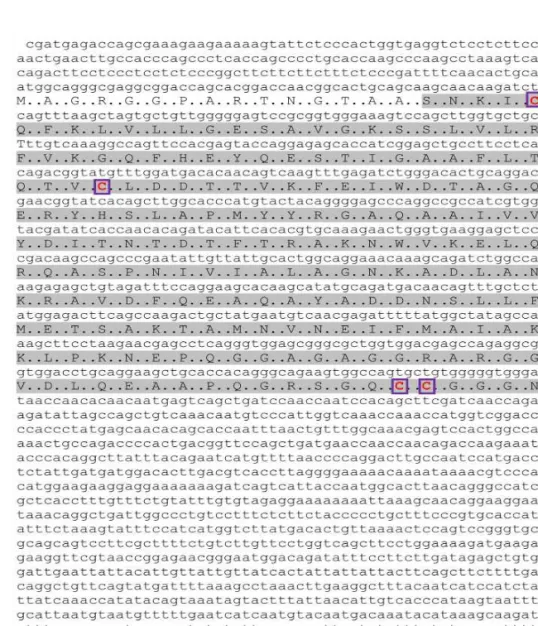
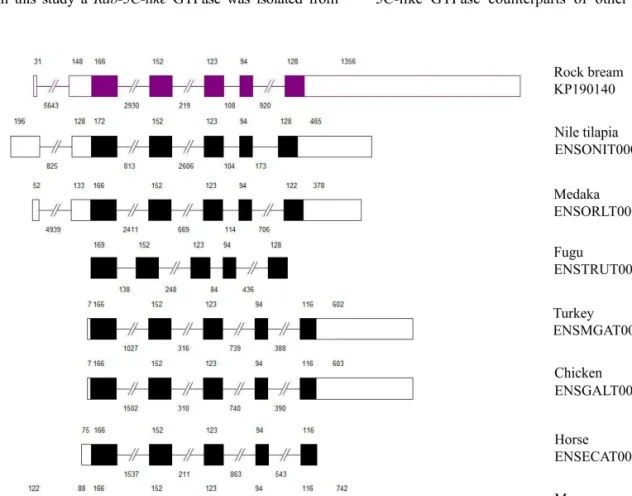
Despite its economic importance as an aquaculture species, the molecular and genetic information regarding physiologically important elements in rock bream (Oplegnathus fasciatus) is not completely understood. Rab proteins play a vital role in cellular mechanisms and immunity as one of the key regulators of membrane trafficking. In this investigation, a Rab gene, named as RbRab-5C-like, was identified from Oplegnathus fasciatus. RbRab-5C-like protein exhibited high homology with Rab pro- teins of other species and possessed signature characteristics of Rab proteins with four conserved cysteine residues. Phylogenetic analysis showed that RbRab-5C-like clustered with other fish counter- parts. The RbRab-5C-like genomic sequence possesses six exons and five introns. Transcriptional analysis revealed that RbRab-5C-like was ubiquitously expressed in all examined tissues with the highest expression occurring in the liver. While the structural and homologic characteristics of RbRab-5C-like suggest a strong conservation of this element in different species, its mRNA distribution implies a wide range of biological significance in rock bream.
Key words: Rab-5C-like, Membrane trafficking, Phylogenetic analysis, Transcriptional analysis
†Corresponding author: Jehee Lee & Ilson Whang Tel: 82-64-754-3472; Fax: 82-64-756-3493 E-mail: [email protected], [email protected]