- 51 -
Introduction
Operating room fires are a rare, but preventable danger in modern operating rooms, and can be life threatening. Oper- ating room fires can occur due to problems with either the sur- gical team or the anesthesia team. Currently, there are a few published reports of incidental fire cases in operating rooms,
1-3)including some associated with skin treatment using pulsed dye lasers (PDL) in the dermatology department.
4-6)But the incidental firing by a pulsed dye laser during laryngeal sur- gery has not been reported. To our knowledge, this is the first fire case caused by a PDL when operating on the larynx in the literature.
Case Report
A 57-year-old man was referred to our department in Au- gust 2010 for progressive voice changes with a breathy sound lasting 1 month. He had a history of diabetes mellitus with no smoking history, and no history of previous voice prob- lems or voice abuse. Videolaryngostroboscopic examination showed the presence of a hyperkeratotic lesion on the mid-
portion of the true vocal fold surrounded by vascular ectasia.
The patient was performed PDL-assisted laryngomicrosur- gery under general anesthesia and the pathology report showed hyperkeratosis without evidence of malignancy.
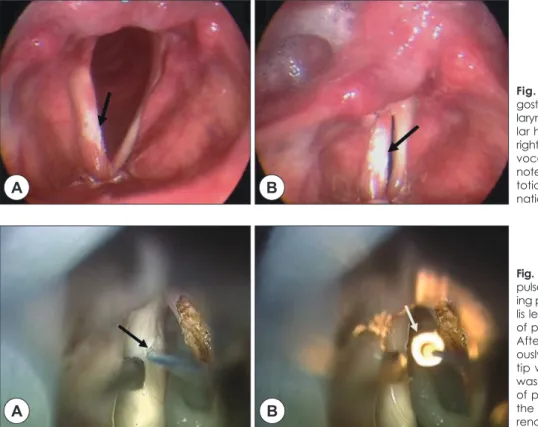
During regular follow-up, the patient complained of voice changes again, and videolaryngostroboscopic examination revealed hyperkeratotic changes on the right true vocal fold (Fig. 1A, B). The hyperkeratotic lesion had an irregular sur- face and glottis gap on contact. We planned a PDL-assisted laryngomicrosurgery to perform PDL vocal cord stripping.
The endotracheal laser tube #6.0 was used via orotracheal intubation. General anesthesia was done using oxygen (FiO
2= 0.5 mmHg), air, remifentanil and sevoflurane. The stripping of the hyperkeratotic lesion using a CO
2laser was performed successfully. After treatment of the main lesion, sulcus vocalis was observed on the counter portion of the main lesion because of repetitive stimulus of the vocal cord during phonation (Fig. 2A). When the PDL switch was turn on near the vocal cord, the PDL tip burst into flames sud- denly, but the flames went out spontaneously after a while (Fig. 2B). Fortunately, the tip flame did not develop a fire.
After applying the PDL to the counter-portion of the vocal cord to create a smooth vocal cord margin, we finished the operation.
Discussion
Researchers estimate that surgical fires occur between
Incidental Ignition of a Pulsed Dye Laser Fiber During Laryngomicrosurgery : A Case Report
Department of Otorhinolaryngology, Gangnam Severance Hospital, Yonsei University College of Medicine, Seoul, Korea
Yun Suk Suh, Eun Jung Lee, Min Ki Kim and Hong-Shik Choi
= Abstract =
Surgical fires require an ignition source, oxidizer, and fuel. The pulsed dye laser (PDL) has been shown to be effective in the treatment of hypertrophic scars and keloids in dermatology. With the increasing number of applications of CO
2, laser as igni- tion source has been associated with operating room fires in the otorhinolaryngologic field. There have been many case re- ports on PDL-induced fires in dermatology, but until now, there were no reports in the larynx. We describe a 57-year-old pa- tient diagnosed with laryngeal hyperkeratosis treated by PDL-assisted laryngomicrosurgery. In this case, we experienced incidental PDL tip flaring during pulsed dye laser vaporization.
KEY WORDS :LasersㆍLarynxㆍMicrosurgeryㆍFires.
증 례