Vol. 18, No. 6, pp. 174-179, December 2014
Friction and Wear of Nano-Sized Silica Filled Epoxy Composites
Jae-Dong Kim*, Yeong-Sik Kim**†and Hyung-Jin Kim***
(Received 30 October 2014, Revised 04 December 2014, Accepted 04 December 2014)
Abstract: The wear behavior of epoxy matrix composites filled with nano sized silica particles is discussed in this paper. Especially, the variation of the coefficient of friction and the specific wear rate under the various applied load and sliding velocity were investigated for these materials. Wear tests of pin-on-disc mode were carried out and followed by scanning electron microscope observations. The presence of silica filler in epoxy composites was demonstrated significant influence on the friction and wear behavior of epoxy nanocomposites. With the incorporation of silica filler into the epoxy matrix, reduction of the coefficient of friction and specific wear rate were identified. Wear mechanism was discussed by analyzing the worn surface by scanning electron microscope as well.
Key Words:Epoxy, Nanocomposites, Wear Property, Wear mechanism.
**†Yeong-Sik Kim(corresponding author) : Department of Mechanical & Automotive Engineering, Pukyong National University.
E-mail : [email protected], Tel : 051-629-6155
* Jae-Dong Kim : Institute of Marine Industry, Gyeongsang National University.
*** Hyung-Jin Kim : Department of Mechanical System Engineering, Gyeongsang National University.
1. Introduction
Over the past decades, polymer composites have been increasingly applied as structural materials in the aerospace, automotive and chemical industries, providing lower weight alternatives to traditional metallic materials. One of the features that make polymer composites so promising in industrial applications is the possibility of tailoring their properties with special fillers. The fundamental understanding of synergy in tribological performance among various functional fillers is essential for
successful applications1-3).
Epoxy resins are characterized by high strength, high elastic modulus, strong bond ability, and excellent chemical stability, which are widely used in the fields of aerospace, automotive, electronic, and chemical engineering. However, epoxy resins are brittle and thus are sensitive to micro-cracks because of their three-dimensional network structure.
In addition, lower impact toughness and poor fatigue property also restrict their further applications. It is noteworthy that pristine epoxy resins perform worse than thermoplastic polymers when used in sliding friction4). Therefore, the modification of epoxy resins is essential to improve their wear resistance.
Recently, the studies on the nanocomposite, which improve the wear resistance of polymers as well as other mechanical properties by addition of a small percentage of nano-sized filler to polymers, are being attempted actively5-11). A polymer nanocomposite is defined as a composite material
with a polymer matrix and filler particles that have at least one dimension less than 100 nm.
From the tribological view-point, the major benefit of these polymer nanocomposites relative to those micro-sized particle composites is that the material removal is expected to be less as the nano-additives has similar size to the segments of the surrounding polymer chains2). This is possible owing to the much greater surface area-to-volume ratio of nano-additives, which may be important for bonding of the particle to the polymer matrix. In addition to the influence on the tribological performance of the composites, the nano-additives also change the crystallinity, microstructure, physical and mechanical properties of the polymer matrix.
In this paper, the wear behavior of epoxy matrix composites filled with nano-sized silica particles is discussed. Especially, the variation of the coefficient of friction and the wear resistance according to the change of applied load and sliding velocity were investigated for these materials. Wear mechanism for these materials are also discussed by analyzing the worn surface of wear track by SEM.
2. Experimental setup and method
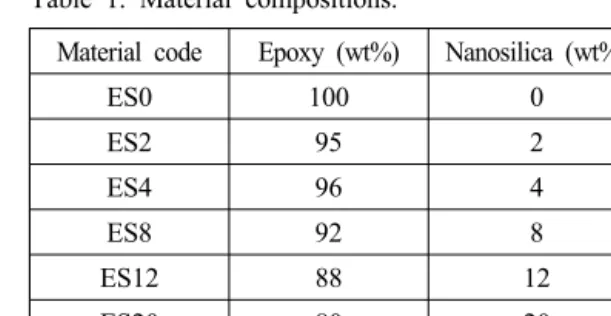
2.1 Fabrication of nanocomposites The raw materials of the resin system include Araldite-F(diglycidyl of bisphenol A, DGEBA) and 40wt% nano-silica/bisphenol A(Nanopox® F400, nanoresins AG, Germany). To prepare the sample, resin and silica batches were mixed in quantities specified in Table 1 using laboratory stirrer for 0.5 hour at 60℃, degassed in vacuum of -100 KPa at 80℃ for 2 hour, then vacuum was removed and stoichiometric amount of hardener was added while stirring slowly. The mixture was at last cast into a preheated stainless steel mould for curing at 120℃
for 16~20 hour. Samples were allowed to cool
gradually in the oven to room temperature after curing.
For comparison, pristine resin was prepared with the same procedure. Grinding and polishing for sample surface were applied before tests to ensure the specimen surfaces were parallel and free of microscopic defects. Further, annealing of 2 hour at 100℃ was applied to remove any residual stresses introduced in the fabrication processes. Before testing, all Specimens were conditioned in ambient temperature for 2 weeks. The code of these materials are given in Table 1.
Table 1. Material compositions.
Material code Epoxy (wt%) Nanosilica (wt%)
ES0 100 0
ES2 95 2
ES4 96 4
ES8 92 8
ES12 88 12
ES20 80 20
2.2 Wear test
The wear test was carried out by using a pin-on-disc wear tester (NANOVIA, USA). As shown in Fig. 1, the specimen pin was fixed on a flat rotating disc and rubbed against pin type counterpart material which is a radius of 1 mm made by tool steel. The reduction of specimen’s height was observed by a displacement sensor, and the coefficient of friction was recorded and calculated by a ratio between the tangential force and normal load.
The specimen was abraded with # 1000 emery paper and 0.3 ㎛ alumina powder and then the specimen and counterpart pin were cleaned in ultrasonic cleaner by acetone solution prior to wear testing. The wear test was performed under the following conditions : the sliding distance kept at 360 m in all experimental condition constantly, and
the sliding velocity and the applied load were changed to various velocity(0.1 m/s, 0.2 m/s and 0.3 m/s) and various load(3N, 6N and 9N) respectively.
The mass loss of the specimen was measured after the wear test in order to calculate the specific wear rate by the following equation
∆
where FN is the normal load applied on the specimen, L the total sliding distance,
the density of the specimen,∆
mass loss of the specimen.Fig. 1 Schematic of pin-on-disc type tribometer.
2.3 Worn surface analyses
SEM(JEOL, JSM-5610) was used to observe the morphology of the worn surfaces of the specimens.
To understand the wear mechanism, the worn surfaces of the specimens were coated with a thin layer of gold and then observed by a SEM. The microhardness of the specimen was measured with a micro-Vickers hardness tester(Akasi, MVK-H1).
When measuring the microhardness, the load kept 1 N and the loading time was 15 sec.
3. Results and discussion
3.1 Coefficient of friction
Fig. 2 show the variation of coefficient of friction according to the sliding distance when the applied
load kept at 6 N and sliding velocity was 0.2 m/s respectively. The coefficient of friction of pristine epoxy indicated higher figures compared with epoxy composites throughout the sliding distance. The running-in period were observed at around until 80 m of sliding distance, and after running-in period, coefficient of friction kept unvaried stable condition for the all wear specimen.
Fig. 2 Variation of coefficient of friction according to sliding distance when applied load kept at 6N and sliding velocity 0.2 m/s.
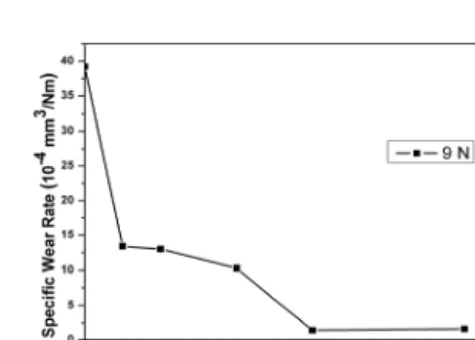
Fig. 3 indicate the specific wear rate according to addition of silica when the applied load kept 9 N. It was found that the wear resistance highly increased by silica adding, especially, the specific wear rate of epoxy composite exhibited about 25 times greater wear resistance compared with pristine epoxy when the epoxy composite with 12 wt% silica filler.
Fig. 3 Wear rate of epoxy matrix nanocomposites with filler content.
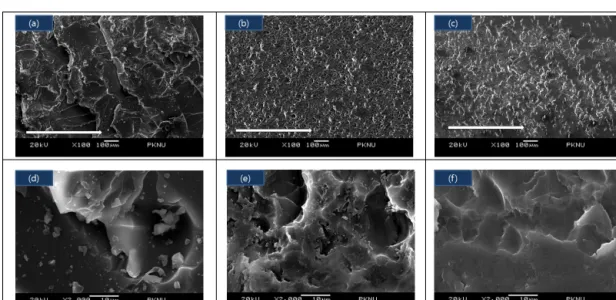
Fig. 8 Morphology of the worn surfaces according to the silica content : (a) (d) Prestine epoxy, (b) (e) epoxy composite with 2 wt% silica filler, and (c) (F) epoxy composite with 10 wt% silica filler.
White arrows indicate the sliding direction.
Fig. 9 Morphology of worn surfaces according to the applied load : (a) applied load of 3 N, (b) applied load of 6 N, and (c) applied load of 9 N.
0 2 4 8 12 20
0 5 10 15 20 25 30
Hv
Nano-silica content (wt%)
Fig. 4 Variation of microhardness of epoxy composites according to the silica content.
3.3 Morphology of the worn surfaces The variation of microhardness of epoxy composites according to the silica content was shown in Fig. 4. It was found that the variation of microhardness according to the addition of silica was insignificant for epoxy composites.
The surface morphology of epoxy and its composites according to the silica content are shown in Fig. 8. It was found that there are many material waves along the sliding direction in the pristine epoxy (Fig. 5(a)) and the silica filled epoxy composites (Fig. 5(b) and (c)). It was identified that
the size of the material waves in pristine epoxy were bigger than that of silica filled epoxy composites.
The pristine epoxy behaved in general brittle fracture during the sliding wear process, and the high magnification micrograph (Fig. 5(d)) demonstrated that many debris by brittle cracking are existed on the worn surface. On the other hand, it can be found that the silica filled epoxy composites behaved in mild abrasive wear relatively (Fig. 5(e) and (f)), and as a result, some dimples were appeared on the worn surface (Fig. 5(f)).
The surface morphology of pristine epoxy according to the applied load are shown in Fig. 6.
It was found that as the increase in the applied load, surface morphology of pristine epoxy progressed more severe condition.
The wear mechanisms of epoxy and particulate filled epoxy matrix composites had been previously discussed by Durand et al.12). The wear mechanism by Durand included the formation of cracks, the development from cracks to waves and the production of debris. These process of wear demage can be identified from Fig. 6, that is, as the increase in the applied load, the surface morphology has progressed from formation of cracks (Fig. 6(a)), development from cracks to waves (Fig. 6(b)) and production of debris (Fig. 6(c)).
The wear rate decreasing mechanism on the silica filled epoxy composites can be explained as follows:
With the incorporation of silica filler into the epoxy matrix, the propagation of the cracks into the epoxy matrix was obstructed by the silica fillers on the surface layer. This resulted in the formation of finer material waves. Furthermore, hard silica filler in a epoxy matrix would reduce the wear rate in case of the applied load is less than a critical value.
For the silica filled epoxy composites, addition of silica filler contributed to a reduction of coefficient of friction and the specific wear rate. And the
dominant wear mechanisms were changed to the mild abrasive wear from the adhesive wear and brittle cracking of the pristine epoxy.
4. Conclusions
The friction and wear behavior of epoxy matrix composites filled with nano-sized silica particles were studied, and the following results were obtained from the experiment.
(1) The coefficient of friction of silica filled epoxy composites indicated lower figures than pristine epoxy throughout the sliding distance.
(2) The wear resistance was certainly improved with the incorporation of silica filler into the epoxy matrix.
(3) The dominant wear mechanisms were changed from the adhesive wear and brittle cracking of the pristine epoxy to the mild abrasive wear of silica filled epoxy composites.
References
1. A. Dasari, Z. Z. Yu and Y. W. Mai, 2009,
"Fundamental aspects and recent progress on wear/scratch damage in polymer nanocomposites", Materials Science and Engineering, Vol. 63, pp.31–80.
2. B. N. R. Kumar, B. Suresha and M.
Venkataramareddy, 2009, "Effect of particulate fillers on mechanical and abrasive wear behaviour of polyamide 66/polypropylene nanocomposites", Materials and Design, Vol. 30, pp.3852–3858.
3. L. Chang, Z. Zhang, L. Ye and K. Friedrich, 2007, "Tribological properties of epoxy nanocomposites III. Characteristics of transfer films", Wear, Vol. 262, pp. 699-706.
4. G. S. hi, M. Q. Zhang, M. Z. Rong, B. Wetzel and K. Friedrich, 2003, “Friction and wear of
low nanometer Si3N4 filled epoxy composites“.
Wear 2003, Vol.254, pp.784–796.
5. J. D. Kim, H. J. Kim and Y. S. Kim, 2010,
"Wear Properties of Epoxy Matrix Nanocomposites", KSPSE, Vol 14(6), pp.83-88.
6. L. C. Zhang, I. Zarudi and K. Q. Xiao, 2006,
"Novel behaviour of friction and wear of epoxy composites reinforced by carbon nanotubes", Wear, Vol. 261, pp.806–811.
7. B. Wetzel, F. Haupert and M. Q. Zhang, 2003,
"Epoxy nanocomposites with high mechanical and tribological performance", Composites Science and Technology, Vol. 63, pp.
2055–2067.
8. S. Yu, H. Hu and J. Yin, 2008, "Effect of rubber on tribological behaviors of polyamide 66 under dry and water lubricated sliding", Wear, Vol. 265, pp. 361-366.
9. G. Xian, R. Walter and F. Haupert, 2006,
"Friction and wear of epoxy/TiO2 nanocomposites: Influence of additional short carbon fibers, Aramid and PTFE particles", Composites Science and Technology, Vol. 66, pp. 3199–3209.
10. L. Chang, Z. Zhang, H. Zhang and A. K.
Schlarb, 2006, "On the sliding wear of nanoparticle filled polyamide 66 composites", Composites Science and Technology, Vol. 66, pp. 3188–3198.
11. Z. Jiang, L. A. Gyurova, A. K. Schlarb, K.
Friedrich and Z. Zhang, 2008, "Study on friction and wear behavior of polyphenylene sulfide composites reinforced by short carbon fibers and sub-micro TiO2 particles", Composites Science and Technology, Vol. 68, pp. 734–742.
12. J. M. Durand, M. Vardavoulias and M. Jeandin, 1995, "Role of reinforcing ceramic particles in the wear behavior of polymer-based model composites", Wear, Vol. 181, pp. 833-839.