• 검색 결과가 없습니다.

Time Course of the Effects of Nitric Oxide on Voluntary Wheel Running Behavior following Restraint Stress

N/A
N/A
Protected

Academic year: 2021

Share "Time Course of the Effects of Nitric Oxide on Voluntary Wheel Running Behavior following Restraint Stress"

Copied!
8
0
0

로드 중.... (전체 텍스트 보기)

전체 글

(1)

Correspondence to: Chan Park, Department of Anatomy and Neuro- biology, Biomedical Science Institute, School of Medicine, Kyung Hee University, 1, Hoeki-dong, Dongdaemun-gu, Seoul 130-701, Korea

Tel: +82-2-961-0288, E-mail: [email protected] Received August 13, 2009, Revised August 31, 2009 Accepted September 5, 2009

Time Course of the Effects of Nitric Oxide on Voluntary Wheel Running Behavior following Restraint Stress

Department of Anatomy and Neurobiology, Biomedical Science Institute, School of Medicine, Kyung Hee University, Seoul, Korea

Hye-Min Kang, Jizi Jin, Chan Park

The involvement of nitric oxide (NO) in stress-induced motivational behavior change in mice was evaluated using voluntary wheel running in the cage. The effects of daily restraint stress on voluntary running were followed for two weeks. Daily restraint stress for 3 hours reduced voluntary running from Day 1 to Day 7. The effects of the NO precursor, L-arginine, and the NO synthase inhibitor, N-nitro-L-arginine methyl ester (L-NAME), on voluntary running were also observed for two weeks. In the L-NAME-treated group, voluntary running decreased on Days 1 to 3 compared to the baseline level (Day 0; voluntary running levels before stress). Treatment with L-arginine following restraint stress markedly sustained the voluntary running activity to basal level, whereas treatment with L-NAME following restraint stress prolonged the decrease in voluntary running induced by stress.

These results suggest that NO may protect against stress-induced motivational behavioral change. (Korean J Str Res 2009;17:277

∼284)

Key Words: Restraint stress, Voluntary wheel running, Nitric oxide

INTRODUCTION

Stressful events play a prominent role in provoking depression (Caspi et al., 2003). Restraint stress, one of the most frequently employed experimental animal models of depression, involves the application of uncontrollable stress and is thought to induce a depressive behavioral state (Albonetti et al., 1993). One of the major symptoms of depression is lack of motivation. Restraint

stress increased immobility in the open-field test (Browne et al., 1980), the forced swim test (Spiacci et al., 2008), and rotarod performance (Morimoto et al., 1994). Stress-induced behavioral abnormalities can disappear shortly after termination of exposure to the stressor; however, depending on the variables in the chosen experimental approach, they can also persist long after the termination of stress. Acute or chronic immobilization stress produced both short- and long-term reductions in spontaneous behavior (Mercier et al., 2003). However, the time course of the effects of repeated restraint stress on the spontaneous behavior has not been examined.

Nitric oxide (NO), a stable gaseous free radical, is an

intracellular messenger in the central nervous system and may

function as a neurotransmitter/neuromodulator (Moncada et al.,

1991; Zhang et al., 1995). NO is produced enzymatically in

(2)

postsynaptic structures from L-arginine by nitric oxide synthase (NOS) as a response to activation of N-methyl-D-aspartate receptors by excitatory amino acids (Garthwaite 1991; Moncada et al., 1991). Neurobehavioral effects of NO have been documented, and roles in analgesia, convulsion, and memory have been proposed (Zhang et al., 1995). The involvement of NOS in stress-induced behavioral change has been observed in the elevated plus maze test, the open-field test, and the forced swim test (Harkin et al., 2003; Masood et al., 2003; Gulati et al., 2007;

Spiacci et al., 2008). Many studies have been performed with a single treatment of NO-mimetics or antagonists before stress (Harkin et al., 2003; Masood et al., 2003; Gulati et al., 2007;

Spiacci et al., 2008). The time course of the effects of NO on behavioral changes with repeated long-term treatment with NO-related chemicals has not been examined.

Voluntary wheel running is perhaps the most widely reported behavior performed by captive animals. The spontaneity of wheel running is used to quantify the strength of motivation (Iversen, 1993). One study showed that a single restraint stress induces a transient decrease in voluntary wheel running activity (Desan et al., 1988). However, time course of change in the voluntary wheel running activity after daily repeated restrained stress has not been examined.

In the present study, with using voluntary wheel running to estimate motivational drive, we examined the time course of changes in spontaneous motor activity following daily repeated restraint stress. And we also investigate the involvement of NO on motivational behavior of animals under repeated stress condition with using the NO precursor, L-arginine, and the NO synthase inhibitor, N-nitro-L-arginine methyl ester (L-NAME).

MATERIALS AND METHODS

1. Animals

Adult (8∼11 weeks old) male C57BL/6 mice weighing 20∼

25 g (Charles River Diagnostics, MA, USA) were used in all of the experiments. The mice were treated and maintained in accordance with the animal care guidelines of the US National Institutes of Health and the Korean Academy of Medical Sciences. The mice were group-housed at a controlled temperature (20±2

o

C) with a 12-h light/dark cycle and ad libitum access to

food and water.

The animals were divided into two groups of mice: a control group (n=18) and a stress group (n=18). Each animal was placed in rat cages containing one plastic running wheel (11 cm in diameter) and given free access to running wheels for overnight on Day 0. A magnet attached to a running wheel triggered a magnetic reed switch that inputted to an electrical counter. Mice ran almost exclusively during the dark period. Therefore, revolution numbers were recorded between 18:00 and 09:00 h.

Wheel revolutions were counted irrespective of the direction of the wheel. After stress treatment and/or chemicals, the number of running wheel revolutions was evaluated for two weeks.

2. Stress procedures

The stress group animals were kept in a well-ventilated restraint tube (10 cm long, 2.8 cm in diameter, 0.5-cm wall) for 3 h a day (09:00∼12:00) for two weeks. Animals were not physically compressed and did not experience pain. Immediately following restraint, they were moved back into the cages equi- pped with running wheels. After 1 h, drugs were administered.

3. Drugs

L-arginine (L-arginine hydrochloride) and L-NAME were dissolved in sterile isotonic saline immediately before use. In each group, six animals were injected with L-arginine (1 g/kg, i.p.) and six animals were injected with L-NAME (50 mg/kg, i.p.) after the restraint stress. Control animals (n=6) were injected with the same volume of saline. Dosages were chosen based on previous investigations of the effects of these compounds (Masood et al., 2003).

4. Count of wheel revolutions and statistical analysis

Wheel running analyses were performed by experimenters blind to group identity. Statistical analyses were conducted using SPSS software. Descriptive statistics of all variables were determined, including means, standard deviations, daily change, and 95%

confidence intervals. Results were considered to be statistically significant at p<0.05.

A repeated measures two-way ANOVA for all continuous

dependent variables determined whether there was (a) a time *

(3)

Fig. 1. Change in the number of revolutions following restraint stress.

(A) saline-treated group, (B) L-arginine treated group, (C) L-NAME treated group. L-NAME: N-nitro-L-arginine methyl ester. p value represents change with respect to Day 0. p values less than 0.05 are indicated *. Dotted line represents Day 0 level (baseline level) in each group.

group interaction effect and/or (b) a time effect. When F values corresponding to a time * group interaction effect for a given variable were significant, simple effects testing was performed to determine time effects within each experimental group. Subse- quently, paired t tests relative to Day 0 variables for each time point determined the earliest detectable change. Differences were considered statistically significant if the p value was less than 0.05.

RESULTS

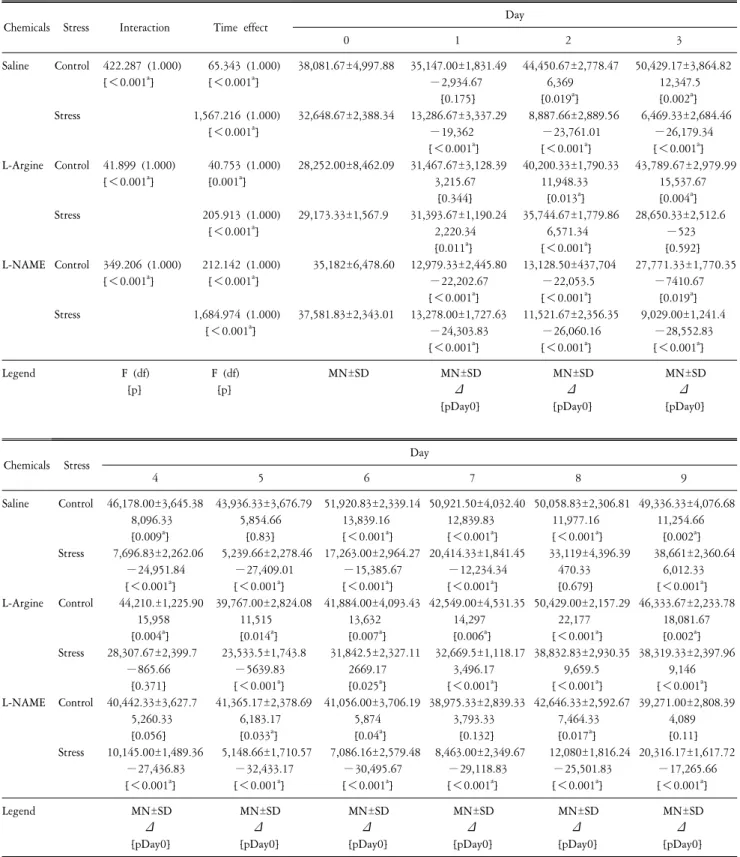
The change in voluntary wheel running activity over the duration of the study as well as group means and standard deviations are presented in Fig. 1.

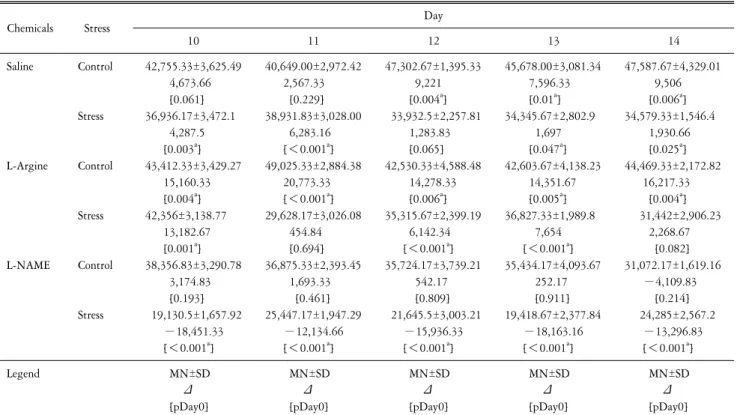
The number of wheel revolutions for the saline-treated control group increased compared to Day 0 except on certain days (Days

1, 5, 10, and 11; p=0.175, 0.83, 0.061, and 0.229, respectively;

Fig. 1A; Table 1). Analysis of the number of wheel revolutions revealed that repeated restraint stress transiently reduced the degree of voluntary running (Fig. 1A). Stress groups showed statistically significant decreases in voluntary running from Day 1 to Day 7 compared to Day 0. Running returned to Day 0 levels after Day 8.

Treatment with L-arginine on the control group showed a significant increase in wheel running revolutions compared to Day 0 levels (Fig. 1B). On the other hand, treatment with L-arginine following restraint stress induced increase of revolution number of wheel on overall days except on Day 5 (Δ=−5,639.83; p=

0.001 vs. Day 0; Fig. 1B). However, the L-NAME treated

control group showed a transient reduction in the degree of

voluntary running on days 1, 2, and 3 compared to Day 0 levels

(p=0.001, 0.001, and 0.019, respectively; Fig. 1C). Running in

(4)

Table 1. Number of wheel revolution and outcome of two-way ANOVA.

Chemicals Stress Interaction Time effect Day

0 1 2 3

Saline Control 422.287 (1.000) 65.343 (1.000) 38,081.67±4,997.88 35,147.00±1,831.49 44,450.67±2,778.47 50,429.17±3,864.82

[<0.001

a

] [<0.001

a

] −2,934.67 6,369 12,347.5

[0.175] [0.019

a

] [0.002

a

] Stress 1,567.216 (1.000) 32,648.67±2,388.34 13,286.67±3,337.29 8,887.66±2,889.56 6,469.33±2,684.46

[<0.001

a

] −19,362 −23,761.01 −26,179.34

[<0.001

a

] [<0.001

a

] [<0.001

a

] L-Argine Control 41.899 (1.000) 40.753 (1.000) 28,252.00±8,462.09 31,467.67±3,128.39 40,200.33±1,790.33 43,789.67±2,979.99

[<0.001

a

] [0.001

a

] 3,215.67 11,948.33 15,537.67

[0.344] [0.013

a

] [0.004

a

] Stress 205.913 (1.000) 29,173.33±1,567.9 31,393.67±1,190.24 35,744.67±1,779.86 28,650.33±2,512.6

[<0.001

a

] 2,220.34 6,571.34 −523

[0.011

a

] [<0.001

a

] [0.592]

L-NAME Control 349.206 (1.000) 212.142 (1.000) 35,182±6,478.60 12,979.33±2,445.80 13,128.50±437,704 27,771.33±1,770.35

[<0.001

a

] [<0.001

a

] −22,202.67 −22,053.5 −7410.67

[<0.001

a

] [<0.001

a

] [0.019

a

] Stress 1,684.974 (1.000) 37,581.83±2,343.01 13,278.00±1,727.63 11,521.67±2,356.35 9,029.00±1,241.4

[<0.001

a

] −24,303.83 −26,060.16 −28,552.83

[<0.001

a

] [<0.001

a

] [<0.001

a

] Legend F (df) F (df) MN±SD MN±SD MN±SD MN±SD

[p] [p] Δ Δ Δ

[pDay0] [pDay0] [pDay0]

Chemicals Stress Day

4 5 6 7 8 9

Saline Control 46,178.00±3,645.38 43,936.33±3,676.79 51,920.83±2,339.14 50,921.50±4,032.40 50,058.83±2,306.81 49,336.33±4,076.68 8,096.33 5,854.66 13,839.16 12,839.83 11,977.16 11,254.66 [0.009

a

] [0.83] [<0.001

a

] [<0.001

a

] [<0.001

a

] [0.002

a

] Stress 7,696.83±2,262.06 5,239.66±2,278.46 17,263.00±2,964.27 20,414.33±1,841.45 33,119±4,396.39 38,661±2,360.64

−24,951.84 −27,409.01 −15,385.67 −12,234.34 470.33 6,012.33 [<0.001

a

] [<0.001

a

] [<0.001

a

] [<0.001

a

] [0.679] [<0.001

a

] L-Argine Control 44,210.±1,225.90 39,767.00±2,824.08 41,884.00±4,093.43 42,549.00±4,531.35 50,429.00±2,157.29 46,333.67±2,233.78

15,958 11,515 13,632 14,297 22,177 18,081.67 [0.004

a

] [0.014

a

] [0.007

a

] [0.006

a

] [<0.001

a

] [0.002

a

] Stress 28,307.67±2,399.7 23,533.5±1,743.8 31,842.5±2,327.11 32,669.5±1,118.17 38,832.83±2,930.35 38,319.33±2,397.96

−865.66 −5639.83 2669.17 3,496.17 9,659.5 9,146 [0.371] [<0.001

a

] [0.025

a

] [<0.001

a

] [<0.001

a

] [<0.001

a

] L-NAME Control 40,442.33±3,627.7 41,365.17±2,378.69 41,056.00±3,706.19 38,975.33±2,839.33 42,646.33±2,592.67 39,271.00±2,808.39

5,260.33 6,183.17 5,874 3,793.33 7,464.33 4,089 [0.056] [0.033

a

] [0.04

a

] [0.132] [0.017

a

] [0.11]

Stress 10,145.00±1,489.36 5,148.66±1,710.57 7,086.16±2,579.48 8,463.00±2,349.67 12,080±1,816.24 20,316.17±1,617.72 −27,436.83 −32,433.17 −30,495.67 −29,118.83 −25,501.83 −17,265.66 [<0.001

a

] [<0.001

a

] [<0.001

a

] [<0.001

a

] [<0.001

a

] [<0.001

a

]

Legend MN±SD MN±SD MN±SD MN±SD MN±SD MN±SD

Δ Δ Δ Δ Δ Δ

[pDay0] [pDay0] [pDay0] [pDay0] [pDay0] [pDay0]

(5)

Table 1. Continued.

Chemicals Stress Day

10 11 12 13 14

Saline Control 42,755.33±3,625.49 40,649.00±2,972.42 47,302.67±1,395.33 45,678.00±3,081.34 47,587.67±4,329.01 4,673.66 2,567.33 9,221 7,596.33 9,506 [0.061] [0.229] [0.004

a

] [0.01

a

] [0.006

a

] Stress 36,936.17±3,472.1 38,931.83±3,028.00 33,932.5±2,257.81 34,345.67±2,802.9 34,579.33±1,546.4

4,287.5 6,283.16 1,283.83 1,697 1,930.66 [0.003

a

] [<0.001

a

] [0.065] [0.047

a

] [0.025

a

] L-Argine Control 43,412.33±3,429.27 49,025.33±2,884.38 42,530.33±4,588.48 42,603.67±4,138.23 44,469.33±2,172.82

15,160.33 20,773.33 14,278.33 14,351.67 16,217.33 [0.004

a

] [<0.001

a

] [0.006

a

] [0.005

a

] [0.004

a

] Stress 42,356±3,138.77 29,628.17±3,026.08 35,315.67±2,399.19 36,827.33±1,989.8 31,442±2,906.23

13,182.67 454.84 6,142.34 7,654 2,268.67 [0.001

a

] [0.694] [<0.001

a

] [<0.001

a

] [0.082]

L-NAME Control 38,356.83±3,290.78 36,875.33±2,393.45 35,724.17±3,739.21 35,434.17±4,093.67 31,072.17±1,619.16 3,174.83 1,693.33 542.17 252.17 −4,109.83 [0.193] [0.461] [0.809] [0.911] [0.214]

Stress 19,130.5±1,657.92 25,447.17±1,947.29 21,645.5±3,003.21 19,418.67±2,377.84 24,285±2,567.2 −18,451.33 −12,134.66 −15,936.33 −18,163.16 −13,296.83 [<0.001

a

] [<0.001

a

] [<0.001

a

] [<0.001

a

] [<0.001

a

]

Legend MN±SD MN±SD MN±SD MN±SD MN±SD

Δ Δ Δ Δ Δ

[pDay0] [pDay0] [pDay0] [pDay0] [pDay0]

Interaction and time effects are reported F (df), and p values are reported for the repeated measures analysis. Measurements for each day include group average (MN±SD) and changes with respect to Day 0 values and a 95% confidence interval of the magnitude of change. p value represents change with respect to Day 0. p values less than 0.05 are indicated (

a

).

the L-NAME?treated group returned to Day 0 levels by day 4.

However, treatment with L-NAME following restraint stress decreased in the number of wheel revolutions compared to Day 0 in all experimental days (Fig. 1C).

DISCUSSION

In the present study, we demonstrated that daily repeated restraint stress transiently induced a change in voluntary wheel running behavior. However, the impact of the stress was relieved by daily treatment with L-arginine, the precursor of NO, and was exacerbated by L-NAME, the inhibitor of NOS. This study shows that restraint stress initially affects motivation to perform familiar behavior, but animals showed adaptation to prolonged repeated stress over time. Furthermore, behavioral change after treatment with a NO precursor or inhibitor shows that NO may play a critical role in the initial response to stress.

We used voluntary wheel running as a measure of motivational

behavior change. The voluntary wheel running test has been used interchangeably as a measure of locomotive activity with other tests (Sherwin, 1998; Sisti et al., 2001; Santucci et al., 2008).

However, the freely accessible running wheel in a familiar cage has some advantages for the estimation of motivational behaviors.

First, the freely accessible running wheel makes possible to record animals behavior for a long time. Animals usually run at night, so the time of estimating the behavior is very long, i.e., 12 h, representing a more convincing result than an open-field or forced swim test. Second, use of a familiar cage equipped with a running wheel may rule out behavior elicited or motivated by a discrete environmental stimulus. The present study demonstrates that the voluntary wheel running test can be used to estimate motivational behavior changes in response to stress.

In the present study, we estimated the long-term change in

voluntary running activity following repeated restraint stress. We

found that 3 h of restraint stress reduced voluntary wheel running

levels for about seven days, demonstrating that restraint stress

(6)

transiently reduces motivational activity. Restraint stress induced a marked decrease in ambulation in the open-field test (Masood et al., 2003) and increased immobility time in the forced swim test (Poleszak et al., 2006). However, the long-term effects of restraint stress on spontaneous behavior are controversial (Desan et al., 1988; Shinba et al., 2001; Trneckova et al., 2004), which indicates that behavioral responses are dependent on the variables chosen for the experiment. Desan et al.(1988) showed that restraint stress dramatically reduced voluntary wheel running activity and that voluntary wheel running activity was depressed for 14∼42 days after repeated restraint stress, although stress was combined with electric tail shock serially for four days. In our study, animals were given repeated daily restraint stress and then allowed voluntary access to wheel running. Spontaneous wheel running behavior was transiently decreased for the initial seven days of the treatment. Ours may be the first study to follow spontaneous behavioral change during exposure to daily restraint stress.

We investigated the effects of NO on voluntary running behavior. Under stress-free conditions, enhancement of NO with L-arginine increased in the degree of voluntary running. However, L-NAME, an NOS inhibitor, induced an initial (Days 1∼3) decrease in voluntary running during the two-week period. A neurobehavioral role for NO in analgesia has been proposed (Zhang et al., 1995). L-NAME reduced spontaneous locomotor activity (Sandi et al., 1995; Dzoljic et al., 1997; Del Bel et al., 2002). In addition, L-NAME (10 and 50 mg/kg) induced dose-related effects on open-field behavior (Masood et al., 2003).

Whereas the lower dose of L-NAME (10 mg/kg) increased ambulation, the higher dose (50 mg/kg)-the same amount used in our study-decreased ambulation in the open-field behavior test, which is consistent with our results.

We also examined the effects of L-arginine and L-NAME on stress-induced behavioral change. L-arginine inhibited the decrease in voluntary wheel running induced by restraint stress, whereas L-NAME prolonged this decrease. In previous studies, pretreat- ment of L-arginine reversed the reduction of the number of entries and time spent in open arms, whereas L-NAME aggravated restraint stress effects (Masood et al., 2003). NO also showed antidepressant-like effects in animal models of depression (Spiacci et al., 2008). These effects are highly suggestive of an

anti-stress/adaptogenic profile for NO.

In our study, the effects of L-arginine or L-NAME treatment following repeated restraint stress on voluntary running behavior demonstrate that NO may be involved in changes in motivational behavior following stress. One possible mechanism by which this may happen is through the serotonergic neurons in the midbrain raphe nucleus, which mediates depression-related behaviors (Abrams et al., 2004) and also contains NOS; NOS inhibition may regulate serotonin release (Spiacci et al., 2008). Restraint stress induces an increase in NOS production in the raphe nucleus (Krukoff et al., 1997; Okere et al., 2006). However, in the brain, NO synthase has been localized to regions involved in depression, such as the hypothalamus, amygdale, and hippocampus (Vincent, 1994). Thus, it is possible that NO in these areas may be involved in behavioral changes induced by stress (Echeverry et al., 2004).

The present study on motivational behavior change using the voluntary wheel running test shows that NO is involved in the initial change in motivational behavior following long-term repeated stress. This suggests that NO may be a therapeutic target for reducing temporary loss of motivational activity during repeated stress.

REFERENCES

Abrams JK, Johnson PL, Hollis JH et al. (2004) Anatomic and functional topography of the dorsal raphe nucleus. Ann. N Y Acad Sci 1018:46-57.

Albonetti ME, Farabollini F (1993) Effects of single and repeated restraint on the social behavior of male rats. Physiol. Behav. 53:

937-942.

Browne RG, Segal DS (1980) Behavioral activating effects of opiates and opioid peptides. Biol. Psychiatry. 15:77-86.

Caspi A, Sugden K, Moffitt TE et al. (2003) Influence of life stress on depression: moderation by a polymorphism in the 5-HTT gene. Science 301:386-389.

Del Bel EA, Souza AS, Guimaraes FS et al. (2002) Motor effects of acute and chronic inhibition of nitric oxide synthesis in mice.

Psychopharmacology (Berl) 161:32-37.

Desan PH, Silbert LH, Maier SF (1988) Long-term effects of inescapable stress on daily running activity and antagonism by desipramine. Pharmacol. Biochem. Behav. 30:21-29.

Dzoljic E, De Vries R, Dzoljic MR (1997) New and potent inhibitors

(7)

of nitric oxide synthase reduce motor activity in mice. Behav.

Brain. Res. 87:209-212.

Echeverry MB, Guimaraes FS, Del Bel EA (2004) Acute and delayed restraint stress-induced changes in nitric oxide producing neurons in limbic regions. Neuroscience 125:981-993.

Garthwaite J (1991) Glutamate, nitric oxide and cell-cell signalling in the nervous system. Trends. Neurosci. 14:60-67.

Gulati K, Chakraborti A, Ray A (2007) Modulation of stress-induced neurobehavioral changes and brain oxidative injury by nitric oxide (NO) mimetics in rats. Behav. Brain. Res. 183:226-230.

Harkin A, Connor TJ, Walsh M et al. (2003) Serotonergic mediation of the antidepressant-like effects of nitric oxide synthase inhi- bitors. Neuropharmacology 44:616-623.

Iversen IH (1993) Techniques for establishing schedules with wheel running as reinforcement in rats. J. Exp Anal. Behav. 60:219- 238.

Krukoff TL, Khalili P (1997) Stress-induced activation of nitric oxide-producing neurons in the rat brain. J. Comp Neurol. 377:

509-519.

Masood A, Banerjee B, Vijayan VK et al. (2003) Modulation of stress-induced neurobehavioral changes by nitric oxide in rats.

Eur. J. Pharmacol 458:135-139.

Mercier S, Frederic, Canini et al. (2003) Behavioural changes after an acute stress: stressor and test types influences. Behav. Brain. Res.

139:167-175.

Moncada S, Palmer RM, Higgs EA (1991) Nitric oxide: physiology, pathophysiology, and pharmacology. Pharmacol. Rev. 43:109-142.

Morimoto S, Kito G (1994) Rotarod method in young rats and the antidepressive effect: is the rotarod method capable of evaluating antidepressive effects? Nippon Yakurigaku Zasshi 104:39-49.

Okere CO, Waterhouse BD (2006) Acute restraint increases NADPH- diaphorase staining in distinct subregions of the rat dorsal raphe

nucleus: implications for raphe serotonergic and nitrergic trans- mission. Brain. Res. 1119:174-181.

Poleszak E, Wlaz P, Kedzierska E et al. (2006) Immobility stress induces depression-like behavior in the forced swim test in mice:

effect of magnesium and imipramine. Pharmacol Rep. 58:746-752.

Sandi C, Venero C, Guaza C (1995) Decreased spontaneous motor activity and startle response in nitric oxide synthase inhibitor- treated rats. Eur. J. Pharmacol. 277:89-97.

Santucci AC, Hernandez L, Caba J (2008) Wheel-running behavior is altered following withdrawal from repeated cocaine in adult rats. Behav. Neurosci. 122:466-470.

Sherwin CM (1998) Voluntary wheel running: a review and novel interpretation. Anim. Behav. 56:11-27.

Shinba T, Shinozaki T, Mugishima G (2001) Clonidine immediately after immobilization stress prevents long-lasting locomotion reduction in the rat. Prog Neuropsychopharmacol Biol Psychiatry 25:

1629-1640.

Sisti HM, Lewis MJ (2001) Naloxone suppression and morphine enhancement of voluntary wheel-running activity in rats. Phar- macol Biochem. Behav. 70:359-365.

Spiacci A Jr, Kanamaru F, Guimaraes FS et al. (2008) Nitric oxide-mediated anxiolytic-like and antidepressant-like effects in animal models of anxiety and depression. Pharmacol Biochem.

Behav. 88:247-255.

Trneckova L, Sida P, Hynie S et al. (2004) Effects of two types of restraint stress on the spontaneous behaviour in rats. Acta Medica (Hradec Kralove) 47:177-180.

Vincent SR (1994) Nitric oxide: a radical neurotransmitter in the central nervous system. Prog Neurobiol 42:129-160.

Zhang J, Snyder SH (1995) Nitric oxide in the nervous system.

Annu. Rev. Pharmacol Toxicol. 35:213-233.

(8)

= 국문초록 =

스트레스에 의해 유도된 동인행동(motivational behavior) 변화에 대한 일산화질소(nitric oxide, NO)의 영향을 자발적인 쳇바퀴 운동(voluntary wheel running)을 이용하여 연구하였다. 생쥐에 매일 3시간씩 결박스트레스(restraint stress)를 가 한 후 2주 동안 자발적인 운동량을 측정하였다. 그 결과, 결박스트레스에 의하여 초기 1일에서부터 7일째까지 자발 적인 운동량이 유의하게 감소하였고, 8일 이후에는 스트레스 처치 이전(0일)의 수준으로 회복되었다. 이에 대한 일산 화질소의 영향을 알아보기 위하여, 일산화질소의 전구물질인 L-arginine과 NO synthase의 억제제인 N-nitro-L- arginine methyl ester (L-NAME)을 결박 스트레스 후 복강 주사 하여 각각의 결과를 조사하였다. 그 결과, L-NAME 투여군에서 1일에서 3일째에 자발적인 운동의 감소가 유도되었다. 결박 스트레스 후 L-arginine을 투여한 군에서는 스트레스에 의한 초기 자발적 운동의 감소가 억제되었다. 반면, 결박 스트레스 후 L-NAME 투여군에서는 스트레스 후의 초기 자발적인 운동의 감소가 계속 유지되었다. 이상의 결과는 스트레스가 동인행동의 감소 현상를 초기에 유발 할 수 있고, 이러한 감소 현상은 스트레스에 의한 일산화질소 변화와 관련되어 있으며, 일산화질소의 전구체에 의하여 억 제될 수 있음을 보여준다.

중심단어: 결박 스트레스, 자발적 쳇바퀴 운동, 일산화질소

수치

Fig.  1.  Change  in  the  number  of  revolutions  following  restraint  stress.
Table  1.  Number  of  wheel  revolution  and  outcome  of  two-way  ANOVA.
Table  1.  Continued.

참조

관련 문서

■ 행렬 A을 가역행렬(invertible matrix) 또는 정칙행렬(nonsingular matrix)이라 한다.. 프로그램의 running time 계산하기. 34.. 프로그램의

1 John Owen, Justification by Faith Alone, in The Works of John Owen, ed. John Bolt, trans. Scott Clark, "Do This and Live: Christ's Active Obedience as the

Also by analysing changes of educational process, the seventh education course, and the direction of educational revision, I closely examined music

The objective of this study is to understand the effects of walking activity using fairy tales on the peer competence and emotional intelligence of

The Study on the Changes of Bacterial Inorganic Phosphate Metabolism in Interactions between Nitric Oxide and Salmonlla enterica serovar Typhimurium..

The purpose of this research is to confirm whether voluntary early morning physical exercise effects on the emotional and behavioral development of

Findings from a six-year longitudinal study which examined the effects over time of using the William and Mary language arts for gifted learners in a

The purpose of this study was to examine the effects of football on PAPS in sports club activity for 12 weeks in middle school boys.. The following