* Corresponding author: Byung-Hyun Lee, Division of Applied Life Science (BK21Plus), IALS, Gyeongsang National University, Jinju 52828, Republic of Korea. Tel.: +82-55-772-1882, Fax: +82-55-772-1889, E-mail: [email protected] Research Article
Stress Inducible Overexpression of Arabidopsis Nucleotide Diphosphate Kinase 2 Gene Confers Enhanced Tolerance to Salt Stress in Tall Fescue Plants
Ki-Won Lee2, Yong-Goo Kim1, Md. Atikur Rahman2, Dong-Hyun Kim1, Iftekhar Alam3, Sang-Hoon Lee2, Yun-Hee Kim6, Sang-Soo Kwak4, Dae-Jin Yun5, Byung-Hyun Lee1,*
1Division of Applied Life Science (BK21Plus), and IALS, Gyeongsang National University, Jinju 52828, Republic of Korea
2Grassland and Forages Division, National Institute of Animal Science, RDA, Chenoan 31000, Republic of Korea
3National Institute of Biotechnology, Ganakbari, Savar, Dhaka 1349, Bangladesh
4Plant Systems Engineering Research Center, Korea Research Institute of Bioscience and Biotechnology (KRIBB), Daejeon 34141, Republic of Korea
5Department of Biomedical Science and Engineering, Konkuk University, Seoul 05029, Republic of Korea
6Department of Biology Education, Gyeongsang National University, Jinju 52828, Republic of Korea
ABSTRACT
Arabidopsis nucleoside diphosphate kinase 2 (AtNDPK2) is an upstream signaling molecule that has been shown to induce stress tolerance in plants. In this study, the AtNDPK2 gene, under the control of a stress-inducible SWPA2 promoter, was introduced into the genome of tall fescue (Festuca arundinacea Schreb.) plants. The induction of the transgene expression mediated by methyl viologen (MV) and NaCl treatments were confirmed by RT-PCR and northern blot analysis, respectively. Under salt stress treatment, the transgenic tall fescue plants (SN) exhibited lower level of H2O2 and lipid peroxidation accumulations than the non-transgenic (NT) plants. The transgenic tall fescue plants also showed higher level of NDPK enzyme activity compared to NT plants. The SN plants were survived at 300 mM NaCl treatment, whereas the NT plants were severely affected. These results indicate that stress-inducible overexpression of AtNDPK2 might efficiently confer the salt stress tolerance in tall fescue plants.
(Key words : NDPK2, salt stress, tall fescue)
Ⅰ. INTRODUCTION
Salinity is one of the most critical environmental problems that reduce plant growth and productivity (Shrivastava and Kumar, 2015). Globally, about 6% (over 800 million ha) of total land, and approximately 20% (forty-five million ha) of irrigated lands are saline affected (FAO, 2015). Soil salinization has become much more prevalent globally that restrain crop production (Vineis et al., 2011). In Asian subcontinent, salinity is being occurred mostly by soluble salt containing irrigated water, sea-level rising, tidal flooding due to the climate change, and lack of water and soil management practices (Yuan et al., 2016; Vineis et al., 2011). Plants often have to face several abiotic stresses such as cold, heat, drought, flood and high salinity (Asada, 1999). Plants exposed to salt stress provoke oxidative stress induced cellular injury
that leads to the generation of reactive oxygen species (ROS) in plants (Asada, 1999; Foyer et al., 1994). High level of salt greatly reduces plant growth and productivity; results in nutritional imbalance, ionic toxicity even plants may die (Qureshi et al. 2013). Therefore, it is necessary to produce salt tolerant crop plants, and need to increase adaptable cultivars in changing climatic conditions.
Tall fescue species is a cool season grass and commonly used in pastures and lawns as forage and turf grass, and its cultivation has recently been extended to the sub-tropical climate and even to the transitional climate between the sub-tropical and the tropical (Lou et al., 2015). The expansion of its cultivation into new areas, including many that have been heavily impacted by salinization, has pushed the limits of its tolerance to abiotic stresses, including drought, salt, and extreme temperature. To increase the productivity of tall fescue
on unfavorable lands, especially reclaimed or marginal lands, it is necessary to enhance its tolerance to abiotic stresses, and particularly to salt stress. Genetic engineering offers the ability to improve stress tolerance in a variety of plant species, and it is especially useful for plants with a complicated genome (Zhang and Blumwald 2001). Tall fescue has been previously engineered to possess several genes that promote stress tolerance, including vacuolar antiporters (Zhao et al., 2007) antioxidants (Kim et al., 2010), transcription factors (Wu et al., 2006) and heat shock proteins (Kim et al., 2012).
Nucleoside diphosphate kinases (NDPKs; EC 2.7.4.6) are housekeeping enzymes that maintain the intracellular levels of (d)NTPs used in biosynthesis, with the exception of ATP (Moon et al., 2003). Increasing evidence suggests that NDPKs play pleiotropic functions. Constitutive over-expression of an NDPK (AtNDPK2) in Arabidopsis resulted in an enhanced tolerance to multiple environmental stresses such as salt, cold, and methyl viologen-mediated oxidative stress (Moon et al., 2003). These effects are associated with AtNDPK2-induced expression of numerous genes involved in antioxidant and protective functions (Kim et al., 2009), possibly through the activation of the MAPK cascade (Yang et al., 2003). In last couple of years, it has been reported that the overexpression of AtNDPK2 under the control of an sweet potato oxidative stress-inducible peroxidase promoter (SWPA2) showed enhanced multiple abiotic stress tolerances in sweet potato, potato, poplar, and alfalfa (Tang et al., 2008; Kim et al., 2009, 2010, 2011; Wang et al., 2014). SWPA2 encodes and anionic peroxidase (POD) in sweet potato, and expression of -1,314 SWPA2 promoter in tobacco transformants was strongly induced in response to abiotic stresses (Kim et al., 2003).
These results indicate that inducible expression of AtNDPK2 driven by the SWPA2 promoter is very effective and useful for the development of plants with enhanced stress tolerance.
The aim of this study is to develop salt tolerant transgenic tall fescue plants overexpressing the AtNDPK2 using the stress-inducible promoter SWPA2. Improving salt stress tolerance of tall fescue plants by overexpressing AtNDPK2 has not been reported previously. In this study, the stress-induced expression of AtNDPK2 conferred enhanced tolerance to salt stress in tall fescue plants.
Ⅱ. MATERIAL AND METHODS 1. Plant Material and Growth Condition
Tall fescue (Festuca arundinacea Schreb. cv. Kentucky-31) was chosen as host plant for this experiment. Mature seed-derived tall fescue calli were produced in petri dishes containing MS medium (Murashige and Skoog, 1962) supplemented with BAP (0.1 mg×L-1), 2,4-D (6 mg×L-1), casein hydrolysate (1 g×L-1) and proline (500 mg×L-1). Calli were propagated in growth room with dark condition at 25°C.
Mainly hard and yellowish type embryogenic calli were chosen for transformation.
2. Construction of the Expression Vector
The expression vector for the AtNDPK2 gene was generated as previously described by Kim et al. (2010). The AtNDPK2 cDNA was obtained from Professor Yun (Moon et al., 2003), which was fused to the 5’-untranslated sequence of the tobacco etch virus (TEV) at the translational initiation codon, which provides highly efficient translational initiation. This construct was ligated into an oxidative stress-inducible sweet potato peroxidase anionic 2 (SWPA2) promoter (Kim et al., 2003).
The completed chimeric gene cassette was then inserted into HindIII site of the binary vector pCAMBIA1300 containing hygromycin phosphotransferase (HPT) gene as a selectable marker, and the final construct was named pSN-H (Kim et al., 2010). Recombinant pSN-H was introduced into A. tumefaciens strain EHA105, which was used for genetic transformation.
3. Transformation of Tall Fescue
Mature seed-derived calli of tall fescue were used as the primary explants for the Agrobacterium-mediated transformation. Seed sterilization, callus induction, infection of embryogenic calli by A. tumefaciens, co-cultivation of infected calli and shoot regeneration were carried out following previously described procedure of Wang and Ge (2005). The hygromycin (30 mg×L-1) resistant regenerated shoots were selected and moved to MS medium (Murashige and Skoog 1962) for rooting. The rooted plantlets were transferred to pots
containing medium (organic soil:perlite; 1:1), acclimatized for 7 days and grown in the greenhouse.
4. Polymerase Chain Reaction
Genomic DNA was isolated from the leaves of wild-type and transgenic tall fescue plants using CTAB. PCR amplification was carried out using primers specific for AtNDPK2 (5'-GTTG GCCGCATTTCGTCCTCA-3' and 5'-CCACTTGCATAGCTC GCCCTCTTT-3') and hpt (5'-CCTGAACTCACCGCGACG-3' and 5'-AAGA-CCAATGCGGAGCATAT-3'), which resulted in 515- and 804-bp products, respectively.
5. Analysis of Gene Expression
Transgenic and nontransgenic wild-type tall fescue plants were exposed to methyl viologen (1 µM), or NaCl (300 mM) treatments to activate SWPA2 promoter, and induction of AtNDPK2 gene expression. Total RNA was extracted from the transgenic and wild-type tall fescue leaves using Trizol reagent (Invitrogen) and treated with RNase-free DNase I. To determine of quantitative expression of AtNDPK2, RT-PCR amplification was performed using an RT-PCR kit (TOPscript, RTD ryMIX), in accordance with manufacturer’s protocols.
For Northern blot analysis, total RNA was extracted from the salt-treated transgenic and wild-type plants using Trizol reagent (Invitrogen). Fifteen micrograms of RNA was separated by denaturing 1.2% agarose gel electrophoresis. The Northern hybridization was performed using the [α-32P]-dCTP-labeled probe following the hybridization protocol (Kim et al., 2012).
6. Determination of Electrolyte Leakage (EC), H2O2
Concentration, and Lipid Peroxidation in Tall Fescue Leaves
Electrolyte leakage activity was performed according to the method of Kim et al. (2010). Hydrogen peroxide (H2O2) accumulation of transgenic and wild-type leaves was measured by spectrophotometrically as described previously by Kim et al.
(2010). The level of lipid peroxidation was measured as correspondence of malondialdehyde (MDA) content. MDA accumulation was determined by the 2-thiobarbituric acid-reactive substances (TBARS) using the method of Kim et al. (2010).
7. Determination of NDPK Enzyme Activity
Total soluble protein was extracted from the tall fescue leaves that were treated with MV or NaCl for analyzing of NDPK enzyme activity. Protein concentrations were determined using the Bio-Rad protein assay kit according to Bradford (1976). The NDPK activity was measured using the coupled reaction method with lactate dehydrogenase and pyruvate kinase (Tang et al., 2008). The NDPK activity was calculated based on the loss of absorbance at 340 nm following the decrease in NADH. One unit of enzyme activity was defined as 1 µmol of ADP production per minute.
8. Determination of Salt Tolerance in Tall Fescue Plants
To examine salt stress tolerance of the transgenic plants, wild-type and transgenic plants were divided into three groups, transferred into pots (13 cm diameter) and grown in a greenhouse. Eight-week old plants were thoroughly irrigated with 300 mM NaCl solution at a 3-day interval for the next 3 weeks, as previously described (Wu et al., 2005).
Morphological changes were observed during this 3 week period. Followed by salt treatments leaf samples were harvested and frozen in liquid nitrogen, stored at -80°C for anti-oxidative enzymes, hydrogen peroxide (H2O2), and malondialdehyde (MDA) analyses.
9. Statistical Analysis
Data were statistically analyzed using SPSS program (version 16.0). All the results were represented as means ±SE of three independent replications. Means were separated using Duncan’s multiple range test at P = 0.05.
Fig. 1. Effect of MV-mediated oxidative stress treatment in NT and transgenic SN tall fescue plants. (A) Analysis of electrolyte leakage in SN plants in response to MV-treatment. (B) H2O2 contents in leaf segments treated with MV. The data are shown the average with SD of three independent replicates. The same letters above bars indicates data are not ignificantly different (P = 0.05) according to Duncan’s multiple range test.
Ⅲ. RESULTS and DISCUSSION
1. Expression of ATNDPK2 and Oxidative Stress Tolerance in Transgenic Plants
In this study, we generated transgenic tall fescue that expressed AtNDPK2 gene under the control of the stress inducible SWPA2 promoter, and its genomic integration and inducible expression by Methyl viologen (MV)-mediated oxidative stress were confirmed by Southern blot and RT-PCR analyses, respectively (data not shown). It has been proven that oxidative stress-inducible expression of AtNDPK2 gene effectively enhanced multiple abiotic stress tolerance in different plant species including poplar (Kim et al., 2010), and alfalfa (Wang et al., 2014). Therefore, we checked whether stress-inducible expression of AtNDPK2 affects tolerance to MV-mediated oxidative stress. MV-mediated oxidative stress tolerance increased in SN plants than NT plants. SN leaf segments exhibited less membrane damage compared to NT plants (Fig.
1A). Following 48 h of 1 µM MV treatment, leaf segments of NT plants highly exhibited cellular disruption (proximately 87% of electrolyte leakage), whereas those five SN lines showed about 18% less membrane damage than NT plants. As a consequence, we measured H2O2 content of NT and SN plants, which were parallel to membrane damage activity. SN2 and SN5 plants showed lower H2O2 after 48 h of 1 µM MV treatment, which were 36.6% and 31.6% lower than NT plants (Fig. 1B). The NDPKs play pivotal role in plant defense
system and involved in oxidative stress tolerance. According to earlier study, NDPK2 exhibits tolerance against chilling, salinity, and MV-mediated oxidative stress (Kim et al., 2009;
Wang et al., 2014). In this study, we expected the SN tall fescue showed increased tolerance to oxidative stress as a consequence of expression of the NDPK2 gene. Based on AtNDPK2 expression and tolerance to MV-mediated oxidative stress, we have chosen SN2, SN5 and SN6 plants for further studies.
2. Increased Salt Tolerance of Transgenic Tall Fescue Plants
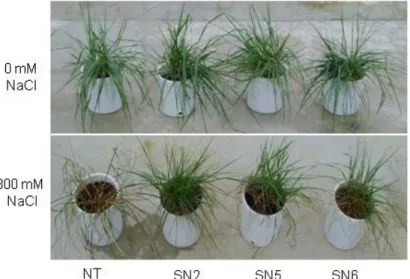
We checked the salt tolerance of the 3 independent transgenic tall fescue lines (SN2, SN5, and SN6) harboring SWPA2::AtNDPK2. No visible morphological differences were observed among the NT and SN plants in normal condition (Fig. 2; upper panel). However, significant differences were observed between the NT and SN plants following an exposure to NaCl treatment. Under the 300 mM NaCl treatment, the leaves of the NT plants became yellow and gradually wilted due to the salt-induced senescence, while the SN plants expressing AtNDPK2 maintained their growth without any visible chlorosis (Fig. 2; lower panel). In addition, the SN plants survived up to 300 mM NaCl, whereas the NT plants were severely affected. These results clearly demonstrate that transgenic plants carrying the AtNDPK2 gene exhibited more salt tolerance than the NT plants.
Fig. 2. Morphological changes of non-transgenic (NT) and transgenic (SN) tall fescue plants at 21 days after treatment of 300 mM NaCl.
Fig. 3. Effect of salt stress treatment on H2O2 (A) and MDA (B) contents in NT and SN plants.
Moreover, salt induced ROS synthesis; as a consequence H2O2 and MDA contents were measured in NT and SN plants.
Under normal condition, no significant variation was observed for H2O2 and MDA contents, while about 1.4- and 1.35-fold higher H2O2 and MDA contents in SN plants, respectively, were exhibited under 300 mM NaCl treatment (Fig. 3). These results indicated that a relatively lower level of ROS was accumulated in SN plants under 300 mM NaCl treatment.
These results clearly suggested that the production of H2O2 and MDA were correlated with the generation of ROS due to the salt stress. The formation of H2O2 and MDA in plants exposed to adverse environmental conditions is a reliable indicator of cellular free-radical generation (Hodges et al., 1999). The low level of H2O2 and MDA in SN lines implies that the degree of membrane damage was lower in SN transgenic plants
compared to NT plants. H2O2 and MDA measurements have also been routinely used in salt-treated plant samples as an indicator of cellular injury and lipid peroxidation due to the salt- induced oxidative stresses (Zhao et al., 2007).
3. Expression of AtNDPK2 mRNA in Transgenic Plants Exposed to NaCl Stress
A Northern blot analysis was used to verify whether the stress-inducible SWPA2 promoter could successfully drive the expression of the AtNDPK2 gene at the mRNA level in salt-stressed transgenic plants. As shown in Fig. 4, AtNDPK2 transcripts were undetectable in transgenic tall fescue plants under normal conditions. However, after 12 h of NaCl treatment, the AtNDPK2 gene was induced at a low level, and
Fig. 4. Salt stress-induced AtNDPK2 gene expression in NT and SN plants under salt stress. Samples were collected at 0 h, 12 h, 24 h and 72 h after 300 mM NaCl treatment. Total RNA from the leaves was transferred onto a nylon membrane and Northern blot analysis was carried by hybridization of AtNDPK2-specific probe.
Fig. 5. NDPK enzyme activity in tall fescue plants after 300 mM NaCl treatment.
it gradually increased after 24 h and 72 h treatments. The level of AtNDPK2 transcripts in the SN2, SN5, and SN6 lines was up-regulated with increasing the durations of NaCl treatment.
This result suggests that the SWPA2 promoter successfully drove the expression of the AtNDPK2 gene under salt stress.
To determine whether the over-expressed AtNDPK2 transcripts were normally translated into its functional proteins with corresponding activity, we further measured the NDPK enzyme activity in soluble extracts from salt stress-treated tall fescue leaves. The SN plants exhibited approximately 1.5-3.0 fold higher NDPK activity than NT plants after 14 days of the salt treatment (Fig. 5). Previous study documented that the SWPA2 promoter is strongly induced by oxidative stresses such as hydrogen peroxide, wounding and UV treatment (Kim et al., 2009; Kim et al., 2011). Compared to the widely used CaMV 35S constitutive promoter, oxidative stress-inducible SWPA2
promoter is more efficient for increasing stress tolerance of plants (Kim et al., 2009). We also found previously that constitutive expression of AtNDPK2 gene driven by CaMV 35S promoter in transgenic tall fescue plants did not show efficient tolerance to abiotic stresses except low level of cold tolerance (Lee et al. 2009). Recently, the expression of AtNDPK2 gene under the control of SWPA2 promoter has been observed enhanced tolerance in transgenic alfalfa under numerous abiotic stresses (Wang et al., 2014). Moreover, the SWPA2-driven AtNDPK transgene expression showed enhanced tolerance to oxidative stress under MV, high temperature, and salt stresses (Tang et al., 2008). These reports indicate that inducible overexpression of AtNDPK2 gene driven by the stress-inducible SWPA2 promoter could be an effective biotechnological strategy to conferring salt tolerance in tall fescue plants.
Ⅳ. CONCLUSIONS
We generated AtNDPK2 transgenic tall fescue plants under the control of the stress-inducible SWPA2 promoter. These transgenic fall fescue plants showed enhanced salt tolerance.
We anticipate that AtNDPK2 mediates salt stress tolerance possibly by regulation of the gene expression involved in antioxidant and defense system. Thus, the progress of studies on tall fescue with abiotic stress tolerance provides genetic information for forage and grass breeding. The transgenic tall fescue plants described in this research would be useful for farming in salt affected areas as well as marginal land.
Ⅴ. ACKNOWLEDGEMENTS
This work was supported by grants from the Next-Generation Bio Green 21 Program (No. PJ008139) of the Rural Development Administration, from Basic Science Research Program through the National Research Foundation of Korea (NRF) funded by the Ministry of Education (NRF-2015R1D1A1A01060495), and from KRIBB Initiative Program. Y.-G. Kim was supported by Post-Doctoral Fellowship from the BK21Plus Program, Ministry of Education, Republic of Korea. Ki-Won Lee, Yong-Goo Kim, and Md. Atikur Rahman contributed equally to this work.
Ⅵ. REFERENCES
Asada, K. 1999. The water–water cycle in chloroplasts: scavenging of active oxygens and dissipation of excess photons. Annual Review of Plant Physiology and Plant Molecular Biology 50:601-639.
Bradford, M.M. 1976. A rapid and sensitive method for the quantitation of microgram quantities of protein utilizing the principle of protein dye binding. Analytical Biochemistry. 72:248-254.
Foyer, C.H., Descourvierse, P. and Kunert, K.J. 1994. Protection against oxygen radicals: an important defense mechanism studied in transgenic plants. Plant Cell Environment 17:507-523.
Hodges, D.M., DeLong, J.M, Forney, C.F. and Prange, R.K. 1999.
Improving the thiobarbituric acid-reactive-substances assay for estimating lipid peroxidation in plant tissues containing anthocyanin and other interfering compounds. Planta. 207:604-611.
Kim, K.Y., Kwon, S.Y., Lee, H.S., Hur, Y., Bang, J.W. and Kwak, S.S.
2003. A novel oxidative stress-inducible peroxidase promoter from
sweetpotato: molecular cloning and characterization in transgenic tobacco plants and cultured cells. Plant Molecular Biology.
51:831-838.
Kim, K.H., Alam, I., Lee, K.W., Sharmin, S.A., Kwak, S.S., Lee, S.Y.
and Lee, B.H. 2010. Enhanced tolerance of transgenic tall fescue plants overexpressing 2-Cys peroxiredoxin against methyl viologen and heat stresses. Biotechnology Letters. 32:571-576.
Kim, K.H., Alam, I., Kim, Y.G., Sharmin, S., Lee, K.W., Lee, S.H. and Lee B.H. 2012. Overexpression of a chloroplast-localized small heat shock protein OsHSP26 confers enhanced tolerance against oxidative and heat stresses in tall fescue. Biotechnology Letters.
34:371-377.
Kim, Y.H., Lim, S., Yang, K.S., Kim, C.Y., Kwon, S.Y., Lee, H.S., Wang, X., Zhou, Z., Ma, D., Yun, D.J. and Kwak, S.S. 2009.
Expression of Arabidopsis NDPK2 increases antioxidant enzyme activities and enhances tolerance to multiple environmental stresses in transgenic sweetpotato plants. Molecular Breeding. 24:233-244.
Kim, M.D., Kim, Y.-H., Kwon, S.-Y., Yun, D.-J. Kwak, S.-S. and Lee, H.-S. 2010. Enhanced tolerance to methyl viologen-induced oxidative stress and high temperature in transgenic potato plants overexpressing the CuZnSOD, APX and NDPK2 genes. Physiologia Plantarum. 140:153-162.
Kim, Y.-H., Kim, M.D., Choi, Y.I., Park, S.-C., Yun, D.-J., Noh, E.W., Lee, H.-S and Kwak, S.-S. 2011. Transgenic poplar expressing Arabidopsis NDPK2 enhances growth as well as oxidative stress tolerance. Plant Biotechnology Journal. 9:334-347.
Lee, S.H., Lee, K.-W., Kim, K. H., Yn, D.-J., Kwak, S.-S. and Lee, B.-H. 2009. Characterization of transgenic tall fescue plants overexpressing NDP Kinase gene in response to cold stress. Journal of the Korean Society of Grassland and Forage Science. 29:299-306.
Lou, Y., Chen, L., Xu, Q. and Zhang, X. 2015. Genotypic variation of morphological traits in tall fescue (Festuca arundinacea Schreb.) accessions. Hortscience. 50:512-516.
Moon, H., Lee, B., Choi, G., Shin, D., Prasad, D.T., Lee, O., Kwak, S.S., Kim, D.H., Nam, J., Bahk, J., Hong, J.C., Lee, S.Y., Cho, M.J., Lim, C.O., and Yun, D.J. 2003. NDP kinase 2 interacts with two oxidative stress-activated MAPKs to regulate cellular redox state and enhances multiple stress tolerance in transgenic plants.
Proceedings of the National Academy of Sciences of the United States of America. 100:358-363.
Murashige, T. and Skoog, F. 1962. A revised medium for rapid growth and bioassay with tobacco tissue cultures. Physiolgia Plantarum.
15:473-497.
Qureshi, M.I., Abdin, M.Z., Ahmad, J. and Iqbal, M. 2013. Effect of long-term salinity on cellular antioxidants, compatible solute and fatty acid profile of Sweet annie (Artemisia annua L.). Phytochemistry. 95:215-223.
Shrivastava, P. and Kumar, R. 2015. Soil salinity: A serious
environmental issue and plant growth promoting bacteria as one of the tools for its alleviation. Saudi Journal of Biological Sciences.
22:123-131.
Tang, L., Kim, M.D., Yang, K.S., Kwon, S.Y., Kim, S.H., Kim, J.S., Yun, D.J., Kwak, S.S. and Lee H.S. 2008. Enhanced tolerance of transgenic potato plants overexpressing nucleoside diphosphate kinase 2 against multiple environmental stresses. Transgenic Research. 17:705-715.
Vineis, P., Chan, Q. and Khan, A. 2011. Climate change impacts on water salinity and health. Journal of Epidemiology and Global Health. 1:5-10.
Wang, Z.-Y. and Ge, Y. 2005. Agrobacterium-mediated high efficiency transformation of tall fescue (Festuca arundinacea). Journal of Plant Physiology. 162:103-113.
Wang, Z., Li, H., Ke, Q., Jeong, J.C., Lee, H.-S., Xu, B., Deng, X.-P.
Lim, Y.P. and Kwak, S.-S. 2014. Transgenic alfalfa plants expressing AtNDPK2 exhibit increased growth and tolerance to abiotic stresses. Plant Physiology and Biochemistry. 84:67-77.
Wu, G.T., Chen, J.Q., Hu, Z.H., Lang, C.X., Chen, X.Y., Wang, F.L., Jin, W. and Xia, Y.W. 2006. Production of transgenic tall fescue plants with enhanced stress tolerances by Agrobacterium tumefaciens-mediated transformation. Agricultural Sciences in China. 5:330-338.
Wu Y.Y., Chen Q.J., Chen M., Chen J. and Wang X.C. 2005.
Salt-tolerant transgenic perennial ryegrass (Lolium perenne L.) obtained by Agrobacterium tumefaciens-mediated transformation of the vacuolar Na+/H+ antiporter gene. Plant Science. 169:65-73.
Yang, K.A., Moon, H.J., Kim, G.T., Lim, C.J., Hong, J.C., Lim, C.O.
and Yun D.J. 2003. NDP kinase 2 regulates expression of antioxidant genes in Arabidopsis. Proceedings of the Japan Academy Series B Physical and Biological Sciences. 79:86-91.
Yuan, F., Leng, B. and Wang, B. 2016. Progress in studying salt secretion from the salt glands in recretohalophytes: How do plants secrete salt? Frontiers in Plant Science. 7: https://doi.org/10.3389/fpls.2016.
00977.
Zhang H. X. and Blumwald, E. 2001. Transgenic salt-tolerant tomato plants accumulate salt in foliage but not in fruit. Nature Biotechnology. 19:765-768.
Zhao, J., Zhi, D., Xue, Z., Liu, H. and Xia, G. 2007. Enhanced salt tolerance of transgenic progeny of tall fescue (Festuca arundinacea) expressing a vacuolar Na+/H+ antiporter gene from Arabidopsis. Journal of Plant Physiology. 164:1377-1383.
(Received : August 25, 2017 | Revised : September 11, 2017 | Accepted : September 11, 2017)