* Corresponding author
Phone: +82-51-510-2837, Fax: +82-51-583-3648 E-mail: [email protected]
해조류 추출물 및 활성성분의 라디칼 소거능
소미정․조은주*
부산대학교 식품영양학과
Radical Scavenging Effect of Methanol Extracts from Seaweeds and Their Active Compounds. Mi Jung So and Eun Ju Cho*. Dept. of Food Science and Nutrition,
Pusan National University, Busan 609-735, Korea
Abstract
The radical scavenging activity of methanol extracts of seaweeds and their active com- pounds, alginic acid, fucoidan and phloroglucinol, were investigated under in vitro. Among meth- anol extracts of seaweeds (sea mustard, sea tangle, seaweed papulosa, fusiforme, sea lettuce, purple laver and chlorella), seaweed papulosa and sea tangle showed strong scavenging activities of 1,1-di- phenyl-2-picrylhydrazyl (DPPH) radical and hydroxyl radical (․OH). In addition, under in vitro, the scavenging activities on DPPH radical of alginic acid and fucoidan, which are active com- pounds of brown algae, and phloroglucinol, the active compound from Ecklonia species, were evaluated and compared. Fucoidan and phloroglucinol showed strong DPPH scavenging effect, in particular, phloroglucinol had strongest activity among the active compounds. On the other hand, alginic acid did not exert DPPH scavenging activity. From the present study, we could confirm the antioxidative activity of seaweeds and its active compounds.Key words : Seaweeds, antioxidative activity, radical scavenging, DPPH, active compounds
서 론
해조류는 우리나라를 비롯한 극동아시아 지역에 서 식용되고 있으며, 세계 8대 해양국의 하나인 우리 나라는 삼면이 바다로 둘러싸인 국지적 여건으로 인 하여 매년 60만 톤 이상의 해조류가 생산되고 있는 데, 주요 해조 자원으로는 김, 우뭇가사리 등의 홍조 류, 미역, 다시마, 톳 등의 갈조류 및 파래와 같은 녹조류 등이다. 이러한 해조류는 40~65%의 탄수화 물을 함유하고 있으며, 비타민과 무기질 등의 미량 성분들이 균형 있게 분포되어 있을 뿐만 아니라 육 상식물과는 다른 독특한 구조를 갖고 있어서 해조류 로부터의 다양한 생리활성물질에 관한 연구에 관심 이 높아지고 있다. 특히 최근의 여러 연구에 의하면 미역, 톳, 모자반, 다시마, 곰피, 감태 등과 같은 갈조 류의 생리활성으로 항혈관 형성, 항비만, 항산화, 항 염증, 항고콜레스테롤 효과 등이 보고되고 있다 [4,
15,16,22,23].
이와 더불어 해조류에 다량으로 함유되어 있는 점 질성 다당류들은 그 특성이 독특하여 생리활성이 강 한 물질로 알려져 있으며, 갈조류의 산성 다당이 나 타내는 다양한 생리활성에 대한 관심도 높아지고 있 다. Alginic acid는 β-D-mannuronic acid와 α-L-gulur- onic acid가 α-1,4결합 또는 β-1,4 결합한 hetero형 직 쇄 다당류로서 혈당 저하효과, 항비만 효과, 고지혈 증 예방 및 항돌연변이 효과가 보고되었으며 [1,14], fucoidan은 L-fucose와 황산에스테르가 주요 구성성 분으로 황산기를 많이 함유하고 있고, 항바이러스 효과, 항산화 효과, 항염증 효과, 항혈액 응고 작용 등이 알려져 있다 [12,21]. 또한 미역과에 속하는 갈 조류인 곰피나 감태 (Ecklonia species)의 활성성분인 phloroglucinol은 항돌연변이 활성 및 라디칼 소거효 과 등이 있는 것으로 보고되어 그 기능성이 주목받 고 있다 [9].
본 연구에서는 해조류 추출물의 in vitro에서의 라 디칼 소거능을 살펴보았고, 이 결과를 바탕으로 해 조류의 활성성분인 alginic acid, fucoidan 및 phlor- oglucinol의 in vitro에서의 라디칼 소거능을 비교 검 토하였다.
재료 및 방법 시료
미역, 다시마, 곰피, 톳, 파래 및 김은 부산 기장시 장에서 구입하였고, 클로렐라는 (주) 대상의 분말제 품을 구입하여 사용하였다. 실험을 위한 해조류 활 성 성분인 sodium alginate, fucoidan 및 phloroglucinol 은 Sigma Chemical Co. (U.S.A)에서 구입하여 사용하 였다.
해조류의 메탄올 추출물 제조
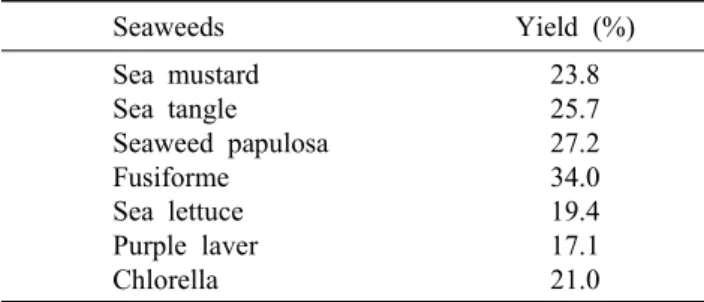
동결 건조시킨 재료를 시료 중량의 20배의 meth- anol (MeOH)로 12시간 추출하였고 동일한 과정을 3번 반복하여 추출물을 모은 후 회전식 진공 농축기 를 이용하여 농축하였다. 농축물은 -80℃의 냉동고 에 보관하면서 실험에 사용하였다. 메탄올 추출물의 수율은 Table 1과 같았다.
1,1-Diphenyl-2-picrylgydrazyl (DPPH) 소 거 효과
농도별로 ethanol (EtOH)에 녹인 시료 100 ㎕와 60 μM DPPH 용액 100 ㎕를 96-well plate에 혼합하여 30분간 실온에 방치시킨 후, 540 nm에서 흡광도를 측정하였다. 시료를 첨가하지 않은 대조군과 비교하 여 free radical 소거효과를 백분율 (%)과 IC50 (DPPH radical 생성을 50%로 억제하는데 필요로 하는 샘플 농도)로 나타내었다 (Hatano, 1989).
Table 1. Yield of MeOH extracts from seaweeds
Seaweeds Yield (%)
Sea mustard Sea tangle Seaweed papulosa Fusiforme Sea lettuce Purple laver Chlorella
23.8 25.7 27.2 34.0 19.4 17.1 21.0
․OH 소거 효과
Fenton 반응에 따라 10 mM FeSO4․7H2O-EDTA 에 10 mM의 2-deoxyribose solution과 농도별 시료용 액을 혼합한 다음, 10 mM의 H2O2를 첨가하여 37℃ 에서 4시간 동안 배양한다. 이 혼합액에 2.8% tri- chloroacetic acid와 1.0% thiobarbituric acid solution을 각각 첨가하여 10분간 boiling한 후 cooling하여 520 nm에서 흡광도를 측정하였다 (Chung et al., 1997).
통계처리
실험결과는 평균±표준편차 (n=5)로 나타내었고, 대조군과 실험군의 실험결과는 one way ANONA로 검증한 후 Duncan's multiple range test로 유의수준 α=0.05에서 유의성을 검증하였다.
결과 및 고찰
DPPH radical 소거 효과
DPPH radical 소거활성법은 시료의 free radical 소 거 능력이나 수소 공여능력을 평가하는 방법으로서 식품을 비롯한 여러 분야에서 널리 이용되고 있다.
해조류 MeOH 추출물의 항산화 활성을 알아보기 위 해 DPPH radical 소거 효과를 IC
50
로 비교해 본 결과, 곰피 15.87 ㎍/㎖, 다시마 33.33 ㎍/㎖, 파래 160.76㎍/㎖, 클로렐라 215.54 ㎍/㎖, 미역 294.18 ㎍/㎖, 김 357.08 ㎍/㎖, 톳 401.30 ㎍/㎖로서 특히 곰피와 다시 마의 DPPH radical 소거 효과가 우수한 것으로 나타 났다 (Fig. 1). 보고에 따르면, 한국산 5종 해조류의
항산화효과를 측정한 결과 DPPH radical 소거에서 다시마가 미역에 비하여 훨씬 우수한 효과를 나타내
0 50 100 150 200 250 300 350 400 450
Fusiforme Purple laver Sea mustard Chlorella Sea lettuce Sea tangle Seaweed papulosa
IC50 (㎍/㎖)
Fig. 1. DPPH scavenging activity of MeOH extracts from
seaweeds.었고, 톳과 미역은 항산화 효과가 거의 없었다고 하 였으며 [18] 이는 본 연구의 결과와 동일하였다. 또 한 해조류 메탄올 가용성 분획의 항산화효과를 보고 한 연구에서 갈조류인 곰피가 홍조류인 김이나 녹조 류와 비교할 때 DPPH를 이용한 전자공여능 평가에 서 우수한 항산화 효과를 보였다 [10]. 보고에 따르 면 해조류의 환원력 및 DPPH 라디칼 소거 활성에서 도 갈조류 중에서도 특히 Ecklonia 속의 곰피가 뛰어 난 활성을 나타내었으며 [18], 이러한 결과들을 통해 곰피의 우수한 항산화 활성을 확인해 볼 수 있었다.
․OH 소거 효과
․OH은 산소 라디칼 중에서 가장 반응성이 높고 인접한 생체 분자에 심각한 손상을 야기하는 것으로 알려져 있다. Macrophages와 leukocytes의 phagocytosis 또한 ․OH이 원인이 되며, 이러한 ․OH는 Fenton 반 응에 의해 O2-와 H2O2로부터 생성되며, 활성질소종 인 ONOO-의 분해에 의해 생성되기도 한다 [2].
해조류 메탄올 추출물의 ․OH 소거 효과를 살펴 보면, 1,000 ㎍/㎖에서 파래 104.09%, 곰피 83.72%, 다시마 77.83%, 김 76.19%, 미역 43.96%, 톳 31.72%, 클로렐라 22.46%의 소거능을 보였으며, 그 중에서 파래, 곰피, 다시마, 김 및 미역은 농도의존적인 ․ OH 소거 효과를 나타내었다 (Fig. 2). 앞서 살펴본 DPPH radical 소거능과 함께 고려해 볼 때, 곰피와 다시마가 in vitro에서 프리 라디칼 소거에 의한 항산 화 효과가 우수한 것으로 나타났다. 이러한 곰피와 다시마의 항산화 활성에 대한 보고에서 김 등은 free radical의 생성계에 관여하는 xanthine oxidase에 대한 해조류 추출물의 효과를 알아본 연구를 통해
g h
g h
k
j j
d
e e
e
j h
i a
b
c d
f h
i
0 25 50 75 100 125
Sea lettuce Seaweed papulosa
Sea tangle Purple laver Sea mustard Fusiforme Chlorella
·OH scavenging activity (%) .
250 (㎍/㎖) 500 (㎍/㎖) 1000 (㎍/㎖)
Fig. 2. Hydroxyl radical scavenging activity of MeOH ex-
tracts from seaweeds. a-kMeans with the different letters are significantly different (p<0.05) by Duncan's multiple range test.Ecklonia속의 감태 및 곰피가 가장 높은 저해 효과를 보였다고 한다 [11]. 또한 해조류에 의한 아질산염 소거활성 분석에서 갈조류 중에서도 특히 곰피가 우 수한 아질산염 분해효과를 나타내었는데 이는 Ecklonia 속의 갈조류에 존재하는 phlorotannin 형태 의 eckol 화합물 및 phloroglucinol과 같은 free hy- droxy group을 갖는 페놀성 화합물에 의한 작용으로 보았다 [18]. 이러한 연구결과로부터 독성이 강한 ․ OH 라디칼에 대해 해조류는 우수한 소거능을 나타 냄을 확인할 수 있었다.
Alginic acid, fucoidan 및 phloroglucinol의 DPPH 소거효과
해조류의 항산화 활성을 in vitro에서 검토한 결과 특히 곰피와 다시마가 우수한 활성을 가지는 것으로 나타났다. 이를 토대로 다시마와 미역 등의 갈조류 에 풍부한 성분으로 다양한 생리활성이 보고된 al- ginic acid와 fucoidan 그리고 곰피의 활성성분으로서 최근 기능성이 주목받고 있는 phloroglucinol을 선정 하였고, 이들 해조류 활성성분의 항산화 효과를 검 토하였다. 갈조류의 다당류 함량은 건물 기준으로 약 30~67% 정도를 차지하며 이 중 alginic acid가 60~80%이고 이외에도 fucoidan 및 중성다당인 lami- naran 등으로 구성되어 있다. 또한 곰피의 생리활성 물질로 phloroglucinol unit로 구성되어진 oligomeric compounds인 phlorotannin 성분이 확인되었는데, 이 들 oligomer 중에 free hydroxy group을 갖는 phlor- oglucinol, eckol, triphlorethol-A, phlorofucofuroeckol, 6,6'-bieckol, 및 dieckol 등이 포함되어 있다 [5,6,7,17].
특히 phloroglucinol의 경우 Kang 등에 따르면 cellular catalase activity 증가와 extracellular signal-related kin- ase signal pathway 조절을 통해 산화적 손상에 대한 세포보호 효과를 나타내며 [8], 또한 발암 과정 중 promotion 과정에 대한 억제작용이 높은 것으로 보 고되었다 [19].
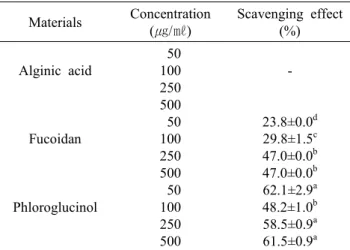
본 연구에서는 해조류 활성성분인 alginic acid, fu- coidan 및 phloroglucinol의 DPPH radical 소거 효과를 살펴 본 결과, alginic acid는 활성을 나타내지 않았고 fucoidan과 phloroglucinol은 500 ㎍/㎖의 농도에서 각 각 47.0%와 61.5%로 phloroglucinol이 가장 높은 DPPH radical 소거 효과를 보였다 (Table 2). 갈조류 에서 추출한 폴리페놀성 물질인 phlorotannin, bieckol,
Table 2. DPPH scavenging activity of alginic acid, fucoidan
and phloroglucinolMaterials Concentration (㎍/㎖)
Scavenging effect (%)
Alginic acid
Fucoidan
Phloroglucinol
50 100 250 500 50 100 250 500 50 100 250 500
-
23.8±0.0d 29.8±1.5c 47.0±0.0b 47.0±0.0b 62.1±2.9a 48.2±1.0b 58.5±0.9a 61.5±0.9a Values are mean ± SD.
a-dMeans with the different letters are significantly different (p<0.05) by Duncan's multiple range test.
dieckol 및 phlorofurofukoeckol에 대한 항산화 효과 연구에서도 ferric reducing antioxidant power assay와 DPPH radical 소거능을 측정한 결과, 잘 알려진 항산 화제인 catechin, tocopherol, BHA 및 BHT 보다 더 우수한 free radical 소거 효과를 보여 이러한 갈조류 의 phlorotannins 성분의 뛰어난 항산화 활성을 확인 할 수 있다 [6,7]. 본 연구결과에서도 해조류의 활성 성분 중 특히 phloroglucinol의 DPPH 라디칼 소거능 이 우수한 것으로 관찰되었다.
참 고 문 헌
1. Cho, E. J., Rhee, S. H., and Park, K. Y. 1998.
Antimutagenic and anticarcinogenic effects of alginic acid extracted from sporophyll of sea mustard. J. Food
Sci. Nutr. 3, 169-174.
2. Chung, S. K., Osawa, T., and Kawakishi, S. 1997.
Hydroxyl radical-scavenging effects of spices and scav- engers from brown mustard (Brassica nigra). J. Biosci.
Biotech. Biochem. 61, 118-123.
3. Hatano, T., Edamatsu, R., Hiramatsu, M., Mori, A., Fujita, Y., Yasuhara, T., Yoshida, T., and Okuda, T.
1989. Effects of the interaction of tannins with co-exist- ing substances, Ⅵ. Effects of tannins and related poly- phenols on superoxide anion radical, and on 1,1-di- phenyl-2-picrylhydrazyl radical. Chem. Pharm. Bull. 37, 2016-2021.
4. Jung, B. M., Ahn, C. B., Kang, S. J., Park, J. H., and Chung, D. H. 2001. Effects of Hijikia fusiforme extracts on lipid metabolism and liver antioxidative enzyme activ- ities in Triton-induced hyperlipidemic rats. J. Kor. Soc.
Food Sci. Nutr. 30, 1184-1189.
5. Kang, K. A., Lee, K. H., Chae, S. W., Zhang, R., Jung, M. S., Ham, Y. M., Baik, J. S., Lee, N. H., and Hyun, J.W. 2006. Cytoprotective effect of phloroglucinol on ox- idative stress induced cell damage via catalase activation.
J. Cell. Biochem. 97, 609-620.
6. Kang, K. J., Park, Y. G., Hwang, H. J., Kim, S. H., Lee, J. G., and Shin, H. C. 2003. Antioxidative properties of brown algae polyphenolics and their perspectives as che- mopreventive agents against vascular risk factors. Arch.
Pharm. Res. 26, 286-293.
7. Kang, H. S., Chung, H. Y., Jung, J. H., Son, B. W., and Choi, J. S. 2003. A new phlorotannin from the brown alga Ecklonia stolonifera. Chem. Pharm. Bull. 51, 1012-1014.
8. Kang, K. A., Lee, K. H., Chae, S. W., Zhang, Rui, Jung, M. S., Lee, Y., Kim, S. Y., Kim, H. S., Joo, H. G., Park, J. W., Ham, Y. M., Lee, N. H., and Hyun, J. W. 2005.
Eckol isolated from Ecklonia cava attenuates oxidative stress induced cell damage in lung fibroblast cells. FEBS
Lett. 579, 6295-6304.
9. Kang, K. A., Lee, K. H., Chae, S. W., Zhang, R., Jung, M. S., Ham, Y. M., Baik, J. S., Lee, N. H., and Hyun, J. W. 2006. Cytoprotective effect of phloroglucinol on oxidative stress induced cell damage via catalase activation. J. Cell. Biochem. 97, 609-620.
10. Kim, B. M., Jun, J. Y., Park, Y. B., and Jeong, I. H.
2006. Antioxidative activity of methanolic extracts from seaweeds. J. Kor. Soc. Food Sci. Nutr. 35, 1097-1101.
11. Kim, O. K., Lee, T. G., Park, Y. B., Park, D. C., Lee, Y. W., Yeo, S. G., Kim, I. S., Park, Y. H., and Kim, S. B. 1996. Inhibition of xanthine oxidase by seaweed extracts. J. Kor. Soc. Food Sci. Nutr. 25, 1069-1073.
12. Kuznetsova, T. A., Besednova, N. N., Mamaey, A. N., Momot, A. P., Shevchenko, N. M., and Zvyagintseva, T. N. 2003. Anticoagulant activity of fucoidan from brown algae Fucus evanescens of the Okhotsk sea. Bull.
Exp. Biol. Med. 5, 471-473.
13. Kwak, C. S., Kim, S. A., and Lee, M. S. 2005. The corre- lation of antioxidative effects of 5 Korean common edible seaweeds and total polyphenol content. J. Kor. Soc. Food
Sci. Nutr. 34, 1143-1150.
14. Lee, D. S., Nam, T. J., and Pyeun, J. H. 1998. Effect of low molecular alginates on cholesterol levels and fatty acid compositions of serum and liver lipids in cholester- ol-fed. J. Kor. Fish. Soc. 31, 399-408.
15. Lim, S. N., Cheung, P. C. K., Ooi, V. E. C., and Ang, P. O. 2002. Evaluation of antioxidative activity of ex- tracts from a brown seaweed, Sargassum siliquastrum.
J. Agric. Food Chem. 50, 3862-3866.
16. Maeda, H., Hosokawa, M., Sashima, T., Funayama, K., and Miyashita, K. 2005. Fucoxanthin from edible sea- weed, Undaria pinnatifida, shows antiobesity effect through UCP1 expression in white adipose tissues.
Biochem. Biophys. Res. Commun. 332, 392-397.
17. Nagayama, K., Iwamura, Y., Shibata, T., Hirayama, I., and Nakamura, T. 2002. Bactericidal activity of phlor- otannins from the brown alga Ecklonia kurome. J.
Antimicrob. Chemother. 50, 889-893.
18. Park, Y. B. 2005. Determination of nitrite-scavenging ac- tivity of seaweed. J. Kor. Soc. Food Sci. Nutr. 34, 1293-1296.
19. Park, Y. B., Kim, I. S., Yoo, S. J., Ahn, J. K., Lee, T.
G., Park, D. C., and Kim, S. B. 1998. Elucidation of anti-tumor initiator and promoter derived from sea- weed-3: anti-tumor promoters of Ecklonia stolonifera extracts. J. Kor. Fish. Soc. 31, 587-593.
20. Park, M. J. and Han, J. S. 2006. Radical scavenging and antioxidant activities of fermented Laminaria japonica extracts. J. Food Sci. Nutr. 11, 10-16.
21. Ponce, N. M. A., Pujol, C. A., Damonte, E. B., Flores,
M. L., and Stortz, C. A. 2003. Fucoidans from brown seaweed Adenocystis utricularis: extraction methods, an- tiviral activity and structural studies. Carbohydrate Res.
338, 153-165.
22. Shin, H. C., Hwang, H. J., Kang, K. J., and Lee, B. H.
2006. An antioxidative and antiinflammatory agent for potential treatment osteoarthritis from Ecklonia cava.
Arch. Pharm. Res. 29, 165-171.
23. Sugawara, T., Matsubara, K., Akgi, R., Mori, M., and Hirata, T. 2006. Antiangiogenic activity of brown algae fucoxanthin and its deacetylated product, fucoxanthinol.