ABSTRACT
Background and Objectives: There are limited data on the use of non-vitamin K antagonist oral anticoagulants (NOACs) in atrial fibrillation (AF) patients with cancer. We aimed to assess the efficacy and safety of NOACs in AF patients with cancer in this study.
Methods: In 2,568 consecutive non-valvular AF patients with newly diagnosed cancer, we analyzed ischemic stroke/systemic embolism (SE), major bleeding, and all-cause death.
Based on propensity score matching, 388 matched pairs were included in the NOAC and warfarin groups.
Results: Patient baseline characteristics were comparable between the matched groups.
During median follow-up of 1.8 years, the NOAC group had significantly lower incidences of ischemic stroke/SE (p<0.001), major bleeding (p<0.001), and all-cause death (p<0.001) than the warfarin group. Moreover, the incidence of major bleeding was significantly lower in the NOAC group than in the warfarin group with optimal international normalized ratio control (p=0.03). Especially, within 1 year after cancer diagnosis, the incidences of all clinical events were significantly lower in the NOAC group than in the warfarin group.
Conclusions: In AF patients with newly diagnosed cancer, NOACs showed lower incidences of ischemic stroke/SE, major bleeding, and all-cause death than warfarin, especially within 1 year after cancer diagnosis.
Keywords: Atrial fibrillation; Hemorrhage; Neoplasms; Stroke; Anticoagulants
INTRODUCTION
Atrial fibrillation (AF) is the most common sustained cardiac arrhythmia, occurring in 1–2%
of the general population.1) AF is associated with a 5-fold increase in the stroke risk, and 1 in 5 cases of stroke is attributed to this arrhythmia.2) Multiple clinical trials have demonstrated the superior therapeutic effect of warfarin compared to that of placebo in the prevention of thromboembolic events among patients with non-valvular AF.3) However, AF patients with comorbidities have a concomitant risk of fatal bleeding, and therefore, clinicians might be reluctant to use vitamin K antagonists (VKAs) despite a high stroke risk.4)5) AF is common in patients with life-threatening cancer and those undergoing active cancer treatments.6)
Original Article
Received: Oct 25, 2017 Revised: Jan 26, 2018 Accepted: Jan 31, 2018 Correspondence to Boyoung Joung, MD, PhD
Division of Cardiology, Department of Internal Medicine, Severance Cardiovascular Hospital, Yonsei University College of Medicine, 50-1, Yonsei-ro, Seodaemun-gu, Seoul 03722, Korea.
E-mail: [email protected]
Copyright © 2018. The Korean Society of Cardiology
This is an Open Access article distributed under the terms of the Creative Commons Attribution Non-Commercial License (https://
creativecommons.org/licenses/by-nc/4.0) which permits unrestricted noncommercial use, distribution, and reproduction in any medium, provided the original work is properly cited.
ORCID iDs Kyu Kim
https://orcid.org/0000-0003-3573-041X Yong-Joon Lee
https://orcid.org/0000-0002-5308-9120 Tae-Hoon Kim
https://orcid.org/0000-0002-4032-1285 Jae-Sun Uhm
https://orcid.org/0000-0002-1611-8172 Hui-Nam Pak
https://orcid.org/0000-0002-3256-3620 Moon-Hyoung Lee
https://orcid.org/0000-0002-7268-0741 Boyoung Joung
https://orcid.org/0000-0001-9036-7225
Kyu Kim , MD, Yong-Joon Lee , MD, Tae-Hoon Kim , MD, Jae-Sun Uhm , MD, Hui-Nam Pak , MD, PhD, Moon-Hyoung Lee , MD, PhD, and
Boyoung Joung , MD, PhD
Division of Cardiology, Department of Internal Medicine, Severance Cardiovascular Hospital, Yonsei University College of Medicine, Seoul, Korea
Effect of Non-vitamin K Antagonist Oral Anticoagulants in Atrial
Fibrillation Patients with Newly
Diagnosed Cancer
Funding
This study was supported by a CMB-Yuhan research grant from Yonsei University College of Medicine (6-2015-0173), the research grants from the Basic Science Research Program through the National Research Foundation of Korea funded by the Ministry of Education, Science and Technology (NRF-2017R1A2B3003303), and the Korean Healthcare Technology R&D project funded by the Ministry of Health and Welfare (HI16C0058, HI15C1200).
Conflict of Interest
The authors have no financial conflicts of interest.
Author Contributions
Conceptualization: Joung B, Kim TH, Uhm JS, Pak HN, Lee MH; Data curation: Joung B, Kim K, Lee YJ; Funding acquisition: Joung B;
Investigation: Joung B, Kim K; Methodology:
Joung B, Lee YJ; Project administration: Joung B; Supervision: Pak HN, Lee MH; Validation:
Joung B, Kim K, Kim TH, Uhm JS; Visualization:
Joung B, Kim K; Writing - original draft: Joung B, Kim K; Writing - review & editing: Joung B, Kim K, Kim TH, Uhm JS, Pak HN, Lee MH.
Several studies have suggested that the association between cancer and AF is not limited to the postoperative period.7)8) Despite the excellent effects of VKAs in the prevention of thromboembolisms, VKAs might result in an elevated bleeding risk in patients with cancer and a history of non-valvular AF because of poor international normalized ratio (INR) control.5)9) Moreover, it is difficult to achieve therapeutic drug levels in cancer patients owing to the risk of drug interactions, malnutrition, and vomiting in these patients.5)
Non-vitamin K antagonist oral anticoagulants (NOACs) are a new additional option for stroke prevention in AF patients, which are considered at least as effective and safe as VKAs.10) NOACs have a wide therapeutic window, low inter- and intra-individual variability, and no clear interactions with food, and there is no need for frequent laboratory monitoring and dose adjustments.10-12) However, there are little controlled data on the use of NOACs in AF patients with cancer, and active cancer was usually an exclusion criterion in randomized NOAC trials.13) We hypothesized that NOAC administration would result in favorable clinical outcomes in AF patients with newly diagnosed cancer. The aim of this study was to evaluate the safety and efficacy of NOACs in AF patients with cancer by comparing the findings with those for patients receiving NOACs and warfarin. Additionally, we evaluated the clinical outcomes according to time of cancer diagnosis, and dosage and types of NOACs in this study.
METHODS
Patients
The study protocol was approved by the Institutional Review Board of Severance Cardiovascular Hospital, Seoul, Korea (4-2016-0105) and complied with the Declaration of Helsinki. No informed consent was required for study populations. Between November 2005 and June 2015, we identified 2,568 consecutive patients with non-valvular AF who were newly diagnosed with cancer in Yonsei University Severance Hospital. The study subjects were followed up until they developed an event or until the last follow-up date whichever came first. Patients who were not prescribed any oral anticoagulants (OACs; n=867), those who underwent radiofrequency catheter ablation or cardioversion (n=5), and those who had insufficient clinical data (n=45) were excluded. Finally, we enrolled 1,651 patients in this study. The patients were divided into the following 2 groups according to treatment: NOAC group (n=572) and warfarin group (n=1,079; Figure 1).
AF was documented using 12-lead electrocardiography or 24-hour Holter recordings. The patients' medical records were reviewed. The patient databases were searched to identify any known or putative risk factors for ischemic stroke.14) Heart failure was considered when hospitalized patients had appropriate symptoms (shortness of breath, fatigue, fluid retention, or any combination of these symptoms) and clinical signs of fluid retention (pulmonary or peripheral) with explainable abnormalities of the cardiac structure and function.15) The congestive heart failure, hypertension, age ≥75 years (doubled), diabetes mellitus, previous stroke or transient ischemic attack (doubled), vascular disease, age 65–74 years, and gender category (female) (CHA2DS2-VASc) and hypertension, abnormal renal/liver function, stroke, bleeding history or predisposition, labile INR, elderly (age >65 years), drugs/alcohol concomitantly (HAS-BLED) scores were evaluated. Bleeding history was defined as follows: Intracranial, hospitalization, hemoglobin decrease >2 g/L, and/
or transfusion. Drugs/alcohol concomitantly was defined as concurrent use of antiplatelet agents (include aspirin, clopidogrel, cilostazol, prasugrel, or ticagrelor), nonsteroidal
anti-inflammatory drugs; one point for drugs plus one point for alcohol excess, maximum 2 points.16) Renal insufficiency was considered when serum creatinine was >2 mg/dL, and abnormal liver function was considered when cirrhosis, bilirubin >2 times the upper limit of normal (ULN), or aspartate aminotransferase/alanine transaminase/alkaline phosphatase
>3 times the ULN was noted. Dialysis patients and cirrhosis patients were excluded owing to the indication of NOAC. Mean INR values and time in therapeutic range (TTR) of INR 2.0–3.0 were calculated using the linear interpolation methods proposed by Rosendaal et al.17) The percentage of time during which a patient had an INR within 2.0 to 3.0 was taken as the TTR. According to the center's protocol, INR was measured every 8–12 weeks and more frequently when it was not within the therapeutic range. The full doses of NOAC were defined as 150 mg twice for dabigatran, 5 mg twice for apixaban, and 20 mg once for rivaroxaban.
The indication of the reduced dose followed the current guideline (dabigatran 110 mg twice a day if patients are aged ≥80 or have an estimated glomerular filtration rate [eGFR] of 30–50 mL/min; rivaroxaban 15 mg once a day if eGFR is 15–49 mL/min; apixaban 2.5 mg twice a day if 2 of the 3 following criteria are present: age ≥80 or serum creatinine ≥1.5 mg/dL or body weight ≤60 kg).10) eGFR was calculated by Cockroft-gault equation.18) Doses not listed above (apixaban 2.5 mg once or rivaroxaban 10 mg once, etc.) were excluded as off-label dose.
Follow-up
The follow-up period was defined as the period from the date of cancer diagnosis to the date of an event or the date of the last visit if an event did not occur. We also set the study endpoint as the point when the first anticoagulation strategy was stopped or changed, according to on- treatment analysis. We evaluated ischemic stroke/systemic embolism (SE), major bleeding, and all-cause death during the follow-up. Ischemic stroke was defined as a neurological deficit with a sudden onset that persisted for >24 hours corresponding to a vascular territory
Patients with a history of non-valvular AF who has been diagnosed newly developed cancer
during 1 November, 2005 through 30 June, 2016 (n=2,568)
NOAC
(n=572) Warfarin
(n=1,079)
1:1 propensity score matching (n=776) Excluded (n=917)
-Did not use oral anticoagulants (n=867) -Insufficient clinical data (n=32)
-Who underwent RFCA or cardioversion (n=5) -End-stage renal disease (n=5)
-Liver cirrhosis (n=4) -Off-label NOAC dose (n=4)
NOAC
(n=388) Warfarin
(n=388) Figure 1. Flowchart of patients participating in this study.
AF = atrial fibrillation; NOAC = non-vitamin K antagonist oral anticoagulant; RFCA = radiofrequency catheter ablation.
in the absence of primary hemorrhage and was not explained by other causes, including trauma, infection, and vasculitis.19) Major bleeding was defined according to the definition by the International Society on Thrombosis and Haemostasis.20) When a patient experienced both ischemic stroke/SE and major bleeding during the follow-up period, each event was counted separately. However, when analyzing the Kaplan-Meier cumulative incidence rate, we considered the first event only.
Statistical analysis
Normally distributed continuous variables are presented as mean±standard deviation, and compared using Student's t-test for parametric data and the Mann-Whitney U test for nonparametric data. Categorical variables are presented as number (percentage), and compared using the χ2 test or Fisher's exact test.
To reduce the effect of selection bias and potential confounding cohort study, estimated propensity scores (PSs) were used to match the patients who received NOACs to patients who received warfarin. PSs were estimated using a non-parsimonious multiple logistic regression model for the NOAC and warfarin groups. The following variables were considered: age, sex, hypertension, diabetes mellitus, heart failure, chronic kidney disease, history of stroke or transient ischemic attack, history of myocardial infarction or peripheral vascular disease, history of hemorrhage, concomitant antiplatelet, type of cancer, rate of metastatic cancer, and follow-up duration. Cases were then matched, without replacement, with controls 1:1 based on the closest possible value of the PS (nearest neighbor matching). We evaluated the balance between treatment populations according to standardized differences of all baseline covariates, using a threshold of 0.1 to indicate imbalance.21) A matching caliper of 0.2 standard deviations of the logit of the estimated PS was enforced to ensure that matches of poor fit were excluded. The matching procedure was performed using R packages (R Foundation, Vienna, Austria). Based on PS matching, 388 matched pairs were included in the NOAC and warfarin groups. Kaplan-Meier curves for cumulative incidence rate were plotted for the NOAC and warfarin groups and were compared using the log-rank test. All statistical analyses were performed using R version 3.1.1 (http://www.r-project.org/). A p value <0.05 was considered statistically significant.
RESULTS
Patient characteristics
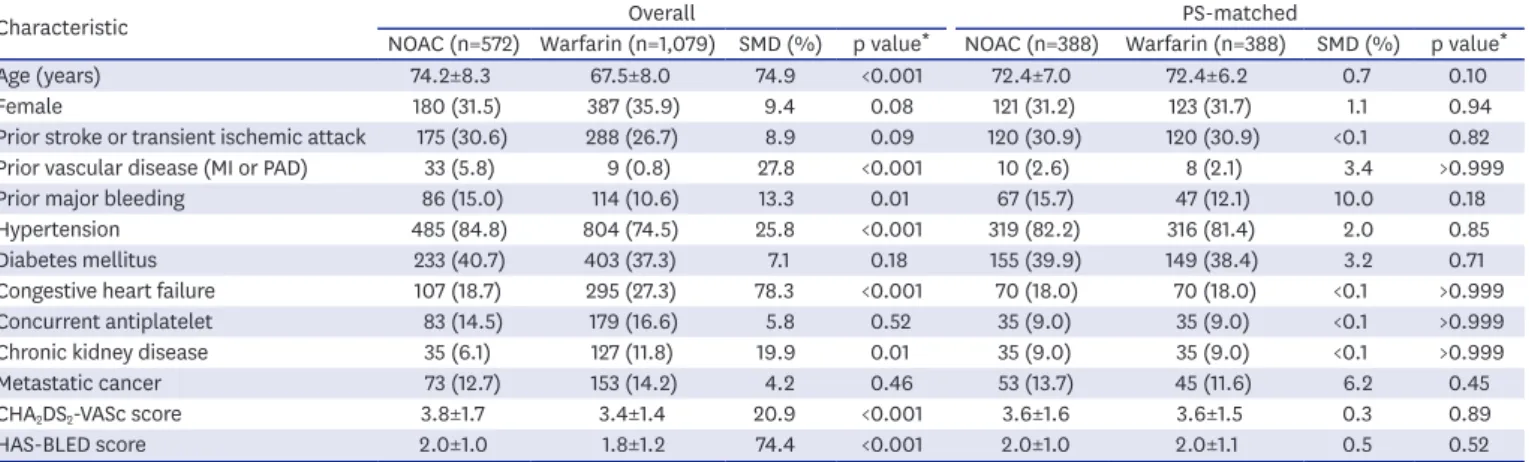
The overall clinical characteristics of the patients are presented in Table 1. The patient age was greater in the NOAC group than in the warfarin group (74.2±8.3 vs. 67.5±8.0 years, p<0.001). The prevalence of hypertension, diabetes, congestive heart failure, stroke/
transient ischemic attacks, and major bleeding was higher in the NOAC group than in the warfarin group (all p<0.001). Additionally, the CHA2DS2-VASc and HAS-BLED scores were higher in the NOAC group than in the warfarin group (CHA2DS2-VASc: 3.8±1.7 vs. 3.4±1.4, p<0.001; HAS-BLED: 2.0±1.0 vs. 1.8±1.2, p<0.001). Stomach cancer was the most common malignancy, followed by colorectal cancer (Supplementary Table 1). There was no patient who was prescribed concomitant dual antiplatelet agents with OACs. After PS matching, the baseline characteristics were well matched between the NOAC and warfarin groups.
The median follow-up duration was comparable between the NOAC and warfarin groups (1.8 vs. 1.7 years, p=0.593). Baseline characteristics of patient without OAC was shown in Supplementary Table 2.
Comparison between the NOAC and warfarin groups
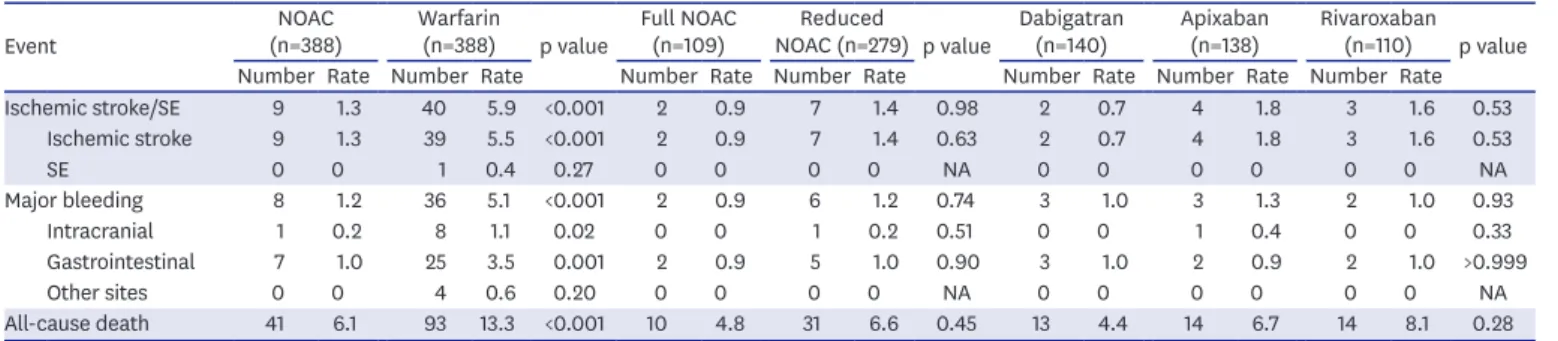
During the median follow-up period of 1.8 years, the cumulative incidence rates of ischemic stroke/SE, major bleeding, and all-cause death were lower in the NOAC group than in the PS-matched warfarin group (Figure 2). The rates of ischemic stroke/SE, major bleeding, and all-cause death in the matched population are presented in Table 2. The rates of ischemic stroke/SE (1.3% vs. 5.9%/year, p<0.001), major bleeding (1.2% vs. 5.1%/year, p<0.001), and all-cause death (6.1% vs. 13.3%/year, p<0.001) were lower in the NOAC group than in the PS-matched warfarin group. With regard to ischemic stroke, the incidence rate was 1.3%/
year in the NOAC group and 5.5%/year in the warfarin group (p<0.001). With regard to major bleeding, the gastrointestinal bleeding rate was 1.0%/year in the NOAC group and 3.5%/year in the warfarin group (p=0.001). Additionally, the intracranial bleeding rate was 0.2%/year in the NOAC group and 1.1%/year in the warfarin group (p=0.02).
Time after cancer diagnosis and anticoagulation
The numbers of patients with ischemic stroke/SE, major bleeding, and all-cause death according to the duration after cancer diagnosis are presented in Figure 2. Within 1 year after cancer diagnosis, there were 7 ischemic stroke/SE events (1.9%/year) in the NOAC group and 26 events (7.9%/year) in the warfarin group (Figure 3; p<0.001). Between 1 and 2 years after cancer diagnosis, there was 1 stroke event (0.3%/year) in the NOAC group and 8 events (2.5%/year) in the warfarin group (p=0.01; Figure 3). There were similar trends in major bleeding (1.1 vs. 7.9%/year within 1 year; p<0.001 and 0.8 vs. 1.9%/year between 1 and 2 years;
p=0.25) and all-cause death (7.2 vs. 17.2%/year within 1 year; p<0.001 and 3.2 vs. 7.0%/year between 1 and 2 years; p=0.03).
Clinical outcomes according to different anticoagulation strategies
Figure 4 presented clinical outcomes according to different anticoagulation strategies. A TTR
≥60% was achieved in 61 of 328 patients in the warfarin group (18.6%). The NOAC group showed significantly lower rates of ischemic stroke/SE, major bleeding, and all-cause death than the TTR <60% group (all p<0.01). However, compared with the TTR ≥60% group, the NOAC group showed similar ischemic stroke/SE, but significantly lower major bleeding rates (p=0.03; Supplementary Figure 1).
Table 1. Baseline characteristics of the PS-matched patients
Characteristic Overall PS-matched
NOAC (n=572) Warfarin (n=1,079) SMD (%) p value* NOAC (n=388) Warfarin (n=388) SMD (%) p value*
Age (years) 74.2±8.3 67.5±8.0 74.9 <0.001 72.4±7.0 72.4±6.2 0.7 0.10
Female 180 (31.5) 387 (35.9) 9.4 0.08 121 (31.2) 123 (31.7) 1.1 0.94
Prior stroke or transient ischemic attack 175 (30.6) 288 (26.7) 8.9 0.09 120 (30.9) 120 (30.9) <0.1 0.82
Prior vascular disease (MI or PAD) 33 (5.8) 9 (0.8) 27.8 <0.001 10 (2.6) 8 (2.1) 3.4 >0.999
Prior major bleeding 86 (15.0) 114 (10.6) 13.3 0.01 67 (15.7) 47 (12.1) 10.0 0.18
Hypertension 485 (84.8) 804 (74.5) 25.8 <0.001 319 (82.2) 316 (81.4) 2.0 0.85
Diabetes mellitus 233 (40.7) 403 (37.3) 7.1 0.18 155 (39.9) 149 (38.4) 3.2 0.71
Congestive heart failure 107 (18.7) 295 (27.3) 78.3 <0.001 70 (18.0) 70 (18.0) <0.1 >0.999
Concurrent antiplatelet 83 (14.5) 179 (16.6) 5.8 0.52 35 (9.0) 35 (9.0) <0.1 >0.999
Chronic kidney disease 35 (6.1) 127 (11.8) 19.9 0.01 35 (9.0) 35 (9.0) <0.1 >0.999
Metastatic cancer 73 (12.7) 153 (14.2) 4.2 0.46 53 (13.7) 45 (11.6) 6.2 0.45
CHA2DS2-VASc score 3.8±1.7 3.4±1.4 20.9 <0.001 3.6±1.6 3.6±1.5 0.3 0.89
HAS-BLED score 2.0±1.0 1.8±1.2 74.4 <0.001 2.0±1.0 2.0±1.1 0.5 0.52
Data are presented as mean±standard deviation or number (percentage).
CHA2DS2-VASc = congestive heart failure, hypertension, age ≥75 years (doubled), diabetes mellitus, previous stroke or transient ischemic attack (doubled), vascular disease, age 65–74 years, and gender category (female); HAS-BLED = hypertension, abnormal renal/liver function, stroke, bleeding history or
predisposition, labile INR, elderly (age >65 years), drugs/alcohol concomitantly; MI = myocardial infarction; NOAC = non-vitamin K antagonist oral anticoagulant;
PAD = peripheral artery disease; PS = propensity score; SMD = standardized mean difference.
*All p values were not statistically significant.
Table 2. Clinical outcomes according to anticoagulation strategies (PS-matched populations)
Event NOAC
(n=388) Warfarin
(n=388) p value Full NOAC
(n=109) Reduced
NOAC (n=279) p value Dabigatran
(n=140) Apixaban
(n=138) Rivaroxaban (n=110) p value Number Rate Number Rate Number Rate Number Rate Number Rate Number Rate Number Rate
Ischemic stroke/SE 9 1.3 40 5.9 <0.001 2 0.9 7 1.4 0.98 2 0.7 4 1.8 3 1.6 0.53
Ischemic stroke 9 1.3 39 5.5 <0.001 2 0.9 7 1.4 0.63 2 0.7 4 1.8 3 1.6 0.53
SE 0 0 1 0.4 0.27 0 0 0 0 NA 0 0 0 0 0 0 NA
Major bleeding 8 1.2 36 5.1 <0.001 2 0.9 6 1.2 0.74 3 1.0 3 1.3 2 1.0 0.93
Intracranial 1 0.2 8 1.1 0.02 0 0 1 0.2 0.51 0 0 1 0.4 0 0 0.33
Gastrointestinal 7 1.0 25 3.5 0.001 2 0.9 5 1.0 0.90 3 1.0 2 0.9 2 1.0 >0.999
Other sites 0 0 4 0.6 0.20 0 0 0 0 NA 0 0 0 0 0 0 NA
All-cause death 41 6.1 93 13.3 <0.001 10 4.8 31 6.6 0.45 13 4.4 14 6.7 14 8.1 0.28
Event rate was described as event per 100-patient years.
NA = not applicable; NOAC = non-vitamin K antagonist oral anticoagulant; PS = propensity score; SE = systemic embolism.
No. at risk
NOAC 388 378 303 264 131
Warfarin 388 344 292 240 209
No. at risk
NOAC 388 375 299 258 124
Warfarin 388 333 271 218 183
No. at risk
NOAC 388 379 306 267 133
Warfarin 388 346 293 246 212
Cumulative incidence of major bleeding (%)
Time (years)
0 0.5 1.0 1.5 2.0
B 45
30
15
Warfarin NOAC Log-rank p<0.001
Time (years) A
0 0.5 1.0 1.5 2.0
Cumulative incidence of ischemic stroke/SE (%) 45
30
15
Warfarin NOAC Log-rank p<0.001
Time (years) C
0 0.5 1.0 1.5 2.0
Cumulative incidence of all-cause death (%) 45
30
15
Warfarin NOAC Log-rank p<0.001
Cumulative incidence of major bleeding (%)
Time (years)
0 0.5 1.0 1.5 2.0
B
45
30
15
Warfarin NOAC Log-rank p<0.001
Time (years) A
0 0.5 1.0 1.5 2.0
Cumulative incidence of ischemic stroke/SE (%) 45
30
15
Warfarin NOAC Log-rank p<0.001
Time (years) C
0 0.5 1.0 1.5 2.0
Cumulative incidence of all-cause death (%) 45
30
15
Warfarin NOAC Log-rank p<0.001
Figure 2. Cumulative incidence of ischemic stroke/SE, major bleeding, and all-cause death in the PS matched NOAC and warfarin groups.
NOAC = non-vitamin K antagonist oral anticoagulant; PS = propensity score; SE = systemic embolism.
In the NOAC group, dabigatran, apixaban, and rivaroxaban were prescribed in 140 (36.1%), 138 (35.6%), and 110 (28.3%) patients, respectively. Full NOAC dose was prescribed in 109 (28.1%) patients. Among 279 (71.9%) patients with reduced NOAC dose, 129 patients were prescribed reduced dose according to indication and 150 patients were underdosed. The rates of ischemic stroke/SE, major bleeding, and all-cause death were not significantly different between the full and reduced NOAC dose groups. Likewise, there were no significant differences according to the NOAC type (Table 2). In subgroup analysis according to cancer type and stage, p values for interaction were not significant (Supplementary Figure 2).
Time (years)
p<0.001 p<0.001
p<0.001
p=0.01 p=0.25
p=0.03
p=0.001
p=0.04 p=0.14
Ischemic stroke/SE Major bleeding All-cause death
A
0 1 2 >2
Event/100-person year
20
10
Warfarin NOAC
Time (years) B
0 1 2 >2
Event/100-person year
20
10
Warfarin NOAC
Time (years) C
0 1 2 >2
Patients with events (n)
20
10
Warfarin NOAC
Figure 3. Proportion of patients with events according to the duration after cancer diagnosis in the PS matched NOAC and warfarin groups.
NOAC = non-vitamin K antagonist oral anticoagulant; PS = propensity score; SE = systemic embolism.
0 4
2
6 * *
Ischemic stroke/SE (%/year)
TTR<60% TTR≥60%
Warfarin NOAC
A
0 4
2 6
* * †
Major bleeding (%/year)
TTR<60% TTR≥60%
Warfarin NOAC
B
0 10
5
15 *
*
All-cause death (%/year)
TTR<60% TTR≥60%
Warfarin NOAC
C
Figure 4. Cumulative incidence rates of all clinical events according to anticoagulation strategy. (A) Ischemic stroke/SE, (B) major bleeding, (C) all-cause death.
NOAC = non-vitamin K antagonist oral anticoagulant; SE = systemic embolism; TTR = target therapeutic range.
*Warfarin and TTR <60% groups showed significantly higher rates of all clinical events than NOAC group, †TTR ≥60% group showed significantly higher rates of major bleeding than NOAC group.
DISCUSSION
All clinical outcomes, including ischemic stroke/SE, major bleeding, and all-cause death, were better in the NOAC group than in the PS-matched warfarin group. Additionally, the rate of major bleeding was significantly lower in the NOAC group than in the optimal INR control (TTR ≥60%) group. Especially, within 1 year after cancer diagnosis, the incidences of all clinical outcomes were significantly lower in the NOAC group than in the warfarin group.
Finally, there was no significant difference in the clinical outcomes according to NOAC dosage and type. These findings suggest that NOACs could be considered for anticoagulation in AF patients with newly diagnosed cancer.
Large studies have suggested that the occurrence of thromboembolisms is 4- to 8-fold higher in patients with active cancer than in those without cancer.22) However, warfarin is largely underused because of concerns regarding the need for systematic monitoring and the risk of bleeding complications.23) Previous studies have shown that it is difficult to obtain an optimal range of the INR in cancer patients owing to cancer treatment.5) It is difficult to maintain a stable INR in the setting of the concomitant use of chemotherapy agents. Furthermore, cancer itself and other invasive procedures may induce fatal bleeding.10)24) In our study, it is notable that 867 patients were not treated with oral anticoagulation and were therefore excluded from the study. The exact reason for not receiving anticoagulation was not known. Maybe a relatively high proportion of metastatic cancers is associated with short life expectancies and higher bleeding tendency, and therefore it is possible that anticoagulants were not prescribed. Other unspecified factors, such as patient preferences, might have been taken into account for not prescription of OACs. In concerns of major bleeding complication, warfarin was often underdosed and NOAC was prescribed at a reduced dose. In our study, NOACs showed significantly lower incidence rates of all clinical outcomes than warfarin, and lower major bleeding rate when compared with optimally controlled warfarin group. This suggests that the worse outcomes of warfarin are related to poor achievement of optimal TTR and that NOAC may be more useful in this situation.
Cancer patients were excluded in previous randomized clinical studies, and there were few cancer patients in phase 3 AF trials.13)25-27) Subgroup analysis suggested that the net benefit of NOACs appears to be better than that of warfarin in situations in which the quality of oral anticoagulation is poor.28) Our previous study found that 10% of warfarin-treated cancer patients achieved ≥60% of the TTR during follow-up. The composite endpoint was better in patients with TTR ≥60% than in those with TTR <60% and without oral anticoagulation therapy.5) In present study, the TTR ≥60% group showed lower rates of ischemic stroke/SE and all-cause death when compared to the rates in the TTR <60% group, whereas major bleeding events were not statistically significant according to TTR. Patients in the TTR <60% group were mostly prescribed underdosed warfarin, and this resulted in a lower incidence of major bleeding.
Interestingly, although 71.9% of patients in NOAC group received reduced doses of NOACs, clinical outcomes were not significantly different between the reduced dose and full dose groups.
In terms of major bleeding, the frequency of a reduced dose was somewhat higher, although not statistically significant. This may be associated with a stronger bleeding tendency that could not be noted in the reduced dose group. In general, Asians have a smaller body size and body mass index than non-Asians who have been used as subjects in many previous large-scale randomized studies.13)26)27) In the J-ROCKET AF trial, it was found that 15 mg of rivaroxaban in Japanese patients was equivalent to 20 mg of rivaroxaban in Caucasians with regard to the pharmacokinetic profile.29) Furthermore, Chan et al.30) reported that low doses of rivaroxaban and dabigatran
reduced the risk of ischemic stroke and bleeding in Taiwanese people when compared to the effect with warfarin. Our study also suggested that low doses of NOACs have superior efficacy when compared to that of warfarin, which may be used more safely in cancer patients.
Approximately 7 of 10 patients with all clinical events showed the events within 1 year after cancer diagnosis. In the early stage of cancer treatment, it is very difficult to maintain proper medication dose due to invasive anticancer treatment such as surgery or biopsy. Therefore, clinical outcomes are likely to occur during early cancer diagnosis. In the present study, NOACs showed lower incidences of all clinical outcomes within 1 year after cancer diagnosis than warfarin. NOACs are known to have a short onset time, short half-life, and low drug to drug interactions compared to warfarin, and this characteristic may be helpful in the early diagnosis of cancer in which anticoagulation is frequently interrupted.12) Therefore, NOACs could be considered in AF patients with newly diagnosed cancer, especially within 1 year after cancer diagnosis.
The present study has several limitations. First, this was a retrospective and non-randomized study, and therefore, it had all the limitations of such studies. To reduce the effect of selection bias and possible confounding in this retrospective cohort study, estimated PSs were
used, and most of the baseline characteristics, including the follow-up duration, were well matched. The second limitation is difference in time of enrollment between study groups.
Starting in 2015, the number of patients in NOAC group was greater than warfarin, and patients in the warfarin group were enrolled earlier than NOAC group. This difference was corrected by PS matching and limiting maximum follow-up duration, but this difference is a critical limitation of this study. The third limitation is a relatively small number of study populations. Because of this, the effectiveness of the reduced dose in cancer patients and the differences in the type of NOAC could not be clarified. Further large-scale and long-term follow-up studies would be needed to clarify these questions. Fourth, the heterogenicity of cancer might resulted in bias. However, the distribution of cancer was well matched in PS- matched population. Fifth, the chemotherapy drug, and the information of surgery were not investigated. Especially, types of chemotherapy drugs and their durations were heterogenous and we were not able to get all the data. Considering that anticoagulation during
chemotherapy may affect bleeding risk, the lack of this data is an important limitation of this study. Large-scale studies with a better design will be needed because the risks of bleeding and thrombosis different according to type of cancer, anticancer medication, and stage.
In AF patients with newly diagnosed cancer, all clinical events were less common with NOACs than with warfarin. Major bleeding rate was lower in NOAC group than optimal INR controlled warfarin group. Finally, although warfarin did not improve the clinical outcomes because of poor INR control caused by cancer treatment during the first year after the cancer diagnosis, NOAC was effective within 1 year. However, there were quite limitations and further well-controlled large-scale studies would be needed to clarify our results.
SUPPLEMENTARY MATERIALS
Supplementary Table 1
Characteristics of cancer and clinical outcomes according to cancer Click here to view
Supplementary Table 2
Clinical outcomes of patient without OACs Click here to view
Supplementary Figure 1
Cumulative incidence rates of all clinical events between NOAC and well controlled warfarin (TTR ≥60%).
Click here to view
Supplementary Figure 2 Forest plot of subgroup analysis.
Click here to view
REFERENCES
1. Go AS, Hylek EM, Phillips KA, et al. Prevalence of diagnosed atrial fibrillation in adults: national implications for rhythm management and stroke prevention: the AnTicoagulation and Risk Factors in Atrial Fibrillation (ATRIA) Study. JAMA 2001;285:2370-5.
PUBMED | CROSSREF
2. Kim TH, Yang PS, Uhm JS, et al. CHA2DS2-VASc score (congestive heart failure, hypertension, age ≥75 [doubled], diabetes mellitus, prior stroke or transient ischemic attack [doubled], vascular disease, age 65–74, female) for stroke in Asian patients with atrial fibrillation: a Korean nationwide sample cohort study. Stroke 2017;48:1524-30.
PUBMED | CROSSREF
3. Furie KL, Kasner SE, Adams RJ, et al. Guidelines for the prevention of stroke in patients with stroke or transient ischemic attack: a guideline for healthcare professionals from the American Heart Association/
American Stroke Association. Stroke 2011;42:227-76.
PUBMED | CROSSREF
4. Lee SJ, Uhm JS, Kim JY, Pak HN, Lee MH, Joung B. The safety and efficacy of vitamin K antagonist in patients with atrial fibrillation and liver cirrhosis. Int J Cardiol 2015;180:185-91.
PUBMED | CROSSREF
5. Lee YJ, Park JK, Uhm JS, et al. Bleeding risk and major adverse events in patients with cancer on oral anticoagulation therapy. Int J Cardiol 2016;203:372-8.
PUBMED | CROSSREF
6. O'Neal WT, Lakoski SG, Qureshi W, et al. Relation between cancer and atrial fibrillation (from the REasons for Geographic and Racial Differences in Stroke Study). Am J Cardiol 2015;115:1090-4.
PUBMED | CROSSREF
7. Guzzetti S, Costantino G, Vernocchi A, Sada S, Fundarò C. First diagnosis of colorectal or breast cancer and prevalence of atrial fibrillation. Intern Emerg Med 2008;3:227-31.
PUBMED | CROSSREF
8. Ostenfeld EB, Erichsen R, Pedersen L, Farkas DK, Weiss NS, Sørensen HT. Atrial fibrillation as a marker of occult cancer. PLoS One 2014;9:e102861.
PUBMED | CROSSREF
9. Lanas A, García-Rodríguez LA, Arroyo MT, et al. Risk of upper gastrointestinal ulcer bleeding associated with selective cyclo-oxygenase-2 inhibitors, traditional non-aspirin non-steroidal anti-inflammatory drugs, aspirin and combinations. Gut 2006;55:1731-8.
PUBMED | CROSSREF
10. Kirchhof P, Benussi S, Kotecha D, et al. 2016 ESC guidelines for the management of atrial fibrillation developed in collaboration with EACTS. Eur Heart J 2016;37:2893-962.
PUBMED | CROSSREF
11. Dentali F, Riva N, Crowther M, Turpie AG, Lip GY, Ageno W. Efficacy and safety of the novel oral anticoagulants in atrial fibrillation: a systematic review and meta-analysis of the literature. Circulation 2012;126:2381-91.
PUBMED | CROSSREF
12. Mani H, Lindhoff-Last E. New oral anticoagulants in patients with nonvalvular atrial fibrillation: a review of pharmacokinetics, safety, efficacy, quality of life, and cost effectiveness. Drug Des Devel Ther 2014;8:789-98.
PUBMED | CROSSREF
13. Connolly SJ, Ezekowitz MD, Yusuf S, et al. Dabigatran versus warfarin in patients with atrial fibrillation. N Engl J Med 2009;361:1139-51.
PUBMED | CROSSREF
14. Lip GY, Edwards SJ. Stroke prevention with aspirin, warfarin and ximelagatran in patients with non- valvular atrial fibrillation: a systematic review and meta-analysis. Thromb Res 2006;118:321-33.
PUBMED | CROSSREF
15. Cowie MR, Struthers AD, Wood DA, et al. Value of natriuretic peptides in assessment of patients with possible new heart failure in primary care. Lancet 1997;350:1349-53.
PUBMED | CROSSREF
16. Pisters R, Lane DA, Nieuwlaat R, de Vos CB, Crijns HJ, Lip GY. A novel user-friendly score (HAS-BLED) to assess 1-year risk of major bleeding in patients with atrial fibrillation: the Euro Heart Survey. Chest 2010;138:1093-100.
PUBMED | CROSSREF
17. Rosendaal FR, Cannegieter SC, van der Meer FJ, Briët E. A method to determine the optimal intensity of oral anticoagulant therapy. Thromb Haemost 1993;69:236-9.
PUBMED
18. Cockcroft DW, Gault MH. Prediction of creatinine clearance from serum creatinine. Nephron 1976;16:31-41.
PUBMED | CROSSREF
19. Jauch EC, Saver JL, Adams HP Jr, et al. Guidelines for the early management of patients with acute ischemic stroke: a guideline for healthcare professionals from the American Heart Association/American Stroke Association. Stroke 2013;44:870-947.
PUBMED | CROSSREF
20. Schulman S, Kearon CSubcommittee on Control of Anticoagulation of the Scientific and Standardization Committee of the International Society on Thrombosis and Haemostasis. Definition of major bleeding in clinical investigations of antihemostatic medicinal products in non-surgical patients. J Thromb Haemost 2005;3:692-4.
PUBMED | CROSSREF
21. Austin PC. Some methods of propensity-score matching had superior performance to others: results of an empirical investigation and Monte Carlo simulations. Biom J 2009;51:171-84.
PUBMED | CROSSREF
22. Cronin-Fenton DP, Søndergaard F, Pedersen LA, et al. Hospitalisation for venous thromboembolism in cancer patients and the general population: a population-based cohort study in Denmark, 1997–2006. Br J Cancer 2010;103:947-53.
PUBMED | CROSSREF
23. Akao M, Chun YH, Esato M, et al. Inappropriate use of oral anticoagulants for patients with atrial fibrillation. Circ J 2014;78:2166-72.
PUBMED | CROSSREF
24. Rose AJ, Sharman JP, Ozonoff A, Henault LE, Hylek EM. Effectiveness of warfarin among patients with cancer. J Gen Intern Med 2007;22:997-1002.
PUBMED | CROSSREF
25. Giugliano RP, Ruff CT, Braunwald E, et al. Edoxaban versus warfarin in patients with atrial fibrillation. N Engl J Med 2013;369:2093-104.
PUBMED | CROSSREF
26. Patel MR, Mahaffey KW, Garg J, et al. Rivaroxaban versus warfarin in nonvalvular atrial fibrillation. N Engl J Med 2011;365:883-91.
PUBMED | CROSSREF
27. Granger CB, Alexander JH, McMurray JJ, et al. Apixaban versus warfarin in patients with atrial fibrillation.
N Engl J Med 2011;365:981-92.
PUBMED | CROSSREF
28. Gómez-Outes A, Terleira-Fernández AI, Calvo-Rojas G, Suárez-Gea ML, Vargas-Castrillón E. Dabigatran, rivaroxaban, or apixaban versus warfarin in patients with nonvalvular atrial fibrillation: a systematic review and meta-analysis of subgroups. Thrombosis 2013;2013:640723.
PUBMED | CROSSREF
29. Hori M, Matsumoto M, Tanahashi N, et al. Rivaroxaban vs. warfarin in Japanese patients with atrial fibrillation – the J-ROCKET AF study –. Circ J 2012;76:2104-11.
PUBMED | CROSSREF
30. Chan YH, Kuo CT, Yeh YH, et al. Thromboembolic, bleeding, and mortality risks of rivaroxaban and dabigatran in Asians with nonvalvular atrial fibrillation. J Am Coll Cardiol 2016;68:1389-401.
PUBMED | CROSSREF