Relationship between Cognitive Impairment and Depression in Dialysis Patients
San Jung,
1Young-Ki Lee,
2Sun Ryoung Choi,
2Sung-Hee Hwang,
1and Jung-Woo Noh
21Department of Neurology, Hallym University College of Medicine, Seoul;
2Department of Internal Medicine, Hallym Kidney Research Institute, Hallym University College of Medicine, Seoul, Korea.
Received: August 7, 2012 Revised: October 1, 2012 Accepted: November 2, 2012
Corresponding author: Dr. Young-Ki Lee, Department of Internal Medicine, Hallym Kidney Research Institute, Hallym University College of Medicine, Kangnam Sacred Heart Hospital, 1 Singil-ro, Yeongdeungpo-gu, Seoul 150-950, Korea.
Tel: 82-2-829-5214, Fax: 82-2-848-9821 E-mail: [email protected]
Abstract presented at the Annual Meeting 2011 of the Korean Society of Nephrology, Seoul, Korea in May 20, 2011.
∙ The authors have no financial conflicts of interest.
© Copyright:
Yonsei University College of Medicine 2013 This is an Open Access article distributed under the terms of the Creative Commons Attribution Non- Commercial License (http://creativecommons.org/
licenses/by-nc/3.0) which permits unrestricted non- commercial use, distribution, and reproduction in any medium, provided the original work is properly cited.
Purpose: Patients with chronic kidney disease frequently show cognitive dysfunc- tion. The association of depression and cognitive function is not well known in maintenance dialysis patients. We evaluated cognitive impairment and depression, as well as their relationship in regards to methods of dialysis, maintenance hemo- dialysis (MHD) and chronic peritoneal dialysis (CPD). Materials and Methods:
Fifty-six maintenance dialysis patients were recruited and their clinical and labora- tory data were collected. The Korean version of the mini-mental state exam (K- MMSE) was applied to screen the patient’s cognitive function, while the Korean version of the Beck Depression Inventory (K-BDI) was used for depression screening. Results: The average age of the participants was 54.2±10.2 years; 29 (51.8%) were female. The average dialysis vintage was 4.2±3.8 years. The CPD group showed significantly higher K-MMSE score (27.8±2.9 vs. 26.1±3.1, p=0.010) and lower K-BDI score (12.0±8.4 vs. 20.2±10.4, p=0.003) compared with the MHD group. The percentage of patients with depression symptoms was higher in the MHD group (51.7% vs. 18.5%). There was a negative correlation between cognitive function and prevalence of depressive symptoms. Depression and educa- tion level were shown to be independent predictors for cognitive impairment in multivariate analysis. Conclusion: Cognitive impairment was closely correlated with depression. It is important to detect cognitive impairment and depression ear- ly in maintenance dialysis patients with simple bedside screening tools.
Key Words: Cognitive impairment, depression, hemodialysis, peritoneal dialysis
INTRODUCTION
Chronic kidney disease (CKD) is a debilitating illness, and is now a growing issue in worldwide health care. CKD patients frequently have cognitive problems in close relation with decreased renal functions.1,2 Many dialysis patients exhibit memory disturbance, slow motor performance and impaired attention.3,4 More- over, the prevalence of cognitive impairment will continue to grow with increases in age and vascular risk factors.5 As many patients with cognitive impairment progress to dementia, it is very important to detect cognitive impairment in main- tenance dialysis patients. The prevalence of cognitive impairment in maintenance
age ranging from 20-80 years, on chronic dialysis for at least 3 months, no history of diagnosed dementia or depres- sion prior to this study, no history of renal transplantation, no history of drugs that may affect cognitive function such as anti-depressants or neuroleptics, and female participants must be nonpregnant. All cognitive tests were performed during the off-dialysis time, with a minimum one hour in- terval from the last dialysis treatment. Clinical data includ- ing age, sex, body weight and height for Body Mass Index calculation, history of smoking, dialysis vintage, underlying cause of renal disease, comorbid diabetes and history of cardiovascular disease such as coronary artery disease or peripheral vascular disease were evaluated. Laboratory data such as hemoglobin, albumin, creatinine, parathyroid hor- mone, cholesterol, calcium, and phosphate were also col- lected. The protocol was approved by the institutional re- view board of Hallym University Kangnam Sacred Heart Hospital. Written informed consent for participation in the study was obtained from all patients.
Neuropsychological evaluations
The Korean version of the MMSE (K-MMSE) was applied to all subjects. Total score of the K-MMSE is 30 points, and consists of five domains of cognition: orientation, registra- tion, attention/calculation, recall, and language. Scores of 24 or less suggest the presence of decline of cognition.17 We used the cutoff point of ≤24 as indicative of cognitive im- pairment. All tests were performed in a quiet room without external stimuli. The time within at least one hour after a meal was avoided and the entire test was performed after dialysis for MHD patients. Substances which can affect the central nervous system such as alcohol, smoking and coffee were restricted at the time of evaluation. The participants’
level of education was also recorded in addition to their K- MMSE score. Depressive symptoms were determined us- ing the Korean version of the Beck Depression Inventory II (K-BDI). The K-BDI, a 21-item scale, was previously vali- dated for both the normal population and patients with medical illness. A K-BDI cutoff score of ≥21 was selected to identify patients with as being at risk for depression.
Statistical analysis
All values are expressed as means±standard deviations.
Chi-square test for continuous variables, Mann-Whitney U test for categorical variables, Spearman’s coefficient for correlation analysis, and logistic regression analysis test for multivariate analysis were used for the statistical analysis.
hemodialysis (MHD) patients in recent studies was report- ed as 30 to 60%.6 This prevalence is more than double that of the U.S. general population.4,7
The mortality rate for dialysis patients is still high, despite improvements in medicine and dialysis techniques. This may be due to the increasing number of elderly patients and concurrent systemic illnesses among the dialysis patient population. However, cognitive impairment and psychiatric factors also have been shown to affect mortality in mainte- nance dialysis patients.8 To screen for cognitive function, the mini-mental state exam (MMSE) is one of the most widely used in clinical practice.9 Since its introduction by Folstein in 1975, the MMSE has been a reliable test for screening cognitive function. It is a simple bedside test that takes 10-20 minutes to perform, and has been used in many observational and clinical studies. Most previous studies on cognitive dysfunction were conducted in older cohorts of MHD patients with dementia.3,4,10 They did not include chronic peritoneal dialysis (CPD) and milder cognitive im- pairment groups. Only a few studies have been performed on cognitive impairment in CPD patients.11,12
Depression is another issue that can affect the overall mortality and quality of the life of these dialysis patients.13 An association between depression and mortality has been shown in many studies.14,15 The lack of energy and initia- tive, hopelessness and cognitive deficits associated with de- pression can lead to lower adherence to medication regi- mens and exercise programs, thus decreasing the quality of life in CKD patients.16 The association of depression and cognitive function is not well known in maintenance dialy- sis patients.
The object of this preliminary study was to evaluate the occurrence of cognitive impairment and its relationship to depression in Korean patients on maintenance dialysis in- cluding CPD. We also examined risk factors for decline of cognitive function in dialysis patients and elucidated the re- lation between cognitive function and dialysis modalities.
MATERIALS AND METHODS
Patient population
This study included end-stage renal disease (ESRD) patients who had been receiving either MHD or CPD between July and October 2009 from a single dialysis center at Hallym University Kangnam Sacred Heart Hospital, in Seoul, Ko- rea. The inclusion criteria for this study were as follows:
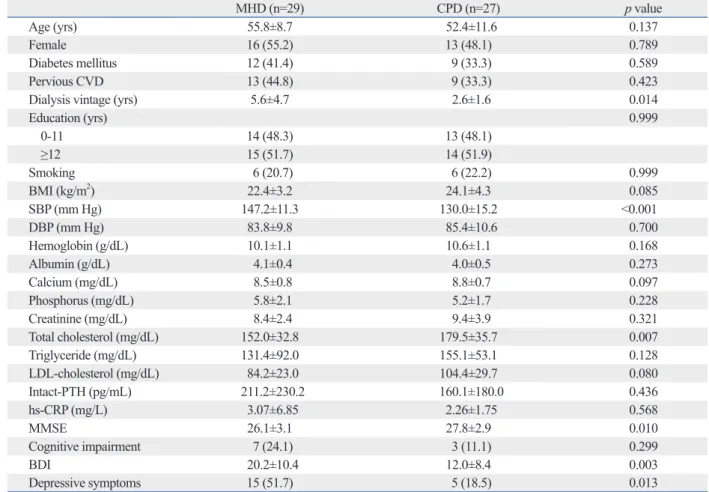
The numbers of patients in the MHD and the CPD groups were 29 (51.8%) and 27 (48.2%), respectively. Demographic factors including age, sex, education level, diabetes, and car- diovascular disease history were not significantly different between the two groups. The MHD patients showed signifi- cantly longer dialysis vintage, higher systolic blood pressure and lower serum total cholesterol level compared with the CPD patients. Neuropsychological evaluation demonstrated that the CPD group showed significantly higher K-MMSE scores (27.8±2.9 vs. 26.1±3.1, p=0.010) and lower K-BDI scores (12.0±8.4 vs. 20.2±10.4, p=0.003) compared with the MHD group. The percentage of the prevalence of depressive symptoms was higher in the MHD group than the CPD group (51.7% vs. 18.5%, p=0.013). The prevalence of cogni- tive impairment also seemed higher in the MHD group than the CPD group (24.1% vs. 11.1%), but this was not statisti- cally significant. The demographic and the clinical character- istics of each group are summarized in Table 1.
Table 2 describes the number of dialysis patients with Statistical analyses were conducted using the SAS package
(version 6.10, SAS institute, Cary, NC, USA). p-values less than 0.05 were considered statistically significant.
RESULTS
A total of 56 dialysis patients were eligible for this study.
The average age of all participants was 54.2±10.2 years and 29 were female (51.8%). The average dialysis vintage was 4.2±3.8 years. The primary causes of ESRD were diabetes (37.5%, n=21), hypertension (33.9%, n=19), glomerulone- phritis (17.9%, n=10), others (3.6%, n=2), and unknown (7.1%, n=4). Twenty-two patients (39.3%) had a history of cardiovascular disorders. The average score of the K-MMSE was 26.9±3.1 and cognitive impairment (scores ≤24) was detected in 10 (17.9%) of the participants. The participants scored an average of 16.3±10.3 on the K-BDI and 20 (35.7%) of them were regarded as being at risk for depression.
Table 1. Clinical and Laboratory Characteristics of Hemodialysis and Peritoneal Dialysis Groups
MHD (n=29) CPD (n=27) p value
Age (yrs) 55.8±8.7 52.4±11.6 0.137
Female 16 (55.2) 13 (48.1) 0.789
Diabetes mellitus 12 (41.4) 9 (33.3) 0.589
Pervious CVD 13 (44.8) 9 (33.3) 0.423
Dialysis vintage (yrs) 5.6±4.7 2.6±1.6 0.014
Education (yrs) 0.999
0-11 14 (48.3) 13 (48.1)
≥12 15 (51.7) 14 (51.9)
Smoking 6 (20.7) 6 (22.2) 0.999
BMI (kg/m2) 22.4±3.2 24.1±4.3 0.085
SBP (mm Hg) 147.2±11.3 130.0±15.2 <0.001
DBP (mm Hg) 83.8±9.8 85.4±10.6 0.700
Hemoglobin (g/dL) 10.1±1.1 10.6±1.1 0.168
Albumin (g/dL) 4.1±0.4 4.0±0.5 0.273
Calcium (mg/dL) 8.5±0.8 8.8±0.7 0.097
Phosphorus (mg/dL) 5.8±2.1 5.2±1.7 0.228
Creatinine (mg/dL) 8.4±2.4 9.4±3.9 0.321
Total cholesterol (mg/dL) 152.0±32.8 179.5±35.7 0.007
Triglyceride (mg/dL) 131.4±92.0 155.1±53.1 0.128
LDL-cholesterol (mg/dL) 84.2±23.0 104.4±29.7 0.080
Intact-PTH (pg/mL) 211.2±230.2 160.1±180.0 0.436
hs-CRP (mg/L) 3.07±6.85 2.26±1.75 0.568
MMSE 26.1±3.1 27.8±2.9 0.010
Cognitive impairment 7 (24.1) 3 (11.1) 0.299
BDI 20.2±10.4 12.0±8.4 0.003
Depressive symptoms 15 (51.7) 5 (18.5) 0.013
MHD, maintenance hemodialysis; CPD, chronic peritoneal dialysis; CVD, cardiovascular disease; BMI, body mass index; SBP, systolic blood pressure; DBP, diastolic blood pressure; LDL, low-density lipoprotein; PTH, parathyroid hormone; hs-CRP, high sensitivity-C reactive protein; MMSE, mini-mental state exam; BDI, Beck Depression Inventory.
Female gender, diabetes mellitus, previous CVD, education and smoking are expressed as the number (percent).
29.6%, p=0.038). The percentage of cognitive impairment also seemed higher in the older patients and those with lon- ger dialysis vintage, but this was not statistically significant.
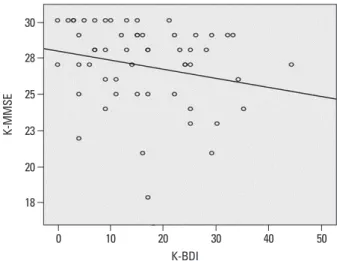
The correlation analysis showed a significant negative cor- relation between the K-MMSE and the K-BDI in dialysis pa- tients (r=-0.296, p=0.026) (Fig. 1). Age (r=-0.299, p=0.025) and dialysis vintage (r=-0.332, p=0.012) were also nega- tively correlated with the K-MMSE.
All variables associated with cognitive impairment were included in the logistic regression analysis test. Depressive symptoms (odds ratio 7.667, 95% confidence interval 1.104- 53.228, p=0.039) and education level (odds ratio 0.106, 95% confidence interval 0.102-0.957, p=0.046) were shown to be the independently predictive of cognitive impairment in multivariate analysis (Table 3).
DISCUSSION
For many years cognitive impairment in maintenance dialy- cognitive impairment according to age, sex, education, dial-
ysis vintage, and diabetes mellitus. The patients with ≥12 years of education were less likely to have cognitive im- pairment than those with 0-11 years of education (6.9% vs.
Table 2. Prevelance of Cognitive Impairment in Dialysis Patients
Normal cognition (n=46) Cognitive impairment (n=10) p value
Age (yrs) 0.308
<50 17 (89.5%) 2 (10.5%)
50-59 17 (85.0%) 3 (15.0%)
≥60 12 (70.6%) 5 (29.4%)
Sex 0.731
Female 23 (79.3%) 6 (20.7%)
Male 23 (85.2%) 4 (14.8%)
Education (yrs) 0.038
0-11 19 (70.4%) 8 (29.6%)
≥12 27 (93.1%) 2 (6.9%)
Dialysis vintage (yrs) 0.254
0-1 17 (94.1%) 1 (5.6%)
2-3 16 (76.2%) 5 (23.8%)
≥4 13 (76.5%) 4 (23.5%)
Diabetes mellitus 0.727
No 28 (80.0%) 7 (20.0%)
Yes 18 (85.7%) 3 (14.3%)
Table 3. Risk Factors of Cognitive Impairment in Dialysis Patients
Variables OR (95% CI) p value
Depressive symptoms 7.667 (1.104-53.228) 0.039
Education (≥12 yrs) 0.106 (0.102-0.957) 0.046
Age (per 1 yr) 1.079 (0.988-1.179) 0.092
Serum albumin level (g/dL) 0.199 (0.023-1.706) 0.141
Diabetes mellitus 0.286 (0.041-1.980) 0.205
Dialysis vintage (per 1 yr) 1.010 (0.846-1.206) 0.911
OR, odds ratio; CI, confidence interval.
18 20 23 25 28 30
K-MMSE
0 10 20 30 40 50
K-BDI
Fig. 1. Correlation analysis between K-MMSE and K-BDI in dialysis patients (r=-0.296, p=0.026). K-MMSE, Korean version of the mini-mental state exam;
K-BDI, Korean version of the Beck Depression Inventory.
cians and other health care providers. Whereas a detailed and systematic neuropsychological test is required to evalu- ate the cognitive status of the patients for further studies, simple and easy screening tools such as the MMSE are suitable for bedside examination. The K-MMSE is the Ko- rean translated and validated version of the MMSE.29 Al- though the original MMSE used ≤23 as a cutoff value for dementia, many studies including Korean studies use a cut- off point of ≤24 in terms of the total score to determine pa- tients with cognitive impairment.17,30 To screen the mood of our participants we used the K-BDI, which is the Korean translated and validated version of the BDI.31 The K-BDI is a self-reporting questionnaire for depression and does not require psychiatric experts to perform the test. We used a cutoff point of 21 in terms of total score to detect depres- sive symptoms in CKD patients instead of a cutoff point of 13. With the cutoff point of 13, 56% of all subjects were shown to have depression in the Korean validation study.31
This study presents the possible impact of different dialy- sis modalities on cognitive function and depressive mood, which may affect QOL and mortality in dialysis patients.
Results from previous studies comparing cognitive function in MHD and the CPD patients show conflicting results.
Some data showed that the prevalence of cognitive impair- ment was high in MHD patients, whereas CPD patients had consistently better cognitive function than MHD patients.11,20 On the contrary, Kalirao, et al.20 reported that cognitive im- pairment in CPD patients was almost as common as that in MHD patients. Some researchers suggested that the differ- ence in the prevalence of cognitive impairment and the lev- el of cognitive function between MHD and CPD patients might be caused by selection bias rather than the dialysis procedure itself.19 The difference could be due to mismatched important variables, including age or level of education, and due to differences in cognitive functions prior to start of dialysis. However, this study showed that cognitive func- tion was higher and the prevalence of cognitive impairment was lower in the CPD group in spite of a well-matched se- lection of the patients. There was no difference in demo- graphic factors including age, sex, education level, diabe- tes, and cardiovascular disease history between the two groups. We hypothesized that the superior effects for CPD over MHD on cognitive impairment may stem from contin- uous treatment and better removal of middle molecular weight uremic toxins.
Among all the factors affecting cognitive impairment, symptoms of depression and education level were detected sis patients has been neglected by clinicians and researchers.
Studies have only recently begun to report a high frequency of cognitive impairment in dialysis patients. However, most studies have focused on MHD patients and their association with high mortality.18,19 Only few studies have been per- formed in CPD patients, focusing on their quality of life.16,20 In addition to mortality, health-related quality of life (QOL) issues are now recognized as an important outcome measure in many clinical research studies and trials for chronic debili- tating disease including chronic dialysis patients.21 Patient QOL is affected by multifactorial components including physical, socioeconomic, cultural, cognitive, and psychologi- cal factors. These factors can affect QOL independently, but can also interact with each other. Among these factors, cog- nition is a major determinant in a patient’s QOL, and is known to be associated with mortality in dialysis patients.
Several explanations may account for cognitive impair- ment in maintenance dialysis patients. Patients with cogni- tive impairment are apt to impede medication adherence, ignore dietary restrictions, and less likely to comply with dialysis schedules.22 Cognitive impairment may result in suboptimal care and increase in mortality. Moreover, the accumulation of toxic substances resulting from reduced metabolic rates can impair central nervous system func- tions.21 Dialysis patients have been demonstrated to devel- op uremic or dialysis-related encephalopathy.23,24 Direct ef- fects of uremic toxin on neurons may also contribute declines in cognition. Additionally, development of cerebrovascular disease can also affect the cognition of dialysis patients, as well as anemia, secondary hyperparathyroidism, and serum albumin level.3,7,25,26 This study enrolled subjects with no history of dementia and depression. Therefore, the rate of cognitive impairment may have been relatively low (17.9%), compared to other studies.4,6,7
Mild cognitive impairment cannot be easily detected by clinicians and health care providers. The early detection of cognitive impairment is very important, because cognitive impairment can progress to dementia and is associated with impaired QOL and increased mortality.27 For early detec- tion of cognitive impairment in dialysis patients at the clinic or dialysis center, fast and simple screening tools are re- quired. Although the MMSE has some weaknesses such as easily being affected by education and age, and not being suitable for executive functions, the MMSE can estimate the overall cognitive status of a patient within 15 to 20 min- utes.28 The MMSE does not need to be applied by well- trained neuropsychologists but can be performed by clini-
REFERENCES
1. Kurella M, Chertow GM, Luan J, Yaffe K. Cognitive impairment in chronic kidney disease. J Am Geriatr Soc 2004;52:1863-9.
2. Buchman AS, Tanne D, Boyle PA, Shah RC, Leurgans SE, Ben- nett DA. Kidney function is associated with the rate of cognitive decline in the elderly. Neurology 2009;73:920-7.
3. Pereira AA, Weiner DE, Scott T, Sarnak MJ. Cognitive function in dialysis patients. Am J Kidney Dis 2005;45:448-62.
4. Murray AM, Tupper DE, Knopman DS, Gilbertson DT, Pederson SL, Li S, et al. Cognitive impairment in hemodialysis patients is common. Neurology 2006;67:216-23.
5. Begum A, Tsopelas C, Lindesay J, Stewart R. Cognitive function and common mental disorders in older people with vascular and non-vascular disorders: a national survey. Int J Geriatr Psychiatry 2009;24:701-8.
6. Madero M, Gul A, Sarnak MJ. Cognitive function in chronic kid- ney disease. Semin Dial 2008;21:29-37.
7. Murray AM. Cognitive impairment in the aging dialysis and chronic kidney disease populations: an occult burden. Adv Chron- ic Kidney Dis 2008;15:123-32.
8. Koo JR, Yoon JW, Kim SG, Lee YK, Oh KH, Kim GH, et al. As- sociation of depression with malnutrition in chronic hemodialysis patients. Am J Kidney Dis 2003;41:1037-42.
9. Brayne C. The mini-mental state examination, will we be using it in 2001? Int J Geriatr Psychiatry 1998;13:285-90.
10. Murray AM, Knopman DS. Cognitive impairment in CKD: no longer an occult burden. Am J Kidney Dis 2010;56:615-8.
11. Tilki HE, Akpolat T, Tunali G, Kara A, Onar MK. Effects of hae- modialysis and continuous ambulatory peritoneal dialysis on P300 cognitive potentials in uraemic patients. Ups J Med Sci 2004;109:
43-8.
12. Buoncristiani U, Alberti A, Gubbiotti G, Mazzotta G, Gallai V, Quintaliani G, et al. Better preservation of cognitive faculty in continuous ambulatory peritoneal dialysis. Perit Dial Int 1993;13 Suppl 2:S202-5.
13. Chilcot J, Wellsted D, Da Silva-Gane M, Farrington K. Depres- sion on dialysis. Nephron Clin Pract 2008;108:c256-64.
14. Lopes AA, Bragg J, Young E, Goodkin D, Mapes D, Combe C, et al. Depression as a predictor of mortality and hospitalization among hemodialysis patients in the United States and Europe.
Kidney Int 2002;62:199-207.
15. Juergensen PH, Wuerth DB, Juergensen DM, Finkelstein SH, Steele TE, Kliger AS, et al. Psychosocial factors and clinical out- come on CAPD. Adv Perit Dial 1997;13:121-4.
16. Condé SA, Fernandes N, Santos FR, Chouab A, Mota MM, Bas- tos MG. Cognitive decline, depression and quality of life in pa- tients at different stages of chronic kidney disease. J Bras Nefrol 2010;32:242-8.
17. Mungas D. In-office mental status testing: a practical guide. Geri- atrics 1991;46:54-8, 63, 66.
18. Kurella M, Mapes DL, Port FK, Chertow GM. Correlates and outcomes of dementia among dialysis patients: the Dialysis Out- comes and Practice Patterns Study. Nephrol Dial Transplant 2006;21:2543-8.
19. Cohen LM, Ruthazer R, Moss AH, Germain MJ. Predicting six- month mortality for patients who are on maintenance hemodialy- sis. Clin J Am Soc Nephrol 2010;5:72-9.
20. Kalirao P, Pederson S, Foley RN, Kolste A, Tupper D, Zaun D, et
as significant risk factors in the multivariate logistic regres- sion analysis of the present study. Cognitive decline was as- sociated with depression in maintenance dialysis patients.
Similar to our findings, Agganis, et al.32 noted that MHD patients with a greater burden of depressive symptoms per- formed worse on tests of cognition. They suggested that the increased vascular risk factors likely put MHD patients at an increased risk of white matter disease that potentially leads to both depression and cognitive impairment. Al- though the relationship between cognitive impairment and depression was not clear in CPD patients, they exhibit as many vascular risk factors as in MHD. Therefore, this ex- planation might be applicable in both patients. Their find- ings indicated that dialysis modality can affect cognitive function indirectly by means of lowering QOL and induc- ing depression. Less than 12 years of education (did not fin- ish high school) was another factor associated with cogni- tive impairment. This observation is consistent with the results of a study by Murray, et al.4 who reported an associ- ation between cognitive impairment and education in MHD patients.
There are several limitations in this study. Compared with other studies, the sample size of each group was small. This might dampen the reliability of the results. A second limita- tion is the screening of the enrolled patients. Exclusion of patients with dementia was based on medical records or history taken from the patients or the care givers. Undetect- ed mild dementia could bias the prevalence of cognitive impairment. However, the high average scores of the K- MMSE in both MHD and CPD patients suggest that our sample was dementia free at the time of the screening. An- other potential limitation is that we did not examine the brain images of the study participants. To clarify the differ- ence of cognition by modality of dialysis, brain images to detect lesions which influence cognition of both MHD and CPD patients should be taken. However, development of cerebrovascular disorders could also be a cause of cognitive impairment in dialysis patients.
In conclusion, this study showed that more MHD pa- tients than CPD patients were affected by cognitive impair- ment and depression. Cognitive impairment was closely correlated with the presence of depressive symptoms. As cognitive impairment can affect the quality of life of main- tenance dialysis patients without sufficient evidence of de- mentia, it is important to detect cognitive impairment and depression in dialysis patients in an early state of ESRD with simple bedside screening tools.
27. Bruscoli M, Lovestone S. Is MCI really just early dementia? A systematic review of conversion studies. Int Psychogeriatr 2004;16:129-40.
28. Crum RM, Anthony JC, Bassett SS, Folstein MF. Population- based norms for the Mini-Mental State Examination by age and educational level. JAMA 1993;269:2386-91.
29. Kang Y, Na DL, Hahn S. A validity study on the Korean Mini- Mental State Examination (K-MMSE) in dementia patients. J Ko- rean Neurol Assoc 1997;15:300-8.
30. Hahn HM, Yum YH, Shin YW, Kim KH, Yoon DJ, Chung KJ. A Standardization study of Beck depression inventory in Korea. J Korean Neuropsychiatr Assoc 1986;25:487-500.
31. Rhee MK, Lee YH, Park SH, Sohn CH, Chung YC, Hong SK, et al. A standardization study of Beck Depression Inventory I-Kore- an version (K-BDI): reliability and factor analysis. Korean J Psy- chopathol 1995;4:77-95.
32. Agganis BT, Weiner DE, Giang LM, Scott T, Tighiouart H, Griffith JL, et al. Depression and cognitive function in mainte- nance hemodialysis patients. Am J Kidney Dis 2010;56:704-12.
al. Cognitive impairment in peritoneal dialysis patients. Am J Kid- ney Dis 2011;57:612-20.
21. Radić J, Ljutić D, Radić M, Kovaĉić V, Sain M, Curković KD.
The possible impact of dialysis modality on cognitive function in chronic dialysis patients. Neth J Med 2010;68:153-7.
22. Griva K, Stygall J, Hankins M, Davenport A, Harrison M, New- man SP. Cognitive impairment and 7-year mortality in dialysis pa- tients. Am J Kidney Dis 2010;56:693-703.
23. Burn DJ, Bates D. Neurology and the kidney. J Neurol Neurosurg Psychiatry 1998;65:810-21.
24. Okada J, Yoshikawa K, Matsuo H, Kanno K, Oouchi M. Revers- ible MRI and CT findings in uremic encephalopathy. Neuroradiol- ogy 1991;33:524-6.
25. Marsh JT, Brown WS, Wolcott D, Carr CR, Harper R, Schweitzer SV, et al. rHuEPO treatment improves brain and cognitive func- tion of anemic dialysis patients. Kidney Int 1991;39:155-63.
26. Herrmann FR, Safran C, Levkoff SE, Minaker KL. Serum albu- min level on admission as a predictor of death, length of stay, and readmission. Arch Intern Med 1992;152:125-30.