서 론
만성폐쇄성폐질환(
chronic obstructive pulmonary disease
,COPD
)이 란 유해한 입자나 가스의 흡입에 의해 발생하는 폐의 비정상적인 염 증반응과 이와 동반되어 완전히 가역적이지 않으며 점차 진행하는 기류제한을 보이는 호흡기 질환이다.COPD
환자는 기도 저항의 증가로 인해 호흡근의 에너지 소모량 증가로 건강한 사람에 비해 호흡 시 더 많은 에너지를 필요로 하며, 하루 총 에너지 소모량이 약
15
% 가 더 높다는 보고가 있다.1-3) 또한 기존의 연구에 따르면,COPD
환 자에서 이러한 에너지 대사의 증가와 영양섭취 감소, 전신적 염증반 응 등의 원인에 의해 체중감소가 발생하고 있는 것으로 알려져 있다.2,4,5) 실제로
COPD
환자의25
%–40
%는 영양이 부족한 상태에 있Received August 14, 2020 Revised June 13, 2021 Accepted June 13, 2021
Corresponding author Jun-Hyun Yoo Tel: +82-2-3410-2440, Fax: +82-2-3410-0388 E-mail: [email protected]
ORCID: https://orcid.org/0000-0002-0344-5123
Copyright © 2021 The Korean Academy of Family Medicine
This is an open-access article distributed under the terms of the Creative Commons At- tribution Non-Commercial License (http://creativecommons.org/licenses/by-nc/4.0) which permits unrestricted noncommercial use, distribution, and reproduction in any medium, provided the original work is properly cited.
Original Article
https://doi.org/10.21215/kjfp.2021.11.4.288 eISSN 2233-9116
Korean J Fam Pract. 2021;11(4):288-295
Korean Journal of Family Practice
KJFP
만성폐쇄성폐질환의 위험도와 영양소 섭취의 연관성: 2007–
2015 국민건강영양조사
조수영
1, 여요환
1, 조인영
2, 전근혜
1, 유준현
1,*
1성균관대학교 의과대학 삼성서울병원 가정의학교실, 2성균관대학교 의과대학 강북삼성병원 가정의학교실
Association between Chronic Obstructive Pulmonary Disease Risk and Nutritional Intake: Using the 2007–2015 Korea National Health and Nutrition Examination Survey Data
Suyeong Cho1, Yohwan Yeo1, In Young Cho2, Keunhye Jeon1, Jun-Hyun Yoo1.*
1Department of Family Medicine, Samsung Medical Center; 2Department of Family Medicine, Kangbuk Samsung Hospital, Sunkyunkwan University School of Medicine, Seoul, Korea
Background: Patients with chronic obstructive pulmonary disease (COPD) spend higher energy in breathing than healthy individuals. Largely owing to this, advanced COPD patients are prone to be in a state of undernutrition and thus commonly undergo weight loss during an exacerbation. This study was designed to statistically assess the association between COPD risk and nutritional intake in Korean patients.
Methods: We analyzed the data of 19,893 individuals aged 40–79 years. The COPD and non-COPD groups were determined based on the results of pulmonary function test. The dietary intake of the subjects was estimated from nutritional intake survey using a 24-hour dietary recall method.
Logistic regression was used to compare the odds ratio for COPD risk in those who had intake of each nutrient between two conditions, above the estimated average requirement (EAR) and below the EAR.
Results: The COPD group showed significantly lower level of intake of most nutrients, including protein, fat, vitamins, and minerals. The proportion of undernutrition state defined by nutrient intake below the EAR was higher in the COPD group than in the non-COPD group. Therefore, we found a significant reduction in COPD risk in a group taking vitamin C above the EAR compared to those taking vitamin C below the EAR.
Conclusion: Our study provides solid statistical evidence for the tendency of less intake of nutrients in the COPD group compared to the non-COPD group in Korea. The statistical analyses of the beneficial effect of each nutrient revealed that antioxidants, particularly vitamin C, appeared to be associated with decrease risk of COPD.
Keywords: Chronic Obstructive Pulmonary Disease; Nutrients; Estimated Average Requirement; Vitamin C
조수영 외. 만성폐쇄성폐질환의 위험도와 영양소 섭취의 연관성 Korean Journal of Family Practice
KJFP
고6,7) 저체중은
COPD
환자에서 나쁜 예후 인자로 인식되고 있다.8-10) 주요 에너지원인 탄수화물, 단백질, 지방, 식이섬유과 같은 다량 영양소(macronutrient
)의 섭취와의 연관성11)뿐만 아니라, 항산화제 등 의 미량영양소(micronutrient
)가COPD
에 미치는 영향에 관한 연구 를 살펴보면 비타민C
와E
로 대표되는 항산화 물질이 폐의 항산화 방어 기전에 중요한 역할을 한다는 보고가 있다.12) 특히vitamin C
섭취가COPD
악화의 완화인자로 작용하며,COPD
위험도 감소에 대한 효과는 몇몇 연구에서 관찰되어 왔다.13-15) 그러나COPD
환자 들을 대상으로 발병의 예방이나 경과 호전을 위하여 특정 영양소 섭취를 권고하기에는 근거가 부족한 실정이며, 이를 위해서는COPD
환자들의 영양소 섭취 빈도와 섭취량 등의 실태에 대해서 파 악할 필요성이 있다.따라서 본 연구는 국민건강영양조사 자료를 이용하여 국내
COPD
환자의 전반적인 영양소 섭취 상태를 조사하고COPD
유무에 따른 차이가 있는지 살펴보고자 하였다.방 법
1. 연구대상
본 연구는
2007
년부터2015
년까지 시행된 제4–6
기 국민건강영양 조사 자료를 기반으로 하였다. 조사에 참여한 인원 중 폐기능 검사 연령에 따라 만40
세에서79
세까지의 성인을 대상으로 하였으며, 폐 기능 검사를 시행하지 못한 사람,24
시간 회상법에 의해 조사된 식 품섭취조사 자료가 없는 사람은 연구에서 제외하여, 총 연구 대상 자19
,893
명을 선발하였다. 남자8
,149
명, 여자11
,744
명이었고 폐기능 검사상1
초간 노력성 호기량(forced expiratory volume in one second
,FEV1
)/노력성 폐활량(forced vital capacity
,FVC
)<0
.7
이면COPD group
,FEV1
/FVC≥0
.7
이면 비COPD group
으로 나누어 분석하였다.2. 폐기능 검사
국민건강영양조사에서 실시하는 폐기능검사는
Vmax series SensorMedics 2130
형(Rolling dry-seal Spirometry
;SensorMedics
,Yorba Linda
,CA
,USA
)을 사용하여 실시되었다. 대상자당3
회 이상 실시 하며, 오류가 없는 적합한 검사를2
회 시행하도록 노력하며 최대8
회까지 검사를 시행하였다.2020 Global Initiative for Chronic Obstructive Lung Disease guideline
에 따라FEV1
/FVC<0
.7
이면COPD
군으로 정의하였으며,16)FEV1
에 따라 중증도를FEV1≥80
%인 경우mild
,50
%≤FEV1<80
%인 경우moderate
,30
%≤FEV1<50
%인 경우severe
,FEV1<30
%인 경우very severe
로 정의하였다.3. 식품섭취조사
영양조사는 국민건강영양조사팀이 해당 조사대상가구를 방문하 여 조사
1
일 전 식품섭취내용을24
시간 회상법을 통하여 응답하는 것으로 이루어졌다. 개인의 항목별 영양소 섭취량은 이를 기반으로 계산하여 제시되었다. 개인별 총 열량 섭취 및 영양소 섭취 상태는2015
한국인 영양소 섭취 기준(2015 dietary reference intakes for koreans
,Korean Nutrition Society
, 보건복지부, 한국영양학회)을 기반 으로 대상자의 연령별로 제시된 섭취 기준에 근거하여 총 열량은 필 요추정량(estimated energy requirement
,EER
), 각 영양소는 평균필요 량(estimated average requirement
,EAR
)에 대해 기준치 미만으로 섭취 한 군과 기준치 이상으로 섭취한 군으로 구분하여 분석하였다.4. 관련지표
연구 대상자의 인구학적 요소나 건강행동에 대한 데이터는 개인 면담을 통해 수집하였다. 인구학적 변수는 연령, 성별, 가구수입을 포함하였다. 가구 소득은 개인면담 시 자가기입 설문방식을 통한 소 득의 정도에 따라
4
등분하였다. 흡연 여부는 평생 동안 흡연 경험이 없는 자를 비흡연자군으로, 평생 흡연량이5
갑(100
개비) 이상인 경 우에는 과거에는 피웠으나 현재 피우지 않거나 혹은 평생 흡연량이5
갑(100
개비) 미만인 경우를 과거 흡연자군으로, 평생 흡연량이5
갑 (100
개비) 이상이며 현재 피우거나 가끔 피우는 경우를 현재 흡연자 로 정의하였다. 체질량지수(body mass index
,BMI
)는 실측된 신장과 체중을 통해 체중(kg
)에 키(m
)의 제곱을 나누어서 산출하였다.5. 통계 분석
통계분석은 질병관리본부의 국민건강영양조사 원시자료이용지 침에 따라 가중치를 사용하여 복합표본분석을 시행하였다. 연구대 상자의 기본특성은 평균과 표준오차, 또는 비율(%)로 표시하였다.
영양소 섭취와 만성 폐쇄성 폐질환 오즈비와의 연관성을 파악하기 위해 로지스틱 회귀분석을 시행하였으며 유의수준은
0
.05
미만으로 하였다. 통계분석은PASW Statistics ver
.18
.0
(IBM Co
.,Armonk
,NY
,USA
)를 이용하였다.6. 연구 윤리
2007
년부터2015
년까지 시행된 제4–6
기 국민건강영양조사 자료 를 활용하여 분석을 수행한 본 연구의 프로토콜은 의학연구윤리심 의위원회(Institutional Review Board
)의 승인을 얻어 진행하였다(IRB no
.SMC 2020-06-138
).Original Article
Korean Journal of Family Practice
Suyeong Cho, et al. The Association between COPD Risk and Nutritional Intake
Korean Journal of Family Practice
KJFP
Table 1. General characteristics of study subjects
Characteristics COPD (N=3,145)
NCOPD
(N=16,748) P-value
Obstructive severity Mild
(N=1,459)
Moderate (N=1,534)
Severe, very severe
(N=152) P-value
Age (y) 64.18±0.25 53.76±0.11 <0.001 65.56±0.36 62.93±0.35 63.96±0.96 <0.001
Age group (y)
40–49 212 (10.6) 5,665 (41.8) <0.001 80 (8.3) 130 (13.3) 2 (3.9) <0.001
50–59 595 (22.6) 5,416 (31.6) 237 (20.1) 320 (24.1) 38 (31.4)
60–69 1,141 (30.2) 3,728 (16.2) 500 (28.9) 590 (31.7) 51 (27.4)
70–79 1,197 (36.6) 1,939 (10.4) 642 (42.8) 494 (30.9) 61 (37.3)
Sex
Male 2,254 (73.1) 5,895 (43.1) <0.001 1,046 (72.4) 1,093 (73.3) 115 (77.8) 0.454
Female 891 (26.9) 10,853 (56.9) 413 (27.6) 441 (26.7) 37 (22.2)
Houshold income
First quartile 771 (26.3) 3,708 (23.5) 0.006 334 (23.6) 378 (27.5) 59 (39.3) 0.009
Second quartile 782 (26.2) 4,136 (25.4) 363 (27.8) 390 (25.4) 29 (19.3)
Third quartile 792 (24.9) 4,262 (25.5) 373 (24.5) 383 (25.1) 36 (27.0)
Fourth quartile 741 (22.6) 4,463 (25.6) 371 (24.1) 343 (21.9) 27 (14.5)
BMI
<18.5 87 (2.9) 241 (1.3) <0.001 22 (1.9) 43 (2.8) 22 (13.2) <0.001
18.5≤BMI<25.0 2,119 (66.6) 10,485 (61.8) 1,046 (69.9) 977 (63.8) 96 (63.7)
≥25 939 (30.5) 6,022 (36.9) 391 (28.2) 514 (33.4) 34 (23.1)
Smoking status
Never 1,002 (31.1) 10,957 (59.8) <0.001 461 (31.3) 502 (31.5) 39 (25.6) 0.011
Former 897 (28.9) 2,373 (16.2) 457 (32.1) 399 (25.9) 41 (28.6)
Current 1,183 (40.0) 3,147 (24.0) 520 (36.6) 594 (42.6) 69 (45.8)
Values are presented as number (%) or mean±standard deviation.
COPD, chronic obstructive pulmonary disease; NCOPD, non-chronic obstructive pulmonary disease; BMI, body mass index.
Table 2. Comparisons of nutrient intakes according to study subjects
Characteristics COPD (N=3,145)
NCOPD
(N=16,748) P-value
Obstructive severity Mild
(N=1,459)
Moderate (N=1,534)
Severe, very severe (N=152) P-value Energy (kcal) 1,969.04±18.40 1,996.43±9.62 0.164 1,999.58±26.50 1,951.54±26.44 1,858.84±60.45 0.069
Carbohydrate (g) 325.07±2.74 322.48±1.49 0.377 330.31±3.86 321.62±3.97 310.70±10.19 0.141
Protein (g) 66.82±0.85 70.02±0.41 0.001 67.08±1.16 67.23±1.32 60.14±2.76 0.045
Fat (g) 33.37±0.72 37.51±0.31 <0.001 32.74±0.93 34.45±1.14 28.38±2.15 0.128
Fat-soluble vitamins
Vitamin A (μgRE) 756.46±25.28 853.65±13.37 <0.001 804.02±43.04 718.67±28.97 691.77±111.13 0.193 Carotene (μg) 3,978.10±144.26 4,440.93±76.53 0.004 4,230.78±243.39 3,769.69±164.52 3,711.76±97.24 0.221
Retinol (μg) 78.89±4.34 99.08±3.69 <0.001 80.99±7.11 79.18±68.09 56.15±6.46 0.019
Water-soluble vitamins
Vitamin C (mg) 100.29±2.32 116.20±1.33 <0.001 103.39±3.47 99.48±3.05 79.33±7.35 0.006
Vitamin B1 (mg) 1.54±0.02 1.60±0.01 0.006 1.58±0.03 1.51±0.03 1.31±0.07 0.001
Vitamin B2 (mg) 1.13±0.01 1.25±0.08 <0.001 1.16±0.02 1.13±0.02 0.96±0.05 0.001
Niacin (mg) 15.85±0.22 16.80±0.10 <0.001 15.97±0.31 15.89±0.33 14.36±0.67 0.063
Major minerals
Calcium (mg) 492.43±8.34 515.46±4.25 0.012 506.19±13.35 482.70±10.19 461.47±34.02 0.299
Phosphorus (mg) 1,120.63±5.84 1,158.78±11.87 0.003 1,131.90±17.50 1,120.41±17.21 1,016.63±35.04 0.007 Sodium (mg) 4,442.59±68.10 4,665.47±35.37 0.003 4,450.51±95.61 4,417.14±93.10 4,626.02±484.43 0.895 Potassium (mg) 3,013.37±35.71 3,227.02±18.82 <0.001 3,068.98±50.71 2,994.53±51.38 2,680.67±129.14 0.010 Trace minerals
Iron (mg) 16.41±0.34 17.00±0.17 0.115 16.85±0.55 16.04±0.35 16.10±1.76 0.386
Values are presented as mean±standard deviation.
COPD, chronic obstructive pulmonary disease; NCOPD, non-chronic obstructive pulmonary disease.
조수영 외. 만성폐쇄성폐질환의 위험도와 영양소 섭취의 연관성 Korean Journal of Family Practice
KJFP
결 과
1. 연구대상자의 인구통계학적 특성
총
19
,893
명의 연구 대상자 중3
,145
명이COPD
군에 포함되었으 며,FEV1
결과값에 따라 중증도를 분류하였을 때mild
군은1
,459
명,moderate
군은1
,534
명,severe
와very severe
군은152
명이었다.COPD
군에서 평균 연령은64
.2
세로 비COPD
군에 비해 높았고, 남성의 비율이 높았다(73
.1
%vs
.26
.9
%;P<0
.001
).COPD
의 유병률은 가구소득의 증가에 따라 감소하였다(
P=0
.006
).BMI 25
이상의 과체중은COPD
군에서 낮게 관찰되었다(30
.5
%vs
.36
.9
%;P<0
.001
). 또한COPD
군에서 현재 흡연자가 유의하게 높게 관찰되었고, 중증도가 증가할수록 현재 흡연자의 분율이 높았다(mild 36
.6
%,moderate 42
.6
%,severe and very severe 45
.8
%;P=0
.011
;Table 1
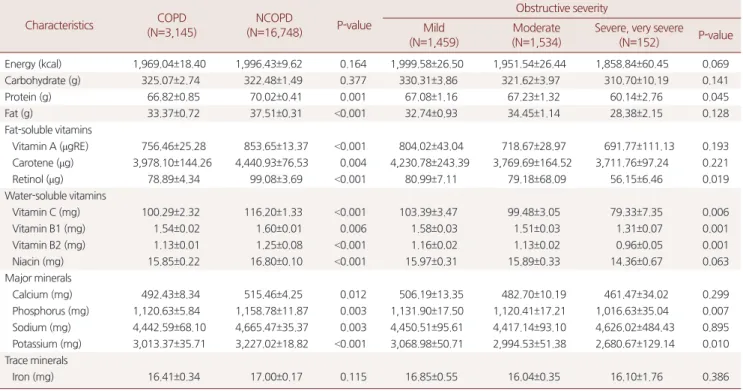
).2. COPD 진단 여부에 따른 영양소 섭취 실태
COPD
군과 비COPD
군의 열량 및 영양소 섭취량에 차이에 대하Table 3. Proportions of subjects with nutrient intake above the estimated average requirement (EAR) according to COPD
Characteristics EAR COPD
(N=3,145)
NCOPD
(N=16,748) P-value
Male Female
Energy (kcal) 2,200 1,800 1,129 (36.3) 6,930 (43.2) <0.001
Protein (g) 45 40 2,294 (72.7) 13,044 (79.7) <0.001
Fat-soluble vitamins
Vitamin A (μgRE) 530 430 1,564 (50.0) 10,100 (60.8) <0.001
Water-soluble vitamins
Vitamin C (mg) 75 75 1,531 (47.9) 9,403 (56.1) <0.001
Vitamin B1 (mg) 1.0 0.9 2,161 (69.1) 12,269 (75.7) <0.001
Vitamin B2 (mg) 1.3 1.0 1,117 (36.4) 7,953 (48.8) <0.001
Niacin (mg) 12 11 1,948 (61.8) 11,296 (69.6) <0.001
Major minerals
Calcium (mg) 570 560 915 (28.8) 5,332 (33.1) <0.001
Phosphorus (mg) 580 580 2,782 (87.8) 14,982 (90.2) 0.001
Sodium (mg) 1,500 1,500 2,851 (90.3) 15,305 (92.0) 0.014
Potassium (mg) 3,500 3,500 936 (29.4) 5,577 (34.7) <0.001
Trace minerals
Iron (mg) 7 6 2,765 (87.7) 15,203 (91.7) <0.001
Values are presented as number (%).
COPD, chronic obstructive pulmonary disease; NCOPD, non-chronic obstructive pulmonary disease.
Table 4. Comparisons of nutrient intakes according to estimated average requirement (EAR)
Characteristics Intake nutrient below the EAR Intake nutrient above the EAR
COPD NCOPD P-value COPD NCOPD P-value
Energy (kcal) 1,509.28±11.54 1,449.90±4.74 <0.001 2,777.00±27.61 2,715.10±13.27 0.042
Protein (g) 31.74±0.37 31.11±0.15 0.113 79.98±0.96 79.95±0.44 0.982
Fat-soluble vitamins
Vitamin A (μgRE) 263.16±4.22 275.11±1.86 0.009 1,249.24±44.46 1,225.99±19.62 0.624
Water-soluble vitamins
Vitamin C (mg) 39.77±0.58 41.94±0.27 0.001 166.14±3.48 174.40±1.77 0.032
Vitamin B1 (mg) 0.68±0.008 0.67±0.003 0.728 1.92±0.02 1.90±0.25 0.477
Vitamin B2 (mg) 0.72±0.008 0.74±0.003 0.037 1.87±0.02 1.79±0.01 0.012
Niacin (mg) 8.28±0.08 8.30±0.03 0.831 20.53±0.28 20.52±0.12 0.976
Major minerals
Calcium (mg) 325.94±3.56 342.99±1.46 <0.001 903.76±18.67 864.19±9.37 0.061
Phosphorus (mg) 440.54±7.69 449.16±3.08 0.293 1,215.09±11.49 1,235.44±5.76 0.110
Sodium (mg) 1,034.55±22.65 1,067.61±11.09 0.191 4,808.39±70.04 4,980.01±36.14 0.026
Potassium (mg) 2,211.85±20.13 2,302.70±8.60 <0.001 4,935.56±56.48 4,964.25±28.30 0.650
Trace minerals
Iron (mg) 4.73±0.09 4.70±0.43 0.775 18.05±0.36 18.12±0.18 0.864
Values are presented as mean±standard deviation.
COPD, chronic obstructive pulmonary disease; NCOPD, non-chronic obstructive pulmonary disease.
Suyeong Cho, et al. The Association between COPD Risk and Nutritional Intake
Korean Journal of Family Practice
KJFP
여 분석한 결과
COPD
군의 단백질, 지방, 비타민A
, 카로틴, 레티놀, 비타민C
, 비타민B1
, 비타민B2
, 니아신, 칼슘, 인, 나트륨, 칼륨 섭 취량은 유의하게 적었다. 또한COPD
의 중증도에 따른 섭취량에서 는 중증도가 증가할수록 유의하게 레티놀, 비타민C
, 비타민B1
, 비 타민B2
, 인, 칼륨의 섭취량이 낮아지는 경향성을 보였다(Table 2
).각 영양소별 섭취량을
EAR
미만일 때를 섭취부족이라고 정의하 였을 때, 모든 영양소에서COPD
군에서 섭취가 부족한 경우가 더 높게 나타났다.COPD
군과 비COPD
군에서 평균 필요량 이상 섭 취의 차이가 가장 두드러진 영양소는 비타민B2
(36
.4
%vs
.48
.8
%), 비타민A
(50
%vs
.60
.8
%), 비타민C
(47
.9
%vs
.56
.1
%)으로 나타났다 (Table 3
).EAR
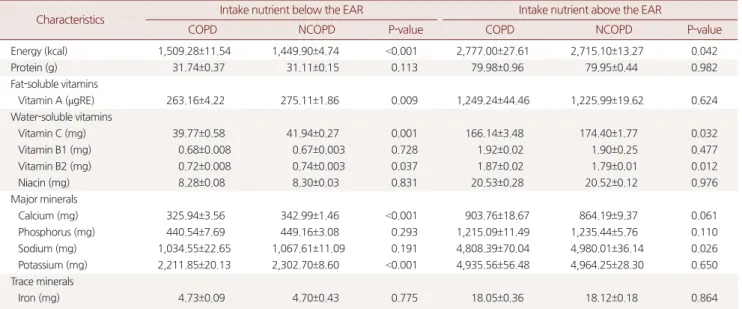
기준으로 미만, 이상으로 섭취한 경우를 나누어 각각의 영 양소 섭취에 대해 살펴보았을 때, 총 에너지 섭취량은EAR
기준과 관계없이COPD
군에서 높게 관찰되었다. 미량영양소의 경우EAR
기준 섭취 여부에 따라 다른데,EAR
미만 섭취자 중COPD
군에서 비타민A
, 비타민C
, 비타민B2
, 칼슘, 포타슘 섭취가 유의하게 낮게 관찰되었다.EAR
이상 섭취자에서는COPD
군에서 비타민C
, 비타 민B2
, 나트륨 섭취가 유의하게 낮았다(Table 4
). 오히려COPD
군에 서 에너지 섭취량이 높은 것처럼 나타난 이유는 남녀에서의EER
기 준의 차이 때문으로,2015
한국인 영양소 섭취 기준을 참고하였을 때50–64
세 남녀가 필요로 하는 에너지 필요 추정량EER
은 남성2
,200 kcal
, 여성1
,800 kcal
으로 약400 kcal
의 차이를 보인다. 다른 미량영양소EAR
기준은 성별에 따른 차이가 없거나 매우 근소하여 위와 같은 결과가 나타나지 않았다. 따라서 에너지 섭취량에 한해서 성별로 나누어 추가로 분석을 시행하였고EER
이상 섭취자, 이하 섭 취자 모두에서COPD
군의 에너지 섭취가 낮음을 확인할 수 있었다 (Table 5
).3. 영양소 섭취와 COPD 오즈비와의 연관성
각각의 미량영양소에서
EAR
기준으로 미만, 이상 섭취 여부에 따 라 연령, 성별, 가구 수입, 흡연력, 총 에너지 섭취량을 보정한 로지 스틱 회귀분석 결과, 비타민C
섭취가EAR
미만일 때보다EAR
이 상을 섭취할수록COPD
오즈비가0
.887
배(P=0
.044
) 낮은 것으로 나타났다(
adjusted odds ratio
,0
.887
;95
%confidence interval
,0
.789–
0
.997
). 이외의 다른 영양소에서는 유의한 결과는 관찰되지 않았다 (Table 6
).고 찰
본 연구에서는 국민건강영양조사 자료를 바탕으로 만성폐쇄성폐 질환 환자에서의 영양소 섭취 실태 및 각 영양소 섭취에 따른 만성 폐쇄성폐질환 유무와의 연관성에 관하여 분석하였다. 성별, 연령, 가계소득, 흡연 이력을 포함한 다양한 요인이
COPD
의 유병률에 영 향을 미치는 것으로 알려져 있다. 본 연구의 분석에서도 남성이 여 성보다COPD
유병율이 유의하게 높았으며,COPD
군이 비COPD
군에 비하여 평균 연령 및 저체중, 현재 흡연자의 비율은 높고 가구 소득은 낮은것으로 나타났다.본 연구를 통해 비
COPD
군에 비하여COPD
군에서 단백질, 지 Table 5. Comparisons of energy intakes according to estimated energy requirement (EER) and sexSex Intake nutrient below the EER P-value Intake nutrient above the EER P-value
Male COPD (N=1,375) NCOPD (N=2,880) COPD (N=879) NCOPD (N=3,015)
Energy (kcal) 1,629.16±12.58 1,703.61±7.58 <0.001 2,902.00±29.97 3,052.15±19.99 <0.001
Female COPD (N=641) NCOPD (N=6,938) COPD (N=250) NCOPD (N=3,915)
Energy (kcal) 1,245.43±16.69 1,309.33±4.74 <0.001 2,255.47±38.22 2,337.26±11.99 0.039
Values are presented as mean±standard deviation.
COPD, chronic obstructive pulmonary disease; NCOPD, non-chronic obstructive pulmonary disease.
Table 6. Logistic regression analysis of associations between chronic obstructive pulmonary disease (COPD) and nutrient intakes according to estimated average requirement (EAR)
Intake each component above the EAR
aORa
(95% confidence interval) P-value
Energy (kcal) 0.920 (0.821–1.032) 0.155
Protein (g) 0.863 (0.743–1.001) 0.052
Fat-soluble vitamins
Vitamin A (μgRE) 0.943 (0.841–1.057) 0.310 Water-soluble vitamins
Vitamin C (mg) 0.887 (0.789–0.997) 0.044
Vitamin B1 (mg) 0.913 (0.794–1.049) 0.199 Vitamin B2 (mg) 0.983 (0.863–1.119) 0.792
Niacin (mg) 0.897 (0.783–1.028) 0.119
Major minerals
Calcium (mg) 0.960 (0.845–1.091) 0.532
Phosphorus (mg) 0.830 (0.687–1.002) 0.052
Sodium (mg) 0.931 (0.753–1.151) 0.508
Potassium (mg) 0.945 (0.827–1.079) 0.400 Trace minerals
Iron (mg) 0.955 (0.789–1.157) 0.639
aOR, adjusted odds ratio.
aAdjusted for age, sex, body mass index, household income, smoking status, to- tal energy intake, odds ratio for COPD risk of those who had intake of each component above EAR compared to that of below EAR.
조수영 외. 만성폐쇄성폐질환의 위험도와 영양소 섭취의 연관성 Korean Journal of Family Practice
KJFP
방, 비타민
A
, 카로틴, 레티놀, 비타민C
, 비타민B1
, 비타민B2
, 니아 신, 칼슘, 인, 나트륨, 칼륨 섭취량이 유의하게 낮음을 확인할 수 있 었다. 또한 각 영양소별 평균 필요량(EAR
) 미만 섭취자와 이상 섭취 자로 나누어 분석하여 영양소 필요량을 충족시키지 못하는 결핍자 의 분율에 대해서 알아보았을 때, 비COPD
군에 비하여COPD
군 에서 평균필요량 이하 섭취 비율이 모든 항목에서 유의하게 높게 나 타났다. 기존에 시행된 연구에서도,COPD
군에서 비COPD
군에 비하여 총 열량, 칼륨, 비타민A
, 카로틴, 레티놀 및 비타민C
섭취 량이 현저히 부족하다는 결과가 있다.17-19) 적절한 영양 섭취와 체중 의 유지가 중요한 예후 인자임에도 불구하고, 식이섭취가 원활하지 못한 원인들에 대해서 고려해보면, 섭취 시의 호흡곤란을 생각해 볼 수 있다.COPD
환자가 음식을 삼키고 씹을 때 호흡패턴이 변화되 고, 식사 후의 위팽만감으로 폐의 기능적 잔류 용량이 줄어들게 되 며 이는 호흡곤란을 초래하여 식이섭취의 감소가 발생한다.20) 이와 더불어 식욕의 상실, 우울감 등도 섭취 감소의 원인으로 생각된다.21) 또한COPD
는 전신적 염증반응 질환으로, 인터루킨(IL-6
,IL-8
), 종 양 괴사 인자(TNF-a
) 등의 염증성 사이토카인 및 아디포카인, 호르 몬과 같은 요인들과 영양의 연관성에 대해서 연구된 바 있는데, 특 히IL-6
와 식욕 감소는 상당한 상관관계를 보였다는 결과가 있고,22) 이는COPD
환자에서 영양섭취 감소의 원인으로 작용할 수 있다고 판단된다.영양소 섭취에 따른 만성폐쇄성폐질환의 오즈비와의 연관성 분 석에서는 항산화 비타민 중 비타민
C
를 평균 필요량 미만으로 섭취 한 군에 비하여 평균 필요량 이상으로 섭취한 군에서COPD
오즈비 가 감소하는 것으로 나타났다. 폐에서의 비타민C
의 역할을 설명할 수 있는 몇 가지 기전이 제안되어 왔는데, 비타민C
(아스코르브산) 는 항산화 특성을 가지며 알레르기 반응, 결합 조직 유지, 종양 억제 등 면역계에서 중요한 역할을 하는 것으로 알려져 있다. 비타민C
는 산화 스트레스를 낮추고, 콜라겐 합성을 증가시키며, 혈관 내피 성 장 인자와 폐포 세포의 증식을 회복시키는 것으로 나타났다.23) 광범 위한 연구에서 비타민C
섭취는COPD
환자들에게 긍정적인 영향 을 미치는 것으로 알려져 있으며,15,24-26)COPD
환자와 건강한 사람을 대상으로 비타민C
의 섭취와 폐기능의 연관성과 관련하여 보고된 연구에서 비타민C
를 높게 섭취한 군에서FEV1
이 더 잘 유지된다는 결과가 있었다.27) 본 연구의 결과는 이러한 사례들을 잘 뒷받침한다.본 연구는 몇 가지 제한점이 있다. 첫째, 단면조사연구로 진행되 어 영양 섭취 실태 결과와 만성폐쇄성폐질환의 인과관계를 추론하 는데 한계가 있었다. 둘째, 본 연구는 이미 완성된 설문 조사 데이터 를 사용한 후향적 연구로, 직업 또는 환경 노출을 평가할 수 없었다.
셋째, 식품섭취 조사에 사용된
24
시간 회상법은 개인 내 식이변이로 인하여, 특정한 하루 또는 짧은 기간의
24
시간 회상 자료로는 개 인의 일상적인 섭취현황을 파악하는 것이 어렵고 기억의존성에 따 른 오류가 발생할 수 있다는 단점이 있다. 넷째, 음식을 통한 섭취가 아닌 보충제나 약물로 섭취한 양은 설문에 포함되지 않았다. 설문 에 의해 조사된 섭취량뿐만 아니라, 보충제로 섭취 여부 및 객관적 지표로 혈액검사를 시행하여 혈중의 비타민C
를 함께 고려한다면 보다 정확한 상관관계를 파악할 수 있을 것으로 기대된다. 다섯째, 식이에 가장 많은 영향을 주는 요소 중 식욕의 개념을 본 연구에서 는 고려하고 있지 않다. 앞서 언급한 것처럼, 식욕의 상실, 우울감은 섭취 감소의 주요한 원인으로 작용할 수 있고COPD
환자에서의 우 울 기분은 비COPD
환자와 차이를 보일 것이다. 우울 기분을 보정 한 이후에도 독립적으로 연관성이 있다면, 그 인과관계에 대한 추가 적인 연구가 필요할 것으로 생각된다. 여섯째,COPD
의 정의에는bronchodilator
사용 후 가역적이지 않은 기류 제한이라는 조건이 있 으며, 의심되는 증상(호흡곤란, 만성기침, 가래)이 있어야 하지만 본 연구에서 이용한 국민건강영양조사 자료로는 이러한 조건들을 모 두 만족하기 어렵다는 제한점이 있다.결론적으로 본 연구는 국민건강영양조사에서 수집된 자료를 바탕 으로 분석한 결과, 항산화비타민, 특히 비타민
C
와COPD
오즈비의 관련성을 관찰할 수 있었으며,COPD
군에서 비COPD
군에 비하여 여러 가지 영양소 섭취가 부족할 가능성이 많다는 결론을 얻었다.본 연구 결과는
COPD
환자들에서의 영양 교육 및 지침을 작성하 는데 있어, 기초 자료로 활용될 수 있을 것으로 사료된다. 또한COPD
환자들에서의 영양섭취의 부족은 질환의 진행에도 영향을 미치게 되고 나아가 치료의 효과나 삶의 질에도 영향을 줄 수 있으 므로 다각적인 지표를 적용하여 영양 고위험군을 선별하고, 이들을 대상으로 영양교육 및 지원이 필요할 것으로 생각된다.요 약
연구배경: 만성폐쇄성폐질환 환자는 호흡근의 에너지 소비량 증가 로 건강한 사람과 비교하였을 때 에너지 요구량이 증가하며, 영양부 족과 체중감소가 발생하기 쉽다. 본 연구에서는 비
COPD
군과COPD
군의 영양 상태를 비교하여 평가하고 한국인 환자에서의COPD
유무와 영양 섭취 사이의 연관성을 확인하고자 하였다.방법:
2007
년부터2015
년까지 시행된 제4–6
기 국민건강영양조사 자 료를 기반으로 하여 만40
세에서79
세까지의 성인을 대상으로 폐기 능 검사 결과에 따라COPD
군과 비COPD
군으로 나누었다.24
시 간 회상법에 의해 조사된 식품섭취조사 자료를 이용하여 각 군에서 의 영양섭취 실태를 비교하였고,2015
한국인 영양소 섭취 기준에Suyeong Cho, et al. The Association between COPD Risk and Nutritional Intake
Korean Journal of Family Practice
KJFP
따라 각 영양소를
EAR
미만으로 섭취한 군과 이상으로 섭취한 군 으로 나누어COPD
오즈비와의 연관성에 관하여 로지스틱 회귀분 석을 실시하였다.결과: 비
COPD
군에 비하여COPD
군에서 단백질, 지방, 비타민A
, 카로틴, 레티놀, 비타민C
, 비타민B1
, 비타민B2
, 니아신, 칼슘, 인, 나트륨, 칼륨 섭취량이 유의하게 낮음을 확인할 수 있었다. 또한 나 이, 성별,BMI
, 가구수입, 흡연 여부, 총 에너지 섭취량을 보정변수 로 하여 로지스틱 회귀분석을 시행하였을 때 비타민C
를EAR
미만 으로 섭취한 군에 비하여EAR
이상으로 섭취한 군에서COPD
오즈 비가 낮음을 확인할 수 있었다.결론: 본 연구결과 비타민
C
를EAR
미만으로 섭취한 군에 비하여EAR
이상으로 섭취한 군에서COPD
오즈비가 감소하는 것으로 나 타났다(0
.887
배,P=0
.044
).중심단어: 만성폐쇄성폐질환; 영양소; 평균필요량; 항산화비타민 CONFLICT OF INTEREST
No potential conflict of interest relevant to this article was reported
. ORCIDSuyeong Cho
,https
://orcid
.org
/0000-0002-3534-9910 Yohwan Yeo
,https
://orcid
.org
/0000-0002-1379-0510 In Young Cho
,https
://orcid
.org
/0000-0002-6240-9026 Keunhye Jeon
,https
://orcid
.org
/0000-0003-2294-0637 Jun-Hyun Yoo
,https
://orcid
.org
/0000-0002-0344-5123
REFERENCES
1. Baarends EM, Schols AM, Pannemans DL, Westerterp KR, Wouters EF. To- tal free living energy expenditure in patients with severe chronic obstructive pulmonary disease. Am J Respir Crit Care Med 1997; 155: 549-54.
2. Goldstein SA, Thomashow BM, Kvetan V, Askanazi J, Kinney JM, Elwyn DH. Nitrogen and energy relationships in malnourished patients with em- physema. Am Rev Respir Dis 1988; 138: 636-44.
3. Wilson DO, Donahoe M, Rogers RM, Pennock BE. Metabolic rate and weight loss in chronic obstructive lung disease. JPEN J Parenter Enteral Nutr 1990; 14: 7-11.
4. Keim NL, Luby MH, Braun SR, Martin AM, Dixon RM. Dietary evaluation of outpatients with chronic obstructive pulmonary disease. J Am Diet Assoc 1986; 86: 902-6.
5. Braun SR, Dixon RM, Keim NL, Luby M, Anderegg A, Shrago ES. Predictive clinical value of nutritional assessment factors in COPD. Chest 1984; 85:
353-7.
6. Schols AM, Soeters PB, Dingemans AM, Mostert R, Frantzen PJ, Wouters EF. Prevalence and characteristics of nutritional depletion in patients with stable COPD eligible for pulmonary rehabilitation. Am Rev Respir Dis 1993; 147: 1151-6.
7. Vermeeren MA, Creutzberg EC, Schols AM, Postma DS, Pieters WR, Roldaan AC, et al. Prevalence of nutritional depletion in a large out-patient population of patients with COPD. Respir Med 2006; 100: 1349-55.
8. Wilson DO, Rogers RM, Wright EC, Anthonisen NR. Body weight in chronic obstructive pulmonary disease. The National Institutes of Health Intermittent Positive-Pressure Breathing Trial. Am Rev Respir Dis 1989;
139: 1435-8.
9. Schols AM. Nutrition in chronic obstructive pulmonary disease. Curr Opin Pulm Med 2000; 6: 110-5.
10. Schols AM, Slangen J, Volovics L, Wouters EF. Weight loss is a reversible fac- tor in the prognosis of chronic obstructive pulmonary disease. Am J Respir Crit Care Med 1998; 157(6 Pt 1): 1791-7.
11. Varraso R, Willett WC, Camargo CA Jr. Prospective study of dietary fiber and risk of chronic obstructive pulmonary disease among US women and men. Am J Epidemiol 2010; 171: 776-84.
12. Heffner JE, Repine JE. Pulmonary strategies of antioxidant defense. Am Rev Respir Dis 1989; 140: 531-54.
13. Isbaniah F, Wiyono WH, Yunus F, Setiawati A, Totzke U, Verbruggen MA.
Echinacea purpurea along with zinc, selenium and vitamin C to alleviate exacerbations of chronic obstructive pulmonary disease: results from a ran- domized controlled trial. J Clin Pharm Ther 2011; 36: 568-76.
14. Hu G, Cassano PA. Antioxidant nutrients and pulmonary function: the Third National Health and Nutrition Examination Survey (NHANES III).
Am J Epidemiol 2000; 151: 975-81.
15. Keranis E, Makris D, Rodopoulou P, Martinou H, Papamakarios G, Daniil Z, et al. Impact of dietary shift to higher-antioxidant foods in COPD: a ran- domised trial. Eur Respir J 2010; 36: 774-80.
16. Güder G, Brenner S, Angermann CE, Ertl G, Held M, Sachs AP, et al. "GOLD or lower limit of normal definition? A comparison with expert-based diag- nosis of chronic obstructive pulmonary disease in a prospective cohort- study". Respir Res 2012; 13: 13.
17. Edge R, McGarvey DJ, Truscott TG. The carotenoids as anti-oxidants--a re- view. J Photochem Photobiol B 1997; 41: 189-200.
18. McKeever TM, Lewis SA, Smit HA, Burney P, Cassano PA, Britton J. A mul- tivariate analysis of serum nutrient levels and lung function. Respir Res 2008; 9: 67.
19. Grievink L, de Waart FG, Schouten EG, Kok FJ. Serum carotenoids, alpha- tocopherol, and lung function among Dutch elderly. Am J Respir Crit Care Med 2000; 161(3 Pt 1): 790-5.
20. Brug J, Schols A, Mesters I. Dietary change, nutrition education and chronic obstructive pulmonary disease. Patient Educ Couns 2004; 52: 249-57.
21. Grönberg AM, Slinde F, Engström CP, Hulthén L, Larsson S. Dietary prob- lems in patients with severe chronic obstructive pulmonary disease. J Hum Nutr Diet 2005; 18: 445-52.
22. Koehler F, Doehner W, Hoernig S, Witt C, Anker SD, John M. Anorexia in chronic obstructive pulmonary disease--association to cachexia and hor- monal derangement. Int J Cardiol 2007; 119: 83-9.
23. Koike K, Ishigami A, Sato Y, Hirai T, Yuan Y, Kobayashi E, et al. Vitamin C
조수영 외. 만성폐쇄성폐질환의 위험도와 영양소 섭취의 연관성 Korean Journal of Family Practice
KJFP
prevents cigarette smoke-induced pulmonary emphysema in mice and provides pulmonary restoration. Am J Respir Cell Mol Biol 2014; 50: 347- 57.
24. Pirabbasi E, Shahar S, Manaf ZA, Rajab NF, Manap RA. Efficacy of ascorbic acid (Vitamin C) and/N-Acetylcysteine (NAC) supplementation on nutri- tional and antioxidant status of male chronic obstructive pulmonary dis- ease (COPD) patients. J Nutr Sci Vitaminol (Tokyo) 2016; 62: 54-61.
25. Tsiligianni IG, van der Molen T. A systematic review of the role of vitamin
insufficiencies and supplementation in COPD. Respir Res 2010; 11: 171.
26. Kodama Y, Kishimoto Y, Muramatsu Y, Tatebe J, Yamamoto Y, Hirota N, et al.
Antioxidant nutrients in plasma of Japanese patients with chronic obstruc- tive pulmonary disease, asthma-COPD overlap syndrome and bronchial asthma. Clin Respir J 2017; 11: 915-24.
27. Ness AR, Khaw KT, Bingham S, Day NE. Vitamin C status and respiratory function. Eur J Clin Nutr 1996; 50: 573-9.