http://dx.doi.org/10.5534/wjmh.2013.31.2.163
Original Article
Received: Jul 4, 2013; Revised: (1st) Jul 29, 2013, (2nd) Aug 5, 2013, (3rd) Aug 9, 2013; Accepted: Aug 9, 2013 Correspondence to: Hong Koo Ha
Department of Urology, Pusan National University Hospital, 179 Gudeok-ro, Seo-gu, Busan 602-739, Korea.
Tel: +82-51-240-7344, Fax: +82-51-247-5443, E-mail: [email protected] Copyright © 2013 Korean Society for Sexual Medicine and Andrology
This is an Open Access article distributed under the terms of the Creative Commons Attribution Non-Commercial License (http://creativecommons.
org/licenses/by-nc/3.0) which permits unrestricted non-commercial use, distribution, and reproduction in any medium, provided the original work is properly cited.
The Surgical Procedure Is the Most Important Factor Affecting Continence Recovery after Laparoscopic Radical Prostatectomy
Seungsoo Lee, Chang Jin Yoon, Hyun Jun Park, Jeong Zoo Lee, Hong Koo Ha
Department of Urology, Pusan National University Hospital, Busan, Korea
Purpose: We analyzed factors associated with early recovery of continence after laparoscopic radical prostatectomy.
Materials and Methods: Among 467 patients treated with laparoscopic radical prostatectomy for localized prostate cancer between 2007 and 2012, 249 patients who underwent a preoperative urodynamic study were enrolled. The patients’ age, prostate volume, preoperative serum prostate-specific antigen (PSA), Gleason score, pathologic stage, and preoperative urodynamic parameters were recorded. The preoperative membranous and prostatic urethral length on magnetic resonance image, nerve sparing technique, and type of surgical procedure (extrafascial and intrafascial) were analyzed. Patients were considered to have early recovery of continence when they needed no pad in 3 months or less after surgery.
Results: Ninety-two patients were in the early recovery group and 157 were in the late recovery group. The membranous urethral lengths were 12.06±2.56 and 11.81±2.87 mm, and prostatic urethral lengths were 36.39±6.15 and 37.45±7.55 mm in each group, respectively. The membranous-posterior urethral length ratios were 0.25±0.06 and 0.24±0.06, and prostatic-posterior urethral length ratios were 0.75±0.06 and 0.76±0.06, respectively. In and of themselves, the membranous and prostatic urethral lengths were not associated with recovery duration however, the membranous-total and prostatic-total urethral length ratios were related (p=0.024 and 0.024, respectively). None of the urodynamic parameters correlated with continence recovery time. In the multivariate analysis, the type of surgical procedure (odds ratio [OR], 7.032; 95% confidence interval [CI], 2.660 to 18.590; p<0.001) and membranous urethral length (OR, 0.845; 95% CI, 0.766 to 0.931; p=0.001) were significantly related to early recovery of continence.
Conclusions: The current intrafascial surgical procedure is the most important factor affecting early recovery of continence after laparoscopic radical prostatectomy.
Key Words: Laparoscopy; Prostatic neoplasms; Urinary incontinence
INTRODUCTION
Laparoscopic radical prostatectomy is currently a com- mon surgical option for localized prostate cancer.
Improvements in laparoscopic equipment and surgical techniques have led to lower morbidity and postoperative complication rates.1 However, several complications af- fect postoperative quality of life; in particular, incon-
tinence is one of the complications with the greatest impact.
The reported rates of urinary incontinence after radical prostatectomy range from 2.5% to 87.0%, and differ con- siderably according to its definition, follow-up duration, and surgical technique.2-4 However, recent studies re- ported faster recovery of continence after radical prostatec- tomy, with up to 95% of patients reported as continent 1 year postoperatively.5 These results are similar to those ob- tained from laparoscopic radical prostatectomy a meta-analysis showed that continence rates 1 year after lap- aroscopic radical prostatectomy range from 60% to 97%.2 As the cause of incontinence after radical prostatectomy remains unclear, many studies have been performed to clarify the factors that affect continence recovery duration after surgery.6-9 For this purpose, we considered various fac- tors that might be related to continence including surgical technique, urodynamic parameters, and urethral length.
Among those factors, we analyzed the effect of pre- operative bladder function, urethral length, and surgical procedure on continence recovery duration after laparo- scopic radical prostatectomy.
MATERIALS AND METHODS
1. Patients
In total, 467 patients underwent laparoscopic radical prostatectomy for localized prostate cancer between January 2007 and March 2012. Of these patients, 249 cas- es who underwent a preoperative urodynamic study were reviewed. An extraperitoneal approach was used in all of the patients and no urethral enhancement techniques were used.
Each patient was interviewed regarding his incon- tinence status in our outpatient clinic every month. They were asked how many pads they used per day for incontinence. The patients were considered to have ach- ieved recovery of continence when they needed no pad.
Patients whose continence recovery duration was in 3 months or less were classified into the ‘early recovery’
group, whereas the remaining patients were classified into the ‘late recovery’ group.
Age, prostate volume, preoperative serum prostate-spe- cific antigen (PSA), Gleason score, and pathologic stage
were recorded for each patient. The membranous and pro- static urethral lengths were measured during preoperative magnetic resonance image (MRI), and the ratio of the membranous and prostatic urethral length to the posterior urethral length was calculated. Preoperative urodynamic parameters including maximal cystometric capacity (MCC), compliance, and maximal detrusor pressure were recorded. Methods of neurovascular bundle sparing were recorded as none, unilateral, and bilateral. The effect of the surgical procedure type was also analyzed. This study has been conducted under approval of Pusan National University Hospital clinical trial (PNUH: IRB-E-2013009).
2. Urodynamic study
All urodynamic evaluations were performed using a Dantec urodynamic testing system (Medtronic Dantec, Tonsbakken, Denmark). Cystometry was performed using an 8 F double lumen catheter with 37oC normal saline sol- ution at a filling rate of 50 ml/min, with abdominal pres- sure monitoring. Intra-abdominal pressure was measured using a pressure sensor attached to a water-filled balloon catheter that was passed into the patient's rectum.
Detrusor pressure was estimated by subtracting the in- tra-abdominal pressure from the intravesical pressure.
Using cystometry, MCC was defined as the bladder vol- ume at which a patient had a strong desire to void.
Maximal detrusor pressure was defined as the detrusor pressure at MCC. Compliance was calculated as volume change/pressure change during bladder filling.
3. Urethral length measurement
MRI was performed on a 1.5 Tesla MRI system (Magnetom Symphony; Siemens, Erlangen, Germany). T2 coronal images were used. The membranous urethral length was measured as the distance from the prostatic apex to the entry of the urethra into the penile bulb. The prostatic urethral length was measured as the distance from the prostatic apex to the bladder neck. The posterior urethral length was the sum of the membranous and pro- static urethral lengths. The membranous-posterior and prostatic-posterior urethral length ratios were calculated as the membranous urethral length/posterior urethral length and prostatic urethral length/posterior urethral length, respectively.
4. Surgical procedure
Although the classical description of the neurovascular bundles is that of two bundles of tissue that are located near the posterolateral surface of the prostate,10 accumu- lating evidence indicates that this complex exhibits a cer- tain amount of variability. Previously, we incised the en- dopelvic fascia lateral to the arcus tendinosus with sparing of both neurovascular bundles. In some patients, the cav- ernosal nerves form lattices or curtains that extend from the posterolateral to the anterolateral surface of the pros- tate, rather than distinct neurovascular bundles.11,12 To preserve these nerves, some surgeons use a special techni- que for sparing the ‘veil of Aphrodite’.
In the present study, laparoscopic sparing of the veil of Aphrodite was performed using cold scissors. A bilateral incision of the periprostatic fascia was made medial to the puboprostatic ligament and directed to the base of the prostate. All lateral periprostatic fascia, endopelvic fascia, and puboprostatic fascia were maintained intact. This ma- neuver is important to skeletonize the urethra and to en- sure the existence of the prostatic apical margin. The pu- boprostatic ligament and arcus tendinosus can be pre- served using this approach. We compared the post- operative urinary continence recovery ability associated with the previous and current procedures.
5. Statistical analysis
T-tests were used to examine the relationship between each parameter, with the exception of the pathologic stage, neurovascular bundle sparing, and surgical procedure. Chi-squared tests were used to examine the differences in the pathologic stage, neurovascular bundle sparing, and surgical procedure between the early and late recovery groups. The age-adjusted partial correlation co- efficients were used to calculate the correlation between the continence recovery duration and the other factors.
Multivariate analysis was performed using logistic re- gression by including the parameters that were significant in the partial correlation analysis. A p<0.05 was consid- ered significant. All of the analyses were performed using IBM SPSS Statistics version 19.0 (SPSS Inc., Chicago, IL, USA).
RESULTS
Among the 249 patients analyzed, 92 patients were classified into the early recovery group and 157 were clas- sified into the late recovery group.
In each group, the mean ages of the patients were 66.05±6.23 (49∼78) years and 66.40±6.24 (52∼80) years, respectively. The prostate volumes were 34.74±
13.92 (13.00∼79.10) g and 36.09±14.78 (16.00∼101.00) g, respectively. The serum PSA values were 12.79±15.12 (0.84∼83.66) ng/ml and 13.43±13.99 (1.42∼89.94) ng/ml, respectively. The Gleason scores were 6.76±0.95 (6∼10) and 6.74±0.89 (5∼10), respectively. In the early recovery group, pathologic stages T1, T2, and T3 were 3, 75, and 14, respectively. In the late recovery group, pathologic stages T1, T2, and T3 were 7, 114, and 36, respectively. The age, prostate volume, PSA, Gleason score, and pathologic stage of the two groups were not significantly different (p=0.997, p=0.877, p=0.728, p=0.711, and p=0.654, respectively).
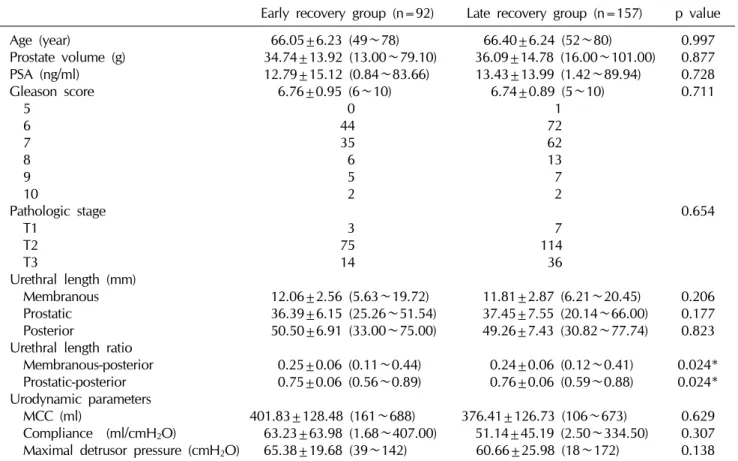
In the early and late recovery groups, the mean mem- branous urethral lengths were 12.06±2.56 (5.63∼19.72) mm and 11.81±2.87 (6.21∼20.45) mm, respectively, and the mean prostatic urethral lengths were 36.39±6.15 (25.26∼51.54) mm and 37.45±7.55 (20.14∼66.00) mm, respectively. The mean posterior urethral lengths were 50.50±6.91 (33.00∼75.00) mm and 49.26±7.43 (30.82
∼77.74) mm, respectively. The membranous-posterior urethral length ratios were 0.25±0.06 (0.11∼0.44) and 0.24±0.06 (0.12∼0.41), respectively. The prostatic-poste- rior urethral length ratios were 0.75±0.06 (0.56∼0.89) and 0.76±0.06 (0.59∼0.88), respectively. While the membranous, prostatic, and posterior urethral lengths were not correlated with continence recovery duration (p=0.206, p=0.177, and p=0.823, respectively), the membranous-posterior and prostatic-posterior urethral length ratios were associated with continence recovery du- ration (p=0.024 and p=0.024, respectively).
The preoperative urodynamic study in the early and late recovery groups revealed that the mean maximal cysto- metric capacities were 401.83±128.48 (161∼688) ml and 376.41±126.73 (106∼673) ml, respectively. The mean compliances were 63.23±63.98 (1.68∼407.00) ml/cmH2O and 51.14±45.19 (2.50∼334.50) ml/cmH2O,
Table 1. Descriptive statistics showing differences between the early and late recovery groups
Early recovery group (n=92) Late recovery group (n=157) p value Age (year)
Prostate volume (g) PSA (ng/ml) Gleason score 5
6 7 8 9 10
Pathologic stage T1
T2 T3
Urethral length (mm) Membranous Prostatic Posterior
Urethral length ratio Membranous-posterior Prostatic-posterior Urodynamic parameters MCC (ml)
Compliance (ml/cmH2O)
Maximal detrusor pressure (cmH2O)
66.05±6.23 (49∼78) 34.74±13.92 (13.00∼79.10) 12.79±15.12 (0.84∼83.66)
6.76±0.95 (6∼10) 0 44 35 6 5 2 3 75 14
12.06±2.56 (5.63∼19.72) 36.39±6.15 (25.26∼51.54) 50.50±6.91 (33.00∼75.00)
0.25±0.06 (0.11∼0.44) 0.75±0.06 (0.56∼0.89) 401.83±128.48 (161∼688)
63.23±63.98 (1.68∼407.00) 65.38±19.68 (39∼142)
66.40±6.24 (52∼80) 36.09±14.78 (16.00∼101.00) 13.43±13.99 (1.42∼89.94)
6.74±0.89 (5∼10) 1 72 62 13 7 2 7 114 36
11.81±2.87 (6.21∼20.45) 37.45±7.55 (20.14∼66.00) 49.26±7.43 (30.82∼77.74)
0.24±0.06 (0.12∼0.41) 0.76±0.06 (0.59∼0.88) 376.41±126.73 (106∼673)
51.14±45.19 (2.50∼334.50) 60.66±25.98 (18∼172)
0.997 0.877 0.728 0.711
0.654
0.206 0.177 0.823 0.024*
0.024*
0.629 0.307 0.138 Values are presented as mean±standard deviation (range) or number only.
PSA: prostate-specific antigen, MCC: maximal cystometric capacity.
*Statistically significant.
Table 2. Patient distribution of the neurovascular bundle sparing technique and the type of surgical procedure between the early and late recovery group
Early recovery group (n=92) Late recovery group (n=157) p value Neurovascular bundle sparing
None Unilateral Bilateral
Type of surgical procedure Extrafascial
Intrafascial
25 27 40 73 19
70 27 60 151
6
0.051
<0.001*
*Statistically significant.
respectively. The mean maximal detrusor pressures were 65.38±19.68 (39∼142) cmH2O and 60.66±25.98 (18∼
172) cmH2O, respectively. None of these urodynamic pa- rameters was associated with continence recovery dura- tion (p=0.629, p=0.307, and p=0.138, respectively) (Table 1).
No sparing technique, and unilateral and bilateral neuro- vascular bundle sparing surgery were performed in 25, 27, and 40 patients in the early recovery group, and in 70, 27, and 60 patients in the late recovery group, respectively. The neurovascular bundle sparing techniques were not related to the continence recovery duration (p=0.051). In the early
Table 3. Age-adjusted partial correlation coefficients (r) between parameters and continence recovery duration
r p value
Prostate volume Gleason score
Prostate-specific antigen Pathologic stage
Membranous urethral length Prostatic urethral length Posterior urethral length M-P urethral length ratio P-P urethral length ratio Neurovascular bundle sparing Type of surgical procedure
0.041
−0.015 0.023 0.032
−0.213
<0.001
−0.085
−0.142 0.142 0.121
−0.277
0.519 0.819 0.717 0.742 0.001*
0.994 0.183 0.025*
0.025*
0.057
<0.001*
M-P: membranous-posterior, P-P: prostatic-posterior.
*Statistically significant.
Table 4. Multivariate analysis of the relationship between parameters and continence recovery duration Multivariate analysis
p value Odds ratio 95% confidence interval
Type of surgical procedure Membranous urethral length M-P urethral length ratio P-P urethral length ratio
<0.001*
0.001*
0.406 0.407
7.032 0.845 0.007 0.040
2.660∼18.590 0.766∼0.931 0.000∼0.542 0.000∼79.848 M-P: membranous-posterior, P-P: prostatic-posterior.
*Statistically significant.
recovery group, the previous extrafascial surgical proce- dure was applied to 73 patients, and the current intrafascial procedure was applied to 19 patients. In the late recovery group, the previous extrafascial procedure was applied to 151 patients and the current intrafascial procedure was ap- plied to 6 patients. The type of surgical procedure affected continence recovery duration (p<0.001) (Table 2).
In partial correlation analysis adjusted by age, the type of surgical procedure, membranous urethral length, and membranous-posterior urethral length ratio correlated neg- atively with continence recovery duration (r=-0.277, r=
-0.213, and r=-0.142, respectively) prostatic-posterior urethral length ratio correlated positively (r=0.142). The other factors were not related to the continence recovery duration (Table 3).
In the multivariate analysis, which included the type of surgical procedure, membranous urethral length, mem- branous-posterior and prostatic-posterior urethral length ratios, the type of surgical procedure (odds ratio [OR],
7.032; 95% confidence interval [CI], 2.660 to 18.590; p
<0.001), and the membranous urethral length (OR, 0.845; 95% CI, 0.766 to 0.931; p=0.001) were sig- nificantly related to early recovery of continence (Table 4).
DISCUSSION
The purpose of this study was to analyze the effects of urethral length, urodynamic parameters, and modified surgical procedures on continence recovery duration after laparoscopic radical prostatectomy.
The patients were divided into two groups - the early and late recovery groups - according to the continence re- covery duration. Although we defined continence recov- ery strictly as ‘needing no pad’, all of the patients recov- ered continence in less than 1 year after the surgery. In re- cent studies, the incontinence rate 1 year after surgery was reported to be 5%, or even as low as 1∼2%.13,14 Thus, the
‘late recovery ’group was conveniently named for com- parison with the ‘early recovery’ group, which did not mean that continence recovery was morbidly delayed.
Although the neuroanatomy of continence has been in- completely characterized, some studies have reported that neurovascular bundle resection resulted in delayed continence recovery after radical prostatectomy.11,12,15 Those studies were based on the concept that the distal urethral sphincter is innervated by the autonomic (by the pelvic nerve) and somatic (by the pudendal nerve) nerv- ous systems.15
In this study, the outcomes did not differ significantly between the two groups according to the neurovascular bundle sparing technique. However, the multivariate analysis showed that the type of surgical procedure was the most important factor, and compared to the extra-
fascial surgical procedure, the intrafascial surgical proce- dure reduced the continence recovery duration. Use of the current intrafascial surgical procedure to preserve the puboprostatic ligament and arcus tendinosus were shown to be related to early continence recovery. In addition, we suggest that the intrafascial surgical procedure can pre- serve more neurovascular bundles, which were not easily spared by the extrafascial surgical procedure. This sug- gests that good preservation of the structures surrounding the prostate is critical to reducing the duration of post- prostatectomy incontinence.
It has been thought that the urethra is deeply involved in incontinence because of the existence of the urethral sphincters. Coakley et al8 reported that the duration of re- covery of continence decreased as the membranous ure- thral length measured on MRI increased. Another study re- ported that the prostatic urethral length measured by trans- rectal ultrasonography exhibited a positive relationship with continence recovery duration.13 Some authors have proposed a modified technique for full functional-length sphincter preservation that increased early continence recovery.14 Others have reported that early continence re- covery was related to a long membranous urethra.8,16 Conversely, Borin et al15 reported that aggressive re- section of the urethra during robot-assisted laparoscopic prostatectomy did not affect continence and allowed a re- duction of the surgical margin-positive rate.
In this study, the continence recovery duration de- creased with the increase in the membranous urethral length. Although the critical urethral length that influences postprostatectomy incontinence has not been established, we suggest that preservation of the membranous urethra during prostatectomy is considered important for sphinc- ter preservation related to continence.
The bladder is one of the most important organs affect- ing incontinence; thus, the effect of preoperative bladder function was analyzed. Kleinhans et al16 estimated the ur- odynamic changes associated with radical retropubic prostatectomy. Those authors reported that postoperative incontinence could not be predicted by parameters repre- senting preoperative bladder function, whereas it was in- fluenced by sphincteric deficiency as expressed by re- duced pressures in the sphincteric mechanism.
However, very few studies have analyzed the relation-
ship between preoperative urodynamic parameters and continence recovery. The preoperative urodynamic study performed here revealed that MCC, compliance, and max- imal detrusor pressure were not related to early recovery.
This result suggests that the bladder has a lesser effect on continence recovery because the detrusor muscles are not injured during surgery. In contrast, another study that ad- dressed urodynamic changes before and after prostatec- tomy reported that bladder denervation is one of the fac- tors affecting stress incontinence after surgery.17
A limitation of this study is that urethral sphincteric pres- sure was not analyzed, although it has been suggested to be an important urodynamic parameter associated with incontinence. Several studies have investigated the effect of urethral sphincteric pressure on incontinence.
Another limitation is that the patient number under- going the current intrafascial surgical procedure was small. Although significant relationships were observed, reports from further surgical experience are needed to strengthen the findings and conclusions.
Nevertheless, it is meaningful that this study analyzed the relationship between continence recovery duration af- ter laparoscopic radical prostatectomy and preoperative factors that are rarely analyzed.
CONCLUSIONS
In this study, the result of the multivariate analysis leads us to conclude that the current intrafascial surgical proce- dure is the most important factor affecting early recovery of continence after laparoscopic radical prostatectomy. In addition, a high membranous urethral length is related to a shortened duration for continence recovery after laparo- scopic radical prostatectomy.
We can predict the results of laparoscopic radical pros- tatectomy and reduce the duration of incontinence based on these conclusions. Further studies are needed to con- firm the ability of the modified current surgical procedure to reduce the continence recovery duration after laparo- scopic radical prostatectomy.
ACKNOWLEDGEMENTS
This work was supported by a 2-Year Research Grant of
Pusan National University.
REFERENCES
1. So BK, Choi JD, Lee SY, Kim HS, Park SY, Seo SI.
Experience of 100 laparoscopic radical prostatectomies per- formed by a single surgeon: an analysis of surgical and functional outcomes. Korean J Urol 2011;52:517-23 2. Rassweiler J, Schulze M, Teber D, Seemann O, Frede T.
Laparoscopic radical prostatectomy: functional and onco- logical outcomes. Curr Opin Urol 2004;14:75-82
3. Steiner MS, Morton RA, Walsh PC. Impact of anatomical radical prostatectomy on urinary continence. J Urol 1991;145:512-4
4. Hammerer P, Huland H. Urodynamic evaluation of chan- ges in urinary control after radical retropubic prosta- tectomy. J Urol 1997;157:233-6
5. Lepor H, Kaci L, Xue X. Continence following radical retro- pubic prostatectomy using self-reporting instruments. J Urol 2004;171:1212-5
6. Gacci M, Carini M, Simonato A, Imbimbo C, Gontero P, Briganti A, et al. Factors predicting continence recovery 1 month after radical prostatectomy: results of a multicenter survey. Int J Urol 2011;18:700-8
7. Majoros A, Bach D, Keszthelyi A, Hamvas A, Romics I.
Urinary incontinence and voiding dysfunction after radical retropubic prostatectomy (prospective urodynamic study).
Neurourol Urodyn 2006;25:2-7
8. Coakley FV, Eberhardt S, Kattan MW, Wei DC, Scardino PT, Hricak H. Urinary continence after radical retropubic prostatectomy: relationship with membranous urethral
length on preoperative endorectal magnetic resonance imaging. J Urol 2002;168:1032-5
9. Hwang JJ, Kim BY, Uchio EM. Improving urinary con- tinence after radical prostatectomy: review of surgical mod- ifications. Korean J Urol 2009;50:935-41
10. Narayan P, Konety B, Aslam K, Aboseif S, Blumenfeld W, Tanagho E. Neuroanatomy of the external urethral sphinc- ter: implications for urinary continence preservation during radical prostate surgery. J Urol 1995;153:337-41
11. Eastham JA, Kattan MW, Rogers E, Goad JR, Ohori M, Boone TB, et al. Risk factors for urinary incontinence after radical prostatectomy. J Urol 1996;156:1707-13
12. Wei JT, Dunn RL, Marcovich R, Montie JE, Sanda MG.
Prospective assessment of patient reported urinary con- tinence after radical prostatectomy. J Urol 2000;164:744-8 13. Oefelein MG. Prospective predictors of urinary continence
after anatomical radical retropubic prostatectomy: a multi- variate analysis. World J Urol 2004;22:267-71
14. Schlomm T, Heinzer H, Steuber T, Salomon G, Engel O, Michl U, et al. Full functional-length urethral sphincter preser- vation during radical prostatectomy. Eur Urol 2011;60:320-9 15. Borin JF, Skarecky DW, Narula N, Ahlering TE. Impact of
urethral stump length on continence and positive surgical margins in robot-assisted laparoscopic prostatectomy.
Urology 2007;70:173-7
16. Kleinhans B, Gerharz E, Melekos M, Weingärtner K, Kälble T, Riedmiller H. Changes of urodynamic findings after radi- cal retropubic prostatectomy. Eur Urol 1999;35:217-21 17. Giannantoni A, Mearini E, Zucchi A, Costantini E, Mearini
L, Bini V, et al. Bladder and urethral sphincter function after radical retropubic prostatectomy: a prospective long-term study. Eur Urol 2008;54:657-64