Information Needs and Seeking Behavior During the
H1N1 Virus Outbreak
ABSTRACT
Timely access to quality healthcare information during an outbreak plays an important role in curtailing its spread. The aim of this study was to investigate the information needs and seeking behavior of the general public in Singapore during the H1N1 pandemic. A pre-tested questionnaire was used for data collection. The convenience snowball sampling method was used and 260 working adults and tertiary-level students participated in this study. The most crucial information needs of a majority of the participants were: symptoms of H1N1, causes of the infection, preventive measures, and possible treatments. Data analysis also revealed that mass media such as television, news-papers, and radio were most frequently used for seeking the needed information. The use of human information sources was also quite high while only a small number of the respondents accessed online news and healthcare web-sites. About three-quarters of the participants indicated that the gathered information helped them to stay vigilant and take necessary precautionary measures. A major problem identified by the participants in using H1N1 informa-tion was the lack of understanding of certain terms used in public communicainforma-tions. This paper suggests certain mea-sures for strengthening health information communication during future outbreaks.
Keywords
: Information Needs, Information Seeking Behavior, N1H1, Swine Flu, Influenza A, Information Sources, Singapore1. INTRODUCTION
Pandemics caused by diseases such as H1N1, also referred to as Influenza A and Swine flu, are likely
to spread around the world quickly due to rapid urbanization, increase in global travelling, and over-crowded conditions in big cities. In order to limit the spread of an outbreak, several organizations
Received date: December 16, 2012 Accepted date: February 13, 2013 *Corresponding Author: Shaheen Majid
Associate professor
Wee Kim Wee School of Communication & Information Nanyang Technological University, Singapore E-mail: [email protected]
All JISTaP content is Open Access, meaning it is accessible online to everyone, without fee and authors’ permission. All JISTaP content is published and distributed under the terms of the Creative Commons Attribution License (http://creativecom-mons.org/licenses/by/3.0/). Under this license, authors reserve the copyright for their content; however, they permit anyone to unrestrictedly use, distribute, and reproduce the content in any medium as far as the original authors and source are cited. For any reuse, redistribution, or reproduction of a work, users must clarify the license terms under which the work was produced. Open Access
http://dx.doi.org/10.1633/JISTaP.2013.1.1.3
Shaheen Majid*
Wee Kim Wee School of Communication & Information Nanyang Technological University, Singapore
Email: [email protected]
Nor Ain Rahmat
Wee Kim Wee School of Communication & Information Nanyang Technological University, Singapore
Email: [email protected]
such as government departments, hospitals, inter-national health institutions, and other healthcare agencies usually make concerted efforts to create awareness among the general public about the potential risks, disease symptoms, precautions, and possible treatments and interventions.
A pandemic may result in the deaths of large numbers of people, disturbing local and interna-tional travelling, straining healthcare services, seri-ously hurting economies, wasting precious resou-rces, and disturbing the daily lives and activities of citizens. In 2009, the world was shocked by a new strain of the H1N1 virus and health experts found it difficult to predict with certainty how this strain would mutate to evolve into a new dangerous strain. In June 2009 the World Health Organization (WHO) declared that the H1N1 virus outbreak had climbed to a Phase 6 pandemic level, meaning that this virus was likely to spread globally. This trig-gered a worldwide panic and many countries start-ed assessing their level of preparstart-edness and began taking appropriate measures to combat the spread of this virus. A necessary step in these preparedness efforts was to provide up-to-date information to the general public about the spread of the H1N1 virus, necessary precautionary measures, and details on how to impr- ove personal health and hygiene.
To stop any further spread of an outbreak, it is necessary that appropriate messages should be delivered to the general public through suitable communication channels. During an outbreak many countries provide health advisories to their citizens using a variety of channels such as televi-sion, radio, newspapers, posters, and the Internet to create awareness and to build social resilience (Thompson, 2003). A study by Walter et al. (2012) investigated the knowledge, attitudes, and behavior of the general public about the H1N1 outbreak and vaccination against this virus. They reported a sig-nificant difference in information-seeking behav-iors of different population subgroups. However they found that in all subgroups, conventional media sources such as television, radio, and news-papers were more frequently used than the Internet. Wong and Sam (2010) explored the H1N1-related information sources, information needs, and preferences of the general public during the
peak of H1N1 outbreak. Their study, based on com-puter-assisted telephone interviews of 1,050 respondents in Malaysia, showed that newspapers, television, family members, and healthcare providers were the main sources for seeking H1N1-related information. It was also revealed that the two major information needs during outbreak were disease prevention and treatment.
As communities in many big cities are becoming very diverse, comprising different ethnic, cultural, and social groups, it is important that the language of the message and delivery channels should be chosen according to demographic composition. Yip et al. (2009) investigated the information-seek-ing behavior of limited-English proficient (LEP) Chinese in Washington State (USA) during the H1N1 outbreak. It was revealed that the major channels used for seeking HIN1 information were TV (81%), reading Chinese newspapers (69%), and community-based organizations (30%). Only 2 per-cent of the obtained information was from a public health system or hotline. The authors suggested that appropriate measures are desirable to reach out to different ethnic minorities to enhance their capacity to effectively respond to an outbreak. Lagasse et al. (2011) assessed the literacy level and readability of online communications about the H1N1 virus issued by the Centers for Disease Control and Prevention (CDC) during the first month of the outbreak. It was found that documents tar-geting non-technical audiences were text-heavy and densely-formatted while the vocabulary and writing style were in accordance with the targeted audience.
Gerwin (2012) argues that information dissemi-nated to the general public by government agencies during a pandemic should be actionable. This means providing accurate facts and their proper interpretations which an individual should be able to use for making judgments and decisions. He fur-ther elaborates that information should allow an individual to consider risks to one s self, his or her family, and community in an uncertain situation. However, Gerwin (2012) reports that a considerable proportion of the general public failed to receive and believe government messages on the safety and desirability of H1N1 vaccination. He also pointed
out various factors that resulted in distorting the government messages on the H1N1 vaccine in dif-ferent newspapers. Holmes et al. (2009) proposed that, given the important role played by mass media during an outbreak, there is an urgent need for pub-lic health agencies to build partnerships with jour-nalists to help disseminate health information effectively. Another related problem is that although mass media and other sources provide quicker access to huge amounts of information, it may be more difficult for the general public to differentiate between fact and fiction (Gerwin, 2012).
In order to effectively meet the information needs of different segments of the society, it is important to adequately understand their information needs. Yang (2012) investigated knowledge levels among 371 college students of the H1N1 pandemic and availability of anti-viral vaccines. It was reported that most of the students overestimated their knowledge of the H1N1 virus although a majority of them were not familiar with basic facts about this outbreak. Caress et al. (2010) studied the informa-tion needs of respiratory patients, considered a high-risk group, and their family members about the H1N1 pandemic. It was revealed that the patients and their family members wanted more informa-tion about H1N1, although a majority of them had already received a leaflet on this outbreak. The respondents pointed out that they would like to receive more focused and in-depth information, particularly condition-specific information.
During the peak of the H1N1 pandemic, all major airports made special arrangements to screen out passengers with flu-like symptoms. They also pro-vided essential information to passengers through advertisements, handouts, and public announce-ments to encourage them to undertake appropriate preventive measures to restrict the spread of the disease. Dickmann et al. (2011) used semi-struc-tured interviews to study the adequacy of informa-tion provided to passengers and airport staff during the H1N1 outbreak. Their findings showed that the desire for additional information was associated with the higher level of concern; that is, participants with higher concerns about the H1N1 pandemic expressed a range of information needs. It was also reported that airport staff coming in contact with
passengers travelling from high risk areas also showed a higher desire for H1N1 information. It is, therefore, desirable to develop appropriate infor-mation strategies for possible future outbreaks to adequately meet the information needs of suspect-ed infectsuspect-ed individuals as well as of other high risk groups (Dickmann et al., 2011).
In addition to mass media and other information sources, librarians and information professionals can also play a key role in providing current, rele-vant and accurate information to their patrons. Featherstone et al. (2012) investigated the support provided by librarians to meet information needs of healthcare administrators. It was revealed that emails and in-person requests were the most popu-lar methods for approaching health librarians for acquiring the needed information. In addition, alerting services from reputable sources were also very useful in gathering reliable information. Therefore, libraries need to leverage their position as a primary source of trustworthy information by providing quick and easy access to credible infor-mation during an outbreak (Zach, 2011).
Availability of a variety of new information com-munication platforms such as blogs, social net-works, text messaging, podcasts, online gaming, and virtual worlds have added a new dimension to health information dissemination during outbreaks (Macario et al., 2011). Tausczik et al. (2012) investi-gated the effectiveness of various media used for information seeking during the H1N1 outbreak by examining language used in blogs, newspaper arti-cles, and the number of visits made to Wikipedia articles. The study revealed that the language used in blogs was strongly related to language used in newspapers on the same day. The number of visits to Wikipedia peaked shortly after the announce-ment of the H1N1 pandemic and then declined rapidly. The study showed that the public reaction to the H1N1 outbreak was rapid and short-lived. It was suggested that an analysis of web behavior can provide useful data about information seeking dur-ing an outbreak (Tausczik et al., 2012).
The above literature review suggests that the impact of any outbreak can be considerably reduced by providing the right information to the right person at the right time and in a right format.
However, to achieve this objective, an adequate understanding of the information needs and seek-ing behavior of the general public durseek-ing an out-break like H1N1 is essential. Singapore was one of the Southeast Asian countries badly affected by H1N1 outbreak. However, only limited research has been done in this region on the information seeking behavior of the general public during this outbreak. The main objective of this study was to bridge this gap and provide insight into this impor-tant subject area. Some aspects covered in this study were: information needs of the general public during the H1N1 pandemic, preference for differ-ent information sources, purposes of seeking infor-mation, use of health websites, and problems faced in using H1N1-related information. The findings of this study will be useful to health information com-municators, hospitals, government health depart-ments, social welfare departdepart-ments, and other agen-cies involved in public safety and wellbeing. They can also use this knowledge to develop appropriate information strategies to keep the general public informed during an outbreak without creating unnecessary information overload.
2. METHODOLOGY
A pre-tested questionnaire was used for data col-lection. Several factors were considered while designing the questionnaire to appropriately mea-sure perceptions, attitudes, and behavior of the study respondents. As the targeted population was the general public, efforts were made to avoid using technical jargon. To become familiarized with the topic, the researchers also consulted health related survey questionnaires from REACH quick poll, MyMailMoment quick poll and health literacy stud-ies conducted by SingHealth [Singapore Health] and the Singapore Health Promotion Board. Visits were also made to neighbourhood clinics and other health-related agencies in Singapore to collect H1N1-related brochures, posters, and other materi-als to analyze their content. To further understand the topic and decide what areas to cover in the sur-vey, informal interviews were conducted with four individuals who were directly or indirectly affected
by H1N1. These included parents of a seven year old H1N1 patient and two tertiary-level students who had some N1H1 symptoms after returning from an overseas trip.
The questionnaire consisted of 5 sections con-taining 26 questions. The purpose of the first sec-tion was to explore the respondents’ healthcare lifestyle and general health awareness. The next two sections, containing 27 statements each, collected data about the pandemic-related information needs and information seeking behavior of the respon-dents. The next section was on problems faced by the respondents in understanding and using H1N1-related information. The final section of the ques-tionnaire collected demographic information about the respondents. The questionnaire was reviewed and approved by the Institutional Review Board (IRB) of Nanyang Technological University, Singapore. The study population included individuals aged 17 years and above from various ethnic groups liv-ing in Sliv-ingapore. The scope of the study was, how-ever, confined to two major groups: working adults and tertiary-level students as all organizations in Singapore were required by the government to reg-ularly disseminate H1N1-related information to their staff and students. As a majority of the ques-tions were not suitable for self-employed and non-working groups, they were excluded from the study population.
The convenience snowball sampling method was used for data collection. Students were approached during class breaks and were given extra copies for distribution to their friends. For working adults the questionnaire was distributed via friends, working colleagues, neighbors, and other contacts. All together 216 useable questionnaires were received and analyzed. The data collection work was com-pleted in the first quarter of 2011.
3. FINDINGS
The following sections present results of the data analysis.
3.1. Respondents’ Demographic
ter-tiary students while the remaining 71% were work-ing adults. There were more male respondents (59%) than female (41%). The majority of the respondents belonged to the age groups 21 to 30 years (34%) and 31 to 40 years (24%). The percentage of the respon-dents in the age groups 20 years or less and 41 to 50 years was 19% and 14% respectively. Those aged over 50 years formed only 9% of the respondents. The majority of the respondents were either Singaporeans (77%) or Singapore permanent resi-dents (13%). The remaining 10% of the responresi-dents were mainly from Malaysia, Indonesia, India, and China.
3.2. Healthcare Habits and Practices
As shown in Table 1, 84.3% of the respondents reported covering their mouth and nose while coughing or sneezing. The percentage of respon-dents washing their hands several times a day and taking body temperature when feeling sick was
78.7% and 77.8% respectively. However, less than 40% of the respondents were using hand sanitizers and going for annual medical check-ups. It was encouraging to note that a majority of the respon-dents were observing good personal hygiene which could play a crucial role in preventing spread of dis-eases.
3.3. Knowledge of the H1N1 Flu Virus
The participants were asked about their knowl-edge of the spread of the H1N1 virus, its symptoms, high risk groups, preventions, and available treat-ments. As shown in Table 2, a majority (mean score =3.70) of the respondents knew how the H1N1 virus could spread from individuals infected with H1N1 influenza. This was consistent with the previous finding in which a majority of the respondents (84.3%) practiced good personal hygiene by cover-ing their mouth and nose when coughcover-ing or sneez-ing. It was, however, observed that the mean scores
Table 1. Respondents’ Healthcare Habits and Practices (N=216)
S. No. Healthcare Measures Frequency Percent
1 I usually cover my mouth and nose while coughing or sneezing. 182 84.3%
2 I wash my hands several times in a day. 170 78.7%
3 I monitor my body temperature when I feel unwell. 168 77.8%
4 I eat balanced meals with plenty of fruits and vegetables. 142 65.7%
5 I exercise regularly. 104 48.2%
6 I use hand sanitizer quite frequently. 85 39.4%
7 I go for health check-up every year. 79 36.6%
Table 2. Respondents’ Knowledge of the H1N1 Virus (N=216)
S. No. Knowledge of H1N1 Mean Score (1~5) SD
1 I know how the H1N1 virus can spread from people with influenza. 3.70 1.07
2 I know the symptoms of H1N1. 3.56 1.02
3 I know who are the high risk groups of people for H1N1 infection 3.46 1.25
4 I know what steps I need to take to control spread of the H1N1 virus. 3.43 1.09
for the remaining types of knowledge fell within a very narrow range of 3.23 and 3.56. On the whole it appeared that participants in this survey had a rea-sonable level of knowledge and awareness about the H1N1 virus.
At the initial stages of the H1N1 outbreak, several terms including ‘Swine flu’ and ‘Influenza A’ were used to describe this pandemic. In order to further investigate the respondents’ knowledge they were asked if the H1N1 virus could spread by eating pork, visiting a pig farm, or undertaking pig-related activi-ties. It was interesting to note that 14% of the respondents believed that people can get H1N1 by
consuming pork while another 29% thought that people engaged in pig-related activities can get infected. Based on these replies, it can be concluded that there were some myths and knowledge gaps in understanding of the H1N1 flu virus.
3.4. H1N1-related Information Needs
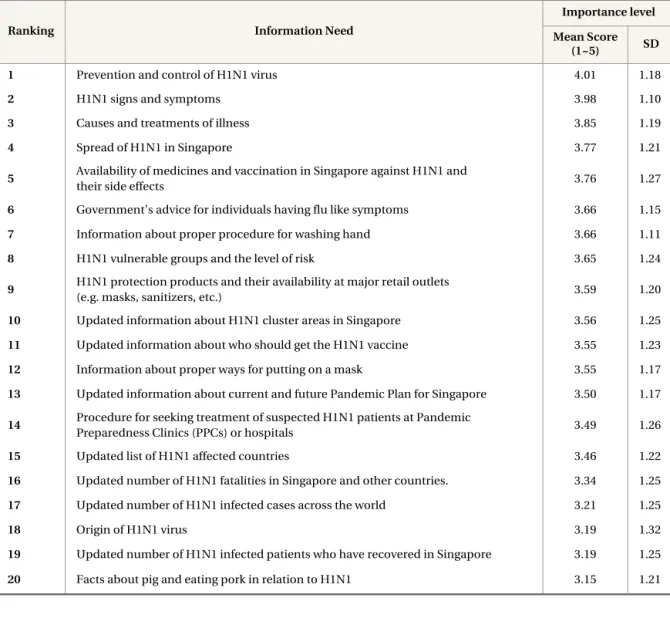
The respondents were asked to indicate the importance of different H1N1-related information needs, using a 5-point Semantic Differential scale where 1 represented the ‘least important’ and 5 the ‘most important’ information need (Table 3). The top 5 most important information needs were:
pre-Table 3. Importance of H1N1-related Information Needs (N=216)
Ranking Information Need
Importance level Mean Score
(1~5) SD
1 Prevention and control of H1N1 virus 4.01 1.18
2 H1N1 signs and symptoms 3.98 1.10
3 Causes and treatments of illness 3.85 1.19
4 Spread of H1N1 in Singapore 3.77 1.21
5 Availability of medicines and vaccination in Singapore against H1N1 and
their side effects 3.76 1.27
6 Government’s advice for individuals having flu like symptoms 3.66 1.15
7 Information about proper procedure for washing hand 3.66 1.11
8 H1N1 vulnerable groups and the level of risk 3.65 1.24
9 H1N1 protection products and their availability at major retail outlets
(e.g. masks, sanitizers, etc.) 3.59 1.20
10 Updated information about H1N1 cluster areas in Singapore 3.56 1.25
11 Updated information about who should get the H1N1 vaccine 3.55 1.23
12 Information about proper ways for putting on a mask 3.55 1.17
13 Updated information about current and future Pandemic Plan for Singapore 3.50 1.17
14 Procedure for seeking treatment of suspected H1N1 patients at Pandemic
Preparedness Clinics (PPCs) or hospitals 3.49 1.26
15 Updated list of H1N1 affected countries 3.46 1.22
16 Updated number of H1N1 fatalities in Singapore and other countries. 3.34 1.25
17 Updated number of H1N1 infected cases across the world 3.21 1.25
18 Origin of H1N1 virus 3.19 1.32
19 Updated number of H1N1 infected patients who have recovered in Singapore 3.19 1.25
vention and control of H1N1 virus (mean score 4.01); symptoms of H1N1 (mean score 3.98); causes and treatments (mean score 3.85); spread of H1N1 in Singapore (mean score 3.77); and availability of medicines and vaccination in Singapore (mean score 3.76). On the other hand, the information needs receiving lowest mean scores were: origin of H1N1virus (mean score 3.19); number of H1N1 recovered patients (mean score 3.19); and relation-ship between eating pork and H1N1 infection (mean score 3.15). As all the information needs fell in a small range of mean scores (3.15 - 4.01), it can be concluded that the respondents had very diverse information needs. A study by Wong and Sam (2010) also revealed that the two most important information needs during the Influenza A pandemic were prevention and treatment of H1N1 infection.
3.5. Information Seeking Behavior
The participants were asked to identify the sources they used for seeking the latest H1N1-relat-ed information during the peak period of the out-break. They were given several options under the broad categories of human sources, print sources, media sources, on-line sources, and health related websites. A 5-point Sem- antic Differential scale was used for data collection where 1 represented ‘least frequently’ and 5 ‘most frequently’ used informa-tion sources.
3.5.1. Use of Human Information Sources
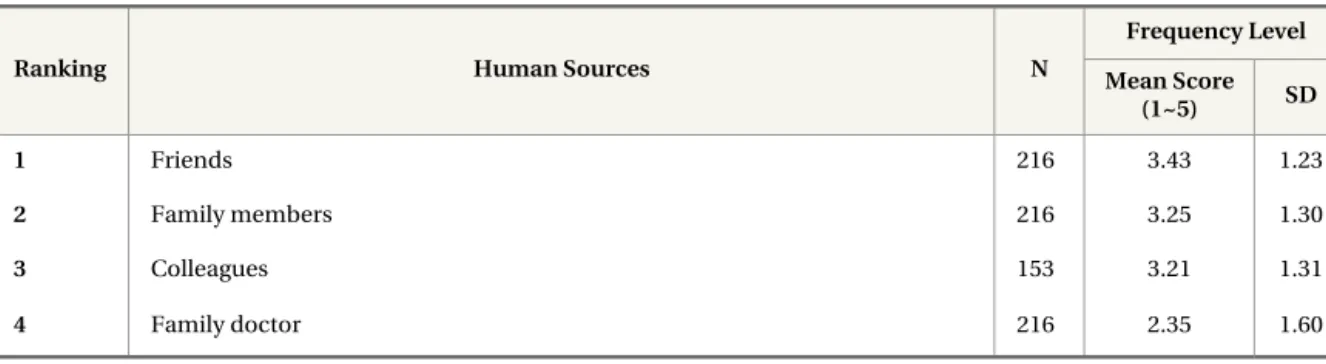
As shown in Table 4, the most frequently used human source for seeking H1N1-related informa-tion was friends (mean score 3.43), followed by
fam-ily members (mean score 3.25) and colleagues (mean score 3.21). Family doctors were approached the least frequently (mean score 2.35) for seeking H1N1 information probably because they were only consulted when it was suspected that someone was infected by the virus. Previously Wong and Sam (2010) also reported more dependence on family members and healthcare providers for getting infor-mation about the H1N1 pandemic.
Through an open-ended option, the respondents were asked to identify other human sources used by them for getting H1N1 information. Two sources reported more frequently were school teachers and institutional Human Resource (HR) staff. In many institutions, HR departments were required to pro-vide up-to-date information about H1N1to their staff as well as instructions about certain precau-tionary measures such as temperature recording, use of face masks, and travel advisories. A further data analysis showed that students were more likely to obtain information from their friends and teach-ers while working adults more likely from their col-leagues and HR department.
3.5.2. Print and Media Information Sources
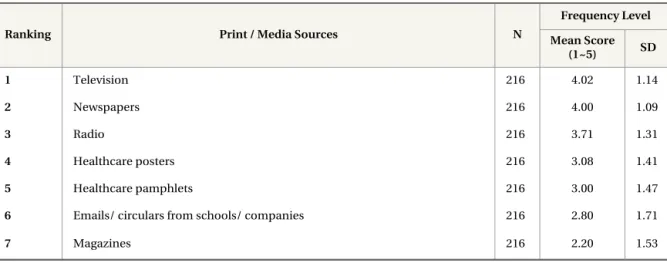
It was found that in this category the top three most frequently used sources were mass media sources, i.e. television (mean score 4.02), newspa-pers (mean score 4.00), and radio (mean score 3.71)(Table 5). Information used from these sources included news, announcements, and healthcare related government advisories. On the other hand, the least frequently used sources were magazines, emails, circulars sent by schools or company
man-Table 4. Preferred Human Sources
Ranking Human Sources N
Frequency Level Mean Score (1~5) SD 1 Friends 216 3.43 1.23 2 Family members 216 3.25 1.30 3 Colleagues 153 3.21 1.31 4 Family doctor 216 2.35 1.60
agement, and H1N1-related health pamphlets. It could be due to the reason that probably the respondents were flooded with many emails and they were getting almost the same instructions repeatedly from different sources. Magazines were the least frequently used source (mean score 2.20) probably due to their inability to provide up-to-date information. These findings are in line with previ-ous studies which also report a preference for mass media sources such as television, newspapers, and radio in an outbreak situation (Walter et al., 2012; Wong & Sam, 2010; Thom- pson, 2003).
3.5.3. Online Information Sources
On the whole, the respondents used online infor-mation sources less frequently (Table 6). Three
comparatively more frequently used online sources were school websites (mean score 2.65), news web-sites (mean score 2.60), and company intranets (mean score 2.56). Interestingly, social networking websites and online databases were the least fre-quently used online information sources.
In response to an open-ended option for online information sources, some respondents indicated Yahoo and Google as other means for seeking H1N1-related information. As Yahoo and Google are search engines, they were not considered as information sources in this study.
3.5.4. Health related Websites
The three most frequently used health websites for seeking H1N1-related information were the
Table 5. Preferred Print and Media Sources
Ranking Print / Media Sources N
Frequency Level Mean Score (1~5) SD 1 Television 216 4.02 1.14 2 Newspapers 216 4.00 1.09 3 Radio 216 3.71 1.31 4 Healthcare posters 216 3.08 1.41 5 Healthcare pamphlets 216 3.00 1.47
6 Emails/ circulars from schools/ companies 216 2.80 1.71
7 Magazines 216 2.20 1.53
Table 6. Preferred Online Sources
Ranking Online Sources N
Frequency Level Mean Score
(1~5) SD
1 School website 63 2.65 1.81
2 News websites (CNA , BBC, etc) 216 2.60 1.81
3 Company intranet 153 2.56 1.76
4 Social network websites (Twitter, Blogspot, etc) 216 1.98 1.69
Singapore Ministry of Health (mean score 2.82) website, a dedicated H1N1 website launched by the Singapore Ministry of Health, and the website of the Singapore Health Promotion Board (Table 7). However, certain international health-related web-sites such as WHO (mean score 2.06) and CDC (mean score 1.87) websites were the least frequently used for seeking H1N1-related information. It was surprising as WHO website provided very compre-hensive coverage during the H1N1 outbreak. A probable explanation is that most respondents believed that local websites could provide more up-to-date and directly relevant information about H1N1. A previous study by Walter et al. (2010) also
reported limited use of the Internet during a 2009 Influenza A outbreak in Germany.
3.5.5. Overall Most Preferred Information Sources
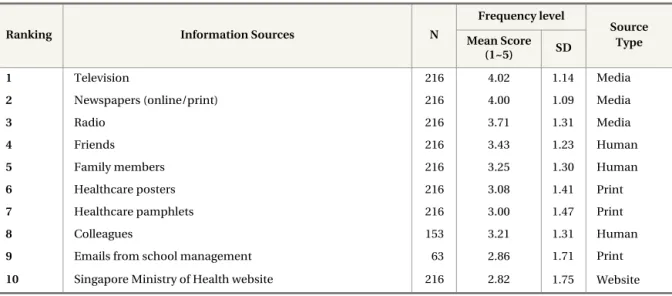
Table 8 presents a combined list of the top ten most preferred information sources for seeking H1N1-related information. The first top three posi-tions were occupied by mass media sources (Table 8). This was probably because these sources provid-ed very up-to-date H1N1-relatprovid-ed news as well as government announcements and advisories. The next two important information sources were friends and family members. It is worth noting that, on the whole, online information sources andTable 7. Preferred Health Web Sources (N=216)
Ranking Health Related Web Sources
Frequency Level Mean Score
(1~5) SD
1 Ministry of Health, Singapore (www.moh.gov.sg) 2.82 1.75
2 Dedicated H1N1 website, Ministry of Health, Singapore (now unavailable) 2.78 1.76
3 Health Promotion Board, Singapore (www.hpb.gov.sg) 2.66 1.70
4 Influenza A Home - Singapore Government Crisis News (now unavailable) 2.25 1.74
5 World Health Organization (WHO) (http://www.who.int/en/) 2.06 1.71
6 Center for Disease Control and Prevention (CDC) (www.cdc.gov) 1.87 1.74
Table 8. Top 10 Sources for Seeking H1N1- related Information
Ranking Information Sources N
Frequency level Source Type Mean Score (1~5) SD 1 Television 216 4.02 1.14 Media
2 Newspapers (online/print) 216 4.00 1.09 Media
3 Radio 216 3.71 1.31 Media
4 Friends 216 3.43 1.23 Human
5 Family members 216 3.25 1.30 Human
6 Healthcare posters 216 3.08 1.41 Print
7 Healthcare pamphlets 216 3.00 1.47 Print
8 Colleagues 153 3.21 1.31 Human
9 Emails from school management 63 2.86 1.71 Print
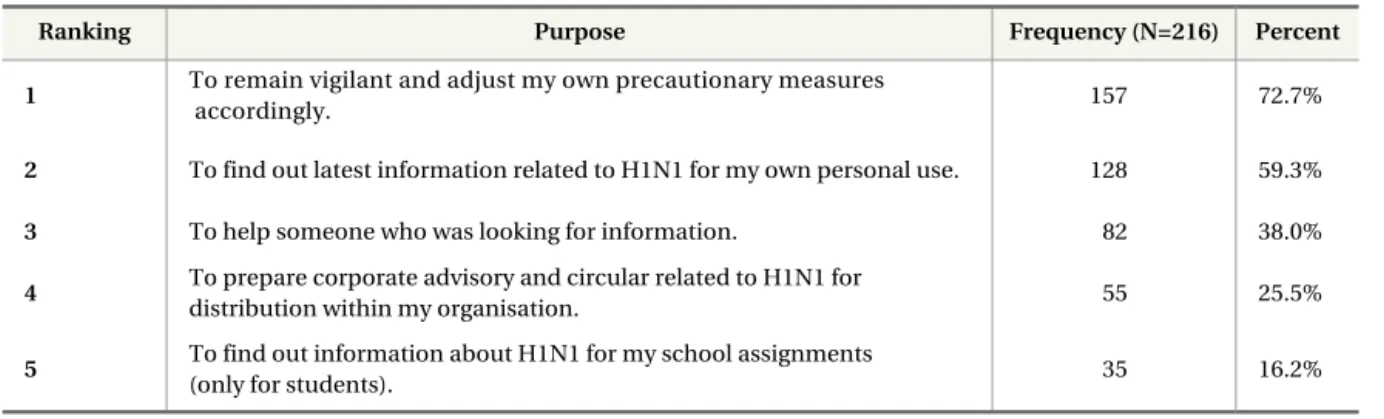
Table 9. Purpose of Seeking H1N1 Information (multiple responses)
Ranking Purpose Frequency (N=216) Percent
1 To remain vigilant and adjust my own precautionary measures
accordingly. 157 72.7%
2 To find out latest information related to H1N1 for my own personal use. 128 59.3%
3 To help someone who was looking for information. 82 38.0%
4 To prepare corporate advisory and circular related to H1N1 for
distribution within my organisation. 55 25.5%
5 To find out information about H1N1 for my school assignments
(only for students). 35 16.2%
health-related websites were least frequently used for seeking H1N1 information. This was particularly surprising as IT literacy in Singapore is quite high and more than 90% of the households have Internet access. It is possible that most of the H1N1-related information needs of the respondents were ade-quately met through mass media and people close to them, and therefore there was no pressing need to further search online sources and websites.
3.5.6. Purposes of Seeking H1N1-related Information
After investigating respondents’ preference for different information sources, they were asked to indicate their purposes in seeking H1N1-related information. The respondents were allowed to select more than one option from the list provided. Though respondents were also given an open-ended option to indicate additional purposes, none of them provided any input.
As shown in Table 9, the two most important pur-poses for seeking H1N1-related information were ‘to remain vigilant and adjust precautionary measures accordingly’ and ‘to keep themselves informed of the latest news.’ It appeared that a majority of the respon-dents were concerned about the emergence of a new virus and wanted to protect themselves and family members against this virus. A considerable number of the respondents also revealed that they sought H1N1 information for its possible dissemination to other interested individuals. This indicated their sense of social responsibility and willingness to help other community members.
3.6. Problems in Using H1N1-releated
Infor-mation
One concern during the H1N1 outbreak was the ability of the general public to adequately under-stand terminology used in news and public com-munications. A list of 8 routinely used H1N1-related terms was provided in the questionnaire and the respondents were asked to point out difficult or confusing terms. It was found that a majority of the respondents (64%) were unable to understand the term ‘DORSCON’ alert levels, which indicate the risk of acquiring an infectious disease (Table 10). Two other difficult to understand terms or concepts were ‘Mitigation Phase’ and ‘Pandemic Business Continuity program.’ The mitigation phase started when the H1N1 flu was expected to be managed in a similar manner to a seasonal flu. The Pandemic Business Continuity program was started by the Singapore government during the H1N1 outbreak to help businesses prepare to deal with the effects of the flu pandemic. The terms adequately understood by a majority of the respondents were ‘social dis-tancing,’ ‘contact tracing,’ ‘swine flu,’ and ‘Influen-za A.’ This recognition could be due to the reason that these terms appeared more frequently in the media and were more relevant to the respondents. Gerwin (2012) also argues the general public is likely to face difficulties in adequately understanding ter-minology in information disseminated by various media channels.
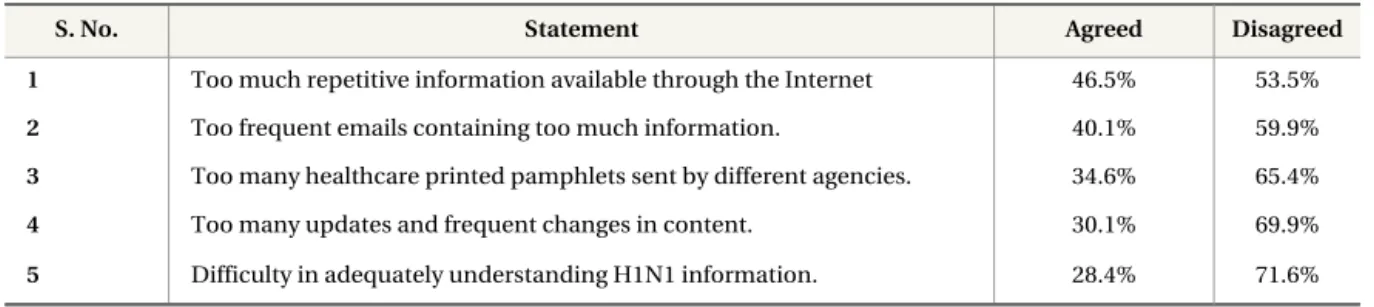
The participants were also asked if they faced any problems in seeking information during the H1N1 outbreak. Although a majority of the respondents
disagreed with the listed statements, two problems pointed out by a considerable number of the partic-ipants were the availability of too much repetitive information through the Internet, and too many emails providing too much H1N1 information (Table 11). The next two problems also highlighted the issue of excessive information availability. It appeared that some respondents were facing infor-mation overload due to availability of excessive and repetitive information about H1N1 from multiple sources. This also explains our earlier findings that emails and circulars were less preferred choices for seeking H1N1 information as probably the respon-dents were already overwhelmed by receiving fre-quent and repetitive updates from different agencies.
4. CONCLUSION
Due to rapid urbanization and frequent air travel, there is a real danger that a local disease outbreak
can easily become pandemic and spread all over the world within a very short period of time. In addition to other measures, creating awareness among the general public is essential to curtail the spread of any epidemic. To achieve this purpose, it is desir-able that we should adequately understand the information needs and seeking behavior of people during an outbreak. Such knowledge would be very useful to national and international health agencies, local public communication departments, hospi-tals, charity and relief organizations, information and communication professionals, and other public service agencies to prepare appropriate information strategies for implementation during possible future epidemics.
It was found that among all the information sources, television, newspapers, and radio were the most preferred sources for obtaining H1N1-related information. Some previous studies also suggest that these sources are frequently used by the gener-al public during epidemics and naturgener-al disasters.
Table 10. Unfamiliar H1N1- related Terms
Ranking Term Frequency Percent
1 DORSCON alert level 138 63.9%
2 Mitigation phase 100 46.3%
3 Flu Pandemic Business Continuity Program 96 44.4%
4 Containment phase 66 30.6%
5 Social distancing 32 14.8%
6 Contact tracing 30 13.9%
7 Swine flu 20 9.3%
8 Influenza A 19 8.8%
Table 11. Information Seeking Problems (N=216)
S. No. Statement Agreed Disagreed
1 Too much repetitive information available through the Internet 46.5% 53.5%
2 Too frequent emails containing too much information. 40.1% 59.9%
3 Too many healthcare printed pamphlets sent by different agencies. 34.6% 65.4%
4 Too many updates and frequent changes in content. 30.1% 69.9%
Thus relevant agencies should take full advantage of the power of mass media for providing emergency alerts, creating awareness, and disseminating nec-essary advisories during crises. Such efforts are like-ly to improve public preparedness to act responsi-bly and cooperate in the efforts to limit the impact of any outbreak.
It is equally important that all agencies involved in public awareness during an outbreak should actively collaborate and come up with common strategies for providing timely, relevant, and accu-rate health information to different segments of society. It appeared in this study that some of the respondents were unhappy about receiving too much repetitive information from multiple agen-cies. The danger is that involvement of too many agencies in public health communication may result in confusion, information overload, or even information anxiety. It would be more appropriate if concerned agencies decide on their information-related roles and responsibilities during a crisis and make necessary preparations accordingly.
REFERENCES
Caress, A., Duxbury, P., Woodcock, A., Luker, K., Ward, D., Campbell, M., & Austin, L. (2010). Exploring the needs, concerns and behaviours of people with existing respiratory conditions in relation to the H1N1 ‘swine influenza’ pandemic: a multi-centre survey and qualitative study. Health
Technology Assessment, 14(34), 1-108.
Dickmann, P., Rubin, G., Gaber, W., Wessely, S., Wicker, S., Serve, H., & Gottschalk, R. (2011). New Influenza A/H1N1 (‘Swine Flu’): Information needs of airport passengers and staff. Influenza
and other Respiratory Viruses, 5(1), 39-46.
Featherstone, R., Boldt, R., Torabi, N., & Konrad, S. (2012). Provision of pandemic disease informa-tion by health sciences librarians: A multisite comparative case series. Journal of the Medical
Library Association, 100(2), 104-112.
Gerwin, L. (2012). The challenge of providing the public with actionable information during a pandemic.
Journal of Law, Medicine & Ethics, 40(3), 630-654.
Holmes, B. J., Henrich, N., Hancock, S., & Lestou, V.
(2009). Communicating with the public during health crises: Experts’ experiences and opinions.
Journal of Risk Research, 12(6), 793-807.
Lagasse, L. P., Rimal, R. N., Smith, K. C., Storey, J., Rhoades, E., Barnett, D. J., & Links, J. (2011). How accessible was information about H1N1 flu? Literacy assessments of CDC guidance documents for different audiences. PLOS ONE, 6(10), 1-6. Macario, E., Ednacot, E., Ullberg, L., & Reichel, J.
(2011). The changing face and rapid pace of pub-lic health communication. Journal of
Communi-cation in Healthcare, 4(2), 145-150.
Tausczik, Y., Faasse, K., Pennebaker, J., & Petrie, K. (2012). Public anxiety and information seeking following the H1N1 outbreak: Blogs, newspaper articles, and Wikipedia visits. Health
Communi-cation, 27(2), 179-185.
Thompson, M. R., Heath, I., Ellis, B. G., Swarbrick, E. T., Wood, L. F., & Atkin, W. S. (2003). Identifying and managing patients at low risk of bowel can-cer in general practice. British Medical
Associa-tion Journal: Clinical Research EdiAssocia-tion, 327
(7409), 263-265.
Walter, D., Bohmer, M., Reiter, S., Krause, G., & Wichmann, O. (2012). Risk perception and infor-mation-seeking behaviour during the 2009/10 influenza A (H1N1) pdm09 pandemic in Ger-many. Euro Surveillance: European
Commu-nicable Disease Bulletin, 17(13).
Wong, L., & Sam, I. (2010). Public sources of infor-mation and inforinfor-mation needs for pandemic influenza A (H1N1). Journal of Community Health,
35(6), 676-682.
Yang, Z. (2012). Too scared or too capable? Why do college students stay away from the H1N1 vac-cine? Risk Analysis: An International Journal,
32(10), 1703-1716.
Yip, M., Ong, B., Painter, I., Meischke, H., Calhoun, B., & Tu, S. (2009). Information-seeking behaviors and response to the H1N1 outbreak in Chinese limited-English proficient individuals living in King County, Washington. American Journal of
Disaster Medicine, 4(6), 353-360.
Zach, L. (2011). What do I do in an emergency? The role of public libraries in providing information during times of crisis. Science & Technology