Can Perioperative Chemotherapy for Advanced Gastric Cancer Be Recommended on the Basis of Current Research?
A Critical Analysis
Katrin Bauer1, Franz Porzsolt2,3, and Doris Henne-Bruns3
1Department of General, Visceral, Vascular, Thoracic and Pediatric Surgery, Kempten Clinic, Kempten, 2Working Group “Healthcare Research”,
3Department of General and Visceral Surgery, Ulm University Clinic, Ulm, Germany
Purpose: According to current guidelines, perioperative chemotherapy is an integral part of the treatment strategy for advanced gastric cancer. Randomized controlled studies have been conducted in order to determine whether perioperative chemotherapy leads to im- proved R0 resection rates, fewer recurrences, and prolonged survival. The aim of our project was to critically appraise three major stud- ies to establish whether perioperative chemotherapy for advanced, potentially resectable gastric cancer can be recommended on the basis of their findings.
Materials and Methods: We analyzed the validity of the three most important studies (MAGIC, ACCORD, and EORTC) using a standard- ized questionnaire. Each study was evaluated for the study design, patient selection, randomization, changes in protocol, participating clinics, preoperative staging, chemotherapy, homogeneity of subjects, surgical quality, analysis of the results, and recruitment period.
Results: All three studies had serious shortcomings with respect to patient selection, homogeneity of subjects, changes in protocol, surgi- cal quality, and analysis of the results. The protocols of the MAGIC and ACCORD-studies were changed during the study period because of insufficient recruitment, such that carcinomas of the lower esophagus and the stomach were examined collectively. In neither the MAGIC study nor the ACCORD study did patients undergo adequate lymphadenectomy, and only about half of the patients in the che- motherapy group could undergo the treatment specified in the protocol. The EORTC study had insufficient statistical power.
Conclusions: We concluded that none of the three studies was sufficiently robust to justify an unrestrained recommendation for periop- erative chemotherapy in cases of advanced gastric cancer.
Key Words: Perioperative chemotherapy; Lower esophageal cancer; Stomach neoplasms; Cancer of the esophagogastric junction
Correspondence to: Katrin Bauer
Department of General, Visceral, Vascular, Thoracic and Pediatric Surgery, Kempten Clinic, Westendstrasse 9, 87439 Kempten, Germany Tel: +49-831-9606074, Fax: +49-831-83294
E-mail: [email protected] Received February 28, 2014 Revised March 18, 2014 Accepted March 20, 2014
Copyrights © 2014 by The Korean Gastric Cancer Association www.jgc-online.org
This is an open-access article distributed under the terms of the Creative Commons Attribution Non-Commercial License (http://creativecommons.org/
licenses/by-nc/3.0) which permits unrestricted noncommercial use, distribution, and reproduction in any medium, provided the original work is properly cited.
Introduction
Malignancies of the upper intestinal tract are among the most common cancers. Approximately 700,000 people die of gastric can- cer worldwide annually,1 and it is the fourth most common cancer
in the world; 989,000 new cases were diagnosed in 2008. The aver- age age at diagnosis in Germany is 71 years for men and 75 years for women.2 In Europe, the five-year survival rate for advanced gastric cancer was approximately 25% in 1999,3 and at present the five-year survival of patients treated with peri-, pre-, and postop- erative (radio-)chemotherapy protocols is estimated to still be only 25% to 30%.
To improve this prognosis, therapy was first augmented with adjuvant chemotherapy. The efficacy of this additional treatment has been analyzed in several meta-analyses, but none of these could find a significant survival advantage conferred by postopera- tive chemotherapy on a review of studies conducted in western
countries.4,5 As a result, a recommendation for postoperative che- motherapy for advanced gastric cancer could not be included in the German or European guidelines.6 Therefore, perioperative chemo- therapy for locally advanced and potentially resectable gastric can- cer has been studied for the past 20 years in an attempt to develop a more effective therapeutic approach.
Randomized, controlled phase III studies were performed to determine whether perioperative chemotherapy plus surgical resec- tion can improve the prognosis of patients with advanced, poten- tially curable gastric cancer as compared to surgical resection alone.
The following questions were to be examined in detail:
• Does an eventual downsizing of the primary tumor lead to an improvement in the R0 resection rate?
• Does this lead to a downstaging that improves the prognosis (in terms of the T and N stage)?
• Is the local recurrence rate reduced?
• Can the number of distant metastases be reduced by adminis- tering preoperative chemotherapy?
• Will disease-free survival and overall survival be prolonged?
The best-known, pioneering evaluation of perioperative che- motherapy for potentially resectable gastric cancer is the MAGIC study, conducted by Cunningham et al.7 and published in the New England Journal of Medicine in 2006. This study found that peri- operative chemotherapy could achieve an extrapolated improve- ment in the five-year survival rate of 13%. This was followed by the German EORTC study by Schuhmacher et al.8 in 2010, which demonstrated no significant survival advantage, but a significantly improved R0 resection rate, with the limitation that, because of the small number of patients recruited, the power of the study was not sufficient to support a definitive conclusion. The third, frequently cited study on this topic was published by the French working group under Ychou et al.9 in the Journal of Clinical Oncology in 2011. The authors concluded that a significantly better overall sur- vival rate as well as a significantly improved disease-free survival rate could be achieved five years after perioperative chemotherapy.
When the German S3 guidelines for the treatment of gastric cancer were developed (2010), the responsible commission had only the MAGIC study as a complete publication to base their recom- mendations on. The other studies (ACCORD and EORTC) were only available as abstracts. This corresponds to an evidence level of 1b (no meta-analyzes).
The recommendation in the German guidelines is that peri- operative chemotherapy should be performed for localized uT3 or resectable uT4a gastric cancers. According to the guidelines,
perioperative chemotherapy or radiochemotherapy should also be administered for advanced adenocarcinoma of the esophagogastric junction.
However, the decision reached by the 66 experts who helped to draft the guidelines was not unanimous. Fifty percent voted for an evidence level of B because of the identified shortcomings of the available studies. Criticisms of the MAGIC and ACCORD studies were primarily the lack of surgical and pathological quality controls as well as the fact that only approximately 50% of the patients in the chemotherapy group were able to complete the study according to protocol. The EORTC study was criticized for having an insuf- ficient power.
On the basis of the results of these three studies, many other European countries developed guidelines similar to those of Ger- many. Therefore, in this report, we refer to the European guide- lines, rather than the American or Asian guidelines, which currently recommend a different treatment for advanced gastric cancer.
Materials and Methods
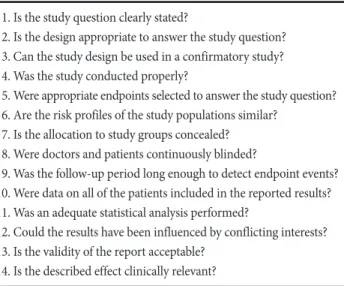
We analyzed the MAGIC, ACCORD, and EORTC studies using a standardized questionnaire to assess the validity of medical publi- cations,10 which is shown in Table 1. On the basis of this question- naire, the design, statistical analysis, and particularly the validity of each study were assessed. For a better understanding of the validity the studies we focused on the following topics: study design, patient selection, randomization, changes in protocol, participating clinics, preoperative staging, chemotherapy, homogeneity of subjects, sur-
Table 1. Standardized questionnaire used to assess the validity of medical publications
1. Is the study question clearly stated?
2. Is the design appropriate to answer the study question?
3. Can the study design be used in a confirmatory study?
4. Was the study conducted properly?
5. Were appropriate endpoints selected to answer the study question?
6. Are the risk profiles of the study populations similar?
7. Is the allocation to study groups concealed?
8. Were doctors and patients continuously blinded?
9. Was the follow-up period long enough to detect endpoint events?
10. Were data on all of the patients included in the reported results?
11. Was an adequate statistical analysis performed?
12. Could the results have been influenced by conflicting interests?
13. Is the validity of the report acceptable?
14. Is the described effect clinically relevant?
gical quality, analysis of the results, and recruitment period.
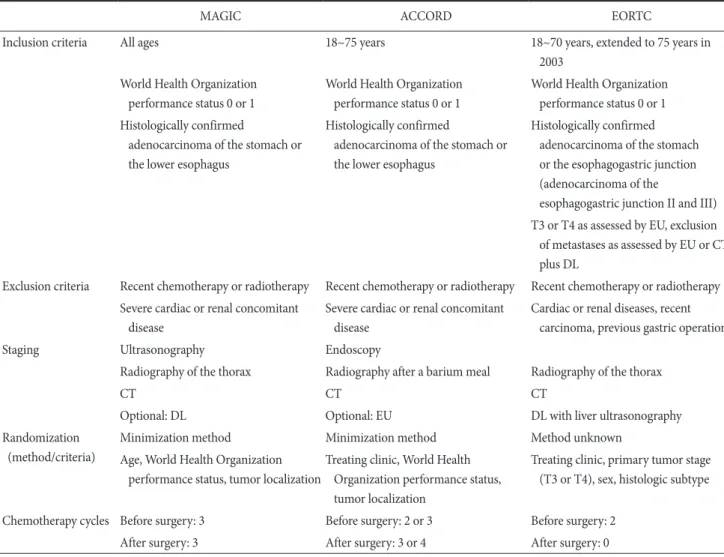
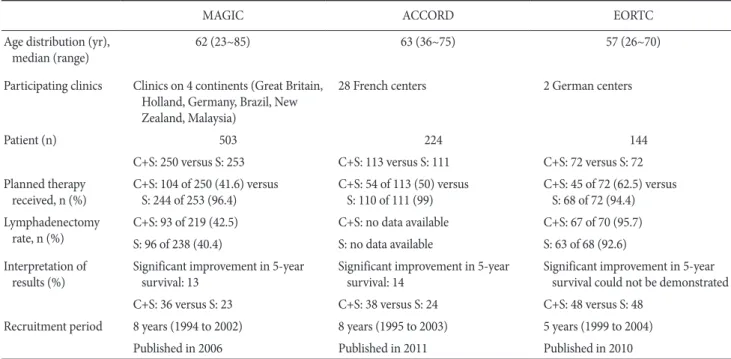
We first examined the validity of the MAGIC study.11 The aim of the current project was to critically appraise all three studies to determine whether perioperative chemotherapy for advanced, po- tentially resectable gastric cancer can be recommended on the basis of their findings. A detailed overview of the three analyzed studies (MAGIC, ACCORD, and EORTC) is given in Table 2, 3.
Results
1. Study design
All three perioperative therapy studies were designed as pro- spective, randomized phase III trials. The common primary endpoint was overall survival, and progression-free survival was defined as the secondary endpoint. The other secondary endpoints differed slightly between the three studies. For the MAGIC study,
these were clinical and pathological evidence of downstaging (tu- mor size and TNM status), the surgeon’s estimation of the curative nature of the intervention, and the patient’s health-related quality of life. However, quality of life was not explored in the study. The secondary endpoints of the ACCORD study were the R0 resection rate and safety, and for the EORTC study, the secondary endpoints were the R0 resection rate, toxicity associated with chemotherapy, postoperative morbidity, and the effect of chemotherapy on the primary tumor and lymph node metastasis.
All studies were approved by the local ethics committees (Current Controlled Trials number of the MAGIC study: ISRCTN93793971, ACCORD study: FNLCC ACCORD07-FFCD 9703 trial, EORTC study: European Organisation for Research and Treatment of Can- cer Randomized Trial 40954) and the patients in all studies signed written informed consent forms. None of the studies mentioned concealment of the randomisation plan.
Table 2. Comparison of the study design of the three analyzed studies
MAGIC ACCORD EORTC
Inclusion criteria All ages 18~75 years 18~70 years, extended to 75 years in
2003 World Health Organization
performance status 0 or 1
World Health Organization performance status 0 or 1
World Health Organization performance status 0 or 1 Histologically confirmed
adenocarcinoma of the stomach or the lower esophagus
Histologically confirmed
adenocarcinoma of the stomach or the lower esophagus
Histologically confirmed adenocarcinoma of the stomach or the esophagogastric junction (adenocarcinoma of the
esophagogastric junction II and III) T3 or T4 as assessed by EU, exclusion
of metastases as assessed by EU or CT plus DL
Exclusion criteria Recent chemotherapy or radiotherapy Recent chemotherapy or radiotherapy Recent chemotherapy or radiotherapy Severe cardiac or renal concomitant
disease
Severe cardiac or renal concomitant disease
Cardiac or renal diseases, recent carcinoma, previous gastric operations
Staging Ultrasonography Endoscopy
Radiography of the thorax Radiography after a barium meal Radiography of the thorax
CT CT CT
Optional: DL Optional: EU DL with liver ultrasonography
Randomization (method/criteria)
Minimization method Minimization method Method unknown
Age, World Health Organization performance status, tumor localization
Treating clinic, World Health Organization performance status, tumor localization
Treating clinic, primary tumor stage (T3 or T4), sex, histologic subtype
Chemotherapy cycles Before surgery: 3 Before surgery: 2 or 3 Before surgery: 2
After surgery: 3 After surgery: 3 or 4 After surgery: 0
EU = endoscopic ultrasonography; CT = computed tomography; DL = diagnostic laparoscopy.
2. Study population
The inclusion criteria were similar in all three studies. The MAGIC and ACCORD studies included adenocarcinomas of the lower esophagus, whereas the EORTC study only included gastric cancers. The EORTC study had stricter inclusion and exclusion cri- teria than the other two studies. Patients over 70 years of age were distinctly under-represented in all three studies; the study popula- tions had a median age of approximately 60 years, which did not correspond with the average age of patients with gastric and lower esophageal cancers.2
3. Randomization
Randomization was performed by the modified minimization method, in which patients were assigned to the treatment groups according to certain criteria in the MAGIC and ACCORD stud- ies.12,13 This minimization method is not generally recognized as randomization because the assignment to therapy is influenced by the designated criteria (e.g., age, performance status, tumor local- ization) and, therefore, is not based entirely on the random prin- ciple.14
4. Changes in protocol
In all three studies, changes were made to the study protocol after the study began.
1) The MAGIC study
Originally, only patients with gastric cancer were to be included in this study, but five years after the study began (1999), patients with adenocarcinoma of the lower esophagus were also included.
This leads us to believe that fewer patients were recruited than ini- tially expected, and that this was compensated for by expanding the inclusion criteria. The authors’ claim that an increasing incidence of tumors in the esophagogastric junction justified changing the pro- tocol of an ongoing study is difficult to accept because changes in the incidence of diseases occur over far longer intervals than those required for clinical studies. Another concern regarding the inter- pretation of the MAGIC study is that the Dutch FAMTX study, the cohort of which, according to the ‘Methods’ section of the MAGIC study, was originally supposed to be part of the MAGIC study population, had to be prematurely terminated after recruitment.
This early end to the FAMTX study was necessary because evalu- ation of the 59 patients involved revealed that the average overall survival was shorter among patients treated with perioperative che- motherapy than among those who were not (18 vs. 30 months).15 The patients in the FAMTX study were, therefore, not included in the MAGIC study after these results became known. Three years after the exclusion of the Dutch patients, it was decided that patients with adenocarcinomas of the lower esophagus would be included in the MAGIC study.
Table 3. Comparison of the results of the three analyzed studies
MAGIC ACCORD EORTC
Age distribution (yr),
median (range) 62 (23~85) 63 (36~75) 57 (26~70)
Participating clinics Clinics on 4 continents (Great Britain, Holland, Germany, Brazil, New Zealand, Malaysia)
28 French centers 2 German centers
Patient (n) 503 224 144
C+S: 250 versus S: 253 C+S: 113 versus S: 111 C+S: 72 versus S: 72 Planned therapy
received, n (%) C+S: 104 of 250 (41.6) versus
S: 244 of 253 (96.4) C+S: 54 of 113(50) versus
S: 110 of 111 (99) C+S: 45 of 72 (62.5) versus S: 68 of 72 (94.4) Lymphadenectomy
rate, n (%) C+S: 93 of 219(42.5) C+S: no data available C+S: 67 of 70 (95.7)
S: 96 of 238 (40.4) S: no data available S: 63 of 68 (92.6)
Interpretation of
results (%) Significant improvement in 5-year
survival: 13 Significant improvement in 5-year
survival: 14 Significant improvement in 5-year survival could not be demonstrated
C+S: 36 versus S: 23 C+S: 38 versus S: 24 C+S: 48 versus S: 48
Recruitment period 8 years (1994 to 2002) 8 years (1995 to 2003) 5 years (1999 to 2004)
Published in 2006 Published in 2011 Published in 2010
C+S = chemotherapy and surgery; S = surgery alone.
2) The ACCORD study
Although, according to the original study protocol, only patients with adenocarcinoma of the lower esophagus and the esopha- gogastric junction were meant to be included, the protocol was changed in 1998 (after the study had been ongoing for three years) to include patients with gastric cancer of the antrum and corpus.
No explanation was provided for the expanded inclusion criteria, but we assume that this was to compensate for the insufficient re- cruitment of patients.
The study populations of both the MAGIC and ACCORD stud- ies were evaluated together after the protocols had been changed, although they did not necessarily have the same prognosis even if they had the same tumor stage. Recent studies involving large patient populations have demonstrated that the prognosis for car- cinoma of the esophagogastric junction is not the same as that of gastric cancer, which led to a change in the Union for International Cancer Control classification.16,17 The prognoses of all carcinomas that reach the Z line at the esophagogastric junction (previously, adenocarcinoma of the esophagogastric junction I to III) are simi- lar to those of carcinomas of the esophagus. Even if there was no change in the surgical procedure, a change in the study protocol led to the combining of two different patient populations that should not have been examined together.
3) The EORTC study
The only change in the protocol of this study was an increase in the age limit for inclusion, to 75 years from 2003 onwards, probably due to difficulties in recruiting sufficient patients.
5. Participating clinics
We assume that the German and the French studies were performed according to their own guidelines, i.e., they had fairly uniform surgical criteria. However, the 129 surgeons from four dif- ferent continents in the MAGIC study presumably lacked precise instructions on the required surgical procedure and the extent of resection and D2 lymphadenectomy required, and acted largely according to subjective decisions. Even if these decisions were conscientiously made, they were nevertheless highly dependent on the surgeon’s individual training and the availability of technical equipment in the different countries (performance bias). We assume that the difficulties encountered in recruiting sufficient patients are responsible for the authors going to a considerably greater effort and accepting an undesired increase in operative variability in order to obtain a sufficiently large study cohort.
6. Staging
The decision to administer perioperative chemotherapy should be based on a precise and well-founded indication. In contrast to adjuvant therapy, perioperative chemotherapy is not based on a his- topathologically examined specimen obtained during the operation, but merely on clinical staging, which emphasizes the importance of the initial diagnosis. According to the German S3 guidelines, a spiral computed tomography scan of the thorax and abdomen and ultrasound-guided endoscopy should be performed. An additional laparoscopy can be performed to exclude occult peritoneal carci- nosis or small, previously undiscovered liver metastases.
An unavoidable study constraint is early randomization because immediately after staging―before operability can be confirmed by the surgeon―preoperative chemotherapy needs to be initiated in the study population assigned to the perioperative chemotherapy group.
An inoperable status can be determined (in both study arms) after the abdomen is operated upon, and this requires a deviation from the study protocol in the form of a modification of the planned surgical intervention.
Since the data required for a reliable prognosis for gastric cancer can only be obtained intraoperatively or by a histological examina- tion,18 it is difficult to confirm the indication for perioperative che- motherapy in a randomized study.
Even in the EORTC study, which had a considerably stricter protocol and which required diagnostic laparoscopy for staging, not all patients were correctly evaluated for operability preoperatively.
7. Chemotherapy
The administration of chemotherapy differed in two essential aspects between the three studies. In the MAGIC and ACCORD studies, chemotherapy was administered both pre- and postopera- tively, whereas only preoperative chemotherapy was administered in the EORTC study. Furthermore, in the EORTC study, folic acid was administered in addition to cisplatin and 5-fluorouracil.
8. Statistics/group homogeneity
1) The MAGIC study
A cursory comparison of the tabulated preoperative patient characteristics indicates no differences in the two randomized therapy groups. The median tumor size was 5 cm in both groups, suggesting homogeneity in this regard. However, the tumor size was only given for some patients (65% in the chemotherapy group and 72% in the group without chemotherapy). It remains unclear
whether the study findings would have changed significantly if these unreported tumor sizes had been included.
The 95% confidence interval (CI) is generally provided when testing heterogeneity. In this case, both the 95% CI and the 99% CI were reported, increasing the likelihood that the CIs of two groups could meet or even overlap. Provision of the 99% CI strengthens the impression that the study results do not differ for patients aged less than 60 years, those with a World Health Organization (WHO) performance status of 0, and those with a tumor location at the esophagogastric junction in the two arms, i.e., that these criteria were homogeneous. Use of the conventional 95% CI might have yielded different results.
2) The ACCORD study
A comparison of the tabulated preoperatively available patient characteristics indicates no essential difference in the two therapy groups with regard to age, gender, and WHO performance status.
However, the group without perioperative chemotherapy experi- enced dysphagia considerably more often preoperatively, which can be a sign of an advanced tumor stage.
3) The EORTC study
The distribution of patients according to the WHO performance status is slightly imbalanced in this study, with the group without perioperative chemotherapy having a higher proportion of patients with a good performance status. Other patient characteristics were evenly distributed.
9. Surgical quality
Data regarding the surgical intervention differ slightly in all studies and were insufficient, especially for the MAGIC and AC- CORD studies.
1) The MAGIC Study
The only definitive information provided about the surgical pro- cedure was that the resection edges of the intraoperative specimen were to be at least 3 cm from the tumor edges, which is insuf- ficient, at least for diffuse gastric cancer. Even if gastric cancers are not classified according to the Lauren classification in all countries, the lateral tumor expansion undermining the submucosa, charac- teristic of diffuse gastric cancer, is not a recent discovery.19
The proportion of patients who underwent D2 lymphadenec- tomy in addition to subtotal stomach resection or gastrectomy was very low (42.5% in the group with chemotherapy and 40.4% in the
group without chemotherapy).
2) The ACCORD study
The only instruction to surgeons was to completely remove the tumor and perform extended lymphadenectomy. Depending on the tumor location and the local practice, each surgeon decided on the operative procedure. Even if D2 lymphadenectomy was rec- ommended, the number of patients among whom it was actually performed was not stated in the tables. Only the range of excised lymph nodes (1~49 in the group that received chemotherapy and 2~82 in the group without chemotherapy) revealed that adequate lymphadenectomy was not performed in all patients.
3) The EORTC study
Subtotal resection or gastrectomy with D2 lymphadenectomy or even multivisceral resection with extended D3 lymphadenectomy was recommended if necessary, depending on the tumor location.
The distance between the tumor and resection edge reported by the surgeon was later confirmed by histopathological examination.
This raises the question of whether perioperative chemotherapy administered in the MAGIC and ACCORD studies could compen- sate for an inadequate operative technique.20 The extended resection and D2 lymphadenectomy, which were performed for every pa- tient in both groups in the EORTC study, may explain the above- average results for all patients in this study (median survival, 36 months) and thereby make it more difficult to decide on the value of perioperative chemotherapy.
Discussion
1. Analysis of the results
1) The MAGIC study
An appropriate analysis of the surgical and pathological results of both study groups is difficult because different subgroups were examined for each parameter. Neither the tables nor the text ex- plains why the lymph node status was only reported for patients with gastric cancer (135 in the chemotherapy group and 156 in the group without chemotherapy), while the assessment of cura- tive success, the description of the surgical intervention (including lymphadenectomy), and the T-stage were reported for all patients (244 in the chemotherapy group and 250 in the group without che- motherapy). Furthermore, the TNM stage was not described for every patient, and the reduction in the number of involved lymph
nodes in the chemotherapy group, as reported in the ‘Results’ sec- tion, does not apply to patients with cancers of the esophagogastric junction and the lower esophagus. Therefore, no statement can be made concerning lymph node involvement in 25% of the patients.
This makes it impossible to identify a trend in the entire patient population.
The validity of the study is limited because only 41% of the pa- tients who received perioperative chemotherapy were able to com- plete the study according to protocol, while 96.4% of the patients without perioperative chemotherapy could be treated according to protocol.
Most patients in the chemotherapy group (59%) actually re- ceived either no chemotherapy or chemotherapy that differed from that specified in the protocol, making it difficult to interpret the results for the majority of patients in this group.
2) The ACCORD study
Most of the tumors were located in the esophagogastric junction (144 patients [64%]). The two other subgroups (25 patients [11%]
with cancer of the esophagus and 55 patients [25%] with stomach cancer) were considerably smaller.
The ‘Results’ section reports an increased overall survival of 14% in the chemotherapy group. This suggests that perioperative chemotherapy was effective in all three subgroups. Critical assess- ment of the individual subgroups reveals, however, that the effect of chemotherapy was significant only for the subgroup with cancer of the esophagogastric junction. The two other subgroups were, ac- cording to the authors, too small to allow them to decide whether the therapy effect was minimal or non-existent. This means that no conclusions regarding the effect of perioperative chemotherapy can be made for more than one-third of the patients. Furthermore, only 50% of the patients in the chemotherapy group were able to complete the trial according to the study protocol. This proportion is too high, as this also includes patients who received only one or two postoperative cycles of chemotherapy. The study protocol, however, requires the administration of three to four cycles of che- motherapy; therefore, the number of patients who completed the study according to the protocol was in fact only 36%.
Since most patients randomized to receive perioperative che- motherapy in the MAGIC and ACCORD studies either did not re- ceive chemotherapy or did not receive chemotherapy according to protocol, it is surprising that this group, even if evaluated conser- vatively according to the intent-to-treat principle,21 demonstrated a significantly longer survival. This statistically significant differ- ence can only be explained if either the effect of chemotherapy on
survival is very strong or the identified shortcomings of the studies influence the positive result.
3) The EORTC study
Only 45 of 75 patients in the EORTC study received both planned chemotherapy cycles. The intent-to-treat principle was also applied in this study. The study was prematurely terminated in 2007 because of an insufficient number of recruited patients. Be- tween 1999 and 2004, only 144 of the planned 360 patients (40%) had been included, which limited the study’s validity a priori. No clear statement can be made regarding whether preoperative che- motherapy actually had no significant effect on overall survival or whether the power of the study was too low to confirm this ef- fect. Since both patient groups in the EORTC study had a signifi- cantly better outcome (overall survival, 36 months) than patients in the other two studies, the additional question of whether well- performed, radical surgery with conventional D2 lymphadenectomy was responsible for this effect arises.
2. Recruitment period
A further reason to question the homogeneity of the study groups arises from the eight-year recruitment period in the MAG- IC and ACCORD studies. Diagnostic techniques may improve over long recruitment periods, and thus, a patient diagnosed at the end of the study period may be recorded as having a higher tumor stage than an identical patient who was diagnosed at the beginning of the study (stage migration).22 This automatically leads to an unre- alistic result because patients with higher tumor stages now achieve survival times that were previously only achieved by patients with (presumably) lower tumor stages. This in turn gives the impression that survival among patients with higher tumor stages has improved when the patients were in fact only assigned a different tumor stage because of improved diagnostic methodology.
3. Summary
This critical analysis of the MAGIC, ACCORD, and EORTC studies has uncovered serious shortcomings particularly with regard to patient selection, changes in protocol, homogeneity of subjects, surgical quality, and analysis of the results.
We believe that none of these studies justify an unrestrained recommendation of perioperative chemotherapy for advanced gastric cancer. Therefore, the recommendations in the European guidelines for perioperative chemotherapy for gastric cancer should be re-evaluated.
References
1. World Cancer Research Fund International. Cancer frequency by country, Source: GLOBOCAN 2008 database (version 1.2) [Internet]. London: World Cancer Research Fund Internation- al; 2008 [updated 2014 Feb 14]. Available from: www.wcrf.org.
2. Robert-Koch-Institut. Cancer in Germany, friquencies and trends.222.rki/krebs.de [Internet]. Berlin: Robert-Koch-Insti- tut; 2010 [updated 2013 Dec 13]. Available from: http://www.
krebsdaten.de/Krebs/DE/Content/Krebsarten/Magenkrebs/
magenkrebs_node.html.
3. Verdecchia A, Francisci S, Brenner H, Gatta G, Micheli A, Mangone L, et al. Recent cancer survival in Europe: a 2000- 02 period analysis of EUROCARE-4 data. Lancet Oncol 2007;8:784-796.
4. GASTRIC (Global Advanced/Adjuvant Stomach Tumor Re- search International Collaboration) Group, Paoletti X, Oba K, Burzykowski T, Michiels S, Ohashi Y, et al. Benefit of adjuvant chemotherapy for resectable gastric cancer: a meta-analysis.
JAMA 2010;303:1729-1737.
5. Janunger KG, Hafström L, Glimelius B. Chemotherapy in gastric cancer: a review and updated meta-analysis. Eur J Surg 2002;168:597-608.
6. Moehler M, Al-Batran SE, Andus T, Anthuber M, Arends J, Arnold D, et al. German S3-guideline "Diagnosis and treat- ment of esophagogastric cancer". Z Gastroenterol 2011;49:461- 531.
7. Cunningham D, Allum WH, Stenning SP, Thompson JN, Van de Velde CJ, Nicolson M, et al. Perioperative chemotherapy versus surgery alone for resectable gastroesophageal cancer. N Engl J Med 2006;355:11-20.
8. Schuhmacher C, Gretschel S, Lordick F, Reichardt P, Hohen- berger W, Eisenberger CF, et al. Neoadjuvant chemotherapy compared with surgery alone for locally advanced cancer of the stomach and cardia: European Organisation for Research and Treatment of Cancer randomized trial 40954. J Clin Oncol 2010;28:5210-5218.
9. Ychou M, Boige V, Pignon JP, Conroy T, Bouché O, Lebreton G, et al. Perioperative chemotherapy compared with surgery alone for resectable gastroesophageal adenocarcinoma: an FNCLCC and FFCD multicenter phase III trial. J Clin Oncol 2011;29:1715-1721.
10. Porzsolt F, Braubach P, Flurschütz PI, Göller A, Sailer MB, Weiss M, et al. Medical students can help avoid the expert bias
in medicine. Creat Educ 2012;3:1115-1121.
11. Bauer K, Porzsolt F, Henne-Bruns D. Validity of the MAGIC study: sufficient for recommendations? Hepatogastroenterol- ogy 2013;60:1822-1824.
12. Taves DR. Minimization: a new method of assigning pa- tients to treatment and control groups. Clin Pharmacol Ther 1974;15:443-453.
13. Pocock SJ, Simon R. Sequential treatment assignment with balancing for prognostic factors in the controlled clinical trial.
Biometrics 1975;31:103-115.
14. Scott NW, McPherson GC, Ramsay CR, Campbell MK. The method of minimization for allocation to clinical trials. a re- view. Control Clin Trials 2002;23:662-674.
15. Hartgrink HH, van de Velde CJ, Putter H, Songun I, Tesselaar ME, Kranenbarg EK, et al. Neo-adjuvant chemotherapy for operable gastric cancer: long term results of the Dutch ran- domised FAMTX trial. Eur J Surg Oncol 2004;30:643-649.
16. Wittekind C, Bertolini J. TNM-system 2010. Onkol 2010;16:
175-180.
17. Rice TW, Rusch VW, Ishwaran H, Blackstone EH; Worldwide Esophageal Cancer Collaboration. Cancer of the esophagus and esophagogastric junction: data-driven staging for the seventh edition of the American Joint Committee on Cancer/
International Union Against Cancer Cancer Staging Manuals.
Cancer 2010;116:3763-3773.
18. Power DG, Schattner MA, Gerdes H, Brenner B, Markowitz AJ, Capanu M, et al. Endoscopic ultrasound can improve the selection for laparoscopy in patients with localized gastric can- cer. J Am Coll Surg 2009;208:173-178.
19. Lauren P. The two histological main types of gastric carcinoma:
diffuse and so-called intestinal-type carcinoma. an attempt at a histo-clinical classification. Acta Pathol Microbiol Scand 1965;64:31-49.
20. Songun I, Putter H, Kranenbarg EM, Sasako M, van de Velde CJ. Surgical treatment of gastric cancer: 15-year follow-up re- sults of the randomised nationwide Dutch D1D2 trial. Lancet Oncol 2010;11:439-449.
21. Lachin JM. Statistical considerations in the intent-to-treat principle. Control Clin Trial 2000;21:167-189.
22. Feinstein AR, Sosin DM, Wells CK. The Will Rogers phenom- enon. Stage migration and new diagnostic techniques as a source of misleading statistics for survival in cancer. N Engl J Med 1985;312:1604-1608.