© 2016 Korean Breast Cancer Society. All rights reserved. http://ejbc.kr | pISSN 1738-6756
INTRODUCTION
Recently, immune checkpoint blockades targeting pro- grammed death receptor 1 (PD-1) and PD-l ligand 1 (PD-L1, B7-H1) have shown promising therapeutic efficacy in several tumor types, particularly highly immunogenic tumors, such as non-small cell lung cancer (NSCLC), malignant melanoma, and renal cell carcinoma (RCC) [1]. PD-1 is a member of the
immunoglobulin superfamily first reported in 1992, and is expressed on activated T cells, B cells, natural killer cells, and myeloid cells [2]. PD-1 conveys an inhibitory signal to T cells and thus impedes immune responses [3]. PD-1 and its ligand, PD-L1, interact to downregulate the activation of T cells in autoimmune disease, chronic infection, and cancer. PD-L1 is expressed on activated T cells, B cells, macrophages, dendritic cells, and mesenchymal stem cells, as well as various tumor cells. Of note, expression of PD-L1 has been discovered in many epithelial cancers including NSCLC [4-6], malignant melanoma [7], colorectal carcinoma [8], gastric cancer [9], oral squamous cell carcinoma [10], RCC [11], and breast can- cer [12-15]. Although the predictive markers for PD-1 inhibi- tors (nivolumab and pembrolizumab) and PD-L1 inhibitors (MPDL3280A and MEDI4736) remain unclear, a few studies have demonstrated that responsiveness and clinical outcome are superior in patients with PD-L1-positive tumors detected
Expression of Programmed Death Receptor Ligand 1 with High Tumor-
Infiltrating Lymphocytes Is Associated with Better Prognosis in Breast Cancer
Sang Byung Bae*, Hyun Deuk Cho1*, Mee-Hye Oh1, Ji-Hye Lee1, Si-Hyong Jang1, Soon Auck Hong1, Junhun Cho1, Sung Yong Kim2, Sun Wook Han2, Jong Eun Lee2, Han Jo Kim, Hyun Ju Lee1
Departments of Hemato-Oncology, Internal Medicine, 1Pathology, and 2Surgery, Soonchunhyang University Cheonan Hospital, Soonchunhyang University College of Medicine, Cheonan, Korea
ORIGINAL ARTICLE
Purpose: The interaction of programmed death receptor 1 (PD-1) and its ligand, programmed death receptor ligand 1 (PD-L1), negatively regulates immune responses. This study aimed to clarify PD-L1 expression levels in breast cancer through immu- nohistochemistry (IHC) and to evaluate associations between these findings and clinicopathologic variables, including prog- nosis. Methods: PD-L1 expression was analyzed using IHC on tissue microarrays of 465 invasive breast carcinomas. Results:
High PD-L1 expression was demonstrated in 63 of 465 tumors (13.5%). High PD-L1 expression was significantly associated with high histologic grade (p<0.001), negative lymph nodes (p=0.011), early pathologic stage (p=0.025), high tumor-infil- trating lymphocyte (TIL) (p<0.001) counts, negative estrogen receptor (p<0.001) and progesterone receptor (p=0.002) ex- pression, positive human epidermal growth factor receptor 2 (HER2) (p=0.003), cytokeratin 5/6 (p=0.011), epidermal growth factor receptor (p<0.001), and p53 (p<0.001) expression, and high Ki-67 proliferating index (p<0.001). Based on intrinsic
subtypes, high PD-L1 expression and high TIL counts were significantly associated with the HER2 and triple-negative basal type (p<0.001). PD-L1 expression was significantly associated with better disease-free survival (DFS) (p=0.041) and overall survival (OS) (p=0.026) in the univariate analysis, but not in the multivariate analysis. Higher TIL levels was an independent prognostic factor for decreased disease progression (hazard ratio [HR], 2.389; 95% confidence interval [CI], 1.284–4.445;
p=0.006) and overall death (HR, 3.666; 95% CI, 1.561–8.607;
p=0.003). Conclusion: PD-L1 protein expression in breast cancer is associated with better DFS and OS, but is not an inde- pendent prognostic factor. High PD-L1 expression was signifi- cantly associated with high TIL levels. This finding has impor- tant implications for antibody therapies targeting the PD-1/PD-L1 signaling mechanism in breast cancer.
Key Words: Breast neoplasms, PD-L1, Prognosis, Tumor-infiltrating lymphocytes
Correspondence to: Hyun Ju Lee
Department of Pathology, Soonchunhyang University Cheonan Hospital, Soonchunhyang University College of Medicine, 31 Suncheonhyang 6-gil, Dongnam-gu, Cheonan 31151, Korea
Tel: +82-41-570-3589, Fax: +82-41-570-3580 E-mail: [email protected]
*These authors contributed equally to this work.
This work was supported by the Soonchunhyang University Research Fund.
Received: June 1, 2016 Accepted: August 18, 2016
Cancer
using immunohistochemistry (IHC) [1,5].
Although breast cancer is one of the less immunogenic tu- mors, triple-negative breast cancers (TNBCs) and human epi- dermal growth factor receptor 2 (HER2)-positive breast can- cers are thought to be more immunogenic than luminal A cancers, as evidenced by the tumor-infiltrating lymphocyte (TIL) composition within the tumor microenvironment [16].
In breast cancer, the reported frequency of PD-L1 expression by carcinoma cells varies considerably between studies (1.7%–
58%) [12,17-20]. Moreover, conflicting results have been pub- lished regarding the prognostic effect of PD-L1 expression in breast cancer [12,14,20,21]. Considering the clinical applica- tions of the PD-1/PD-L1 axis, analysis of PD-L1 expression and its prognostic role may have important implications for breast cancer treatment. Thus, we investigated the clinico- pathological and prognostic significance of PD-L1 expression in patients with invasive breast cancer using IHC, with a par- ticular emphasis on intrinsic subtype.
METHODS
Patients
We used a tissue microarray (TMA) encompassing 520 breast cancer tissue punches from formalin-fixed and paraffin- embedded tumors collected from patients diagnosed with pri- mary breast cancer between 2001 and 2013 at Soonchunhyang University Cheonan Hospital. Of these 520 tissue punches, 465 were evaluable for this study. The tissue samples were brought into a TMA format as previously described [22].
Briefly, 2-mm tissue cylinders were punched out of donor tu- mor tissue blocks and transferred into a recipient paraffin block using a manual TMA device (SuperBioChips Laborato- ries, Seoul, Korea). Histopathological data was obtained from the pathology reports. Hematoxylin and eosin (H&E)-stained slides were reviewed by two pathologists (H.D.C. and H.J.L.).
Tumor specimens were histopathologically diagnosed as invasive ductal carcinoma (IDC) (n=423), invasive lobular carcinoma (ILC) (n=20), mucinous carcinoma (n=10), metaplastic car- cinoma (n=5), medullary carcinoma (n=3), mixed IDC and ILC (n=1), mixed IDC and mucinous carcinoma (n=1), ad- enoid cystic carcinoma (n=1), and neuroendocrine carcino- ma, poorly differentiated (n=1). The scoring of TILs (defined as the percentage of stroma of invasive carcinoma infiltrated by lymphocytes and plasma cells in 10% increments) was per- formed in all available H&E-stained full sections [23]. TIL scores were classified into two groups, with a cutoff score of
≥40% (0%–30%, low expression; 40%–100%, high expres- sion), using a modified Schalper’s scoring method [21]. Areas in which there was discordance in TIL categorization between
pathologists were reviewed jointly and a single consensus cat- egory was established. Clinicopathological information, in- cluding patient age at initial diagnosis, tumor size, histological tumor grade, histological type, TNM stage, date of surgery, date of last follow-up, and date of recurrence or death, was collected retrospectively from the electronic medical records.
This study was approved by the Institutional Review Board at Soonchunhyang University Cheonan Hospital (SCHCA 2016- 05-017).
Immunohistochemistry
Using 4-μm thick TMA tissue sections, IHC for PD-L1 was performed. Sections were subjected to antigen retrieval using a Bond-Max automated immunostainer (Leica Microsystems, Bannockburn, USA). Primary antibody binding was detected with the Bond Polymer Refine Detection Kit (Leica Microsys- tems), according to the manufacturer’s instructions. Primary PD-L1 rabbit monoclonal antibody (clone E1L3N; Cell Sig- naling Technology, Beverly, USA) was used at a dilution of 1:100. Two independent observers (H.D.C. and H.J.L.) examined the slides in a blinded manner, and consensus was reached by repeated examination when results were discordant. Since PD-L1 is expressed on the cell membrane as well as the endo- membrane system, membranous as well as cytoplasmic stain- ing was considered positive. The histochemical score (H- score) was used to assess the intensity of staining and the per- centage of stained cells. Staining intensity was scored as nega- tive (score=0), weak (score=1), moderate (score=2), or strong (score=3). The percentage of positive cells at each in- tensity was subjectively estimated to produce a final score in the range of 0 to 300, by multiplying each score. PD-L1 ex- pression was categorized into two groups according to the fre- quency distributions of the H-scores, using a cutoff score of
≥100 (H-score 0–99, low expression; 100–300, high expres- sion), using a modified Muenst’s scoring method [12].
The expression levels of standard biomarkers, including es- trogen receptor (ER; 1:50), progesterone receptor (PR; 1:50), HER2 (1:200), Ki-67 (1:800), cytokeratin 5/6 (CK5/6; 1:50), epidermal growth factor receptor (EGFR; 1:100), and p53 (1:1,200) were available in all samples. The staining intensity of ER, PR, and HER2 was scored as described previously [22].
Statistical analyses
SPSS version 19.0 software (IBM Corp., Armonk, USA) was used. Pearson chi-square test (or Fisher exact test when the number of cases in a category was <10) was used to ana- lyze categorical data between PD-L1 high and low expression.
Disease-free survival (DFS) and overall survival (OS) on the basis of expression of PD-L1 were assessed by the Kaplan-
Meier method with the log-rank test. Survivors were censored at the date of last contact. Multivariate survival analysis using the Cox proportional hazards regression model was per- formed to adjust for variables that may have been statistically significant for prognosis in univariate analysis. Significance was defined as p<0.05.
RESULTS
Patient characteristics and PD-L1 immunoreactivity
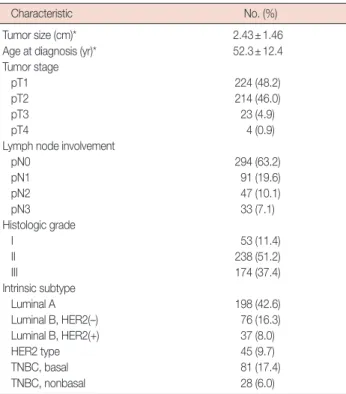
Demographic information of the patients is provided in Ta-
ble 1. This study included 459 women (98.7%) and six men (1.3%). The mean age was 52.3 years (standard deviation, 12.4; range, 24–81 years). The mean tumor size was 2.43±1.46 cm (range, 0.3–12 cm). Primary tumor size data were calcul- ated for the 465 patients. From this analysis, 224 patients (48.2%) were found to have pT1 tumors, 214 patients (46.0%) had pT2 tumors, 23 patients (4.9%) had pT3 tumors, and four patients (0.9%) had pT4 tumors. Among the 465 patients, lymph node metastasis was detected in 171 patients (36.8%).
Of the 465 samples, 53 were histological grade 1 (11.4%), 238 were histological grade 2 (51.2%), and 174 were histological grade 3 (37.4%). The tumors from the 465 patients were clas- sified, applying the TNM classification system, as stage I (n =165, 35.5%), stage II (n =213, 45.8%), and stage III (n=87, 18.7%). The proportions of patient tumors positive for ER and PR expression were 66.9% and 35.5%, respectively.
Analysis for HER2 expression revealed that 17.7% of all pa- tient tumors were positive. High Ki-67 expression was noted in 44.9% of tumors. Positive CK5/6 expression levels were found in 9.7%. Positive EGFR expression levels were found in 21.1% of tumors, while 17.8% of patient tumors were positive for p53 expression.
Membranous as well as cytoplasmic expression of PD-L1 protein was observed in breast tumor cells (Figure 1). For sta- tistical analyses, the cases were subdivided into a PD-L1-high expression group (n=63, 13.5%) and a PD-L1-low expression group (n=402, 86.5%).
Correlations between PD-L1 expression and clinicopathologic parameters
High PD-L1 expression was significantly associated with high histologic grade (p<0.001), negative lymph node metas- tasis (p=0.011), early pathologic stage (p=0.025), and high TIL counts (p<0.001) (Table 2). The expression of PD-L1 was negatively associated with ER (p<0.001) and PR (p=0.002) expression, and positively associated with HER2 expression Table 1. Basic demographic data for 465 evaluable breast cancer cases
Characteristic No. (%)
Tumor size (cm)* 2.43±1.46
Age at diagnosis (yr)* 52.3±12.4
Tumor stage
pT1 224 (48.2)
pT2 214 (46.0)
pT3 23 (4.9)
pT4 4 (0.9)
Lymph node involvement
pN0 294 (63.2)
pN1 91 (19.6)
pN2 47 (10.1)
pN3 33 (7.1)
Histologic grade
I 53 (11.4)
II 238 (51.2)
III 174 (37.4)
Intrinsic subtype
Luminal A 198 (42.6)
Luminal B, HER2(–) 76 (16.3)
Luminal B, HER2(+) 37 (8.0)
HER2 type 45 (9.7)
TNBC, basal 81 (17.4)
TNBC, nonbasal 28 (6.0)
HER2=human epidermal growth factor receptor 2; TNBC=triple-negative breast cancer.
*Mean±SD.
Figure 1. Immunohistochemical analysis of programmed death receptor 1 (PD-L1) expression in breast cancer: (A) normal breast (×200), (B) low ex- pression (×200), and (C) high expression. Note that PD-L1 protein is expressed membranous as well as cytoplasmic in tumor cells (×200).
A B C
(p=0.003), Ki-67 staining index (p<0.001), CK5/6 expres- sion (p=0.011), EGFR expression (p<0.001), and p53 expres- sion (p<0.001) (Table 2). There was no significant association between PD-L1 and age (p=0.139), sex (p=0.605), histology (p=0.166), or tumor stage (p=0.812).
Interestingly, a strong correlation was observed between PD-L1 expression and the various intrinsic subtypes of breast cancer (p<0.001) (Table 3). High PD-L1 expression was sig- nificantly correlated with basal TNBC (29.6%) and HER2 type cancer (28.9%), but high PD-L1 was not associated with luminal A cancer (2.5%), HER2-negative luminal B (17.1%), HER2-positive luminal B (18.9%), or nonbasal TNBC (3.6%).
High TIL levels were also significantly associated with basal TNBC (69.1%) and HER2 type cancer (68.9%) (p<0.001) (Table 3). High PD-L1 expression was significantly associated with high TIL counts in luminal A cancer (23.5%, p<0.001) (Table 4), HER2-negative luminal B (38.5%, p =0.001), HER2-positive luminal B (35.0%, p=0.009), and HER2 type cancer (41.9%, p=0.004), as well as basal TNBC (42.9%, p<0.001), but high PD-L1 expression was not associated with high TIL levels in non-basal TNBC (7.7%, p=0.464).
Survival analysis
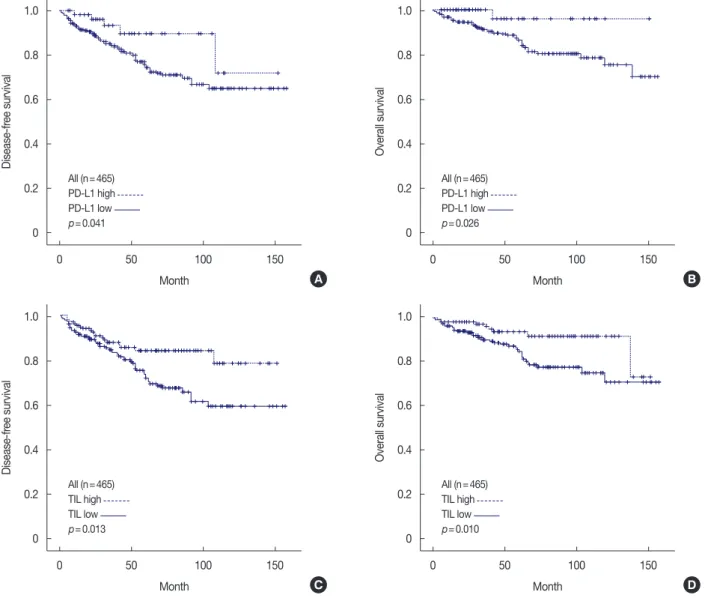
During a median follow-up period of 41.0 months (range, 1–158 months), disease recurrence was observed in 86 pa- tients (18.5%), and 51 patients (11.0%) died. The 4-year OS rates for patients with invasive breast cancer with high or low PD-L1 expression were 98.4% and 87.6%, respectively. In the univariate survival analyses, patients with breast tumors ex- pressing PD-L1 had significantly better DFS (p=0.041) and OS (p=0.026) (Table 5, Figure 2A and B). The presence of higher TIL levels was also associated with better DFS (p=0.013) and OS (p=0.010) (Table 5, Figure 2C and D). To evaluate PD-L1 positivity in invasive breast cancer as an independent prognostic factor of DFS and OS, multivariate analysis using the Cox proportional hazards model was performed, and includ- ed PD-L1 expression, TIL status, age, tumor size, lymph node metastasis, pathologic stage, and intrinsic subtype. Multivari- ate analysis revealed that expression of PD-L1 was not an in- dependent prognostic factor for disease progression (hazard ratio [HR], 1.937; 95% confidence interval [CI], 0.701–5.354;
p=0.203) or overall death (HR, 4.837; 95% CI, 0.584–40.087;
p=0.144) (Table 6). However, the presence of higher TIL lev- els proved to be an independent prognostic factor for de- creased disease progression (HR, 2.389; 95% CI, 1.284–4.445;
p=0.006) and overall death (HR, 3.666; 95% CI, 1.561–8.607;
p=0.003).
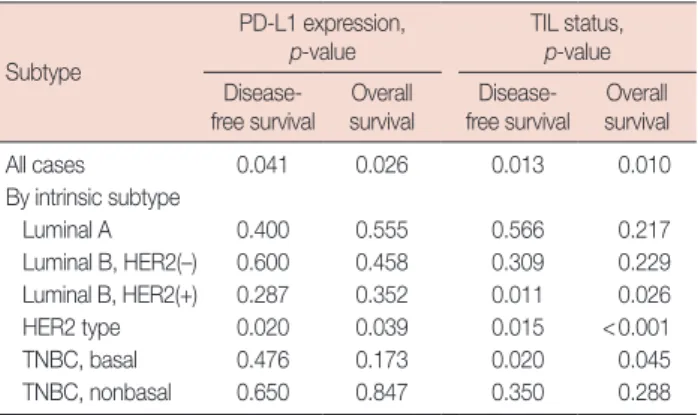
In subset analyses by intrinsic subtype, PD-L1 expression was associated with improved DFS (p =0.020) and OS Table 2. Association between PD-L1 expression and clinicopathologi-
cal parameters
Clinicopathologic parameter PD-L1, No (%)
p-value High (n=63) Low (n=402)
Age (yr) 0.139
<50 36 (16.0) 189 (84.0)
≥50 27 (11.3) 213 (88.8)
Sex 0.605
Female 63 (13.7) 396 (86.3)
Male 0 6 (100)
Histology 0.166
IDC 59 (13.9) 364 (86.1)
ILC 0 20 (100)
Others 4 (18.2) 18 (81.8)
Histologic grade <0.001
I 0 53 (100)
II 16 (6.7) 222 (93.3)
III 47 (27.0) 127 (73.0)
Tumor stage 0.812
pT1 30 (13.4) 194 (86.6)
pT2 30 (14.0) 184 (86.0)
pT3 2 (8.7) 21 (91.3)
pT4 1 (25.0) 3 (75.0)
Lymph node involvement 0.011
Negative 49 (16.7) 245 (83.3)
Positive 14 (8.2) 157 (91.8)
Pathologic stage 0.025
I 25 (15.2) 140 (84.8)
II 34 (16.0) 179 (84.0)
III 4 (4.6) 83 (95.4)
Tumor-infiltrating lymphocytes <0.001
Low 4 (1.3) 298 (98.7)
High 59 (36.2) 104 (63.8)
ER <0.001
Positive 25 (8.0) 286 (92.0)
Negative 38 (24.7) 116 (75.3)
PR 0.002
Positive 11 (6.7) 154 (93.3)
Negative 52 (17.3) 248 (82.7)
HER2 0.003
Positive 20 (24.4) 62 (75.6)
Negative 43 (11.2) 340 (88.8)
Ki-67 (%) <0.001
<14 6 (2.3) 250 (97.7)
≥14 57 (27.3) 152 (72.7)
CK5/6 0.011
Positive 12 (26.7) 33 (73.3)
Negative 51 (12.1) 369 (87.9)
EGFR <0.001
Positive 27 (27.6) 71 (72.4)
Negative 36 (9.8) 331 (90.2)
p53 <0.001
Positive 27 (32.5) 56 (67.5)
Negative 36 (9.4) 346 (90.6)
PD-L1 =programmed death ligand 1; IDC =invasive ductal carcinoma;
ILC=invasive lobular carcinoma; ER=estrogen receptor; PR=progesterone receptor; HER2 =human epidermal growth factor receptor 2; EGFR = epidermal growth factor receptor.
Table 3. Comparison of PD-L1 expression, TIL status and breast cancer intrinsic subtype
Intrinsic subtype PD-L1, No (%)
p-value TIL, No. (%)
p-value
High (n=63) Low (n=402) High (n=163) Low (n=302)
Luminal A 5 (2.5) 193 (97.5) <0.001 17 (8.6) 181 (91.4) <0.001
Luminal B, HER2(–) 13 (17.1) 63 (82.9) 26 (34.2) 50 (65.8)
Luminal B, HER2(+) 7 (18.9) 30 (81.1) 20 (54.1) 17 (45.9)
HER2 type 13 (28.9) 32 (71.1) 31 (68.9) 14 (31.1)
TNBC, basal 24 (29.6) 57 (70.4) 56 (69.1) 25 (30.9)
TNBC, nonbasal 1 (3.6) 27 (96.4) 13 (46.4) 15 (53.6)
PD-L1=programmed death ligand 1; TIL=tumor-infiltrating lymphocytes; HER2=human epidermal growth factor receptor 2; TNBC=triple-negative breast cancer.
Figure 2. Kaplan-Meier survival curves for programmed death receptor 1 (PD-L1) (A, B) and tumor-infiltrating lymphocyte (TIL) (C, D). (A) Disease-free survival (DFS; p=0.041) and (B) overall survival (OS; p=0.026) in breast cancer (n=465). Statistically significant differences between high and low TIL of (C) DFS (p=0.013) and (D) OS (p=0.010).
1.0
0.8
0.6
0.4
0.2
0
1.0
0.8
0.6
0.4
0.2
0
1.0
0.8
0.6
0.4
0.2
0
1.0
0.8
0.6
0.4
0.2
0
0 50 100 150
0 50 100 150
0 50 100 150
0 50 100 150
Month
Month
Month
Month
Disease-free survivalDisease-free survival Overall survivalOverall survival
A
C
B
D All (n=465)
All (n=465)
All (n=465)
All (n=465) PD-L1 high
TIL high
PD-L1 high
TIL high PD-L1 low
TIL low
PD-L1 low
TIL low p=0.041
p=0.013
p=0.026
p=0.010
(p=0.039) in the HER2 subtype (Table 5, Figure 3A and B).
Of note, there was no association between PD-L1 expression and DFS and OS in the luminal A subtype, HER2-negative lumi-
nal B subtype, HER2-positive luminal B subtype, basal TNBC subtype, or nonbasal TNBC subtype (Table 5, Supplementary Figures 1 and 2, available online). In patients with HER2-positive
Table 6. Multivariate analysis for the effect of clinicopathologic parameters and PD-L1 expression and TIL status on disease-free survival and overall survival
Variable Disease-free survival Overall survival
HR (95% CI) p-value HR (95% CI) p-value
PD-L1 expression 0.203 0.144
High 1 1
Low 1.937 (0.701–5.354) 4.837 (0.584–40.087)
TIL status 0.006 0.003
High 1 1
Low 2.389 (1.284–4.445) 3.666 (1.561–8.607)
Age (yr) 0.038 0.003
<50 1 1
≥50 1.637 (1.027–2.607) 2.804 (1.419–5.541)
Tumor stage 0.059 0.035
T1, T2 1 1
T3, T4 1.888 (0.977–3.650) 2.286 (1.061–4.924)
Lymph node involvement 0.095 0.658
Negative 1 1
Positive 1.829 (0.900–3.719) 1.260 (0.453–3.505)
Pathologic stage 0.029 0.026
I 1 1
II 1.727 (0.784–3.804) 0.175 2.046 (0.675–6.208) 0.206
III 3.589 (1.299–9.916) 0.014 6.199 (1.451–26.482) 0.014
Intrinsic subtype <0.001 <0.001
Luminal A 1 1
Luminal B, HER2(–) 1.201 (0.638–2.263) 0.570 0.943 (0.371–2.398) 0.903
Luminal B, HER2(+) 0.944 (0.358–2.493) 0.908 1.437 (0.457–4.519) 0.535
HER2 type 5.312 (2.667–10.582) <0.001 7.228 (2.964–17.624) <0.001
TNBC, basal 1.645 (0.808–3.351) 0.170 2.562 (1.078–6.092) 0.033
TNBC, nonbasal 1.174 (0.487–2.825) 0.721 1.800 (0.618–5.244) 0.281
PD-L1=programmed death ligand 1; TIL=tumor-infiltrating lymphocytes; HR=hazard ratio; CI=confidence interval; HER2=human epidermal growth factor re- ceptor 2; TNBC=triple-negative breast cancer.
Table 4. Association between PD-L1 expression and TIL status accord- ing to breast cancer intrinsic subtype
Intrinsic subtype TIL PD-L1, No. (%)
p-value
High Low
Luminal A <0.001
Low 1 (0.6) 180 (99.4) High 4 (23.5) 13 (76.5)
Luminal B, HER2(–) 0.001
Low 3 (6.0) 47 (94.0) High 10 (38.5) 16 (61.5)
Luminal B, HER2(+) 0.009
Low 0 17 (100)
High 7 (35.0) 13 (65.0)
HER2 type 0.004
Low 0 14 (100)
High 13 (41.9) 18 (58.1)
TNBC, basal <0.001
Low 0 25 (100)
High 24 (42.9) 32 (57.1)
TNBC, nonbasal 0.464
Low 0 15 (100)
High 1 (7.7) 12 (92.3)
PD-L1 =programmed death ligand 1; TIL =tumor-infiltrating lymphocytes;
HER2=human epidermal growth factor receptor 2; TNBC=triple-negative breast cancer.
Table 5. Univariate analyses for all cases, and by intrinsic subtype, for the effect of PD-L1 expression and TIL status on disease-free survival and overall survival
Subtype
PD-L1 expression, p-value
TIL status, p-value Disease-
free survival
Overall survival
Disease- free survival
Overall survival
All cases 0.041 0.026 0.013 0.010
By intrinsic subtype
Luminal A 0.400 0.555 0.566 0.217
Luminal B, HER2(–) 0.600 0.458 0.309 0.229 Luminal B, HER2(+) 0.287 0.352 0.011 0.026 HER2 type 0.020 0.039 0.015 <0.001
TNBC, basal 0.476 0.173 0.020 0.045
TNBC, nonbasal 0.650 0.847 0.350 0.288 PD-L1 =programmed death ligand 1; TIL =tumor-infiltrating lymphocytes;
HER2=human epidermal growth factor receptor 2; TNBC=triple-negative breast cancer.
luminal B tumors, the presence of higher TIL levels was asso- ciated with better DFS (p=0.011) and OS (p=0.026). In pa- tients with HER2-positive disease, the presence of higher TIL levels was also associated with superior DFS (p=0.015) and
OS (p < 0.001) (Table 5, Figure 3C and D). Similarly, in patients with basal TNBC, the presence of higher TIL levels was also associated with better DFS (p =0.020) and OS (p=0.045). Multivariate analysis using the Cox proportional hazards model found that neither high expression of PD-L1 nor high TIL levels in patients with HER2-positive disease was associated with significantly different DFS or OS.
DISCUSSION
PD-L1 expression was apparent in 13.5% (n=465) of inva- sive breast cancer specimens. As previously described, the H- score (which comprises the intensity of staining and the per-
centage of stained cells) was used to assess the expression of PD-L1 [12]. In breast cancer, the reported frequency of PD- L1 expression by carcinoma cells varies considerably between studies [12,17-20]. In a study that analyzed tissue from 44 pa- tients, PD-L1 was expressed in 34% of breast cancers using the mouse monoclonal MIH1 clone [18]. In a subsequent study conducted by the same group and using an expanded version of the cohort (n=69), PD-L1 expression was reported in 29% of breast carcinomas [19]. A report using similar scor- ing methods to those used in our cohort found that PD-L1 was expressed in 23.4% of 650 breast cancer patients [12]. A study analyzing tissue from 192 patients reported PD-L1 ex- pression in 56% of breast cancers [14]. Another study report- Figure 3. Kaplan-Meier survival curves for programmed death receptor 1 (PD-L1) and tumor-infiltrating lymphocyte (TIL) in patients with human epi- dermal growth factor receptor 2 (HER2) type disease (n=45). (A) Disease-free survival (DFS; p=0.020) and (B) overall survival (OS; p=0.039). Statisti- cally significant differences between high and low TIL of (C) DFS (p=0.015) and (D) OS (p<0.001).
1.0
0.8
0.6
0.4
0.2
0
1.0
0.8
0.6
0.4
0.2
0
1.0
0.8
0.6
0.4
0.2
0
1.0
0.8
0.6
0.4
0.2
0
0 50 100 150
0 50 100 150
0 50 100 150
0 50 100 150
Month
Month
Month
Month
Disease-free survivalDisease-free survival Overall survivalOverall survival
A
C
B
D HER2 type (n=45)
HER2 type (n=45)
HER2 type (n=45)
HER2 type (n=45) PD-L1 high
TIL high
PD-L1 high
TIL high PD-L1 low
TIL low
PD-L1 low
TIL low p=0.020
p=0.015
p=0.039
p<0.001
ed that PD-L1 was expressed in more than 1% of tumor cells in only 1.7% of the total 3,916 breast tumors by IHC analysis [17]. A study analyzing 636 breast tumors using in situ mRNA hybridization revealed that PD-L1 was expressed in 58% of the breast cancer specimens in TMAs [21]. Another study using mRNA expression and DNA microarrays reported that PD- L1 gene expression was upregulated in 20% of all clinical sam- ples and 38% of basal tumors [20]. These differences might be explained by the absence of validated assays, reliable antibod- ies, and interpretative uncertainties (e.g., cutoff for positivity).
We investigated the associations between PD-L1 in invasive breast cancer and a number of clinicopathologic characteris- tics, including prognosis, by intrinsic subtype. High PD-L1 expression was associated with high histologic grade, negative lymph node metastasis, early pathologic stage, ER and PR negativity, HER2 positivity, CK5/6 and EGFR positivity, high Ki-67 proliferative index, and positive p53 expression. Our data also reveal that PD-L1 expression was significantly asso- ciated with elevated TILs, and point to the critical role of local immunity in limiting tumor progression. There was no signif- icant correlation between PD-L1 expression and age, sex, his- tology, or tumor stage. The results of the current study regard- ing high histologic grade, ER negativity, PR negativity, HER2 positivity, CK5/6 positivity, EGFR positivity, and high Ki-67 proliferative index are similar to those reported in numerous previous studies of breast cancer [6,12-15,18-21,24,25]. How- ever, one study reported that PD-L1 expression in breast can- cer specimens is associated with large tumor stage and posi- tive lymph node metastasis [12], with other authors reporting an association between PD-L1 expression and younger age at diagnosis, lymph node positivity, and larger tumors [14]. An- other study reported that lymph node-positive tumors dem- onstrated higher PD-L1 protein expression than lymph node- negative tumors [25]. These discrepant findings could have been due to elements such as variations in subtypes of TILs, or differences in the carcinoma types; patient races or sample sizes; laboratory IHC methods; or other cofactors that affect tumor behavior. Therefore, additional research involving a larger cohort will be needed to confirm our findings. In agree- ment with previous studies [6,13,20,24], our results showed that high PD-L1 expression was significantly associated with basal TNBC (29.6%) subtype. Interestingly, we also found a strong correlation between PD-L1 expression and HER2 type.
In our cohort, PD-L1 expression was significantly correlat- ed with better DFS and OS in univariate analysis, but not in multivariate analysis. In contrast, the presence of higher TIL levels proved to be an independent prognostic factor for de- creased disease progression and overall death. In the subset analyses by intrinsic subtype, the expression of PD-L1 and
higher TIL levels were associated with better DFS and OS in patients with HER2 type disease. In the multivariate analysis, neither high PD-L1 expression nor high TIL levels showed significant differences.
PD-L1 expression is associated with poor prognosis in a va- riety of human cancers, such as malignant melanoma [26], lung cancer [27], RCC [11], and gastric cancer [9,28]. PD-L1 protein expression is reportedly associated with poor progno- sis in breast cancer [12]. The results of the study showed that the expression of PD-L1 was associated with decreased OS in the HER2-negative luminal B subtype, the HER2-positive lu- minal B subtype, the HER2 subtype, and the basal TNBC subtype. The authors suggest that expression of PD-L1 by tu- mor cells can contribute to impaired function of TILs, imped- ing antitumor immunity.
However, a recent report found that PD-L1 expression was significantly associated with better OS in a cohort of 192 breast cancer patients, despite its association with poor clini- cal and pathologic features, such as younger age at diagnosis, lymph node positivity, negative ER status, and recurrence at distant sites [14]. Another study, using in situ hybridization, found that PD-L1 mRNA expression in 636 breast tumors was significantly associated with longer recurrence-free sur- vival [21]. A study analyzing 5,400 breast tumors by mRNA expression and DNA microarrays showed that PDL1 upregu- lation was correlated with better metastasis-free survival and OS in basal breast cancers [20]. In addition, supporting this notion, PD-L1 expression by tumor cells has been significant- ly associated with better outcomes in NSCLC [4], malignant melanoma [7], Merkel cell carcinoma [29], and colorectal cancer [8].
The present study revealed that PD-L1 expression correlates with higher TIL levels, and similar findings have been report- ed by others [13,15,18,21,24]. The presence of TILs in TNBC and HER2-positive carcinomas is an independent prognostic factor for better OS, decreased distant recurrence, and in- creased metastasis-free survival [16]. This would explain why PD-L1 expression was found to be associated with better prognosis in our study of human breast cancers.
Our analysis has a number of limitations. First, this study involved a retrospective design with a relatively small sample size drawn from a single institution; therefore, there may have been an inherent selection bias. Second, mature survival in- formation was limited as the follow-up duration in our study was not long enough to fully evaluate 5-year survival rates. A third issue is that the use of TMAs may underestimate or overestimate PD-L1 protein expression owing to intratumoral heterogeneity of expression. Another shortcoming of this study is that the significant differences in percentage of speci-
mens positive for PD-L1 protein expression, relationships with clinicopathologic features, and survival might be affected by several confounders, such as the lack of a standardized staining and analysis protocol, as well as the variety of anti- bodies. A final limitation is that we did not assess PD-L1 pro- tein expression in the metastatic setting in which trials of PD- L1 inhibitors have been conducted to date.
In conclusion, we assessed the clinicopathological correla- tions, intrinsic subtype, and the prognostic significance of PD- L1 expression via IHC in invasive breast cancer. PD-L1 pro- tein expression in breast cancer is correlated with better DFS and OS, but is not an independent prognostic factor. High PD-L1 expression was significantly associated with high TIL levels. Prospective studies along with clinical trials are re- quired to confirm these observations, and will be of assistance in selecting patients with a high likelihood of responding to immunotherapy targeting PD-1 and PD-L1.
CONFLICT OF INTEREST
The authors declare that they have no competing interests.
REFERENCES
1. Topalian SL, Hodi FS, Brahmer JR, Gettinger SN, Smith DC, McDermott DF, et al. Safety, activity, and immune correlates of anti-PD-1 antibody in cancer. N Engl J Med 2012;366:2443-54.
2. Keir ME, Butte MJ, Freeman GJ, Sharpe AH. PD-1 and its ligands in tolerance and immunity. Annu Rev Immunol 2008;26:677-704.
3. Bour-Jordan H, Esensten JH, Martinez-Llordella M, Penaranda C, Stumpf M, Bluestone JA. Intrinsic and extrinsic control of peripheral T- cell tolerance by costimulatory molecules of the CD28/ B7 family. Im- munol Rev 2011;241:180-205.
4. Velcheti V, Schalper KA, Carvajal DE, Anagnostou VK, Syrigos KN, Sznol M, et al. Programmed death ligand-1 expression in non-small cell lung cancer. Lab Invest 2014;94:107-16.
5. Phillips T, Simmons P, Inzunza HD, Cogswell J, Novotny J Jr, Taylor C, et al. Development of an automated PD-L1 immunohistochemistry (IHC) assay for non-small cell lung cancer. Appl Immunohistochem Mol Morphol 2015;23:541-9.
6. Gatalica Z, Snyder C, Maney T, Ghazalpour A, Holterman DA, Xiao N, et al. Programmed cell death 1 (PD-1) and its ligand (PD-L1) in com- mon cancers and their correlation with molecular cancer type. Cancer Epidemiol Biomarkers Prev 2014;23:2965-70.
7. Taube JM, Anders RA, Young GD, Xu H, Sharma R, McMiller TL, et al.
Colocalization of inflammatory response with B7-h1 expression in hu- man melanocytic lesions supports an adaptive resistance mechanism of immune escape. Sci Transl Med 2012;4:127ra37.
8. Droeser RA, Hirt C, Viehl CT, Frey DM, Nebiker C, Huber X, et al.
Clinical impact of programmed cell death ligand 1 expression in colorectal cancer. Eur J Cancer 2013;49:2233-42.
9. Eto S, Yoshikawa K, Nishi M, Higashijima J, Tokunaga T, Nakao T, et al.
Programmed cell death protein 1 expression is an independent prog- nostic factor in gastric cancer after curative resection. Gastric Cancer 2016;19:466-71.
10. Oliveira-Costa JP, de Carvalho AF, da Silveira da GG, Amaya P, Wu Y, Park KJ, et al. Gene expression patterns through oral squamous cell car- cinoma development: PD-L1 expression in primary tumor and circu- lating tumor cells. Oncotarget 2015;6:20902-20.
11. Shin SJ, Jeon YK, Kim PJ, Cho YM, Koh J, Chung DH, et al. Clinico- pathologic analysis of PD-L1 and PD-L2 expression in renal cell carci- noma: association with oncogenic proteins status. Ann Surg Oncol 2016;23:694-702.
12. Muenst S, Schaerli AR, Gao F, Däster S, Trella E, Droeser RA, et al. Ex- pression of programmed death ligand 1 (PD-L1) is associated with poor prognosis in human breast cancer. Breast Cancer Res Treat 2014;
146:15-24.
13. Wimberly H, Brown JR, Schalper K, Haack H, Silver MR, Nixon C, et al. PD-L1 expression correlates with tumor-infiltrating lymphocytes and response to neoadjuvant chemotherapy in breast cancer. Cancer Immunol Res 2015;3:326-32.
14. Baptista MZ, Sarian LO, Derchain SF, Pinto GA, Vassallo J. Prognostic significance of PD-L1 and PD-L2 in breast cancer. Hum Pathol 2016;
47:78-84.
15. Cimino-Mathews A, Thompson E, Taube JM, Ye X, Lu Y, Meeker A, et al. PD-L1 (B7-H1) expression and the immune tumor microenviron- ment in primary and metastatic breast carcinomas. Hum Pathol. 2016;
47:52-63.
16. Cimino-Mathews A, Foote JB, Emens LA. Immune targeting in breast cancer. Oncology (Williston Park) 2015;29:375-85.
17. Ali HR, Glont SE, Blows FM, Provenzano E, Dawson SJ, Liu B, et al.
PD-L1 protein expression in breast cancer is rare, enriched in basal-like tumours and associated with infiltrating lymphocytes. Ann Oncol 2015;
26:1488-93.
18. Ghebeh H, Mohammed S, Al-Omair A, Qattan A, Lehe C, Al-Qudaihi G, et al. The B7-H1 (PD-L1) T lymphocyte-inhibitory molecule is ex- pressed in breast cancer patients with infiltrating ductal carcinoma: cor- relation with important high-risk prognostic factors. Neoplasia 2006;
8:190-8.
19. Ghebeh H, Tulbah A, Mohammed S, Elkum N, Bin Amer SM, Al- Tweigeri T, et al. Expression of B7-H1 in breast cancer patients is strongly associated with high proliferative Ki-67-expressing tumor cells.
Int J Cancer 2007;121:751-8.
20. Sabatier R, Finetti P, Mamessier E, Adelaide J, Chaffanet M, Ali HR, et al. Prognostic and predictive value of PDL1 expression in breast cancer.
Oncotarget 2015;6:5449-64.
21. Schalper KA, Velcheti V, Carvajal D, Wimberly H, Brown J, Pusztai L, et al. In situ tumor PD-L1 mRNA expression is associated with increased TILs and better outcome in breast carcinomas. Clin Cancer Res 2014;
20:2773-82.
22. Jang SH, Lee JE, Oh MH, Lee JH, Cho HD, Kim KJ, et al. High EZH2 protein expression is associated with poor overall survival in patients with luminal a breast cancer. J Breast Cancer 2016;19:53-60.
23. Salgado R, Denkert C, Demaria S, Sirtaine N, Klauschen F, Pruneri G, et al. The evaluation of tumor-infiltrating lymphocytes (TILs) in breast cancer: recommendations by an International TILs Working Group 2014. Ann Oncol 2015;26:259-71.
24. Mittendorf EA, Philips AV, Meric-Bernstam F, Qiao N, Wu Y, Harrington S, et al. PD-L1 expression in triple-negative breast cancer. Cancer Immunol Res 2014;2:361-70.
25. Soliman H, Khalil F, Antonia S. PD-L1 expression is increased in a sub- set of basal type breast cancer cells. PLoS One 2014;9:e88557.
26. Hino R, Kabashima K, Kato Y, Yagi H, Nakamura M, Honjo T, et al. Tu- mor cell expression of programmed cell death-1 ligand 1 is a prognostic factor for malignant melanoma. Cancer 2010;116:1757-66.
27. Mu CY, Huang JA, Chen Y, Chen C, Zhang XG. High expression of PD-
L1 in lung cancer may contribute to poor prognosis and tumor cells immune escape through suppressing tumor infiltrating dendritic cells maturation. Med Oncol 2011;28:682-8.
28. Wu P, Wu D, Li L, Chai Y, Huang J. PD-L1 and survival in solid tumors:
a meta-analysis. PLoS One 2015;10:e0131403.
29. Lipson EJ, Vincent JG, Loyo M, Kagohara LT, Luber BS, Wang H, et al.
PD-L1 expression in the Merkel cell carcinoma microenvironment: as- sociation with inflammation, Merkel cell polyomavirus and overall sur- vival. Cancer Immunol Res 2013;1:54-63.