Ⅰ. Introduction
Extranodal NK/T-cell lymphoma (NTCL) is rare disease and has strong geographic prevalence1. NTCL is an aggressive form of lymphoma which shows necrosis and ulceration.
NTCL often shows an angiocentric and angiodestructive growth pattern .
This disease is often found in extranodal sites. The nasal region is the most common involving area of nasal-type NTCL. However, nasal-type NTCL may involve the upper aerodigestive tract (UADT) to the level of the larynx, skin and subcutaneous tissue, gastrointestinal tract and testis2. However, lung involvement is rare and this is the difference with pul- monary lymphomatoid granulomatosis, which has similar his- tological findings with nasal-type NTCL3. A common compli- cation of NTCL is a hemophagocytic syndrome and this badly affects survival in NTCL. EBV seemed to contribute to the pathogenesis of this syndrome4.
NTCL is highly fatal malignant neoplasm, but early patho- logic diagnosis is highly difficult and has been no consensus for the treatment. The immunohistochemical findings have been major criteriar for the diagnosis and some molecular markers have been used for the evaluation of the prognosis.
We recently experienced a case of Nasal-type NTCL in the mandible. Presented case might be a relapsed lesion from the neck. As the primary lesion was diagnosed as peripheral T-cell lymphoma at other hospital, the oral lesion was easily con- fused as a relapsed peripheral T-cell lymphoma. The case was presented with its immunohistochemical findings, treatment outcome, and review of literatures.
Ⅱ. Case report
A 79-year-old man visited to our hospital with premolar area of right mandible gingival ulceration and pain in February 2008.(Fig. 1) Past medical history was described as follows.
He was diagnosed with benign prostate hyperplasia in October 2002. He received the treatment for the tuberculosis in 2003.
His major past medical history was peripheral T-cell lym- phoma of the larynx. Before visiting our hospital, he visited the other hospital for neck discomfort in November 2006.
Computed tomography (CT) scan of the neck revealed a lesion in both aryepiglottic fold and right false cord. There was no lymphadenopathy. Subsequent whole body positron emission tomography (PET) image showed a highly enhanced lesion around the epiglottis but otherwise had a normal appearance.
According to the biopsy report, it was peripheral T-cell lym- phoma with CD 56+ and Epstein-Barr virus (EBV)-. He received radiation therapy from February 2007 to March 2007.
The lesion of the larynx was evaluated as complete remission (CR) after radiation therapy. CR is the state that all symptoms and signs of disease are gone, although cancer cells may remain in the body. In this situation, the patient does not feel http://dx.doi.org/10.5125/jkaoms.2011.37.4.329
329 김 성 곤
210-320 강릉시 강릉대학로120
강릉원주대학교 치과대학 구강악안면외과학교실 Seong-Gon Kim
Department of Oral and Maxillofacial Surgery, College of Dentistry, Gangneung-Wonju National University
120 GangneungDaehag-ro, Gangneung, 210-320, Korea TEL: +82-33-640-2468 FAX: +82-33-640-3113 E-mail: [email protected]
Relapsed extranodal NK/T-cell lymphoma in the mandible, Nasal Type:
a case report and review of the literatures
Young-Wook Park1, Yong-Tae Park1, Kyo-Hee Choi2, Seong-Gon Kim1
1Department of Oral and Maxillofacial Surgery, College of Dentistry, Gangneung-Wonju National University, Gangneung,
2Department of Dentistry, College of Medicine, Hallym University, Chuncheon, Korea
Extranodal NK/T-cell lymphoma (NTCL), nasal type is rare and highly fatal malignant neoplasm. Early diagnosis and establishing treatment plan are very difficult. Furthermore, NTCL in the mandible is an extremely rare condition. The clinical significance of presented case is the very rare location of NTCL. To the best of author’s knowledge, this is the first reported case of NTCL of the mandible in the literature.
Key words:Extranodal NK/T-cell lymphoma, Mandible, Epstein-Barr virus, CD56, Granzyme-B
[paper submitted 2011. 4. 20 / revised 2011. 7. 22 / accepted 2011. 7. 26]
Abstract (J Korean Assoc Oral Maxillofac Surg 2011;37:329-32)
*This study was supported by a grant of the Korea Health 21 R&D Project Ministry of Health and Welfare, Republic of Korea.(A080293)
J Korean Assoc Oral Maxillofac Surg 2011;37:329-32
330
any of the former symptoms and doctors cannot find clinical signs of the tumor.
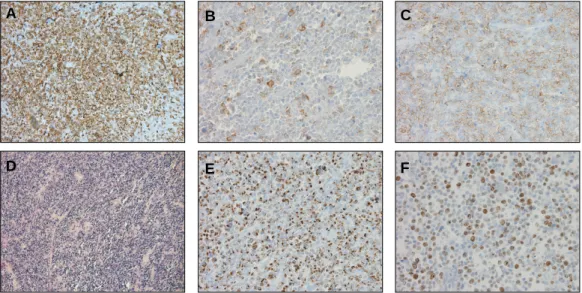
Presented lesion was found 1.5 years after the initial diagno- sis of the laryngeal lesion. The oral lesion was a hard expan- sive mass on the premolar area of right mandible.(Fig. 1) Magnetic resonance imaging (MRI) showed a highly enhanced lesion in the premolar area of right mandible and invasion into the labial and lingual soft tissue.(Fig. 2) The initial diagnosis of oral lesion performed in the other hospital was a relapsed peripheral T-cell lymphoma. Therefore no additional biopsy was taken in our hospital and the patient received a marginal mandibulectomy in January 2008. A biopsy from main mass revealed Nasal-type NTCL. It was CD 3+, CD 20-, CD 30±,
CD 56+, EBV+, and granzyme-B+.(Figs. 3. A-E)
There were numerous Ki67+ cells.(Fig. 3. F) It took 1 month for getting the biopsy result for the resection margin after mar- ginal mandibulectomy. It was clear and no evidence of the mass remained. During follow-up, the patient visited the department of ophthalmology for swelling of eye area in November 2008. Initial diagnosis was keratoconjunctivitis and an anti-inflammatory drug was prescribed. With no improve- ment in the symptoms, a biopsy was done on the lesion. It was CD 3+, CD 20-, CD 56-, EBV+, and granzyme B+ (data not shown). It was diagnosed as relapsed NTCL and the patient refused further treatment. The patient expired from systemic organ failure in January 2009.
Fig. 1. Intraoral presentation of the lesion. The presented line showed a planned resection margin.
Fig. 2. Magnetic resonance imaging of the lesion showed highly enhanced lesion in the mandible.(arrow)
Fig. 3.The findings of immunohistochemistry and in situ hybridization.
A. CD 3.(immunohistochemical staining, original magnification ×200), B. CD 30.(immunohistochemical stain- ing, original magnification ×400), C. CD 56.(immunohistochemical staining, original magnification ×400), D. In situ hybridization for Epstein-Barr virus.(original magnification ×100), E. Granzyme B.(immunohistochemi- cal staining, original magnification ×400), F. Ki67.(immunohistochemical staining, original magnification ×400)
A B C
D E F
Relapsed extranodal NK/T-cell lymphoma in the mandible, Nasal Type: a case report and review of the literatures
331
Ⅲ. Discussion
Peripheral T-cell lymphoma is often observed in the mandible5. However, Nasal-type NTCL has not been reported in the mandible. As the patient was previously diagnosed as peripheral T-cell lymphoma of the larynx, the mass in the mandible was assumed to be relapsed peripheral T-cell lym- phoma. The surgical resection can be considered as a treatment in case that peripheral T-cell lymphoma is localized lesion6. The image from scintigraph showed that there was no hot spot except for the mandibular area (data not shown). However the final biopsy revealed Nasal-type NTCL.
The diagnosis of lymphoma is very difficult. There are many subtypes of lymphoma and each subtypes presents different prognosis7. In NTCL, there are angiocentric lymphoprolifera- tive lesions and lymphomas and biopsy result showed lympho- proliferative and polymorphous inflammatory infiltration of the dermis with a follicular and angiocentric growth pattern and epidermal necrosis8. In immunohistochemical findings, the tumor cells were positive for T-cell lineage antigen CD2 and often CD7. Expression of surface CD3 was not seen but cyto- plasmic CD3 was positive. Natural-Killer cell lineage antigen, CD16, CD56, CD57 were also positive9and immunohisto- chemical staining expressed the cytotoxic proteins such as T- cell intracellular antigen and granzyme B, perforin. NTCL is strongly associated with expression of EBV. Findings from an in situ hybridization study shows that EBV was positive when patient underwent NTCL10.
Though the laryngeal lesion was EBV+ and the diagnosis was based on the pathological specimen, the possibility of mis- diagnosis should be always considered for the relapsed case.
However, further histological exam for the laryngeal lesion could not be done because the paraffin block was not provided from previous hospital.
Though it was unclear when the EBV infection occurred, oral and eye lesion showed very high expression of EBV DNA. Strong expression of EBV DNA is related to a poor prognosis of NTCL11. High Ki-67 expression was also reported as a prognostic indicator12. Our case also had a high Ki-67 expression.(Fig. 3. F) Occasionally, cases of NTCL in the UADT show non-UADT involvement and the primary site might not be the independent prognostic factor13.
There has been no consensus for the treatment of NTCL.
Surgical resection is needed in some cases. Surgical care for patients with NTCL is limited to biopsy, stabilization of the airway if necessary, or debulking of disease especially bowel obstruction is occurred. In this case, if the incisional biopsy
was taken before marginal mandibulectomy and the result revealed NTCL, further surgical treatment should be ceased and chemotherapy and radiation therapy could bring more bet- ter result. In this case, patient refused treatment and finally expired. If patient agreed to receive chemotherapy and radia- tion therapy, it is possible that his lifetime could be extended.
Before creating the current classification of NTCL, radiation therapy had been the main treatment for early NTCL14. A pre- vious report showed 69% CR following radiation alone (medi- an dose of 50.4 Gy) in early NTCL15. However, radiation alone for NTCL shows high recurrence16. The patient remained dis- ease free for a year after radiation therapy but relapse in the mandible occurred. When the mandibular lesion was found, the larynx was still in CR state. Considering its frequent relapse after CR, regional control such as surgical resection or radiation therapy could not be considered. Regional control might only be considered in combination with chemotherapy when the patient’s discomfort is serious for localized invasive lesion. CR rates of early NTCL for ifosfamide, methotrexate, etoposide, and prednisolone (IMEP) chemotherapy was 79- 93%, but 64% of the CR patients relapsed at the local sites17. L-asparaginase-based chemotherapy18 or secondline IMEP chemotherapy19could achieve CR in the advanced stage of NTCL. However, regional or systemic relapse was also fre- quently observed in patients who achieved CR.
Therefore, regional response to the treatment could not reflect overall disease activity. Circulating EBV DNA titer may be directly related to disease activity5. However, CR of the disease cannot be decided by EBV DNA titer alone.
Discovering the exact pathogenesis of NTCL and prognostic factors would be vital for setting up the proper treatment proto- col. As many extranodal lymphomas look similar to each oth- er, definite diagnosis has been often difficult to make.
Therefore, precise diagnosis of NTCL will be highly important for the better results and prognosis.
References
1. Lee J, Suh C, Park YH, Ko YH, Bang SM, Lee JH, et al.
Extranodal natural killer T-cell lymphoma, nasal-type: a prognos- tic model from a retrospective multicenter study. J Clin Oncol 2006;24:612-8.
2. Nakamura S, Suchi T, Koshikawa T, Kitoh K, Koike K, Komatsu H, et al. Clinicopathologic study of CD56 (NCAM)-positive an- giocentric lymphoma occurring in sites other than the upper and lower respiratory tract. Am J Surg Pathol 1995;19:284-96.
3. Jaffe ES, Lipford EH, Margolick JB, Longo DL, Fauci AS.
Lymphomatoid granulomatosis and angiocentric lymphoma: a spectrum of post-thymic T-cell proliferations. Semin Respir Med 1989;10:167-72.
4. Mroczek EC, Weisenburger DD, Grierson HL, Markin R, Purtilo DT. Fatal infectious mononucleosis and virus-associated hemo-
J Korean Assoc Oral Maxillofac Surg 2011;37:329-32
332
phagocytic syndrome. Arch Pathol Lab Med 1987;111:530-5.
5. Pileri SA, Montanari M, Falini B, Poggi S, Sabattini E, Baglioni P, et al. Malignant lymphoma involving the mandible. Clinical, morphologic, and immunohistochemical study of 17 cases. Am J Surg Pathol 1990;14:652-9.
6. Mafune KI, Tanaka Y, Suda Y, Izumo T. Outcome of patients with non-Hodgkin’s lymphoma of the stomach after gastrecto- my: clinicopathologic study and reclassification according to the revised European-American lymphoma classification. Gastric Cancer 2001;4:137-43.
7. Harris NL, Jaffe ES, Stein H, Banks PM, Chan JK, Cleary ML, et al. A revised European-American classification of lymphoid neo- plasms: a proposal from the International Lymphoma Study Group. Blood 1994;84:1361-92.
8. Chorianopoulos D, Samitas K, Vittorakis S, Kiriazi V, Rondoyianni D, Tsaousis G, et al.. Extranodal natural killer/T- cell lymphoma, nasal-type. Skinmed 2010;8:56-8.
9. Kwong YL. Natural killer-cell malignancies: diagnosis and treat- ment. Leukemia 2005;19:2186-94.
10. Oshimi K. Progress in understanding and managing natural killer-cell malignancies. Br J Haematol 2007;139:532-44.
11. Au WY, Pang A, Choy C, Chim CS, Kwong YL. Quantification of circulating Epstein-Barr virus (EBV) DNA in the diagnosis and monitoring of natural killer cell and EBV-positive lym- phomas in immunocompetent patients. Blood 2004;104:243-9.
12. Au WY, Weisenburger DD, Intragumtornchai T, Nakamura S, Kim WS, Sng I, et al. Clinical differences between nasal and ex- tranasal natural killer/T-cell lymphoma: a study of 136 cases from the International Peripheral T-Cell Lymphoma Project.
Blood 2009;113:3931-7.
13. Wong KF, Chan JK, Ng CS, Lee KC, Tsang WY, Cheung MM.
CD56 (NKH1)-positive hematolymphoid malignancies: an ag- gressive neoplasm featuring frequent cutaneous/mucosal involve- ment, cytoplasmic azurophilic granules, and angiocentricity.
Hum Pathol 1992;23:798-804.
14. Sakata K, Hareyama M, Ohuchi A, Sido M, Nagakura H, Morita K, et al. Treatment of lethal midline granuloma type nasal T-cell lymphoma. Acta Oncol 1997;36:307-11.
15. Kim GE, Lee SW, Chang SK, Park HC, Pyo HR, Kim JH, et al.
Combined chemotherapy and radiation versus radiation alone in the management of localized angiocentric lymphoma of the head and neck. Radiother Oncol 2001;61:261-9.
16. Kim GE, Cho JH, Yang WI, Chung EJ, Suh CO, Park KR, et al.
Angiocentric lymphoma of the head and neck: patterns of sys- temic failure after radiation treatment. J Clin Oncol 2000;18:54- 63.
17. Lee KW, Yun T, Kim DW, Im SA, Kim TY, Yoon SS, et al.
First-line ifosfamide, methotrexate, etoposide, and prednisolone chemotherapy +/- radiotherapy in active stage I/II extranodal NK/T-cell lymphoma. Leuk Lymphoma 2006;47:1274-82.
18. Yamaguchi M, Suzuki R, Kwong YL, Kim WS, Hasegawa Y, Izutsu K, et al. Phase I study of dexamethasone, methotrexate, ifosfamide, L-asparaginase, and etoposide (SMILE) chemothera- py for advanced-stage, relapsed or refractory extranodal natural killer (NK)/T-cell lymphoma and leukemia. Cancer Sci 2008;
99:1016-20.
19. Kim BS, Kim DW, Im SA, Kim CW, Kim TY, Yoon SS, et al.
Effective second-line chemotherapy for extranodal NK/T-cell lymphoma consisting of etoposide, ifosfamide, methotrexate, and prednisolone. Ann Oncol 2009;20:121-8.