Acupuncture and Cortisol Levels: a Systematic Review
Jin-Woong Lim
1, Ki-Tae Song
1, Sang-Hoon Lee
21Department of pre-Oriental Medicine, 2Department of Acupuncture and Moxibustion, College of Oriental Medicine and Institute of Oriental Medicine, Kyung Hee University Original Article
⋅Received:1 September 2010 ⋅Revised:2 November 2010 ⋅Accepted:4 November 2010
⋅Correspondence to:Sang-Hoon Lee
Hoegi-dong, Dongdae-mun-gu, Seoul, 130-702, South Korea.
Tel:02-958-9209, Fax:02-957-4245, E-mail:[email protected]
Objective: This study was undertaken to systematically assess and summarize the effects of acupuncture on cortisol secretion.
Materials and methods: We searched articles published up to May 2010 in six electronic databases (PubMed, Cochrane Library, KISS, KISTI, DBPIA, Kyobo Scholar). Randomized clinical trials (RCTs) which met all the inclusion criteria were reviewed. Eight RCTs were finally selected for this systematic review and assessed by three reviewers. The risk of bias was also estimated by using the Cochrane criteria.
Results: Six RCTs reported no distinct difference of cortisol levels between control and experimental groups. Two RCTs reported significant differences of cortisol levels between groups; one reported the acupuncture group with markedly higher concentrations of cortisol while the other reported the opposite result.
Conclusion: There are some difficulties in clearly identifying the effects of acupuncture on cortisol levels in this systematic review due to inconsistent results. Therefore, more rigorous trials with larger scales need to be conducted to clarify the effects of acupuncture on cortisol levels.
Key Words : Acupuncture, cortisol level, systematic review
Introduction
Acupuncture has been practiced for thousands of years, since long before there was any sound knowledge of anatomy, physiology or pathophy- siology
1). It has been generally used in East Asian countries in the past, but is increasingly gaining popularity in Western countries nowadays.
Acupuncture treatment has been claimed to be effective at treating a wide range of conditions, including pain, musculoskeletal disorders, and several neurologic disorders
2). However, the underlying mechanisms of acupuncture have not been clearly demonstrated although many studies have tried to reveal these mechanisms. Recent studies suggest that
acupuncture may affect the central and autonomic nervous systems
3-6)and mental stress
7). There are some systematic reviews assessing the effect of acupuncture on some indicators of the autonomic nervous system such as heart rate variability (HRV)
8), but there has been no systematic review examining the effect of acupuncture on the endocrine system.
Cortisol is a kind of hormone produced in the
zona fasciculata of the adrenal cortex. Cortisol
secretion is a key process in hypothalamic-
pituitary-adrenal (HPA) axis activation
9)and it
facilitates the body’s response to stress and regulates
the immune system
10). Therefore, the aim of this
systematic review was to summarize and assess the
Articles identified (n =100)
Full text read (n =37)
RCTs included (n =8)
Articles excluded after screening the title and abstract (n =63)
Reasons:
․ Not related with acupuncture or cortisol (n=21)
․ Using different type of acupuncture (n=13)
․ Animal studies (n=18)
․ Review articles (n=4)
․ Case report (n=1)
․ Without abstract (n=6)
Articles excluded after reading the full text (n=29)
Reasons:
․ CCTs (n=11)
․ Excluded with language restriction (n=17)
․ RCTs but excluded (n=1) because of
- Using electrical acupuncture with needle acupuncture (n=1)
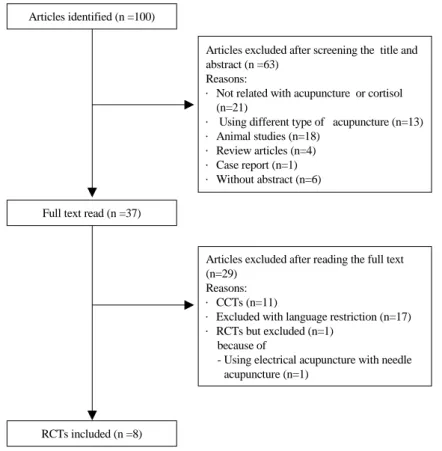
Fig. 1. Flowchart of process of selecting trials. RCT: randomized clinical trial; CCT: non-randomized clinical trial.
trials conducting experiments for the effects of acupuncture on cortisol secretion.
Methods
Data sources
We searched six electronic databases for all articles published up until May 2010. Included databases were four Korean electronic databases (KISS, KISTI, DBPIA, Kyobo Scholar), PubMed and The Cochrane Library. The terms for searching were
“acupuncture AND cortisol” in PubMed and The Cochrane Library, and the Korean language terms for
“침 AND 코티솔” in four Korean electronic databases. We manually searched the references of all articles for relevant articles.
Study selection
Only randomized clinical trials (RCTs) for human subjects were considered to be included. RCTs using needle acupuncture with electrical stimulation or auricular acupuncture were excluded. Articles written in Korean or English were considered to be included with language restriction. Articles of other languages were excluded. The trials which didn’t assess cortisol level or were not related to acupuncture were also excluded. There was no restriction about the condition of subjects and the control group which was done by either sham acupuncture or conven- tional treatment.
Data extraction and assessment of risk of bias
The full text of selected articles was obtained and
read in full by two independent reviewers (SHL, JWL). The relevant criteria for analyzing trials were defined by discussion among reviewers, then the two independent reviewers (SHL, JWL) extracted data from articles according to the criteria. The opinion of another reviewer (KTS) was considered, if needed.
The extraction of data was based on the statement of author of each article or on outcome data reported in the article.
The risk of bias was assessed by six factors using the Cochrane criteria: sequence generation, allocation sequence concealment, blinding of participants, blinding of assessor, incomplete outcome data and selective outcome reporting
11). The assessment was based on the statement of the author of each article.
Two reviewers (SHL, JWL) estimated the risk of bias and the disagreements of opinion were resolved through discussion. The opinion of another reviewer (KTS) was also considered, if needed.
Results
Study description
The total number of articles searched through six electronic databases was 100, of which 92 were excluded and eight were RCTs which satisfied our inclusion criteria. The exclusion criteria for the 92 articles and selection process are described in Fig.1.
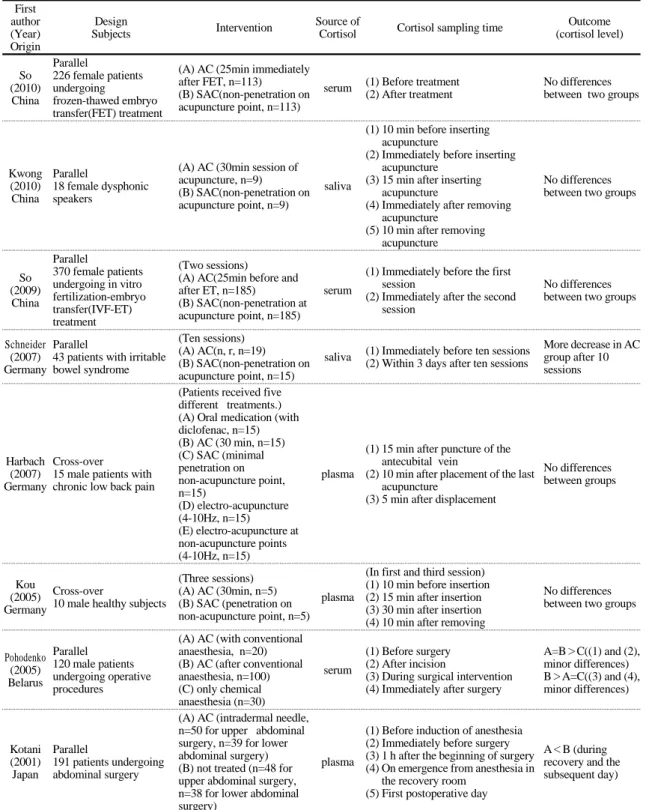
Data extracted from eight RCTs were summarized in Table 1. Three RCTs were conducted in Germany
12-14), three in China
15-17), one in Belarus
18)and one in Japan
19). Intradermal needle was used in one study
19), and the other studies used needle acupuncture. One study treated healthy subjects
14)and seven studies treated patients with other conditions: undergoing frozen-thawed embryo transfer (FET) treatment
15), with dysphonia
17), undergoing in vitro fertilization-embryo transfer (IVF-ET)
16), with irritable bowel syndrome
12), with chronic low back pain
13), undergoing operative
procedures
18)and undergoing abdominal surgery
19). Sham acupuncture treatment was conducted in six trials
12-17)and two trials compared acupuncture treatment with conventional treatment
18,19). Three trials sampled cortisol from serum
15,16,18), two trials from saliva
12,17)and three from plasma
13,14). Cortisol sampling times differed in each trial and are summarized in Table 1.
Risk of bias
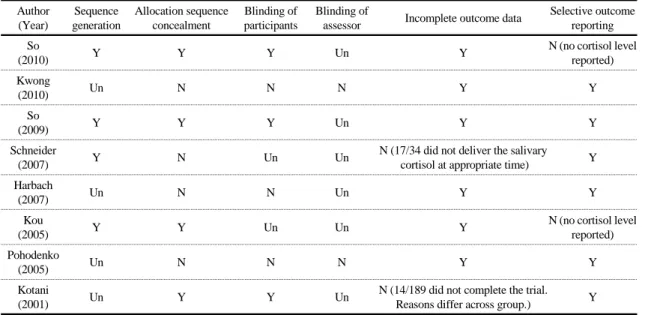
The assessment of the risk of bias in each trial was summarized in Table 2. Four trials reported the specific methods of sequence generation
12,14-16), and allocation sequence concealment was described in four trials
14-16,19). Five RCTs conducted participant blinding
12,14-16,19), of which three were considered to control blinding of participants with relevant methods
15,16,19)and one trial didn’t blind the participants
13). None of the eight RCTs stated the precise method of blinding assessors. Two RCTs reported incomplete outcome data because participants dropped out of trials
12,19). There was no reported cortisol level in two trials
14,15).
Outcomes
Six articles reported no significant difference of cortisol levels between groups
13-18). A difference of cortisol levels between groups was reported in two trials
12,19).
Among patients with irritable bowel syndrome (IBS), the cortisol level decreased more in the acupuncture-treated group than the sham-acupuncture- treated group
12). It measured saliva cortisol level before and after treatment 4 times a day. Cortisol concentration in both two groups reduced, however, the gap of decline was more noticeable in the acupuncture treatment group.
The difference of cortisol levels in patients
experiencing postoperative pain (after upper
abdominal surgery and lower abdominal surgery) was
First author (Year) Origin
Design
Subjects Intervention Source of
Cortisol Cortisol sampling time Outcome (cortisol level)
So (2010) China
Parallel
226 female patients undergoing
frozen-thawed embryo transfer(FET) treatment
(A) AC (25min immediately after FET, n=113)
(B) SAC(non-penetration on acupuncture point, n=113)
serum (1) Before treatment (2) After treatment
No differences between two groups
Kwong (2010) China
Parallel
18 female dysphonic speakers
(A) AC (30min session of acupuncture, n=9)
(B) SAC(non-penetration on acupuncture point, n=9)
saliva
(1) 10 min before inserting acupuncture
(2) Immediately before inserting acupuncture
(3) 15 min after inserting acupuncture
(4) Immediately after removing acupuncture
(5) 10 min after removing acupuncture
No differences between two groups
So (2009) China
Parallel
370 female patients undergoing in vitro fertilization-embryo transfer(IVF-ET) treatment
(Two sessions)
(A) AC(25min before and after ET, n=185)
(B) SAC(non-penetration at acupuncture point, n=185)
serum
(1) Immediately before the first session
(2) Immediately after the second session
No differences between two groups
Schneider (2007) Germany
Parallel
43 patients with irritable bowel syndrome
(Ten sessions) (A) AC(n, r, n=19) (B) SAC(non-penetration on acupuncture point, n=15)
saliva (1) Immediately before ten sessions (2) Within 3 days after ten sessions
More decrease in AC group after 10 sessions
Harbach (2007) Germany
Cross-over
15 male patients with chronic low back pain
(Patients received five different treatments.) (A) Oral medication (with diclofenac, n=15) (B) AC (30 min, n=15) (C) SAC (minimal penetration on non-acupuncture point, n=15)
(D) electro-acupuncture (4-10Hz, n=15)
(E) electro-acupuncture at non-acupuncture points (4-10Hz, n=15)
plasma
(1) 15 min after puncture of the antecubital vein
(2) 10 min after placement of the last acupuncture
(3) 5 min after displacement
No differences between groups
Kou (2005) Germany
Cross-over
10 male healthy subjects
(Three sessions) (A) AC (30min, n=5) (B) SAC (penetration on non-acupuncture point, n=5)
plasma
(In first and third session) (1) 10 min before insertion (2) 15 min after insertion (3) 30 min after insertion (4) 10 min after removing
No differences between two groups
Pohodenko (2005) Belarus
Parallel 120 male patients undergoing operative procedures
(A) AC (with conventional anaesthesia, n=20) (B) AC (after conventional anaesthesia, n=100) (C) only chemical anaesthesia (n=30)
serum
(1) Before surgery (2) After incision
(3) During surgical intervention (4) Immediately after surgery
A=B>C((1) and (2), minor differences) B>A=C((3) and (4), minor differences)
Kotani (2001) Japan
Parallel
191 patients undergoing abdominal surgery
(A) AC (intradermal needle, n=50 for upper abdominal surgery, n=39 for lower abdominal surgery) (B) not treated (n=48 for upper abdominal surgery, n=38 for lower abdominal surgery)
plasma
(1) Before induction of anesthesia (2) Immediately before surgery (3) 1 h after the beginning of surgery (4) On emergence from anesthesia in
the recovery room (5) First postoperative day
A<B (during recovery and the subsequent day)
AC: acupuncture; SAC: sham-acupuncture; n.r.: not reported
Table 1. Summary of RCTs Assessing Acupuncture and Cortisol Level
Author (Year)
Sequence generation
Allocation sequence concealment
Blinding of participants
Blinding of
assessor Incomplete outcome data Selective outcome reporting So
(2010) Y Y Y Un Y N (no cortisol level
reported) Kwong
(2010) Un N N N Y Y
So
(2009) Y Y Y Un Y Y
Schneider
(2007) Y N Un Un N (17/34 did not deliver the salivary
cortisol at appropriate time) Y Harbach
(2007) Un N N Un Y Y
Kou
(2005) Y Y Un Un Y N (no cortisol level
reported) Pohodenko
(2005) Un N N N Y Y
Kotani
(2001) Un Y Y Un N (14/189 did not complete the trial.
Reasons differ across group.) Y Y: appropriate; N: not reported or inappropriate; Un: unclear
Table 2. Results of Assessing the Risk of Bias
reported in Kotani et al.
19)This trial compared the change of cortisol levels in acupuncture treatment and conventional treatment groups for upper abdominal surgery and lower abdominal surgery.
Plasma cortisol was sampled 5 times: before induction of anesthesia, immediately before surgery, 1 hour after the beginning of surgery, on emergence from anesthesia in the recovery room and first postoperative day, and the difference was significant during recovery. Cortisol level in both groups (upper abdominal surgery and lower abdominal surgery) increased more in the acupuncture treatment group than conventional treatment group and both reduced on the postoperative day.
Discussion
From this systematic review, it is hard to conclude how acupuncture treatment affects cortisol secretion.
Although two trials showed a difference of cortisol levels between two groups, since other trials reported no significant difference, any conclusion about the effect of acupuncture on cortisol secretion cannot be
defined clearly. Therefore, we needed to consider some potential factors of bias in this systematic review by two aspects: one is the aspect of included trials and the other is the aspect of this review itself.
The aspect of included trials is as following:
First of all, the familiarity of patients with acupuncture treatment was not controlled at all.
Acupuncture is the practice of inserting a needle or needles into certain points in the body for therapeutic purposes
20)and all trials recruited patients regardless of familiarity difference about acupuncture treatment. In this situation, patients’ anxiety about sticking treatment of acupuncture might differ across the group and this state anxiety level could affect the secretion of cortisol
21)more significantly than acupuncture treatment affects do. Hence, it can be hypothesized that the anxiety level about acupuncture treatment concealed the effect of acupuncture on cortisol level.
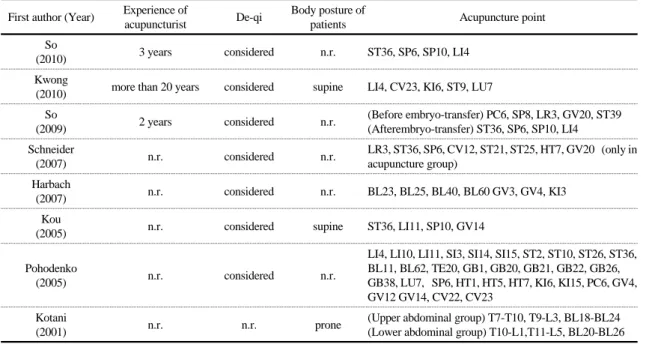
Secondly, the suitability of acupuncture treatment
should be suspected. The acupuncture treatment
First author (Year) Experience of
acupuncturist De-qi Body posture of
patients Acupuncture point
So
(2010) 3 years considered n.r. ST36, SP6, SP10, LI4
Kwong
(2010) more than 20 years considered supine LI4, CV23, KI6, ST9, LU7 So
(2009) 2 years considered n.r. (Before embryo-transfer) PC6, SP8, LR3, GV20, ST39 (Afterembryo-transfer) ST36, SP6, SP10, LI4 Schneider
(2007) n.r. considered n.r. LR3, ST36, SP6, CV12, ST21, ST25, HT7, GV20 (only in acupuncture group)
Harbach
(2007) n.r. considered n.r. BL23, BL25, BL40, BL60 GV3, GV4, KI3
Kou
(2005) n.r. considered supine ST36, LI11, SP10, GV14
Pohodenko
(2005) n.r. considered n.r.
LI4, LI10, LI11, SI3, SI14, SI15, ST2, ST10, ST26, ST36, BL11, BL62, TE20, GB1, GB20, GB21, GB22, GB26, GB38, LU7, SP6, HT1, HT5, HT7, KI6, KI15, PC6, GV4, GV12 GV14, CV22, CV23
Kotani
(2001) n.r. n.r. prone (Upper abdominal group) T7-T10, T9-L3, BL18-BL24
(Lower abdominal group) T10-L1,T11-L5, BL20-BL26 n.r.: not reported
Table 3. Summary of Acupuncture Treatment Administrated in Each Trial