<연구논문> http://dx.doi.org/10.5805/SFTI.2013.15.1.057
57
The Effects of Environment-conscious Consumer Attitudes towards Eco-friendly Product and Artificial Leather Fashion Product Purchase Intentions
Sung Hee Park
1), Kyung Wha Oh
2)†, and Youn Kyu Na
1)1)
Dept. of Clothing & Textiles, Chung-Ang University; Seoul, Korea
2)
Dept. of Home Economics Education, Chung-Ang University; Seoul, Korea
Abstract : This research examines the environmental consciousness of fashion consumer attitudes towards eco-friendly products and artificial leather purchase intentions. The survey was conducted from March 11 to March 15 2012 and all respondents had at least once experience of purchasing fashion items made of artificial leather. A total of 426 subjects were used in the dataset; the statistical analysis methods were frequency analysis, factor analysis, reliability analysis and multiple analysis. The results are as follows. The study finds that environmental consciousness has three dimensions of public participation, resource conservation, and recycling. Public participation, recycling, and resource conservation influ- enced eco-friendly product attitudes. Eco-friendly product attitudes influenced artificial leather purchase intentions. The research results show that appropriate plans in fashion business such as usefulness of design and business value will need to be provided to fashion consumers. Detailed information on materials related to fashion products as the content of envi- ronment-friendly techniques and recycling methods will help consumers to evaluate environmental-friendly attitude prod- ucts.
Key words: environmental consciousness, eco-friendly product attitudes, consumer environmental concern, artificial leather fashion purchase intentions
I. Introduction
Pollution, climate changes, and natural disasters have changed 21
stcentury consumption tendencies towards eco-friendly attitudes;
subsequently, many companies have made significant efforts towards the development of eco-friendly products and marketing strategies in order to find new opportunities. Increased consumer interest in environmental problems has changed consumer con- sciousness, lifestyles and behavioral patterns(Park & Oh, 2005).
Government and corporations seek to offer environmental solu- tions to the enforcement of environmental regulations. There are now stricter regulations and heightened consumer consciousness over the environment; subsequently, the importance of eco-friendly management of global corporations has increased.
Many countries have established eco-friendly development, manufacturing, and supply policies to meet the demands of global markets. For example, the OECD chose environmentally friendly government procurement policies through direct recommendation, and the US and Japan made it mandatory to purchase eco-friendly products and services through the Green Consumption Act(Korea Fashion Association, 2012).
Corporations wish to harness new economic growth trends based on the development of environmentally friendly fashion products and marketing methods for those products. Public aware- ness research on eco-friendly products by the Ministry of Envi- ronment and the Government Information Agency showed that 59.7% of Koreans are interested in such products and 73% of them wish to purchase them even if the price of these items is higher than regular prices. The results indicate that consumer eco-conscious- ness is increasing(Korea Development Institute, 2009).
The product preference which reflects consumer needs has grown with high-level sensibility as well as value consumption through product information. There is increased public interest in artificial leather fashion products as environmentally friendly and sustainable goods due to the desire to protect nature and animals.
There are various kinds of fashion items included these market- tendencies as shown through constant product development and new merchandising strategies. Corporations and consumers are especially interested in artificial leather fashion products as shown through ongoing eco-consciousness studies.
This study examined how eco-friendly consciousness and fash- ion consumer attitudes influence purchase intentions as well as investigated moderating effects between consciousness and pur- chase intentions. We examine consumer purchasing patterns and provide information on the establishment of new marketing strat- egies and the development of artificial leather fashion items.
†Corresponding author; Kyung Wha Oh
Tel. +82-2-820-5381, Fax. +82-2-826-4243
E-mail: [email protected]
2. Theoretical Background
2.1. Environment Conscious Attitude of Consumers It is important for consumers to evolve lifestyle and behavioral patterns in order to resolve environmental problems; subsequently, an increased consumer eco-consciousness results in a more positive towards eco-conscious activities(Lee, 2003). Eco-consciousness means that a consumer is more cognizant about environmental problems and follows a more environmentally friendly lifestyle that results inmitigated environmental problems in the purchase, use, or disposal of goods(Ahn & Park, 1998). This reduction in waste also entails reduced energy consumption to help preserve the natural environment. These behavioral patterns produce positive results in the preservation of nature through a lifestyle that is har- monized with nature and are considered behavior that improves the quality of life in consumers(Min & Rhee, 1999; Cha, 2000).
Eco-conscious behavior is an environmentally friendly con- sumption philosophy that recognizes the importance of the rela- tionship between society and the environment as well as considers individual desires and the well-being of society as a whole. These behavioral patterns arise throughout the purchase of, use and dis- posal of goods(Park & Rhee, 1995). Recycling is found to be closely related to pro-social behavior such as altruism and social contribution(Hopper & Nielsen, 1991). A study by Park and Oh(2005) suggests eco-conscious behavior is categorized as resource conservation, public awareness, environmental preserva- tion and recycling consciousness with significant effects on apparel recycling attitude and behavior. Park and Rhee(1995) argued that eco-conscious behavior was positively affected by the influence of reference groups, environmental interest, consumer efficiency, public awareness, income level, consumer awareness, and expo- sure to environmental education.
Kim(1995) studies on eco-conscious consumer behavior and clothing purchasing type showed that there were purchase behavior differences between high eco-consciousness and low eco-con- sciousness groups and that the high eco-consciousness group was more active in recycling clothes. A study by Shim(1995) on recy- cling tendencies in the case of clothes disposal found that females recycled more clothing than males. Continuous research and study on eco-conscious behavior helps to understand consumer behavior and emphasizes it as the most important artificial leather fashion item purchasing behavior variable; therefore, previous studies searched for eco-conscious behavior, resource conservation, and recycling consciousness.
2.2. Attitude on Environmentally Friendly Products An environmentally friendly product attitude occurs when con-
sumers assume an environmentally friendly position in their indi- vidual and social lives. The ultimate purpose of purchasing is for consumers to satisfy their wants and needs. In this context, an envi- ronmentally friendly product attitude results in the purchase of environmentally friendly goods(Sung, 2005). It is also a belief that people maintain constructive thoughts towards environmental problems and preservation(Lee, 1999). The environmental attitude of consumers is a collective concept that embraces all consumer awareness towards environmental problems as expressed in terms such as environmental consciousness, environmental interest and environment preservation attitude(Won, 2003; Park, 2012).
Studies on attitudes towards environmentally friendly products have mainly focused on the characteristics of eco-friendly con- sumers(Lee et al., 2002; Park & Lee, 1995) and eco-friendly con- sumers are defined as those who conduct purchasing activities based on a consideration of the benefits provided to society and the environment. Consumers have significant interest in environmental problems and eco-friendly consumers have begun to emerge as a new consumer group in the market. Environmentally friendly con- sumers are sensitive towards and consider environmental effects when they purchase products; in addition, they alter purchasing and using patterns based upon environmental preservation(Hong et al., 2010). Advanced research on eco-friendly customer attitudes com- pares the differences of environmentally friendly consumers and non-environmentally friendly consumers based on population sta- tistical variables and eco-friendly variables(Yun & Yang, 2009).
Individual personality shows more environmental interest than the socioeconomic factors found in the research by Park and Suh(1998).
Individual personality emphasizes segmented customer charac- ter variables as well as demographic characteristics to show that they would positively and consciously participate in environment- oriented behavior, education, and practices towards the environ- ment.
Research by Balderjahn(1988) shows that customers who have
an increased interest and positive attitude towards the environment
become personally active in their involvement energy conservation
and eco-friendly purchasing. Jung(2009) also analyzed the pur-
chasing activity of environmentally-friendly fashion that followed
environmentally-friendly attitudes and segmented attitudes into an
interest in environmental friendly attitudes, environmental activity
participation level and the level of environmental friendly product
consumption. Min and Rhee(1999) examined environmentally
friendly consumption attitudes at the social-oriented level and indi-
vidual-oriented level; they claimed that direct individual benefits
are more influential than social concerns to promote the activity. He
showed that there were more cases of consumer expression in their
initial behavior when they respond sensitively to direct environ- mental damages or benefits. Huh(2004) categorized the purchasing activities of consumers to examine if there were any differences between the environment and environmentally friendly behavior;
however, Park(2000) stated that environmental interest and attitude contained the influential variables of eco-friendly consumer behav- ior. Salient research on environmentally friendly product shows the importance of environmental awareness behavior.
2.3. Consumer Interest in the Environment
Consumer interest in the environment is determined through the consumer attitude towards environmental issues such as pollution, population growth, sustainable growth and natural resource devel- opment(Liere & Dunlap, 1981). Research to develop environmen- tal interest criterion for environmental problems has progressed;
however, Stern et al.(1993) states the need for a varied analysis to understand the main causes and solutions to environmental destruc- tion. He argues for a research method to evaluate individual feel- ings and convictions towards the environment needs; in addition, he clarified the factors needed to protect the environment and developed criterion for environmental preservation.
Schwepker and Cornwell(1991) conducted research on changes of attitudeby environmental-friendly consumers to clarify the importance of environmental issues through a practical research on the environment. They also inquired on the practical factors that influence environmental issues with further research on the seri- ousness and degree of concern towards the changes of attitude by consumer groups.
We have to consider attitude and behavior in the evaluation of the degree of environmental concern. Social psychology empha- sizes the relation of environmental attitudes and environmental behavior where behavior becomes a more important issue than the attitude(Liere & Dunlap, 1981). New research on consumers with substantial environmental interest involves conscious environmen- tal-friendly activities as well as shifts in perceptions towards an evaluation of environmental policy and the will to resolve envi- ronmental issues. Environmental seriousness and interest are thee- motional and rational preferences of individuals when individual preference becomes the basis for eco-awareness. Consumers inter- ested in the environment have a detailed and professional knowl- edge towards the environment and are classified as highly responsible consumers based on environmental-friendly consump- tion(Park, 2000).
There is a significant correlation between consumer interest in the environment and super behavior related to the environment due to the close correlation of environmental-friendly attitudes and pur- chasing behavior in the criterion related to the environmental inter-
est of the consumer(Stern et al., 1993). The research of Rice et al.
(1997) recognized the relevance of environmental interest and con- sumption behavior in an environmental conscious manner. Previ- ous studies show and eco-friendly attitude and environmentally conscious purchasing behavior correlation; in addition, an eco- friendly attitude significantly influenced artificial leather fashion- product purchase intentions.
2.4. Artificial leather fashion product purchasing intentions Purchasing behavior is related to product and brand evaluation as well as behavior related to selection and intention(Noh, 1996).
The data processing theory shows that consumers form attitudes by conviction based on the attributes of a product as proven by a con- tinued purchasing behavior. Consumers can go through three steps such as perception, attitude and behavior intention when they obtain and ultimate purchase behavior level. Lee(2008) defined purchasing intention as expected or planned future behavior or the possibility of changing behavior attitudes.
Research on environmental-friendly product purchasing activi- ties verified crucial variables that influence environmental-friendly product purchasing behavior(Jeong & Park, 2006). Alwitt and Pitts(1996) emphasized the importance of environmental-friendly consumer purchasing behavior as they clarified that environmental interest influence environment related product purchasing inten- tions.
Research by Schwepker and Cornwell(1991) clarified that envi- ronmental-friendly attitudes are an important purchasing intention variable through the perception on attitudes towards waste mate- rials and environmental pollution.
Koh and Noh(2009) claimed that ethical consumption statisti- cally influence attitudes towards ethical fashion product purchases and purchase intentions. Kim(2004) show that environmental pur- chasing behavior can be considered a simple purchasing behav- ior(buying used products, utilizing resource-saving products, and selecting environmental products) as well as an environmental con- scious behavior throughout the whole product purchasing process.
Research shows an active environmental-friendly purchasing behavior; however, research on artificial leather fashion products is limited and in need of further investigation.
3. Method
3.1. Research Problems and Research Model
The following research problems were implemented to under-
stand the environmental-conscious behavior of consumers and the
relationship of eco-friendly product attitudes and artificial leather
fashion product purchasing intentions.
• Research Problem 1
Quantify consumer behavior towards environmental concepts.
• Research Problem 2
Understand the effects of environmentally conscious consumer behavior on eco-friendly product attitudes.
• Research Problem 3
Examine the effects of consumer attitude towards environmen- tal-friendly products and artificial leather fashion product purchas- ing intentions.
• Research Problem 4
Study the controlling effect of consumer’s environmental inter- est on the relationship between environment-friendly product atti- tudes and artificial leather fashion product purchase intentions.
3.2. Measurement Tools
A questionnaire was used for the practical survey and a survey was conducted on consumers who had at least one artificial leather fashion product purchase experience. The content of the question- naire consisted of questions related to environmental behavior, environmental-friendly product attitudes, artificial leather fashion product purchasing intentions, and environmental interest. Envi- ronmental-friendly behavior content were based on research and preliminary surveys by Park and Oh(2005), Kim(2004), and Hop-
per and Nielsen(1991), which were measured in 20 questions on 5 point Likert criterion. There were 8 questions based on environ- mental-friendly product attitude research by Won(2003) and Jung(2009); in addition, there were 5 questions(5 points each) for the environmental interest of consumers by Cho and Kim(2003) and Rice et al.(1997). Statistical population characteristics such as gender, age, marital status, school, and occupation were measured on a nominal scale.
3.3. Data Collection and Analysis
A question survey collected data on consumers over 20 years of age who had artificial leather fashion product purchasing experi- ences. A preliminary survey asked 100 people from February 10
thto 22
nd2012 and then ambiguous questions were modified to answer easily through the preliminary survey.
This research implemented an internet questionnaire from March 1
stto 15
th2012 that provided a data sample of 426 responses. An SPSS 19.0 program conducted the frequency analysis of credibility, factors, and multiple regression of collected data. Men and women were divided by gender to account for population statistical char- acteristics of the research target data and consisted of 213 people each(50%). For age, there were 100 people in 20s(23.5%), 105 people in 30s(24.6%), 111 people in 40s(26.1%), and 110 people in
Table 1. Factor analysis of consciousness of environmental fashion consumers
Factor Items Factor
Loading Eigen Value
Variance
% Cronbach’s α
Civic activist participation
The problem of air pollution is something that the government and corporations should take care of; however, I also have to be interested in it and try to solve it. .770
4.382 23.07 .80
It would be helpful for environmental conservation of Korea if the matter is resolved privately. .768 I believe the environmental pollution problem is serious. .675 The development of eco-friendly products by companies has to be done
(through government regulations). .660
I am interested in attending consumer environmental issue education classes held by
schools, social communities or companies. .605
Conservation consciousness
I usually use recyclable shopping bags when shopping. .707
3.392 40.91 .81
I have purchased recycled plastic, bottle or can products. .674 I am conscious of using water for personal hygiene in order to save water. .669 I walk or use public transportation when going the nearby places to save energy and
protect the environment. .651
I sort my recyclable garbage. .606
I try not to use the disposable products. .598
Recycling consciousness
I am very interested in environmental issues. .669
3.201 60.13 .79
I am very interested in environmental management by companies or green marketing. .631 I have an experience in purchasing recycled products at recycling shops or second-hand stores. .620 I believe it is better to use products that are environmentally less harmful, even though
the price is a bit higher. .605
I am willing to endure inconvenience to solve environmental problems. .590
I am currently more interested in the environmental issues compared to 10 years ago. .580
50s(25.8%). As for marital status, there were 291 people mar- ried(68.3%) and 135 people single(31.7%). Education consisted of 122(28.9%) high school graduates, 56(13.1%) junior college grad- uates, 213(50%) university graduates, and 34(8.0%) graduate school students. Occupation was broken down into 119(27.9%) businessmen, 77(18.1%) technicians, and 78 housewives(18.3%).
4. Results and Discussion
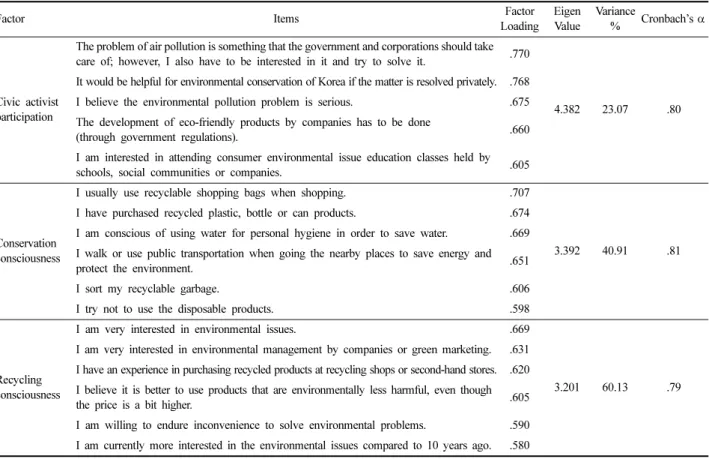
4.1. Factor Analysis and Credibility Analysis 4.1.1. Environmental Conscious Behavior by Consumers A factor analysis measured the validity of composition concepts through a main Varimax circulation analysis of angle spinning with Kaiser normalization. A factor loading figure over 0.5 and larger than 1.0 standard in the process of factor extraction was considered as an effective variable; therefore, the items with effective costs were extracted to be factorized after the factor circulation. Table 1 shows the results of the environmental conscious behavior factor analysis of consumers. Factor 1 consisted of questions called “Cit- izen’s Activity and Sense of Participation” about education par- ticipation in environmental problems such as pollution problems, environmental pollution, and environmental problems at school, society organization, and enterprises. Factor 2 consisted of ques- tions called “Sense of Resource Savings” that inquired about shop- ping baskets when shopping, conserving water, and using mass- transportation to save energy. Factor 3 consisted of contents called
“Sense of Recycling” that examined interest in environmental issues, recycled products, and products that are not environmen- tally toxic to the environment(even if more expensive). Factor 2,
“Citizen‘s Activity and Sense of Participation”(which the factor cost is below 0.5) and Factor 1 “Sense of Recycling” were removed. The total variable was 60.13% and the coefficient of con- fidence was more than 0.7%. Environmentally conscious behavior was classified into resource saving consciousness, participation consciousness, environment preservation, and recycling conscious- ness in the research related to the effect of materialistic tendency, environmental conscious attitude and behavior as analyzed by Park and Oh(2005). This research showed that a sense of resource sav- ings and sense of recycling were partially consistent.
4.1.2. Eco-friendly product attitude of Consumers, Artificial leather fashion product purchasing intentions, and Environmental Consumer Interest
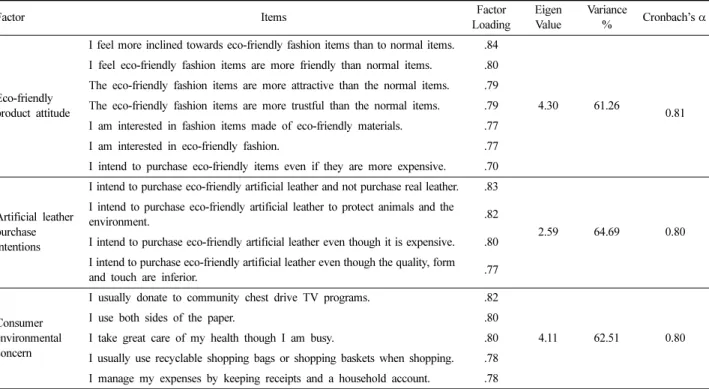
Table 2 shows the factor analysis results of fashion consumer eco-friendly product attitudes divided into artificial leather fashion product purchasing intentions and the environmental interest of consumers. Environmentally friendly product attitudes consisted of 7 questions and had a factor loading figure under 0.5. The total variable about this factor was 61.26% and the confidence coeffi- cient was over 0.8. The artificial leather fashion produ ct purchasing intention consisted of 5 questions with a total variable of 64.69%
and a confidence of coefficient over 0.8.
Table 2. Factor analysis of attitude on Eco-friendly products, artificial leather fashion product purchase intentions, and consumer environmental concern.
Factor Items Factor
Loading
Eigen Value
Variance
% Cronbach’s α
Eco-friendly product attitude
I feel more inclined towards eco-friendly fashion items than to normal items. .84
4.30 61.26
0.81 I feel eco-friendly fashion items are more friendly than normal items. .80
The eco-friendly fashion items are more attractive than the normal items. .79 The eco-friendly fashion items are more trustful than the normal items. .79 I am interested in fashion items made of eco-friendly materials. .77
I am interested in eco-friendly fashion. .77
I intend to purchase eco-friendly items even if they are more expensive. .70
Artificial leather purchase intentions
I intend to purchase eco-friendly artificial leather and not purchase real leather. .83
2.59 64.69 0.80
I intend to purchase eco-friendly artificial leather to protect animals and the
environment. .82
I intend to purchase eco-friendly artificial leather even though it is expensive. .80 I intend to purchase eco-friendly artificial leather even though the quality, form
and touch are inferior. .77
Consumer environmental concern
I usually donate to community chest drive TV programs. .82
4.11 62.51 0.80
I use both sides of the paper. .80
I take great care of my health though I am busy. .80
I usually use recyclable shopping bags or shopping baskets when shopping. .78
I manage my expenses by keeping receipts and a household account. .78
The environment interest of consumers consisted of 5 questions and the total variable was 64.69%; in addition, the confidence of coefficient was also high.
4.2. The effect of environmentally conscious consumer behavior attitudes towards eco-friendly products
The sense of activity, participation, saving resources, and recy- clingof citizens were designated as independent variables in order to understand the environmental conscious behavior effect of con- sumer attitudes on eco-friendly products. Environmental product attitudes were asubordinate variable in the multiple regression anal- ysis; subsequently, Table 3 shows that citizen’s sense of activity, participation, saving resources, and recycling were important envi- ronmental product attitude factors. The sense of participation and citizen’s environmental-friendly product attitudes showed β=0.188 t=5.018, p<.001, conservation showed β=0.1915 t=5.096, p<.001, and sense of recycling showed β=0.578 t=15.394, p<.001, which were statistically significant and the total explanation ability was 40.6%. The recycling conscious regression value was higher because consumers with more environmental interest and recycling activities were more amicable towards environment-friendly prod- ucts. Research related to environmental-friendly fashion product purchasing activities followed the hypothesis of Jung(2009); sub- sequently, resource saving was the most important factor and seems to partially correlate with previous studies.
4.3. Effects of Environment-Friendly Product on Artificial Letter Fashion Product Purchase Intentions
We conducted an analysis of multiple regression with environ- mental-friendly attitude as an independent variable and fashion product purchasing intentions as a subordinate variable in order to understand the environmental product attitude effect on fashion product purchasing intentions. Subsequently, all attitude factors on environment-friendly products had a significant effect on artificial leather fashion product purchasing intentions. The environment- friendly products attitudes influenced at β=0.655, t=18.230 p<.001 and the total explanation ability was 45.8%. This research on envi- ronmentally consciousness purchasing behavior leads to be the- significant effect with environmental product purchase intentions and correlates with Kim(2004).
4.4. Controlling Effect on Consumer’s Environmental Interest The environmental interest of consumers analyzed the control regression to understand the control effect of environmental- friendly product attitudes and artificial leather fashion product pur- chasing intentions; subsequently, the regression equation(as in Table 5) was statistically significant in the standard of p<.001. The explanation ability of the regression model between environment- friendly product attitudes and artificial leather fashion product pur- chasing intentions was 41.6%. However, there was a changed amount by 1.3% and showed the control effects in the control level of consumer’s environmental interest with an explanation ability of 42.9%. Larger numbers of consumers with an environmental inter- est results in higher artificial leather fashion product purchasing intentions.
5. Conclusion
This research analyzed the effects of consumer environmental consciousness behavior and eco-friendly attitude on the influential relationship of artificial leather fashion product purchase intentions, through consumers who have purchased leather products to pro- vide basic marking strategy data for the leather fashion market.
First, environmental consciousness behavior by consumers was
Table 3. Effect of Eco-friendly products and consumer environment on environmental fashion consumer consciousnessDependent variance Independent variance
β
t F R2Eco-friendly productattitudes
Civic activist Participation Consciousness .188 5.018***
96.045*** .406
Conservation Consciousness .191 5.096***
Recycling consciousness .578 15.394***
*** p<.001
Table 4. The effect of artificial leather purchase intention attitudes on Eco-friendly products
Dependent variance
Independent
variance β t F R
2Artificial leather purchase intentions
Eco-friendly
productattitudes .655 18.230*** 178.722*** .458
*** p<.001
Table 5. Moderating effects of consumer environmental consciousness
Dependent
variance
Independent variance
Moderating
variance *R
2**R
2∆R
2Artificial
leather purchase intentions
Eco-friendly product attitudes
Consumer environmental consciousness
.416 .429 .000***
*** p<.001
*R
2: R
2of regression equation not included interaction term
**R
2: R
2of regression equation included interaction term
classified into citizen’s activity, participation, conservation, and recycling; however, the attitude on environment-friendly products and environmental interest by consumers appeared as single fac- tors. Second, the effects of the environmental consciousness behav- ior by consumers influenced the environmental-friendly product attitudes. All environmental consciousness behavior factors signif- icantly influenced attitudes. Third, the control effects of environ- mental interest on environmental product attitudes by consumers influenced leather product purchasing intentions and the environ- mental interest by customers showed the control effect of purchas- ing intentions.
The results of this study suggest a significance and implication of research. First, the behavior of environmental consciousness by consumers is classified into citizens’ activity, participation, con- servation, and recycling. All environmental consciousness behav- ior factors were important factors towards environmental-friendly product attitudes. The research results show that appropriate plans in fashion business such as usefulness of design and business value(not by pursuit of trends) will need to be provided to fashion consumers. Detailed information on materials related to fashion products(including clothing, shoes, bags, and accessories) as the content of environment-friendly techniques and recycling methods will help consumers to evaluate environmental-friendly attitude products. Second, environmental-friendly attitude products influ- enced artificial leather product purchasing intentions. There is increased and more varied research on artificial leather. Artificial leather is unlike the traditional life cycle of discarding products from raw materials; there is an interest in the behavior on the nat- ural environment that differentiates existing artificial leathers. It would be useful to utilize ascientific method to simplify the con- sumers purchase of environmental-friendly products along with the continuous development of artificial leathers. Important factors that influence the environment and consumption at each level of the life cycle of fashion products need to be clarified and it will be useful to suggest methods to resolve environmental issues. Consumer infor- mation on the manufacturing process of artificial leathers will help clarify leather product purchasing intentions if a more prevalent environmental protection message is suggested along with more information on the advantages of artificial leather. Third, the envi- ronmental consumers interest variable shows the moderating effect between environment-friendly product attitudes and artificial leather fashion product purchasing intentions. Consumers with increased environmental interest were more positive with increased artificial leather product purchases. Artificial leather products should be considered a strategic factor for environment-friendly marketing as well as marketing factors(design, price, and quality) to increase environmentally conscious consumer purchases.
The practical survey in this research was limited to men and women aged from 20 to 50 and it would be difficult to extend the meaning to other classes of consumers. The results can differ dependingon age, gender, and occupation, behavior on environ- mental consciousness and attitude on environment-friendly; sub- sequently, further research that considers all these issues is imperative. Artificial leather as well as future fashion product devel- opment research on artificial fur and environment-friendly fibers are suggested as other areas of research.
Acknowledgement
This work was supported by the National Research Foundation of Korea(NRF) grant funded by the Korea government (MEST) (No. 2012047656).
References
Ahn, S. C., & Park, S. Y. (1998). A study of consumer's environmental consciousness and purchasing behavior of environmental goods.
Journal of Resource Development, 18(1), 14-25.
Alwitt, L. F., & Pitts, R. E. (1996). Predicting purchase intentions for an environmentally sensitive product. Journal of Consumer Psychology, 5(1),49-64.
Balderjahn, I. (1988). Personality variables and environmental attitudes as predictors of ecologically responsible consumption patterns. Journal of Business Research, 17(1), 51-56.
Cha, J. Y. (2000). Study on the relationship between pro-environmental consumption consciousness and behavior of teenager consumer.
Unpublished master‘s thesis, Sookmyung University, Seoul.
Cho, Y. Y., & Kim, K. H. (2003). Environmental consciousness in Korea.
Korean Resource Economics Association, 21(1), 177-204.
Hong, B. S., Lee, E. J., & Chu, Y. J. (2010). The effect of environmental values of fashion consumers on purchase satisfaction and repurchase intention of eco-friendly fashion products. Journal of the Korean Society for Clothing Industry, 12(4), 431-438.
Hopper, J. R., & Nielsen, M. J. (1991). Recycling as altruistic behavior:
normative and behavioral strategies to expand participation in a community recycling program. Environment and Behavior, 26(1), 195-220.
Huh, K. O. (2004). The effect of consumers’ environmental conservation behavior on the purchase of pro-environmental and used products.
International Journal of Human Ecology, 42(9), 85-97.
Jeong, Y. J., & Park, O. L. (2006). A study on university student's clothing disposition behavior depending on their personality and environ- mental consciousness. Korean Journal of Human Ecology, 15(1), 157-164.
Jung, H. J. (2009). Extraction of evaluation criterion descriptions for public designs. Unpublished master’s thesis, Chosun University, Gwangju.
Kim, Y. S. (2004). A model of the antecedents of consumers' green purchase behavior. Korean Journal of Marketing, 8(2), 1-26.
Kim, Y. D. (1995). Environmental consciousness & clothing consump-
tion behavior of the consumers. Unpublished master’s thesis, Chung-Ang University, Seoul.
Koh, A. R., & Noh, J. Y. (2009). Ethical fashion consumer behavior in Korea: factors influencing ethical fashion consumption. Journal of the Korean Society of Clothing and Textiles, 33(12), 1956-1964.
Korea Fashion Association. (2012). Fashion CEO report, pp. 20-28.
Korea Development Institute. (2009). Global environment forum 2009, pp. 3-7.
Lee, Y. J. (2008). Influences of globalization factors of Korean food on country image, attitudes and product buying intention. Unpublished master’s thesis, KyungHee University, Seoul.
Lee, K. H. (1999). The relationships of clothing benefit and clothing attributes evaluation to ego identity of college students. The Research Journal of the Costume Culture, 7(4), 637-652.
Lee, C. H., Noh, J. K., & Kim, Y. S. (2000). A study on the factors that influence the environmentally concerned consumption behavior.
Business Administration, 29(2), 171-195.
Lee, S. H. (2003). A study on environment-friendly family resource management behaviors, environmental consciousness, knowledge, and education. Korea Home Management Association, 21(1), 91- 102.
Lee, J. E., Kim, I., & Park, S. K. (2002). A study on the consumer behavior on environmentally beneficial clothing. Journal of Fashion Business, 6(2), 77-92.
Min, H. S., & Rhee, K. C. (1999). Consumers' pro-environmental attitude and behavior. International Journal of Human Ecology, 37(1), 29-44.
Noh, J. K. (1996). A study on the relations between environmentally concerned consumption behavior and life style. Journal of Marketing Management, 2(1), 1-18.
Park, K. Y. (2000). A theoretical study on the behaviors of the environmentally concerned consumer. Kyongju University Research, 13(1), 295-309.
Park, H. H., & Oh, S. D. (2005). The influence of materialism and environment consciousness on recycling attitude and behavior of clothing. Journal of the Korean Home Economics Association, 43(10), 167-177.
Park, U. A., & Rhee, K. C. (1995). A study on environmentally conscious consumer behavior. International Journal of Human Ecology, 33(4),
199-212.
Park, W. A., & Lee, K. C. (1995). A study on environmentally conscious consumer behavior. Korean Home Management Association, 33(4), 199-210.
Park, H. S., & Suh, Y. S. (1998). Environmental perception of consumers and clothing consumption behavior. Korean Home Management Association, 128, 79-88.
Park, Y. H. (2012). A study on the purchase appraisal standard and post- purchase satisfaction of natural dyeing products. Journal of the Korean Society for Clothing Industry, 14(1), 64-74.
Sung, Y. Y. (2005). A study on the environmental consciousness and behavior of the consumers in Incheon Area. Korean Home Management Association, 23(3), 35-51.
Rice, J., Farquhar, A., Piernot, P., & Gruber, T. (1996). Using the web instead of a window System. Proceedings of ACM CHI 96 Conference on Human Factors in Computing Systems, Vancouver, BC, pp.103-110.
Stern, P. C., Dietz, T., & Kalof, L. (1993). Value orientations, gender, and environmental concern. Environment and Behavior, 25(3), 322-348.
Shim, S. (1995). Environmentalism and consumers clothing disposal patterns: an exploratory study. Clothing and Textiles Research Journal, 13(1), 38-48.
Schwepker, C. H., & Cornwell, T. B. (1991). An examination of ecologically concerned consumers and their intention to purchase ecologically packaged products. Journal of Public Policy and Marketing, 10(2), 77-101.
Van Liere, K. D., & Dunlap, R. E. (1981). Environment concern does make a difference how it‘smeasured. Environment and Behavior, 13(6), 651-676.
Won, D. D. (2003). Study on the relationship between pro-environmental consumption consciousness and behavior of teenager consumer.
Unpublished doctoral dissertation, Wonkwang University, Iksan.
Yun, S. W., & Yang, Y. J. (2009). Analysis of the difference in environment-friendly behavior based on list of value. Marketing Management Research, 14(2), 103-122.
(Received 3 August 2012; 1st Revised 8 September 2012;
Accepted 27 December 2012)
Copyright © The Society of Fashion and Textile Industry. 2013. This is an open access article distributed under the terms and condi- tions of the Creative Commons Attribution Non-Commercial license (http://creativecommons.org/licenses/by-nc/3.0/), which permits unrestricted non-commercial use, distribution, and reproduction in any medium, provided the original work is properly cited.