• 검색 결과가 없습니다.

Effects of Manufacturing Technology on the Mechanical Properties of Alfa Fiber Non-woven Reinforced PMMA Composites

N/A
N/A
Protected

Academic year: 2021

Share "Effects of Manufacturing Technology on the Mechanical Properties of Alfa Fiber Non-woven Reinforced PMMA Composites"

Copied!
6
0
0

로드 중.... (전체 텍스트 보기)

전체 글

(1)

Paper

Effects of Manufacturing Technology on the Mechanical Properties of Alfa Fiber Non-woven Reinforced PMMA Composites

Bechir Wanassi* , Mounir Jaouadi*, Mohamed Ben Hassan*, Slah Msahli*

ABSTRACT: Mechanical properties of nonwoven alfa fiber based reinforced biocomposite were evaluated to assess the possibility of using it as a new material in engineering applications such as orthopedic application. Samples were fabricated by needle punching, thermal bonding and Hydroentanglement, by blending alfa fibers with wool fibers or Polypropylene fibers. The mechanical properties were tested and showed that the nonwoven NW3 (alfa fiber/PP/PLA, with hydroentanglement) is the best. It has a value of stress at break of 1.94 MPa, a strain of 54.2% and a young’s module of 7.95 MPa, in a production normal direction. A biocomposite has been made with NW3 mixed with PMMA matrix. The use of nonwoven based alfa fiber in reinforcing the composite material increases its rigidity and the tensile strength; the elongation was found to be 1.53%, the Young’s Module of 1.79 GPa and the tensile at break of 15.06 MPa. Results indicated that alfa fibres are of interest for low-cost engineering applications and can compete with glass fibres in orthopedic application.

Key Words: Alfa fiber, Biocomposite, Nonwoven, Needle punching, Mechanical proprieties

1. INTRODUCTION

Alfa fiber (Stipa tenacissima L.) is now widespread in the regions of semi-arid ecosystems of the southern and western Mediterranean basin [1]. The recovery of alfa fiber in the manufacture of green composite materials was the subject of several recent research works [2-6].

Natural fibres have always formed wide applications from the time they gained commercial recognition. They possess desirable properties such as biodegradability, renewability, combustibility, excellent mechanical properties, low density and low price [7].

The utility of nonwoven products increased dramatically in the last decade due to their light weight and low production cost. Nonwovens have found utility in automotive manufac- turing, building construction, medical applications [8]. Now- adays nonwovens pure natural fibers or hybrid nonwovens of natural fibers and manmade fibers are used as semi-fabricated forms for components. These semi-fabricated forms are made in the textile industry and then they are used in compression

molding processes [9,10].

The use of natural fibers for composites is growing rapidly to several uses in medical, geotextiles, transport, and other construction industries [11,12]. Natural fibers have an import- ant role in developing biodegradable composites to substitute glass or carbon fiber and to provide an opportunity of replac- ing existing materials with a higher strength, low cost alter- native that is environmentally friendly [13]. High costs of synthetic fibres and health hazards have really necessitated the exploration of natural fibres [14].

Natural fiber reinforced composites are likely to be envi- ronmentally superior to glass- fiber reinforced composites in most applications also for the following reasons: (1) natural fiber production results in lower environmental impacts com- pared to glass fiber production; (2) Natural fiber reinforced composites have higher fiber content for equivalent perfor- mance, which reduces the amount of more polluting base polymers; (3) end of life incineration of natural fibers results in energy and carbon credits [15].

Received 26 December 2014, received in revised form 26 June 2015, accepted 27 June 2015

*

*

Laboratory of Textile Engenineering of Iset Ksar-hellal, Tunisia

Laboratory of Textile Engenineering of Iset Ksar-hellal, Tunisia, Corresponding author (E-mail: [email protected])

(2)

2. MATERIAL AND METHODS

2.1. Material

The samples of alfa fibers were obtained from the LRBBO (Biomechanical and Biomaterial Laboratory of Research of the Orthopedic Institute). They were collected from the Kasserine area, in Tunisia, then attacked chemically by a solution of (NaOH) 3 N (120 g/l) for 3 hours after boiling point and bleached in a (NaOCl) solution to takes out a certain portion of hemicelluloses, lignin, pectin, wax and oil covering mate- rials [16,17].

After chemical treatment, alfa fibers have undergone mechanical treatment via a Sherley machine. The sherley used in the separation of alfa was located in the laboratory of ISET- KH (High Institute of technological Studies in Ksar-Hellal, Tunisia).

Alfa fiber used in this study has a density of 1.28, a rate of recovery was equal to 10%, a rate of cellulose equal to 92% and an average project diameter is 138.28 μm[18]. The mechan- icals properties of alfa fibers are show in Table 1. Major mechanical properties of alfa fibers in comparison with another natural fiber reinforced composite are listed in Table 2. This data was provided by the literature.

In this study, the polymethyl Methacrylate PMMA resin (Resin laminating Otto Bock 617H19) was used, which is cur- rently used for the manufacture of composite materials for orthopedic use in orthopedic devices at center hospital Mohamed Kassab Ksar Said.

2.2. Web forming

Carding and Needle-Punching were used to form the fiber web. The web is a textile surface formed by fibers. Carding is a process used to comb the individual fibers to be relatively par-

allel, and to make the different kinds of fibers blend uniformly.

Alfa fibers were blended manually with wool fibers, polypro- pylene PP and PLA fibers in the desired ratio. Wool or PP and PLA acted as an entangling material for the alfa fibers. The mixed fibers were oriented and entangled to form a contin- uous fiber web.

Needle-punching is a process used to entangle fibers in the direction perpendicular to the web surface, making the fiber web much more compact with balanced absorbability [25]. A needle-punching process was employed for the web bonding using a needle-punching machine with 63 needles/cm² and 6 mm depth of penetration, correspondingly. In this research, the needle-punching had another function, that is, to punch lots of tiny holes through the cellulose web, thus allowing the PMMA matrix to penetrate the web easier.

2.2.1. Bonding of nonwoven alfa web

The above aligned carded and drawn alfa fiber batts had lit- tle mechanical strength, especially in the transverse direction.

They needed to be bonded to obtain the strength required for handling in downstream composite fabrication. Two bonding methods, thermal bonding and Hydroentanglement bonding, were used.

2.2.2. Thermal bonding

The alfa fiber web contains 7 wt% and 10 wt% of ther- moplastic polypropylene (PP) fibers and polylactic acid (PLA) respectively. For this reason, they can be bonded using a ther- mal bonding method. The alfa/polypropylene fiber webs were passed between a pair of steam-heated pressure rollers, known as calendaring rollers used by the textile industry to apply heat setting to fabrics. The rollers of calendar were heated to 150°C.

During heat setting, the PP and PLA fibers were softened and bonded with each other at contact points under the high pres- sure at the nip point of the heated rollers.

Thermal bonding of nonwoven webs occurs through three steps (1) heating the fibers in the web, (2) forming a bond through breaking of the polymer chains across the fiber-fiber interface, and (3) cooling and resolidifying the fibers [24].

2.2.3. Hydroentanglement

Another technique has been used to consolidate the alfa/

wool fiber webs and alfa/PP/PLA webs, such as a Hydroen- tanglement bonds. Hydroentanglement bonds webs in a man- ner similar to needle punching, except that very high velocity water jets, instead of needles, are used to entangle the fibers [26]. The web is subjected to high pressure water jets 100 to 250 bars Fig. 1. In this study, the injection pressure used is about 100 Bars. The injectors holes are 80-150 μm in diameter, arranged and 1-3 mm hole on remote rows of 3-5 mm. Gen- erally the water pressure increases from the first to the last injection, but in our case we worked with a single injector Fig. 1.

Table 1. Tensile properties of alfa fiber

Property Mean value CV%

Ultimate tensile strength (cN) 856 32

Stress at break (MPa) 237 65

Strain at break (%) 15 21

Table 2. Properties of selected natural and manmade fibers Fiber Stress at break

(MPa)

Strain at break

(%) Refs

Alfa 237 15 [18]

Coton 400 7-8 [19]

Jute 393-773 1.5-1.8 [20]

Flax 500-1500 2.7-3.2 [21]

Ramie 400-938 3.6-3.8 [22]

Coir 593 30 [23]

E-Glass 2000-3500 0,5 [23]

(3)

2.3. Preparation of the specimen

The composite was done using the vacuum bagging method at room temperature. All resin was catalyzed by 3 percent by weight of a curing agent (Otto Bock 617H21). The specimen was achieved under a minimum vacuum of 2666 Pa and left one hour from the time the resin was catalyzed.

The first step of the composite manufacture was to place a layer of PVA onto the mould then the non-woven was placed above.

Then a cast resin which is mixed before hand with the hard- ener in a proportion weight of about 3% is produced. The next step is to make a homogeneous distribution of the resin over the entire surface of the nonwoven. Finally a pressure is exerted on the composite material using the PVA to force the passage of the resin of the upper face to the lower face of the nonwoven. After polymerization the composite plate is cut.

The tensile tests were performed using a testing machine.

The width and the thickness of the specimens were measured and recorded (250 mm by 15 mm by 2-5 mm). The tensile tests were carried out according to NF T 57-301. The tensile strengths were calculated from this test.

In this paper, the following nomenclature indicated in the Table 3 was used to describe the nonwoven.

When thermobonding nonwovens (NW1, NW2 and NW3), PP and PLA are melted, which causes a retraction of the non- woven and subsequently an increase in the thickness and the basis weight of the nonwoven NW2 Table 4. The thickness of the nonwoven NW1 is less than the nonwoven NW3 due to the action of high pressure water during hydroentanglement and calendering upon drying. The basis weight of the non- woven is reduced because of the stretching of the structure during drying.

3. RESULTS AND DISCUSSIONS

3.1. Nonwoven properties

According to Fig. 2, if changing from one type of building to another, the tensile strength of nonwoven exchange, in the production direction and in the cross direction. The value of the constraint is multiplied by three in the case of heat treat- ment of the nonwoven and multiplies by almost nine in the case of consolidation by hydroentangling. For tensile tests in the direction producing the nonwoven fabric, the values of stress rupture was greater than those obtained in the normal direction of the production. During the thermal consolidation, there will be a fusion of two PLA polymers and PP which forms a kind of glue in the nonwoven and subsequently improving the tensile strength. The penetration of water Fig. 1. Hydroentanglement principal

Table 4. Characteristics nonwovens alfa fiber mixed with PP and PLA

Refs Thickness (mm) Surface weight (g/m²)

NW1 3.07 361.31

NW2 3.54 371.24

NW3 1.46 298.15

Fig. 2. Breaking stress of different non-woven

Table 3. Nomenclature of non-woven

Refs Web Composition Needle-Punching Thermal bonding Hydroentanglement

NW1 83% alfa 7% PP 10% PLA X

NW2 83% alfa 7% PP 10% PLA X X

NW3 83% alfa 7% PP 10% PLA X X

NW4 90% alfa 10% wool X

NW5 90% alfa 10% wool XX(2 passages in needle-Punching machine)

NW6 90% alfa 10% wool X

(4)

injected through nozzles beams during hydroentangling causes a strong entanglement of fibers; more calendering the nonwoven wet promotes compaction of the structure and the cohesion between the fibers thereby improving the mechanical properties product.

Thermobonding nonwoven decreased elongation at break in both test direction. This is due to the stickiness effect of molten polymers. The hydroentangling also causes a reduction in elongation at break that the nonwoven fabric is more com- pact following this treatment method.

The thermal treatment of the nonwoven NW1 was accom- panied by a decrease in elongation at break, and also by a decrease in the stiffness Fig. 3. Against this treatment increases a rigidity of NW1.

The Table 5 shows the Thickness and surface weight of alfa/

wool nonwoven. The surface weight of nonwoven NW5 is a little bit less than NW4 due to the second passage in needle punching machine. The nonwoven NW6 has a hydroentan- glement which results in a decrease in his thickness, but the decrease in the surface weight is due to drawing operations of drying action Table 5.

Needle punching operation decreases the breaking stress of nonwoven in the production direction and in the cross direc- tion Fig. 2. The solicitation of the nonwoven by needling causes breakage of fibers which shows the decrease in the breaking stress. The Production normal direction corresponds to that of the card, where the wool fibers are more or less par-

allel and impact a good resistance of the nonwoven during the tensile tests.

The elongation at break of nonwoven fibers made o f wool and alfa fiber Fig. 3 decreases in proportion as the consoli- dation treatment. This is due to the fact that each treatment (needling or hydroentanglement) increases the friction between the fibers and minimizes elongation. Note that the nonwoven based alfa mixed with PP and PLA are greater than nonwoven mixed with wool. This phenomenon is explained by the exis- tence of the scales in a wool fiber, which increase the friction coefficient in the nonwoven.

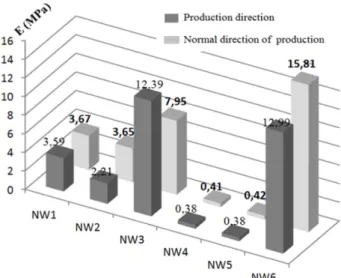
The hydroentanglement treatment increases significantly the initial modulus of the nonwoven, since it makes the struc- ture more compact. Because there is a more friction, between the fibers within the structure, which leads to the increase in the rigidity of the nonwoven.

It has been noticed that the most appropriate nonwoven, in terms of mechanical strength, corresponds to the nonwoven NW3 (alfa/PP/ PLA with hydroentanglement), has 1.94 (MPa), 7.95 (MPa) and 54.2 (%) respectively for maximum value of stress, Young’s modulus and strain in the cross direction Fig. 4.

3.2. Composite properties

The results of tensile and flexural tests on the final com- posites produced from the four carded and gilled mats are summarized in Fig. 5 and Table 6. The composites fabricated from NW3 nonwoven (both needle punched and hydroen- tangling), showed considerably higher mechanical properties (tensile strength, Young’s modulus and strain) in the produc- tion normal direction of nonwoven NW3.

The use of the nonwoven NW3 decreases the elongation at break of the composite material.

Previous studies [27,28] have shown that the deformations in the composite materials of the preforming and are a com- plex combination of several phenomena in the reinforcement:

Fig. 3. Strain (%) of different nonwovens

Table 5. Characteristics nonwovens alfa mixed with wool fiber Refs Thickness (mm) surface weight (g/m²)

NW4 3.66 397.69

NW5 3.61 383.8

NW6 1.46 337.97 Fig. 4. Young’s Module (MPa) of different nonwovens

(5)

biaxial tensile, shear plane between the tensile fibers.

On the other hand, the use of nonwoven based alfa fiber in reinforcing the composite material increases its rigidity and the tensile strength Table 6, which suggest that the alfa fiber can reinforce composite materials with a thermoplastic matrix such as PMMA resin.

The properties of alfa fiber/PMMA composite are similar to that of the manmade fiber composite materials used for man- ufacturing lower-limb prosthetic sockets Table 7.

The alfa fiber composite has the same quality with the exist- ing materials, probably; it can be used to make artificial limbs (especially the socket of prosthetic legs). The use of alfa fiber- based biocomposites in the manufacture of sockets will reduce the manufacturing cost of artificial lower limbs in terms of material costing, and at the same time, provide an eco-friendly

alternative to plastic-based materials.

4. CONCLUSION

The mechanical and physical behavior in various nonwoven fabrics depends on the type of structure formed by the bond- ing method.

In this study, we have prepared a biocomposite reinforced with alfa fiber mixed with other fibers. In order to achieve bet- ter mechanical properties of biocomposite, we first select the best nonwoven and then mixed it PPMA matrix. This kind of biocomposite exhibits excellent material proprieties such us tensile and young’s module. The results show potential use in orthopedic application.

REFERENCES

1. García-Fayos, P. and Gasque, M., “Seed vs. Microsite Limitation for Seedling Emer Gence in the Perennial Grass Stipa tenacis- sima L. (Poaceae)”, Acta Oecologica, Vol. 30, 2006, pp. 276–282.

2. Djalal, T., André, D., Kamel, K., Riad, B., and Nicolas, B., “Physico- chemical Properties and Thermal Stability of Microcrystalline Cellulose Isolated from Alfa Fibres”, Carbohydrate Polymers, Vol. 104, 2014, pp. 223-230.

3. Maafi, E.M., Malek, F., Tighzert, L., and Dony, P., “Synthesis of Polyurethane and Characterization of Its Composites Based on Alfa Cellulose Fibers”, Journal of Polymer Environment, Vol. 18, 2010, pp. 638–646.

4. Nadji, H., Diouf, P.N., Benaboura, A., Bedard, Y., Riedl, B., et al.

“Comparative Study of Lignins Isolated from Alfa Grass (Stipa tenacissima L.)”, Bioresource Technology, Vol. 100, 2009, pp 3585–3592.

5. Ben Brahim, S. and Ben Cheikh, R., “Influence of Fibre Ori- entation and Volume Fraction on the Tensile Properties of Uni- directional Alfa-polyester Composite”, Composites Science and Technology, Vol. 67, 2007, pp. 140–147.

6. Paiva, M.C., Ammar, I., Campos, A.R., Cheikh, R.B., and Cunha, A.M., “Alfa Fibres: Mechanical, Morphological and Interfacial Characterization”, Composites Science and Technol- ogy, Vol. 67, 2007, pp. 1132–1138.

7. Stamboulis, A. and Baley, C., “Effects of Environmental Con- ditions on Mechanical and Physical Properties of Flax Fibres”, Composites Part A: Applied Science and Manufacturing, Vol. 30, 2001, pp. 1105-1115.

8. Ajmeri, J.R. and Joshi Ajmeri, C., Handbook of Medical Textiles, 2011, pp, 106-131.

9. Madlener, R., Anwendung und Potentiale von Naturfasern im Automobil Seminar: Verbundwerkstoffe-Ma’rkte und O’kono- mie, Wolfsburg, 1999. Schafer

10. D. Kurznaturfaserversta rkte Kunststoffe im Kfz-Innenbereich- Aufbereitung und Verarbeitung- 2nd International Wood and Natural Fibre Composites Symposium Kassel, 28 und 29 Jun1999.

11. Singh, B. and Gupta, M., Natural Fiber Composites for Building Fig. 5. Example of stress-strain curve for composite NW3/PMMA

Table 7. Tensile properties of Epoxy matrix composites with vari- ous reinforcement[29]

Reinforcement fiber Elongation (%)

Young’s Module

(GPa)

Tensile at break (MPa)

Perlon 1-1,2 1-1,2 8-9

Glass 5 1,5-2 45-50

Carbon 4 4-4,5 88-90

Carbon and glass 5 3,5-4 68-70

Table 6. Mean of mechanical and physical properties of NW3/

PMMA composite

Property Matrix NW3/PMMA

Thickness (mm) - 2.08

Weight fraction (%) - 15.85

Elongation (%) 2.83 1.53

Young’s Module (GPa) 0.746 1.79

Tensile at break (MPa) 11.50 15.06

(6)

Applications. Natural Fibers, Biopolymers, and Biocomposites.

CRC Press, 2005.

12. Chapman, R.A., Applications of Nonwovens on Technical Tex- tiles. In: Chen Y, editor. Nonwoven Textiles in Automotive Inte- riors. Boca Raton: CRC Press LLC. 2010.

13. Samuel, O.D., Agbo, S., and Adekanye, T.A., “Assessing Mechanical Properties of Natural Fibre Reinforced Composites for Engineering Applications”, Journal of Minerals and Materi- als Characterization and Engineering, Vol. 11, 2012, pp. 780- 784.

14. Agbo, S., Modelling of Mechanical Properties of a Natural and Synthetic Fiber-Reinforced Cashew Nut Shell Resin Compos- ites, M.Sc. Thesis, University of Nigeria, 2009.

15. Joshia, S.V., Drzalb, L.T., Mohantyb, A.K., and Arora, S., “Are Natural Fiber Composites Environmentally Superior to Glass Fiber Reinforced Composites”, Composites: Part A, Vol. 30, 2004, pp. 371–376.

16. Li, X., Tabil, L.G., and Panigrahi, S., “Chemical Treatment of Natural Fibre for Use in Natural Fibre-reinforced Composites:

A Review”, Journal of Polymers and the Environment, Vol. 15, No. 1, 2007, pp. 25–33.

17. Ray, D., Sarkar, B.K., Rana, A.K., and Bose, N.R. “Effect of Alkali Treated Jute Fibres on Composite Properties”, Bulletin of Materials Science, Vol. 24, No. 2, 2001, pp. 129-135.

18. Mounir, J., Béchir, W., Slah, M., and Mohamed, B., “Charac- terization of Mechanical Extracted Alfa Fibres”, International Journal of Fiber and Textile Research, Vol. 4, No. 1, 2014, pp. 1- 4.

19. Ahmad, I., Baharum, A., and Abdullah, I., “Effect of Extrusion Rate and Fiber Loading on Mechanical Properties of Twaron Fiber-thermoplastic Natural Rubber (TPNR) Composites”, Journal of Reinforced Plastics and Composites, Vo. 25, 2006, pp. 957–965.

20. Wambua, P., Ivens, J., and Verpoest, I., “Natural Fibres: Can They Replace Glass in Fibre Reinforced Plastics”, Composites

Science and Technology, Vol. 63, 2003, pp. 1259–1264.

21. Nabi Saheb, D. and Jog, J.P., “Natural Fiber Polymer Compos- ites: A Review”, Advances in Polymer Technology, Vol. 18, No. 4, 1999, pp. 351-363.

22. Holbery, J. and Houston, D., “Natural-fiber-reinforced Polymer Composites in Automotive Applications”, JOM, Vol. 58, No. 11, 2006, pp. 80–86.

23. Hajnalka, H., Racz, I., and Anandjiwala, R.D., “Development of HEMP Fibre Reinforced Polypropylene Composites”, Journal of Thermoplastic Composite Materials, Vol. 21, 2008, pp. 165–74.

24. Michielsen, S., Pourdeyhimi, B., and Desai, P., “Review of Ther- mally Point-Bonded Nonwovens: Materials, Processes, and Properties”, Journal of Applied Polymer Science, Vol. 99, 2006, pp. 2489-2496.

25. Irwin M. Hutten, Handbook of Nonwoven Filter Media. 2007, pp. 103-194.

26. Woodings, C., (Ed.). Regenerated Cellulose Fibers. Woodhead Publishing. Cambridge: England. 2001.

27. Hivet, G., Allaoui, S., Soulat, D., Wendling, A., and Chatel, S.,

“Analysis of Woven Reinforcement Performing Using an Experimental Approach”, Proceedings of the 17th International Conference on Composite Materials (ICCM17) 27 Jul 2009 - 31 Jul 2009, Edinburgh, UK.

28. Boisse, P., Hamila, N., Vidal-Sallé, E., and Dumont, F., “Simu- lation of Wrinkling during Textile Composite Reinforcement Forming. Influence of Tensile, In-plane Shear and Bending Stiffnesses”, Composites Science and Technology, Vol. 71, Issue 5, 2011, pp. 683–692.

29. Kahtan Al-Khazraji, Jawad Kadhim and Payman Sahbah

Ahmed, “Tensile and Fatigue Characteristics of Lower-Limb

Prosthetic Socket Made from Composite Materials”, Proceed-

ings of the 2012 International Conference on Industrial Engi-

neering and Operations Management Istanbul, Turkey, July 3 –

6, 2012.

수치

Table 2. Properties of selected natural and manmade fibers Fiber Stress at break
Table 3. Nomenclature of non-woven
Table 5. Characteristics nonwovens alfa mixed with wool fiber Refs Thickness (mm) surface weight (g/m²)
Table 7. Tensile properties of Epoxy matrix composites with vari- vari-ous reinforcement[29]

참조

관련 문서

첫째, UTAUT모형을 이용하여 스마트폰 어플리케이션의 구매에 대해 검정한 결과 독립변수들 (성과기대, 예상노력, 사회적 영향, 유희적 가치,

웹 표준을 지원하는 플랫폼에서 큰 수정없이 실행 가능함 패키징을 통해 다양한 기기를 위한 앱을 작성할 수 있음 네이티브 앱과

_____ culture appears to be attractive (도시의) to the

1 John Owen, Justification by Faith Alone, in The Works of John Owen, ed. John Bolt, trans. Scott Clark, "Do This and Live: Christ's Active Obedience as the

In this study, the finite element analysis was used to predict and obtain the material properties of the carbon fibers and the resin even if the carbon fiber laminate and the

Third, direct tensile strength tests showed that tensile performance appeared to be higher in cases where fiber volume fraction was high and in cases of 1% fiber volume

The effects of recycling on the tensile bond strength of new and clinically used stainless steel orthodontic brackets: an in vitro study. Material testing of

Summerscales, "An investigation into the effects of fabric architecture on the processing and properties of fibre reinforced composites produced by resin