Printed in the Republic of Korea
Na-DDTC로 흐림점 추출을 사용한 물시료에서 초미량 비스머스의 예비농축
Ali Moghimi*
Department of Chemistry, Varamin Campus Islamic Azad University, Varamin, Iran (2007. 8. 14 접수)
Preconcentration of Ultra Trace Amounts Bismuth in Water Samples Using Cloud Point Extraction with Na-DDTC and Determination
by Electrothermal Atomic Absorption Spectrometry (ET-AAS)
Ali Moghimi*
Department of Chemistry, Varamin Campus Islamic Azad University, Varamin, Iran (Received August 14, 2007)
요 약. 흐림점 추출- 전열 원자 흡수 분광법에 대한 새로운 시도가 비스머스 측정에 사용되었다. 수용액 분석물은
황산으로 산성화하였다(pH 3.0-3.5). Triton X-114는 계면활성제로 가하였고, natriumdiethyldithiocarbaminat(Na-
DDTC)는 착체 시약으로 사용했다. 혼합물의 흐림점 분리를 기저로한 50oC에서 상분리 후에 많은 계면활성제는
tetrahydrofuran(THF)로 희석했다. 농축 용액의 20 µL와 화학개질제로 0.1% (w/v) Pd(NO3)2를 10 µl 그라파이트 튜브 안으로 분산시켰다. 분석물은 전열 원자 흡수 분광법으로 측정했다. 추출 조건과 기기 파라메타의 최적화 후에 195의 예비 농축 인자를 10 mL의 시료에서 얻었다. 검출한계는 0.04 ng ml1 분석곡선은 0.04-0.70 ng mL1의 농도범위에서 선형을 얻 었다. 상대표준편차는 5% 보다 적었다. 이 방법은 성공적으로 추출과 물시료에서 비스머스 추출과 검출에 적용되었다.
주제어: 흐림점 추출, 비스머스, 전열 원자 흡수 분광법, Natrium diethyldithiocarbaminat (Na-DDTC), 수도물
ABSTRACT. A new approach for a cloud point extraction-electrothermal atomic absorption spectrometric method was used for determining bismuth. The aqueous analyte was acidified with sulfuric acid (pH 3.0-3.5). Triton X-114 was added as a surfactant and natriumdiethyldithiocarbaminat (Na-DDTC) was used as a complexing agent. After phase sep- aration at 50oC based on the cloud point separation of the mixture, the surfactant-rich phasen was diluted using tet- rahydrofuran (THF). Twenty microliters (20 µL) of the enriched solution and 10 µl of 0.1% (w/v) Pd(NO3)2 as chemical modifier were dispersed into the graphite tube and the analyte determined by electrothermal atomic absorption spec- trometry. After optimizing extraction conditions and instrumental parameters, a preconcentration factor of 195 was obtained for a sample of only 10 mL. The detection limit was 0.04 ng ml-1 and the analytical curve was linear for the concentration range of 0.04-0.70 ng mL-1. Relative standard deviations were <5%. The method was successfully applied for the extraction and determination of bismuth in water samples.
Keywords: Cloud Point Extraction, Bismuth, Electrothermal Atomic Absorption Spectrometry, Natrium Diethyldithio- carbaminat (Na-DDTC), Tap Water
INTRODUCTION
Bismuth has been associated with medicine for more than 200 years. The element was first intro- duced in a pharmaceutical used in the treatment of syphilis.1 Presently, bismuth is used in the cosmet- ics industry for the preparation of creams and hair dyes, while some of its colloidal salts (subcitrate and subgallate), due to their antiseptic, astringent and diuretic properties, have important applications in pharmaceutical preparations and are employed as anti-ulcer, antibacterial, anti-HIV and radiothera- peutic agents.2 Although there is little possibility of poisoning from bismuth as used in industrial appli- cations, there have been several reported cases of nephrotoxic and neurotoxic symptoms from the use of bismuth-containing pharmaceuticals.3-5 These cases underscore the necessity for methods to determine bismuth.
Several sensitive methods have been developed for determination of bismuth. These include hydride generation atomic absorption spectrometry,6 elec- trothermal atomic absorption spectrometry,7 atomic fluorescence spectrometry,8 hydride generation induc- tively-coupled plasma spectrometry,9 hydride gener- ation atomic fluorescence spectrometry10,11 electrothermal vaporization inductively-coupled plasma mass spectrom- etry,12 potentiometric stripping analysis,13 anodic stripping voltammetry,14-16 cathodic stripping voltammetry17 and adsorptive stripping voltamme- try.18 However, direct determination of trace amounts of metals in seawater and biological mate- rials is difficult. This is because of low concentra- tions of trace amounts of metals and strong interference from the sample matrix. Preconcentration addresses both of these problems. There are a lot of methods for preconcentration and separation, such as liquid- liquid extraction19-21 and solid phase extraction.22-28
The use of surfactants in analytical chemistry is providing many new possibilities29,30 separation/
preconcentration based on cloud point extraction (CDE) is emerging as an important practical tech- nique. The cloud point extraction technique is based on the fact most nonionic surfactants form micelles in aqueous solutions and become turbid when they
are heated beyond a temperature called the cloud point temperature (tc). Above tc, the micellar solu- tion separates into two phases: a surfactant-rich phase of small volume and a diluted aqueous phase, in which the surfactant concentration is close to the critical micellar concentration (cmc). Any analyte solubilized in the hydrophobic core of the micelles will separate and become concentrated in the small volume of the surfactant-rich phase. The small vol- ume of the surfactant-rich phase permits the design of simple, efficient, inexpensive extraction schemes that do not involve the use of toxic organic solvents.
Accordingly, any species that interacts with the micellar system, either directly (generally hydropho- bic organic compounds) or after a prerequisite deriva- tization reaction (e.g. metal ions after reaction with a suitable hydrophobic ligand) may be extracted from the initial solution and thus also be preconcen- trated.29
When cloud point extraction is used for the extraction of metal chelates, flame atomic absorp- tion spectrometry (FAAS) is by far the most frequently used technique for analyte detection. Although FAAS provides fast throughput, techniques of higher sen- sitivity would improve considerably detection lim- its for several analytes. In this sense, electrothermal atomic absorption spectrometry is an efficient alter- native, particularly because the organic matrix, con- sisting of the surfactant and residual organic substances from the digested material, can be eliminated dur- ing the gradual increase in temperature prior to the atomization of the analyte.
The aim of this work is to introduce a reliable method for determination of bismuth in tap water samples by electrothermal atomic absorption spec- trometry after preconcentration by the cloud point extraction technique. Preconcentration of a 10 mL sample solution allowed an enrichment factor approaching 195, which compares favorably with other CPE methodologies.31-50
EXPERIMENTAL
Apparatus
The experiments were performed using a Shi-
madzu atomic absorption spectrometer (AA 6800G) with a graphite furnace atomizer (GFA-6500), and an autosampler (ASC-6100). A bismuth hollow cath- ode lamp (Hamamatsu Photonics, L233 Series), operated at a current of 10mA and a wavelength of 223.1 nm with a spectral band- pass of 0.5 nm was used. Pyrolytic graphite-coated graphite tubes (P/N 206-69984-02) were purchased from Shimadzu.
The sample injection volume was 20 µL in all experi- ments. The instrumental parameters and tempera- ture programme for the graphite atomizer are listed in Table 1. Argon 99.995% purchased from Roham Gas Co. (Tehran, Iran) was used as sheath gas. A thermostated bath (Fison, model HAKKE-N3) maintained at the desired temperature, was used for cloud point preconcentration experiments and phase separation was assisted using a centrifuge.
Reagents
Analytical-grade reagents and deionized doubly distilled water were used. The nonionic surfactant Triton X-114 (Sigma) was used without further purifi- cation. Stock solution of bismuth was prepared from Merck Titrasol standard solutions (Bi(NO3)3) in 5% HNO3. Working standard solutions were obtained by appropriate dilution of the stock stan- dard solution.
A solution of 5×10⁴ M Na-DDTC(Merck) was prepared by dissolving appropriate amounts of this reagent in THF (Merck). Sulfuric acid (Merck) pur- chased and used in order to adjust pH. A 0.1% (w/v) chemical modifier solution was prepared by dilut- ing palladium stock solution (10 g L-1, Merck). The materials and vessels used for trace analysis were
kept in a chromic acid mixture (saturated K2Cr2O7 in concentrated H2SO4) for at least 1 h and were subsequently rinsed four times with deionized dou- bly distilled water before use.
Cloud point preconcentration procedure For the cloud point preconcentration, 10 ml ali- quots of the sample or analyte standard (0.04-0.70 ng mL-1), Triton X-114 (0.05% (w/v), Na-DDTC (5×10⁻⁶ M) and sulfuric acid (pH 3.0-3.5), were kept in a thermostated bath at 50oC for 5 min. Separation of the aqueous and surfactant-rich phases was accom- plished by centrifugation for 10 min at 3500 rpm.
After cooling in an ice-NaCl mixture (5 min), the surfactant-rich phase became viscous. The aqueous supernatant phase was then separated completely by a 5-ml syringe centered in the tube. To decrease the viscosity of the surfactant-rich phase and facili- tate sample handling, 50 µL of THF was added and 20 µL of the final solution plus 10 µL of Pd(NO3)2 (0.1% (w/v)) as chemical modifier was injected to the graphite furnace by autosampler.
Preparation of Water samples
Water samples were filtered using a 0.45 µm pore size membrane filter to remove suspended particu- late matter, adjusted to the pH of about 3.0-3.5 by adding diluted H2SO4 and stored in a refrigerator in the dark. Aliquots (8 ml) of water samples were subjected to the cloud point extraction methodol- ogy as described above.
RESULTS AND DISCUSSION
Optimization of the furnace conditions To reduce interferences and to increase accuracy, the use of a chemical modifier has become indis- pensable for stabilization of volatile elements dur- ing the pretreatment step. The main purpose of using a modifier or a modifier mixture in ET-AAS is to stabilize relatively volatile elements so that higher permissible pyrolysis temperatures can be used to efficiently volatilize the matrix components in a sample prior to atomization of the analyte.52-57 By using higher pyrolysis temperatures, less inter- Table 1. Instrumental parameters for bismuth determinationa
Stage Time(s)Temperature (oC)
Argone gas flow (ml min-1) Ramp Hold
60 20 5 250
90 10 5 250
120 10 10 250
1150 15 10 500
2000 3 - 0
2200 2 - 500
aPd(NO3)2 as a modifier was used and the integration time was 3 s.
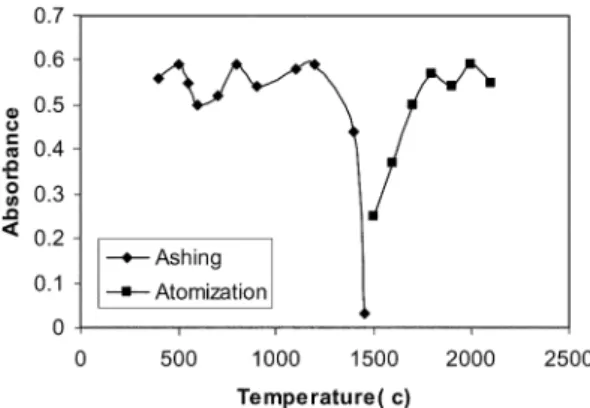
ference are encountered in the atomization step.52 In these experiments we used Pd (10 µg) as a modifier. When Pd was not added, the loss of bis- muth was observed at pyrolysis temperatures higher than 450oC. The influence of the palladium on the background level and atomic signal was of utmost importance. Addition of a 0.1% (w/v) Pd(NO3)2 solution, allowed increasing the pyrolysis tempera- ture to 1150oC with considerable background reduc- tion without losses of bismuth (Fig. 1).
The atomic signals were enhanced by 35% when Pd injected volume was increased from 5 to 10 µL.
For aliquots larger than 10 µL, the signals were not further improved. The modifier volume was thus chosen as 10 µL.
Effect of pH
CPE of bismuth was performed in solutions of pH ranging from 0.5 to 9.5. Separation of metal ions by cloud point method involves the prior for- mation of a complex with suf- ficient hydrophobicity to be extracted in to the small volume of surfactant- rich phase. Extraction recovery depends on the pH at which complex formation occurs.
Fig. 2 shows the effect of pH on the extraction of bismuth complex. It was found that in the pH range 2.5-6.0, extraction was quantitative. Extraction recov- ery of bismuth will decrease at 6<pH<2.5 because its complex is decomposed at pH values smaller than 2.5. In subsequent experiments a pH of 3.0-3.5 was chosen because lead, thallium and cadmium
dithizonates are unstable in slightly acidic medium (3.0-3.5); further, the optimum condition for the selective extraction of a soft acid like bismuth by Na-DDTC is attained in acidic conditions.
Effect of Na-DDTC concentration
The extraction recovery as a function of the Na- DDTC concentration is shown in Fig. 3. For this study, 10mL of a solution containing 0.5 ng ml-1 bismuth in 0.05% (w/v) Triton X-114 with various amounts of Na-DDTC was subjected to the cloud point preconcentration process. At this stated con- centration of bismuth, ~100% extraction was achieved for a Na-DDTC concentration of 0.8×10⁻⁶M. A concentration of 5×10⁻⁶ M Na-DDTC was chosen for subsequent experiments.
Effect of Triton X-114 concentration
A successful cloud point extraction should be able to maximize the extraction efficiency through minimizing the phase volume ratio (Vorg/Vaqueous), so as to improve the preconcentration factor. Triton Fig. 1. Pyrolysis and atomization temperature curves after
preconcentration. Initial bismuth concentration is 0.5 ng mL-1.
Fig. 2. Effect of pH on the extraction recovery of bismuth.
Applied condition is of 0.5 ng mL-1 Bi, 5×10⁻⁶ M Na-DDTC, 0.05% (w/v) Triton X-114 and 1% THF.
Fig. 3. Effect of Na-DDTC concentration on the extraction recovery of bismuth. Utilized condition is of 0.5 ng mL-1 Bi, 0.05% (w/v) Triton X-114, 1% THF, pH 3.0-3.5.
X-114 was chosen as the nonionic surfactant due to its low cloud point temperature and high density, which facilitates phase separation by centrifuga- tion. Fig. 4 highlights the effect of the surfactant concentration in the range of 0.04-0.25% (w/v) on the extraction efficiency. Triton X-114 was found to quantitatively extract the Bi-DDTC complex from the aqueous sample at surfactant concentrations above 0.05%, using a single step extraction proce- dure. Using more than 0.05% of surfactant, the ana- lytical sensitivity decreased due to dilution of the sample by additional surfactant solution.
Selection of the dilution agent for the surfactant- rich phase
High viscosity of the surfactant-rich phase (~20 cP) is drastically decreased using diluting agents. Dif- ferent solvents such as methanol, ethanol and acidic solutions of methanol and ethanol were tried. None of these solvents could dissolve the extracted phase completely. However, THF dissolved the surfac- tant-rich phase and the extracted materials (com- plex of bismuth and excess of Na-DDTC) completely and the best results were obtained with this diluent.
Effect of THF concentration
Fig. 5 shows the effect of THF concentration on extraction efficiency. It was found that the extrac- tion efficiency decreased at THF concentrations
>3% due to dissolution of the surfactant phase and a decrease in the volume of this phase. Hence, a rel- atively concentrated solution (5×10⁻⁴ M) of Na-DDTC in THF was used.
Effect of equilibration temperature and time The equilibration temperature above the cloud point and the incubation time were also optimized.
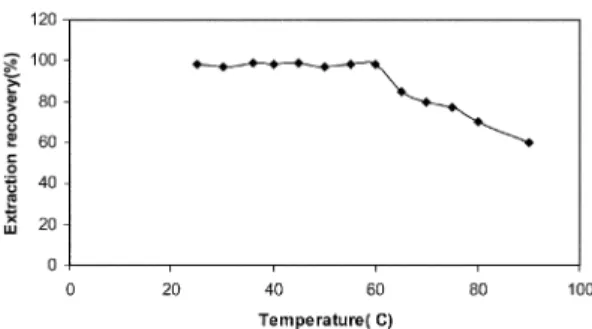
The shortest incubation time and the lowest possi- ble equilibration temperature are desired. The results, illustrated in Fig. 6 show excellent recoveries for equilibration temperature from 40 to 60oC.
Higher temperature lead to the decomposition of Na-DDTC and the reduction of extraction yield. A temperature of 50oC was hence used in all experi- ments. The dependence of extraction efficiency upon incubation time was studied in the range of 5-20 min. An incubation time of 5 min was suffi- cient for quantitative extraction.
Interferences
Bismuth(III) ions produce an orange-brown com- plex with Na-DDTC, Bi(HD2)3, which is stable over the pH range 2.5-6.0. Na-DDTC is known to be highly selective for bismuth at pH 3.0-3.5.58 Only Fig. 4. Extraction recovery of the bismuth as a function of
Triton X-114 concentration. Applied condition is of 0.5 ng mL-1 Bi, 5×10⁻⁶ M Na-DDTC, 1% THF, pH 3.0-3.5.
Fig. 5. Effect of THF concentration on the extraction recovery of bismuth. Utilized condition is of 0.5 ng mL-1 Bi, 5×10⁻⁶ M Na-DDTC, 0.05% (w/v) Triton X-114, pH 3.0-3.5.
Fig. 6. Effect of equilibration temperature on the extraction recovery of bismuth. Applied condition is of 0.5 ng mL-1 Bi, 5 × 10⁶ M Na-DDTC, 0.05% (w/v) Triton X-114, 1% THF, pH 3.0-3.5.
lead, thallium and cadmium can be co-extracted with bismuth but their dithizonates are unstable in slightly acidic medium (pH 3.0-3.5). The noble met- als (Pt, Pd, Au, Ag, and Hg) and copper are quanti- tatively extracted with Na-DDTC at pH 0.5-1.0.
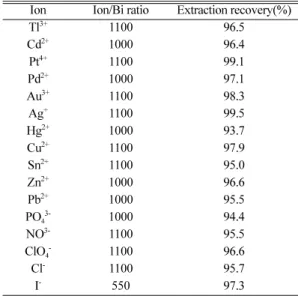
The results of the interference study are shown in Table 2; it will be seen that bismuth recovery was essentially quantitative in the presence of foreign cations. Therefore these ions produce no interfer- ence in the extraction of bismuth.
Characteristics of the method
A calibration curve was constructed by precon- centration of 10 ml of sample standard solutions with Triton X-114. Table 3 shows the analytical characteristics of the method. Under the optimum experimental conditions, the calibration curve for bismuth was linear from 0.05 to 0.70 ng mL-1.
The enhancement factor of about 195 was obtained by preconcentration a 10ml of sample.
The limit of detection was calculated to be 0.04 ng ml-1 (S/N=3). If samples with volumes larger than 20 µl are injected into graphite furnace, sensitivity can be increased but in all experiments we injected 20 µl of analyte, because, otherwise sample may spread to the low-temperature areas of the furnace, or may overflow to the filler port that results in decreased accuracy.
Analysis of real samples
In order to validate the proposed methodology, the developed procedure was applied to the deter- mination of bismuth in tap water, and some waste water samples. Various water samples were also analysed (Table 4) in all cases the spike recoveries were excellent, showing no matrix interferences.
The analytical results shown in Table 4 demon- strate that the results by using the present method are consistent with those obtained by ICP-MS.
Table 2. Effect of foreign ions on the preconcentration and determination of bismuth (0.3 ng mL-1)
Ion Ion/Bi ratio Extraction recovery(%)
Tl3+ 1100 96.5
Cd2+ 1000 96.4
Pt4+ 1100 99.1
Pd2+ 1000 97.1
Au3+ 1100 98.3
Ag+ 1100 99.5
Hg2+ 1000 93.7
Cu2+ 1100 97.9
Sn2+ 1100 95.0
Zn2+ 1000 96.6
Pb2+ 1000 95.5
PO43- 1000 94.4
NO3- 1100 95.5
ClO4- 1100 96.6
Cl- 1100 95.7
I- 550 97.3
Table 3. Analytical characteristics of the method Bi with
CPE
Bi without CPE Concentration rang (ng mL-1) 0.04-0.70 4-110
Slope 0.756 0.0038
Intercept 0.018 0.004
Correlation coefficient(R) 0.9993 0.9994
R.S.D.(%) (n= 5)a 4.0 4.7
LOD(ng ml-1)b 0.04 1.5
Enhancement factorc 195 -
aBismuth concentration was 0.3 ng mL-1 for which the R.S.D.
was obtained.
bDetermined as three times of the standard deviation of the blank signal.
cCalculated as the ratio of slope of preconcentrated samples to that obtained without preconcentration.
Table 4. Determination of Bi in real samples (results of recoveries of spiked samples)
Sample Added Recovery(%) Found a Found Bi in natural sample (ng mL-1)
Bi(ng mL-1) Tap water b
- 0.3
- 99.1
0.165±0.01 0.458±0.03
- 0.453±0.04 Bi(ng mL-1)
Rain water c
- 0.3
- 98.9
0.102±0.03 0.399±0.04
- 0.386±0.03
aMean of three experiments ± standard deviation.
bFrom drinking water system of Saveh, Iran.
cFrom Rain water of Varamin, Iran.
CONCLUSIONS
We have proposed the use of cloud point extrac- tion as an alternative method for the preconcentra- tion of Bi as a prior step to its determination by ET- AAS. The method allows the determination of ultra low levels of Bi by ET-AAS.
The methodology offers a simple, rapid, sensi- tive, low cost, good extraction efficiency and lower toxicity than those using organic solvents. Environ- mental pollution is limited to a small amount of sur- factant. The method gives a low limit of detection and good R.S.D.
Compared with other methods, interference from other cations is minor. The proposed method can be applied for the determination of bismuth in tap water .
Acknowledgements. We gratefully acknowledge financial support of chemistry department, faculty of science, Imam Khomeini International Univer- sity, Qazvin. The authors wish to thank the chemis- try department of Varamin campus Islamic Azad University and Saveh campus Islamic Azad Uni- versity for financial support.
REFERENCES
1. Bertholf, R. L.; Renoe, B. W. Anal. Chim. Acta 1982, 139, 287.
2. Burguera, M.; Burguera, J. L.; Rondon, C.; Garcia, M.
I. J. Anal. At. Spectrom. 2001, 16, 1190.
3. Burguera, J. L.; Burguera, M.; Rivas, C.; Rondon, C.;
Carrera, P.; Gallignani, M. Talanta 1999, 48, 885.
4. Thomas, D. W.; Hartley, T. F.; Coyle, P.; Sobecki, S.
Handbook on Toxicity of Inorganic Compounds, Mar- cel Decker, New York, 1987, p. 15.
5. Thomas, D. W. Bismuth, in: E. Merian (Ed.), Metals and their Compounds in the Environment, VCH, Wein- heim, 1991, p. 789.
6. Ribeiro, A. S.; Arruda, M. A. Z.; Cadore, S. Spectro- chim. Acta B 2002, 57, 2113.
7. Acar, O.; Kl´ll´ç, Z.; Rehber Türker, A. Anal. Chim. Acta 1999, 382, 329.
8. Rahman, L.; Corns, W. T.; Bryce, D. W.; Stockwell, P.
B. Talanta 2000, 52, 833.
9. Morrow, A.; Witshire, G.; Huvsthous, A. At. Spectrosc.
1997, 18, 23.
10. Zhang, L.; Lu, Y.; Yang, G. Huaxue Fence 2000, 36, 26.
11. Feng, X.; Fu, B. Anal. Chim. Acta 1998, 371, 109.
12. Hinds, M. V.; Gregoie, D. C.; Ozaki, E. A. J. Anal. At.
Spectrom. 1997, 12, 131.
13. Ostapczuk, P. Anal. Chim. Acta 1993, 273, 35.
14. Yang, H.-Y.; Chen, W.-Y.; Sun, I.-W. Talanta 1999, 50, 977.
15. Ye, R. D.; Khoo, S. B. Electroanalysis 1997, 9, 481.
16. Wang, C. M.; Sun, Q. Y.; Li, H. L. Electroanalysis 1997, 9, 645.
17. Ferri, T.; Paci, S.; Morabito, R. Anal. Dichim. 1996, 89, 245.
18. Hajian, R.; Shams, E. Anal. Chim. Acta 2003, 491, 63.
19. Alonso, A.; Almendral, M. J.; Báez, M. D.; Porras, M.
J.; López Lavl´n, C. Garcl´a de Marl´a, Anal. Chim. Acta 2000, 408, 129.
20. Sarkar, S. G.; Dhadke, P. M. Sep. Purif. Technol. 1999, 15, 131.
21. Lo, J. M.; Lin, Y. P.; Lin, K. S. Anal. Sci. 1991, 7, 455.
22. Tokman, N.; Akman, S.; Ozcan, M. Talanta 2003, 59, 201.
23. Yamini, Y.; Chaloosi, M.; Ebrahimzadeh, H. Talanta 2002, 56, 797.
24. Pournaghi-Azar, M. H.; Djozan, Dj.; Abdolmohammad zadeh, H. Anal. Chim. Acta 2001, 437, 217.
25. Moyano, S.; Gasquez, J. A.; Olsina, R.; Marchevsky, E.
Martinez, L. D. J. Anal. At. Speltrom. 1999, 14, 259.
26. Silva, J. B. B.; Giacomelli, M. B. O.; Curtius, A. J.
Analyst 1999, 124, 1249.
27. Moghimi, A. “Chinese Journal of Chemistry” 2007, 25, 640.
28. Kocjan, R.; Garbacka, M. Sep. Sci. Technol. 1994, 29, 799.
29. Manzoori, J. L.; Bavili-Tabrizi, A. Microchem. J. 2002, 72, 1.
30. Moghimi, A.; Tehrani, M. S.; Waqif Husain, S. Mate- rial Science Research India 2006, 3(1a), 27.
31. Garrido, M.; Di Nezio, M. S.; Lista, A. G.; Palomeque, M.; Fernández Band, B. S. Anal. Chim. Acta 2004, 502, 173.
32. Manzoori, J. L.; Karim-Nezhad, G. Anal. Sci. 2003, 19, 579.
33. Nascentes, C. C.; Arruda, M. A. Z. Talanta 2003, 61, 759.
34. Shemirani, F.; Baghdadi, M.; Ramezani, M.; Jamalim.
R.; Analytica Chimica Acta 2005, 534, 163.
35. K. Evangelos, Paleologos, G. Athanasios, Vlessidis, I.
Miltiadcs, Karayannis, P. Nicholaos, Evmiridis, Anal.
Chim. Acta 2003, 477, 223.
36. Paleologos, E. K.; Giokas, D. L.; Tzouwara-Karayanni, S. M.; Karayannis, M. I. Anal. Chim. Acta 2002, 458,
241.
37. Manzoori, J. L.; Bavili-Tabrizi, A. Anal. Chim. Acta 2002, 470, 215.
38. Carasek, E.; Tonjes, J. W.; Scharf, M. Talanta 2002, 56, 185.
39. Chen, J.; Teo, K. C. Anal. Chim. Acta 2001, 450, 215.
40. J. Chen, K.C. Teo, Anal. Chim. Acta 2001, 434, 325.
41. Giokas, D. L.; Paleologos, E. K.; Tzouwara-Karayanni, S. M.; Karayannis, M. I. J. Anal. At. Spectrom. 2001, 16, 521.
42. Paleologos, E. K.; Stalikas, C. D.; Karayannis, M. I.
Analyst 2001, 126, 389.
43. Kim, Y. S.; Choi, Y. S.; In, K. Bull. Korean Chem. Soc.
2001, 21, 137.
44. Luconi, M. O.; Fernanda Silva, M.; Olsina, R.A.;
Fernandez, L. P.; Talanta 2000, 51, 123.
45. Mesquita da Silva, M. A.; Frescura, V. L. A.; Curtius, A. J. Spectrochim. Acta B 2000, 52, 803.
46. Ozturk, B. D.; Filik, H.; Tutem, E.; Apak, R. Talanta 2000, 53, 263.
47. Zaporozhets, O.; Petruniock, N.; Sukhan, V. Talanta 1999, 50, 865.
48. Concepcion Cerrato Oliveros, M.; de Blas, O. J.;
Pavon, J. L. P.; Cordero, B. M. J. Anal. At. Spectrom.
1998, 13, 547.
49. Mesquita da Silva, M. A.; Azzolin Frescura, V. L.;
Nome Aguilera, F. J.; Curtius, A. J. J. Anal. At. Spec- trom. 1998, 13, 1369.
50. Manzoori, J. L.; Sorouradin, M. H.; Hajishabani, A. M.
J. Anal. At. Spectrom. 1998, 13, 305.
51. Rjabuchin, S. Y.; Report IAEA/RL/50, Vienna, 1987.
52. He, B.; Ni, Z.-M. J. Anal. At. Spectorm. 1996, 11, 165.
53. Wei-Ming, Y.; Zhe-Ming, N. Spectrochim. Acta B 1997, 52, 241.
54. Acar, O.; Türker, A. R.; Kilic, Z., Fresenius, J. Anal.
Chem. 1997, 357, 656.
55. Shan, X.-Q.; Wen, B. J. Anal. At. Spectrom. 1995, 10, 791.
56. Imai, S.; Hasegawe, N.; Nishiyama, Y.; Hayashi, Y.;
Satio, K. J. Anal. At. Spectrom. 1996, 11, 601.
57. Havezov, I.; Detcheva, A.; Rendl, J. Mikrochim. Acta 1995, 119, 147.
58. Marczenko, Z. Separation and Spectrophotometric Determination of Elements, Ellis Horwood, Chichester, UK, 1986, p. 169.