INTRODUCTION
In the last few decades, the body of knowledge re- quired for nursing has expanded greatly as the nursing role has new dimensions of patient care. Today’s nursing schools place a much stronger emphasis on the psycho- logical and behavioral aspects related to patient care than in the past. Unfortunately most nursing schools have not made corresponding revisions in standard nurs- ing courses dealing with bioscientific aspect of nursing knowledge (Trnobranski, 1933; Jordan, 1994;. Torrance
& Jordan, 1995). Yet most in the nursing field would agree that a sound ‘working’ knowledge of anatomy,
physiology, pharmacology, pathophysiology and micro- biology should, in fact, be the force along with nursing courses in psychology and interpersonal patient-care be- havioral skills. Clearly, a more meaningful integration of bioscience courses into the new nursing curriculum is needed (Akinsanya, 1987; Trnobranski, 1993; Clark, 1995; Wynne et al., 1997).
Recently, studies have found that nursing students themselves are pointing to insufficient training in physi- ology as a major cause of their failure to understand much of the clinical phenomena they encounter in the hospital setting (Akinsanya, 1987; Courtenay, 1991).
Moreover, the balance between the behavioral and bio- logical sciences in nursing education is perceived by stu-
A Preliminary Report on the Differences in the Perceived Impacts of Undergraduate Bioscience Knowledge on Clinical Practice Among Korean RNs
Myoung-Ae Choe, RN, PhD1, Smi Choi-Kwon, RN, PhD1, Kyung Ja Song, RN, PhD2
1. College of Nursing, Seoul National University and Department of Nursing 2. Seoul National University Hospital, Seoul, Korea
Corresponding author: Myoung-Ae Choe, College of Nursing, Seoul National University, 28, Yongon-dong, Chongno-gu, Seoul 110-799, Korea
Tel: 82-2-740-8803 Fax: 82-2-765-4103 E-mail: [email protected] Received April 18, 2003 ; Accepted June 19, 2003January 31, 2000
Purpose. Nursing has evolved as a unique and independent field over the last decades. Unfortunately, many nurses in Korea express concern that they lack appropriate background knowledge in bioscience necessary to practice nursing competently. To determine the reasons of their concerns, we examined the perceptions of RNs regarding bioscience courses in their undergraduate (Baccalaureate and 3 year diploma program) and their perceived relations to the practice of nursing.
Methods. The structured questionnaires were sent to 3 university-affiliated tertiary hospitals in Seoul, Korea.
Results. The responses given by the nurses in the two groups were similar. The nurses in this study reported that the bioscience courses they took as undergraduates had little relation to their professional tasks. This lack of link between bioscientific knowledge and nursing practice may be partly due to the fact that the courses are taught by non-nursing faculties who are not familiar with nursing tices. It also appears that bioscience knowledge deficit was most prominent during nursing assessment regardless of the program they attended or the unit they are currently working.
Conclusion. Bioscience courses should be integrated into the nursing curriculum properly and taught by nursing faculty who have a strong background in biological sciences.
Key Words: Bioscientific knowledge in nursing; Clinical competency; Nursing education
dents as being too much in favor of the behavioral sci- ences(Courtenay, 1991).
Nurses in Korea often present criticism on their train- ing regarding bioscience courses in nursing education, however, no researcher has ever attempted to ascertain just what type of bioscientific aspect of nursing knowl- edge is needed for registered nurses. Moreover, the depth and details covered in bioscience courses for nurs- es has never been scrutinized in terms of either need analysis or the actual application of course in the clinical field.
This study attempts to determine why practicing nurs- es in Korea feel that bioscience courses they had are not helpful in clinical settings and when the knowledge deficit related to bioscience was apparent in clinical situ- ation. We also sought to find the differences in percep- tions regarding bioscientific aspect of nursing knowledge deficit between the graduates of baccalaureate nursing program and those of 3 year diploma program.
Based upon their perceptions, suggestions for strength- ening bioscientific aspects of nursing knowledge devel- opment are also discussed.
METHODS
The questionnaire was developed based on informa- tion obtained from 2 nursing faculties specializing in bio- science nursing, and 6 nurses who graduated from differ- ent degree programs and are currently working in a vari- ety of units in different hospitals. The instrument’s inter- nal validity was Cronbach alpha of 0.935. The question- naire was sent to the 3 biggest university-affiliated ter- tiary hospitals with more than 1000 beds each in Seoul, Korea. We do believe that these hospitals best represent the nurses from different programs, having employed the best students from each program, therefore providing us with a suitable subject group for this study.
The questionnaire covered demographic information of the respondents and the perceptions of bioscience nurs- ing knowledge.
The demographic information included the name of the hospital, the type of training program they had at- tended (3 year diploma program, 4 year baccalaureate science of nursing (BSN) program, or graduate program), the current working units, their position in the unit and their working experiences after graduation from nursing school.
The information of the perceptions included 1) the
name of bioscience courses each nurse completed; 2) the lecturer’s background; 3) whether the nurses felt that they currently were lacking in bioscience knowledge; 4) if they felt deficient in this area, and why they felt that way; 5) if they felt a lack of bioscience knowledge in their work, when they felt the lack of such knowledge most; 6) order of frequency of subjects’ response to sug- gestions for strengthening bioscience courses in training.
7) what sort of bioscience nursing knowledge from each bioscience courses listed did they feel would be most pertinent to achieve optimal performance in their nurs- ing tasks.
Questionnaire data were analyzed with descriptive sta- tistics, Chi-square, and ANOVA with the use of the SPSS statistical package for PC.
RESULTS
Out of 660, 559 subjects answered. Among 559 re- spondents, 321 (57.4%) had BSN degrees and 78 (13.9%) had either finished graduate program or were currently enrolled in graduate school. And 499 (89.3%) were staff nurses, 57 (10.2%) were unit managers and 3 were supervisor nurses. 183 (32.7%)nurses worked in ICU, 75 (13.4%) worked in OR and the remaining nurs- es worked in GU (See Table 1). The mean number of years of experience for the entire group was 5.5 years.
Table 1. General Characteristics of the Subjects (N=559)
General characteristics N (%)
Educational background Diploma 238 (42.6%)
BSN 321 (57.4%)
Graduate school Attending 042 (7.5%) Graduated 036 (6.4%) Never attended 481 (86.1%)
Position Staff nurse 499 (89.3%)
Unit manager 057 (10.2%)
Supervisor nurse 003 (0.5%)
Working unit ICU total 183 (32.7%)
Medical 068 (37.2%) Surgical 050 (27.3%) Pediatric 041 (22.4%) Neurologic 024 (13.1%) GW total 301 (53.9%)
Medical 111 (36.9%) Surgical 120 (39.8%) Pediatric 033 (11.0%) Neurologic 006 (2.0%)
Other 031 (13.4%)
OR 075 (13.4%)
ICU: Intensive Care Unit, GW: General Wards OR: Operating Rooms
Bioscience Courses taken by nurses during their nurs- ing training:
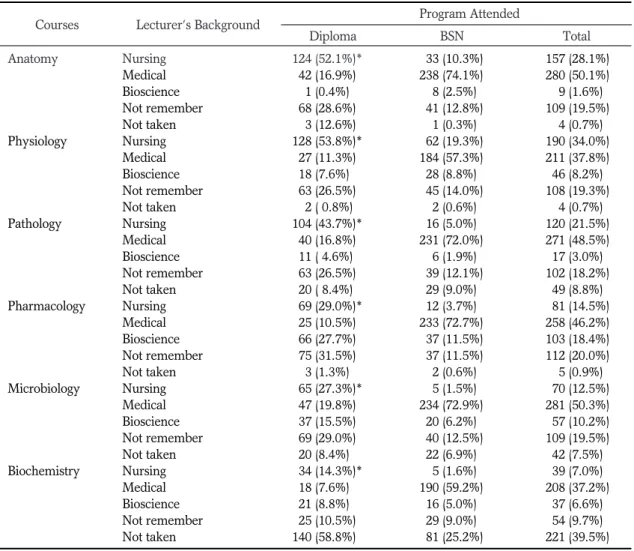
Six bioscience courses (anatomy, physiology, pathology, pharmacology, microbiology, biochemistry) were listed on the questionnaire. More than 90% of the nurses had taken all of them except biochemistry course which only 60% of nurses had taken(p<0.01). Nurses who had been trained in 3 year college programs reported more of their courses were taught by nursing faculty than did those nurses who had been trained in BSN programs (See Table 2). The number and percentage of subjects who had tak- en six bioscience courses are listed in Table 2. Also the number and percentage of nurses who identified the lec- turer’s background and their courses are listed.
Reasons given by nurses as to why their bioscience courses are not helpful in clinical settings:
531 (94.9%) respondents reported that they feel a
knowledge deficit with respect to their bioscience nurs- ing knowledge. There were no significant differences ei- ther in the reasons or the order of reasons between the respondents with diploma degree and BSN degree.
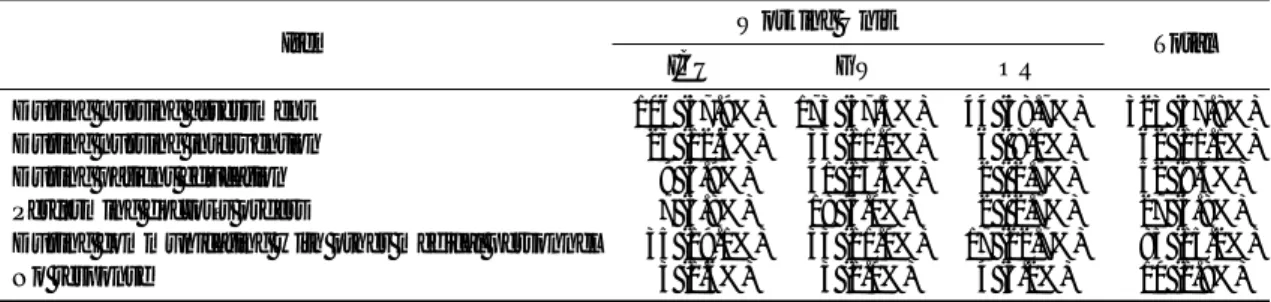
As shown in Table 3, the most frequent reason given for not having enough bioscience knowledge was ‘the content of courses did not relate to clinical settings’, not- ed by 39.2% of the subjects. The second reason was the
‘superficial content of course materials’ (19.5%). The third reason was “the lectures were delivered by medical staff, not by nursing faculty” (4.6% of diploma degree nurses and 10.3% of the BSN degree nurses).
When nurses reported that their bioscience knowledge deficit most needed
In the 5 clinical situations listed above, nurses reported that they felt their bioscience knowledge deficit most keenly during nursing assessments (57.8%) and no sig-
Table 2. Bioscience Nursing Courses Taken by Subjects During Their Nursing Training (N=559)
Courses Lecturer’s Background Program Attended
Diploma BSN Total
Anatomy Nursing 124 (52.1%)* 033 (10.3%) 157 (28.1%)
Medical 042 (16.9%) 238 (74.1%) 280 (50.1%)
Bioscience 001 (0.4%) 008 (2.5%) 009 (1.6%)
Not remember 068 (28.6%) 041 (12.8%) 109 (19.5%)
Not taken 003 (12.6%) 001 (0.3%) 004 (0.7%)
Physiology Nursing 128 (53.8%)* 062 (19.3%) 190 (34.0%)
Medical 027 (11.3%) 184 (57.3%) 211 (37.8%)
Bioscience 018 (7.6%) 028 (8.8%) 046 (8.2%)
Not remember 063 (26.5%) 045 (14.0%) 108 (19.3%)
Not taken 002 ( 0.8%) 002 (0.6%) 004 (0.7%)
Pathology Nursing 104 (43.7%)* 016 (5.0%) 120 (21.5%)
Medical 040 (16.8%) 231 (72.0%) 271 (48.5%)
Bioscience 011 ( 4.6%) 006 (1.9%) 017 (3.0%)
Not remember 063 (26.5%) 039 (12.1%) 102 (18.2%)
Not taken 020 ( 8.4%) 029 (9.0%) 049 (8.8%)
Pharmacology Nursing 069 (29.0%)* 012 (3.7%) 081 (14.5%)
Medical 025 (10.5%) 233 (72.7%) 258 (46.2%)
Bioscience 066 (27.7%) 037 (11.5%) 103 (18.4%)
Not remember 075 (31.5%) 037 (11.5%) 112 (20.0%)
Not taken 003 (1.3%) 002 (0.6%) 005 (0.9%)
Microbiology Nursing 065 (27.3%)* 005 (1.5%) 070 (12.5%)
Medical 047 (19.8%) 234 (72.9%) 281 (50.3%)
Bioscience 037 (15.5%) 020 (6.2%) 057 (10.2%)
Not remember 069 (29.0%) 040 (12.5%) 109 (19.5%)
Not taken 020 (8.4%) 022 (6.9%) 042 (7.5%)
Biochemistry Nursing 034 (14.3%)* 005 (1.6%) 039 (7.0%)
Medical 018 (7.6%) 190 (59.2%) 208 (37.2%)
Bioscience 021 (8.8%) 016 (5.0%) 037 (6.6%)
Not remember 025 (10.5%) 029 (9.0%) 054 (9.7%)
Not taken 140 (58.8%) 081 (25.2%) 221 (39.5%)
Nurses trained in diploma program reported that more of bioscience courses listed above were taught by nursing faculty than did those nurses who had been trained in BSN programs. * <0.05
nificant difference were found between the diploma and BSN program attendees (Table 4). The second most fre- quently reported bioscientific knowledge deficit situation for nurses with BSN degrees concerned communicating with other health care providers (19.0%). Diploma de- gree nurses said they were most aware of their deficit during performing nursing intervention (16.0%). The third most frequent time of concern noted was in situa- tions in which they were educating patients (10.0%) for BSN degree nurses, while for diploma program gradu- ates, the third most frequently noted situation was
“communicating with other medical personnel.”
Responses were also categorized according to working units and we found no significant differences among the 3 groups where they all reported that their bioscience knowledge deficit was the most profound when they are conducting nursing assessment (See Table 5).
Order of frequency of subjects’ response to suggestions for strengthening bioscience courses in training
The questionnaire listed four possible ways to remedy the situations brought on by lack of bioscientific knowl- edge in practicing nurses. There were no significant dif- ferences in the order of these choices between the nurses who had a diploma degree and BSN degree nurses, nor among working units. The respondents’ suggestions to strengthen the bioscience course are summerized as fol- lows: 1) to emphasize the link between bioscience cours- es and nursing practice (65%). 2) to integrate the bio- science courses into a nursing model and have them taught by nursing faculty (61%), 3) and 4) to increase the number of credit hours which are currently between 12-14 (34%) and to provide more anatomy and physi- ology laboratory experiences (17%).
Table 4. When the Knowledge Deficit Related to Bioscience Nursing was Most Apparent in Nursing Practice (By program attended, N=559)
Item Program attended
Diploma BSN Total
During nursing assessment 136 (57.1%) 187 (58.2%) 323 (57.8%)
During nursing intervention 038 (16.0%) 024 (7.5%) 062 (11.1%)
During patient education 020 (8.4%) 032 (10.0%) 052 (9.3%)
Performing doctor’s orders 016 (6.7%) 011 (3.4%) 027 (4.8%)
During communicating with other medical personnel 024 (10.1%) 061 (19.0%) 085 (15.2%)
No response 004 (1.7%) 006 (1.9%) 010 (1.8%)
Table 5. When the Knowledge Deficit Related to Bioscience Nursing was Most Apparent in Nursing Practice (By Working Unit, N=559)
Item Working Unit
Total
ICU GW OR
During nursing assessment 106 (57.9%) 173 (57.5%) 44 (58.7%) 323 (57.8%) During nursing intervention 023 (12.6%) 033 (11.0%) 06 ( 8.0%) 062 (11.1%) During patient education 009 (4.9%) 041 (13.5%) 02 ( 2.7%) 052 (9.3%) Performing doctor’s orders 007 (3.8%) 018 (6.0%) 02 ( 2.7%) 027 (4.8%) During communicating with other medical personnel 035 (19.1%) 033 (11.0%) 17 (22.7%) 085 (15.2%)
No response 003 (1.6%) 003 (1.0%) 04 (5.2%) 010 (1.8%)
Table 3. The Perceived Reasons why Bioscience Nursing Courses were Not Helpful in Clinical Settings (N=559)
Diploma BSN Total
Lectures delivered by non nursing faculties 011 (4.6%) 033 (10.3%) 044 (7.9%) Not related to clinical settings 104 (43.7%) 115 (35.8%) 219 (39.2%) No link among bioscience nursing courses 007 (2.9%) 017 (5.3%) 024 (4.3%) Superficial content of course materials 051 (21.4%) 058 (18.1%) 109 (19.5%)
Others 009 (3.8%) 009 (2.8%) 018 (3.2%)
No response 056 (23.6%) 089 (27.7%) 145 (25.9%)
Bioscience courses the nurses felt to be most pertinent to the practice of nursing
Among the 6 different bioscience courses listed in the questionnaire, physiology was reported as the most nec- essary (37.9%), followed by anatomy (18.6%), patholo- gy (11.8%), pharmacology (9.7%), and microbiology (6.5%). When we categorized the responses by the working units of the respondents, the courses noted as most needed did not differ statistically (p=0.15, See Table 6).
Content areas which nurses felt should be covered in courses:
The lists of content descriptions are given to the sub- jects, and the responses are following.
Anatomy : The areas the nurses listed as being highly necessary were the neurologic system (65%), followed by the circulatory system (45%), and the endocrine sys- tem(39%).
Physiology : In this field, information on and under- standing of the hematologic system was listed by (99.5%) of the respondents as being crucial. This area was followed by fluid and electrolyte balance (61%), the neurologic system (43%), endocrine system (43%), and the cardiovascular system (41%).
Biochemistry : Therapeutic diet was reported as most needed (53%), followed by nutrition (39%), and protein metabolism (30%).
Pathology : Pathology related to immune function was reported to be needed by 64% of the subjects ; infection by 46% and tumor by 41%.
Pharmacology : 47% of the diploma degree nurses and 50% of the BSN degree nurses reported that phar- macodynamics and pharmacokinetics are needed in prenursing training courses. Autonomic nervous system pharmacology was listed as needed by 42%.
Microbiology : Inflammation and immunity were cited
as needed by 66%. Knowledge of the routes of infection was also reported as needed by15%.
DISCUSSION
To our knowledge, our study provides the first descrip- tions of bioscientific nursing knowledge deficit perceived among nurses in Korea, who for some time have com- plained about their lack of knowledge in bioscience ar- eas. They were asked to examine that lack on the basis of their own experience and perceptions via a question- naire. The administered questionnaire covered their per- ceptions of the reason why they lacked bioscience knowledge and when they perceived the knowledge deficit most seriously in the nursing field. In addition, the questionnaire also included the suggestions for the improvements of the bioscience course.
Out of 559 subjects who responded , 531 (94.9%) re- ported that they felt themselves lacking in bioscience nursing knowledge although more than 90% also noted that they had taken bioscience courses as undergradu- ates. When asked why the courses they had taken in bio- science were inadequate, respondents invariably an- swered that there was no link, or none that was made explicit, between the content of the courses they took and what they encountered during actual practice. It may be also due, in part, to the fact that over 50% of the diploma prepared nurses did not take biochemistry course. However, these results rather support the argu- ment raised by other researchers working with other populations (Lynaugh & Bates, 1973) that it is crucial to provide an explicit link between bioscience and nursing practice in nursing curricula since a lack of knowledge in bioscience adversely affects the quality of nursing care and that nurses themselves are acutely aware of this deficit. Jordan (1996) suggests utilizing the case study approach to teach bioscience courses in order to inte-
Table 6. Bioscience Nursing Courses the Nurses Felt to be Most Pertinent to the Practice of Nursing (N=559)
Item Working unit
Total
ICU GW OR
Anatomy 22 (12.0%) 057 (18.9%) 25 (33.3%) 104 (18.6%)
Physiology 75 (41.0%) 116 (38.6%) 21 (28.0%) 212 (37.9%)
Biochemistry 28 (15.3%) 032 (10.6%) 05 (6.7%) 065 (11.6%)
Pathology 19 (10.3%) 032 (10.6%) 15 (20.0%) 066 (11.8%)
Pharmacology 25 (13.7%) 023 (7.7%) 06 (8.0%) 054 (9.7%)
Microbiology 12 (6.6%) 021 (7.0%) 03 (4.0%) 036 (6.5%)
No response 02 (1.1%) 020 (6.6%) 00 (0.0%) 022 (3.9%)
ICU: Intensive Care Unit, GW: General Wards, OR: Operating Rooms
grate theory with practice. Clinical scenarios dramatical- ly point up the realities of patient care and the need for applied knowledge for optimum care. It is also possible that the nursing faculties in Korea had made an attempt to reinforce biosicence knowledge in nursing curriculum which apparently may not have been enough for the stu- dent’ need.
Although bioscience courses are often taught by re- searchers in the field, the second most frequent reason given by the nurses for their lack of bioscientific knowl- edge was that the bioscience courses during their nursing training treated the subject matter superficially. That ex- perts in their field offer only superficial knowledge in courses presents a paradox worth examining. It has al- ways been assumed that, since bioscience courses were often taught by medical staff or scientists who were in the midst of conducting research in their specialty, the courses would be pertinent and dynamically relevant to the clinical setting. This argument is clearly articulated by Casey (1996) who points to the situation in Australia and New Zealand where the biosciences are taught by bioscience major faculties. Casey argues that in the bio- medical model, the staff teaching the bioscience courses are in the field of bioscience and therefore can be pre- sumed to provide vivid bioscience contents with cutting edge research data.
The nurses in our study, however, indicate that the op- posite is more probably the case. Medical staff or science faculties are usually not that familiar with the detailed roles of nursing and know little of how the biosciences are connected to nursing practices. Unaware of the per- spective of nursing and therefore of why the nurses need bioscientific knowledge, biomedical staff often prepare courses which are inadequate for nursing students, though they may well be adequate for medical students.
The science backgrounds of nursing students are likely to be much different than those of medical students and it is understandable that the nursing students are often times ill prepared to deal with courses designed for non nursing major students.
On the other hand, those respondents who had re- ceived their bioscience courses from nursing faculty, who it is to be supposed do understand the needs of nurses, also claimed that their knowledge was insufficient for the duties they had to perform in clinical area. This may be due to the fact that many bioscience teachers with nursing degrees are not themselves specifically trained or, even, had additional training in the biosciences they
teach. In Korea, most junior college nursing faculty do not hold a degree in the biosciences whereas often many faculties in BSN program who are involved in teaching bioscience courses hold a BSN degree in Nursing and a Ph.D. either in physiology or anatomy and this factor may certainly have influenced the results of our study.
In view of the recent emphasis on unique and inde- pendent role of nurses, it is alarming to note that the nurses in this study reported that they felt their lack of bioscience knowledge to be most debilitating as they perform those professional duties such as nursing assess- ments, communicating with other members of the health care team, educating patients, and nursing intervention.
Certainly an analysis of the nurses’ responses in this study suggest that the relationship between the nursing process and the teaching of biological sciences in the nursing training curriculum needs to be improved in Korea and elsewhere as this study’s conclusions concur with studies of other nursing populations (Jordan &
Hughes, 1998). That study made the credible claim that when nurses’ understanding of physiology was adequate, they were better able to monitor patients and question or discuss medical decisions. Jordan and Reid (1997) al- so came to similar conclusions, noting particularly that overall patient care was improved when nurses were able to apply their knowledge of physiology to their tasks.
Recently, there appears to be a push toward bridging bioscience and nursing practice, to improve patient care on a global scale. For example, Cowan et al (1993) pro- posed a multiyear plan to enhance research and training for integration of biological and nursing sciences. They developed a research training program which utilizes bi- ological nursing scientists. In Korea, a ‘Society for the bionursing science’ has been organized to standardize the bionursing science curriculum and provide national guidelines, to integrate bioscience knowledge into the nursing repertoire and to promote research in these ar- eas as well. Just as the new millenium is highlighting de- mands that the role of nursing be expanded to meet the increased need for broad and holistic solutions.
We have to admit that there are limitations in our study. 1st, the information obtained from the respon- dents regarding undergraduate bioscience programs may not be accurate, being based on the subjects’ memory.
However, the primary aim of the current study was not to assess the level of knowledge of bioscience in general, but to make a comparison of the differences between 2 different programs. 2nd, we should note that this is a pre-
liminary study where we limited our discussion to the curriculum related to biological science in Nursing.
Finally, we are limited in knowledge regarding the sub- jects who responded and those who did not.
In summary, our results demonstrate that many Korean RNs are acutely aware of a lack of proper bionursing science knowledge when they are implement- ing the nursing process, communicating with other med- ical personnel, or teaching patients regardless of the pro- gram attended. Today, nurses’ observations are crucial to the quality patient care. Nurses in this study are not only aware of their lack in bioscience knowledge but also they have strong suggestions to remedy this deficit. The outcome of this study is clear: nurses need holistic knowledge and they need the ability to integrate and ap- ply bioscientific nursing knowledge to their practice of nursing.
Therefore, research is needed which aims at finding out just how bioscience knowledge can be used by nurs- es in the present situation. Such research should explore the potential of bioscientific knowledge for further clini- cal uses as the role of the nurse becomes stronger and more integrated into patient care systems. Furthermore, future studies are needed to integrate and articulate re- lated knowledge not only in bioscience courses but also in behavioral nursing courses.
References
Akinsanya, J.A. (1987) The life sciences in nursing:development of a theoretical model. Journal of Advanced Nursing, 12, 267- 274.
Bond, E.F. & Heitkemper, M.M. (1987) Importance of basic physio- logic research in nursing science (research editorial). Heart &
Lung, 16, 4, 347-349.
Casey, G. (1996) Analysis of Akinsanya’s model of bionursing.
Journal of Advanced Nursing, 23, 1065-1070.
Chapple, M., Allcock, N., Wharrad, H.J. (1993) Bachelor of Nursing students’ perceptions of learning biological sciences alongside medical students. Nurse Education Today, 13, 426- 434.
Choe, M. & Shin, G. (1997) A study on the current status of the curriculum operation of the basic medical sciences in nursing education. Journal of Korean Academy of Nursing, 27, 4,975- 987.
Clark, M. (1995) Nursing and the biological sciences. Journal of Advanced Nursing, 22, 405-406.
Courtenay, M. (1991) A Study of the teaching and learning of the biology sciences in nurse education. Journal of Advanced Nursing, 16, 1110-1116.
Cowan, M. J., Heinrich, J., Lucas, M., Sigmon, H., & Hinshaw, A. S.
(1993) Integration of biological and nursing science: a 10- years plan to enhance research and training. Research in Nursing and Health, 16, 3-9.
Hinshaw, A., Sigmon, H., & Lindsey, A. (1991) Interfacing nursing and biologic science. Journal of Professional Nursing, 7, 5, 264.
Jordan, S. (1994) Should nurses be studying bioscience? A discus- sion paper. Nurse Education Today, 14, 417-426.
Jordan, S. (1997) Teaching pharmacology by case study. Nurse Education Today, 17, 386-393.
Jordan, S., & Hughes, D. (1998) Using bioscience knowledge in nursing: actions, interactions and reactions. Journal of Advanced Nursing, 27, 1060-1068.
Jordan, S., & Reid, K. (1997) The biological sciences in nursing: an empirical paper reporting on the application of physical of nursing care. Journal of Advanced Nursing, 27, 1060-1068.
Mulhall, A. (1990) The contribution of the basic sciences to nursing practice research. Journal of Advanced Nursing, 15, 1354- 1357.
Torrance, C., & Jordan, S. (1995) Bionursing: putting science into practice. Nursing Standard, 9, 49, 25-27.
Trnobranski, P.H. (1993) Biological sciences and the nursing cur- riculum: a challenge for educationalists. Journal of Advanced Nursing, 18, 493-499.
Wharrad, H. J., Allcock, N., & Chapple, M. (1994) A Survey of the teaching and learning of biological sciences on undergraduate nursing courses. Nurse Education Today, 14, 436-442.
Wynne, N., Brand, S., & Smith, R. (1997) Incomplete holism in pre- registration nurse education: the position of the biological sci- ences. Journal of Advanced Nursing, 26, 470-474.