Tobacco use, immunosuppressive, chronic pain, and psychiatric conditions are prevalent in
women with symptomatic mesh complications undergoing mesh removal surgery
Elliot K. Blau1 , Sarah A. Adelstein2 , Katherine A. Amin1 , Sharon J. Durfy1 , Alvaro Lucioni1 , Kathleen C. Kobashi1 , Una J. Lee1
1Section of Urology and Renal Transplantation, Virginia Mason Medical Center, Seattle, WA, 2Department of Urology, Rush University Medical Center, Chicago, IL, USA
Purpose: To identify demographic and clinical characteristics of patients with symptomatic pelvic floor mesh complications who underwent mesh removal at our academic medical center. The secondary goal was to determine patient-reported outcomes after mesh removal.
Materials and Methods: We conducted a retrospective review of consecutive patients from 2011–2016 undergoing removal of mesh graft for treatment of symptomatic mesh-related complications. Patient demographics, comorbidities, symptoms, and mesh factors were evaluated. Outcomes after explant were determined by the Patient Global Impression of Improvement and a Likert satisfaction scale.
Results: One hundred fifty-six symptomatic patients underwent complete or partial pelvic floor mesh removal during the study period. Mid-urethral slings comprised 86% of explanted mesh grafts. Mesh exposure or erosion was identified in 72% of patients.
Eighty-one percent of patients presented with pain, and 35% reported pain in the absence of exposure or erosion. Pre-operative comorbidities included psychiatric disease (54.5%), chronic pain (34.0%), irritable bowel syndrome (20.5%) and fibromyalgia (9.6%).
Forty-three percent of patients reported current or past tobacco use. At mean follow-up of 14 months, 68% of responding patients reported improvement on the Patient Global Impression of Improvement after surgery.
Conclusions: This research identified tobacco use, and psychiatric, immunosuppressive, and chronic pain conditions as prevalent in this cohort of patients undergoing mesh removal. Surgical removal can improve presenting symptoms, including for patients with pain in the absence of other indications.
Keywords: Pain; Pelvic organ prolapse; Suburethral slings; Urinary incontinence; Urologic surgical procedures
This is an Open Access article distributed under the terms of the Creative Commons Attribution Non-Commercial License (http://creativecommons.org/licenses/by-nc/4.0) which permits unrestricted non-commercial use, distribution, and reproduction in any medium, provided the original work is properly cited.
Received: 26 June, 2019 • Accepted: 13 October, 2019
Corresponding Author: Una J. Lee https://orcid.org/0000-0003-1128-5083
Section of Urology and Renal Transplantation, Virginia Mason Medical Center, 1100 9th Ave, C7-URO, Seattle, WA 98101, USA TEL: +1-206- 223-6772, FAX: +1-206-223-7650, E-mail: [email protected]
ⓒ The Korean Urological Association
www.icurology.org
Investig Clin Urol 2020;61 Suppl 1:S57-63.
https://doi.org/10.4111/icu.2020.61.S1.S57 pISSN 2466-0493 • eISSN 2466-054X
INTRODUCTION
Stress urinary incontinence (SUI) and pelvic organ pro-
lapse (POP) are common pelvic floor disorders affecting women of all ages. Approximately 11% of women will seek surgical correction of their incontinence and/or prolapse in
their lifetime [1]. Polypropylene mesh mid-urethral slings (MUS) were approved by the U. S. Food and Drug Adminis- tration (FDA) in 1998. These thin strips of mesh revolution- ized treatment of SUI for women by providing a minimally invasive, durable, effective surgical treatment for SUI [2,3].
In the mid-2000s, polypropylene mesh began to be used for vaginal POP surgery, to augment transvaginal repairs in a manner similar to inguinal herniorrhaphy. Sheets of mesh have also been utilized abdominally for sacrocolpo- pexy for POP since well before MUS surgery developed wide acceptance. However, complication rates of POP repairs with transvaginal mesh (TVM) were higher than expected, prompting the FDA to issue a public health notification in 2008 and an update in 2011 [4,5]. The FDA emphasized the need for a more rigorous informed consent process to edu- cate and inform patients of the full range of potential and serious complications associated with the surgical use of polypropylene mesh in this setting, including erosion, pain, infection, bleeding, organ perforation, dyspareunia and uri- nary issues [4-6]. Complications after MUS have also been identified and include vaginal mesh exposure, mesh erosion into the bladder or urethra, pelvic pain, groin pain, and dys- pareunia [7,8]. Mesh complications after sacrocolpopexy have also been reported, including mesh erosion into the bladder, bowel, or vagina, dyspareunia, and pelvic pain [9-12].
There is limited literature on preoperative factors which may predispose patients to mesh complications specifically, as opposed to complications from surgery in general [7].
Similarly, there are limited data regarding the outcomes of women undergoing mesh explant due to mesh complications [13]. Here, we present data from our tertiary referral center experience of pelvic floor mesh explant surgery for symp- tomatic mesh complications. The primary goal of this study was to characterize the clinical and demographic features of patients in our clinical population with symptomatic mesh complications and secondarily, to describe outcomes after mesh removal in this population.
MATERIALS AND METHODS
This is an institutional review board (IRB)-approved, ret- rospective case series of consecutive female patients under- going partial or complete removal of synthetic mesh graft for POP and/or SUI for the treatment of symptomatic, mesh- related complications, performed at a single-site tertiary re- ferral center by 3 fellowship-trained female pelvic medicine and reconstructive surgery (FPMRS) urologists (Benaroya Research Institute at Virginia Mason IRB, approval number:
3011200). Informed consent was waived for this study. Mesh
explant surgeries were performed between January 2011 and December 2016 and were identified by Current Proce- dural Terminology (CPT) codes 57287 (removal or revision of sling for stress incontinence), 57295 (removal or revision of vaginal mesh, vaginal approach) and 57296 (removal or revision of prosthetic vaginal graft, abdominal approach).
The decision for partial versus complete mesh graft removal was discretional based on both surgical and patient consid- erations, and detailed pre-operative counseling between the surgeon and patient. Patients with mesh complications who were asymptomatic and managed conservatively without surgical excision were not included in the study.
Index surgeries included MUS for anti-incontinence, TVM and/or sacrocolpopexy for POP repair, and included any combination of these surgeries. MUS type was further defined as retropubic, transobturator, single-incision, or bone anchored. Index surgeries were not required to be performed at the study institution. Original operative notes were ob- tained whenever possible. Patient demographics, comorbidi- ties, presenting symptoms, exam findings, mesh characteris- tics, and surgical factors were obtained via chart review of the electronic medical record, and primary care and specialty clinic records were reviewed when possible to confirm diag- noses. Comorbidities were defined as conditions determined to be present prior to placement of mesh. Psychiatric comor- bidities included depression, anxiety and/or bipolar disorder.
Chronic pain conditions preexisting prior to mesh placement were recorded, including chronic neck and/or back pain, mi- graines, chronic pelvic pain, fibromyalgia, and endometriosis.
Chronic obstructive pulmonary disease, diabetes, and rheu- matologic/autoimmune diseases were identified. When avail- able, pre-operative visual analogue scale (VAS) for pain (0–10) was collected prior to explant surgery. The International Urogynecological Association (IUGA) Complication grades were determined pre-operatively from review of the medical record for all patients reporting pain related to their mesh [14].
Patient-reported outcome measures including the Pa- tient Global Impression of Improvement (PGI-I) and Likert satisfaction scale (0–10), were collected postoperatively via questionnaires mailed 6 and 12 months after surgery and annually thereafter. When more than 1 questionnaire was returned, the first questionnaire returned was included in the analysis. Measures were summarized using means and frequencies, and 95% confidence intervals (CIs) where appro- priate. Descriptive statistics were performed using R version 3.5.1 (https://www.R-project.org).
RESULTS
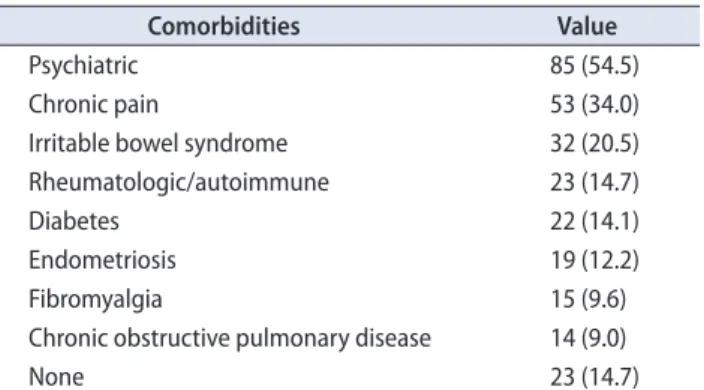
A total of 156 women underwent surgical removal of mesh graft for treatment of symptomatic complications dur- ing the 5 year study period. All initial mesh implants were placed between 1990 and 2015. Table 1 summarizes the pre-
operative comorbidities of this cohort at time of the initial surgery. Psychiatric diagnoses were prevalent 85 (54.5%) patients, depression and anxiety co-occurred in 21 (13.5%), de- pression alone was recorded in 42 (26.9%), and anxiety alone in 17 (10.9%). Bipolar disorder was observed in 3 patients.
Chronic pain conditions were observed in 53 (34.0%) patients, though no patient had chronic pelvic pain prior to the mesh implant surgery. Autoimmune and rheumatologic disorders were seen in 23 (14.7%) patients and included diagnoses of rheumatoid arthritis, systemic lupus erythematosus, psoria- sis, Sjogren’s syndrome, Raynaud’s disease and/or thyroiditis.
Demographic characteristics and patients’ presenting symptoms at the time of mesh removal are shown in Table 2. The primary indication for removal of mesh was pain, reported in 127 women (81.4%) and 92 (59.0%) women with pain described 2 or more sites/sources of pain. The severity of pain measured by the IUGA/International Continence Society (ICS) Grades of Pain Subclassification Scale ranged from “provoked pain only (during vaginal exam)” to “spon- taneous pain”, Fig. 1. A total of 78 (50.0%) women presented with a vaginal mesh exposure and 31 (19.9%) presented with mesh erosion into the bladder, urethra, and/or bowel. Three women presented with concomitant visceral erosion and vaginal exposure. There were 2 cases of erosion of mesh into both the bladder and urethra and 1 case of mesh erosion into bowel. Pain co-occurred with a mesh exposure or erosion 64.7% of the time (101/156). Thirty-five percent (54/156) of women presented with pain localized to their mesh implant and no evidence of exposed mesh in the vagina and no ero- sion within the bladder or urethra. De novo urinary tract infections (defined as 2 or more annual infections beginning Table 1. Patient comorbidities at time of index mesh implant surgery
(n=156)
Comorbidities Value
Psychiatric 85 (54.5)
Chronic pain 53 (34.0)
Irritable bowel syndrome 32 (20.5)
Rheumatologic/autoimmune 23 (14.7)
Diabetes 22 (14.1)
Endometriosis 19 (12.2)
Fibromyalgia 15 (9.6)
Chronic obstructive pulmonary disease 14 (9.0)
None 23 (14.7)
Values are presented as number (%).
Table 2. Patient characteristics and presenting symptoms prior to mesh removal or revision (n=156)
Characteristic Value
Age (y) 57.0±12.4
BMI (kg/m2) 29.3±6.6
Parity (median) 2.0
Tobacco
Current use 37 (23.7)
Past use 30 (19.2)
Prior mesh revision surgery 75 (48.1)
One 39 (25.0)
Two or more 9 (5.8)
Pain 127 (81.4)
Dyspareunia 83 (53.2)
Vaginal 54 (34.6)
Suprapubic 37 (23.7)
Groin 14 (9.0)
Urethra 12 (7.7)
Pelvic, not otherwise specified 7 (4.5)
Mesh exposure
Vagina 78 (50.0)
Mesh erosion
Urethra 17 (10.9)
Bladder 11 (7.1)
Urethra and bladder 2 (1.3)
Bowel 1 (0.6)
Obstructive voiding 53 (34.0)
Infections, urinary 44 (28.2)
Values are presented as mean±standard deviation, number only, or number (%).
A 60 50 40 30 20 10
Numberofpatients
IUGA/ICS Grades of Pain 0
B C D E
30
5
41
23
57
Fig. 1. International Urogynecological Association (IUGA)/International Continence Society (ICS) Grades of Pain Subclassification Scale, based on pre-operative assessment. A, asymptomatic or no pain; B, provoked pain only (during vaginal examination); C, pain during sexual inter- course; D, pain during physical activities; E, spontaneous pain.
after placement of mesh) occurred as a presenting symptom for 44 (28.2%) of women.
Patient mesh implant characteristics and the surgical approaches utilized for removal are presented in Table 3.
Median time from index surgery to mesh explant was 63.5 months (interquartile range [IQR], 30.4–89.8 months). One patient ultimately required urinary diversion for oblitera- tion of the bladder outlet and persistent ureterovaginal fis- tula, having failed prior conservative surgical management of her MUS complication.
Median preoperative VAS pain score was available for 123 patients (78.8%) and was 5/10 (IQR, 0–7). Forty-two percent of patients returned at least 1 post-surgery ques- tionnaire, with a mean follow-up of 14 months. For these patients, the mean Likert satisfaction score after mesh removal was 7.4/10±3.0. Responses to the PGI-I showed that 68% of these patients reported feeling a little better, better, or very much better after surgery (mean, 2.9±1.68).
DISCUSSION
Developing a deeper understanding of why mesh com- plications occur in some women but not in others is a criti- cal issue for female pelvic medicine. Risk factors associated with complications are challenging to study, in part because the development of mesh complications in women is multi- factorial. The heterogeneity of patient characteristics and
surgical factors, limited sample sizes, as well as the lack of a matched control group of women without mesh complica- tions are challenges that occur with research in this area.
Additionally, assessment of risk factors for mesh implant complications can be challenging due to the relatively low frequency of mesh complications and the variable length of time to presentation of these issues. In this study, we identi- fied several demographic and clinical characteristics and comorbidities in a tertiary patient population undergoing mesh explant surgery for symptomatic mesh complications.
These included psychiatric comorbidities, chronic pain, rheu- matologic or autoimmune disease, diabetes, irritable bowel syndrome, tobacco use, and having a prior revision.
Previous research has suggested possible risk factors for mesh complications, including hypertension, diabetes, fibromyalgia, tobacco use, and concomitant hysterectomy [15- 17]. One study investigating common comorbidities among urogynecologic patients showed a high prevalence of obesity, hypertension, coronary artery disease, and diabetes mellitus, conditions which may increase overall risk of adverse surgi- cal outcomes [18]. Similar to our findings, Danford et al. [16]
identified tobacco use as frequently present in patients who undergo surgical excision for mesh complications. Another study showed that tobacco use was associated with a three- fold increase in the risk of developing a vaginal erosion af- ter TVM repair of POP [19].
The American Urological Association (AUA) 2017 guide- lines on the surgical management of SUI address some of the potential risk factors associated with mesh sling surgery, specifically in Guidelines 19 and 22 which discuss special populations and circumstances [20]. Guideline 19 indicates that chronic states such as systemic autoimmune disorders may lead to impaired wound healing and thereby increase the risk for mesh complications. Guideline 22 notes that diabetic, obese, and/or geriatric patients should be counseled regarding a higher risk of mesh erosion and potential for reduced clinical effectiveness, compared with patients with- out these conditions. Our results support the importance of these recommendations, as our cohort included 40 patients (25.6%) with rheumatologic and autoimmune disorders and/
or diabetes. Our results also raise questions about whether women with immunosuppressive and chronic inflamma- tory disorders may be at greater risk for complications from mesh implants.
Chronic neck or back pain and migraines predating their mesh surgery were present in 34% of our cohort. Evidence that chronic pain disorders may contribute to mesh-related complications in POP surgery is increasing, although differ- ences in definitions of chronic pain make direct comparisons Table 3. Surgical characteristics of mesh removal or revision proce-
dures (n=156)
Characteristic Value
Time to explant (mo) 63.5 (30.4–89.8) [0.9, 317.7]
Mesh type
Transvaginal mesh 38 (24.4)
Sacrocolpopexy 13 (8.3)
Multiple 31 (19.9)
Sling 126 (80.8)
Sling type
Retropubic 21 (13.5)
Transobturator 23 (14.7)
Single-incision 2 (1.3)
Bone anchor 3 (1.9)
Not available 77 (49.4)
Surgical approach
Vaginal 131 (84.0)
Vaginal and retropubic 7 (4.5)
Abdominal 8 (5.1)
Urinary diversion 1 (0.6)
Values are presented as median (interquartile range) [minimum, maxi- mum] or number (%).
between studies challenging [21,22]. Another observation was that 53% of the patients in this study had a history of psy- chiatric disorders prior to their initial surgery, including de- pression, anxiety, and/or bipolar disorder. Previous literature has thoroughly examined the complex relationship between depression and pain [23,24]. Other evidence supports an asso- ciation between psychiatric disorders, such as depression and anxiety, and post-operative complications [25-27]. Currently, the association of mental health conditions with symptom- atology related to pelvic floor surgeries is not well under- stood. Depression has been associated with pelvic floor dis- orders in women, however as Larouche et al. [28] note, study methodologies and prevalence reported vary considerably. A recent report identified an increased risk of depression for women younger than 46 years after receiving a mesh surgi- cal revision compared with women not requiring a revision, although women with a previous history of depression were excluded from these analyses [29]. To the best of our knowl- edge, our observation of increased prevalence of anxiety, depression, and/or bipolar disorder prior to index surgery in women who undergo mesh explant for symptomatic relief has not been previously reported. A deeper understanding of the interplay of mental health conditions such as anxiety, depression, and bipolar disorder with pain in pelvic floor dis- orders is needed.
A secondary goal of our study was to describe patient-re- ported outcomes associated with mesh removal in symptom- atic patients. Most women undergoing mesh removal in this cohort presented with pain. However, it is important to note that 35% of women in this cohort experienced pain in the absence of mesh exposure or erosion. This may be explained by the histopathologic findings and inflammatory response that have been observed with the use of transvaginal poly- propylene mesh, which may invoke pain without clinical evidence of obstruction or erosion [30-32]. Prior studies have shown that 60% to 80% of women have relief of pain after mesh removal (TVM and/or sling mesh) [15,22], and our re- sults are consistent with these reports. Rogo-Gupta et al. [33]
examined a cohort of 179 of 306 women who underwent re- moval of TVM and completed a follow-up questionnaire. Of 81 women providing PGI-I scores, 64 patients (78%) reported that their symptoms were improved overall reiterating the role for surgical excision in properly identified and coun- seled patients.
This retrospective study has several limitations. The pa- tient cohort represents a single-institution and practice pat- terns may vary across different institutions and regions of the U.S and internationally. Surgeries were performed by 3 fellowship-trained FPMRS urologic surgeons located at a ter-
tiary referral center. This referral pattern may impact the characteristics and/or complexity of patients who presented.
Original operative notes for index mesh implant surgeries were obtained whenever possible, but were not always avail- able. Pre-operative VAS pain scores were obtained as avail- able, and post-operative VAS pain scores were not collected.
The post-operative outcome data was patient-reported, and subjective in nature. Additionally, the patient population was heterogeneous and all types of mesh excision surgeries were included in this series (i.e., sling, TVM, and abdominal/
robotic sacrocolpopexy). We acknowledge that correlations or associations cannot be established from this descriptive, clinically-based case series, but these observations may pro- vide data for further hypothesis-driven investigation.
This study examines complications related to the use of polypropylene mesh in female pelvic floor surgery which is a timely and critically important issue. Information on mesh- related complications is important to further our under- standing, to potentially identify risk factors, and to prevent future complications that are specific to the use of mesh in pelvic floor reconstruction. This study has several strengths, including the large, consecutive series of patients at a tertia- ry referral center. Post-operative outcomes described in this study are consistent with prior series examining surgically managed mesh complications. Further, this study examines the impact and site(s) of patients’ pain with the IUGA/ICS Grades of Pain Subclassification Scale. Finally, this study provides real-world clinical data reflecting patient and surgi- cal characteristics, including pre-operative patient-specific co- morbidities and presenting symptoms together with follow- up data following mesh removal.
CONCLUSIONS
The use of polypropylene mesh for SUI and/or POP is associated with potential complications ranging in severity from minor to devastating. This research identified tobacco use, and psychiatric, immunosuppressive, and chronic pain conditions as prevalent in this cohort of patients undergo- ing mesh removal. Surgical removal can improve presenting symptoms, including for patients with pain in the absence of other indications, underlining the importance of counseling patients with symptomatic complications about this option.
CONFLICTS OF INTEREST
The authors have nothing to disclose.
ACKNOWLEDGMENTS
The authors thank Deborah Sparks, CCRC, for assistance with data collection and Virginia M. Green, PhD for manu- script preparation.
AUTHORS’ CONTRIBUTIONS
Research conception and design: Elliot K. Blau, Sarah A. Adelstein, Katherine A. Amin, Alvaro Lucioni, Kath- leen C. Kobashi, and Una J. Lee. Data acquisition: Elliot K. Blau, Sarah A. Adelstein, and Una J. Lee. Statistical analysis: Elliot K. Blau, Sarah A. Adelstein, and Una J. Lee.
Data analysis and interpretation: Elliot K. Blau, Sarah A.
Adelstein, Sharon J. Durfy, and Una J. Lee. Drafting of the manuscript: Elliot K. Blau, Sarah A. Adelstein, Katherine A.
Amin, Sharon J. Durfy, and Una J. Lee. Critical revision of the manuscript: Elliot K. Blau, Sarah A. Adelstein, Kather- ine A. Amin, Sharon J. Durfy, Alvaro Lucioni, Kathleen C.
Kobashi, and Una J. Lee. Administrative, technical, or mate- rial support: Elliot K. Blau, Sarah A. Adelstein, Katherine A. Amin, and Sharon J. Durfy. Supervision: Alvaro Lucioni, Kathleen C. Kobashi, and Una J. Lee. Approval of the final manuscript: all authors.
REFERENCES
1. Olsen AL, Smith VJ, Bergstrom JO, Colling JC, Clark AL. Epi- demiology of surgically managed pelvic organ prolapse and urinary incontinence. Obstet Gynecol 1997;89:501-6.
2. Jonsson Funk M, Siddiqui NY, Kawasaki A, Wu JM. Long-term outcomes after stress urinary incontinence surgery. Obstet Gy- necol 2012;120:83-90.
3. Nager C, Tulikangas P, Miller D, Rovner E, Goldman H. Posi- tion statement on mesh midurethral slings for stress urinary incontinence. Female Pelvic Med Reconstr Surg 2014;20:123-5.
4. Stanford E, Moen M. Patient safety communication from the Food and Drug Administration regarding transvaginal mesh for pelvic organ prolapse surgery. J Minim Invasive Gynecol 2011;18:689-91.
5. Menchen LC, Wein AJ, Smith AL. An appraisal of the Food and Drug Administration warning on urogynecologic surgical mesh. Curr Urol Rep 2012;13:231-9.
6. Barski D, Otto T, Gerullis H. Systematic review and classifica- tion of complications after anterior, posterior, apical, and total vaginal mesh implantation for prolapse repair. Surg Technol Int 2014;24:217-24.
7. Kirby AC, Nager CW. Indications, contraindications, and com- plications of mesh in the surgical treatment of urinary inconti-
nence. Clin Obstet Gynecol 2013;56:257-75.
8. Marks BK, Goldman HB. Controversies in the management of mesh-based complications: a urology perspective. Urol Clin North Am 2012;39:419-28.
9. Nygaard I, Brubaker L, Zyczynski HM, Cundiff G, Richter H, Gantz M, et al. Long-term outcomes following abdominal sa- crocolpopexy for pelvic organ prolapse. JAMA 2013;309:2016- 24.
10. Paine M, Harnsberger JR, Whiteside JL. Transrectal mesh ero- sion remote from sacrocolpopexy: management and comment.
Am J Obstet Gynecol 2010;203:e11-3.
11. Sarlos D, Aigmueller T, Schaer G. A technique of laparoscopic mesh excision from the bladder after sacrocolpopexy. Am J Obstet Gynecol 2015;212:403.e1-3.
12. Takacs EB, Kreder KJ. Sacrocolpopexy: surgical technique, out- comes, and complications. Curr Urol Rep 2016;17:90.
13. Ulrich D, Bjelic-Radisic V, Höllein A, Trutnovsky G, Ta- mussino K, Aigmüller T. Quality of life and objective outcome assessment in women with tape division after surgery for stress urinary incontinence. PLoS One 2017;12:e0174628.
14. Haylen BT, Freeman RM, Swift SE, Cosson M, Davila GW, Deprest J, et al.; International Urogynecological Association;
International Continence Society, Joint IUGA/ICS Working Group on Complications Terminology. An International Uro- gynecological Association (IUGA)/International Continence Society (ICS) joint terminology and classification of the com- plications related directly to the insertion of prostheses (mesh- es, implants, tapes) and grafts in female pelvic floor surgery.
Neurourol Urodyn 2011;30:2-12.
15. Hou JC, Alhalabi F, Lemack GE, Zimmern PE. Outcome of transvaginal mesh and tape removed for pain only. J Urol 2014;192:856-60.
16. Danford JM, Osborn DJ, Reynolds WS, Biller DH, Dmochows- ki RR. Postoperative pain outcomes after transvaginal mesh revision. Int Urogynecol J 2015;26:65-9.
17. Geller EJ, Babb E, Nackley AG, Zolnoun D. Incidence and risk factors for pelvic pain after mesh implant surgery for the treatment of pelvic floor disorders. J Minim Invasive Gynecol 2017;24:67-73.
18. Rechberger T, Nowakowski Ł, Rechberger E, Ziętek A, Win- kler I, Miotła P. Prevalence of common comorbidities among urogynaecological patients. Ginekol Pol 2016;87:342-6.
19. Araco F, Gravante G, Sorge R, De Vita D, Piccione E. Risk evaluation of smoking and age on the occurrence of postopera- tive erosions after transvaginal mesh repair for pelvic organ prolapses. Int Urogynecol J Pelvic Floor Dysfunct 2008;19:473- 9.
20. Kobashi KC, Albo ME, Dmochowski RR, Ginsberg DA, Gold- man HB, Gomelsky A, et al. Surgical treatment of female
stress urinary incontinence: AUA/SUFU guideline. J Urol 2017;198:875-83.
21. Crosby EC, Abernethy M, Berger MB, DeLancey JO, Fenner DE, Morgan DM. Symptom resolution after operative manage- ment of complications from transvaginal mesh. Obstet Gyne- col 2014;123:134-9.
22. Jong K, Popat S, Christie A, Zimmern PE. Is pain relief after vaginal mesh and/or sling removal durable long term? Int Uro- gynecol J 2018;29:859-64.
23. Bair MJ, Robinson RL, Katon W, Kroenke K. Depression and pain comorbidity: a literature review. Arch Intern Med 2003;163:2433-45.
24. Katona C, Peveler R, Dowrick C, Wessely S, Feinmann C, Gask L, et al. Pain symptoms in depression: definition and clinical significance. Clin Med (Lond) 2005;5:390-5.
25. Britteon P, Cullum N, Sutton M. Association between psycho- logical health and wound complications after surgery. Br J Surg 2017;104:769-76.
26. Ghoneim MM, O'Hara MW. Depression and postoperative complications: an overview. BMC Surg 2016;16:5.
27. Rosenberger PH, Jokl P, Ickovics J. Psychosocial factors and surgical outcomes: an evidence-based literature review. J Am Acad Orthop Surg 2006;14:397-405.
28. Larouche M, Brotto LA, Koenig NA, Lee T, Cundiff GW, Geoffrion R. Depression, anxiety, and pelvic floor symptoms before and after surgery for pelvic floor dysfunction. Female Pelvic Med Reconstr Surg 2018 Apr 23 [Epub]. http://doi.
org/10.1097/SPV.0000000000000582.
29. Welk B, Reid J, Kelly E, Wu YM. Association of transvaginal mesh complications with the risk of new-onset depression or self-harm in women with a midurethral sling. JAMA Surg 2019;154:358-60.
30. Thomas D, Demetres M, Anger JT, Chughtai B. Histologic inflammatory response to transvaginal polypropylene mesh: a systematic review. Urology 2018;111:11-22.
31. Nolfi AL, Brown BN, Liang R, Palcsey SL, Bonidie MJ, Abramowitch SD, et al. Host response to synthetic mesh in women with mesh complications. Am J Obstet Gynecol 2016;215:206.e1-8.
32. Hill AJ, Unger CA, Solomon ER, Brainard JA, Barber MD. His- topathology of excised midurethral sling mesh. Int Urogynecol J 2015;26:591-5.
33. Rogo-Gupta L, Grisales T, Huynh L, Rodríguez LV, Raz S.
Symptom improvement after prolapse and incontinence graft removal in a case series of 306 patients. Female Pelvic Med Re- constr Surg 2015;21:319-24.