D I A B E T E S & M E T A B O L I S M J O U R N A L
This is an Open Access article distributed under the terms of the Creative Commons At- tribution Non-Commercial License (http://creativecommons.org/licenses/by-nc/3.0/) which permits unrestricted non-commercial use, distribution, and reproduction in any medium, provided the original work is properly cited.
Predictive Factors for Efficacy of Dipeptidyl Peptidase-4 Inhibitors in Patients with Type 2 Diabetes Mellitus
Shusuke Yagi1, Ken-ichi Aihara2, Masashi Akaike3, Daiju Fukuda1, Hotimah Masdan Salim1, Masayoshi Ishida1,
Tomomi Matsuura1, Takayuki Ise1, Koji Yamaguchi1, Takashi Iwase1, Hirotsugu Yamada1, Takeshi Soeki1, Tetsuzo Wakatsuki1, Michio Shimabukuro4, Toshio Matsumoto2, Masataka Sata1
Departments of 1Cardiovascular Medicine, 2Hematology, Endocrinology and Metabolism, 3Medical Education, 4Cardio-Diabetes Medicine, Institute of Biomedical Sciences, Tokushima University Graduate School, Tokushima, Japan
Background: Predictive factors for the efficacy of dipeptidyl peptidase-4 (DPP-4) inhibitors for lowering glycosylated hemoglo- bin (HbA1c) remain unclear in patients with type 2 diabetes mellitus. The aim of this study is therefore to clarify predictive fac- tors of the efficacy of DPP-4 inhibitors for lowering HbA1c after 12 months of treatment.
Methods: A total of 191 consecutive type 2 diabetic patients (male sex 55%, mean age, 68.3±35.8 years), who had been treated with DPP-4 inhibitors for 12 months, were enrolled in this study and evaluated retrospectively.
Results: After 12 months of DPP-4 inhibitor treatment, random blood glucose level, and HbA1c level, decreased from 167±63 to 151±49 mg/dL (P<0.01), and from 7.5%±1.3% to 6.9%±0.9% (P<0.01) respectively, without severe side effects. Multiple re- gression analysis showed that predictors of DPP-4 inhibitor treatment efficacy in lowering HbA1c level after 12 months were a decrease in HbA1c level after 3 months of treatment, a high baseline HbA1c level, a low baseline body mass index, and the ab- sence of coronary artery disease.
Conclusion: Most suitable candidates for treatment with DPP-4 inhibitors are diabetics who are not obese and do not have coro- nary artery disease. In addition, long-term efficacy of DPP-4 inhibitors can be predicted by decrement of HbA1c after 3 months of treatment.
Keywords: Coronary artery disease; Diabetes mellitus; Dipeptidyl-peptidase IV inhibitors; Obese; Predictive factors
Corresponding author: Shusuke Yagi
Department of Cardiovascular Medicine, Institute of Biomedical Sciences, Tokushima University Graduate School, 3-18-15 Kuramoto-cho, Tokushima 770-8503, Japan
INTRODUCTION
Dipeptidyl peptidase-4 (DPP-4) inhibitors improve glucose metabolism by inhibiting the breakdown of incretins (a group of gastrointestinal hormones), including glucagon-like peptide 1 and glucose-dependent insulinotropic polypeptide. Glucose in the small intestine stimulates incretin release, and then these secreted incretins stimulate insulin secretion from β-cells and suppress inappropriate glucagon secretion from α-cells. Thus, DPP-4 inhibitors have a glucose-dependent anti-hyperglyce- mic action with a low incidence of hypoglycemia. DPP-4 in-
hibitors are widely used for the treatment of type 2 diabetes [1].
Reaching a glycosylated hemoglobin (HbA1c) level <7.0% is recommended as a treatment target [1]; however, predictive factors for the efficacy of these inhibitors in lowering HbA1c levels have not yet been identified. The aim of this study is to clarify factors including age, gender, body mass index (BMI), estimated glomerular filtration rate (eGFR), presence of dys- lipidemia, hypertension, and coronary artery disease (CAD), that are predictive of the efficacy of DPP-4 inhibitors in lower- ing HbA1c level after 12 months of treatment.
http://dx.doi.org/10.4093/dmj.2015.39.4.342 pISSN 2233-6079 · eISSN 2233-6087
METHODS
We enrolled 191 consecutive type 2 diabetic patients who were recruited from Tokushima University Hospital during the pe- riod from April 2010 to January 2012, and who had been treat- ed with DPP-4 inhibitors for at least 12 months with medical records. Anti-hyperglycemic efficacy of DPP-4 inhibitors was assessed by levels of HbA1c (National Glycohemoglobin Stan- dardization Program) before and 12 months after treatment retrospectively.
Subjects with the following diseases/conditions were exclud- ed: active malignant diseases, connective tissue diseases treated by immunosuppressant and/or steroid therapy, renal failure (defined as serum creatinine >3.0 mg/dL), and liver dysfunc- tion (defined as aspartate aminotransferase >100 IU/L, alanine aminotransferase >100 IU/L). Also excluded were patients re- ceiving insulin or steroid therapy and patients whose treat- ment—e.g., with angiotensin-converting enzyme inhibitors/an- giotensin II receptor blockers, statins, diuretics, or β-blockers—
could affect glucose metabolism if that treatment was changed during the observational period. This study was carried out in conformance with the Declaration of Helsinki and the study protocol was approved by the Tokushima University Hospital Ethics Committee (No. 1760).
Statistical analysis
Continuous variables were averaged and each value expressed as the mean±standard deviation, or as a percentage for cate- gorical parameters. HbA1c levels, random blood sugar levels, and parameters associated with dyslipidemia including low density lipoprotein cholesterol (LDL-C), triglyceride, high den- sity lipoprotein cholesterol (HDL-C) before and 12 months af- ter treatment with DPP-4 inhibitors were compared using the paired t-test. CAD was defined as angina pectoris, myocardial infarction, and silent myocardial ischemia with or without per- cutaneous coronary intervention or coronary artery bypass surgery. Gender and the presence of dyslipidemia, hyperten- sion, and CAD were coded as dummy variables. The degrees of association among independent variables for HbA1c level after 12 months, including age, gender, BMI, eGFR, presence of dys- lipidemia, hypertension, and CAD, were assessed by multiple regression analyses (stepwise regression model). All statistical analyses were performed using SPSS II version 11 software (SPSS Inc., Chicago, IL, USA). Statistical significance was de- fined as P<0.05.
RESULTS
Clinical characteristics of study subjects
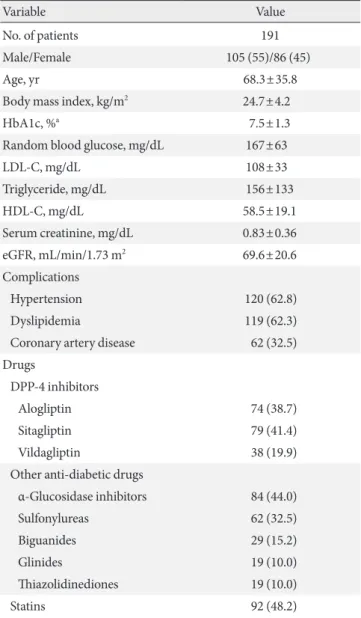
Characteristics of the patients enrolled in this study are shown in Table 1. Overall, these patients had moderate diabetes, with a mean HbA1c level of 7.5%±1.3%.
Effects of DPP-4 inhibitors on blood glucose and HbA1c level Twelve months of treatment with DPP-4 inhibitors led to a sig-
Table 1. Clinical characteristics of study subjects
Variable Value
No. of patients 191
Male/Female 105 (55)/86 (45)
Age, yr 68.3±35.8
Body mass index, kg/m2 24.7±4.2
HbA1c, %a 7.5±1.3
Random blood glucose, mg/dL 167±63
LDL-C, mg/dL 108±33
Triglyceride, mg/dL 156±133
HDL-C, mg/dL 58.5±19.1
Serum creatinine, mg/dL 0.83±0.36
eGFR, mL/min/1.73 m2 69.6±20.6
Complications
Hypertension 120 (62.8)
Dyslipidemia 119 (62.3)
Coronary artery disease 62 (32.5) Drugs
DPP-4 inhibitors
Alogliptin 74 (38.7)
Sitagliptin 79 (41.4)
Vildagliptin 38 (19.9)
Other anti-diabetic drugs
α-Glucosidase inhibitors 84 (44.0)
Sulfonylureas 62 (32.5)
Biguanides 29 (15.2)
Glinides 19 (10.0)
Thiazolidinediones 19 (10.0)
Statins 92 (48.2)
Values are presented as number (%) or mean±standard deviation.
HbA1c, glycosylated hemoglobin; LDL-C, low density lipoprotein cholesterol; HDL-C, high density lipoprotein cholesterol; eGFR, esti- mated glomerular filtration rate; DPP-4, dipeptidyl peptidase-4.
aNational Glycohemoglobin Standardization Program reference value.
nificant decrease in random blood glucose level, from 167±63 to 151±49 mg/dL (P<0.01), and in HbA1c level, from 7.5%±
1.3% to 6.9%±0.9% (P<0.01) (Fig. 1). Single regression analy- sis showed that the magnitude of decrease in HbA1c level after 12 months was positively associated with the baseline (the ini- tial level at pre-treatment) HbA1c (P<0.01) (Fig. 2). In addi- tion, the percentage of patients with a HbA1c level <7.0% after 12 months treatment increased from 36.6% to 60.2%.
There was a significant decrease in LDL-C level, from 108±33 to 104±30 mg/dL (P<0.05), in response to treatment with DPP- 4 inhibitors; however, no effects were observed for triglyceride, or HDL-C levels. There were no significant changes in eGFR values, and no cases of severe liver dysfunction were reported post-treatment.
Contributors to decreased HbA1c levels after treatment with DPP-4 inhibitors
Stepwise multiple regression analysis was performed to eluci- date independent determinants for decreased HbA1c level 12 months after the start of treatment (baseline HbA1c to HbA1c at 12 months). It was shown that the degree of change in HbA1c level 3 months after the start of treatment (baseline HbA1c to HbA1c at 3 months) and baseline HbA1c level were positive contributors to change in HbA1c at 12 months after the start of treatment, and that BMI, and a history of CAD were negative contributors to change. This implies that the decrease in HbA1c level is greater in patients with a high baseline HbA1c level, a low baseline BMI, and an absence of CAD. However, associa- tions with gender, age, eGFR, and presence of hypertension or dyslipidemia, were statistically excluded (Table 2).
Safety of DPP-4 inhibitor treatment
Over the 12-month DPP-4 inhibitor treatment period, no pa- tients experienced severe side effects, such as hypoglycemic ep- isodes or pancreatitis, which resulted in a hospital visit or hos- pitalization.
DISCUSSION
We have shown that DPP-4 inhibitors are effective in decreas- ing HbA1c level after 12 months of treatment with no severe side effects. We also show that predictors of the efficacy of treat-
250 200 150 100 50 0
Blood glucose (mg/dL)
Before treatment 12 months
a
8 6 4 2 0
HbA1c (%)
Before treatment 12 months
a
A B
Fig. 1. Effects of dipeptidyl peptidase-4 inhibitor treatment on (A) glycosylated hemoglobin (HbA1c) and (B) blood glucose lev- els. Values from before the onset of treatment and after 12 months of treatment are compared. aP<0.01.
Fig. 2. Association between baseline glycosylated hemoglobin (HbA1c) level and changes in HbA1c after 12 months of treat- ment.
4
2
0
Change in HbA1c after 12 months of treatment (%) -2
Baseline HbA1c (%) 6 8 10 12
R=0.69 P<0.01
ment were a decrease in HbA1c level after 3 months of treat- ment, a higher baseline HbA1c level, a lower baseline BMI, and the absence of CAD which is a novel finding of the study.
It has not yet been established which patients would benefit from the effects of DPP-4 inhibitor treatment. For example, Monami et al. [2] showed that DPP-4 inhibitors were more ef- fective in older patients with a mild/moderate fasting hypergly- cemia, while Kim et al. [3] showed they were more effective in Asians than in other ethnic groups, especially in a lower BMI group of <30 kg/m2. In terms of predicting efficacy, Nomiyama et al. [4] and Maeda et al. [5] showed that a higher baseline HbA1c level, lower BMI, and shorter period since the onset/
diagnosis of diabetes were significantly correlated with a great- er HbA1c reduction. Iwasaki et al. [6] also reported that in- creased serum levels of eicosapentaenoic acid and docosa- hexaenoic acid could predict DPP-4 inhibitor efficacy. Lim et al. [7] showed that low insulinogenic index, indicating β-cell dysfunction, was a predictor of combination therapy of sita- gliptin and metformin. Consistent with previous studies, our results also show that a decrease in HbA1c level is dependent on baseline HbA1c. Secondary failure such as desensitization of insulin secretion with sulfonylurea has been known in some antidiabetics [8]; however, we have shown that the decrease in HbA1c level after 12 months of treatment is associated with the decrease seen after 3 months of treatment, suggesting that long-term effects of DPP-4 inhibitors on glucose metabolism can be predicted by the short-term effects of this treatment.
Another predictor of DPP-4 inhibitor response is low BMI. In- sufficiency in insulin secretion occurs predominantly in pa- tients with low BMI, while insulin resistance occurs predomi- nantly in patients with high BMI. Thus DPP-4 inhibitors, which improve insulin secretion as well as insulin resistance, are more effective in patients with low BMI. Increased DPP-4 activity in patients with high BMI may account for the lower efficacy of DPP-4 inhibitors in this group [9]. Furthermore,
DPP-4 inhibitors were more effective in patients without CAD than in patients with CAD. The mechanisms of the results were unknown, further basic studies are therefore needed to clarify the issue. In addition, whether DPP-4 inhibitors decrease car- diovascular events or mortality is still debatable [10-13], fur- ther clinical studies are also needed.
HbA1c <7% is known as a treatment target with respect to diabetic complications from the guidelines [1,14]. In this study, 60.2% of patients with moderate diabetes reached this level, in- dicating that DPP-4 inhibitors are effective in lowering glucose.
Lipid profile is an important determinant of cardiovascular risk in type 2 diabetic patients, and LDL-C is the most impor- tant risk factor. DPP-4 inhibitors have been reported to reduce LDL-C in addition to total cholesterol; however, results be- tween studies are not consistent [15-17]. The precise mecha- nism by which LDL-C is reduced by DPP-4 inhibitors has not been determined; although, DPP-4 inhibitors might reduce the expression of hepatic genes involved in cholesterol synthe- sis [18] or reduce intestinal secretion of cholesterol and apoli- poprotein B-48 [19].
The present study had several limitations. Only patients who had been treated with DPP-4 inhibitors for at least 12 months at our hospital were included, and thus, the study contains a patient selection bias. In addition, patients receiving insulin therapy were excluded, because co-administration of DPP-4 inhibitors and insulin was not permitted in Japan at the time of this study. This was a retrospective study with a small sample size; thus, we could not compare the effects of each DPP-4 in- hibitor as the characteristics of patients varied between groups.
We also had a comparatively short observation period, and thus could not analyze the long-term effects of DPP-4 inhibitor treatment. Randomized, or large, clinical cohort studies, with a longer observation period are needed to clarify these issues.
In conclusion, suitable candidates for treatment with DPP-4 inhibitors are diabetic patients without obesity or CAD. In ad- Table 2. Multiple regression analysis for determinants of degree of decrease in HbA1c level after 12 months of treatment:
ΔHbA1c (baseline to 12 months)
Variable Coefficient 95% CI Standardized coefficient P value
ΔHbA1c (baseline−3 mo) 0.5 0.36 to 0.64 0.47 <0.001
Baseline HbA1c 0.32 0.24 to 0.40 0.39 <0.001
Body mass index –0.02 –0.003 to –0.045 –0.10 0.024
History of coronary artery disease –0.19 –0.01 to –0.38 –0.10 0.041
CI, confidence interval; HbA1c, glycosylated hemoglobin.
dition, the long-term efficacy of DPP-4 inhibitors can be pre- dicted by a decrease in HbA1c level after 3 months of treatment.
CONFLICTS OF INTEREST
D.F. has received research funding from Takeda Pharmaceuti- cal Company Ltd. and Ono Pharmaceutical Company Ltd.
T.M. has received research funding from MSD Pharmaceuti- cals Private Ltd. and Takeda Pharmaceutical Company Ltd., and received lecture fees from Ono Pharmaceutical Company Ltd. and Novartis Pharmaceuticals Corporation. M.Sa. has re- ceived research funding from Takeda, Tanabe-Mitsubishi, As- tellas, Daiichi-Sankyo, MSD, Byer Healthcare, and Ono, and lecture fees from Takeda, Boehringer Ingelheim, Byer Health- care, Mochida, Astellas, Tanabe-Mitsubishi, Novartis, Astra- Zeneca, MSD, and Shionogi. The Department of Cardio-Dia- betes Medicine, Tokushima University Graduate School, is supported in part by unrestricted research grants from Boeh- ringer Ingelheim, Tanabe-Mitsubishi, Kowa, and Actelion. The others declare no conflict of interest.
ACKNOWLEDGMENTS
We thank the staff of the Hospital Information Center at Tokushi- ma University Hospital for extracting patient data from medical records. This work was supported in part by JSPS KAKENHI (Grant Number 25461131, 25860605, and 25293184).
REFERENCES
1. American Diabetes Association. Standards of medical care in diabetes: 2013. Diabetes Care 2013;36 Suppl 1:S11-66.
2. Monami M, Cremasco F, Lamanna C, Marchionni N, Mannuc- ci E. Predictors of response to dipeptidyl peptidase-4 inhibitors:
evidence from randomized clinical trials. Diabetes Metab Res Rev 2011;27:362-72.
3. Kim YG, Hahn S, Oh TJ, Kwak SH, Park KS, Cho YM. Differ- ences in the glucose-lowering efficacy of dipeptidyl peptidase-4 inhibitors between Asians and non-Asians: a systematic review and meta-analysis. Diabetologia 2013;56:696-708.
4. Nomiyama T, Akehi Y, Takenoshita H, Nagaishi R, Terawaki Y, Nagasako H, Kudo T, Kodera T, Kobayashi K, Urata H, Yanase T; CHAT. Contributing factors related to efficacy of the dipep- tidyl peptidase-4 inhibitor sitagliptin in Japanese patients with type 2 diabetes. Diabetes Res Clin Pract 2012;95:e27-8.
5. Maeda H, Kubota A, Tanaka Y, Terauchi Y, Matsuba I; ASSET- K Study group. The safety, efficacy and predictors for HbA1c reduction of sitagliptin in the treatment of Japanese type 2 dia- betes. Diabetes Res Clin Pract 2012;95:e20-2.
6. Iwasaki M, Hoshian F, Tsuji T, Hirose N, Matsumoto T, Kitatani N, Sugawara K, Usui R, Kuwata H, Sugizaki K, Kitamoto Y, Fu- jiwara S, Watanabe K, Hyo T, Kurose T, Seino Y, Yabe D. Pre- dicting efficacy of dipeptidyl peptidase-4 inhibitors in patients with type 2 diabetes: association of glycated hemoglobin reduc- tion with serum eicosapentaenoic acid and docosahexaenoic acid levels. J Diabetes Investig 2012;3:464-7.
7. Lim S, An JH, Shin H, Khang AR, Lee Y, Ahn HY, Yoon JW, Kang SM, Choi SH, Cho YM, Park KS, Jang HC. Factors pre- dicting therapeutic efficacy of combination treatment with si- tagliptin and metformin in type 2 diabetic patients: the COS- METIC study. Clin Endocrinol (Oxf) 2012;77:215-23.
8. Satoh J, Takahashi K, Takizawa Y, Ishihara H, Hirai M, Katagiri H, Hinokio Y, Suzuki S, Tsuji I, Oka Y. Secondary sulfonylurea failure: comparison of period until insulin treatment between diabetic patients treated with gliclazide and glibenclamide. Di- abetes Res Clin Pract 2005;70:291-7.
9. Kirino Y, Sei M, Kawazoe K, Minakuchi K, Sato Y. Plasma di- peptidyl peptidase 4 activity correlates with body mass index and the plasma adiponectin concentration in healthy young people. Endocr J 2012;59:949-53.
10. Scirica BM, Bhatt DL, Braunwald E, Steg PG, Davidson J, Hirsh- berg B, Ohman P, Frederich R, Wiviott SD, Hoffman EB, Cav- ender MA, Udell JA, Desai NR, Mosenzon O, McGuire DK, Ray KK, Leiter LA, Raz I; SAVOR-TIMI 53 Steering Committee and Investigators. Saxagliptin and cardiovascular outcomes in pa- tients with type 2 diabetes mellitus. N Engl J Med 2013;369:
1317-26.
11. White WB, Cannon CP, Heller SR, Nissen SE, Bergenstal RM, Bakris GL, Perez AT, Fleck PR, Mehta CR, Kupfer S, Wilson C, Cushman WC, Zannad F; EXAMINE Investigators. Alogliptin after acute coronary syndrome in patients with type 2 diabetes.
N Engl J Med 2013;369:1327-35.
12. Monami M, Ahren B, Dicembrini I, Mannucci E. Dipeptidyl peptidase-4 inhibitors and cardiovascular risk: a meta-analysis of randomized clinical trials. Diabetes Obes Metab 2013;15:
112-20.
13. Patil HR, Al Badarin FJ, Al Shami HA, Bhatti SK, Lavie CJ, Bell DS, O’Keefe JH. Meta-analysis of effect of dipeptidyl peptidase-4 inhibitors on cardiovascular risk in type 2 diabetes mellitus. Am J Cardiol 2012;110:826-33.
14. Teramoto T, Sasaki J, Ishibashi S, Birou S, Daida H, Dohi S, Egusa G, Hiro T, Hirobe K, Iida M, Kihara S, Kinoshita M, Maruyama C, Ohta T, Okamura T, Yamashita S, Yokode M, Yo- kote K. Diabetes mellitus. Executive summary of the Japan Ath- erosclerosis Society (JAS) guidelines for the diagnosis and pre- vention of atherosclerotic cardiovascular diseases in Japan: 2012 version. J Atheroscler Thromb 2014;21:93-8.
15. Sakamoto Y, Oyama J, Ikeda H, Kuroki S, Gondo S, Iwamoto T, Uchida Y, Kodama K, Hiwatashi A, Shimomura M, Taguchi I, Inoue T, Node K; S-DOG investigators. Effects of sitagliptin be- yond glycemic control: focus on quality of life. Cardiovasc Dia- betol 2013;12:35.
16. Ayaori M, Iwakami N, Uto-Kondo H, Sato H, Sasaki M, Kom- atsu T, Iizuka M, Takiguchi S, Yakushiji E, Nakaya K, Yogo M, Ogura M, Takase B, Murakami T, Ikewaki K. Dipeptidyl pepti-
dase-4 inhibitors attenuate endothelial function as evaluated by flow-mediated vasodilatation in type 2 diabetic patients. J Am Heart Assoc 2013;2:e003277.
17. Monami M, Lamanna C, Desideri CM, Mannucci E. DPP-4 inhibitors and lipids: systematic review and meta-analysis. Adv Ther 2012;29:14-25.
18. Flock G, Baggio LL, Longuet C, Drucker DJ. Incretin receptors for glucagon-like peptide 1 and glucose-dependent insulino- tropic polypeptide are essential for the sustained metabolic ac- tions of vildagliptin in mice. Diabetes 2007;56:3006-13.
19. Hsieh J, Longuet C, Baker CL, Qin B, Federico LM, Drucker DJ, Adeli K. The glucagon-like peptide 1 receptor is essential for postprandial lipoprotein synthesis and secretion in hamsters and mice. Diabetologia 2010;53:552-61.