27
책임저자:장영철, 서울시 영등포구 영등포동 94-200, 우편번호: 150-020
한림대학교 한강성심병원 성형외과, Tel: 02-2639-5700, Fax: 02-672-9684 E-mail: [email protected]
Management of Burned Ear Using Acticoat
ⓇSilver Coated Dressing:
Treatment and Prevention of Suppurative Chondritis.
Jae Eok Ryu, M.D., Young Chul Jang, M.D., Ph.D. and Chan Min Chung, M.D.
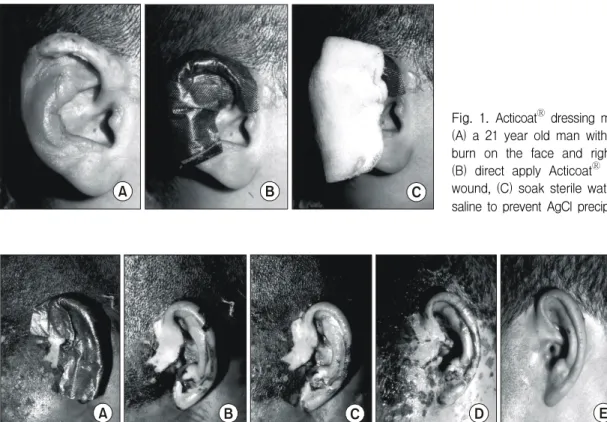
Department of Plastic and Reconstructive Surgery, College of Medicine, Hallym University, Seoul, Korea Backgrounds: A burned ear is frequently associated with burns to the face and is difficult to treat due to its prominent location. A serious complication associated with a burned ear is the chance of suppurative chondritis, which is caused by delayed wound healing and results in severe ear deformities. The conventional treatment used is antibiotics or a saline soaked wet dressing, silver sulfadiazine or sulfamylon cream, which have eschar penetration effects. Recently, a nano-crystalline silver coated dressing material (Acticoat
Ⓡ), which is known to have a broad-spectrum antimicrobial effect and enhance the wound healing process, was introduced as a burn or chronic uncontrolled wound dressing. In an effort to improve burned ear treatments and prevent chondritis, the authors performed a comparative study of treatments with Acticoat
Ⓡand a conventional dressing method.
Methods: From June 2000 to June 2001, 60 cases of partial thickness burned ears (40 patients) were treated and evaluated. Acticoat
Ⓡdressing (30/60 ears) was managed according to the manufac- ture’s guidelines and a conventional dressing (30/60 ears) was prepared with a saline soaked wet dressing combined with sulfadiazine or sulfamylon cream. The results of each group were evaluated during the healing period, in terms of surgery (debridement and partial thickness skin graft), infection, and the incidence of chondritis.
Results: The mean healing period was 13.5±5.9 days with the Acticoat
Ⓡdressing and 15.54±4.3 days when using the conventional dressing. The frequency of surgery to prevent chance of chondritis was 10% (3/30) in the Acticoat
Ⓡdressing group and 26.6% (8/30) in the conventional dressing group. In the wound culture study, 7 ears were confirmed positive and 6 cases were healed without any operation in the Acticoat
Ⓡdressing (staphylococcus aureus is common) group. In the con- ventional dressing group, 6 ears were confirmed positive (pseudomonas aeruginosa is common) and
Acticoat Ⓡ 를 이용한 귀 화상의 관리:
치료 및 화농성 연골염의 예방
한림대학교 의과대학 성형외과학교실