Conduction, Evaluation, and Future Considerations for an Obesity Educator Training Program in Korea
Yang-Hyun Kim
1, Jisun Lim
2, Jong-Hwa Kim
3, JungHwan Kim
4, Jeong-Hyun Lim
5, Hye-Jung Shin
6, Yun-A Shin
7, Yong Jin Kim
8, Kyu Rae Lee
9,*
1Department of Family Medicine, Korea University Anam Hospital, Korea University College of Medicine, Seoul; 2Department of Family Medicine, Asan Medical Center, University of Ulsan College of Medicine, Seoul; 3Department of Endocrinology, Bucheon Sejong Hospital, Bucheon; 4Department of Family Medicine, Eulji Hospital, Eulji University, Seoul; 5Department of Food Service and Nutrition Care, Seoul National University Hospital, Seoul; 6Department of Pediatrics, National Medical Center, Seoul; 7Department Prescription and Rehabilitation of Exercise, Dankook University, Cheonan; 8Department of Surgery, Soonchunhyang University Seoul Hospital, Seoul; 9Department of Family Medicine, Dongincheon Gil Hospital, Gachon University of Medicine and Science, Incheon, Korea
To reduce the prevalence of obesity and provide information on evidence-based obesity treatments, the Educa- tion Committee of the Korean Society for the Study of Obesity (KSSO) has developed and launched the first Obesity Educator Training Program (OETP). After the course, we analyzed the results of a survey from 110 partici- pants, comprising medical doctors (n=58), nutrition specialists (n=19), exercise specialists (n=14), and stu- dents (n=6). Approximately half of the participants were recruited through the Internet (48%), followed by aca- demic leaflets, such as conference posters (21%); the reasons for participation were to learn about evidence- based treatments for obesity (47%), to receive up-to-date knowledge on obesity treatments (39%), to obtain basic information on obesity (10%), and others (4%). More than half of the participants found the date, lecture time, process, and theme of the OETP favorable. The participants indicated that there should be an in-depth course, sharing of the presented files with attendees, a longer lecture time, and a broader OETP that includes other specialties such as nursing. To improve the OETP, the educational committee of the KSSO must develop an in-depth OETP that will reflect these participant’s feedback.
Key words: Obesity, Obesity Educator Training Program, Evaluation, Education
Received May 8, 2017 Reviewed July 10, 2017 Accepted September 26, 2017
* Corresponding author Kyu Rae Lee
https://orcid.org/0000-0003-2178-0459 Department of Family Medicine, Dongincheon Gil Hospital, Gachon University of Medicine and Science, 21 Keunumul-ro, Jung-gu, Incheon 22318, Korea
Tel: +82-32-770-1220 Fax: +82-32-764-9022 E-mail: [email protected]
INTRODUCTION
Obesity has steadily increased worldwide, and the prevalence of obesity is also increasing in Korea.
1-3From 2006 to 2015, the preva- lence of obesity in Korea increased from 28.7% to 32.4%. In addi- tion, the prevalence of grade II obesity increased from 2.7% to 4.8%
according to health check-up database of the National Health In- surance Service.
4This increase in obesity prevalence adds to the socioeconomic burden related to obesity.
5However, the level of knowledge about obesity varies according to socioeconomic status;
Latino with lower socioeconomic status had low levels of obesity
knowledge in one study.
6Since the early 2000s, it has been required that European countries develop an action plan for obesity educa- tion.
7In one systematic review, obesity education programs in U.S.
medical schools were not efficient in relaying knowledge about obesity or dealing with obese patients.
8Moreover, the efficacy of self-management education for chronic diseases, such as type 2 dia- betes, is well studied.
9In Korea, there are many adverse factors regarding the purchase of healthy foods, the use of exercise equipment or programs, and dietary programs for weight loss based on the low level of obesity knowledge. Given this, the education committee of the Korean So-
Copyright © 2017 Korean Society for the Study of Obesity
This is an Open Access article distributed under the terms of the Creative Commons Attribution Non-Commercial License (http://creativecommons.org/licenses/by-nc/4.0/) which per- mits unrestricted non-commercial use, distribution, and reproduction in any medium, provided the original work is properly cited.
2017-03-16 https://crossmark-cdn.crossref.org/widget/v2.0/logos/CROSSMARK_Color_square.svg
ciety for the Study of Obesity (KSSO) has planned an Obesity Ed- ucator Training Program (OETP) and certification of Obesity Ed- ucators to reduce the prevalence of obesity and provide informa- tion about evidence-based obesity treatment.
10,11The Educational course for obesitologists was held for the first time on September 4, 2016 at the International Congress on Obesity and Metabolic Syn- drome meeting. Although several issues remain regarding certifica- tion and the process of the OETP
11, a total of 110 individuals regis- tered for the OETP and received certification for their participa- tion. Additionally, the education committee of the KSSO surveyed participants in order to develop and revise the program and the process of the OETP. In this article, we review the first OETP and present analysis of the questionnaire results. In addition, we discuss improvements and future considerations for the OETP based on the results of this survey.
The first OETP
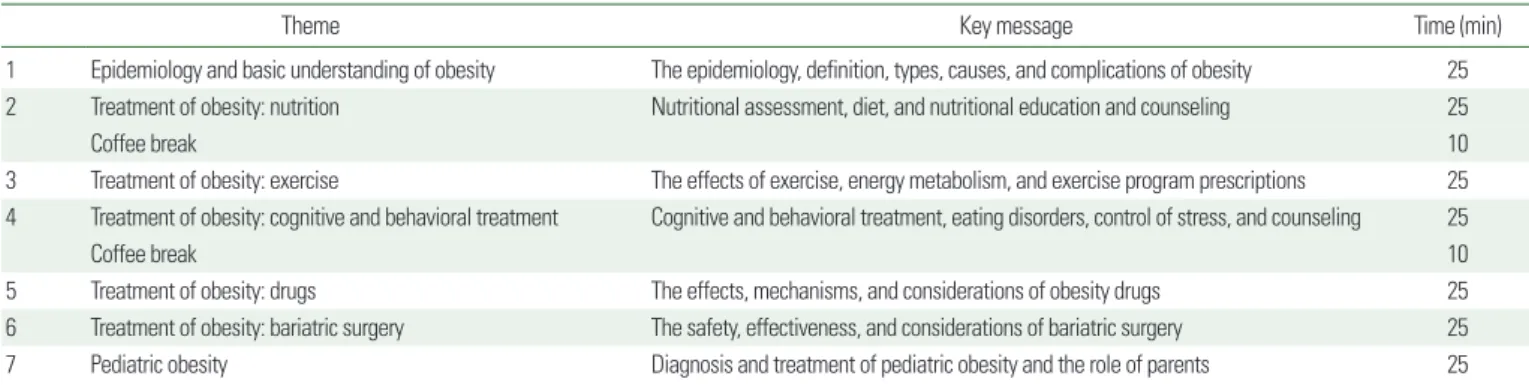
The schedule of the first OETP is shown in Table 1. It consisted of the following themes: epidemiology and basic understanding of obesity; treatment of obesity through nutrition, exercise, cognitive and behavioral treatments, drugs, and bariatric surgery; and pediat- ric obesity.
We analyzed the surveys completed by all participants of the OETP (n= 110). The detailed survey questionnaire is shown in Supplementary Fig. 1. We asked participants about their specialties, how they learned of the program, the reason for their participation, and their opinions on the overall management, including the date, process, themes, and lecture times, all measured using a 5-point Likert scale, as well as free opinions for comment.
Participant categorization by employment type and specialty
The participant’s specialties are shown in Table 2. More than half of the participants were medical doctors (n= 58); nutrition special- ists (n = 19), exercise specialists (n = 14), and students (n = 6) composed the rest of the sample. Of the medical doctors, family medicine (n= 30) was the most frequent specialty of the partici-
Table 1. Schedule and key messages of the first Obesity Educator Training ProgramTheme Key message Time (min)
1 Epidemiology and basic understanding of obesity The epidemiology, definition, types, causes, and complications of obesity 25
2 Treatment of obesity: nutrition Nutritional assessment, diet, and nutritional education and counseling 25
Coffee break 10
3 Treatment of obesity: exercise The effects of exercise, energy metabolism, and exercise program prescriptions 25 4 Treatment of obesity: cognitive and behavioral treatment Cognitive and behavioral treatment, eating disorders, control of stress, and counseling 25
Coffee break 10
5 Treatment of obesity: drugs The effects, mechanisms, and considerations of obesity drugs 25
6 Treatment of obesity: bariatric surgery The safety, effectiveness, and considerations of bariatric surgery 25
7 Pediatric obesity Diagnosis and treatment of pediatric obesity and the role of parents 25
This program was conducted at 08:00 AM–12:00 PM on Sunday, September 4, 2016.
Table 2. Categories of participants by employment type and specialty
Category Number
Medical doctor 58
Clinic or non-training hospital (n= 26)
Family medicine 9
Internal medicine 9
Surgery 2
General physician 2
Other or no reply 4
Training hospital (n= 19)
Family medicine 10
Internal medicine 8
Surgery 0
General physician 1
Other or no reply 0
Resident (n= 13)
Family medicine 11
Internal medicine 1
Surgery 0
General physician 0
Other or no reply 1
Nutrition specialist 19
Exercise specialist 14
Postgraduate student 6
College student 0
Other 13
Total 110
half of the participants found the date, lecture time, process, and theme favorable.
Additional participant comments about the OETP course
Table 3 shows the 10 most frequent comments by participants about the OETP course in order of frequency. The most frequent comments about the OETP course were the need for an additional in-depth course and the sharing of presented files to attendees. In addition, the participants asked for a longer lecture with question and answer time, and an OETP course for nurses (in particular, for coordinators in obesity clinics).
Issues regarding the OETP course
Following completion of the first OETP course, several issues need to be addressed to improve subsequent OETP courses. The Korean Diabetes Association has a Diabetes Educator Training Module similar to that of the American Association of Diabetes
Table 3. Frequent comments by participants about the Obesity Educator Training ProgramRank Comment
1 It would be beneficial if there was an in-depth education course.
2 Please share lecture slides with the attendees.
3 It would be helpful for attendees to participate more and in a longer course.
4 Specific lectures for nurses (coordinators in the clinics) are needed.
5 It would be better to add a periodic training lecture including the latest research, such as endo balls.
6 Please provide more information regarding the role of exercise and nutrition.
7 It would be better if practical clinical content was included.
8 Specific conditions, such as obesity in the elderly and postpartum weight retention, should be considered.
9 For members from local provinces, the Obesity Educator Training Program could be held in the afternoon on weekdays.
10 Please include a case study session.
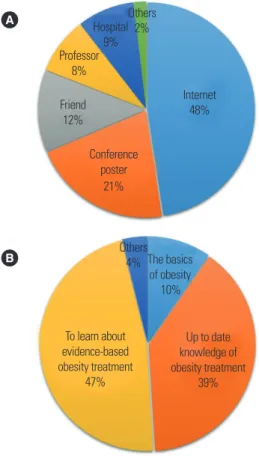
Figure 1. The information source (A) and reasons for participating (B) in the Obesi- ty Educator Training Program.
A
B
pants in the OETP, followed by internal medicine (n= 18). Twen- ty-six doctors were from clinics or non-training hospitals; 19 were from training hospitals; and 13 were residents.
Information source regarding the OETP
Approximately half of the participants learned about the pro- gram through the Internet (48%), followed by academic leaflets, such as conference posters (21%), and friends (12%) (Fig. 1A).
Reasons for participating in the OETP
The reasons for participating in the OETP were to learn about evidence-based treatment for obesity (47%), to receive up-to-date knowledge on obesity treatments (39%), to obtain basic informa- tion on obesity (10%), and others (4%) (Fig. 1B).
Suitability of the OETP
The results regarding the suitability of the OETP course by date, process, theme, and lecture time are shown in Fig. 2. More than
Internet 48%
Others Hospital 2%
Professor9%
8%
Friend 12%
Conference poster
21%
Others 4% The basics
of obesity 10%
Up to date knowledge of obesity treatment
39%
To learn about evidence-based obesity treatment
47%
Figure 2. The suitability of the Obesity Educator Training Program.
Date Lecture time Process Theme
Strongly disagree Disagree Neither Agree Strongly agree
0 10 20 30 40 50 60 70 80 90 100 2.8 7.3 10.1 28.4 51.4
2.8 7.3 10.1 51.4 28.4 2.8 7.3 10.1 28.4 51.4 7.6 10.4 52.8 29.2
(%)