Quality of Life in Korean Patients with Burning Mouth Syndrome
Ju-Hyun Park, D.D.S.,M.S.D., Jeong-Seung Kwon, D.D.S.,M.S.D.,Ph.D., Jong-Hoon Choi, D.D.S.,M.S.D.,Ph.D., Hyung-Joon Ahn, D.D.S.,M.S.D.,Ph.D.
Department of Oral Medicine, College of Dentistry, Yonsei University, Seoul, South Korea
The purpose of this study was to evaluate the individually perceived quality of life in Korean patients with BMS using two questionnaires : the Medical Outcome Short Form Health Survey Questionnaire (SF-36) and the Oral Health Impact Profile (OHIP-49).
This cross-sectional study included sixty subjects diagnosed with BMS and sixty healthy subjects as controls.
All subjects in this study completed two questionnaires: the Medical Outcome Short Form Health Survey Questionnaire (SF-36) and the Oral Health Impact Profile (OHIP-49), which had been translated into Korean and subsequently validated for use in Korea.
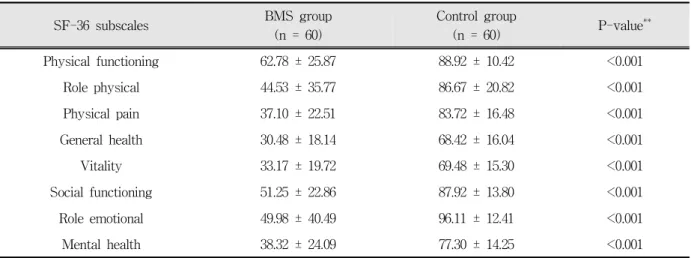
All of the subscales in the SF-36 exhibited significantly lower scores in BMS patients than control groups.
Comparison of the mean SF-36 scores between the two groups revealed the greatest differences to be for the subscales of physical pain and role emotional (role limitations due to emotional problems).
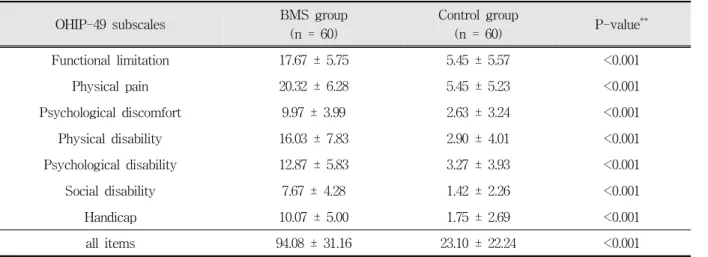
The mean score on each subscale of the OHIP-49 was significantly higher in BMS patients than control groups.
Comparison of the mean OHIP-49 scores between the two groups revealed the greatest difference to be for the subscale of physical pain.
These findings demonstrated that BMS had an impact on various components of a patient's quality of life. BMS patients exhibited more impaired results and a poorer quality of life than control groups.
Key words: Burning mouth syndrome, Quality of life, SF-36, OHIP-49
Corresponding author : Hyung-Joon Ahn, D.D.S., M.S.D., Ph.D.
Department of Oral Medicine, College of Dentistry, Yonsei University, 134 Shinchon-dong, Seodaemun-gu, Seoul, South Korea
Tel: 82-2-2228-8875 Fax: 82-2-393-5673 E-mail: [email protected] 원고접수일: 2011-01-29 심사완료일: 2011-04-30
* 본 연구는 연세대학교 치과대학 2009년도 교수연구비에 의하여 이루어졌음(6-2009-0031).
Ⅰ. INTRODUCTION
Burning mouth syndrome (BMS) is defined by the International Association for the Study of Pain as burning pain in the tongue or other oral mucous membrane that is associated with normal signs and laboratory findings and lasts at least 4 - 6 months1. This condition (ICHD-II:13.18.5) is described by the International Classification of Headache Disorders II (ICHD-II) of the International Headache Society as an intraoral burning sensation for which no medical or dental cause can be found.
There are as yet no definitive criteria for diagnosing BMS, and because various criteria are
used in diagnosis, its prevalence ranges from 0.6%
to 15%2. In 1989, the National Health Interview conducted a questionnaire survey of 45,711 members of the US civilian population. The prevalence of BMS at that time among the entire cohort was 0.7%; of these, 0.8% of female subjects and 0.6% of male subjects3. BMS occurs more frequently among women, especially during middle and old age4.
The major complaints of BMS patients may be described as burning, tender, tingling, hot, scalding, and numb sensations of the oral mucosa. These symptoms are usually experienced bilaterally and are persistent, but do not disturb sleep. The pain most frequently affects the anterior two thirds of the tongue, followed by the dorsum and lateral borders, the anterior aspect of the hard palate, and the labial mucosa of the lips5. Patients who have BMS have more nonspecific physical problems and/or other psychogenic-related complaints than healthy controls, such as dry mouth, bad or altered taste, thirst, headaches, tenderness or pain in the neck, shoulder, and masticatory muscles, anxiety, depression, and personality disorders. However, it is unclear whether these symptoms are risk factors for the development of BMS or a consequence of the syndrome6.
The underlying etiology of BMS has yet to be identified. It appears to be complex and multifactorial, involving interactions between local factors such as dentures, candidiases, and parafunctional oral habits, and systemic factors such as various types of nutritional and hormonal deficiencies. The chronic pain experienced in conditions such as BMS is closely related to psychological factors like depression, anxiety, and somatic reactions to stress7.
Furthermore, it has recently been suggested that life components such as stressful events, functioning, and well-being play a role in chronic oral disorders and are etiologic factors8.
Quality of life takes into account factors such as health, work, economic status, leisure activities, environment, and social relationships9. As stated
above, various general, psychosocial, and psychological well-being factors may be associated with symptoms in BMS patients. In this context, health-related quality of life (HRQoL) is particularly important for evaluating chronic oral disorders like BMS. Lopez-Jornet et al. studied HRQoL in BMS patients using two questionnaires, the Medical Outcome Short Form Health Survey Questionnaire (SF-36) for evaluating self-perceived general health status and the Oral Health Impact Profile (OHIP- 49), which assesses the self-rated oral health and oral HRQoL10. Meanwhile, Strmbeck et al. studied the HRQoL in primary Sjgren’s syndrome, rheumatoid arthritis, and fibromyalgia using the SF-36 in Sweden, and McMillan et al. studied the impact of Sjgren’s syndrome on oral HRQoL using the SF-36 and the OHIP-49 in a southern Chinese population11,12. According to these studies, it is possible to compare the quality of life in patients and healthy people. However, the quality of life in Korean BMS patients has not been studied yet.
The purpose of this study was to evaluate the individually perceived quality of life in Korean patients with BMS, a typical chronic oral disorder, using two questionnaires that were designed to assess quality of life: the validated Korean version of the SF-36 questionnaire and the validated Korean version of the OHIP-49.
Ⅱ. MATERIALS AND METHODS 1. Subjects
Sixty subjects of both genders (female = 57, male
= 3) diagnosed with BMS were enrolled in this study. All subjects were registered voluntarily at the Department of Oral Medicine of the Dental Hospital of Yonsei University. According to the ICHD-II of the International Headache Society, the diagnostic criteria for BMS states that patients have normal appearance of the oral mucosa, pain in the mouth that is present daily, persists for most of the day, and lasts at least 4 months, and are without local and systemic disease. Subjects who
had taken medications that can cause an oral burning sensation (e.g., angiotensin-converting enzyme inhibitors) and had organic causes of this symptom (candidiasis, dermatoses such as lichen planus, hormonal problems such as diabetes and hypothyroidism) were excluded for this study. All patients underwent a comprehensive clinical examination of the oral cavity and dental status, and radiographic examination to exclude organic findings. Sixty healthy subjects of both genders (female = 52, male = 8) or who had not sought any medical treatment were enrolled as a control group.
2. Methods
1) Medical Outcome Short Form Health Survey Questionnaire (SF-36)
At the first visit, the subjects from both groups completed the Korean version of the SF-36, which had been translated and subsequently validated13. The SF-36 was originally designed to survey subjective health status in the Medical Outcomes Study and was specifically designed for clinical practice, research, health-policy evaluations, and general-population surveys14. The SF-36 includes eight multi-item variables: physical functioning, social functioning, role limitations due to physical
SF-36 subscales Number of Items Item Numbers
Physical functioning 10 3,4,5,6,7,8,9,10,11,12
Role physical* 4 13,14,15,16
Physical pain 2 21,22
General health 5 1,33,34,35,36
Vitality 4 23,27,29,31
Social functioning 2 20,32
Role emotional** 3 17,18,19
Mental health 5 24,25,26,28,30
* Role physical : role limitations due to physical problems
** Role emotional : role limitations due to emotional problems Table 1. Conceptual subscales and items of SF-36
problems, role limitations due to emotional problems, general mental health (psychological distress and psychological well-being), vitality, physical pain, and general perception of health. There is also an additional unscaled single item on changes in health over the previous year. Each item is coded, summed using the Likert method of summated ratings, and transformed to a scale from 0 to 100, whereby a higher score indicates a better subjective health status15.(Table 1)
2) Oral Health Impact Profile (OHIP-49)
At the first visit, OHIP-49 was carried out with SF-36 to subjects in both groups. The Korean version of the English-language OHIP with 49 items was constructed originally by Slade and Spenser, and was translated and validated for use in a Korean population16,17. Each question in the questionnaire was related to how frequently each event was experienced during the past 3 months.
The items were arranged in the form of seven subscales, as follows: functional limitation, physical pain, psychological discomfort, physical disability, psychological disability, social disability, and handicap. The subjects were required to answer in the form of a five-point Likert scale, whereby 0=
‘never’, 1=‘hardly ever’, 2=‘occasionally’, 3=‘fairly
often’, and 4=‘very often’. By summing the scores of the responses to the 49 items and items corresponding to the subscales, the OHIP-49 and
Subscales and items Subscales and items
Functional limitation Q25. Others misunderstood
Q1. Difficulty chewing Q26. Less flavor in food
Q2. Trouble pronouncing words Q27. Unable to brush teeth Q3. Noticed tooth that doesn't look right Q28. Avoid eating
Q4. Appearance affected Q29. Diet unsatisfactory
Q5. Breath stale Q30. Unable to eat (dentures)
Q6. Taste worse Q31. Avoid smiling
Q7. Food catching Q32. Interrupts meals
Q8. Digestion worse Psychological disability
Q9. Dentures not fitting Q33. Sleep interrupted
Physical pain Q34. Upset
Q10. Painful aching Q35. Difficult to relax
Q11. Sore jaw Q36. Depressed
Q12. Headaches Q37. Concentration affected
Q13. Sensitive teeth Q38. Been embarrassed
Q14. Toothache Social disability
Q15. Painful gums Q39. Avoid going out
Q16. Uncomfortable to eat Q40. Less tolerant to family members
Q17. Sore spot Q41. Trouble getting on with others
Q18. Discomfort (dentures) Q42. Irritable with others
Psychological discomfort Q43. Difficulty doing job
Q19. Worried Handicap
Q20. Self-conscious Q44. Health worsened
Q21. Miserable Q45. Financial loss
Q22. Appearance unsatisfied Q46. Unable to enjoy people's company
Q23. Tense Q47. Life unsatisfying
Physical disability Q48. Unable to function
Q24. Speech unclear Q49. Unable to work
Table 2. Conceptual subscales and items of OHIP-49
the OHIP subscale scores were calculated. The overall OHIP score ranged from 0 to 196, a higher score indicating a poorer state of health. (Table 2)
Age (years) BMS group (n=60) Control group (n=60)
n % n %
21 - 30 2 3.33 2 3.33
31 - 40 1 1.67 2 3.33
41- 50 8 13.33 21 35.00
51 - 60 15 25.00 24 40.00
61 - 70 22 36.67 7 11.67
71 - 12 20.00 4 6.67
Mean 60.25 ± 11.86 52.65 ± 10.30
Table 3. Demographic characteristics in BMS and control group
3) Statistical analysis
Statistical analyses were performed to compare the SF-36 and OHIP-49 scores between the BMS and control group. The Kolmogorov-Smirnov normality test was applied to check the normality of distribution. Groups were compared using the two sample t-test. SPSS Version 12.0 statistical package (SPSSⓇ Inc., Chicago, IL, USA) was used for all statistical analyses. Statistical significance was established at 95%.
SF-36 subscales BMS group
(n = 60)
Control group
(n = 60) P-value**
Physical functioning 62.78 ± 25.87 88.92 ± 10.42 <0.001
Role physical 44.53 ± 35.77 86.67 ± 20.82 <0.001
Physical pain 37.10 ± 22.51 83.72 ± 16.48 <0.001
General health 30.48 ± 18.14 68.42 ± 16.04 <0.001
Vitality 33.17 ± 19.72 69.48 ± 15.30 <0.001
Social functioning 51.25 ± 22.86 87.92 ± 13.80 <0.001
Role emotional 49.98 ± 40.49 96.11 ± 12.41 <0.001
Mental health 38.32 ± 24.09 77.30 ± 14.25 <0.001
* Values are given as mean ± SD.
** Statistically significant at significance level of 95%
Table 4. Mean SF-36 scores*
Ⅲ. RESULTS 1. Subject demographics
The demographic data of the BMS and control group are shown in Table 3. The study included 120 subjects. Of the 60 BMS patients, 57 (95%) were female and 3 (5%) were male, with a mean age of 60.25 (±11.86) years. Of the 60 healthy controls, 52 (86.67%) were female and 8 (13.33%) were male, with a mean age of 52.65 (±10.30) years.(Table 3)
OHIP-49 subscales BMS group (n = 60)
Control group
(n = 60) P-value**
Functional limitation 17.67 ± 5.75 5.45 ± 5.57 <0.001
Physical pain 20.32 ± 6.28 5.45 ± 5.23 <0.001
Psychological discomfort 9.97 ± 3.99 2.63 ± 3.24 <0.001
Physical disability 16.03 ± 7.83 2.90 ± 4.01 <0.001
Psychological disability 12.87 ± 5.83 3.27 ± 3.93 <0.001
Social disability 7.67 ± 4.28 1.42 ± 2.26 <0.001
Handicap 10.07 ± 5.00 1.75 ± 2.69 <0.001
all items 94.08 ± 31.16 23.10 ± 22.24 <0.001
* Values are given as mean ± SD.
** Statistically significant at significance level of 95%
Table 5. Mean OHIP-49 scores*
Fig. 1. Mean SF-36 scores
2. Results for the Medical Outcome Short Form Health Survey Questionnaire (SF-36) Table 4 presents the SF-36 questionnaire scores for each group. All the SF-36 subscales exhibited significantly lower scores in BMS patients than controls. There were significant differences between BMS group and control group in all of the subscales (p< 0.001).
Fig. 1 illustrates mean scores of the SF-36 subscales in BMS patients compared with controls.
Comparison of the mean SF-36 scores between the two groups revealed the greatest differences to be for the subscales of physical pain and role emotional(role limitations due to emotional
Fig. 2. Mean OHIP-49 scores
problems), and the smallest difference to be for the subscale of physical functioning.
3. Results for the Oral Health Impact Profile (OHIP-49)
Data for the OHIP-49 subscales between the two groups are described in Table 5, which exhibits the significant differences observed between groups in all of the subscales. The BMS group’s scores (94.08±31.16, p< 0.001) were significantly higher than the control group (23.10±22.24, p< 0.001) in all of the subscales.
Comparison of the mean OHIP-49 scores between the two groups revealed the greatest difference to
be for the subscale of physical pain and the smallest difference to be for the subscale of social disability.
(Fig. 2).
Ⅳ. DISCUSSION
HRQoL refers to the individual’s perceived physical and mental status in their daily life, and is increasingly being recognized as an applicable and significant measure of intervention outcomes and service need in public health research and in practice. A thorough understanding of how a patient’s life is impaired by disease and its influences on clinical decision making regarding the various treatment possibilities for a particular disease have been achieved through various measures of HRQoL designed to assess the detailed picture of chronic disorders in various groups of patients. However, most traditional HRQoL questionnaires ignore the perceptions and feelings of the individual-based assessments and the effect of the oral status on the psychosocial well-being of the patient. There is thus a need for measures that consider patient-perceived multiple outcomes based on the physical, social, and psychological factors of oral health that influence quality of life18.
Functional scales of quality of life, such as the SF-36, have been validated for use in the assessment of numerous chronic oral diseases.
Indeed, the SF-36 has been used to compare the general state of health in patients. Despite its lack of sensitivity in relation to oral health status, this questionnaire is currently accepted as a good measure of general health status.
The awareness of oral HRQoL has increased, and its measurement is a commonly accepted method of specialized assessment of individual-perceived oral health in dentistry19. Since Locker's conceptual framework for measuring oral health was published, various methods of measuring oral HRQoL have been developed19,20. One of the most widely used, comprehensive and available instruments is the OHIP-49, which allows a detailed measurement of the levels of dysfunction, discomfort and disabilities
associated with oral health status16. Several possible benefits of using such instruments have been described21. These include finding out subgroups within the population that require medical service, monitoring of risk groups, outcomes of clinical interventions and targeting of financial resources. At the present time, these measures have been used mainly in descriptive population studies, and predominantly in elderly groups22.
In this study, the quality of life of the BMS and control groups was compared with the aid of two questionnaires, the SF-36 and the OHIP-49, which are standardized and widely used. Both have been translated into Korean and validated for use in Korea. According to previously published studies, BMS patients exhibit more impaired results and a poorer quality of life than control groups. A reduced quality of life has been demonstrated previously in Spanish patients with BMS using these two questionnaires. A poorer HRQoL in Italian BMS patients was also described by Tabolli et al. The BMS patients in my study exhibited similar results, with a relatively poorer quality of life than those described in the previous studies.
We observed statistically significant differences between the BMS group and the control group in all of the subscales. Comparison of the mean SF-36 scores between the two groups revealed the greatest differences to be for the subscales of physical pain and role emotional (role limitations due to emotional problems). In other words, the BMS patients experienced not only more severe physical pain, but also problems with work or other daily activities as a result of emotional problems.
Similarly, comparison of the mean OHIP-49 scores between the two groups revealed the greatest difference to be for the subscale of physical pain.
These findings demonstrate that oral diseases such as BMS have an impact on various components of a patient's quality of life, and in particular the physical pain and role-emotional subscales.
There were some limitations to the present study.
First, the cohort was fairly small, which resulted in difficulty controlling external factors such as the
age and gender distributions. A larger sample is required to elucidate the association between quality of life and BMS. In addition, this is a cross-sectional study that was carried out at a single point of time and without long-term follow-up. Improvements in oral status may result in an improvement in HRQoL; close follow-up is needed to establish this possibility.
The possible etiological factors underlying BMS are many and varied. The multifactorial characteristics of BMS render it important to identify the sources of the symptoms for every BMS patient to enable provision of the most effective treatment. A treatment protocol should include dental and medical aspects, further psychological factors, general health, and life to manage the varying conditions of BMS patients. As stated above, the evaluation of quality of life plays a significant role in the assessment of BMS patients, and so it is important to identify and manage these factors using reliable and validated measurement methods. Depending upon the characteristics identified, extended treatment can be provided to these patients with disturbances of quality of life.
Administration of specific and generic quality-of- life questionnaires to patients provides detailed information regarding the complex issues of other chronic oral diseases. Such questionnaires may be useful in clinical practice.
In summary, differences in individual-perceived HRQoL were found between BMS patients and controls. The present study thus confirms the findings of previous studies suggestive that there is a significant association between quality of life and BMS. Therapeutic goals toward reducing the development of disease and the negative impact on quality of life are required, and these may be achieved via the management of physical and emotional aspects. Close cooperation among practitioners is needed to optimize the management of these patients.
REFERENCES
syndromes and definitions of pain terms. In: 2nd ed.
Classification of chronic pain. Seattle: IASP press, 1994.
2. Zakrzewska JM, Hamlyn PJ. Facial pain. Crombie IK (ed). Seattle(W.A.) : IASP press, 1999.
3. Lipton JA, Ship JA, Larach-Robinson D. Estimated prevalence and distribution of reported orofacial pain in the United States. J Am Dent Assoc 1993;124:
115-121.
4. Scala A, Checchi L, Montevecchi M, Marini I, Giamberardino MA. Update on burning mouth syndrome: overview and patient management. Crit Rev Oral Biol Med 2003;14:275-291.
5. Gorsky M, Silverman S Jr, Chinn H. Clinical characteristics and management outcome in the burning mouth syndrome. An open study of 130 patients. Oral Surg Oral Med Oral Pathol 1991;72:
192-195.
6. Suarez P, Clark GT. Burning mouth syndrome: an update on diagnosis and treatment methods. J Calif Dent Assoc 2006;34(8):611-622.
7. Lamey PJ, Lamb AB. Prospective study of aetiological factors in burning mouth syndrome. Br Med J 1998;296:1243-1246.
8. Stewart A, and Kamberg CJ. Measuring functioning and well being: the medical outcomes study approach.
Durham, North Carolina: Duke University Press, 1992.
9. Burckhardt CS, Archienholtz B, Mannerkorpi K, Bjelle A. Quality of life of Swedish women with fibromyalgia syndrome, rheumatoid arthritis and systemic lupus erythematosus. J Musculoskel Pain 1993;1:199-207.
10. Lopez-Jornet P, Camacho-alonso F, Lucero-Berdugo M. Quality of life in patients with burning mouth syndrome. J Oral Pathol Med 2008;37:389-394.
11. Strmbeck B, Ekdahl C, Manthorpe R, Wilkstrm I, Jacobsson L. Health-related quality of life in Sjgren's syndrome, rheumatoid arthritis and fibromyalgia compared to normal population data using SF-36.
Scand J Rheumatol 2000;29:20-28.
12. McMillan AS, Leung KC, Leung WK, Wong MC, Lau CS, Mok TM. Impact of Sjgren's syndrome on oral health-related quality of life in southern Chinese. J Oral Rehabil 2004;31:653-659.
13. Koh SB, Chang SJ, Kang MG, Cha BS, Park JK.
Reliability and validity on measurement instrument for health status assessment in occupational workers.
Korean J of Preventive Medicine 1997;30(2):251-266.
14. Ware JE, Sherbourne CD. The MOS 36-item short- form health survey (SF-36). Med Care 1992;30(6):
473-483.
15. Likert R. A technique for the measurement of attitudes. Archives of Psychology 1932;140:1-55.
16. Slade GD, Spencer AJ. Development and evaluation of the Oral Health Impact Profile. Community Dent Health 1994;11:3-11.
17. Bae KH, Kim HD, Jung SH et al. Validation of the Korean version of the oral health impact profile among the Korean elderly. Community Dent Oral Epidemiol 2007;35:73-79.
18. McGrath C, Bedi R. The value and use of ‘quality of life’ measures in the primary dental care setting.
Primary Dental Care 1999;6:53-57.
국문요약
한국인을 대상으로 한 구강작열감증후군 환자의 삶의 질 평가
연세대학교 치과대학 구강내과학교실 박주현․권정승․최종훈․안형준
만성 통증의 양상을 보이는 구강작열감증후군은 환자들의 신체적, 심리적인 면 뿐만 아니라 전반적인 삶의 질과의 연관성 도 많은 연구들에서 보고되어 왔다. 하지만 현재까지의 대부분의 연구들에서는 구강작열감환자에게 있어서 총괄적인 건강 상태와 관련된 삶의 질을 평가하는 데에는 부족한 면이 있고, 이들의 관계에 대한 연구가 아직은 미흡한 상태이다. 이에 본 연구에서는 구강내과에 내원한 구강작열감증후군 환자를 대상으로 Medical Outcome Short Form Health Survey Questionnaire (SF-36)과 Oral Health Impact Profile (OHIP-49)를 이용한 평가를 시행하여, 시행 결과를 대조군의 결과와 비교, 분석하여 삶의 질과의 관계를 분석해 보고자 하였다.
총 60명의 구강작열감증후군 환자 및 60명의 건강한 대조군이 본 연구에 참여하였다. 각 군을 대상으로 전반적인 삶의 질을 평가하기 위해 고안된 설문인 SF-36과 구강 건강과 관련한 삶의 질을 평가하기 위해 고안된 설문인 OHIP-49를 시행하였다.
구강작열감증후군과 전반적인 삶의 질 사이에는 유의한 상관관계가 관찰되었다. SF-36의 모든 항목에서 구강작열감증후군 환자군은 대조군에 비하여 현저히 낮은 점수를 보여 전반적인 삶의 질이 떨어지는 것으로 나타났다. OHIP-49 설문의 결과, 각 항목의 평균에서 구강작열감증후군 환자군은 대조군에 비하여 현저히 높은 점수를 보여 구강 건강과 관련한 삶의 질이 떨어지는 것으로 나타났다.
주제어: 구강작열감증후군, 삶의 질, 구강건강 관련 삶의 질
19. Schierz O, John MT, Reibmann DR, Mehrstedt M, Szentpetery A. Comparison of perceived oral health in patients with temporomandibular disorders and dental anxiety using oral health-related quality of life profiles. Qual Life Res 2008;17:857-866.
20. Locker D. Measuring oral health: a conceptual framework. Community Dent Health 1988;5:3-18.
21. Locker D, Jokovic, A. Using subjective oral health status indicators to screen for dental in older adults.
Community Dent Oral Epidemiol 1996;24:398-402.
22. Slade GD, Strauss R, Atchison KA, Kressin NR, Locker D, Reisine ST. Conference summary:
assessing oral health outcomes-measuring health status and quality of life. Community Dent Health 1998;15:3-7.