• 검색 결과가 없습니다.

Trunk Muscle Activation during Bridge Exercise with Various Shoulder Supporting Surfaces

N/A
N/A
Protected

Academic year: 2021

Share "Trunk Muscle Activation during Bridge Exercise with Various Shoulder Supporting Surfaces"

Copied!
6
0
0

로드 중.... (전체 텍스트 보기)

전체 글

(1)

Research Article Open Access

Trunk Muscle Activation during Bridge Exercise with Various Shoulder Supporting Surfaces

Ho-hee Son, PT, PhD

Department of Physical Therapy, College of Health Sciences, Catholic University of Pusan

Received: July 15, 2015 / Revised: July 20, 2015 / Accepted: July 25, 2015

ⓒ 2015 J Korean Soc Phys Med

| Abstract |

1)

PURPOSE: Bridge exercises are broadly used to develop trunk co-activation patterns that promote spine stability. This study was to analyze the trunk muscle activity during bridge exercise with various shoulder support surface(stable, sling, Swiss ball).

METHODS: The subjects were 20 healthy subjects in their twenties. Subjects were performed bridge exercise on 4 different shoulder support surfaces using stable and labile instruments. 1) Bridge exercise on a stable surface. 2) Bridge exercise with their shoulder on a stable bench. 3) Bridge exercise with their shoulder on a sling. 4) Bridge exercise with their shoulder on a Swiss ball. Rectus abdominis, erector spinae, internal oblique, external oblique muscle activities were measured using electromyography.

RESULTS: There were significant differences in RA, EO muscles between performing each of the 4 exercises(p<.05).

RA and EO was recorded the highest activity during the bridge exercise with their shoulder on a sling. The lowest activity was recorded during conventional supine bridge on a stable surface. There were no differences found for the EO/RA and

†Corresponding Author: [email protected]

This is an Open Access article distributed under the terms of the Creative Commons Attribution Non-Commercial License (http://creativecommons.org/licenses/by-nc/3.0) which permits unrestricted non-commercial use, distribution, and reproduction in any medium, provided the original work is properly cited.

IO/RA ratio. The EO/RA and IO/RA ratio was the highest in the bridge exercise with their shoulders resting on a stable bench.

CONCLUSION: These findings suggest that change of shoulder support surface during bridge exercise may be useful for enhancing the trunk stability.

Key Words: Bridge exercise, Trunk stability, Labile surface

Ⅰ. introduction

Lumbar stabilization exercises are a commonly used for sport training and rehabilitation. The abdominal musculature in trunk movement and spine stability is important to treat or prevent of lower back injuries (Czaprowisk et al, 2014).

Proper activation of core stability muscles is essential for accurate functioning of the lombopelvic complex (McGill and Cholewicki, 2001).

A variety of trunk stabilization exercises are broadly used to develop trunk co-activation patterns that promote spine stability (McGill and Karpowicz, 2009; Stokes et al, 2011). Many of these exercises are commonly known as “bridge” exercise. The bridge exercise is used to enhance trunk stability and is easily applied in a clinical setting.

Variety of bridge exercise is performed with single and

double leg support while bridging, supine position, prone

(2)

position and lateral position. (McGilll and Karpoxicz, 2009;

Okubo et al, 2010; Garcia-Vaquero, 2012).

The bridge exercise is also performed widely on stable or unstable surface (Stevens et al, 2006; Choi and Kang, 2013). The use of unstable surface such as the Swiss ball or sling is to increase muscular demand required to maintain postural stability (Imai et al, 2010). The response of muscle activity to unstable surfaces may be variable and dependent on the type of exercises. Some authors confirm that the unstable surface enhances the activities of trunk muscles (Lehman et al, 2005a; Desai and Marshall, 2010). Other authors claim that the type of surface, whether stable or unstable, dose not notably affect the activity of the trunk stabilizing muscles(Lehman et al, 2005b; Stevens et al, 2006).

Despite the large number of studies that have analyzed the trunk muscular response during bridge exercise, none of these studies were designed to change the shoulder support surface. The purpose of this study is to analyze the trunk muscle activity during bridge exercise with various shoulder support surface(stable, sling, Swiss ball).

Ⅱ. Methods

1. Subjects

Twenty asymptomatic subjects volunteered in this study;

10 men(age: 21.9±1.45yrs, height: 174.7±3.92cm, weight:

66.3±6.24kg) and 10 women(age: 20.7±0.48yrs, height:

164.7±3.2cm, weight: 56.6±3.86kg). All participants signed an informed consent form prior to their entry into the study.

Individuals with known medical problems, histories of abdominal or back surgery, psychological problems within 12 months prior to this study were excluded.

2. Procedures

Prior to data collection, each subject were instructed with all the exercise protocols verbally and visually. All

subjects performed bridge exercise on 4 different shoulder support surfaces using stable and labile instruments. 1) Bridge exercise on a stable surface. Subjects lay on the floor in supine position to perform the bridge exercise and then lift off their pelvis off the floor while resting on their shoulders and feet, with the knees bent and the trunk fully aligned the thighs. 2) Bridge exercise with their shoulder on a stable bench. Similar to the previous exercise, with their shoulders resting on a stable bench. 3) Bridge exercise with their shoulder on a sling. Similar to the previous exercise, but with their shoulders resting on a sling suspension system. 4) Bridge exercise with their shoulder on a Swiss ball. Similar to the previous exercise, but with their shoulders resting on a Swill ball. The subject’s shoulder on the bench, sling and Swiss ball was placed at each subject’s knee height to maintain a neutral position of the spine and pelvis of each subject.

3. Data collection and EMG processing Surface EMG (LXM3204, LAXTHA Inc., Korea) was used to record muscle activity of the rectus abdominis(RA), erector spinae(ES), external oblique(EO), internal oblique(IO) muscles. Disposable bipolar Ag/AgCl surface electrodes were positioned at an interelectrode distance of 2cm. Prior to applying the electrodes, skin impedance was reduced by shaving excess body hair, cleaning with an alcohol swab.

Electrode placement for each muscles was used; RA – 3cm superior to umbilicus and 2cm lateral to the midline; ES – 3cm lateral to the level of the L4/5 spinous process;

EO – an oblique arrangement above the anterior superior iliac spine and lateral to the umbilicus; IO – halfway between the anterior superior iliac spine of the pelvis (Cram et al, 1998).

The EMG signals were band-pass filtered from 50 to 500Hz and sampled at 1210Hz. Following data collection, EMG signals were rectified and smoothed using a root mean square(RMS) for raw data.

Subjects were required to perform 5 second maximum

(3)

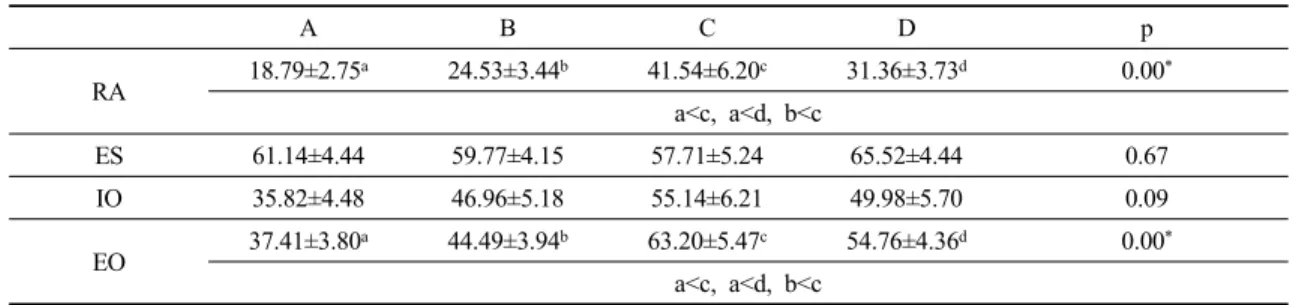
Table 1. EMG activities(%MVIC) for each muscle during bridge exercise(RA; rectus abdominis, ES; erector spinae, IO; internal oblique, EO; external oblique muscles)

(values are mean±se)

A B C D p

RA 18.79±2.75

a

24.53±3.44

b

41.54±6.20

c

31.36±3.73

d

0.00

*

a<c, a<d, b<c

ES 61.14±4.44 59.77±4.15 57.71±5.24 65.52±4.44 0.67

IO 35.82±4.48 46.96±5.18 55.14±6.21 49.98±5.70 0.09

EO 37.41±3.80

a

44.49±3.94

b

63.20±5.47

c

54.76±4.36

d

0.00

*

a<c, a<d, b<c

※ A: Bridge exercise on a stable surface.

B: Bridge exercise with shoulder on a stable bench.

C: Bridge exercise with shoulder on a sling.

D: Bridge exercise with shoulder on a Swiss ball.

voluntary isometric contraction(MVIC) for each muscles.

The Muscle activity data during all subsequent exercise was expressed as %MVIC. Exercise was carried out in random order.

4. Data analysis

Collected data were analyzed using SPSS version 21.0 (SPSS, Inc., Chicago, IL). One way analysis of variance (ANOVA) was used to determine the differences in type of supporting shoulder surface influenced trunk muscle activity. A post hoc Tukey test used to identify where differences were. The statistical significance of the study was at p<0.05.

Ⅲ. Results

1. EMG activities during each exercise

EMG activities of each muscle tested during the exercises on the different shoulder surfaces are summarized in Table 1.

There were significant differences in RA, EO muscles between performing each of the 4 exercises. RA was recorded the highest activity during the bridge exercise with their shoulder on a sling. The lowest activity was

recorded during conventional supine bridge on a stable surface. EO was recorded the highest activities during the bridge exercise with their shoulder on a sling. The lowest activity of the EO was also recorded during conventional supine bridge on a stable surface.

2. Ratio of muscle activity compared with rectus abdominis

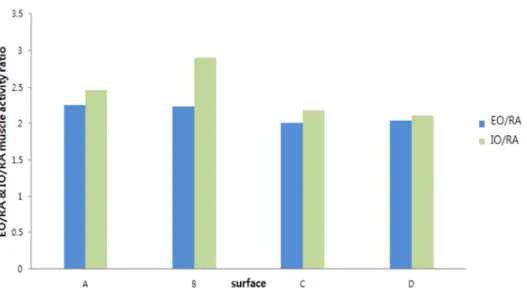
The EO/RA and IO/RA ratio was the highest in the bridge exercise with their shoulders resting on a stable bench. But there were no differences found for the EO/RA and IO/RA ratio.

Ⅳ. Discussion

Bridge exercises are commonly used in spine stabilization

programs to maintain and improve trunk muscle co-

activation patterns for spine stability (Monfort-Panege et

al, 2009). This study was conducted to identify the change

in trunk muscle activity during bridge exercise on different

shoulder support surface. Use of unstable surface (Swiss

ball, TOGU, sling) has been a trend in the rehabilitation

setting (Marshall and Murphy, 2008; Wahl and Behm,

2008), but there is little evidence to change the shoulder

(4)

※ A: Bridge exercise on a stable surface.

B: Bridge exercise with shoulder on a stable bench.

C: Bridge exercise with shoulder on a sling.

D: Bridge exercise with shoulder on a Swiss ball.

Fig. 1. External oblique/rectus abdominis ratio (EO/RA) and Internal oblique/rectus abdominis ratio (IO/RA)

support surface into a unstable surface.

The results of this study, the bridge exercise with their shoulder on a sling led to significantly higher activity of the RA and EO muscles than during conventional bridge exercise and bridge exercise with their shoulder on a stable bench shoulder surface. A previous study has suggested that performing stabilizing exercise on a labile surfaces changes the level of muscle activity and the way that the muscles coactivate to stabilize the spine (Vera-Gracia et al, 2000). Lehman et al (2005a) reported the activity of the trunk muscle during bridging exercises on and off a Swiss ball. They found that bridge on exercise ball resulted in increased activity in the rectus abdominis and external oblique, but the internal oblique and erector spinae were not. Other authors have obtained similar results, Saliba et al (2010) investigated the changes in transverse abdominis activation while performing bridge exercises on stable and unstable surface with low back pain patients.

In their study, the sling based exercise resulted in a significantly higher activation of the local stabilizers of

the spine compared to traditional bridging exercise. As seen in this study, activities of the RA and EO muscles were significantly increased during performing bridge exercise with their shoulders on sling and Swiss ball. These findings suggested that exercise can be designed to maximize or minimize trunk muscle exertion depending on the needs of the exercise population.

The RA muscle activity during stabilization exercise

should be minimal in comparison to other lumbopelvic

muscles (Richardson et al, 2004). Kim et al (2013) reported

IO/RA ratio during bridging on the floor and bridging on

the ball with arm movement and showed significant low

ratio during bridging on the ball. They suggested that bridge

exercise on the ball may be suitable for promoting trunk

stabilizing muscles in more harmonious way. Similarly,

Czaprowski et al (2014) reported the lowest ratio was

obtained during prone bridge on the Swiss ball, and the

highest ratio was obtained during prone bridge on stable

surface. However, there were no significant differences in

the EO/RA ratio and IO/RA ratio in this study. This may

(5)

explained by different exercise positions or specific tasks used in their studies. Kavcic et al (2004) suggested that it is recommended in conjunction with bridge exercise as it provides a substantial challenge to spine stability.

Regardless of results of this study, it is also worth noting that using an unstable shoulder support surface may facilitate abdominal muscle activity more than conventional bridge exercise position.

The current study was conducted with healthy young subjects and the sample size was small. Future research should focus on different population such as low back pain patients. And further research should be to determine the effective positions whether trunk muscle activities should be increased during minimizing RA activity.

Ⅴ. Conclusion

Although the change of shoulder support surface is not a conventional bridge exercise, it is commonly used as a stabilization exercise in rehabilitation and sport clinic.

In this study, the highest RA, EO muscle activities were obtained during the bridge exercise with their shoulder on a sling. These findings suggest that change of shoulder support surface during bridge exercise may be useful for enhancing the trunk stability.

Acknowledgements

This paper was supported by RESEARCH FUND offered from Catholic University of Pusan.

References

Choi Y, Kang H. The effects of sling exercise using vibration on trunk muscle activities of healthy adults. J Phys

Ther Sci. 2013;25(10):1291-4.

Cram JR, Kasman GS, Holtz J. Introduction to surface electromyo- graphy. Gaithersburg. Md. Aspen Publishers. 1998.

Czaprowski D, Afeltowicz A, Gebicka A, et al. Abdominal muscle EMG-activity during bridge exercises on stable and unstable surfaces. Phys Ther Sport. 2014;

15(3):162-8.

Desai I, Marshall PW. Acute effect of labile surfaces during core stability exercises in people with and without low back pain. J Electromyogr Kinesiol. 2010;20(6):

1155-62.

Garcia-Vaquero MP, Moreside JM, Brontons-Gil E, et al. Trunk muscle activation during stabilization exercises with single and double leg support. J Electromyogr Kinesiol. 2012;22(3):398-406.

Imai A, Kaneoka K, Okubo Y, et al. Trunk muscle activity during lumbar stabilization exercises on both a stable and unstable surface. J Orthop Sports Phys Ther.

2010;40(6):369-75.

Kavcic N, Grenier S, McGill SM. Quantifying tissue loads and spine stability while performing commonly prescribed low back stabilization exercises. Spine (Phila Pa 1976). 2004;29(20):2319-29.

Kim MJ, Oh DW, Park HJ. Integrating arm movement into bridge exercise: Effect on EMG activity of selected trunk muscles. J Electromyogr Kinesiol. 2013;23(5):

1119-23.

Lehman GJ, Gordon T, Langley J, et al. Replacing a Swiss ball for an exercise bench causes variable changes in trunk muscle activity during upper limb strength exercises. Dyn Med. 2005a;4(6).

Lehman GJ, Hoda W, Oliver S. Trunk muscle activity during bridging exercises on and off a Swiss ball. Chiropr Osteopat. 2005b;13(14).

Marshall PW, Murphy BA. Muscle activation changes after exercise rehabilitation for chronic low back pain.

Arch Phys Med Rehabil. 2008;89(7):1305-13.

McGill SM, Cholewicki J. Biomechanical basis for stability:

(6)

an explanation to enhance clinical utility. J Orthop Sports Phys Ther. 2001;31(2):96-100.

McGill SM, Karpowicz A. Exercises for spine stabilization:

motion/motor patterns, stability progressions, and clinical technique. Arch Phys Med Rehabil.

2009;90(1):118-26.

Monfort-Panego M, Vera-Garcia FJ, Sanchez-Zuriaga D, et al. Electromyographic studies in abdominal exercises:

a literature synthesis. J Manipulative Physiol Ther.

2009;32(3):232-44.

Okubo Y, Kaneoka K, Imai A, et al. Electromyographic analysis of transversus abdominis and lumbar multifidus using wire electrodes during lumbar stabilization exercises.

J Orthop Sports Phys Ther. 2010;40(11):743-50.

Richardson C, Hodges PW, Hides J, et al. Therapeutic exercise for lumbopelvic stabilization : a motor control approach for the treatment and prevention of low back pain(2

nd

ed). Edinburgh New York, Churchill

Livingstone. 2004.

Saliba SA, Croy T, Guthrie R, et al. Differences in transverse abdominis activation with stable and unstable bridging exercises in individuals with low back pain. N Am J Sports Phys Ther. 2010;5(2):63-73.

Stevens VK, Bouche KG, Mahieu NN, et al. Trunk muscle activity in healthy subjects during bridging stabilization exercises. BMC Musculoskelet Disord. 2006;7(75).

Stokes IA, Gardner-Morse MGHenry SM. Abdominal muscle activation increases lumbar spinal stability: analysis of contributions of different muscle groups. Clin Biomech (Bristol, Avon). 2011;26(8):797-803.

Vera-Garcia FJ, Grenier SG, McGill SM. Abdominal muscle response during curl-ups on both stable and labile surfaces. Phys Ther. 2000;80(6):564-9.

Wahl MJ, Behm DG. Not all instability training devices enhance

muscle activation in highly resistance-trained

individuals. J Strength Cond Res. 2008;22(4):1360-70.

수치

Table  1.  EMG  activities(%MVIC)  for  each  muscle  during  bridge  exercise(RA;  rectus  abdominis,  ES;  erector  spinae, IO;  internal  oblique,  EO;  external  oblique  muscles)
Fig.  1.  External  oblique/rectus  abdominis  ratio  (EO/RA)  and  Internal  oblique/rectus  abdominis  ratio  (IO/RA)

참조

관련 문서

First, the rhythmic gymnastics exercise program improves the skeletal muscle mass of adult women in office workers and reduces body fat percentage,

In the health-related fitness of middle-aged women who participated in the Zumba fitness exercise, muscle strength, muscular endurance, cardiopulmonary

This paper aims at analyzing the relationship among social support, intense factor, and exercise maintenance according to the participation activity in sports

The purpose of this study was to examine the effects of 8 weeks of Zumba dance exercise for obese middle-aged women on blood lipid index and vascular aging.. The subjects of

Changes in the level of physical fitness of obese women who performed complex exercise were significantly different in muscle endurance,

This paper intends to analyze marketing activity, service directivity through SNS, targeting at various consumer classes for dance performance activation, and

The purpose of this study was to investigate how the Da Vinci body board exercise program affects the body balance and physical stress of women with body imbalance.. For

The purpose of this study was to investigate how the BOSU Ball exercise, which can develop core muscles in middle-aged women, affects body composition and